
Market Overview
| Study Period | 2021 - 2031 |
|---|---|
| Forecast Data Period | 2026 - 2031 |
| Historical Data Period | 2021 - 2024 |
| Growth Rate | 1.92 % |
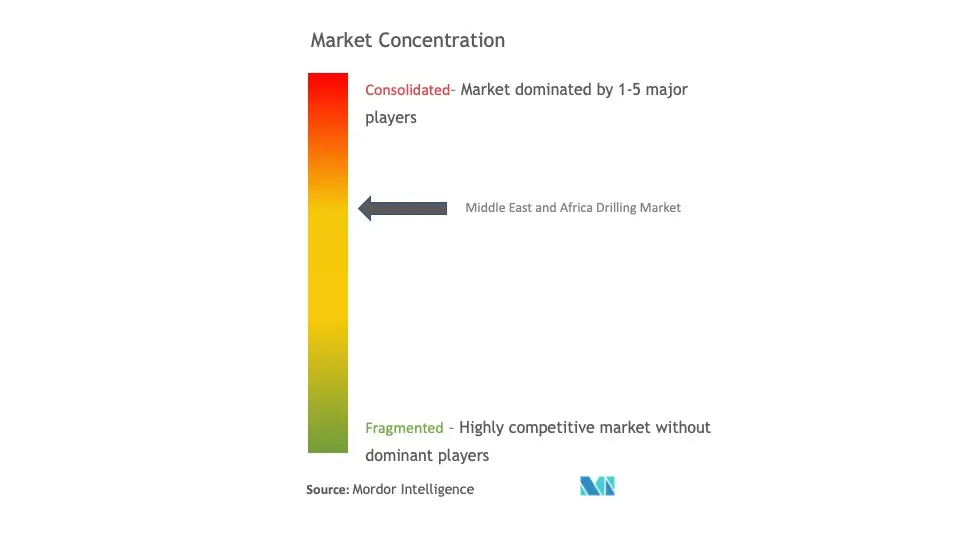
| Market Concentration | Medium |
Major Players *Disclaimer: Major Players sorted in no particular order Image © Mordor Intelligence. Reuse requires attribution under CC BY 4.0. | |
Middle East And Africa Drilling Market Analysis by Mordor Intelligence
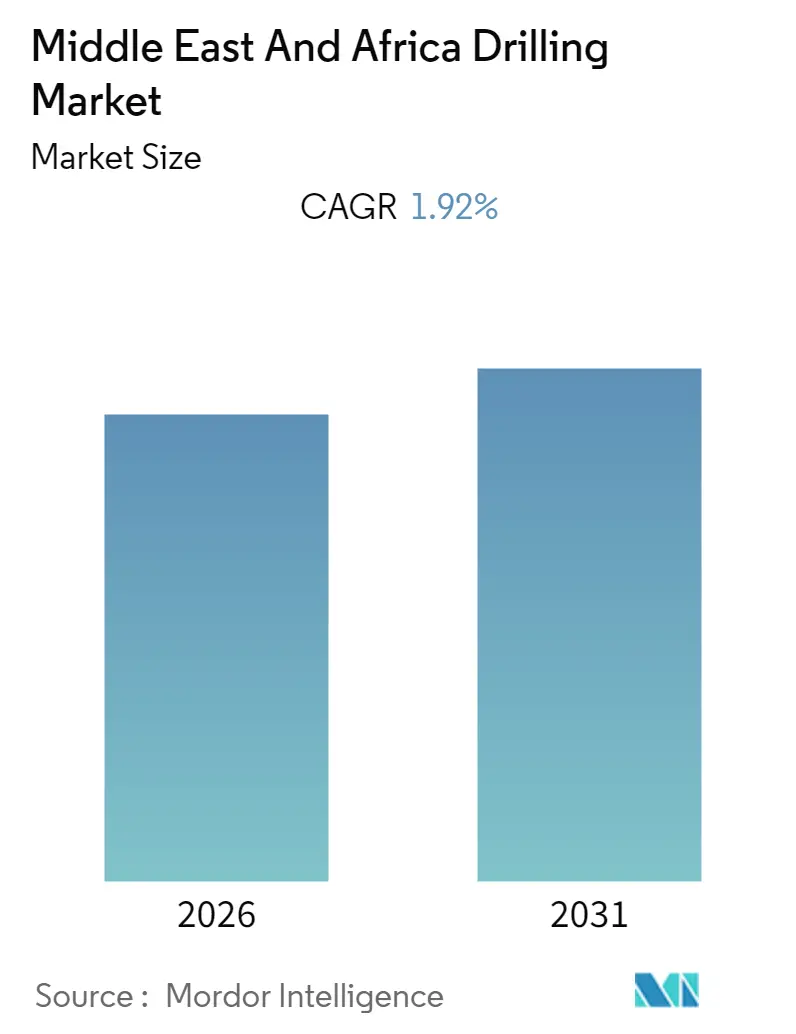
The Middle East and Africa Drilling Market size is expected to register a CAGR of 1.92% during the forecast period.
COVID-19 negatively impacted the market in 2020. Presently the market has now reached pre-pandemic levels.
- Over the short term, the Middle East and African drilling markets are forecasted to grow due to the increasing oil demand at the international level and the rising interest of private companies to invest in the regional oil and gas upstream industry.
- On the other hand, the growing momentum toward renewable energy sources is expected to pose an uphill challenge for the market in the coming years.
- Nevertheless, the abundance of proven oil and gas reserves in the Middle East and Africa region creates ample opportunities for the drilling market. The region has also witnessed new offshore oil and gas discoveries in the current scenario.
- Saudi Arabia is expected to dominate the market in the near future due to massive oil and gas reserves in the country and the new upcoming exploration and production projects in the country.
Note: Market size and forecast figures in this report are generated using Mordor Intelligence’s proprietary estimation framework, updated with the latest available data and insights as of 2026.
Market Trends and Insights
Offshore Segment Expected to Dominate the Market
- The Middle East and Africa are prominent offshore oil and gas-producing regions, and offshore oil and gas exploration spending in the region is set to grow significantly over the next few years. With abundant resources and increased technological potential to recover oil and gas from deep water and ultra-deep water areas, it is expected to provide an excellent opportunity for offshore drilling operations.
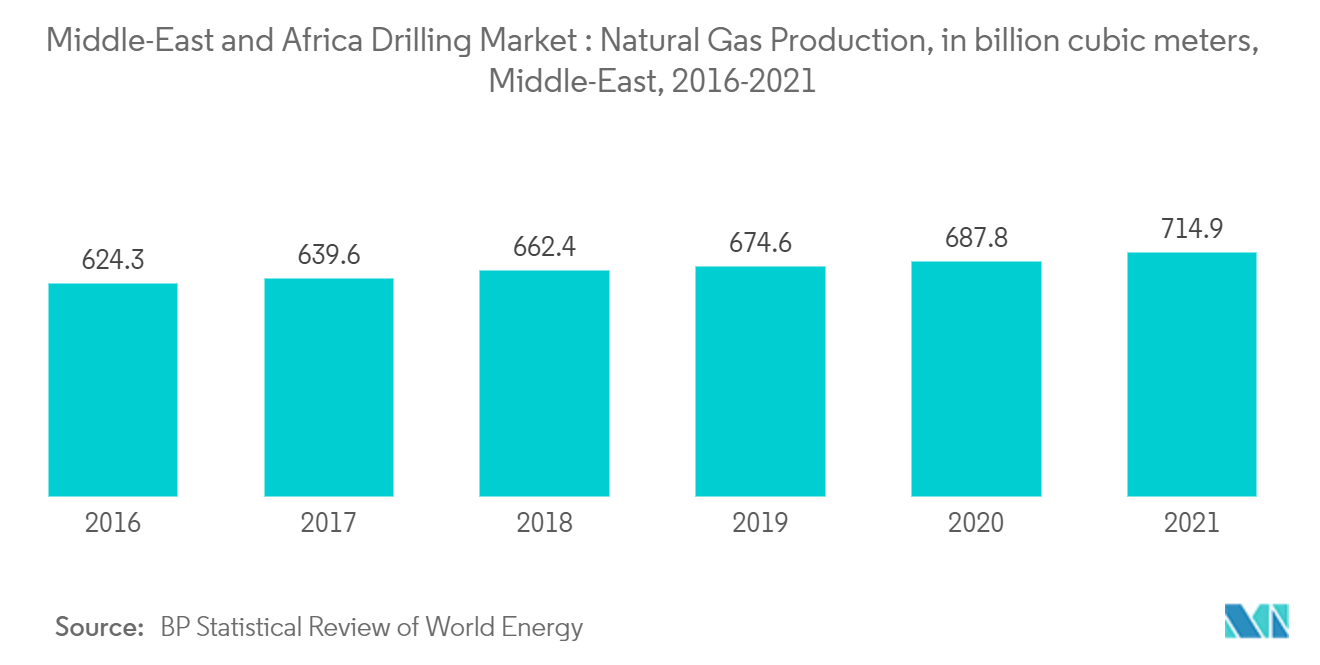
- Moreover, with the rapidly increasing global energy needs, offshore oil production has become an attractive energy source. The countries with major regional players focus on exploring offshore oil and gas fields, particularly when running out of onshore oil and gas reserves in the region. The region has witnessed remarkable growth in natural gas production due to the offshore gas discoveries that happened in recent years. The production was around 714 billion cubic meters in 2021. The trend is expected to get upscaled in the coming years.
- In March 2022, Kuwait and Saudi Arabia announced new plans to develop the Dorra offshore gas field in the northern Arabian Gulf. The plan came out when the field was contentious among three countries: Iran, Saudi Arabia, and Kuwait. The area, once operational, will be able to produce around 1 billion cubic feet of dry gas per day and 84,000 barrels per day of condensate.
- Additionally, in February 2022, Abu Dhabi National Oil Company (ADNOC) kicked off a bid process for an engineering, procurement, construction, and installation contract for further development at its huge Lower Zakum offshore oilfield. Furthermore, there are more than 77 and 27 approved upstream projects in the Middle East and Africa for the 2021-2025 period.
- Overall, the increasing offshore oil and gas projects in the region would aid the offshore drilling market.
Saudi Arabia Expected to Dominate the Market
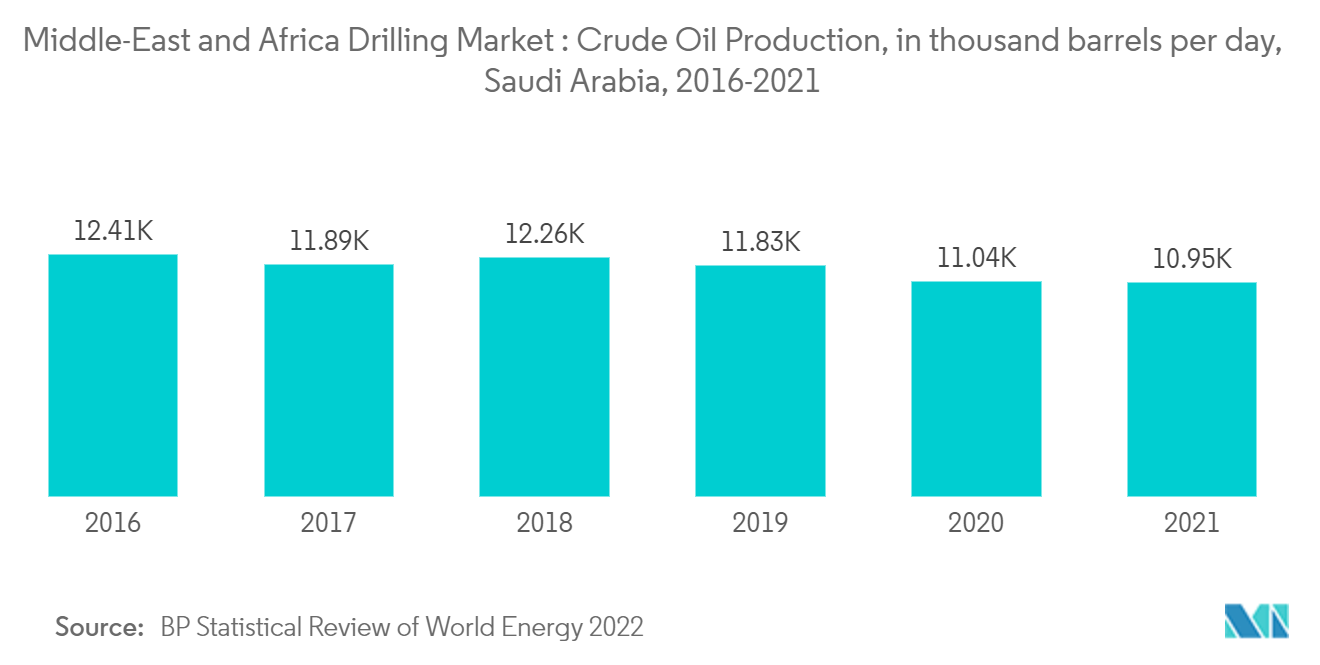
- Saudi Arabia is the second-largest crude oil producer globally and the world's largest crude oil exporter. The country holds around 17% of the total proven petroleum reserves globally. As of 2021, the country has around 267,192 million barrels of crude oil and 8507 cubic meters of natural gas. The crude oil production of Saudi Arabia was recorded as 10,954 thousand barrels per day in the year 2021.
- Saudi Arabia is estimated to have the world's fifth-largest estimated shale gas reserves. Thus, it has great potential to replicate North America's unconventional reserves' development growth. In December 2021, Saudi Aramco was awarded USD 100 billion in contracts on the Jafurah project to place itself as the third-largest natural gas producer by 2030. Further, the project's development is expected to help the country incline more towards natural gas as a source of electricity generation, thus supporting its 2060 net-zero target.
- Hence such developments are expected to serve the country's Vision 2030 program to diversify the economy from crude oil and sharply would reduce the carbon footprint in Saudi Arabia. Moreover, the country's development would support the nation in increasing its crude oil export by depending more on domestic natural gas consumption.
- In March 2022, with soaring crude oil prices and doubling profit in 2021, the country's state oil company, Saudi Aramco, planned to increase its investment by around 50% in 2022. As per Saudi Aramco, the company plans to invest nearly USD 40-50 billion in 2022 and is expected to continue its growth until mid-2030. With such investment plans, the company is expected to increase its crude oil production capacity to 13 million barrels per day by 2027 and wants to increase natural gas production by more than 50% by 2030. Such plans will directly aid the drilling market.
- In 2022, the Marjan Oil field will be under development, operated, and owned by Saudi Aramco. The offshore field is being expanded as part of the Marjan Crude Increment program. The expansion project is expected to increase the production facility from 300,000 barrels per day to about 800,000 barrels per day by 2025.
- The oil and gas drilling market is expected to increase in the Middle East and Africa due to rising oil and gas projects and hydrocarbon prices.
Regulatory Landscape
Across the Middle East and Africa, upstream drilling activity is shaped by petroleum licensing terms, local content requirements, and EIA and permitting processes that sit alongside national oil company (NOC) procurement and contracting models. In South Africa, the Upstream Petroleum Resources Development Act (UPRDA, Act 23 of 2024) created a standalone legislative regime for upstream petroleum and includes a 20% carried interest for the State, with Petroleum Agency SA (PASA) continuing as the designated regulator for upstream petroleum under this framework.
In North Africa, Egypt's downstream gas market access rules influence midstream and offtake conditions that can affect upstream development schedules and drilling programs. The Gas Market Activities Regulatory Authority (GRA) supervises the third-party access framework under the Gas Market Activities Law. Separately, several jurisdictions including Libya have been refreshing licensing approaches to bring new blocks to market into the late 2020s and beyond, which increases the importance of bid-round terms and work program commitments for drilling demand visibility.
Value Chain Analysis
The drilling value chain in the Middle East and Africa runs from acreage access and field development planning (typically led by NOCs and host ministries) through rig contracting and integrated well construction services, then into completions, production support, and well intervention. Service delivery often combines rig owners and drilling contractors (onshore and offshore) with oilfield service providers supplying directional drilling, drilling fluids, cementing, logging, and well integrity, plus OEMs and distributors for drill pipe, bits, BOPs, and downhole tools. This is supported by regional logistics bases and ports.
Operationally, the chain is being tightened around capacity utilization, reactivation cycles, and digital workflows. For example, Arabian Drilling reported a SAR 12.5 billion backlog in Q1 2026 and noted successful reactivation of multiple offshore and land rigs that had been recalled in Q4 2025, highlighting how contracting visibility translates into rig readiness, staffing, and consumables demand. Alongside physical capacity, digital enablement is moving closer to operations, illustrated by the Ahmadi Innovation Valley initiative in Kuwait, which is designed to connect digital tool development with field deployment for oilfield extraction.
Competitive Landscape
The Middle East and Africa Drilling market are moderately consolidated. The major companies (in no particular order) include Saudi Aramco Oil Co, Arabian Drilling Company (ADC), Schlumberger Limited, Baker Hughes Company, Weatherford International PLC, and Transocean Ltd.
Middle East And Africa Drilling Industry Leaders
-
Arabian Drilling Company (ADC)
-
Schlumberger Limited
-
Baker Hughes Company
-
Weatherford International PLC
-
Transocean Ltd.
-
Saudi Aramco Oil Co.
- *Disclaimer: Major Players sorted in no particular order
Middle East And Africa Drilling Market Companies Covered in this Report
- Arabian Drilling Company (ADC)
- Schlumberger Limited
- Baker Hughes Company
- Weatherford International PLC
- Transocean Ltd.
- Saudi Aramco Oil Co.
- Volgaburmash Middle East & Africa
- ADES International Holding
- CNOOC International Ltd.
- VALLOUREC
Market Opportunities and Future Outlook
Multi-year programs and bid rounds are creating openings for rigs and integrated well construction services across both offshore and onshore basins. In early 2026, Libya launched a national exploration bid round covering 22 onshore and offshore blocks and stated a target production level of 2 million barrels per day, creating a pipeline where drilling contractors, directional drilling, and well construction service providers compete on speed and execution capability. In West Africa, SLB OneSubsea received an EPC contract from Eni for Phase 3 of the Baleine project offshore Cote d'Ivoire, covering 13 subsea wells, reinforcing demand for deepwater drilling and subsea-integrated execution.
Opportunities are also building around higher productivity drilling and field-scale delivery models in core Gulf markets. SLB secured a 7-year technology partnership contract with Kuwait Oil Company for the Ahmadi Innovation Valley initiative, with a dedicated physical facility scheduled to commence construction in 2026 and open in 2028, supporting deployment of digital tools into drilling and production operations. Kuwait offshore activity has also been stimulated by major discoveries including the Nokhetha field, supporting demand for offshore rigs and associated services as operators move from discovery through appraisal and development drilling.
Recent Industry Developments in Middle East And Africa Drilling Market
- May 2026: The SLDC (Drilling Joint Venture) was awarded a significant drilling contract by SLB for operations in Kuwait's Mutriba field, including two high-specification 3,000 HP rigs with mobilization in 2026. The award supports Kuwait's Mutriba field development and regional drilling activity. It also establishes a regional high-performance drilling platform through the JV and aligns with regional energy development goals.
- April 2026: SLB secured an agreement with a major operator in Qatar for deployment of DrillOps autonomous drilling technologies across land and offshore rigs. The autonomous drilling deployment expands AI-enabled automation across the region. It advances autonomous drilling and could help reduce downtime across MEA rigs.
- February 2026: SLB was awarded a 1.5 billion dollar, five-year integrated development contract by Kuwait Oil Company for the Mutriba field in Kuwait. The contract reinforces SLB's footprint in Kuwait and supports end-to-end development and production services. It supports development and production activity in Kuwait and adds to regional market momentum.
Middle East And Africa Drilling Market Report Scope and Research Methodology
Market Definition and Coverage
This market covers revenues earned from drilling activities that create and develop oil and gas wells across the Middle East and Africa, including work onshore and offshore. Revenues are counted when the drilling service is delivered in the region.
Scope exclusions: It does not include completion, workover, well intervention, production services, or broader oilfield services that sit outside drilling as a standalone activity.
Segments Covered in This Report
- Location of Deployment
- Onshore
- Offshore
- Geography
- Saudi Arabia
- United Arab Emirates
- South Africa
- Others
Data Sources, Market Sizing, and Validation
Desk Research
Desk work starts with building the operating picture for drilling activity in the region, then lining up the data series that can anchor volumes and activity levels. Public sources such as OPEC statistical publications, IEA reports, national energy ministries and regulators, and central bank or national statistics portals help us track upstream investment signals alongside production context. We also use country licensing rounds and national oil company announcements, plus press releases and trusted industry press, to map planned wells and project timing.
To translate activity into a revenue view, we review public filings and investor materials of drilling contractors and service providers, and we compare that against oil price history and major rig contracting cycles covered by reputable industry media. Where needed, paid subscriptions are used for company financial intelligence, patent databases are reviewed for direction on drilling-related technology, and shipment-level trade datasets are used to cross check directional movements in key drilling equipment flows. The specific list of desk sources above is illustrative, and additional public and paid references were used to collect, verify, and clarify inputs.
Primary Interviews and Surveys
Primary input is used to convert desk signals into usable assumptions, especially day rate ranges, utilization patterns, and how activity shifts between onshore and offshore programs. We speak with a mix of contractors, drilling teams, procurement and field operations roles, and other industry experts across the Middle East and Africa, so country-level differences in contracting and cost pass-through are reflected in the model. When inputs disagree, we recontact respondents and reconcile them against observable activity markers before finalizing the assumptions.
Distribution of primary research fieldwork respondents
| Company type | Respondent position |
|---|---|
| Top tier: 36% | CXOs: 13% |
| Mid tier: 48% | Functional/Unit leaders: 38% |
| Smaller Players: 16% | Managers: 49% |
Market-Sizing & Forecasting
Sizing is built using a top-down reconstruction that starts from regional drilling activity and then translates it into revenue using utilization, typical contract coverage, and drilling service price levels. To keep the totals realistic, we cross check against selective bottom-up approximations, including sampled day rate ranges by rig type, operator program counts, and channel checks on utilization. If the checks do not align, the totals are adjusted.
Data Validation & Update Cycle
Validation is done through stepwise checks where model outputs are compared with independent signals such as public project pipelines, announced well programs, and directional rig activity trends. When a country result looks out of line with its stated activity level, we revisit assumptions, recheck supporting sources, and trigger interview follow-ups so the variance is understood before sign off. The team also runs internal peer reviews to keep inputs, calculations, and interpretation consistent across countries and across the onshore and offshore split.
Reports are refreshed annually, and interim updates are made when material events occur, such as sharp price movements, major contract awards, or policy changes that alter drilling plans. Before delivery, a final analyst pass is completed to capture the latest public updates and confirm the key assumptions still match current market behavior.
Mordor Intelligence's Middle East and Africa Drilling Market Size Versus Other Published Estimates
Published market values for drilling in the Middle East and Africa often do not match because the underlying scope is not always the same, and the activity to revenue conversion is handled differently. Differences usually come from what services are counted, whether drilling is separated from nearby oilfield services, how offshore activity is treated, and how quickly assumptions are updated after contract and price changes.
Completion and well intervention revenues sit outside Mordor Intelligence's scope here, and that single exclusion can change totals materially when other publishers present bundled oilfield services numbers and label them as drilling. Pricing is another common driver of variance: some estimates apply one blended day rate across countries, while others adjust for offshore intensity, national content impacts, and short-term utilization swings. Currency timing also affects the reported USD value, since different average exchange rates for the base year can shift the final figure even when the local market reality is similar.
Benchmark comparison
| Source | Market Size | Gaps in Research Methodology |
|---|---|---|
| Mordor Intelligence | USD 0.00 B (2025) | |
| Regional Consultancy A | USD 8.72 B (2024) | Often presented as a broader oilfield services bundle, which can fold in completion and intervention revenues and can inflate the drilling only total, especially in offshore heavy programs. |
| Trade Journal B | USD 11.92 B (2030) | Uses a longer range forecast where utilization and day rates are sometimes assumed to expand steadily, and the year average FX and inflation treatment can push the USD figure higher versus a more conservative rate curve. |
The spread in the table mainly points back to scope and pricing mechanics, rather than a disagreement that drilling activity is happening. When inclusions are kept consistent and the revenue build is tied to observable rig activity, contract cadence, and country-level utilization, the resulting market number becomes easier to trace and repeat across update cycles.
Key Questions Answered in the Report
What is the current Middle East and Africa Drilling Market size?
The Middle East and Africa Drilling Market is projected to register a CAGR of 1.92% during the forecast period (2026-2031)
Who are the key players in Middle East and Africa Drilling Market?
Arabian Drilling Company (ADC), Schlumberger Limited, Baker Hughes Company, Weatherford International PLC, Transocean Ltd. and Saudi Aramco Oil Co. are the major companies operating in the Middle East and Africa Drilling Market.
What years does this Middle East and Africa Drilling Market cover?
The report covers the Middle East and Africa Drilling Market historical market size for years: 2020, 2021, 2022, 2023, 2024 and 2025. The report also forecasts the Middle East and Africa Drilling Market size for years: 2026, 2027, 2028, 2029, 2030 and 2031.