
Market Overview
| Study Period | 2021 - 2031 |
|---|---|
| Forecast Data Period | 2026 - 2031 |
| Base Year Market Size (2025) | USD 284.43 Million |
| Market Size (2026) | USD 299.22 Million |
| Market Size (2031) | USD 390.14 Million |
| Growth Rate (2026 - 2031) | 5.45 % |
| Market Concentration | Medium |
Major Players *Disclaimer: Major Players sorted in no particular order Image © Mordor Intelligence. Reuse requires attribution under CC BY 4.0. | |
Middle East And North Africa Perforating Gun Market Analysis by Mordor Intelligence
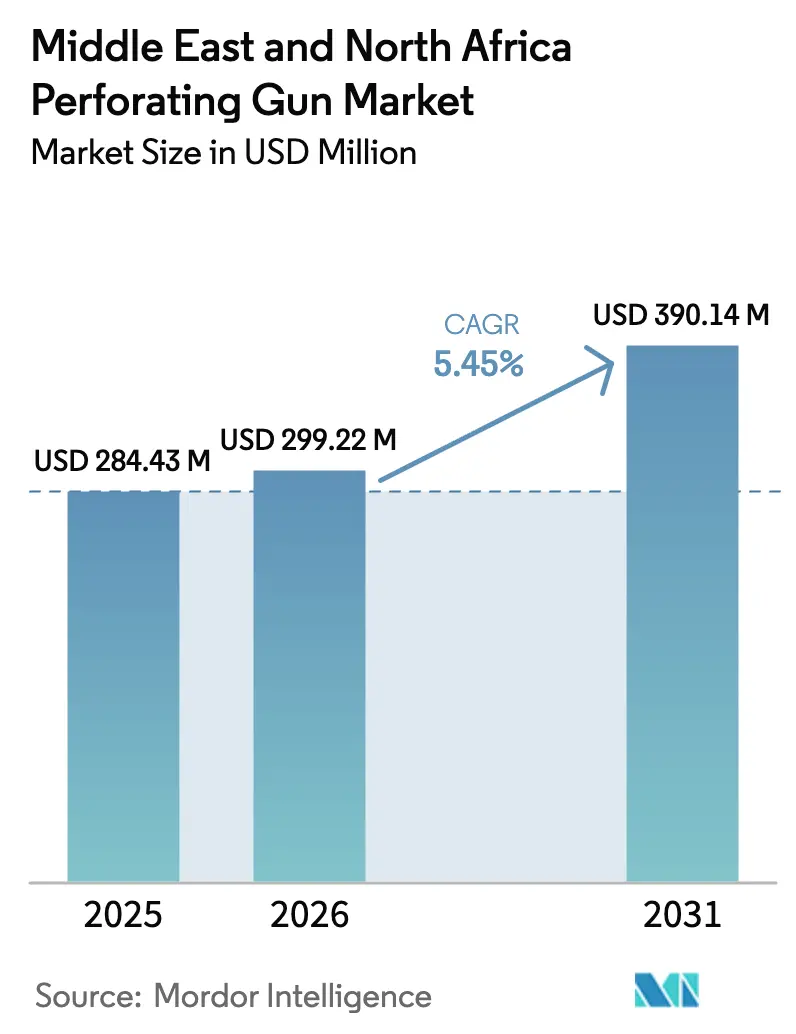
The Middle East And North Africa Perforating Gun Market size is projected to expand from USD 284.43 million in 2025 and USD 299.22 million in 2026 to USD 390.14 million by 2031, registering a CAGR of 5.45% between 2026 to 2031.
Several factors underpin this steady climb. Horizontal drilling campaigns in unconventional reservoirs demand higher shot densities than legacy vertical wells, multiplying perforating-gun intensity per completion. National oil companies (NOCs) are simultaneously directing sizable re-perforation budgets toward mature onshore fields to defer expensive infill drilling. Localization mandates such as Saudi Aramco’s iktva and ADNOC’s in-country value (ICV) framework shorten supply chains, support regional manufacturing of shaped charges, and stabilize lead times despite global logistics shocks. Operators are also embracing rig-less conveyance, coiled-tubing, and slickline to trim intervention costs, while offshore gas megaprojects in Qatar and Egypt accelerate demand for high-pressure tubing-conveyed systems. Against this backdrop, competitive dynamics are intensifying as integrated service majors defend share against regional specialists and state-owned Chinese contractors.
Key Report Takeaways
- By carrier type, retrievable tubing guns held a 30.2% share of the Middle East & North Africa perforating gun market size in 2025 and are expanding at an 8.1% CAGR through 2031.
- By well type, horizontal and deviated wells captured 64.9% of the Middle East & North Africa perforating gun market share in 2025.
- By conveyance method, coiled-tubing is forecast to post a 7.3% CAGR through 2031, the fastest growth within the segment mix.
- By application, offshore projects accounted for 24.9% of the Middle East & North Africa perforating gun market size in 2025 and are advancing at a 7.8% CAGR to 2031.
- By geography, Saudi Arabia, the largest geography, commanded 33.5% revenue share in 2025, while Morocco is projected to be the fastest-growing country at an 8.0% CAGR over 2026–2031.
Note: Market size and forecast figures in this report are generated using Mordor Intelligence’s proprietary estimation framework, updated with the latest available data and insights as of January 2026.
Market Trends and Insights
Drivers Impact Analysis of Middle East And North Africa Perforating Gun Market*
| Driver | (~) % Impact on CAGR Forecast | Geographic Relevance | Impact Timeline |
|---|---|---|---|
| Surge in unconventional horizontal drilling programs | +1.4% | Saudi Arabia (Jafurah, Tuwaiq), UAE (unconventional gas), Oman | Long term (≥ 4 years) |
| Accelerating re-perforation campaigns in mature MENA fields | +1.1% | Saudi Arabia (Ghawar, Safaniyah), UAE (onshore fields), Kuwait, Algeria | Medium term (2-4 years) |
| National oil-company push for in-country perforating manufacturing | +0.9% | Saudi Arabia, UAE, Qatar | Medium term (2-4 years) |
| Adoption of compact fragmenting guns to cut rigless P&A cost | +0.7% | Saudi Arabia, UAE, Qatar, Egypt | Short term (≤ 2 years) |
| Rising rig-less well-intervention budgets post-2024 oil-price rebound | +0.8% | Global MENA, with concentration in Saudi Arabia, UAE | Short term (≤ 2 years) |
| Source: Mordor Intelligence | |||
Surge in Unconventional Horizontal Drilling Programs
Commercial production from Saudi Arabia’s Jafurah shale in December 2025 marked a watershed for unconventional gas in the region, with 200 horizontal wells slated annually through 2031 and each well demanding 8–12 perforating stages.[1] Similar tight-gas pilots in the UAE’s Diyab and Bab formations and Oman’s Mabrouk North East project reinforce the pull for high-shot-density gun strings. The switch to long laterals favors retrievable and fragmenting carriers that leave minimal debris and cut clean-out time. In parallel, local-content rules compel global vendors to co-manufacture shaped charges in the Gulf, reducing customs delays. Collectively, these trends lift per-well hardware intensity and anchor long-term demand across the Middle East & North Africa perforating gun market.
Accelerating Re-Perforation Campaigns in Mature MENA Fields
Selective re-perforation in Saudi Arabia’s Ghawar, Kuwait’s Burgan, and ADNOC’s onshore blocks is delivering 15%–25% production uplifts at one-tenth the cost of drilling new wells.[2] Coiled-tubing conveyance enables live-well interventions, avoiding costly workovers. Algeria and Egypt apply similar tactics in thin pay zones, extending field life by up to 10 years. Rapid payback, often under six months, encourages NOCs to earmark rising portions of well-services budgets for re-perforation, reinforcing a resilient aftermarket for the Middle East & North Africa perforating gun market.
National Oil-Company Push for In-Country Perforating Manufacturing
Aramco’s iktva program certified 59 perforating-equipment suppliers by 2022 and redirected USD 11 billion into the Saudi supply chain. ADNOC’s ICV scheme has cycled AED 242 billion (USD 65.9 billion) into local vendors since 2018 and sets an AED 90 billion target by 2030. QatarEnergy follows suit with contract clauses mandating local assembly for North Field expansion hardware. Localization compresses lead times from 12–16 weeks to roughly six weeks, cushions freight volatility, and locks multiyear call-off agreements in favor of vendors that invest in regional plants, thereby fortifying the Middle East & North Africa perforating gun market.
Adoption of Compact Fragmenting Guns to Cut Rig-less P&A Cost
Fragmenting or capsule guns disintegrate upon detonation, eliminating retrieval trips and slashing plug-and-abandonment (P&A) timelines. Aramco recorded 35% cost savings across 15 Safaniyah wells in 2024 after adopting expendable capsule guns. ADNOC achieved similar efficiencies in offshore Umm Shaif, while UAE regulations encourage low-debris systems for environmental compliance.[3] Offshore platforms facing decommissioning mandates now view fragmenting carriers as an economical route, opening a sizeable niche within the Middle East & North Africa perforating gun market.
Restraints Impact Analysis of Middle East And North Africa Perforating Gun Market*
| Restraint | (~) % Impact on CAGR Forecast | Geographic Relevance | Impact Timeline |
|---|---|---|---|
| Renewable-energy CAPEX diversion by Gulf sovereign funds | -0.6% | Saudi Arabia, UAE, Qatar | Long term (≥ 4 years) |
| Steel & RDX/HMX supply-chain volatility after Red Sea disruptions | -0.4% | Global MENA, import-dependent markets (Egypt, Morocco, Algeria) | Short term (≤ 2 years) |
| ESG-driven explosives-handling restrictions at onshore fields | -0.3% | Saudi Arabia, UAE, Algeria, Egypt (onshore-heavy markets) | Medium term (2-4 years) |
| Source: Mordor Intelligence | |||
Renewable-Energy CAPEX Diversion by Gulf Sovereign Funds
Saudi Arabia’s Public Investment Fund now commits USD 10 billion annually to renewables, while the UAE targets USD 54 billion by 2030 through Masdar[4]. Such commitments can cap upstream budgets, potentially trimming annual perforating-gun volumes by 8%–12% over a decade. Still, the projects that survive budget cuts often require higher-complexity completions, partly offsetting volume declines for the Middle East & North Africa perforating gun market.
Steel and RDX/HMX Supply-Chain Volatility After Red Sea Disruptions
Houthi attacks cut Suez Canal traffic in half during 2024, stretching freight times by two weeks and hiking rates threefold. Seamless tubing prices climbed 18%, and RDX shipments faced 6–8-week delays, forcing Egypt’s West Nile Delta project to postpone 12 perforating jobs. Operators with local manufacturing, such as Aramco and ADNOC, proved more resilient, highlighting the advantages of regional supply chains within the Middle East & North Africa perforating gun market.
*Our forecasts treat driver/restraint impacts as directional, not additive. The impact forecasts reflect baseline growth, mix effects, and variable interactions.
Middle East And North Africa Perforating Gun Market Segment Analysis
By Carrier Type:
Retrievable Guns Advance on Cost EfficiencyRetrievable tubing guns claimed 30.2% of the Middle East & North Africa perforating gun market size in 2025, thanks to their ability to be redeployed across multiple zones, driving an 8.1% CAGR outlook through 2031. Hollow-carrier systems, still dominant at 40.6%, remain indispensable in high-pressure carbonates where full debris retrieval safeguards well integrity. Fragmenting guns, though smaller in share, are gaining ground in offshore P&A campaigns where eliminating retrieval trips slashes rig days. Semi-expendable strip guns fill a niche for through-tubing work in tight-clearance casings. Over the forecast horizon, mature fields that require several interventions favor retrievable carriers for total-cost-of-ownership advantages, while single-shot unconventional wells continue to lean on expendable designs that compress completion time. Service firms are accordingly broadening portfolios: Halliburton opened a USD 45 million plant in Dammam in October 2025 to manufacture both hollow and retrievable carriers, achieving 72% local content and cementing preferred-vendor status with Aramco.


By Well Type:
Horizontal Dominance Sustains Hardware IntensityHorizontal and deviated wells accounted for 64.9% of the Middle East & North Africa perforating gun market demand in 2025 and are forecast to expand at 6.5% through 2031. Each Jafurah lateral needs 8–12 stages, quadrupling gun consumption over a conventional vertical well. QatarEnergy’s extended-reach offshore wells exceed 5,000 feet and rely on oriented shots to optimize fracture clusters. Vertical wells persist in Algeria and Egypt, where legacy infrastructure supports low-cost completions. Regulatory bodies such as the UAE Supreme Petroleum Council now encourage horizontal drilling to maximize reservoir contact, ensuring a sustained pull for high-shot-density systems. Consequently, tubing-conveyed and coiled-tubing conveyances outpace wireline in long laterals, reinforcing the lead of horizontal architecture within the Middle East & North Africa perforating gun market.
By Conveyance Method:
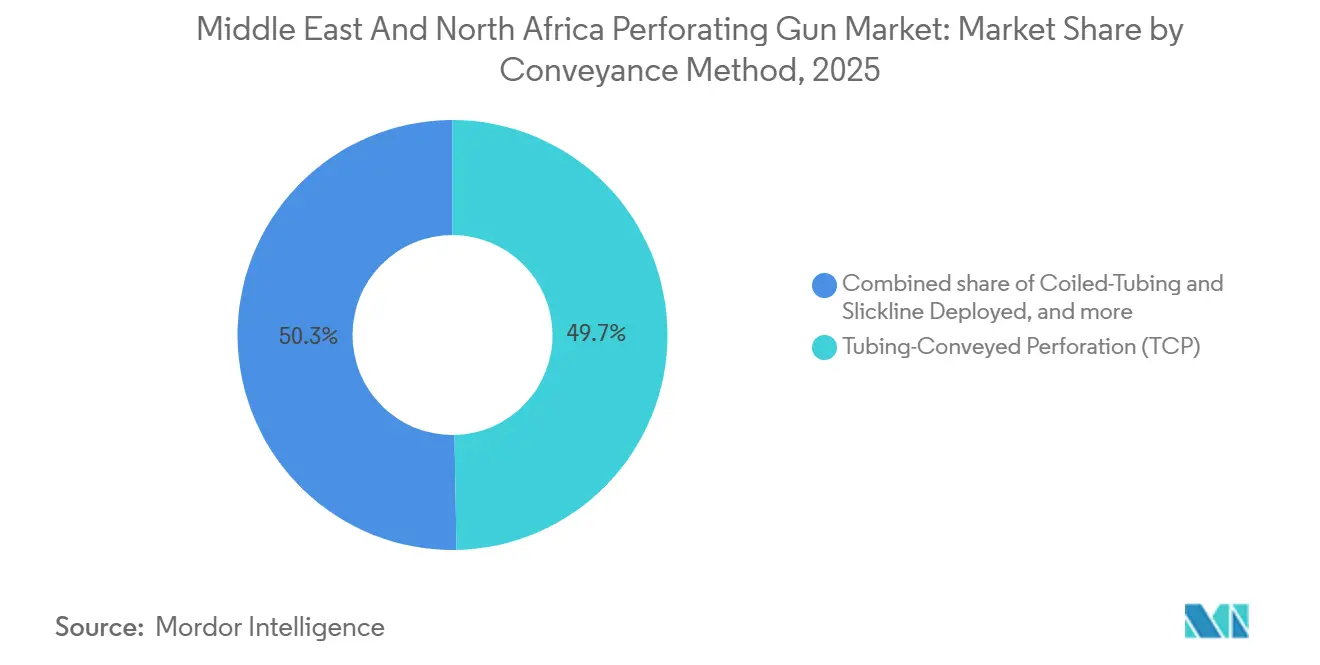
Coiled-Tubing Captures Rig-Less UpsideTubing-conveyed perforation (TCP) retained 49.7% revenue share in 2025, underpinned by high-pressure completions that demand robust well control. Yet coiled-tubing and slickline deployments, projected to grow 7.3% annually to 2031, thrive on rig-less economics. Schlumberger’s CoilFLEX cut intervention time in Kuwait’s Burgan field from four days to 1.5, freeing rigs for drilling new horizontals. Wireline’s share is slipping in torturous laterals where friction limits are reached. The conveyance mix is thus bifurcating: TCP stays dominant for new wells, while coiled-tubing rules re-perforation. This duality keeps the Middle East & North Africa perforating gun market competitive across equipment classes.
By Application:
Offshore Share Rises on Gas MegaprojectsOnshore operations generated 75.1% of 2025 revenue, but offshore activity is gaining momentum with a 7.8% CAGR outlook through 2031. Qatar’s North Field, Egypt’s Zohr hub, and Morocco’s upcoming Anchois field drive demand for high-pressure, deep-water gun systems. Each subsea perforating job can cost USD 1.5 million, nearly quadruple the onshore average, magnifying revenue impact despite fewer wells. Operators increasingly specify fracturing carriers to cut offshore P&A expense, widening the adoption of expendable technology. If oil prices stay above USD 75/bbl, offshore’s contribution to the Middle East & North Africa perforating gun market will expand beyond the current one-quarter stake.
Geography Analysis
Saudi Arabia Perforating Gun Market
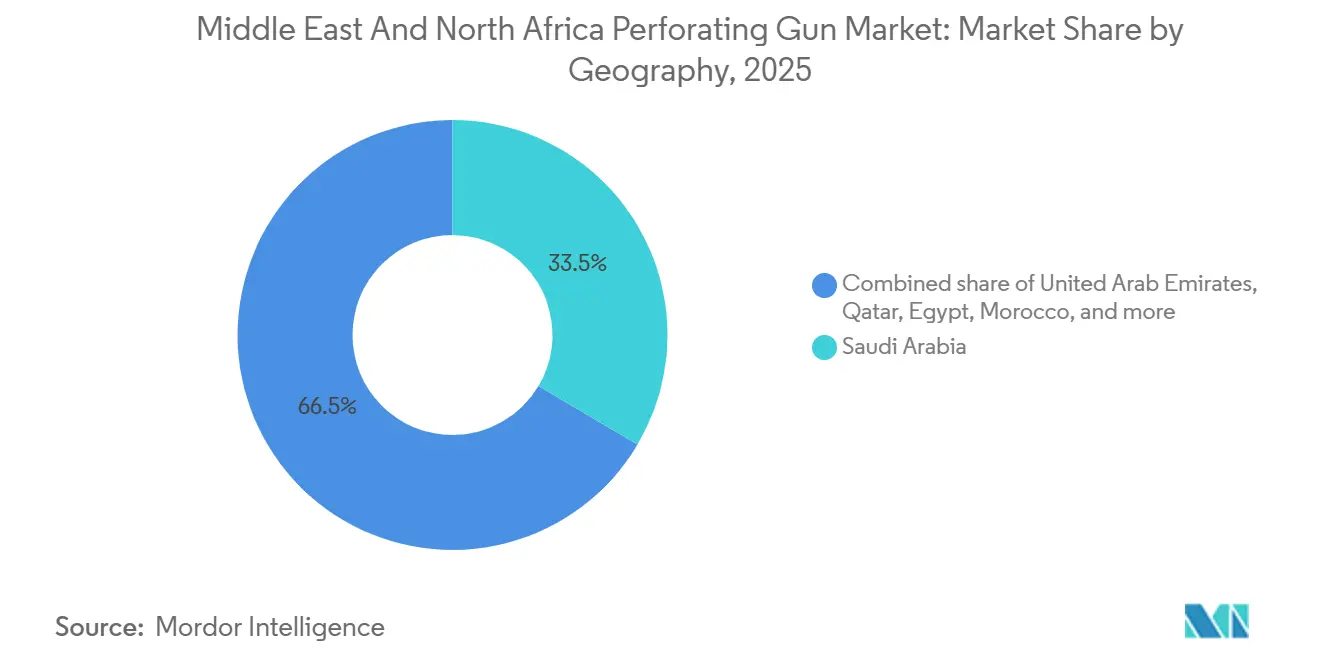
Saudi Arabia held 33.5% of the Middle East & North Africa perforating gun market revenue in 2025, underwritten by Aramco’s USD 50–60 billion annual upstream spend and the iktva program that channels purchases to 59 local suppliers. The Jafurah shale alone will require roughly 200 horizontal wells per year, each consuming 8–12 gun stages, ensuring robust demand through 2031. Concurrent re-perforation in giant maturing fields such as Ghawar and Khurais absorbs considerable volumes of through-tubing guns.
United Arab Emirates and Qatar Perforating Gun Market
The United Arab Emirates follows as ADNOC’s ICV framework, targeting AED 90 billion in local spending by 2030, spurring regional manufacture of shaped charges and detonation cord. Qatar ranks third as its North Field LNG expansion schedules 120 offshore wells with high-pressure specifications that elevate average gun value per well.
Algeria and Egypt Perforating Gun Market
Algeria and Egypt, characterized by vast inventories of aging wells, fund coiled-tubing re-perforations to extend field life. Sonatrach budgeted USD 2.1 billion for well interventions in 2024, assigning 35% to perforating services. Egypt’s joint ventures perforated 340 wells in 2024 using slim guns that pass through 2⅞-inch tubing, reducing rig time by 40%.
Morocco Perforating Gun Market
Morocco, though small today, is projected to grow at an 8.0% CAGR over 2026-2031 on the back of Chariot Energy’s Anchois development, which will introduce deep-water completion workflows and spur demand for specialized casing guns. Frontier license awards to TotalEnergies and Eni in 2024 could double prospective gas resources and prolong perforating demand into the next decade.
MEA Perforating Gun Market
Elsewhere, Oman’s Mabrouk North East tight-gas project adds multi-stage fracturing work to the mix, while civil unrest continues to cap upside in Yemen and Libya. Overall, geographic dispersion balances the Middle East & North Africa perforating gun market, with Gulf incumbents pursuing localization and North African countries offering margin upside for agile entrants.
Regulatory Landscape
Perforating operations across the Middle East and North Africa are shaped by a mix of oilfield standards and explosives-safety requirements, with API specifications commonly referenced for tool qualification and perforator performance evaluation (notably API 19PT for perforating tools and API RP 19B for perforator performance). In the Gulf, standardization efforts are coordinated through bodies such as the GCC Standardization Organization (GSO), including its oil and gas-focused Technical Committee TC07, which supports harmonized practices across member states.
On the explosives side, shaped charges and associated detonating components must comply with transport, packaging, and handling rules aligned with established explosives classifications and shipping instructions (as reflected in guidance from organizations such as the Institute of Makers of Explosives). At the operator level, national oil companies reinforce compliance through procurement and localization frameworks, including Saudi Aramco's iktva and ADNOC's in-country value (ICV) program, which influence vendor eligibility, testing documentation, and the level of regional assembly and manufacturing required for perforating gun systems and consumables.
Competitive Landscape
The three global service majors, Schlumberger, Halliburton, and Baker Hughes, collectively control about 55%–60% of the Middle East & North Africa perforating gun market, bundling hardware with broader completion and intervention services. Regional challengers are closing gaps: ADNOC Drilling’s 2021 IPO funded 12 coiled-tubing units and eight wireline spreads, enabling turnkey packages priced 15%–20% below international competitors. Chinese contractors, led by Sinopec Oilfield Service, undercut bids by roughly 25% but face hurdles in meeting local-content thresholds that favor Gulf-based fabrication.
Technology differentiation concentrates on shaped-charge design and oriented-shot placement. DynaEnergetics’ DS Select copper-liner charges penetrated 15% deeper than standard alternatives and gained traction in Saudi tight-gas wells during 2025. Weatherford’s Centric system places shots on the low side of horizontal wellbores and raised initial production 16% in ADNOC’s Bab field. Fragmenting guns for offshore P&A remains under-penetrated at less than 20% of interventions, representing a potential USD 180–220 million opportunity through 2031.
Regulatory compliance, ISO 10426, API RP 19B, remains mandatory, yet NOC localization programs increasingly dictate vendor selection. Companies committing to Gulf manufacturing secure multi-year call-off contracts, while import-dependent players risk erosion of market share. Competitive intensity is therefore expected to rise, but high technical barriers and safety requirements continue to guard margins for established suppliers in the Middle East & North Africa perforating gun market.
Middle East And North Africa Perforating Gun Industry Leaders
-
Baker Hughes Company
-
Schlumberger Limited
-
Weatherford International PLC
-
Halliburton Company
-
Hunting plc
- *Disclaimer: Major Players sorted in no particular order

Middle East And North Africa Perforating Gun Market Companies Covered in this Report
- Schlumberger Ltd
- Halliburton Company
- Baker Hughes Co.
- Weatherford International plc
- Hunting plc
- NOV Inc.
- DynaEnergetics GmbH & Co. KG
- DMC Global Inc.
- Core Laboratories (Nov Completion/Owen)
- Nine Energy Service Inc.
- ADNOC Drilling
- Arabian Drilling Co.
- TAQA Well Services
- Saudi Aramco (Perforating Services)
- Sinopec Oilfield Service Corp.
- CNPC Greatwall Drilling Co.
- Promperforator LLC
- Tassaroli SA
- Geodynamics Inc.
- Titan Division – Yellow Jacket Oil Tools
- FHE USA LLC
- Shaanxi FYPE Rigid Machinery Co.
- Vigor Oil Tools Co.
Read Analysis of Middle East And North Africa Perforating Gun Companies
Market Opportunities and Future Outlook
The strongest opportunity is in integrated, high-intensity unconventional completions where perforating hardware demand scales with stage count and service bundling. In Saudi Arabia, Aramco's unconventional gas development has continued to move into multi-year contracting structures, highlighted by Halliburton's award for integrated stimulation and completion services for the Jafurah Basin, with operations scheduled to begin in Q3 2026. Contracts structured around end-to-end stimulation and completion increase the pull for fit-for-purpose perforating systems (including high-shot-density strings and reliable addressable initiation architectures) that can be supplied at scale while meeting localization expectations.
A second opportunity track is expansion of completion and intervention activity linked to field redevelopment and capacity programs beyond the Gulf core, including Iraq's southern fields. In July 2026, Halliburton signed a joint management contract with Iraq's Basra Oil Company for the Bin Omar and Al Sindbad fields, supporting a program aimed at lifting production, which typically translates into incremental work across well construction, recompletions, and interventions where perforating remains a recurring requirement. Suppliers that can combine compliant explosives logistics with local testing, assembly, and quick-turn inventory should be positioned to win these multi-country programs as operators seek shorter lead times and reduced supply risk amid shipping and security disruptions.
Recent Industry Developments in Middle East And North Africa Perforating Gun Market
- July 2026: Saudi Aramco awarded a multi-billion-dollar, multi-year contract to Halliburton for integrated stimulation and completion services to support unconventional gas development in the Jafurah Basin. The scope includes drilling and completion solutions, hydraulic fracturing, well intervention, and advanced digital technologies. Operations are scheduled to begin in the third quarter of 2026.
- November 2025: Abu Dhabi National Oil Company (ADNOC) announces bold plans for oil and gas production with a focus on local procurement under Make it in the Emirates initiatives. Local procurement boosts regional perforating-system demand. Strengthens in-country value, supports regional manufacturers, and shifts vendor mix toward Gulf-based suppliers.
- October 2025: Sabtex Corporation (with X9 Incorporated) launches SAIF STRIKE Perforating Systems in the MENA region. Introduces standardized and self-orienting perforating options. Expands local-system offerings, enhances competition, and impacts pricing and supplier selection in the region.
Middle East And North Africa Perforating Gun Market Report Scope and Research Methodology
Market Definition and Coverage
For this report, the market is defined as revenues earned from perforating guns used in well completion and workover to create perforations in the casing and reservoir interval across Middle East and North Africa oil and gas activity.
Scope exclusions: We exclude upstream drilling tools outside perforating, and we also exclude well stimulation services unless the revenue is directly tied to the perforating gun hardware or its direct deployment.
Segments Covered in This Report
- By Carrier Type
- Hollow Carrier
- Fragmenting/Capsule (Expendable)
- Semi-Expendable Strip
- Retrievable Tubing Guns
- By Well Type
- Horizontal and Deviated
- Vertical
- By Conveyance Method
- Wireline-Conveyed Casing Guns
- Tubing-Conveyed Perforation (TCP)
- Coiled-Tubing and Slickline Deployed
- By Application
- Onshore
- Offshore
- By Geography
- Saudi Arabia
- United Arab Emirates
- Qatar
- Algeria
- Egypt
- Morocco
- Rest of Middle East and North Africa
Data Sources, Market Sizing, and Validation
Desk Research
Desk work was used to set the factual backbone for the model so our assumptions start from real activity signals in the region. We referred to public statistics and operating indicators such as OPEC monthly oil market reports, the U.S. Energy Information Administration for liquids and gas context, IEA market balances, and Baker Hughes rig count releases as a quick proxy for drilling and completion momentum.
We also reviewed national regulator and NOC publications where available, along with country energy ministries, customs and trade portals for relevant import lines, and technical papers from groups such as SPE that discuss completion designs and perforating practices. To connect activity to revenue, we screened company filings and investor presentations, reputable trade press, and we also used paid subscriptions for company financial intelligence, news and financials, patent coverage, and selective contract and tender tracking. This list is illustrative only, and many other sources were checked to collect, validate, and clarify data points.
Primary Interviews and Surveys
Primary work was used to pressure test what was seen in desk research, especially around how often perforating is run, which conveyance methods are preferred, and how pricing behaves across onshore and offshore programs. We spoke with a mix of operators, completion engineers, service-side technical managers, and procurement stakeholders across key Middle East and North Africa countries, and then reconciled inputs across viewpoints so gaps in public data did not carry into the final model.
Distribution of primary research fieldwork respondents
| Company type | Respondent position |
|---|---|
| Top tier: 31% | CXOs: 18% |
| Mid tier: 47% | Functional/Unit leaders: 39% |
| Smaller Players: 22% | Managers: 43% |
Market-Sizing & Forecasting
Sizing was built using a top down reconstruction that starts from the region's completion activity pool, and then converts it into perforating demand using adoption and intensity factors. In practice, we mapped onshore and offshore well activity, linked it to likely perforating runs per well type, and then applied blended pricing to arrive at annual revenue.
To keep the outputs realistic, results were corroborated with selective bottom up checks, such as sampled job pricing ranges shared in interviews, sanity checks against tool shipment and procurement patterns, and cross checks against completion service intensity in major producing countries. Where country level data was thin, gaps were handled using proxy indicators like rig trends, upstream capex direction, and relative well stock maturity, then adjusted after expert feedback.
For forecasting, scenario analysis was used because the market moves with upstream spending cycles, project timing, and completion design choices. Inputs that were tracked include active rig counts, planned well additions and workover intensity, the onshore versus offshore activity split, the mix of well types (including horizontal), and expected price movement tied to metal inputs and service availability. Assumptions were reviewed with industry respondents so the final curve reflects what is seen in tender pipelines and field execution cadence.
Data Validation & Update Cycle
Model outputs were checked in multiple steps so large jumps or unusual country shares were flagged early. We compare the implied spend per active rig and per completion campaign against independent signals, and then variances are reworked until they match a reasonable operating picture.
Before sign off, the work goes through analyst reviews that focus on unit logic, currency consistency, and year over year movements. When a material event happens, such as a sharp change in rig activity, a new offshore campaign, or a policy shift that affects upstream budgets, we re contact sources to confirm the direction and scale. Reports are refreshed annually, with interim updates when needed, and a final pre delivery pass is completed so clients receive the latest updated view.
Mordor Intelligence's Middle East and North Africa Perforating Gun Market Size Compared Against Other Published Estimates
It is normal to see different market values for the same topic because the boundaries and counting logic are not always aligned. In this space, the biggest swings typically come from what is counted as a perforating gun revenue line, how offshore work is treated, and which countries are included under the region label.
By tracking completion activity, refreshing pricing assumptions with recent tender and interview inputs, and then validating country splits through separate checks, Mordor Intelligence keeps the estimate tied to perforating gun revenues rather than adjacent completion tools or bundled service lines.
Benchmark comparison
| Source | Market Size | Gaps in Research Methodology |
|---|---|---|
| Mordor Intelligence | USD 284.43 M (2025) | |
| Industry Association A | USD 260.00 M (2025) | Often focuses on member reported volumes and may miss imported tools supplied through non member channels, and offshore campaign spending can be undercounted when aggregated at a high level. |
| Global Consultancy B | USD 315.00 M (2026) | May include related perforating systems and integrated completion charges within a broader completion basket, and it can apply a more aggressive price escalation across the forecast start year. |
The spread mainly comes from scope boundaries and timing, not from a disagreement that perforating demand is growing in the region. When the counted revenue is restricted to perforating gun specific hardware and direct deployment, and when activity and pricing are reconciled with practical field inputs, the resulting number is easier to trace and repeat year to year.
Key Questions Answered in the Report
How large is the Middle East & North Africa perforating gun market in 2026?
The market is valued at USD 299.22 million in 2026 and is forecast to grow at a 5.45% CAGR to USD 390.14 million by 2031.
Which well type dominates regional demand?
Horizontal and deviated wells account for 64.9% of 2025 demand and are expanding at a 6.5% CAGR as unconventional gas and extended-reach offshore projects multiply perforating stages per well.
Why are retrievable guns gaining share?
Retrievable tubing guns can be reused across multiple zones, lowering total-cost-of-ownership and driving an 8.1% CAGR outlook through 2031.
How will localization policies affect suppliers?
Programs such as iktva and ICV shorten lead times, lock in long-term contracts, and favor vendors that invest in Gulf manufacturing facilities.
What is the outlook for offshore applications?
Offshore perforating demand is forecast to rise at 7.8% through 2031, propelled by deep-water gas megaprojects in Qatar, Egypt, and Morocco that require high-pressure gun systems.