
Middle East and Africa Data Center Sustainable Cooling Market Size and Share
Market Overview
| Study Period | 2021 - 2032 |
|---|---|
| Forecast Data Period | 2027 - 2032 |
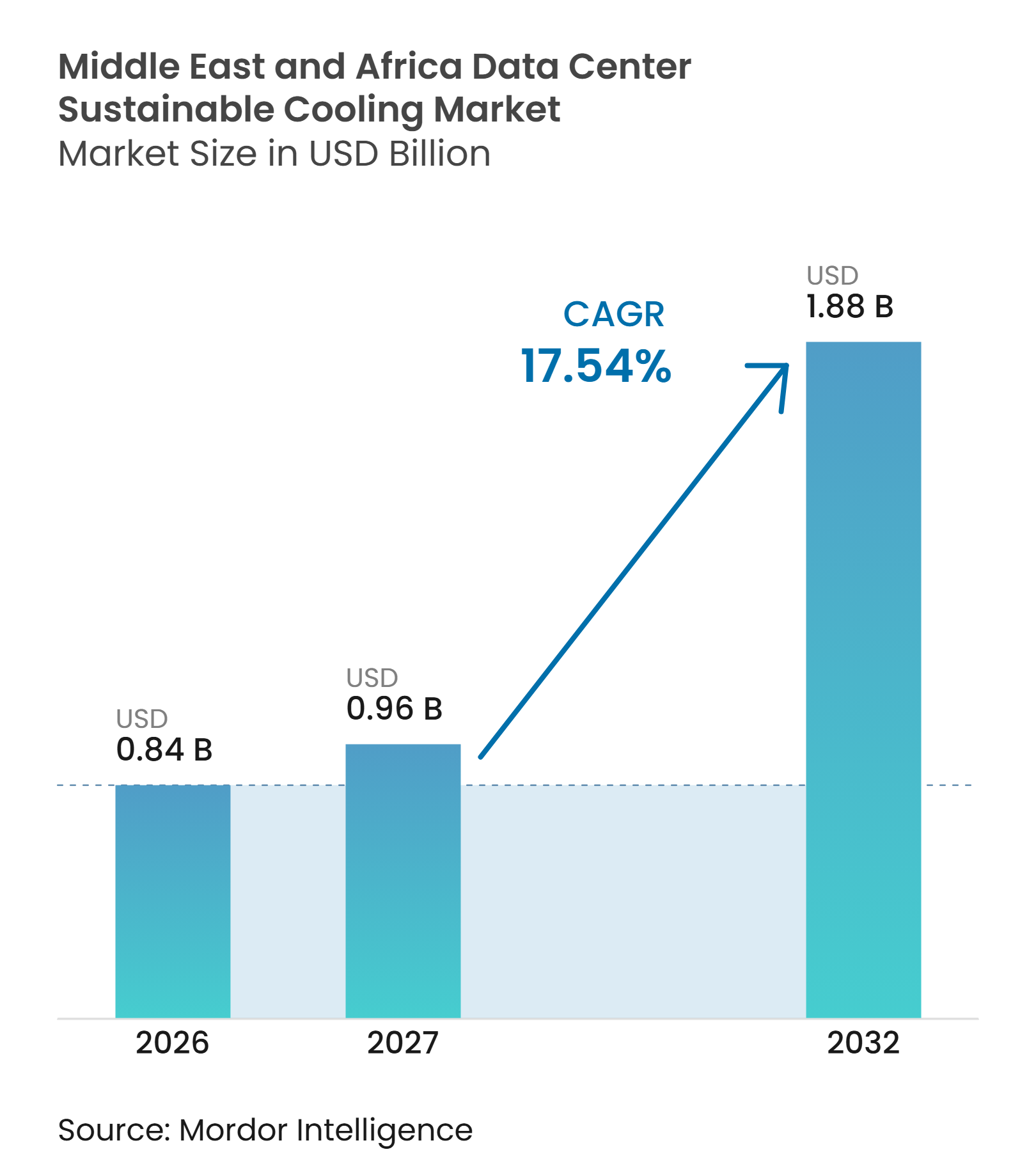
| Base Year Market Size (2026) | USD 0.84 Billion |
| Market Size (2027) | USD 0.96 Billion |
| Market Size (2032) | USD 1.88 Billion |
| Growth Rate (2027 - 2032) | 17.54 % |
| Market Concentration | Medium |
Major Players *Disclaimer: Major Players sorted in no particular order Image © Mordor Intelligence. Reuse requires attribution under CC BY 4.0. | |
Middle East and Africa Data Center Sustainable Cooling Market Analysis by Mordor Intelligence
The Middle East and Africa data center sustainable cooling market size is projected to expand from USD 0.84 billion in 2026 to USD 1.88 billion by 2032, registering a CAGR of 17.54% between 2027 to 2032. New data center campuses are bringing cooling requirements into early design decisions, particularly where AI workloads require higher rack densities. Sovereign investment, cloud-region expansion, and data localization rules are supporting construction across Gulf markets and selected African hubs. Water availability is becoming a central operating consideration because conventional evaporative systems can add pressure to desalinated supplies. Suppliers are responding by combining liquid cooling, monitoring software, power infrastructure, and local service support. The Middle East and Africa data center sustainable cooling market is therefore moving toward systems that manage heat, electricity use, and water use together.
Key Report Takeaways
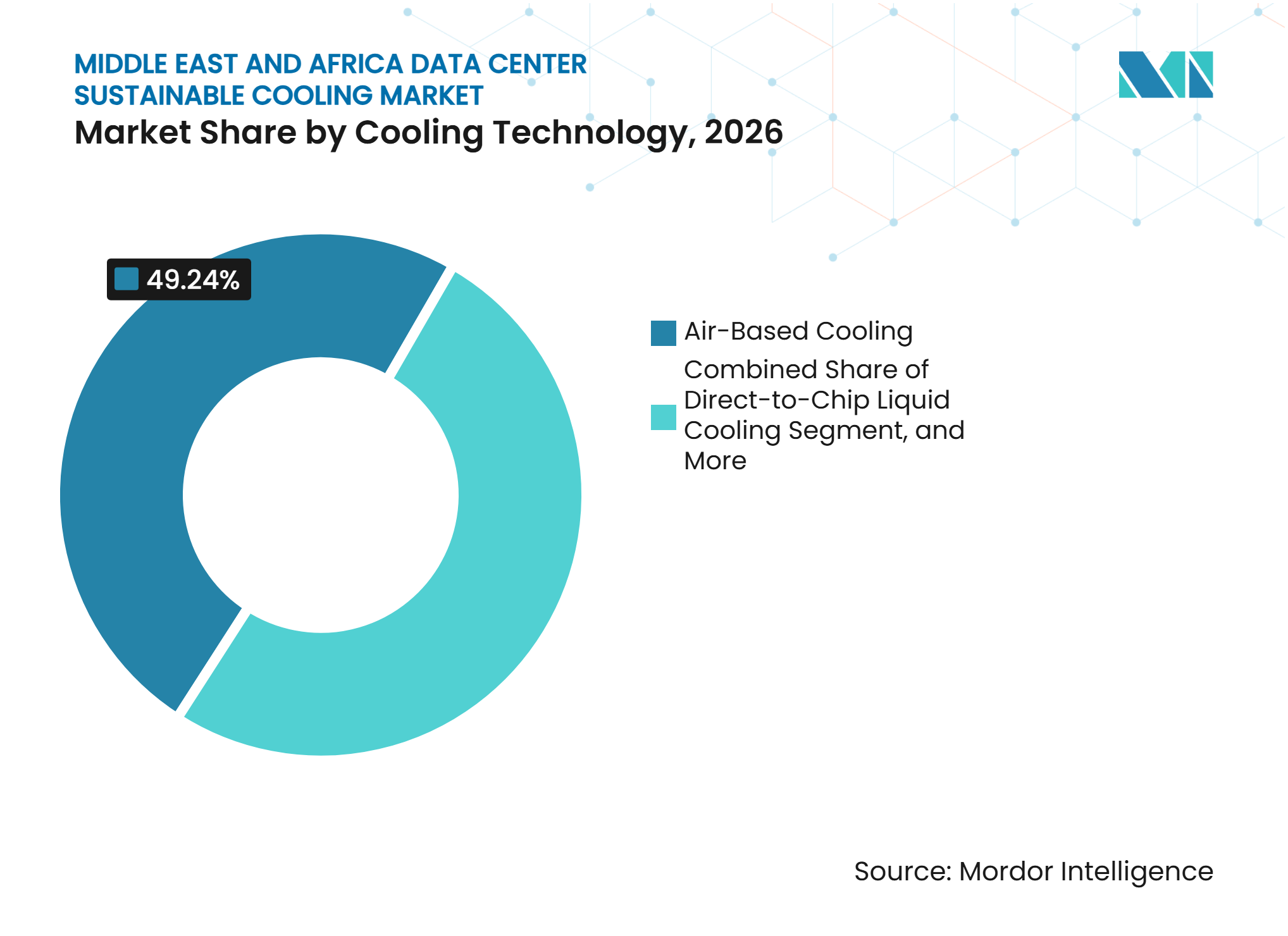
- By cooling technology, air-based cooling held 49.24% of the Middle East and Africa data center sustainable cooling market share in 2026, while direct-to-chip liquid cooling is projected to expand at a 17.88% CAGR through 2032.
- By heat rejection technology, air-cooled systems accounted for 40.17% of the Middle East and Africa data center sustainable cooling market size in 2026, while hybrid heat rejection systems are projected to expand at an 18.21% CAGR through 2032.
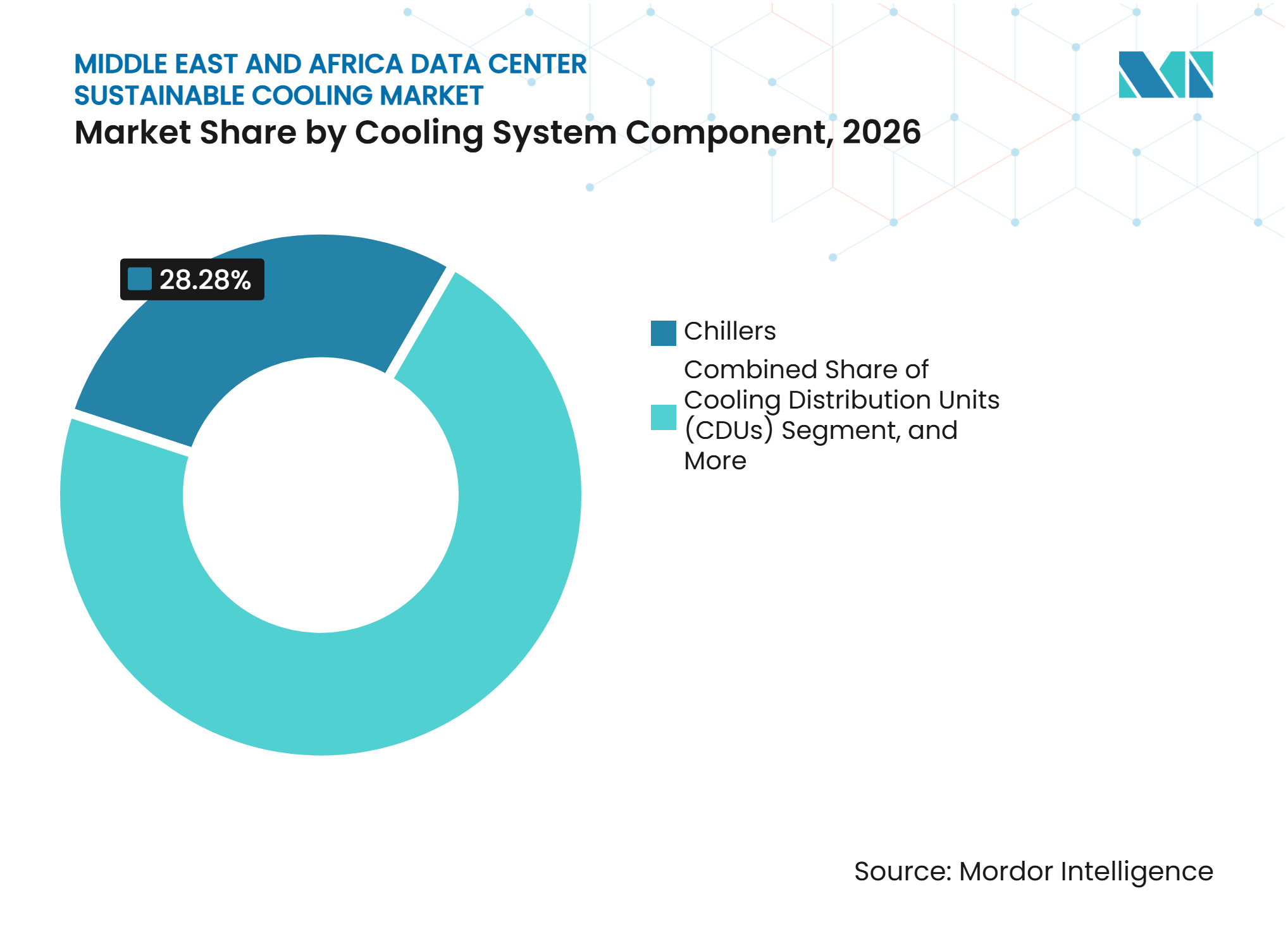
- By cooling system component, chillers accounted for 28.28% share in 2026, while coolant distribution units are projected to expand at an 18.14% CAGR through 2032.
- By sustainability approach, energy-efficient cooling held 40.52% share in 2026, while heat recovery-enabled cooling is projected to expand at a 17.93% CAGR through 2032.
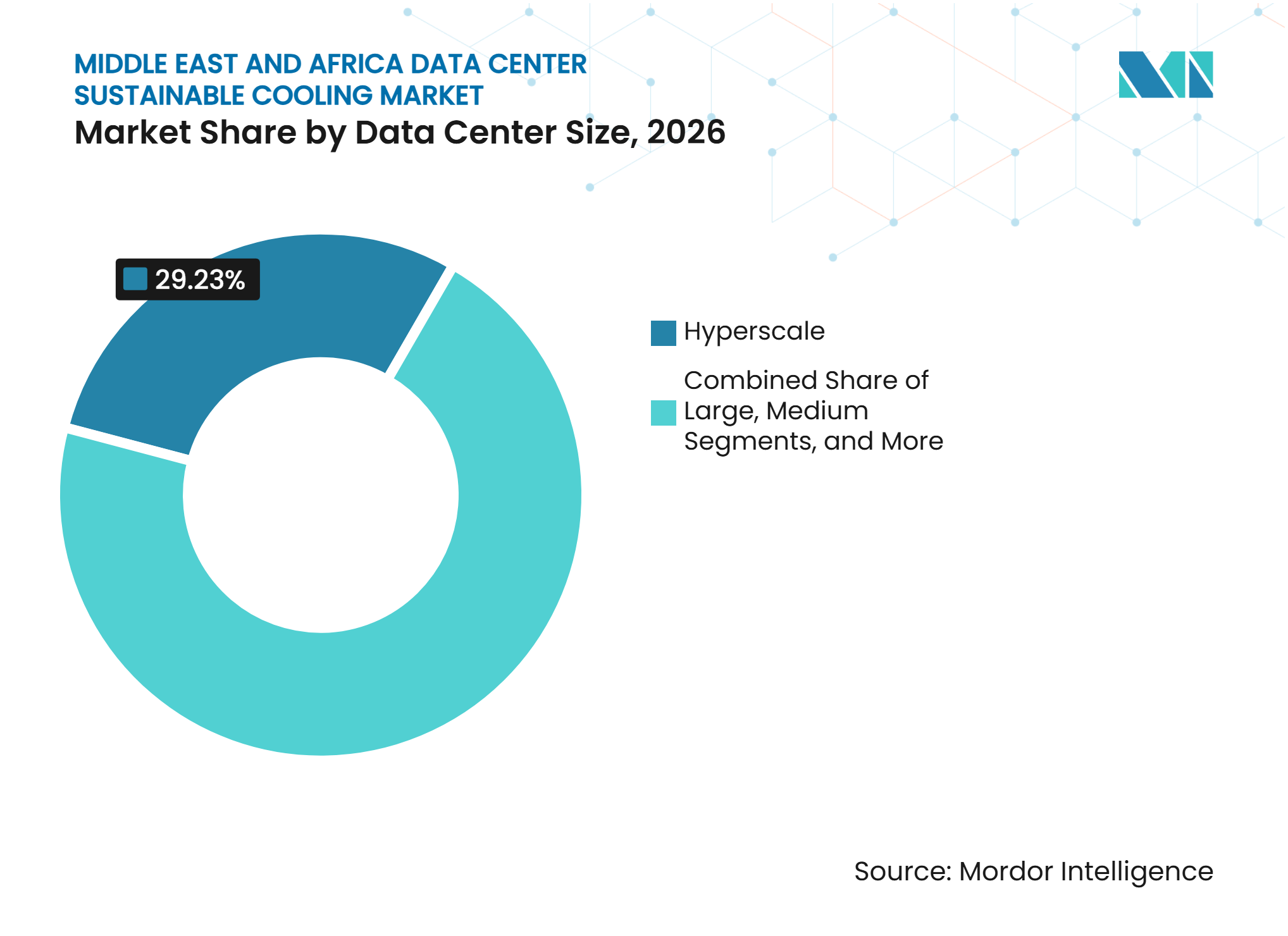
- By data center size, hyperscale facilities held 29.23% share in 2026 and are projected to expand at an 18.22% CAGR through 2032.
- By data center type, cloud service providers held 44.87% share in 2026 and are projected to expand at an 18.36% CAGR through 2032.
- By geography, the Middle East held 79.44% share in 2026 and is projected to expand at a 17.96% CAGR through 2032.
Note: Market numbers in this report are based on Mordor Intelligence's proprietary estimation framework, which combines nine months of actuals with Q4 projections for base year 2026.
Market Trends and Insights
Drivers Impact Analysis of Middle East and Africa Data Center Sustainable Cooling Market*
| Driver | (~) % Impact on CAGR Forecast | Geographic Relevance | Impact Timeline |
|---|---|---|---|
| Hyperscale and Sovereign AI Capacity Expansion | +4.8% | UAE, Saudi Arabia, Qatar, expanding to Egypt and South Africa | Short term (≤ 2 years) |
| Rising Rack Power Density From AI and HPC Workloads | +4.0% | Global, with acute expression in GCC hyperscale campuses | Short term (≤ 2 years) |
| Data Localization and Cloud-Region Expansion | +2.9% | UAE, Saudi Arabia, South Africa, Egypt, Israel | Medium term (2-4 years) |
| Water-Scarcity-Led Shift to Closed-Loop and Low-Water Cooling | +2.0% | GCC core, with spillover to North Africa and sub-Saharan hubs | Medium term (2-4 years) |
| GCC Sustainability and Energy-Efficiency Mandates | +1.5% | Saudi Arabia, UAE, Qatar, with early influence in Oman and Bahrain | Medium term (2-4 years) |
| Liquid-Cooling Adoption in African Water- and Grid-Constrained Hubs | +0.9% | South Africa, Kenya, Nigeria, Egypt | Long term (≥ 4 years) |
| Source: Mordor Intelligence | |||
Hyperscale and Sovereign AI Capacity Expansion
Sovereign-backed investment is concentrating data center construction into a limited number of large projects across the Gulf. The Middle East had 1.1 GW of commissioned data center capacity, 760 MW under construction, and a pipeline exceeding 5.5 GW in early 2026. This construction pattern gives cooling suppliers a chance to participate before facility specifications are finalized. Saudi Arabia’s data center strategy targeted 1.5 GW of capacity by 2030, which supported planning for larger thermal systems and liquid-cooling-ready facilities. The UAE also advanced large AI campus plans, creating demand for equipment that can accommodate high-density computing. The Middle East and Africa data center sustainable cooling market benefits because cooling is specified as part of national digital infrastructure rather than added after a facility opens.
Rising Rack Power Density From AI and HPC Workloads
AI and high-performance computing workloads are raising the heat load that each rack must reject. The U.S. Department of Energy reported that high-end AI and HPC installations can operate at up to 250 kW per rack, well above the range traditionally served by room-level air cooling.[1] Air cooling becomes difficult to apply once rack densities move beyond the 40-50 kW range described in the supplied research. This changes cooling design from an efficiency decision into a technical requirement for GPU clusters. Direct-to-chip systems, liquid-to-liquid loops, and rear-door heat exchangers give operators more options for managing concentrated heat. The Middle East and Africa data center sustainable cooling market is gaining support from new campuses that need to prepare for higher rack density before the hardware is installed.
Data Localization and Cloud-Region Expansion
Data localization is encouraging construction in several MEA jurisdictions instead of concentrating all capacity in one location. Saudi Arabia, the UAE, South Africa, Egypt, Israel, Qatar, and Oman are all relevant to this distributed development pattern. Each location has a different combination of ambient temperatures, water availability, power conditions, and operating rules. That variation encourages modular cooling designs that can be adjusted for local conditions. New cloud regions also create procurement opportunities for facilities that serve national and regional workloads. The Middle East and Africa data center sustainable cooling market can benefit from this wider build-out, although suppliers will need local engineering and service capability.
Water-Scarcity-Led Shift to Closed-Loop and Low-Water Cooling
Water constraints are shaping cooling choices in the Gulf, where desalination supplies much of the freshwater used in Saudi Arabia and the UAE. Conventional evaporation-based cooling can create additional pressure during the hottest periods, when data centers need the most cooling. Teraco completed the JB4 Bredell Campus expansion in August 2025 with a closed-loop chilled water system that achieves zero water use during ongoing operations.[2] The project shows how liquid cooling can address heat management and water use at the same time. Operators are also placing more attention on water-use effectiveness when selecting cooling equipment. This supports adoption of closed-loop systems and low-water configurations within the Middle East and Africa data center sustainable cooling market.
Restraints Impact Analysis of Middle East and Africa Data Center Sustainable Cooling Market*
| Restraint | (~) % Impact on CAGR Forecast | Geographic Relevance | Impact Timeline |
|---|---|---|---|
| High Retrofit Cost and Facility-Design Incompatibility | -3.5% | GCC and South Africa, with existing air-cooled facility bases | Short term (≤ 2 years) |
| Shortage of Liquid-Cooling Operations and Maintenance Skills | -2.0% | Pan-MEA, most acute in sub-Saharan Africa | Medium term (2-4 years) |
| Water-Energy Trade-Offs in Hot, Water-Stressed Climates | -1.3% | GCC core, Saudi Arabia, UAE, Qatar | Long term (≥ 4 years) |
| Regional CDU, Coolant, and Qualified-Service Supply Bottlenecks | -0.8% | Sub-Saharan Africa and North Africa | Long term (≥ 4 years) |
| Source: Mordor Intelligence | |||
High Retrofit Cost and Facility-Design Incompatibility
Existing air-cooled facilities are more difficult to convert than purpose-built AI campuses. A retrofit requires changes to pipework, floor layouts, electrical distribution, rack arrangements, and operational procedures. Work can also disrupt customers that have long-term colocation contracts and limited tolerance for downtime. The result is a divide between new campuses that can include liquid cooling in their original design and older facilities that continue using air cooling for moderate-density workloads. Operators must compare the cost of conversion with the revenue potential from hosting dense AI infrastructure. This constraint can slow the Middle East and Africa data center sustainable cooling market in the installed base even when demand for new capacity remains strong.
Shortage of Liquid-Cooling Operations and Maintenance Skills
Liquid cooling needs staff who can monitor fluid quality, detect performance deviations, and maintain coolant distribution units. These capabilities are less common than the skills required for conventional air-cooled facilities. WSP noted that liquid cooling requires specialized operational knowledge and that adoption plans in African data centers are outpacing workforce development. Imported equipment can also require external specialists during commissioning and maintenance. The skills gap is most restrictive in markets where service networks and technical training are still developing. Suppliers that provide training, local field support, and standardized maintenance procedures can reduce this barrier.
*Our forecasts treat driver/restraint impacts as directional, not additive. The impact forecasts reflect baseline growth, mix effects, and variable interactions.
Middle East and Africa Data Center Sustainable Cooling Market Segment Analysis
By Cooling Technology:
Air Cooling Holds Share as Liquid Systems Gain GroundAir-based cooling held 49.24% of the regional market in 2026, supported by the large installed base of legacy facilities. It remains appropriate for workloads that have not reached liquid-critical power density. Many existing sites are improving fans, air handling, and controls rather than replacing their full cooling architecture. This approach can extend the usable life of established equipment while reducing energy use. New AI-oriented projects are taking a different route by planning hybrid or fully liquid systems from the start. Immersion cooling is gaining early traction in AI training environments where heat is concentrated in a smaller footprint. Rear-door heat exchangers provide an intermediate option for sites that host a mix of conventional servers and denser equipment. Free cooling and economizer configurations are also being considered in North African and sub-Saharan projects where local climate conditions permit their use.
Direct-to-chip liquid cooling is projected to expand at a 17.88% CAGR through 2032, making it the fastest-moving cooling technology segment. GPU clusters in Gulf campuses can exceed 80-100 kW per rack, a range that makes direct liquid cooling technically relevant. The technology transfers heat close to the processor rather than relying only on room air. This can make thermal management more predictable in dense deployments. The U.S. Department of Energy identified the continued rise in AI and HPC power density as a major planning issue for digital infrastructure. Facility designers are increasingly assessing cooling technology alongside power delivery, rack layout, and network design. ASHRAE TC9.9 guidance and Open Compute Project rack standards offer useful reference points for system design. The Middle East and Africa data center sustainable cooling market is consequently shifting toward cooling systems that are ready for high-density hardware before it arrives.



By Heat Rejection Technology:
Hybrid Systems Emerge as AI-Density EnablersAir-cooled systems represented 40.17% of the market in 2026 because they are straightforward to deploy and align with lower-water operating models. Their performance can be affected by high ambient temperatures, especially during Gulf summers. Open-circuit evaporative towers can improve heat rejection but create water-use concerns in water-stressed locations. Operators are therefore balancing power use, water availability, and local climate in the same design decision. Khazna reported that recycled water met 19.8% of its cooling water needs in 2025.[3] Dry coolers are also relevant in African markets where grid variability can make energy-intensive chiller operation more difficult. These conditions favor heat rejection solutions that do not depend on a single operating mode.
Hybrid heat rejection systems are projected to expand at an 18.21% CAGR through 2032. They combine operating modes and can switch configurations as outdoor conditions change. This gives facilities more flexibility during extreme temperature peaks without depending continuously on evaporative water use. The approach is well suited to new Saudi Arabian and UAE projects, where daily and seasonal temperature changes affect cooling performance. Hybrid systems can also help operators meet sustainability targets while maintaining the thermal capacity required for AI workloads. Their adoption depends on controls that can select the appropriate operating mode without interrupting critical equipment. The Middle East and Africa data center sustainable cooling market is seeing interest in these systems because the regional operating environment rarely favors one heat-rejection method throughout the year. Local engineering support is important because site conditions affect the balance between dry, mechanical, and water-assisted operation.
By Cooling System Component:
CDUs Rise as the Liquid-Cooling Infrastructure CoreChillers held 28.28% of the market in 2026, reflecting the established infrastructure used across air-cooled and mixed cooling facilities. They remain important where centralized chilled water systems serve large halls. Their role is changing as facilities add liquid loops closer to racks and processors. Cooling towers face pressure where open-circuit water use is restricted by water-efficiency objectives. Fans and air handling equipment retain a large installed base because many sites are pursuing incremental efficiency upgrades. Heat exchangers, pumps, and fluid distribution equipment are gaining importance as closed-loop designs become more common. Saudi Arabia’s data center capacity increased 42% compared with 2023, which shortened procurement cycles for multiple cooling components in its leading facilities. The component mix is therefore broadening rather than replacing conventional equipment at once.
Coolant distribution units are projected to expand at an 18.14% CAGR through 2032. They manage the fluid interface between rack-level cold plates and facility heat-rejection equipment. This function becomes essential when operators use direct liquid cooling at scale. Schneider Electric announced its acquisition of 75% of Motivair in June 2025, positioning the transaction around AI-ready thermal management requirements in Saudi Arabia. The transaction reflects the value suppliers place on CDU capability as liquid cooling expands. Monitoring systems are also becoming more important because fluid temperature, pressure, and load must be managed continuously. Teraco’s JB4 facility uses AI-enabled cooling controls within its water-efficient configuration. The Middle East and Africa data center sustainable cooling market is creating demand for components that connect the IT load to the facility-wide cooling system.

By Sustainability Approach:
Energy Efficiency Leads as Heat Recovery AcceleratesEnergy-efficient cooling held 40.52% share in 2026 because power usage effectiveness remains a basic performance measure for facility operators. Efficiency improvements can come from better controls, optimized airflow, higher operating temperatures, and equipment selection. In the GCC, these measures support data center plans that seek to reduce the energy intensity of new digital infrastructure. Water-efficient cooling is also becoming more relevant where desalination creates a direct link between water use and energy demand. Low-global-warming-potential refrigerants support a separate part of the sustainability agenda. The Kigali Amendment to the Montreal Protocol provides an international framework for reducing hydrofluorocarbon use. Operators increasingly need to consider refrigerant choice, water use, and electricity consumption together rather than as separate technical issues. This broadens the role of sustainability in the Middle East and Africa data center sustainable cooling market.
Heat recovery-enabled cooling is projected to expand at a 17.93% CAGR through 2032. Dense GPU installations generate heat streams that can have practical value if a suitable local use exists. A 2025 assessment in Energy and Buildings described integrated heat reuse as important for reducing the environmental impact of digital infrastructure. District cooling networks in some GCC urban areas could create a potential setting for recovery projects. Commercial models are still developing because recovery value depends on nearby demand, temperature requirements, and the cost of connection. Digital twins and AI-enabled controls can help operators identify periods when recovery is operationally practical. Khazna and Presight signed an agreement in October 2025 to deploy AI-driven facility management, including cooling optimization and predictive maintenance, across Khazna’s UAE network. This approach can make sustainability performance more visible at the portfolio level.
By Data Center Size:
Hyperscale Anchors Both Market Share and GrowthHyperscale facilities held 29.23% share in 2026 and are projected to expand at an 18.22% CAGR through 2032. Their position reflects a regional development model centered on very large, AI-ready campuses. A small number of projects can produce large cooling orders because each site requires extensive thermal infrastructure. Large facilities also serve enterprise and colocation demand where rack densities are rising toward the point at which liquid cooling becomes relevant. Medium facilities are expanding across Nigeria, Kenya, and Egypt as cloud adoption moves beyond the largest regional hubs. Small facilities and edge sites support smart city applications, real-time government services, and local inference workloads. Their equipment choices often differ from hyperscale projects because they need compact and modular systems. The Middle East and Africa data center sustainable cooling market must therefore serve both very large campuses and distributed sites with different deployment patterns.
AI accelerator systems can place a major power load in a compact footprint, which is why hyperscale projects have an outsized effect on cooling procurement. Goldman Sachs noted in 2025 that advanced AI infrastructure is increasing data center power-density requirements. Hyperscale operators are more likely to specify liquid-cooling readiness, precise monitoring, and defined performance thresholds. Large-scale facilities follow similar practices where they host GPU-heavy customer workloads. Medium and smaller facilities may retain air cooling for longer, but their thresholds are also moving upward. Modular liquid-cooling systems can give these operators a path to add capacity without rebuilding an entire hall. The gap between cooling requirements for large and smaller facilities is narrowing as dense servers become available to more users. This supports a more diverse equipment market, even though hyperscale campuses remain the largest immediate source of demand.
By Data Center Type:
Cloud Providers Drive Density-Led Cooling DemandCloud service providers held a 44.87% share in 2026 and are projected to expand at an 18.36% CAGR through 2032. Their procurement requirements influence system design because they operate large environments with standardized performance expectations. Cloud providers are also positioning the region for sovereign AI computing and local cloud services. Du and NextGenAI unveiled a 13+ MW liquid-cooled AI supercluster with NVIDIA B300 GPUs and direct-to-chip cooling in October 2025. Such projects show how cloud-oriented infrastructure can set a high bar for heat removal. Colocation facilities face a different challenge because their older designs were often intended for racks operating at 5-15 kW. They must accommodate a wider variety of customers' equipment while avoiding disruption to existing tenants.
Enterprise and edge deployments are also increasing as public agencies and businesses seek local processing for smart city applications, autonomous mobility, and operational analytics. Their cooling needs are more varied than those of a cloud campus. Modular and prefabricated systems can suit these deployments because capacity can be added as the hardware profile changes. CSP requirements can also shape regional supply chains because their volumes justify local service partnerships and component inventory. The Middle East and Africa data center sustainable cooling market is therefore affected by a relatively small group of cloud procurement teams in the near term. At the same time, enterprise and edge projects can create a broader base of demand for adaptable equipment. Suppliers that can support both large liquid-cooled halls and distributed installations are better positioned for this mix. The data center sustainable cooling industry is becoming more dependent on service quality, controls, and integration capability as well as equipment performance.
Geography Analysis
Middle East
The Middle East held 79.44% of the Middle East and Africa data center sustainable cooling market share in 2026 and is projected to expand at a 17.96% CAGR through 2032. Saudi Arabia and the UAE are central to this position because both are building large data center and AI capacity. The UAE exceeded 376 MW of live data center capacity in late 2025, while Saudi Arabia targeted 1.5 GW of total data center capacity by 2030. These projects require cooling systems that can operate through sustained high ambient temperatures. Water efficiency is particularly important because Gulf facilities operate in countries with material desalination dependence. Khazna’s development of AI-driven facility management across its UAE network shows how operators are applying digital controls to cooling optimization. Uptime Institute Tier III certification and LEED Gold targets are also shaping expectations for reliability and building performance. The Middle East data center sustainable cooling market size is supported by a construction pipeline that is likely to favor liquid-ready and low-water system designs.
Africa
Africa’s operating conditions create demand for cooling systems that are reliable under water, grid, and supply-chain constraints. Teraco completed its JB4 Bredell Campus expansion in August 2025, adding 30 MW and bringing the facility to 50 MW of total critical IT load. The project incorporated liquid-to-liquid cooling and a closed-loop chilled water system with zero water use during ongoing operation. It also operates under ISO 9001, ISO 27001, ISO 50001, and ISO 14001 certifications, which connect quality, information security, energy management, and environmental management practices. South Africa leads the continent’s cooling infrastructure demand because of its connectivity and established colocation base. Egypt is gaining importance as a regional data center location, while Kenya and Nigeria offer further expansion potential. Local service capability and component availability will influence how quickly advanced liquid cooling moves from large projects into a wider group of African facilities.
Qatar, South Africa, and Rest of Middle East and Africa
Qatar’s high temperatures, desalination dependence, and sovereign AI funding favor closed-loop and water-efficient cooling designs. Israel has a specialized demand base tied to defense, cloud, and AI research, which can support direct-to-chip and rear-door heat exchanger installations. Nigeria, Kenya, Ghana, and Rwanda are developing more digital capacity, but operators must match cooling choices to local power costs and grid conditions. Oman and Bahrain continue to support edge and colocation infrastructure, which can create demand for modular systems. Mitsubishi Electric established MEHITS Middle East FZCO in Dubai in October 2025 to provide design, sales, installation, and maintenance support for IT cooling systems. This service investment reflects the importance of local technical support across the Middle East and Africa data center sustainable cooling market. The varied geography means suppliers need a portfolio that can accommodate high-density campuses, smaller edge sites, and different water and power conditions.
Competitive Landscape
Market Concentration
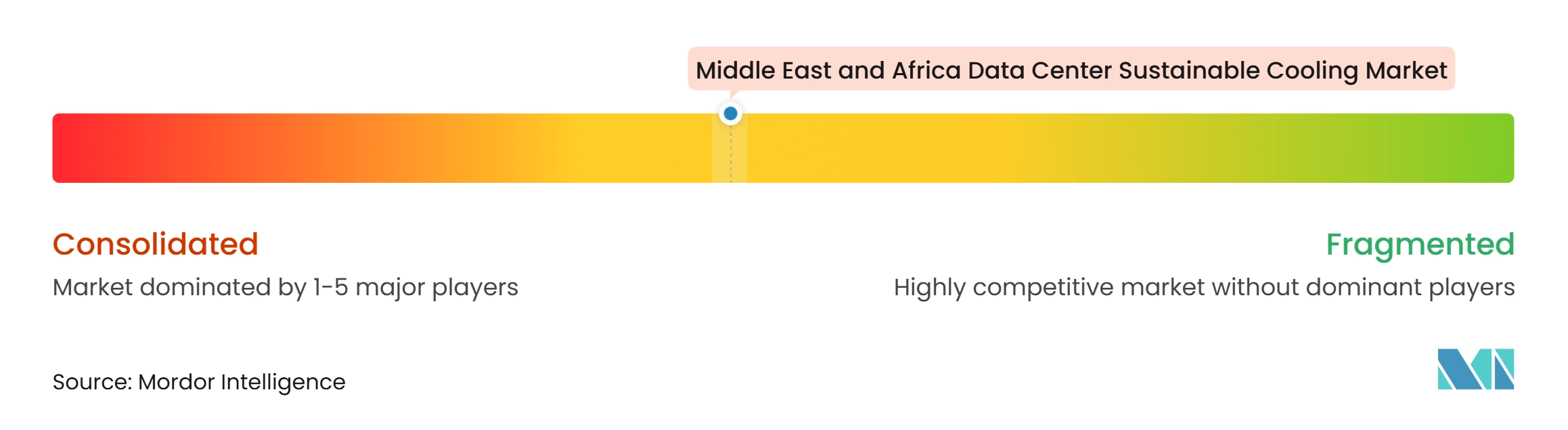
The Middle East and Africa data center sustainable cooling market has a moderately consolidated global supplier tier and a more fragmented regional service and specialized technology tier. Schneider Electric, Vertiv, and STULZ have broad portfolios that include precision cooling, liquid cooling, digital management, and related infrastructure. Their installed bases and service organizations provide an advantage when customers seek integrated solutions. Vertiv and Ezditek signed a technical cooperation agreement in October 2025 to develop AI-ready data center solutions in Saudi Arabia. Schneider Electric also partnered with Petra Engineering Industries in October 2025 on locally manufactured premium-efficiency air-cooled chillers for Saudi Arabia. These arrangements address local-content expectations and shorten the distance between equipment supply and service delivery. Larger vendors are increasingly packaging thermal management with power distribution, monitoring, and facility management tools.
Specialists in immersion cooling and advanced liquid cooling are challenging the established supplier model in selected applications. Iceotope Technologies, Submer Technologies, and Asperitas Technologies address workloads for which conventional air cooling cannot meet the required thermal performance. Their opportunities are strongest in GPU training clusters, direct liquid-cooling projects, and sites that require water-efficient designs. Specialized suppliers can win projects by providing a distinct technical capability, but they must demonstrate service coverage and long-term support. Demand for coolant distribution units and in-region maintenance capacity also creates room for companies that invest in local technical teams. The Middle East and Africa data center sustainable cooling market continues to favor vendors that can translate specialized cooling technology into deployable, maintainable projects.
Competition is also developing around heat recovery, operating controls, and regional manufacturing. Heat recovery remains less mature because its commercial value depends on nearby demand for the recovered heat. AI-based controls can help operators respond to changing loads and demonstrate operating efficiency. Khazna’s agreement with Presight is one example of this portfolio-level approach to cooling optimization. Suppliers with local manufacturing partnerships have an additional advantage when customers face import lead times or local-content requirements. The competitive structure is not concentrated enough to give any provider overwhelming control across the region. The leading suppliers still retain influence because large projects value proven equipment, integration capability, and reliable service.
Middle East and Africa Data Center Sustainable Cooling Industry Leaders
-
Schneider Electric SE
-
Vertiv Group Corp.
-
STULZ GmbH
-
Johnson Controls International plc
-
Daikin Industries, Ltd.
- *Disclaimer: Major Players sorted in no particular order
Middle East and Africa Data Center Sustainable Cooling Market Companies Covered in this Report
- Schneider Electric SE
- Vertiv Group Corp.
- STULZ GmbH
- Johnson Controls International plc
- Daikin Industries, Ltd.
- Mitsubishi Electric Corporation
- Munters Group AB
- Rittal GmbH & Co. KG
- Trane Technologies plc
- Eaton Corporation plc
- Airedale International Air Conditioning Ltd.
- Fujitsu General Limited
- Emerson Electric Co.
- Super Micro Computer, Inc.
- Shell plc
- Chemours Company
- Iceotope Technologies Limited
- Submer Technologies S.L.
- Asperitas Technologies B.V.
- Digital Realty Trust, Inc.
- Teraco Data Environments (Pty) Ltd
- Khazna Data Centers Limited
- Africa Data Centres (Pty) Ltd
- Open Access Data Centres (Pty) Ltd
Recent Industry Developments in Middle East and Africa Data Center Sustainable Cooling Market
- October 2026: Submer and Saudi-based ACES signed an MoU to accelerate the development of AI-ready data centers in Saudi Arabia. The collaboration combines Submer's liquid and immersion-cooling technologies with ACES's local infrastructure engineering and deployment capabilities. The scope includes cooling-system design, new-build and retrofit projects, and potential co-investment in data-center capacity.
- October 2026: Accelsius deployed its commercial IR150 two-phase direct-to-chip liquid cooling system at EdgeConneX's Global Training Center in Houston, marking the next commercial milestone for its NeuCool technology. The system supports rack densities up to 150 kW.
- May 2026: Schneider Electric committed to nearly tripling its Saudi Arabia manufacturing capacity to 32 production lines by 2030, including locally manufactured cooling chillers, directly reducing MEA cooling supply chain importation lead times.
- February 2026: Khazna Data Centers received Uptime Institute Tier III Certification of Design Documents for its QAJ01 facility in Ajman, UAE. The facility is the first certified AI data center with liquid cooling in the MENA region, with 100 MW capacity across 20 data halls.
Middle East and Africa Data Center Sustainable Cooling Market Report Scope
The Middle East and Africa Data Center Sustainable Cooling Market refers to the regional market for energy-efficient, low-carbon, and water-conscious cooling technologies, systems, and services designed to manage thermal loads in data centers across the Middle East and Africa while minimizing environmental impact, covering liquid cooling (direct-to-chip, immersion, rear-door heat exchangers), free/air-side economization, evaporative and adiabatic cooling, low-GWP refrigerant chillers, waste-heat recovery, AI-driven thermal optimization, and water-efficient closed-loop systems.
The Middle East and Africa Data Center Sustainable Cooling Market Report is Segmented by Cooling Technology (Air-Based Cooling, Direct-to-Chip Liquid Cooling, Immersion Cooling, Rear-Door Heat Exchangers, Evaporative and Adiabatic Cooling, Free Cooling and Economizer Systems, and Other Sustainable Cooling Technologies), Heat Rejection Technology (Air-Cooled Systems, Water-Cooled Systems, Evaporative Heat Rejection, Dry Coolers, and Hybrid Heat Rejection Systems), Cooling System Component (Cooling Distribution Units (CDUs), Chillers, Cooling Towers, Heat Exchangers, Pumps and Fluid Distribution Systems, Fans and Air Handling Equipment, and Cooling Controls and Monitoring Systems), Sustainability Approach (Energy-Efficient Cooling, Water-Efficient Cooling, Low-Global-Warming-Potential Refrigerant Solutions, Heat Recovery-Enabled Cooling, and Integrated Cooling Optimization and Controls), Data Center Size (Small, Medium, Large, and Hyperscale), Data Center Type (Colocation, Cloud Service Providers (CSPs), and Enterprise and Edge), and Geography (Saudi Arabia, United Arab Emirates, Israel, Qatar, South Africa, Egypt, and Rest of Middle East and Africa). The Market Forecasts Are Provided in Terms of Value (USD).
Segmentation Overview
| Air-Based Cooling |
| Direct-to-Chip Liquid Cooling |
| Immersion Cooling |
| Rear-Door Heat Exchangers |
| Evaporative and Adiabatic Cooling |
| Free Cooling and Economizer Systems |
| Other Sustainable Cooling Technologies |
| Air-Cooled Systems |
| Water-Cooled Systems |
| Evaporative Heat Rejection |
| Dry Coolers |
| Hybrid Heat Rejection Systems |
| Cooling Distribution Units (CDUs) |
| Chillers |
| Cooling Towers |
| Heat Exchangers |
| Pumps and Fluid Distribution Systems |
| Fans and Air Handling Equipment |
| Cooling Controls and Monitoring Systems |
| Energy-Efficient Cooling |
| Water-Efficient Cooling |
| Low-Global-Warming-Potential Refrigerant Solutions |
| Heat Recovery-Enabled Cooling |
| Integrated Cooling Optimization and Controls |
| Small |
| Medium |
| Large |
| Hyperscale |
| Colocation |
| Cloud Service Providers (CSPs) |
| Enterprise and Edge |
| Saudi Arabia | United Arab Emirates |
| Israel | |
| Qatar | |
| South Africa | |
| Egypt | |
| Rest of Middle East and Africa |
| By Cooling Technology | Air-Based Cooling | |
| Direct-to-Chip Liquid Cooling | ||
| Immersion Cooling | ||
| Rear-Door Heat Exchangers | ||
| Evaporative and Adiabatic Cooling | ||
| Free Cooling and Economizer Systems | ||
| Other Sustainable Cooling Technologies | ||
| By Heat Rejection Technology | Air-Cooled Systems | |
| Water-Cooled Systems | ||
| Evaporative Heat Rejection | ||
| Dry Coolers | ||
| Hybrid Heat Rejection Systems | ||
| By Cooling System Component | Cooling Distribution Units (CDUs) | |
| Chillers | ||
| Cooling Towers | ||
| Heat Exchangers | ||
| Pumps and Fluid Distribution Systems | ||
| Fans and Air Handling Equipment | ||
| Cooling Controls and Monitoring Systems | ||
| By Sustainability Approach | Energy-Efficient Cooling | |
| Water-Efficient Cooling | ||
| Low-Global-Warming-Potential Refrigerant Solutions | ||
| Heat Recovery-Enabled Cooling | ||
| Integrated Cooling Optimization and Controls | ||
| By Data Center Size | Small | |
| Medium | ||
| Large | ||
| Hyperscale | ||
| By Data Center Type | Colocation | |
| Cloud Service Providers (CSPs) | ||
| Enterprise and Edge | ||
| By Geography | Saudi Arabia | United Arab Emirates |
| Israel | ||
| Qatar | ||
| South Africa | ||
| Egypt | ||
| Rest of Middle East and Africa | ||
Key Questions Answered in the Report
What is the size of the Middle East and Africa data center sustainable cooling market?
The Middle East and Africa data center sustainable cooling market is valued at USD 0.84 billion in 2026 and is projected to reach USD 1.88 billion by 2032, at a 17.54% CAGR during 2027-2032.
What is driving demand for sustainable data center cooling in the Middle East and Africa?
AI and HPC workloads, sovereign AI capacity, cloud-region expansion, data localization, and water constraints are increasing demand for liquid-ready and low-water cooling systems.
Which cooling technology has the largest share in the Middle East and Africa?
Air-based cooling holds 49.24% share in 2026 because it serves the regions large installed base of conventional facilities.
Which cooling technology is expanding fastest in the region?
Direct-to-chip liquid cooling is projected to expand at a 17.88% CAGR through 2032 as GPU clusters raise rack heat loads.
Which data center type is the largest buyer of sustainable cooling systems?
Cloud service providers hold 44.87% share in 2026 and are projected to expand at an 18.36% CAGR through 2032.
Why is water-efficient cooling important for Gulf data centers?
Gulf sites operate in hot, water-stressed settings where desalinated water is important to supply, making closed-loop and low-water systems an operational priority.