
Middle East and Africa Data Center Security Services Market Size and Share
Market Overview
| Study Period | 2021 - 2032 |
|---|---|
| Forecast Data Period | 2027 - 2032 |
| Base Year Market Size (2026) | USD 0.47 Billion |
| Market Size (2027) | USD 0.54 Billion |
| Market Size (2032) | USD 1.07 Billion |
| Growth Rate (2027 - 2032) | 14.66 % |
| Market Concentration | Medium |
Major Players *Disclaimer: Major Players sorted in no particular order Image © Mordor Intelligence. Reuse requires attribution under CC BY 4.0. | |
Middle East and Africa Data Center Security Services Market Analysis by Mordor Intelligence
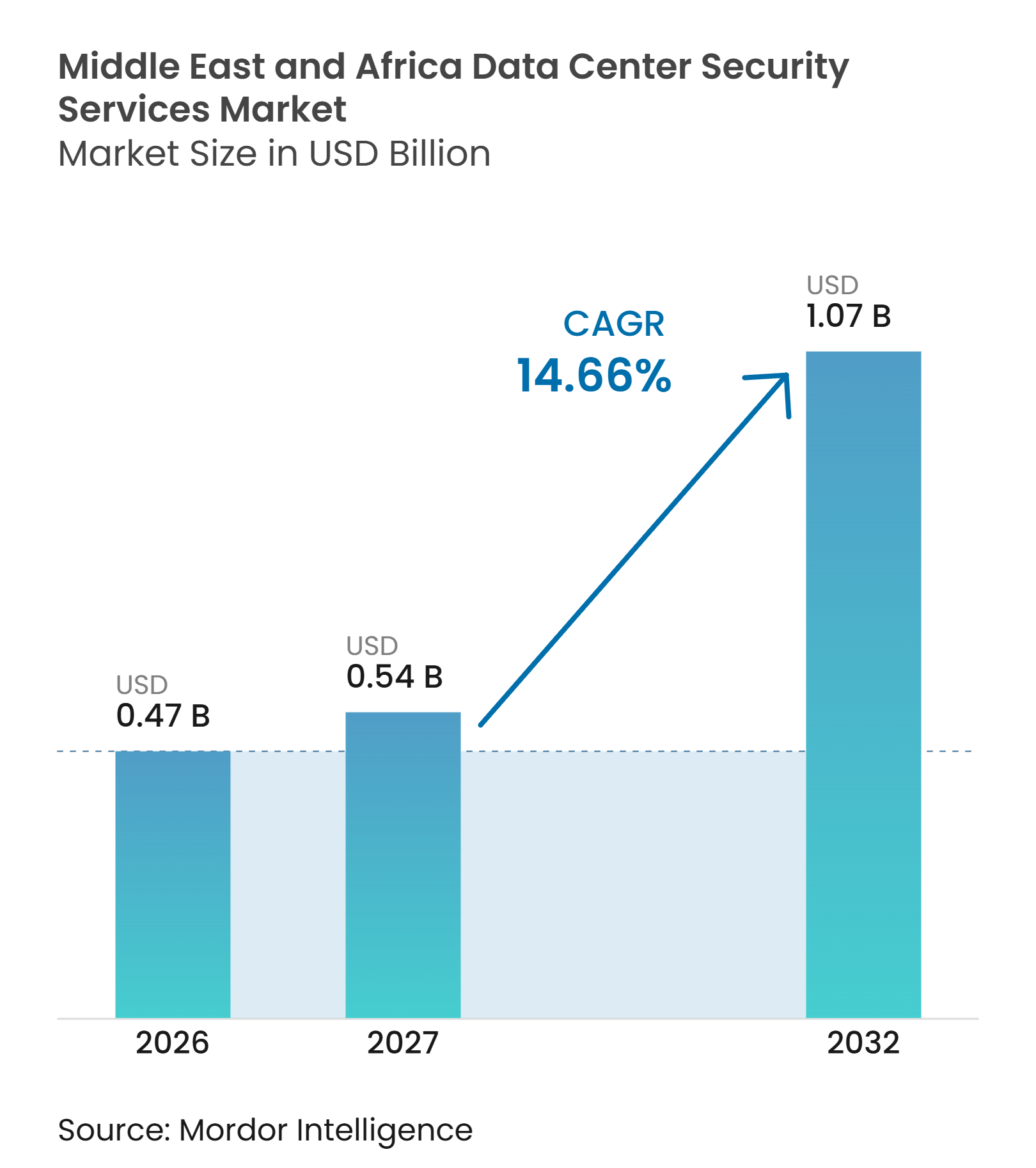
The Middle East and Africa data center security services market size is projected to expand from USD 0.47 billion in 2026 and USD 0.54 billion in 2027 to USD 1.07 billion by 2032, registering a CAGR of 14.66% between 2027 and 2032. New hyperscale, colocation, and sovereign cloud facilities are raising demand for on-site controls, continuous monitoring, and documented incident response across the Middle East and Africa data center security services market. The region is adding high-capacity AI infrastructure, and these facilities require security programs that can protect restricted equipment, cooling systems, power infrastructure, and access routes. Data localization rules and regulated-sector procurement requirements also favor providers that can operate locally staffed security operations centers and maintain auditable records. The Middle East and Africa data center security services market is therefore moving toward integrated physical and cyber security services rather than stand-alone guarding or surveillance contracts. Talent shortages and different national compliance rules may delay projects, particularly where operators need certified local personnel and resilient site infrastructure.
Key Report Takeaways
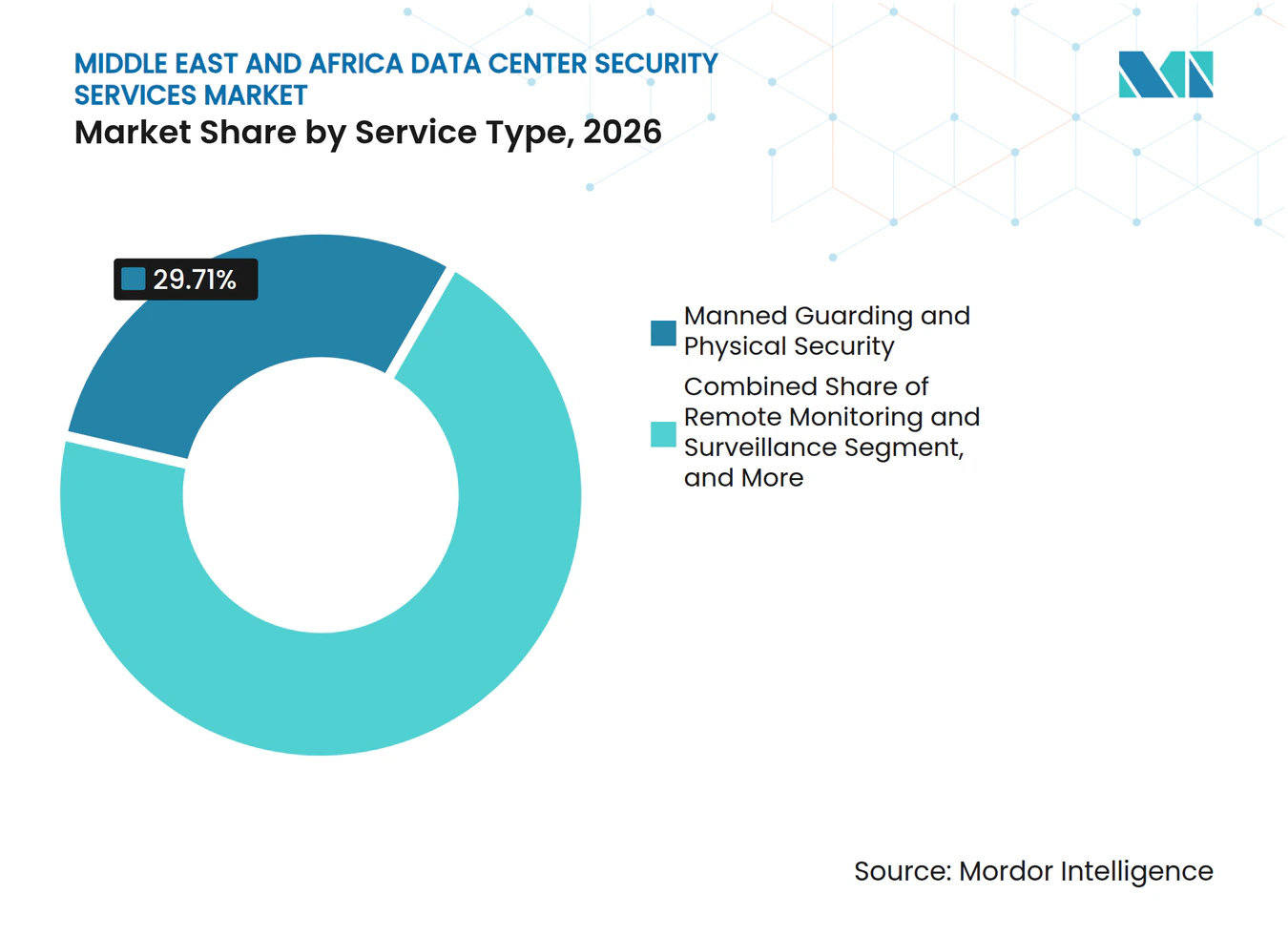
- By service type, Manned Guarding and Physical Security held 29.71% of the Middle East and Africa data center security services market share in 2026, while Security Operations Center Services is projected to expand at a 16.26% CAGR through 2032.
- By service delivery model, On-Site Security Services accounted for 44.28% of revenue in 2026, while Remote and Centralized Security Services are expected to expand at a 16.92% CAGR through 2032.
- By contract type, Dedicated Site-Level Contracts held 37.74% of revenue in 2026, while Managed Service Agreements are projected to expand at a 17.36% CAGR through 2032.
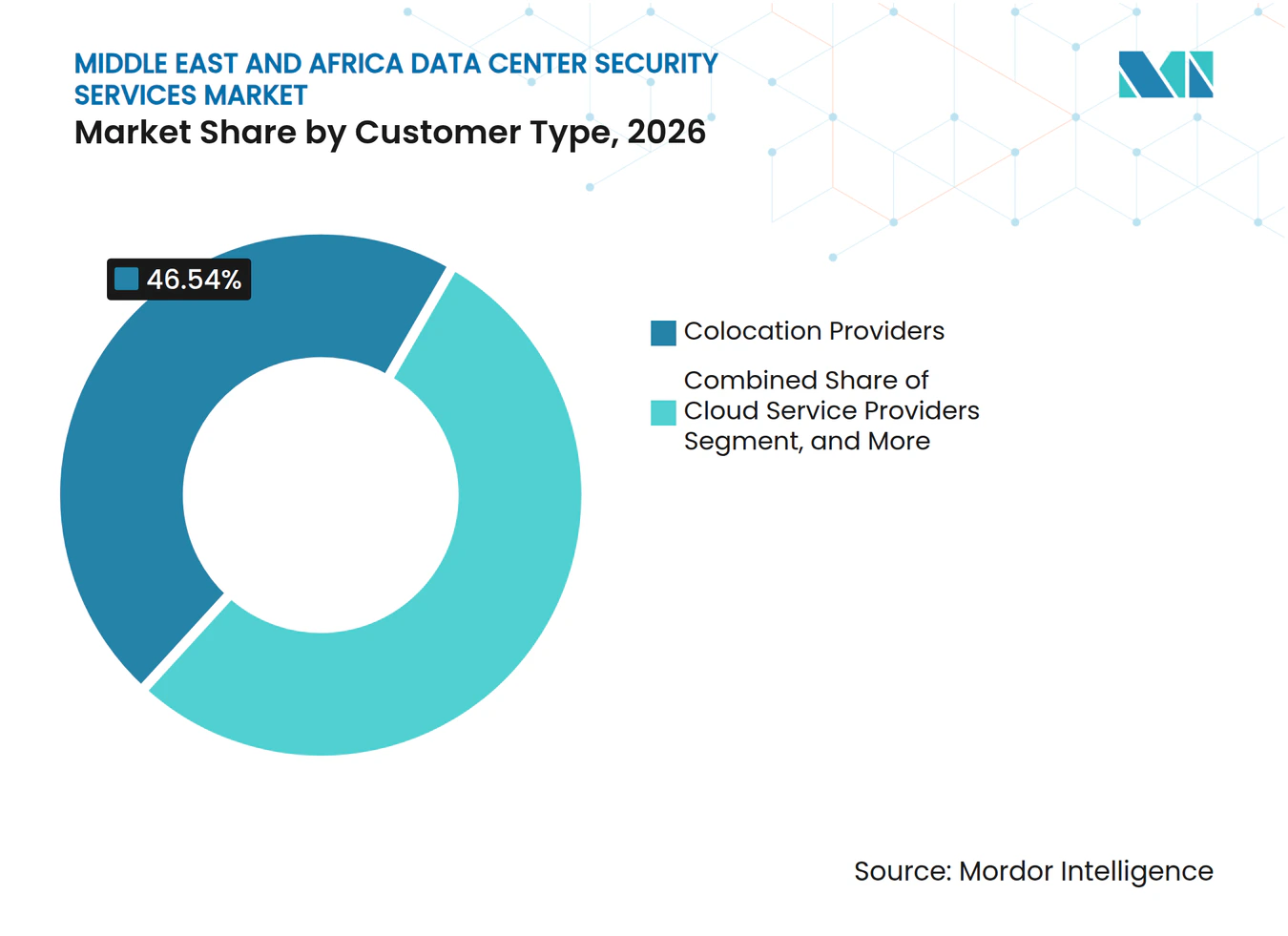
- By customer type, Colocation Providers accounted for 46.54% of revenue in 2026, while Cloud Service Providers are expected to expand at an 18.59% CAGR through 2032.
- By data center size, Large Data Centers held 36.84% of revenue in 2026, while Hyperscale Data Centers are projected to expand at a 17.27% CAGR through 2032.
- By country, the UAE accounted for 42.51% of the Middle East and Africa data center security services market regional revenue in 2026, while Saudi Arabia is expected to expand at an 18.93% CAGR through 2032.
Note: Market numbers in this report are based on Mordor Intelligence's proprietary estimation framework, which combines nine months of actuals with Q4 projections for base year 2026.
Market Trends and Insights
Drivers Impact Analysis of Middle East and Africa Data Center Security Services Market*
| Driver | (~) % Impact on CAGR Forecast | Geographic Relevance | Impact Timeline |
|---|---|---|---|
| Expansion of Hyperscale, Colocation, and Sovereign Cloud Capacity | +4.2% | UAE and Saudi Arabia core, extending to South Africa, Nigeria, and Turkey | Short term (≤ 2 years) |
| Escalating Cyberattacks Against Critical Digital Infrastructure | +3.1% | Global, most acute in the Middle East and North Africa, rising in Sub-Saharan Africa | Short term (≤ 2 years) |
| Data Sovereignty and Local Hosting Requirements | +2.4% | National mandates in UAE, Saudi Arabia, and South Africa, extending to Qatar, Turkey, and Nigeria | Medium term (2-4 years) |
| AI, 5G, and High-Density Compute Workloads | +2.0% | UAE and Saudi Arabia hyperscale clusters, emerging in South Africa and Nigeria | Medium term (2-4 years) |
| Regulated-Sector Demand for Audit-Ready Security Controls | +1.5% | UAE, Saudi Arabia, and South Africa | Medium term (2-4 years) |
| Lights-Out Operations and IT-OT Security Convergence | +1.0% | Global hyperscale operators in UAE and Saudi Arabia, with early adoption in Turkey | Long term (≥ 4 years) |
| Source: Mordor Intelligence | |||
Expansion of Hyperscale, Colocation, and Sovereign Cloud Capacity
Center3 announced in August 2025 that it plans to reach 1 GW of data center capacity by 2030, supported by USD 13 billion of investment and a target of 300 MW of capacity across Saudi Arabia and Bahrain by 2027.[1] This buildout creates recurring requirements for controlled entry, surveillance, emergency procedures, and audit records throughout the Middle East and Africa data center security services market. Cisco joined the Stargate UAE initiative in May 2025 as a preferred technology and security partner for the planned 1 GW AI data center, whose initial 200 MW phase was planned for 2026. Such projects place security terms closer to the core design and operating model of a facility. They also create demand for providers that can support government-level verification processes and protect high-value equipment during construction and operation. This pattern gives experienced local and regional service providers an opportunity to secure longer contracts before new campuses enter service.
Escalating Cyberattacks Against Critical Digital Infrastructure
The 2025 INTERPOL Africa Cyberthreat Assessment reported that ransomware detections across Africa increased year over year in 2024, with South Africa and Egypt recording the highest incident counts on the continent.[2] This environment increases the need for coordinated security response across facilities in the Middle East and Africa data center security services market. The UAE Cybersecurity Council reported that it blocked an attack campaign directed at 634 government and private entities, with more than 223,800 assets potentially exposed. Cyber incidents can require physical access lockdowns, evidence handling, and controlled access for response teams. Providers are therefore training security personnel to recognize physical indicators that may support a cyber incident investigation. Facilities that connect surveillance, access events, and network alerts through a common operating process can respond faster than sites using separate systems.
Data Sovereignty and Local Hosting Requirements
Saudi Arabia's Cloud Cybersecurity Controls 2024 establishes security control requirements for cloud service providers and provides a clear compliance basis for locally delivered security services. These requirements make local monitoring, properly cleared personnel, and retained audit records more important in the Middle East and Africa data center security services market. The UAE also has sector-specific data localization requirements for banking, healthcare, and IoT services, which can limit cross-border handling of sensitive logs and operational data. Data residency rules affect both where information is stored and who can access the physical environment that processes it. Local security operations centers can therefore become part of an operator's compliance design rather than an optional outsourced function. South Africa's data protection requirements add a related compliance need for demonstrable physical and organizational safeguards at data processing facilities.
AI, 5G, and High-Density Compute Workloads
du and NextGenAI introduced a 13+ MW AI supercluster in Dubai in October 2025 that uses NVIDIA B300 GPUs and direct-to-chip liquid cooling. High-density racks bring power distribution and liquid-cooling systems into the security perimeter, raising the potential consequences of unauthorized access or system interference. The Security Industry Association identified siloed security systems and partners unfamiliar with high-density environments as leading risks to data center resilience. The Middle East and Africa data center security services market is consequently rewarding integrators that can bring camera feeds, access data, and network signals into one security operations center. Expanded 5G connectivity also increases the number of remote access points that must be monitored. Providers who understand operational technology, cooling equipment, and conventional physical controls can differentiate their service delivery.
Restraints Impact Analysis of Middle East and Africa Data Center Security Services Market*
| Restraint | (~) % Impact on CAGR Forecast | Geographic Relevance | Impact Timeline |
|---|---|---|---|
| High Upfront Investment and Uncertain Security ROI | -3.2% | Global, more acute in Sub-Saharan Africa and smaller Middle East and Africa markets | Short term (≤ 2 years) |
| Shortage of Specialized Security and Data Center Personnel | -2.4% | Regional, most acute in UAE and Saudi Arabia, extending across Africa | Medium term (2-4 years) |
| Fragmented Regulatory Requirements Across Countries | -1.8% | Regional, across Middle East and Africa jurisdictions with varying compliance calendars | Medium term (2-4 years) |
| Energy, Water, and Site-Resilience Constraints for Security Modernization | -1.2% | Sub-Saharan Africa, with secondary effects in Turkey and Egypt | Long term (≥ 4 years) |
| Source: Mordor Intelligence | |||
High Upfront Investment and Uncertain Security ROI
Integrated physical and cyber security programs require early spending on access control, surveillance, and security operations center integration before a site produces recurring service revenue. This spending burden is more difficult for smaller enterprises and edge operators in the Middle East and Africa data center security services market. The issue is especially relevant in Sub-Saharan Africa, where operators may also manage diesel-dependent power costs. Security spending can remain classified as overhead where a buyer does not face third-party audit requirements. Service providers are responding with outcome-linked contracts based on response times and audit readiness. These arrangements can reduce uncertainty for buyers, but they are not yet standard across the region. Limited budgets may therefore favor phased modernization instead of comprehensive security upgrades.
Shortage of Specialized Security and Data Center Personnel
Data center security personnel need knowledge of intrusion procedures, operational technology, access-control programming, and security operations center processes. ISC2 found that 59% of security teams globally reported critical or significant skills gaps in 2025, compared with 44% in 2024. AI security and cloud security were among the capabilities most often identified as needed, and both are relevant to data center monitoring. The Middle East and Africa data center security services market, therefore, faces a staffing constraint even as infrastructure spending rises. Managed service agreements can address this problem by combining technology platforms with trained local teams. Providers with locally cleared and certified personnel can compete on service credibility as well as technical capability.
*Our forecasts treat driver/restraint impacts as directional, not additive. The impact forecasts reflect baseline growth, mix effects, and variable interactions.
Middle East and Africa Data Center Security Services Market Segment Analysis
By Service Type:
Physical Security Leads, Security Operations Center Services AccelerateManned Guarding and Physical Security held 29.71% of the Middle East and Africa data center security services market share in 2026, reflecting the continuing need for documented human verification, visible deterrence, patrol coverage, and immediate response at critical infrastructure facilities. On-site personnel remain necessary at critical infrastructure facilities, even where remote monitoring is available. Guards can verify identity at perimeter gates, building entrances, equipment rooms, and rack cages. Raxio Group's site specifications describe security arrangements that include 24/7 operations center coverage, manned patrols, and biometric access controls. These requirements help physical security retain its leading position across new and established campuses. The service also supports incident management where a facility must restrict movement or preserve evidence. Remote monitoring can reduce staffing needs in lower-risk zones, but it does not eliminate the need for trained personnel in sensitive locations. Maintenance services add recurring revenue because access, surveillance, and detection systems require regular testing and calibration.
Security Operations Center Services is projected to expand at a 16.26% CAGR through 2032. ZainTECH launched an AI-powered managed SecOps service in August 2025 with security operations centers in the UAE, Saudi Arabia, and Jordan that process client data within the region.[3] In-region processing supports customers that must maintain local data residency. Security risk assessment and consulting services also benefit as operators review risks before commissioning GPU clusters and restricted workloads. Access control and visitor management remain relevant for mid-sized operators responding to audit requirements. This combination means service buyers may procure assessments, physical controls, and continuous monitoring from the same provider. The Middle East and Africa data center security services market is shifting toward programs that connect physical events with cyber alerts. Providers that can document these controls clearly may be better placed to serve regulated customers.



By Service Delivery Model:
On-Site Services Remain Essential, Remote Monitoring ExpandsOn-Site Security Services accounted for 44.28% of the Middle East and Africa data center security services market size in 2026. Government and classified workloads often require human verification at key entry points. On-site delivery also remains practical in locations where power resilience and fiber redundancy do not support constant centralized monitoring. Security staff can manage visitor checks, patrol routes, delivery control, and immediate incident response. These duties are particularly important at facilities with several physical security barriers. On-site services can also support construction-stage protection when a new facility has not yet activated its full monitoring system. This delivery model remains relevant across both hyperscale campuses and smaller regional sites. Its position is reinforced by the operational need to control access to high-value infrastructure.
Remote and Centralized Security Services are projected to expand at a 16.92% CAGR through 2032. Saudi and UAE localization frameworks support remote monitoring when the service is operated from a compliant local location. Help AG's cybersecurity operations center in Riyadh process customer data in Saudi Arabia through a hybrid sovereign-cloud model.[4] This structure allows operators to centralize oversight without transferring logs across borders. Multi-site colocation operators can use centralized analytics to improve consistency across distributed campuses. The approach can also reduce duplication of specialist resources, although it cannot fully replace on-site roles. Integrators with middleware that links legacy access systems to a central platform have an advantage. The Middle East and Africa data center security services market is likely to favor hybrid delivery where centralized analysis and local response work together.
By Contract Type:
Dedicated Contracts Lead, Managed Agreements Gain MomentumDedicated Site-Level Contracts accounted for 37.74% of the Middle East and Africa data center security services market size in 2026. Facilities carrying classified workloads often need non-shared security teams whose responsibilities can be reviewed during compliance audits. Dedicated contracts give the operator direct control over staffing, procedures, and escalation routes. This structure suits large campuses that require continuous guard rotations and site-specific knowledge. Multi-Site and Regional Contracts serve operators who want consistent specifications across several countries. Integrated Security Service Contracts combine guarding, surveillance, access control, and maintenance for customers without large internal security teams. These formats can simplify vendor management while keeping the service tied to local conditions. Dedicated arrangements nevertheless remain important where exclusivity is a documented requirement.
Managed Service Agreements are projected to expand at a 17.36% CAGR through 2032. These agreements move beyond fixed headcount and focus on defined outcomes such as response times, audit readiness, and incident escalation. Salam and Netskope announced a colocation arrangement in Saudi Arabia in February 2025 that included managed security as part of the service-level agreement. This model transfers more operational responsibility to the provider. It can be attractive to cloud service providers that are entering the region and need local compliance support. The contract also gives providers an opportunity to package certified personnel, operational processes, and technology in one offer. The Middle East and Africa data center security services market benefits when security terms become a core operating commitment rather than a procurement add-on. Buyers must still assess whether service-level measures address their specific regulatory obligations.
By Customer Type:
Colocation Providers Anchor Revenue, Cloud Service Providers Lead ExpansionColocation Providers accounted for 46.54% of revenue in 2026, reflecting their direct responsibility for security procurement, facility availability, customer trust, and compliance evidence across purpose-built data center sites. These companies directly procure security contracts because they own and operate purpose-built data center facilities. They commonly use certifications such as ISO/IEC 27001, SOC 2, and PCI DSS to demonstrate that physical and cyber controls are aligned. Pure Data Centers Group appointed Securitas as security partner for its AUH01 campus on Yas Island, Abu Dhabi, in May 2025. The arrangement illustrates how a new market entrant can use an established security provider to support local operating credibility. Enterprise and edge operators also procure security through wider facilities management contracts. Their spending rises with local IT expansion, although their site-level budgets are typically smaller. Colocation providers remain the largest customer group because security is fundamental to their core facility proposition.
Cloud Service Providers are projected to expand at an 18.59% CAGR through 2032. The e& and AWS UAE Sovereign Launchpad became commercially available in November 2025 with zero-trust controls, in-country key management, and automated compliance reporting built into the service. These design requirements create demand for both on-site and security operations center services. Cloud providers entering the region must adapt to local rules on personnel clearances and data-residency-compliant monitoring. Global suppliers without locally licensed facilities may need regional partners or new operating capacity. This favors providers that already have compliant security operations centers and local staff. The Middle East and Africa data center security services market can gain from this customer group's need to establish credible local delivery quickly. The pace of expansion will depend on cloud investment plans and the execution of national compliance requirements.

By Data Center Size:
Large Facilities Lead, Hyperscale Campuses Expand FastestLarge Data Centers held 36.84% of revenue in 2026, supported by the extensive guard rotations, multiple access zones, dedicated operations arrangements, and formal incident procedures required at established Tier III campuses. Their position reflects established Tier III capacity in the UAE, Saudi Arabia, and South Africa. These sites need continuous guard rotations, multiple access zones, and dedicated network and security operations arrangements. Large campuses also have the scale to procure specialized surveillance, visitor management, and incident response services. Small and medium facilities across Africa often use shared-service or part-time security arrangements. This reduces revenue per site even as the number of smaller facilities rises. Medium-sized facilities are increasingly suitable for bundled managed services because they face data protection obligations without the procurement scale of a large campus. Large sites will remain the largest size category because operational complexity increases with facility scale.
Hyperscale Data Centers are projected to expand at a 17.27% CAGR through 2032. center3's 300 MW program, Khazna's planned 200 MW AI-ready Dammam campus, and Stargate UAE's initial 200 MW phase represent facilities that require specialized security operations. Khazna acquired a 225,000 m² site in Dammam in December 2025 to support up to 200 MW of AI-ready data center capacity. Large AI campuses need controls for sensitive hardware, high-voltage power systems, liquid-cooling equipment, and government-related workloads. Saudi data center classification rules and Uptime Institute standards reinforce the need for formal security management. Providers serving hyperscale customers need a clear process for managing large perimeters and high volumes of access events. This segment also encourages closer integration between facility operations and cyber monitoring. Its rapid expansion will create opportunities for providers able to deliver specialized personnel and unified monitoring platforms.
Geography Analysis
United Arab Emirates
The UAE held 42.51% of regional revenue in 2026, supported by its developed digital infrastructure base, a broad vendor ecosystem, and requirements for security controls in cloud and critical infrastructure operations. Its position reflects a mature digital infrastructure base and active security oversight for cloud and critical infrastructure. The UAE Cybersecurity Council's reported response to a campaign targeting 634 entities highlighted the operational importance of coordinated security controls. Dubai's 13+ MW AI supercluster also requires personnel who can work across physical security and operational technology monitoring. Turkey is adding colocation capacity in Istanbul, while Qatar, Bahrain, and Oman are developing local services for sovereign cloud and national AI infrastructure. The Middle East and Africa data center security services market has a strong base in the UAE because customers can access mature infrastructure, a broad vendor pool, and formal security requirements.
Saudi Arabia
Saudi Arabia is projected to expand at an 18.93% CAGR through 2032. The NCA's Essential Cybersecurity Controls and Cloud Cybersecurity Controls establish physical and cyber security expectations for cloud service providers and critical infrastructure operators. center3's plan to reach 1 GW by 2030 provides a significant pipeline for security service contracts. Sirar by stc formalized an integrated cybersecurity framework with Saudi Airlines in December 2025, showing demand for managed services among regulated operators. Honeywell launched the Himaya Centre in Jubail in January 2025 to provide localized managed security services aligned with NCA regulations. Saudi Arabia's combination of capacity expansion, local operating requirements, and regulated-sector investment supports its role as the fastest-expanding country market.
South Africa
South Africa held the largest share of the African market in 2026 because Johannesburg and Cape Town have established data center ecosystems and formal data protection requirements. Nigeria is the fastest-expanding African market, and Raxio Group operates a 10 MW Lagos campus with 24/7 security operations center coverage, manned guards, and biometric access controls. GardaWorld described a July 2025 framework that combines guarding, biometric authentication, IoT environmental monitoring, and drone surveillance for African data center operators. Egypt's July 2026 Ramses data center fire disrupted connectivity across 20 of Egypt's 27 provinces and increased attention on site protection and emergency response. Kenya and Ethiopia are emerging locations as digital infrastructure investment expands. African operators may favor bundled programs when they do not have extensive in-house security management capacity.
Competitive Landscape
Market Concentration
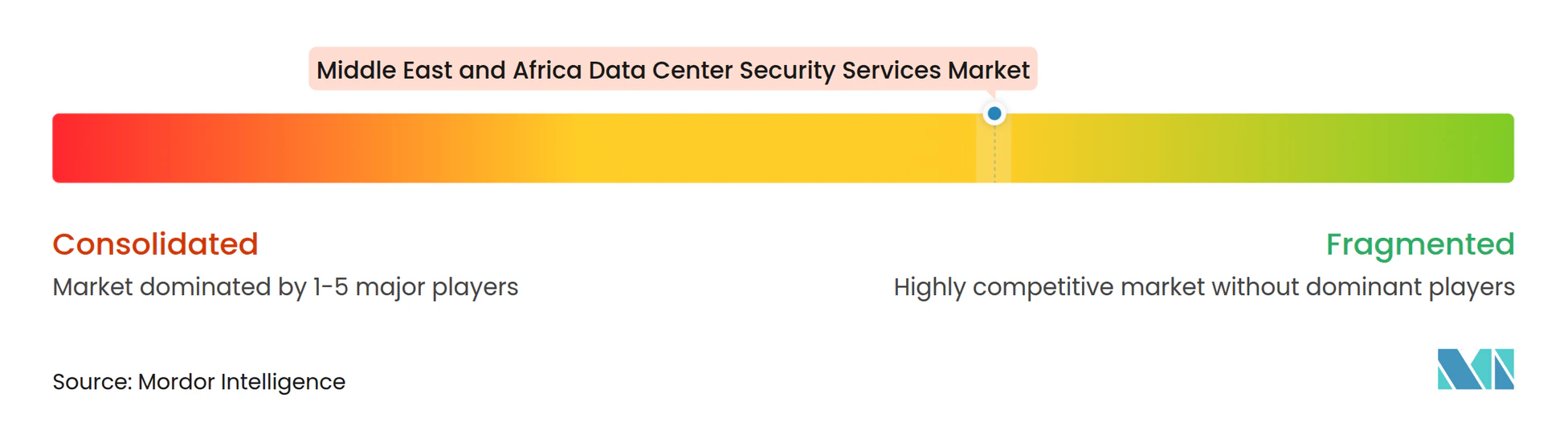
The Middle East and Africa data center security services market has a moderately fragmented structure, with global integrated security firms, regional specialists, and cyber-physical managed service providers competing for contracts. Johnson Controls, Honeywell, Bosch, and Securitas use regional offices, compliance experience, and multi-country delivery to pursue hyperscale and colocation accounts. BIOS Middle East Group, 3S System Security Solutions, Help AG, and Sirar by stc compete through local regulatory knowledge, Arabic-language security operations center services, and locally cleared personnel. These local capabilities matter where data and security functions must remain in-country. The competitive position of a provider depends on its ability to combine guarding, monitoring, technology integration, and compliance documentation. Larger providers can support multi-site clients, while regional specialists can respond quickly to national requirements. This mix supports the assessment that no single supplier dominates the full regional service base.
Security technology vendors are also extending into managed service partnerships. Fortinet announced a partnership with Springs Tech in February 2026 to expand managed cybersecurity services in Saudi Arabia. Palo Alto Networks and du announced an AI-driven security partnership at GITEX Global 2025 for UAE enterprise and data center infrastructure customers. These arrangements increase the pressure on traditional guarding providers to add monitoring and cyber response capabilities. Securitas integrated Rohde and Schwarz AI-based millimeter-wave screening into its data center offering in September 2025. The move gives Securitas a differentiated entry-screening capability for higher-security facilities. Competition in the Middle East and Africa data center security services market is therefore moving beyond conventional guarding toward integrated service packages.
Potential demand remains strongest for security programs tailored to AI hyperscale facilities with sovereign-classification requirements. Providers that can secure high-density liquid-cooled GPU clusters and connect IT and operational technology monitoring have a clear service opportunity. Africa-specific packages that combine guarding, IoT monitoring, biometric control, and compliance documentation can address operators with limited internal resources. Cisco's participation in the Stargate UAE consortium shows that major AI infrastructure projects are including security technology commitments at an early stage. Service providers must translate these technology commitments into practical local operating procedures. Strong partnerships can help a provider offer broader capabilities without building every component internally. The competitive balance will continue to depend on local delivery depth, credentialed personnel, and the ability to meet audit requirements.
Middle East and Africa Data Center Security Services Industry Leaders
-
Johnson Controls International
-
Honeywell International Inc.
-
Bosch Sicherheitssysteme GmbH
-
Axis Communications AB
-
Siemens AG
- *Disclaimer: Major Players sorted in no particular order
Middle East and Africa Data Center Security Services Market Companies Covered in this Report
- Johnson Controls International
- Honeywell International Inc.
- Bosch Sicherheitssysteme GmbH
- Axis Communications AB
- Siemens AG
- Cisco Systems, Inc.
- International Business Machines Corporation
- Palo Alto Networks
- Fortinet, Inc.
- Check Point Software Technologies Ltd.
- Securitas Technology
- LenelS2
- Schneider Electric SE
- ABB Ltd
- ASSA ABLOY AB
- Genetec Inc.
- Suprema Inc.
- Brivo Systems LLC
- Convergint Technologies LLC
- 3S System Security Solutions Co.
- BIOS Middle East Group
- Pacific Control Systems
- Fiber Optics Supplies and Services LLC
- Help AG
- Sirar by stc
Recent Industry Developments in Middle East and Africa Data Center Security Services Market
- October 2026: Johnson Controls participated at DCD Connect MENA 2026 in Dubai (October 26-27), showcasing AI-powered video analytics, multi-layered physical security architecture, and fire suppression systems engineered for hyperscale and AI data center environments across the Middle East and Africa region.
- September 2026: Johnson Controls showcased AI-enabled security at GSX 2026, including managed SOC services for centralized monitoring and incident response, and Proactive Video Solutions combining intelligent analytics with expert human monitoring.
- June 2026: Accenture entered agreements to acquire a majority stake in Dragos and 100% of runZero and NetRise at a combined enterprise value of USD 4.175 billion to deliver end-to-end OT cybersecurity for critical infrastructure including data centers, building on its USD 10 billion cybersecurity business, with transactions expected to close in late 2026.
- March 2026: Johnson Controls reinforced its data center and mission-critical security leadership at ISC West 2026, launching C•CURE IQ 3.2 with built-in video management and standardized incident workflows, alongside hardware updates spanning PowerSeries Neo 5, IQ Panel 5, Kantech EntraPass 9.10, and exacqVision 26.0.
Middle East and Africa Data Center Security Services Market Report Scope
The Middle East and Africa data center security services market covers revenue from security services deployed in data centers across the UAE, Saudi Arabia, Turkey, South Africa, Nigeria, and other regional markets. Growth is driven by government-led digital infrastructure programs, data center construction in the Gulf region, critical infrastructure protection initiatives, and the rising adoption of remote monitoring and integrated security services.
The Middle East and Africa Data Center Security Services Market Report is Segmented by Service Type (Manned Guarding and Physical Security, Remote Monitoring and Surveillance, Security Operations Center Services, Security Risk Assessment and Consulting, Access Control and Visitor Management Services, and Security System Maintenance and Support), Service Delivery Model (On-Site Security Services, Remote and Centralized Security Services, and Hybrid Security Services), Contract Type (Dedicated Site-Level Contracts, Multi-Site and Regional Contracts, Integrated Security Service Contracts, and Managed Service Agreements), Customer Type (Colocation Providers, Cloud Service Providers (CSPs), and Enterprise / Edge Data Center Operators), Data Center Size (Small, Medium, Large, and Hyperscale), and Country (United Arab Emirates, Saudi Arabia, South Africa, Nigeria, and Rest of Middle East and Africa). The Market Forecasts are Provided in Terms of Value (USD).
Segmentation Overview
| Manned Guarding and Physical Security |
| Remote Monitoring and Surveillance |
| Security Operations Center Services |
| Security Risk Assessment and Consulting |
| Access Control and Visitor Management Services |
| Security System Maintenance and Support |
| On-Site Security Services |
| Remote and Centralized Security Services |
| Hybrid Security Services |
| Dedicated Site-Level Contracts |
| Multi-Site and Regional Contracts |
| Integrated Security Service Contracts |
| Managed Service Agreements |
| Colocation Providers |
| Cloud Service Providers (CSPs) |
| Enterprise / Edge Data Center Operators |
| Small |
| Medium |
| Large |
| Hyperscale |
| United Arab Emirates |
| Saudi Arabia |
| South Africa |
| Nigeria |
| Rest of Middle East and Africa |
| By Service Type | Manned Guarding and Physical Security |
| Remote Monitoring and Surveillance | |
| Security Operations Center Services | |
| Security Risk Assessment and Consulting | |
| Access Control and Visitor Management Services | |
| Security System Maintenance and Support | |
| By Service Delivery Model | On-Site Security Services |
| Remote and Centralized Security Services | |
| Hybrid Security Services | |
| By Contract Type | Dedicated Site-Level Contracts |
| Multi-Site and Regional Contracts | |
| Integrated Security Service Contracts | |
| Managed Service Agreements | |
| By Customer Type | Colocation Providers |
| Cloud Service Providers (CSPs) | |
| Enterprise / Edge Data Center Operators | |
| By Data Center Size | Small |
| Medium | |
| Large | |
| Hyperscale | |
| By Country | United Arab Emirates |
| Saudi Arabia | |
| South Africa | |
| Nigeria | |
| Rest of Middle East and Africa |
Key Questions Answered in the Report
What is the size of the Middle East and Africa data center security services market?
The Middle East and Africa data center security services market size is projected to expand from USD 0.47 billion in 2026 and USD 0.54 billion in 2027 to USD 1.07 billion by 2032, registering a CAGR of 14.66% between 2027 and 2032.
Which service type has the largest revenue share?
Manned Guarding and Physical Security leads with a 29.71% share in 2026 because critical facilities continue to require on-site access verification, documented patrol coverage, and immediate response for sensitive areas.
Which customer group is expanding most quickly?
Cloud Service Providers are projected to expand at an 18.59% CAGR through 2032, supported by sovereign cloud launches, local compliance requirements, and the need for locally compliant monitoring capabilities.
Why are managed security agreements gaining adoption?
Managed Service Agreements are projected to expand at a 17.36% CAGR because buyers seek defined response times, audit readiness, certified local personnel, and compliance support in a single arrangement.
Which country is projected to expand the fastest?
Saudi Arabia is projected to expand at an 18.93% CAGR through 2032, supported by data center capacity plans, NCA security controls, and a growing requirement for permanently staffed local delivery.
How are AI data centers changing security requirements?
High-density AI facilities require protection for GPU systems, liquid-cooling equipment, power infrastructure, and restricted operating areas, increasing demand for integrated physical and cyber monitoring across the Middle East and Africa data center security services market.