
Middle East and Africa Data Center Renewable Energy Market Size and Share
Market Overview
| Study Period | 2021 - 2032 |
|---|---|
| Forecast Data Period | 2027 - 2032 |
| Base Year Market Size (2026) | USD 0.51 Billion |
| Market Size (2027) | USD 0.67 Billion |
| Market Size (2032) | USD 1.91 Billion |
| Growth Rate (2027 - 2032) | 23.31 % |
| Market Concentration | Medium |
Major Players *Disclaimer: Major Players sorted in no particular order Image © Mordor Intelligence. Reuse requires attribution under CC BY 4.0. | |
Middle East and Africa Data Center Renewable Energy Market Analysis by Mordor Intelligence
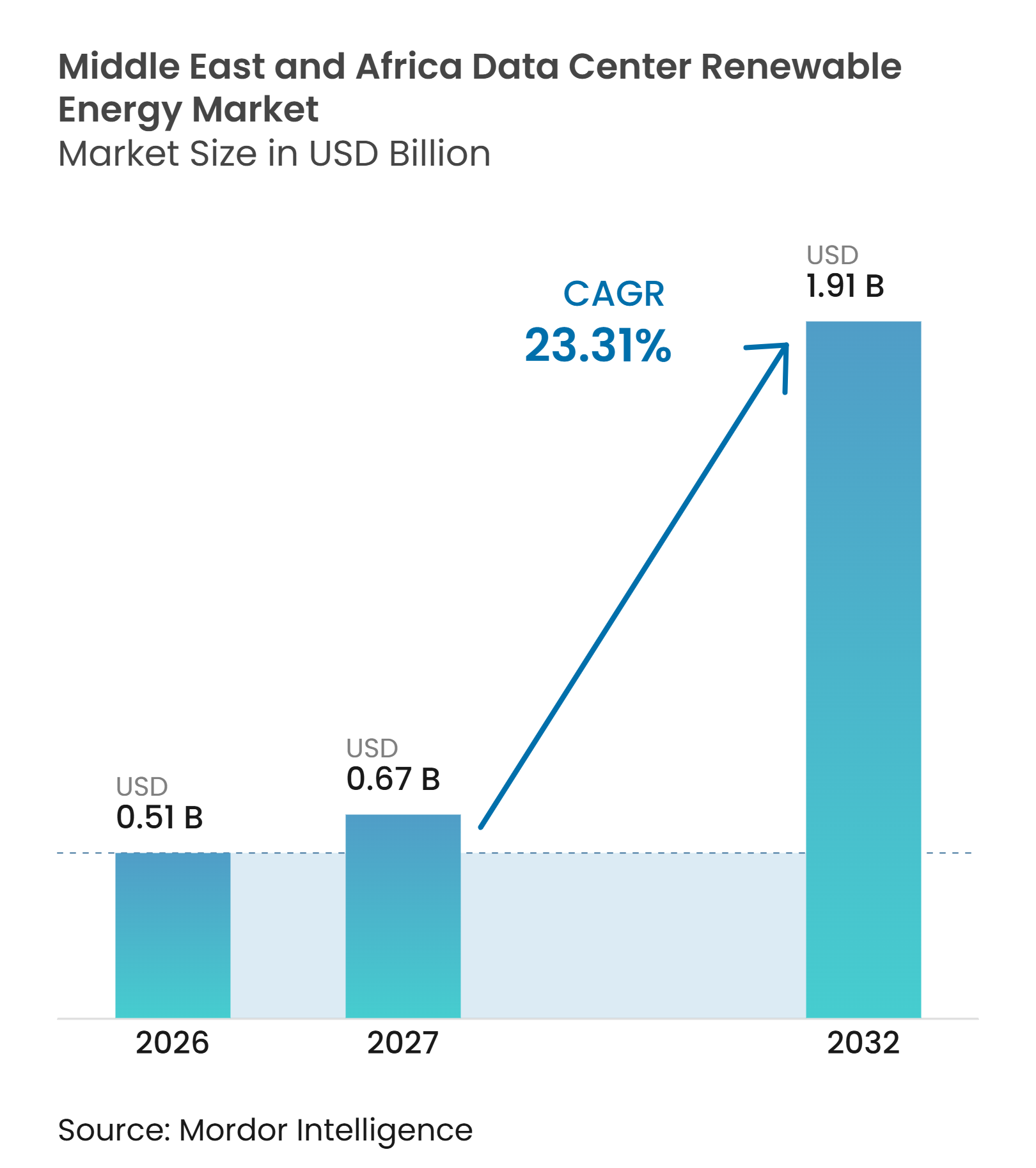
The Middle East and Africa data center renewable energy market size was valued at USD 0.51 billion in 2026 and is estimated to expand from USD 0.67 billion in 2027 to reach USD 1.91 billion by 2032, at a CAGR of 23.31% during the forecast period (2027-2032). In volume terms, the market is estimated at 6.79 million MWh in 2026 and 8.93 million MWh in 2027, and is projected to reach 22.31 million MWh by 2032 at a 20.11% CAGR over 2027-2032. Renewable procurement has become a core operating cost decision as solar power purchase agreement rates in the Gulf start below USD 20 per MWh, while grid tariffs for high-consumption facilities range from USD 63-103 per MWh. Artificial intelligence workloads require far more electricity per rack than conventional computing, which has brought power availability into data center planning earlier. Operators are therefore combining on-site generation, contracted renewable supply, and storage to strengthen energy security. National cloud and digital infrastructure plans are also aligning large facilities with renewable capacity programs. The Middle East and Africa data center renewable energy market is shaped by the ability of hyperscale buyers to provide the long-term contracts that allow large projects to secure financing.
Key Report Takeaways
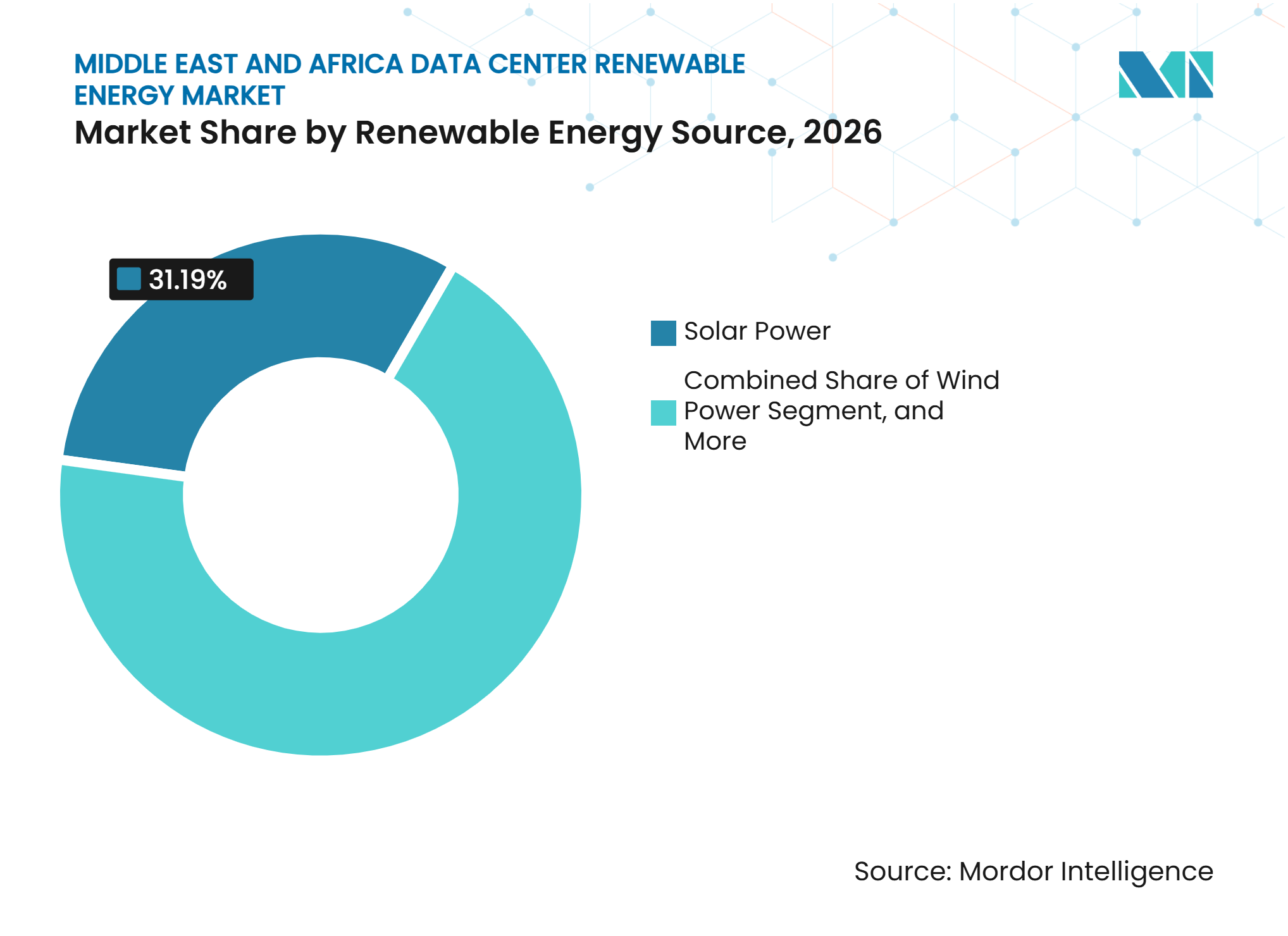
- By renewable energy source, solar power held 31.19% of the Middle East and Africa data center renewable energy market share in 2026 and is projected to expand at a 24.51% CAGR through 2032.
- By procurement model, virtual and financial PPAs held a 30.89% share in 2026 and are expected to expand at a 24.29% CAGR through 2032.
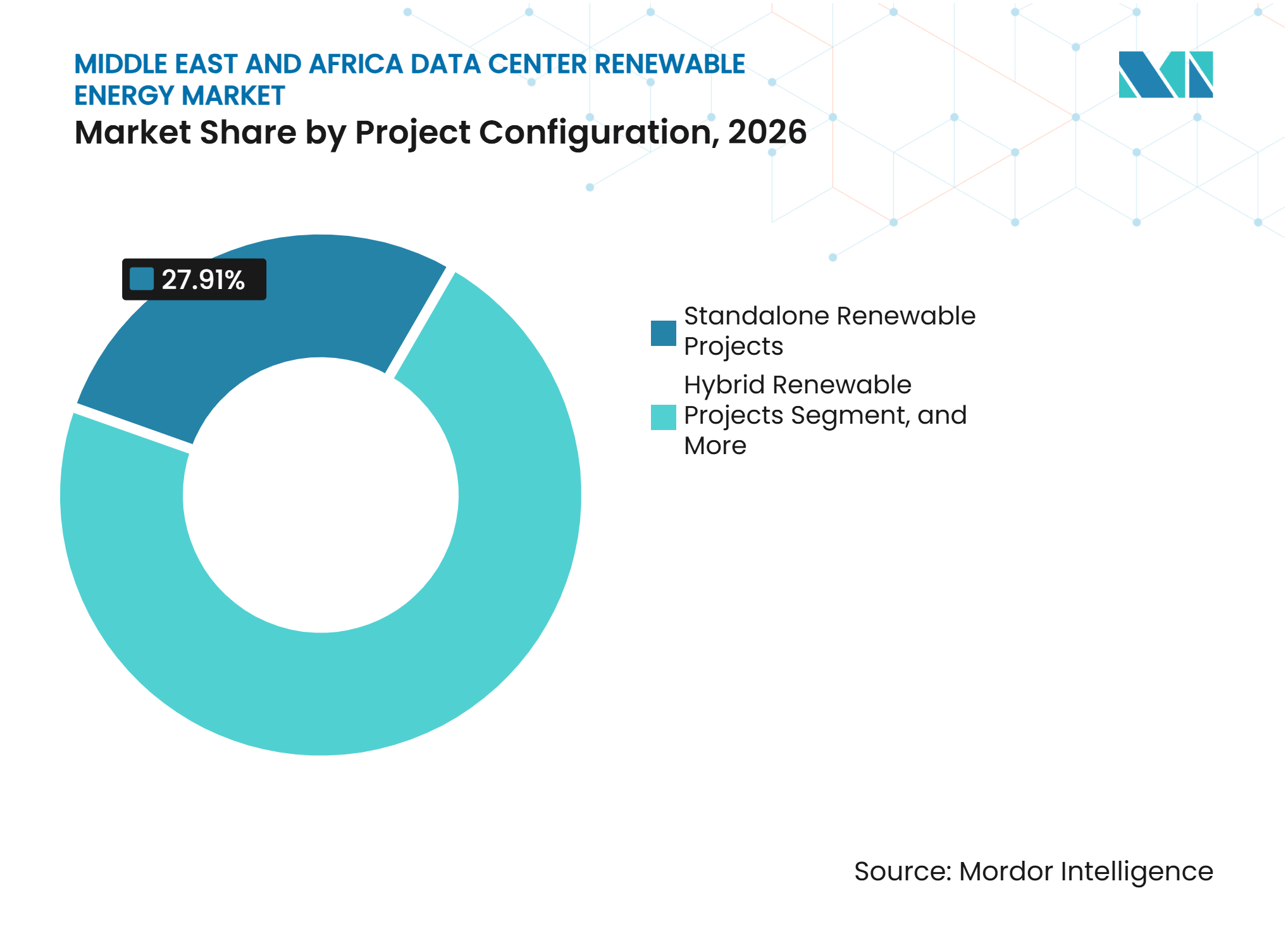
- By project configuration, standalone renewable projects accounted for 27.91% of the market in 2026, while battery-storage-enabled projects are projected to expand at a 24.26% CAGR through 2032.
- By contract duration, long-term contracts held a 32.11% share in 2026 and are expected to expand at a 23.87% CAGR through 2032.
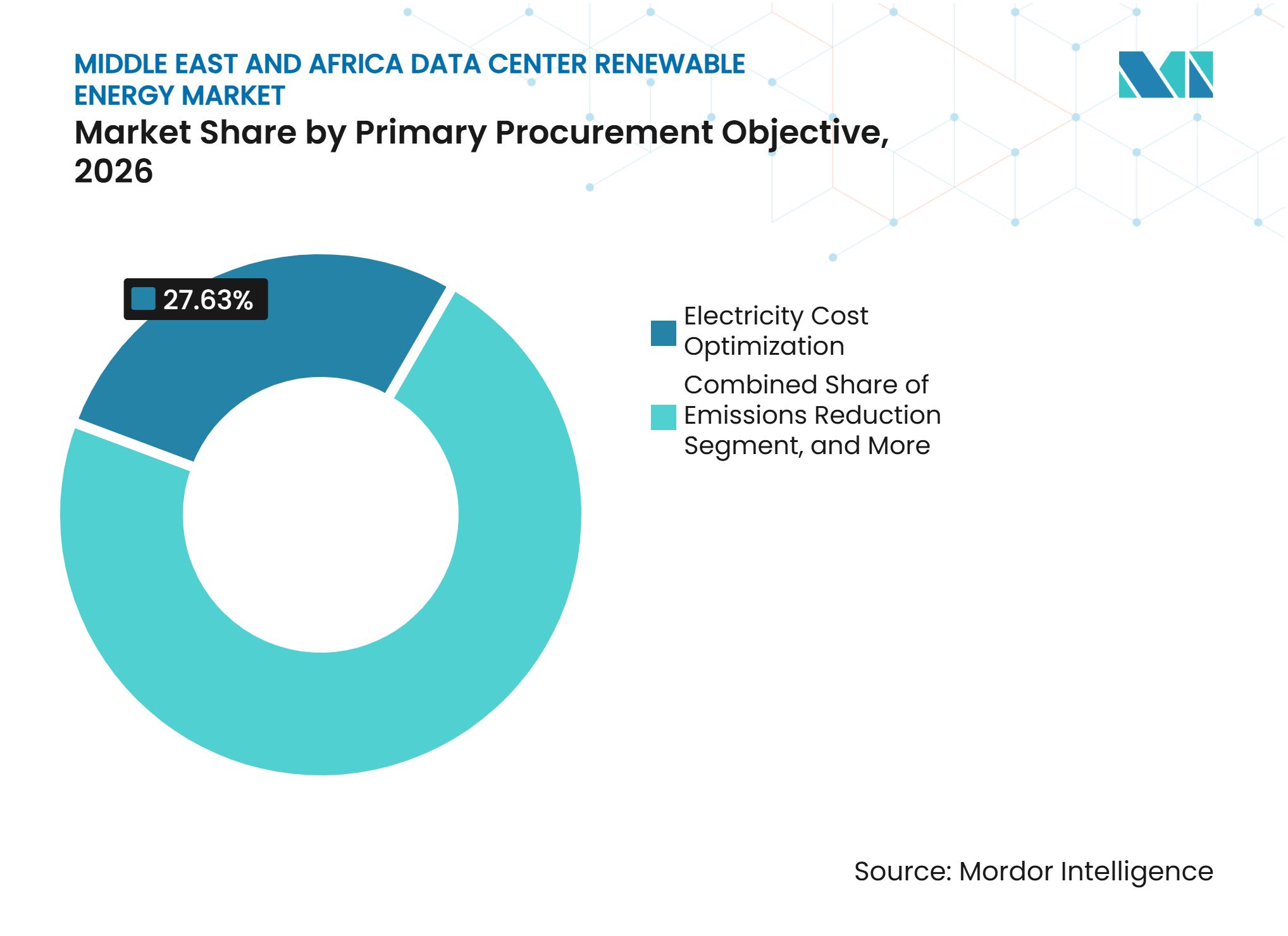
- By primary procurement objective, electricity cost optimization accounted for a 27.63% share in 2026, while renewable energy matching is projected to expand at a 24.08% CAGR through 2032.
- By data center size, hyperscale facilities held a 33.89% share in 2026 and are expected to expand at a 24.11% CAGR through 2032.
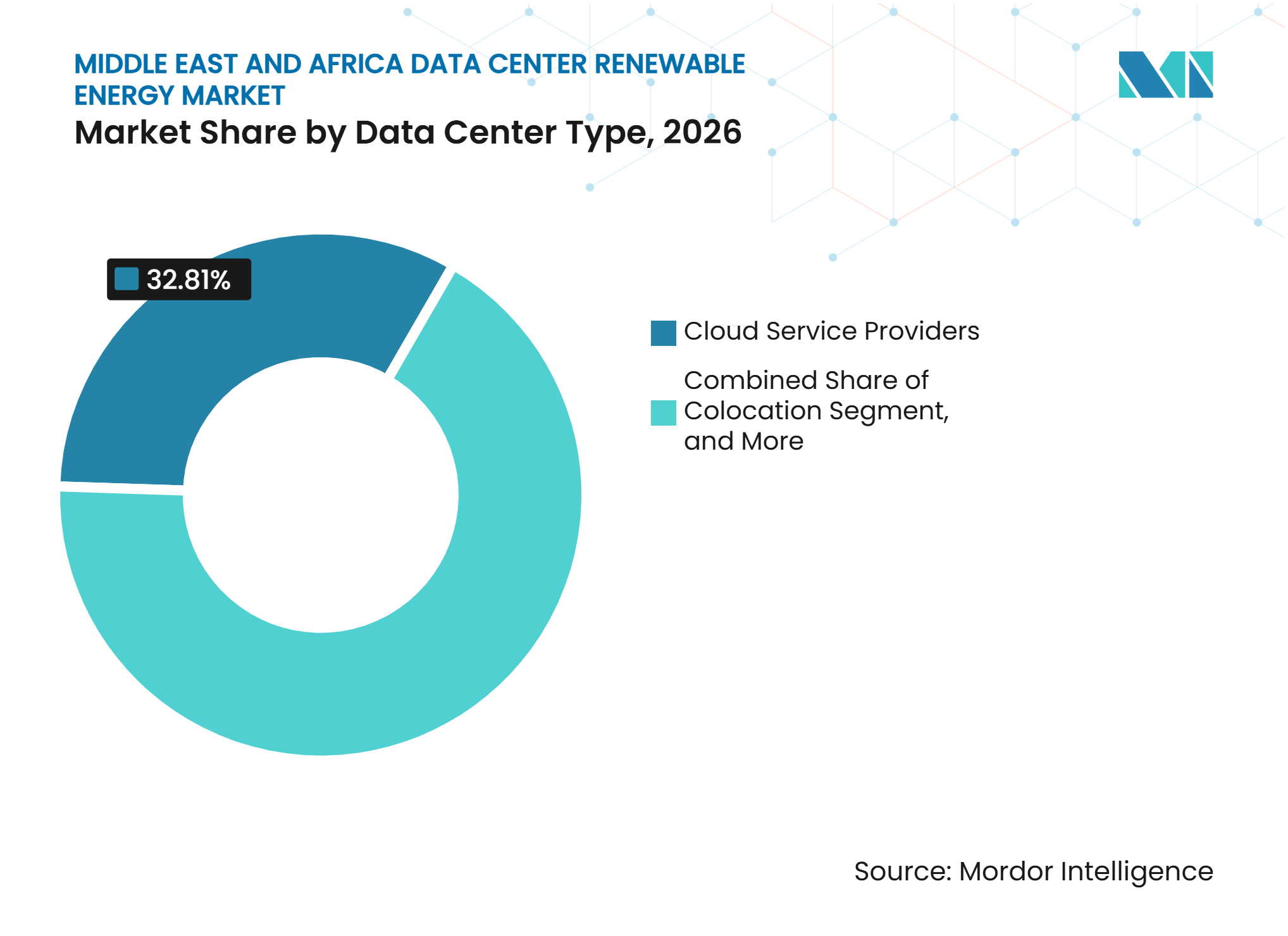
- By data center type, cloud service providers accounted for 32.81% of the market in 2026 in the Middle East and Africa data center renewable and are projected to expand at a 23.92% CAGR through 2032.
- By geography, the UAE held a 31.72% share in 2026, while Saudi Arabia is expected to expand at a 24.46% CAGR through 2032.
Note: Market numbers in this report are based on Mordor Intelligence's proprietary estimation framework, which combines nine months of actuals with Q4 projections for base year 2026.
Market Trends and Insights
Drivers Impact Analysis of Middle East and Africa Data Center Renewable Energy Market*
| Driver | (~) % Impact on CAGR Forecast | Geographic Relevance | Impact Timeline |
|---|---|---|---|
| Hyperscale and Artificial Intelligence Capacity Expansion | +5.2% | UAE, Saudi Arabia, with spillover to Qatar and Egypt | Medium term (2-4 years) |
| National Digital Transformation and Cloud Sovereignty Programs | +4.8% | UAE, Saudi Arabia, Egypt, and South Africa | Long term (≥ 4 years) |
| Falling Utility-Scale Solar and Wind Costs | +4.1% | Global, concentrated in UAE, Saudi Arabia, and South Africa | Short term (≤ 2 years) |
| Corporate Decarbonization and 24/7 Carbon-Free Energy Requirements | +3.5% | Global hyperscalers operating across the region | Medium term (2-4 years) |
| Data Center Reliability Requirements Driving Behind-the-Meter Renewables | +2.7% | UAE and South Africa | Short term (≤ 2 years) |
| Abundant Solar Resource and New Renewable Power Procurement Capacity | +2.2% | Regional, concentrated in the Gulf | Long term (≥ 4 years) |
| Source: Mordor Intelligence | |||
Hyperscale and Artificial Intelligence Capacity Expansion
Sovereign artificial intelligence programs are making renewable energy procurement an operating requirement for major facilities. Microsoft announced a 200 MW capacity expansion in the UAE with Khazna Data Centers in November 2025, as part of its USD 15.2 billion investment commitment. The companies also said they would explore sourcing renewable energy from Masdar for these facilities. DataVolt and HUMAIN began construction of a 100 MW artificial intelligence data center at Oxagon in August 2026. This project forms part of a 360 MW first phase within a planned 1.5 GW campus. Such commitments increase the value of firm, contracted renewable supply because large campuses cannot depend on short-term energy arrangements. The Middle East and Africa data center renewable energy market benefits when these buyers sign long-duration contracts that support developer financing.
National Digital Transformation and Cloud Sovereignty Programs
Government digital plans are linking national data capacity with renewable power development. Saudi Arabia's National Data Center Strategy targets up to 1.5 GW of data center capacity by 2030. The country awarded 4,500 MW of renewable capacity across five sixth-phase National Renewable Energy Program projects during 2025. Egypt is also developing an environment for renewable-backed digital infrastructure through green energy projects and new data center investment. These programs create clearer demand signals for project developers and large energy buyers. Sovereign backing can also coordinate approvals, land, grid planning, and financing across related infrastructure. This coordination supports more direct links between new data centers and renewable supply in the Middle East and Africa data center renewable energy market.
Falling Utility-Scale Solar and Wind Costs
Solar economics are strengthening the commercial case for renewable procurement across Gulf data centers. Saudi Arabia's 2025 renewable awards involved investments exceeding SAR 9 billion (USD 2.4 billion) across wind and solar projects. Long-term solar PPAs can start below USD 20 per MWh, compared with USD 63-103 per MWh grid tariffs for high-consumption facilities in the source material. This cost difference supports renewable contracts even before customers include carbon targets in their decisions. South Africa adds a separate value proposition because wind output can supplement solar generation outside daylight hours. Teraco's wind PPA with NOA demonstrates how buyers are using complementary resources to improve supply profiles. Lower generation costs can make more complex procurement structures worth the effort for operators across the Middle East and Africa data center renewable energy market.
Corporate Decarbonization and 24/7 Carbon-Free Energy Requirements
Annual renewable matching does not yield the same outcome as matching clean power to electricity use on an hourly basis. This distinction is moving buyers toward physical PPAs, hourly tracking, and battery-backed arrangements. Masdar and EWEC began construction of the Al Wathba project in October 2025. It combines 5.2 GW of solar capacity and 19 GWh of battery storage to deliver 1 GW of uninterrupted clean baseload power from 2027.[1] The project has a capital investment exceeding USD 6 billion and is intended to support demand for artificial intelligence and data centers. Its design shows that storage is becoming part of the renewable product offered to high-availability facilities. These requirements support premium demand for firm renewable supply within the Middle East and Africa data center renewable energy market.
Restraints Impact Analysis of Middle East and Africa Data Center Renewable Energy Market*
| Restraint | (~) % Impact on CAGR Forecast | Geographic Relevance | Impact Timeline |
|---|---|---|---|
| Grid Connection and Transmission Bottlenecks | -3.8% | UAE, Saudi Arabia, and South Africa | Short term (≤ 2 years) |
| Renewable Intermittency Versus Mission-Critical Uptime | -2.9% | Regional, strongest in UAE and Saudi Arabia | Medium term (2-4 years) |
| Extreme Heat and Water Constraints Increasing Cooling Costs | -2.1% | UAE, Saudi Arabia, and Qatar | Long term (≥ 4 years) |
| Limited Regional Contracting, Certification, and Specialist Talent Maturity | -1.4% | Africa outside South Africa and nascent regional markets | Medium term (2-4 years) |
| Source: Mordor Intelligence | |||
Grid Connection and Transmission Bottlenecks
Grid availability limits the conversion of announced capacity into operating renewable-powered facilities. The International Energy Agency reports that nearly 20% of planned global data center projects could face delays due to grid-related issues. Electricity demand across the Middle East and North Africa is also rising because of cooling and desalination needs. New campuses require transmission capacity, connection approvals, and predictable operating rules before renewable contracts can be delivered. The GCC Interconnection Authority is expanding regional infrastructure, but physical grid works will take time to complete. Different emirate-level rules may further complicate procurement for operators with sites across multiple emirates. These conditions can extend development schedules in the Middle East and Africa data center renewable energy market.
Renewable Intermittency Versus Mission-Critical Uptime
Solar output declines during the late afternoon, when heat can increase cooling demand at data centers. This timing gap makes unsupported renewable supply unsuitable for facilities designed for continuous operation. Storage, grid services, and complementary generation sources are needed to meet strict availability requirements. Saudi Arabia is pursuing battery storage expansion, while Al Wathba shows how solar and storage can be designed as a single continuous supply product. The transition requires significant capital and long-term operating expertise. It also favors buyers who can commit to larger, longer-term contracts. The pace of storage deployment will influence the ability of the Middle East and Africa data center renewable energy market to offer 24/7 renewable electricity at scale.
*Our forecasts treat driver/restraint impacts as directional, not additive. The impact forecasts reflect baseline growth, mix effects, and variable interactions.
Middle East and Africa Data Center Renewable Energy Market Segment Analysis
By Renewable Energy Source:
Solar Anchors Demand While Diversification Gains MomentumSolar power held 31.19% of the Middle East and Africa data center renewable energy market share in 2026 and is projected to expand at a 24.51% CAGR through 2032. Strong solar irradiation and low utility-scale PPA rates make solar the region's principal renewable option. Moro Hub operates a solar-powered data center at the Mohammed bin Rashid Al Maktoum Solar Park. Dubai's government inaugurated the second phase of the facility in January 2025. The development illustrates a local approach that combines data infrastructure with an established solar asset. Solar is also easier to deploy at large scale where land, transmission access, and procurement frameworks are available. Its limitation is that daily generation does not naturally align with every hour of a data center load.
Wind expands the supply mix, particularly when it can provide power during nighttime and early morning. Teraco signed a PPA with NOA in February 2025 for the supply of wind power to its South African facilities. The agreement complements Teraco's 120 MW solar plant in the Free State. Hydropower and geothermal remain relevant to selected East African settings with suitable resources. Biomass, biogas, and other sources offer additional options, although they do not yet lead regional procurement. Multi-source procurement can reduce exposure to a single generation profile. ISO 50001 energy management systems can help operators measure and manage this diversified energy portfolio. The Middle East and Africa data center renewable energy market is likely to use solar as its foundation while adding other sources where they improve supply continuity.



By Procurement Model:
Financial PPAs Address Regulatory LimitsVirtual and financial PPAs accounted for 30.89% of the market in 2026 and are projected to grow at a 24.29% CAGR through 2032. They allow an operator to support renewable generation without a direct physical connection to the project. This approach is important where direct corporate PPAs or wheeling arrangements remain restricted. In Dubai, on-site solar under the Shams framework is limited by plot-level conditions, which narrows the role of rooftop supply for larger campuses. Financial contracts can provide a way to support generation and receive associated renewable attributes. They also allow companies to apply a common procurement framework across multiple sites. Their effectiveness still depends on credible contractual structures and accepted certificate rules.
Physical PPAs remain an important route in markets with developed wheeling arrangements. South Africa provides a clear example through the National Energy Regulator of South Africa licensing structures. Teraco uses off-site arrangements for renewable supply, including its Free State solar project and the NOA wind agreement. Utility green programs and renewable energy certificates offer lower-complexity alternatives for some buyers. Larger customers are becoming more attentive to the difference between bundled supply and unbundled certificates. This raises the importance of transparent claims and reliable documentation. Procurement choices in the Middle East and Africa data center renewable energy market will depend as much on local market rules as on power prices.
By Project Configuration:
Battery Storage Defines the Higher-Value OptionStandalone renewable projects accounted for 27.91% of the Middle East and Africa data center renewable energy market size in 2026. This configuration suits buyers that can use established solar or wind generation without advanced integration requirements. It remains easier to structure than projects that combine several assets and operating technologies. Its commercial logic is strongest where a grid can supply balancing services. Standalone systems can also serve as the first stage of a broader renewable strategy. They help operators lock in long-term energy prices while learning local procurement processes. The configuration therefore remains relevant even as the market moves toward more complex reliability solutions.
Renewable projects with battery storage are projected to expand at a 24.26% CAGR through 2032. Storage shifts solar and wind from variable generation into a more dispatchable resource. Al Wathba combines 5.2 GW of solar with 19 GWh of storage to deliver 1 GW of continuous clean power. This design is significant for data center operators because it addresses the gap between daytime solar output and continuous load. Hybrid projects are also relevant in South Africa and Egypt, where complementary resources can be contracted. Other firming solutions, including green hydrogen backup, remain early-stage options. The higher cost and technical requirements mean battery-backed projects are likely to serve facilities with demanding uptime needs first.

By Contract Duration:
Long-Term Agreements Support Project FinanceLong-term contracts held a 32.11% share in 2026 and are expected to expand at a 23.87% CAGR through 2032. These contracts typically run for 15-25 years and provide predictable revenue for renewable developers. They also provide operators with a known electricity cost base over a substantial part of an asset's life. The Middle East and Africa data center renewable energy market share of long-term agreements reflects the financing needs of large renewable projects. Low PPA prices are valuable only if they can be secured for a sufficient term. Long durations also give lenders more certainty when assessing project cash flows. This structure is particularly suited to hyperscale campuses with established demand.
Egypt's Obelisk solar-and-battery project shows how long-term contracts support infrastructure financing. The African Development Bank reported USD 479.1 million of financing for the 1.1 GW project during 2025. The project uses a 25-year USD-denominated PPA with the Egyptian Electricity Transmission Company. Medium-term contracts can offer operators flexibility around future storage costs and evolving load profiles. Short-term contracts can bridge supply needs while larger projects are developed. However, shorter contracts generally provide less support for new project finance. Contract duration will remain central to how renewable supply reaches large data center customers.
By Primary Procurement Objective:
Cost Control Leads While Energy Matching Gains MomentumElectricity cost optimization accounted for 27.63% of the total in 2026. It leads because Gulf solar contracts can begin below USD 20 per MWh, compared with USD 63-103 per MWh grid tariffs cited for high-consumption facilities. This price gap gives renewable procurement a direct financial rationale. It can also protect operators from changes in grid tariff structures over extended periods. Cost-oriented buyers may prefer simple, long-term solar contracts where their facilities can rely on the grid for balancing. The approach does not require a complete shift to hour-by-hour clean electricity. It is likely to remain the entry point for many customers in the Middle East and Africa data center renewable energy market.
Renewable energy matching is projected to expand at a 24.08% CAGR through 2032. This objective aligns with corporate commitments to more closely align energy consumption with clean electricity. It creates demand for storage, hybrid generation, and more detailed contract tracking. Major cloud providers also use renewable credentials in discussions with enterprise customers. AWS says that moving workloads to its cloud can reduce carbon emissions by up to 90% compared with on-premises infrastructure. Emissions reduction remains a related objective, while supply security becomes increasingly important for facilities that need reliable long-term power. These objectives can overlap, but they favor different technologies and contract structures.
By Data Center Size:
Hyperscale Facilities Shape Procurement ConditionsHyperscale facilities held a 33.89% share in 2026 and are projected to expand at a 24.11% CAGR through 2032. Their size makes them the leading demand anchor for major renewable developments. DataVolt's planned 1.5 GW Oxagon campus and its 360 MW initial phase illustrate this scale. Large commitments can provide the credit support needed to bring renewable projects to financial close. They can also justify dedicated grid connections, storage, and complex supply arrangements. This places hyperscale operators at the center of renewable procurement decisions. The Middle East and Africa data center renewable energy market is strongly influenced by their capacity plans.
Large data centers from 10 MW to 100 MW form another substantial customer group. This group includes colocation providers and telecom-linked operators that use renewable supply as part of their customer offering. Their projects are smaller than hyperscale campuses, but they can aggregate demand across several facilities. Africa Data Centers and Distributed Power Africa have used a 20-year PPA for a 12 MW solar facility. Medium and small facilities are also relevant in distributed markets such as South Africa and Egypt. They may use on-site solar, wheeling, or local green power programs. These buyers can broaden renewable demand beyond a small number of very large contracts. Their adoption will depend on accessible contract structures and available local grid capacity.
By Data Center Type:
Cloud Service Providers Lead Renewable DemandCloud service providers held a 32.81% share in 2026 and are projected to expand at a 23.92% CAGR through 2032. They operate at a scale that makes renewable sourcing a commercial and customer-facing issue. AWS, Microsoft, and Google are building or planning cloud capacity across Saudi Arabia and the UAE. Their global renewable commitments create a consistent procurement benchmark for regional projects. Cloud providers also serve enterprise customers with their own data residency and emissions requirements. This makes renewable sourcing part of their broader infrastructure proposition. The Middle East and Africa data center renewable energy market benefits from the sustained demand.
Colocation operators are the second-largest user group and can use clean power to differentiate themselves as tenants. Teraco, Africa Data Centres, Equinix, Digital Realty, and NTT DATA have renewable programs linked to capacity expansion. Enterprise and edge facilities exhibit a different demand pattern because they are smaller and more distributed. National data residency policies can support local processing rather than concentrating all workloads in one market. This can make on-site solar and local procurement arrangements more relevant. The Middle East and Africa data center renewable energy industry includes both large cloud campuses and decentralized facilitie, each with distinctt energy needs. Providers that can document energy provenance and operating performance may have an advantage when customers report Scope 2 emissions.
Geography Analysis
United Arab Emirates
The UAE held 31.72% of the Middle East and Africa data center renewable energy market share in 2026. Moro Hub's solar-powered data center at the Mohammed bin Rashid Al Maktoum Solar Park provides a visible example of renewable integration with digital infrastructure. The Dubai Government Media Office reported the inauguration of its second phase in January 2025. Microsoft and G42 also announced a 200 MW capacity expansion through Khazna Data Centers in November 2025. The companies said they would explore renewable energy sourcing with Masdar. The UAE's emerging strategy combines new data capacity, utility-scale solar, battery storage, and transmission upgrades. Regulatory influence remains fragmented because procurement rules vary across emirates. Greater consistency in corporate PPA structures would make larger multi-site contracts easier to execute.
Saudi Arabia
Saudi Arabia is projected to expand at a 24.46% CAGR through 2032. Its pipeline is supported by national investment in both renewable electricity and sovereign artificial intelligence infrastructure. The Ministry of Energy awarded 20.2 GW of renewable capacity during 2025, including the 4,500 MW sixth-phase awards. The National Data Center Strategy targets up to 1.5 GW of capacity by 2030. DataVolt and HUMAIN began construction at Oxagon in August 2026, with the first 100 MW scheduled to be available in 2028. Battery storage is a strategic requirement because large data centers need continuous supply rather than daytime generation alone. The scale of planned projects gives Saudi Arabia a path to connect energy and computing infrastructure more directly. The remaining challenge is to commission renewables, storage, and grid capacity in time with new data center loads.
Qatar, South Africa, Egypt, and Other Markets
Qatar, South Africa, Egypt, and other markets are using different routes to build renewable-backed data center supply. QatarEnergy agreed with Samsung C&T on the 2,000 MW Dukhan solar project, which is intended to increase the country's solar capacity.[2] South Africa has a more established wheeling environment, and Teraco is combining a 120 MW solar facility with wind procurement. Egypt is advancing through the 1.1 GW Obelisk solar and battery project, which received USD 479.1 million in financing from development finance institutions. Masdar and Octopus Energy signed an agreement in January 2026 to scale clean energy systems for commercial and industrial users in Africa, initially in South Africa. These models range from utility-scale procurement to distributed solar and batteries. They demonstrate that regulatory frameworks and grid reliability are as important as resource availability. A regional mix of centralized and distributed approaches will be needed as data capacity expands.
Competitive Landscape
Market Concentration
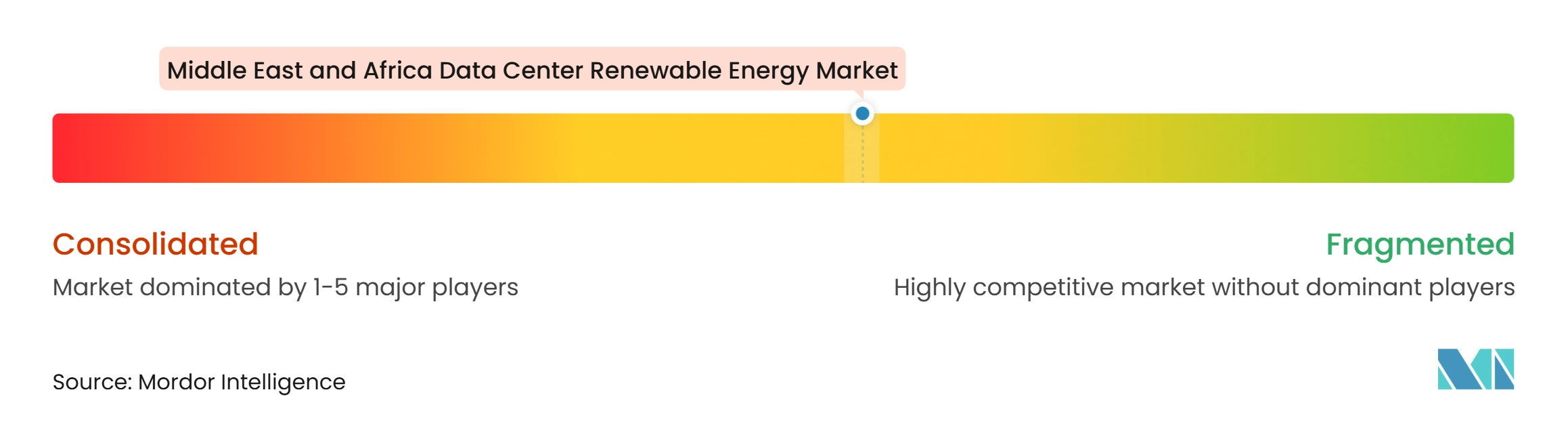
The competitive field is moderately fragmented because power developers, global cloud providers, colocation operators, and technology suppliers perform different roles. AWS, Microsoft, and Google influence demand through their renewable commitments and regional capacity investments. Masdar and ACWA Power supply large-scale renewable development capability. Masdar reported a 65 GW renewable portfolio in 2026. ACWA Power announced USD 10 billion in clean energy and financing agreements during 2025.[3] DataVolt and Africa Data Centers compete by connecting energy solutions more directly with data center deployment. These roles overlap as developers increasingly offer storage and firm power services alongside generation.
Several company actions show the market's direction. Masdar and EWEC began the Al Wathba solar and battery project to supply 1 GW of continuous clean power from 2027. DataVolt and HUMAIN began the Oxagon artificial intelligence data center project in August 2026. Teraco added wind procurement alongside its Free State solar facility, improving its ability to match generation across different periods. These moves point toward integrated renewable supply rather than isolated energy purchases. Companies that can provide generation, storage, contracting, and provenance documentation may be better placed to serve high-availability sites. ISO 50001, ISO 14001, and ISO 45001 certifications provide a recognized framework for operators that need auditable energy and environmental practices.
Financial PPA structuring is an important competitive opening for mid-sized operators in markets with limited physical procurement options. Storage integration is another area lacking a clear regional leader that serves multiple third-party tenants. Many large developers have capital and project experience, but data center customers need products that reflect continuous loads and strict reliability standards. This requires stronger coordination among utilities, developers, operators, and regulators. Procurement sophistication may become a differentiator as buyers look beyond annual certificate matching. The Middle East and Africa data center renewable energy market does not disclose combined market shares for leading companies. A clear share-based ranking cannot therefore be established from the available information. Competition is consequently best described through the scale of projects, contracted capacity, and service integration rather than a verified vendor share table.
Middle East and Africa Data Center Renewable Energy Industry Leaders
-
Amazon Web Services, Inc.
-
Microsoft Corporation
-
Google LLC
-
Equinix, Inc.
-
Digital Realty Trust, Inc.
- *Disclaimer: Major Players sorted in no particular order
Middle East and Africa Data Center Renewable Energy Market Companies Covered in this Report
- Amazon Web Services, Inc.
- Microsoft Corporation
- Google LLC
- Equinix, Inc.
- Digital Realty Trust, Inc.
- Africa Data Centres Proprietary Limited
- G42 PJSC
- Khazna Data Centers Limited
- Moro Hub Integrated Solutions LLC
- DataVolt
- Gulf Data Hub FZ-LLC
- Ooredoo Q.P.S.C.
- e& UAE
- Orange S.A.
- NTT DATA Corporation
- Teraco Data Environments (Pty) Ltd
- MainOne Cable Company Limited
- Schneider Electric SE
- Eaton Corporation plc
- Abu Dhabi Future Energy Company PJSC - Masdar
- ACWA Power Company
Recent Industry Developments in Middle East and Africa Data Center Renewable Energy Market
- August 2026: HUMAIN, a Saudi Public Investment Fund company, and DataVolt commenced construction of a 100 MW AI data center at Oxagon, NEOM, forming part of the 360 MW first phase of DataVolt's planned 1.5 GW campus. The facility is designed to integrate renewable energy sources and advanced cooling technologies, with the first 100 MW available in 2028.
- August 2026: DataVolt announced a 2-year electrical and HVAC diploma with the Energy and Water Academy to develop data center talent in Saudi Arabia. The company said that its first cohort of 30 trainees was expected to graduate in August 2026 for employment at DataVolt facilities in Riyadh.
- January 2026: Masdar and Octopus Energy signed two MOUs during Abu Dhabi Sustainability Week, one targeting clean energy scaling for commercial and industrial users across Africa, initially South Africa, using distributed solar, batteries, and local grids, and one to unlock UK distribution-network capacity for AI data center energy access. The Africa collaboration targets catalyzing more than USD 450 million in clean energy investment.
- January 2026: Masdar announced that its renewable energy portfolio had reached 65 GW, including 45 GW that were operational, under construction, or committed, with a further 20 GW in an advanced pipeline. The portfolio represented 2/3 of Masdar's 100 GW capacity target for 2030.
Middle East and Africa Data Center Renewable Energy Market Report Scope
The Middle East and Africa Data Center Renewable Energy Market includes renewable electricity generation, procurement, and supply solutions that meet data centers' growing energy needs. It covers solar, wind, hydropower, geothermal, biomass, and biogas electricity procured through on-site installations or third-party arrangements, including off-site physical and virtual/financial power purchase agreements (PPAs), utility green power programs, renewable energy certificates (RECs), and Guarantees of Origin (GOs).
The Middle East and Africa Data Center Renewable Energy Market Report is Segmented by Renewable Energy Source (Solar Power, Wind Power, Hydropower, Geothermal Power, Biomass and Biogas Power, and Other Renewable Sources), Procurement Model (On-Site Renewable Generation, Off-Site Physical PPAs, Virtual or Financial PPAs, Utility Green Power Programs, and Renewable Energy Certificates and Guarantees of Origin), Project Configuration (Standalone Renewable Projects, Hybrid Renewable Projects, Renewable Projects with Battery Storage, and Renewable Projects with Other Firming Solutions), Contract Duration (Short-Term Contracts, Medium-Term Contracts, and Long-Term Contracts), Primary Procurement Objective (Electricity Cost Optimization, Emissions Reduction, Renewable Energy Matching, and Long-Term Supply Security), Data Center Size (Small, Medium, Large, and Hyperscale), Data Center Type (Colocation, Cloud Service Providers, and Enterprise and Edge), and Geography (United Arab Emirates, Saudi Arabia, Qatar, South Africa, Egypt, and Rest of Middle East and Africa). The Market Forecasts are Provided in Terms of Value (USD), and Volume (MWh/GWh).
Segmentation Overview
| Solar Power |
| Wind Power |
| Hydropower |
| Geothermal Power |
| Biomass and Biogas Power |
| Other Renewable Sources |
| On-Site Renewable Generation |
| Off-Site Physical PPAs |
| Virtual or Financial PPAs |
| Utility Green Power Programs |
| Renewable Energy Certificates and Guarantees of Origin |
| Standalone Renewable Projects |
| Hybrid Renewable Projects |
| Renewable Projects with Battery Storage |
| Renewable Projects with Other Firming Solutions |
| Short-Term Contracts |
| Medium-Term Contracts |
| Long-Term Contracts |
| Electricity Cost Optimization |
| Emissions Reduction |
| Renewable Energy Matching |
| Long-Term Supply Security |
| Small |
| Medium |
| Large |
| Hyperscale |
| Colocation |
| Cloud Service Providers (CSPs) |
| Enterprise and Edge |
| United Arab Emirates |
| Saudi Arabia |
| Qatar |
| South Africa |
| Egypt |
| Rest of Middle East and Africa |
| By Renewable Energy Source | Solar Power |
| Wind Power | |
| Hydropower | |
| Geothermal Power | |
| Biomass and Biogas Power | |
| Other Renewable Sources | |
| By Procurement Model | On-Site Renewable Generation |
| Off-Site Physical PPAs | |
| Virtual or Financial PPAs | |
| Utility Green Power Programs | |
| Renewable Energy Certificates and Guarantees of Origin | |
| By Project Configuration | Standalone Renewable Projects |
| Hybrid Renewable Projects | |
| Renewable Projects with Battery Storage | |
| Renewable Projects with Other Firming Solutions | |
| By Contract Duration | Short-Term Contracts |
| Medium-Term Contracts | |
| Long-Term Contracts | |
| By Primary Procurement Objective | Electricity Cost Optimization |
| Emissions Reduction | |
| Renewable Energy Matching | |
| Long-Term Supply Security | |
| By Data Center Size | Small |
| Medium | |
| Large | |
| Hyperscale | |
| By Data Center Type | Colocation |
| Cloud Service Providers (CSPs) | |
| Enterprise and Edge | |
| By Geography | United Arab Emirates |
| Saudi Arabia | |
| Qatar | |
| South Africa | |
| Egypt | |
| Rest of Middle East and Africa |
Key Questions Answered in the Report
What is the size of the Middle East and Africa data center renewable energy market?
The market was valued at USD 0.51 billion in 2026 and is estimated at USD 0.67 billion in 2027. It is projected to reach USD 1.91 billion by 2032.
What CAGR is forecast for renewable energy procurement by data centers in the region?
The market is projected to expand at a 23.31% CAGR from 2027 to 2032.
Which renewable source leads data center procurement in the Middle East and Africa?
Solar power held 31.19% share in 2026 and is projected to expand at a 24.51% CAGR through 2032.
Why are battery-backed projects becoming important for data centers?
Storage helps align renewable supply with continuous facility loads and supports strict uptime needs. Renewable projects with battery storage are projected to expand at a 24.26% CAGR through 2032.
Which country offers the strongest near-term opportunity for renewable-powered data centers?
The UAE held 31.72% share in 2026, while Saudi Arabia is projected to expand at the fastest 24.46% CAGR through 2032.
How do long-term PPAs support new renewable projects?
Long-term contracts held 32.11% share in 2026. They improve revenue certainty for developers and support cost predictability for data center operators.