
Middle East and Africa Data Center Perimeter Security Market Size and Share
Market Overview
| Study Period | 2021 - 2032 |
|---|---|
| Forecast Data Period | 2027 - 2032 |
| Base Year Market Size (2026) | USD 118.40 Million |
| Market Size (2027) | USD 139.71 Million |
| Market Size (2032) | USD 268.80 Million |
| Growth Rate (2027 - 2032) | 14.23 % |
| Market Concentration | Medium |
Major Players *Disclaimer: Major Players sorted in no particular order Image © Mordor Intelligence. Reuse requires attribution under CC BY 4.0. | |
Middle East and Africa Data Center Perimeter Security Market Analysis by Mordor Intelligence
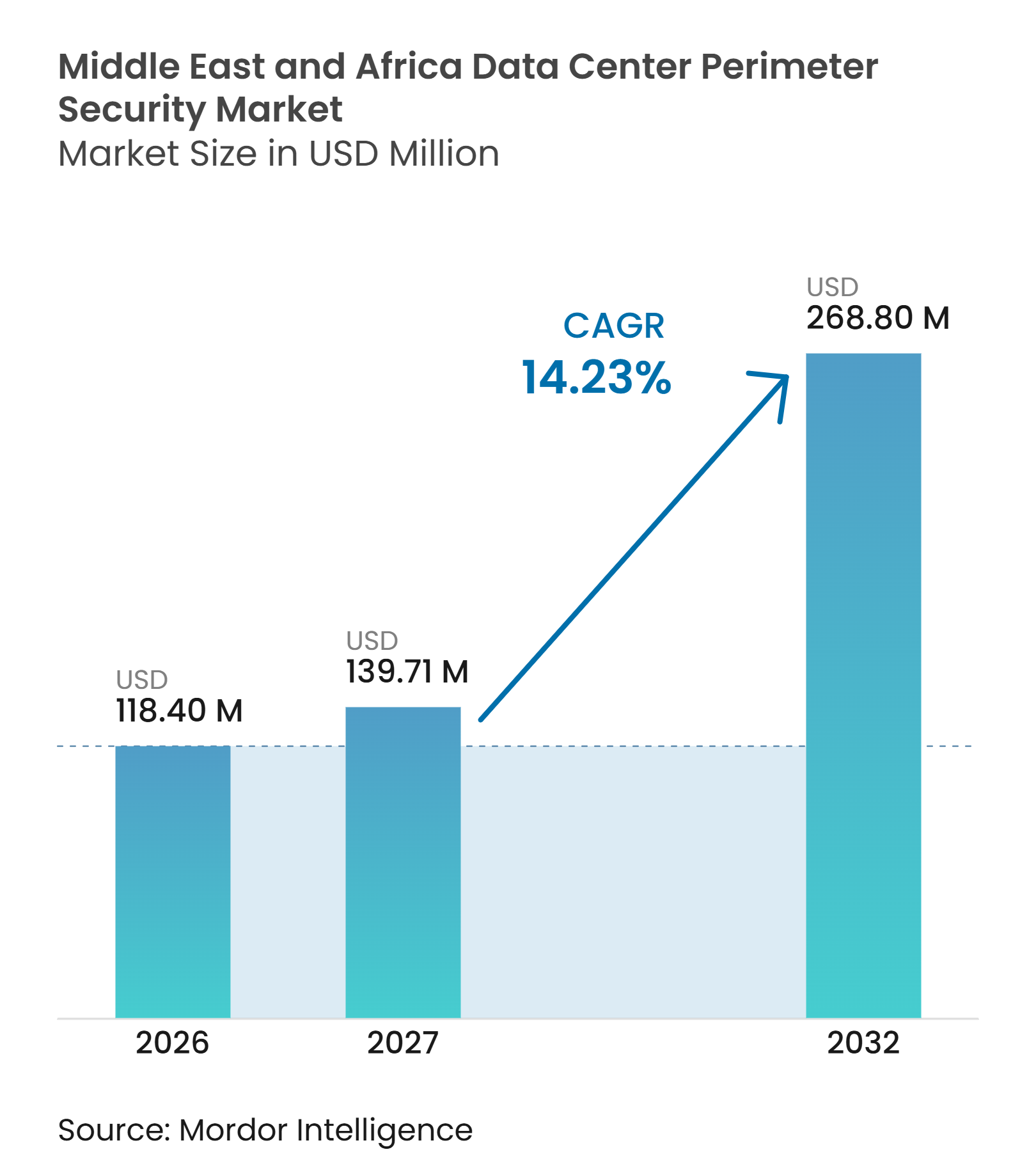
The Middle East And Africa Data Center Perimeter Security Market size is expected to increase from USD 118.40 million in 2026 to USD 139.71 million in 2027 and reach USD 268.80 million by 2032, growing at a CAGR of 14.23% over 2027-2032.
The Middle East and Africa data center perimeter security market is being shaped by a broad regional data center construction cycle, particularly around hyperscale, colocation, sovereign cloud, and AI facilities. Security requirements are moving earlier into project design because operators need barriers, access control, video coverage, and intrusion detection to work together before a site opens. AI workloads are increasing the value concentrated within each facility, which raises the need for rapid detection and controlled access. National data residency and critical infrastructure requirements are also favoring locally supported systems and in-country service capabilities. Providers that can combine hardware, analytics, integration, and ongoing support are better placed to address these purchasing requirements.
Key Report Takeaways
- By component, hardware held 52.18% of the Middle East and Africa data center perimeter security market share in 2026, while software and analytics is projected to expand at a 15.75% CAGR through 2032.
- By solution type, intrusion detection systems held 24.56% of the Middle East and Africa data center perimeter security market share in 2026, while perimeter radar and sensor systems is projected to expand at a 15.85% CAGR through 2032.
- By technology, video-based detection held 30.68% of the Middle East and Africa data center perimeter security market share in 2026, while radar-based detection is projected to expand at a 15.68% CAGR through 2032.
- By deployment type, new data center construction accounted for 68.34% of the Middle East and Africa data center perimeter security market size in 2026 and is projected to expand at a 15.78% CAGR through 2032.
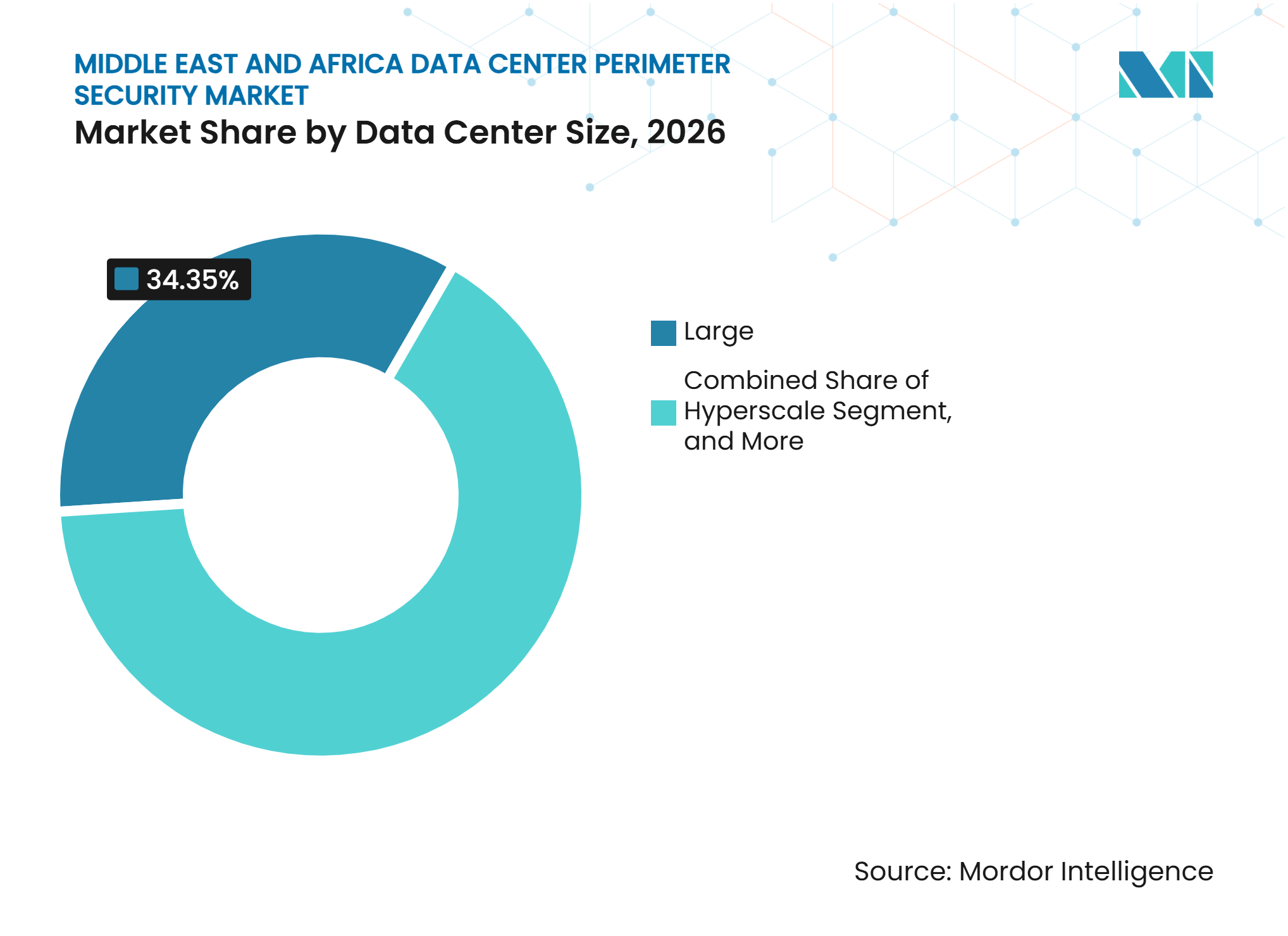
- By data center size, large data centers held 34.35% of the Middle East and Africa data center perimeter security market share in 2026, while hyperscale facilities are projected to expand at a 15.89% CAGR through 2032.
- By data center type, enterprise and edge data centers held 35.78% of the Middle East and Africa data center perimeter security market share in 2026, while cloud service providers are projected to expand at a 15.97% CAGR through 2032.
- By geography, Saudi Arabia held 30.56% of the Middle East and Africa data center perimeter security market share in 2026 and is projected to expand at a 15.68% CAGR through 2032.
Note: Market numbers in this report are based on Mordor Intelligence's proprietary estimation framework, which combines nine months of actuals with Q4 projections for base year 2026.
Market Trends and Insights
Drivers Impact Analysis of Middle East and Africa Data Center Perimeter Security Market*
| Driver | (~) % Impact on CAGR Forecast | Geographic Relevance | Impact Timeline |
|---|---|---|---|
| Hyperscale and Colocation Data Center Expansion | +3.5% | Saudi Arabia and UAE core, with spillover to South Africa and Qatar | Short term (≤ 2 years) |
| Cloud Adoption and AI Workload Growth | +3.0% | Regional, concentrated in the GCC and South Africa | Short term (≤ 2 years) |
| Data Sovereignty and Critical Infrastructure Protection Requirements | +2.5% | Saudi Arabia, UAE, and South Africa, where national mandates are deepening | Medium term (2-4 years) |
| Integrated Security and Building Management Platforms | +2.0% | GCC core, expanding to Sub-Saharan markets | Medium term (2-4 years) |
| Rack-Level Protection for High-Density Computing | +1.5% | Saudi Arabia and UAE hyperscale nodes | Long term (≥ 4 years) |
| Cyber-Physical Convergence in Unmanned and Remote Facilities | +1.2% | UAE and Saudi Arabia unmanned edge sites | Long term (≥ 4 years) |
| Source: Mordor Intelligence | |||
Expansion of Hyperscale and Colocation Data Centers
Expansion in hyperscale and colocation capacity is creating direct demand for perimeter security equipment and integration services across the Middle East and Africa data center perimeter security market. New facilities need outer barriers, controlled vehicle entry, surveillance, intrusion detection, and access controls before they can receive customers or critical workloads. Capacity additions also move procurement forward because system selection occurs during the site design and construction process. Progress Security Systems reported deployments of more than 6,500 surveillance units and over 1,800 controlled access points across data hall and technical spaces during 2026, illustrating the volume of physical security equipment involved in regional data center projects.[1] The buildout gives suppliers an opportunity to standardize designs across multiple campuses rather than sell isolated devices. It also increases the value of providers that can commission complex systems within construction schedules.
Cloud Adoption and AI Workload Growth
Cloud adoption and AI workloads are changing how operators assess physical risk within a data center. High-density computing clusters concentrate more equipment and operational value in a smaller area, making rapid response and clear access controls more important. This shifts spending toward analytics that can identify an event and direct staff to the relevant location without relying only on recorded video. The Middle East and Africa data center perimeter security market is therefore moving toward systems that connect video, sensor, radar, and access events in one operational view. The Security Industry Association stated that physical security planning for data centers needs to reflect the facility's critical role and evolving threat environment.[2] AI-oriented campuses also require security designs that can operate consistently across large areas and a high number of access points.
Data Sovereignty and Critical Infrastructure Protection Requirements
Data sovereignty requirements are strengthening the case for locally supported security infrastructure. Saudi Arabia's Essential Cybersecurity Controls require qualifying remote managed security monitoring operations centers to be physically located in the Kingdom, linking compliance with local monitoring capabilities. The UAE's data classification approach similarly places attention on the location and protection of sensitive data. South Africa's Protection of Personal Information Act places accountability obligations on organizations handling personal information, including controls surrounding the facilities that support data processing.[3] These conditions favor vendors that can support national compliance requirements, provide in-country operations, and document how physical controls fit within broader risk management programs. They also make regional implementation capability a meaningful factor in procurement decisions.
Integrated Security and Building Management Platforms
Operators are replacing fragmented security deployments with platforms that bring video, access control, intrusion detection, and building management into a single interface. Johnson Controls and Al-Futtaim Technologies launched the OpenBlue smart building platform in the UAE in June 2025, combining digital intelligence, energy optimization, and security management for government entities and commercial data center operators. A unified system can connect an access event with power, cooling, or facility alarms that occur at the same time. This helps operators investigate possible tampering or unauthorized entry with more context. The Security Industry Association identifies coordinated physical security planning as a central part of data center protection. The approach supports longer vendor relationships because operators need integration, updates, and support across several systems.
Restraints Impact Analysis of Middle East and Africa Data Center Perimeter Security Market*
| Restraint | (~) % Impact on CAGR Forecast | Geographic Relevance | Impact Timeline |
|---|---|---|---|
| High Capital and Integration Costs for Multilayer Security Architecture | -2.0% | GCC and South Africa small and medium operators | Short term (≤ 2 years) |
| Shortage of Cyber-Physical Security Specialists | -1.5% | Regional, with the sharpest effect in the Rest of Middle East and Africa | Medium term (2-4 years) |
| Legacy Infrastructure and Interoperability Constraints | -1.2% | South Africa and the Rest of Middle East and Africa, especially older enterprise data centers | Medium term (2-4 years) |
| Supply-Chain Delays and Environmental Hardening Requirements | -0.8% | GCC, where high ambient temperature hardening adds cost and lead time | Medium term (2-4 years) |
| Source: Mordor Intelligence | |||
High Capital and Integration Costs for Multilayer Security Architecture
A multilayer architecture can require crash-rated barriers, fencing detection, rack-level controls, a security operations platform, and the work needed to connect them. That upfront requirement can be difficult for smaller operators to justify within standard investment cycles. The Middle East and Africa data center perimeter security market also faces added expense when older access control hardware must connect to newer analytics systems. Custom middleware or a full replacement can raise both implementation cost and project complexity. Johnson Controls stated that the Metasys 16.0 update includes cybersecurity capabilities aligned with IEC 62443-4-2, showing how cybersecurity requirements are being incorporated into building and security platforms. These requirements improve system resilience but can add to the initial cost of a fully integrated deployment.
Shortage of Cyber-Physical Security Specialists
The shortage of people trained across physical security and networked security systems is extending deployment and support challenges. Converged deployments require staff who understand access control, video, intrusion detection, network architecture, and physical threat models. Axis Communications stated in November 2026 that unclear ownership of cybersecurity risk in physical security systems can leave known vulnerabilities unresolved. The shortage can delay commissioning where a project needs specialized design, configuration, and compliance support. It can also raise managed-service costs for operators without internal expertise. The situation favors suppliers that can pair technology with regional engineering and lifecycle support.
*Our forecasts treat driver/restraint impacts as directional, not additive. The impact forecasts reflect baseline growth, mix effects, and variable interactions.
Middle East and Africa Data Center Perimeter Security Market Segment Analysis
By Component:
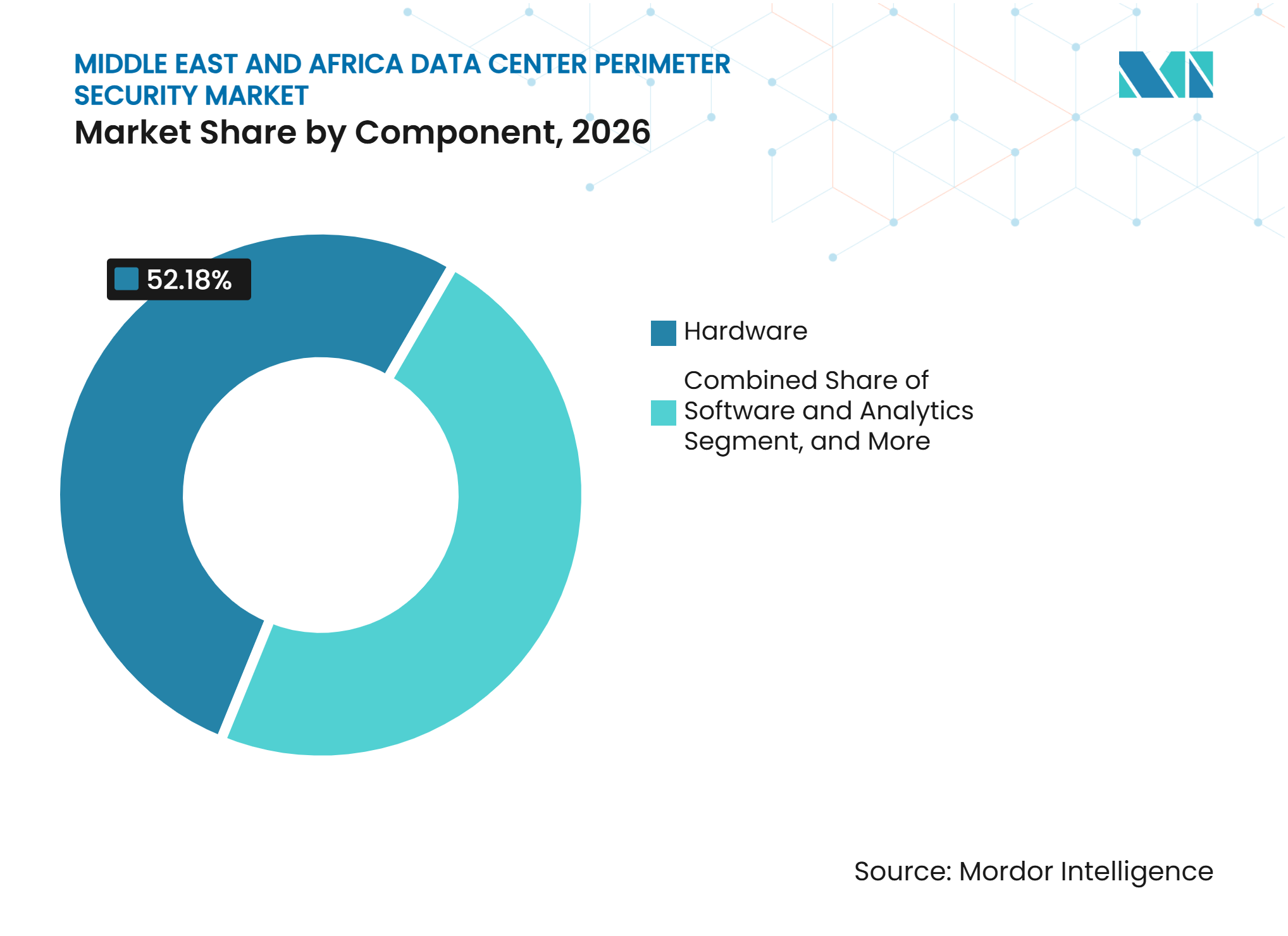
Hardware Anchors Security Spend as Software Gains MomentumHardware accounted for 52.18% of the Middle East and Africa data center perimeter security market share in 2026. Physical barriers, controlled access hardware, and intrusion detection equipment remain essential in every facility design. Crash-rated vehicle barriers, fencing systems, and rack-level locking infrastructure are often selected during design because their installation affects the site layout. This makes hardware spending difficult to defer once construction and security planning begin.
Software and analytics is projected to expand at a 15.75% CAGR through 2032. AI-enabled monitoring and event-correlation tools can improve the coverage achieved by a fixed hardware footprint. The Security Industry Association described integrated physical security planning as important for protecting critical data center environments. Installation, integration, and maintenance services provide recurring work as operators update firmware, configure platforms, and commission equipment. The component mix is consequently shifting toward hardware installed at the start of a project and software services used throughout the facility life cycle.



By Solution Type:
Radar Systems Outpace Conventional DetectionIntrusion detection systems held 24.56% of the Middle East and Africa data center perimeter security market share in 2026. The category is used in new construction and in retrofit work because it provides direct notification when a perimeter is breached or disturbed. Security fencing, physical barriers, and vehicle access barriers remain the structural base of perimeter protection. K12-rated bollards and anti-ram gates certified under PAS 68 are relevant where operators need to control vehicle access at large campuses.
Perimeter radar and sensor systems are projected to expand at a 15.85% CAGR through 2032. On a campus-scale site, radar can cover wide fence-line areas without requiring the camera density needed for continuous video coverage. These systems can classify moving objects and send event data to an integrated platform before an intrusion reaches the building. Providers are also offering integrated perimeter security platforms to reduce the number of separate vendors and interfaces an operator must manage. The Middle East and Africa data center perimeter security industry is increasingly rewarding detection systems that support early action and lower false alarms.
By Technology:
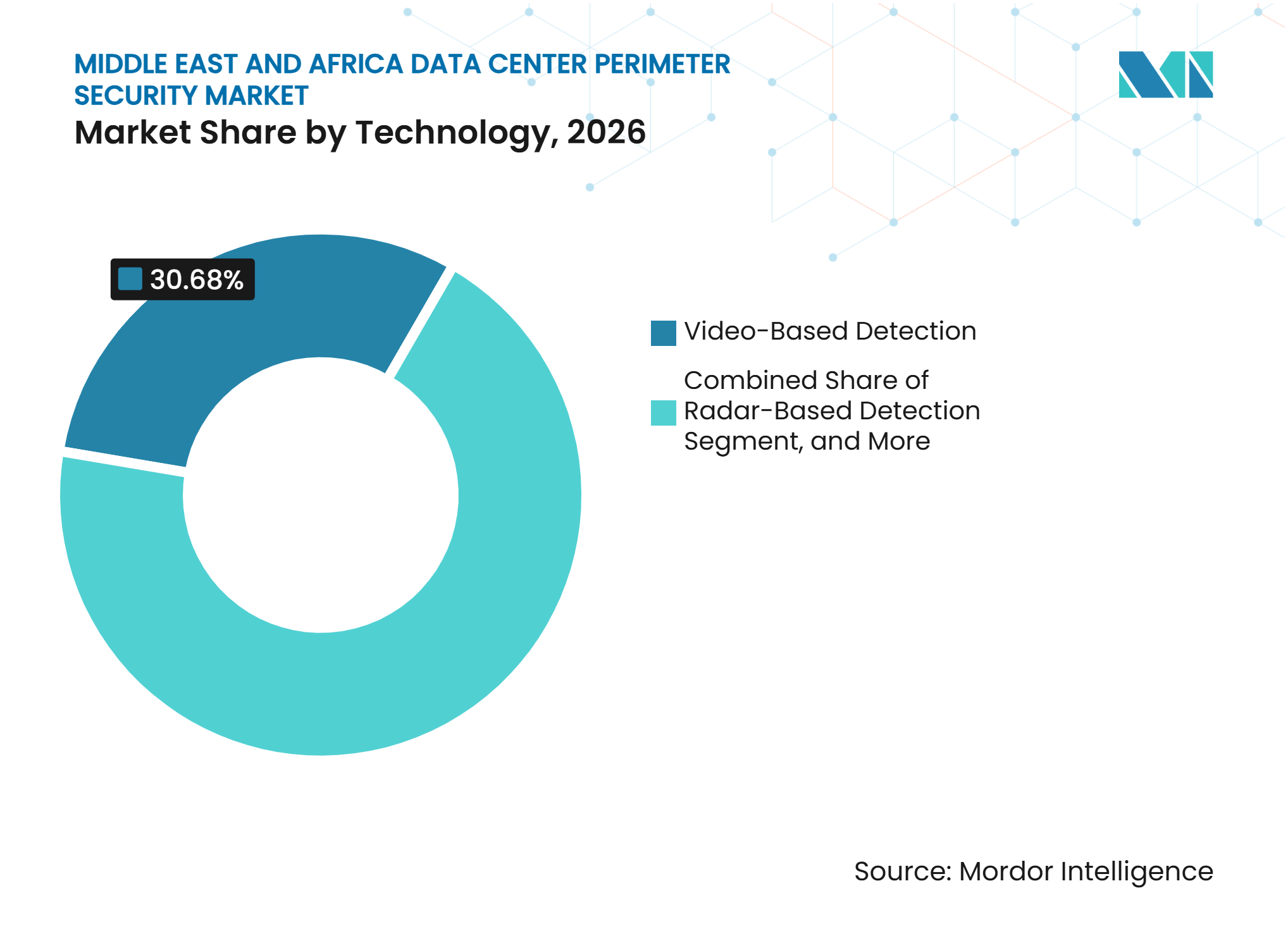
Video Detection Leads Today, Radar Accelerates TomorrowVideo-based detection accounted for 30.68% of the Middle East and Africa data center perimeter security market share in 2026. It remains the established surveillance layer for legacy locations and greenfield data center sites. Operators understand its operating model, and it fits easily with control room procedures that depend on visual review. Sensor-based detection, including fiber-optic fence sensors and vibration detectors, adds a physical tamper signal that does not depend on lighting conditions.
Radar-based detection is projected to expand at a 15.68% CAGR through 2032. Operators are combining radar with optical and thermal cameras to support detection in high temperatures and dust conditions. Axis Communications stated that combinations of thermal, radar, and optical solutions can support autonomous tracking at large perimeters. These combinations can reduce the number of patrols needed while retaining active monitoring. Integrated multi-technology systems are also gaining relevance because two or more detection modes can be used to validate an event and lower false positive rates.

By Deployment Type:
New Builds Drive Security by DesignNew data center construction represented 68.34% of the Middle East and Africa data center perimeter security market size in 2026. It is also projected to expand at a 15.78% CAGR through 2032. This pattern reflects a regional construction cycle in which a full security architecture can be designed before the facility becomes operational. New projects allow operators to place intrusion detection, access control, barriers, and command systems around the campus without the constraints of an occupied site.
Security upgrades and retrofitting make up the remaining deployment demand. They are important in established data center fleets, including older enterprise facilities that need to meet changing compliance requirements. Retrofit projects can be more difficult than new installations because older cabling, existing operations, and limited installation windows restrict the work. The Security Industry Association notes that planning physical security early can reduce later integration and retrofit challenges. This makes security by design a practical procurement approach for large regional construction programs.
By Data Center Size:
Hyperscale Ambitions Reshape Perimeter RequirementsLarge data centers held 34.35% of the Middle East and Africa data center perimeter security market share in 2026. Their position reflects the installed base of established carrier-neutral colocation facilities in the UAE and South Africa. Such sites need layered controls but generally operate within established operational procedures. Their large customer bases also require detailed access permissions across shared technical areas.
Hyperscale facilities are projected to expand at a 15.89% CAGR through 2032. A campus of 100 MW or more requires layered detection across outer fence lines, automated vehicle screening, and a command platform that can handle data from many sensors at once. Small edge facilities require a different model because full-time security staffing is often impractical. They need compact systems that support remote monitoring while maintaining access and detection standards. The Middle East and Africa data center perimeter security market therefore serves very different operating needs across campus, colocation, and distributed edge environments.
By Data Center Type:
Enterprise Facilities Lead as Cloud Providers Close the GapEnterprise and edge data centers held 35.78% of the Middle East and Africa data center perimeter security market share in 2026. The segment includes corporate-owned and government-operated locations across the GCC and South Africa. These facilities often need controls aligned with internal access rules, government requirements, and site-specific risk conditions. Their installed base supports continued demand for equipment replacement, analytics, and integration work.
Cloud service providers are projected to expand at a 15.97% CAGR through 2032. The regional shift toward public cloud and sovereign cloud services is increasing demand for large facilities with robust physical security controls. Colocation operators need one secure outer perimeter while enforcing tenant-specific access down to individual cages and racks. This supports demand for modular platforms that can be configured for different tenants without separate hardware installations. CSP activity in Egypt and Morocco also supports new security procurement where sovereign and hybrid cloud facilities are being developed.
Geography Analysis
Saudi Arabia
Saudi Arabia held 30.56% of the Middle East and Africa data center perimeter security market share in 2026 and is projected to expand at a 15.68% CAGR through 2032. Installed capacity reached 467 MW in the first quarter of 2026, up from 68 MW in 2021, as Vision 2030 programs, HUMAIN, and hyperscaler partnerships support large projects. Riyadh and the planned 360 MW NEOM Oxagon campus need layered systems that can protect extensive sites. Johnson Controls Arabia received Security Industry Regulatory Agency accreditation for its American Dynamics range in early 2026, while National Cybersecurity Authority requirements reinforce the importance of locally supported operations.
United Arab Emirates
The UAE had more than 376 MW of live commissioned capacity in 2025, with colocation operators accounting for more than 95% of that capacity. This structure concentrates procurement with operators that manage shared facilities for many customers. Microsoft’s investment commitment and the planned Stargate UAE AI campus are expanding the pipeline of large cloud and AI sites. Those projects increase demand for coordinated perimeter controls, facility systems, and access management. Johnson Controls and Al-Futtaim Technologies introduced the OpenBlue platform in the UAE in 2025, providing an integrated building and security approach.
South Africa and Other Middle East and Africa Markets
South Africa has an established sub-Saharan data center base and remains important for security upgrades and new projects. Digital Realty completed Teraco JB4 with 50 MW in August 2025, and Teraco CT2 entered operational expansion with a 90 MW utility power feed in January 2026. Egypt is adding capacity through Africa Data Centres Egypt, while Kenya is developing campuses through Digital Realty iColo and Nxtra’s Tatu City project. Morocco’s Naver-NVIDIA Tamesna campus signals the growing role of North Africa in AI infrastructure development. The different maturity levels across these markets create demand for systems that support new construction, retrofits, tenant access, and remote sites, while POPIA remains a compliance consideration in South Africa.
Competitive Landscape
Market Concentration
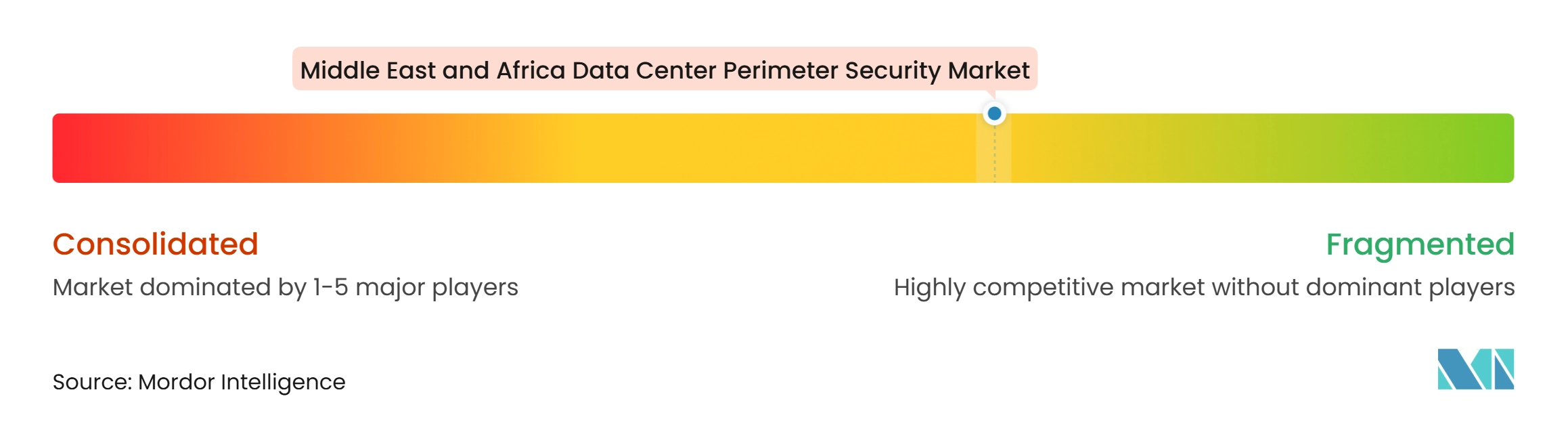
The Middle East and Africa data center perimeter security market is moderately fragmented. Johnson Controls International, Honeywell International, Siemens, Schneider Electric, Axis Communications, ASSA ABLOY, Motorola Solutions, and Genetec compete with regional specialists and system integrators. Competition is stronger in hyperscale and government-linked projects because vendors need integrated systems, national compliance knowledge, and local service capacity. Regional integrators can compete where they have established procurement relationships and in-country engineering teams.
Major vendors are moving beyond individual devices toward platforms that combine access control, video management, intrusion detection, and building automation. Honeywell acquired Carrier Global Corporation’s Global Access Solutions business for USD 4.9 billion, a move that increases its access and security portfolio. Genetec offers Security Center SaaS with open integration for cameras from Axis, Bosch, and i-PRO, and the platform is designed to align with IEC 62443-4-2 cybersecurity requirements. This type of interoperability can reduce integration work for operators that use equipment from several suppliers.
Johnson Controls expanded its regional smart-building position through the June 2025 OpenBlue partnership with Al-Futtaim Technologies. Axis Communications highlighted a Perimeter Defender deployment at Moro Hub in Dubai that used thermal, radar, and optical cameras from the perimeter through server racks. Honeywell and LS ELECTRIC announced a global partnership in October 2025 for data center power management and monitoring solutions. Smaller companies such as Brivo Systems and Suprema are pursuing cloud-native enterprise and niche requirements. Suppliers able to provide remote monitoring, radar, analytics, and response tools can address edge facilities where a manned-guard model is less practical.
Middle East and Africa Data Center Perimeter Security Industry Leaders
-
Johnson Controls International plc
-
Honeywell International Inc.
-
Schneider Electric SE
-
Siemens AG
-
Bosch Sicherheitssysteme GmbH
- *Disclaimer: Major Players sorted in no particular order
Middle East and Africa Data Center Perimeter Security Market Companies Covered in this Report
- Johnson Controls International plc
- Honeywell International Inc.
- Schneider Electric SE
- Siemens AG
- Bosch Sicherheitssysteme GmbH
- Axis Communications AB
- ASSA ABLOY AB
- LenelS2
- Securitas Technology
- ABB Ltd
- Suprema Inc.
- Brivo Systems LLC
- Genetec Inc.
- Motorola Solutions, Inc.
- Convergint Technologies LLC
- GardaWorld Security Corporation
- 3S System Security Solutions Co.
- Schneider Electric Saudi Arabia
- Teraco Data Environments (Pty) Ltd
- Africa Data Centres
- Gulf Data Hub
Recent Industry Developments in Middle East and Africa Data Center Perimeter Security Market
- September 2026: Microsoft announced plans to invest over USD 10 billion across the UAE, Saudi Arabia, Qatar, and Kuwait through 2030, encompassing cloud infrastructure, AI capacity, and data center campuses alongside over USD 400 million for regional telecommunications networks. The commitment materially expands the addressable perimeter security market across GCC data centers for the forecast period.
- July 2026: MEEZA, Qatar's leading data center operator, secured QAR 1.6 billion (USD 438.7 million) in financing to expand its portfolio with M-Vault 6, 7, and 8, adding around 44 MW of new capacity and driving corresponding demand for large-scale perimeter security deployments at mission-critical Gulf facilities.
- May 2026: Stargate UAE, a joint initiative by G42, OpenAI, Oracle, NVIDIA, Cisco, and SoftBank Group, was announced with a USD 20 billion investment to build a 1 GW AI campus in Abu Dhabi, with 200 MW expected to be operational by 2026-2027, creating direct and immediate demand for hyperscale-grade integrated perimeter security systems.
- March 2026: Johnson Controls Arabia received SIRA (Security Industry Regulatory Agency) accreditation for its American Dynamics video surveillance range, confirming eligibility for deployment in government and high-security data center environments across the UAE and positioning the company as a certified provider for mission-critical facility protection.
Middle East and Africa Data Center Perimeter Security Market Report Scope
The Data Center Perimeter Security Market refers to the industry focused on solutions and services designed to protect the physical boundaries of data center facilities from unauthorized access, intrusion, vandalism, theft, and security threats.
The Middle East and Africa Data Center Perimeter Security Market Report is Segmented by Component (Hardware; Software and Analytics; Installation, Integration, and Maintenance Services), Solution Type (Intrusion Detection Systems; Security Fencing and Physical Barriers; Vehicle Access Barriers; Perimeter Radar and Sensor Systems; Integrated Perimeter Security Platforms), Technology (Sensor-Based Detection; Video-Based Detection; Fiber-Optic Detection; Radar-Based Detection; Integrated Multi-Technology Systems), Deployment Type (New Data Center Construction; Security Upgrades and Retrofitting), Data Center Size (Small; Medium; Large; Hyperscale), Data Center Type (Colocation; Cloud Service Providers (CSPs); Enterprise and Edge), and Geography (Saudi Arabia; United Arab Emirates; South Africa; Rest of Middle East and Africa). The Market Forecasts are Provided in Terms of Value (USD).
Segmentation Overview
| Hardware |
| Software and Analytics |
| Installation, Integration, and Maintenance Services |
| Intrusion Detection Systems |
| Security Fencing and Physical Barriers |
| Vehicle Access Barriers |
| Perimeter Radar and Sensor Systems |
| Integrated Perimeter Security Platforms |
| Sensor-Based Detection |
| Video-Based Detection |
| Fiber-Optic Detection |
| Radar-Based Detection |
| Integrated Multi-Technology Systems |
| New Data Center Construction |
| Security Upgrades and Retrofitting |
| Small |
| Medium |
| Large |
| Hyperscale |
| Colocation |
| Cloud Service Providers (CSPs) |
| Enterprise and Edge |
| Saudi Arabia |
| United Arab Emirates |
| South Africa |
| Rest of Middle East and Africa |
| By Component | Hardware |
| Software and Analytics | |
| Installation, Integration, and Maintenance Services | |
| By Solution Type | Intrusion Detection Systems |
| Security Fencing and Physical Barriers | |
| Vehicle Access Barriers | |
| Perimeter Radar and Sensor Systems | |
| Integrated Perimeter Security Platforms | |
| By Technology | Sensor-Based Detection |
| Video-Based Detection | |
| Fiber-Optic Detection | |
| Radar-Based Detection | |
| Integrated Multi-Technology Systems | |
| By Deployment Type | New Data Center Construction |
| Security Upgrades and Retrofitting | |
| By Data Center Size | Small |
| Medium | |
| Large | |
| Hyperscale | |
| By Data Center Type | Colocation |
| Cloud Service Providers (CSPs) | |
| Enterprise and Edge | |
| By Geography | Saudi Arabia |
| United Arab Emirates | |
| South Africa | |
| Rest of Middle East and Africa |
Key Questions Answered in the Report
What is the Middle East and Africa data center perimeter security market size?
The market is valued at USD 118.40 million in 2026 and is projected to reach USD 268.80 million by 2032 at a 14.23% CAGR. The forecast reflects demand from new data center construction, AI-oriented campuses, and more integrated security requirements.
Which component has the largest share of data center perimeter security spending?
Hardware leads with 52.18% in 2026 because barriers, access hardware, and intrusion detection are core elements of facility security designs. Software and analytics is also gaining relevance as facilities need event correlation and automated monitoring.
Which perimeter security solution is expanding fastest in the region?
Perimeter radar and sensor systems are projected to expand at a 15.85% CAGR through 2032 as large campuses need broader detection coverage. The systems can support early alerts along fence lines and reduce the need for dense camera coverage.
Why are AI data centers changing physical security requirements?
High-density AI environments concentrate valuable equipment within smaller spaces, increasing the need for controlled access, rapid detection, and integrated monitoring. Operators are combining video, radar, sensors, and access data to investigate security events with greater context.
Which country leads regional demand for data center perimeter security?
Saudi Arabia leads with 30.56% share in 2026 and is projected to expand at a 15.68% CAGR through 2032. Large projects in Riyadh and NEOM are raising the need for layered campus protection, certified equipment, and locally supported services. The countrys large project pipeline also favors vendors that can coordinate installation with construction schedules.
How do data sovereignty requirements affect data center security procurement?
They increase the importance of locally supported monitoring, documentation, and compliance capabilities, particularly for sensitive and government-linked workloads. The requirements can favor suppliers that maintain in-country operations and understand national cybersecurity frameworks. They also bring physical access, monitoring location, and support accountability into the same procurement decision. This can reduce reliance on remote operating models without local compliance support and can extend implementation schedules.