
Middle East and Africa Data Center Optical Connectivity Market Size and Share
Market Overview
| Study Period | 2021 - 2032 |
|---|---|
| Forecast Data Period | 2027 - 2032 |
| Base Year Market Size (2026) | USD 2.58 Billion |
| Market Size (2027) | USD 3.04 Billion |
| Market Size (2032) | USD 6.70 Billion |
| Growth Rate (2027 - 2032) | 17.12 % |
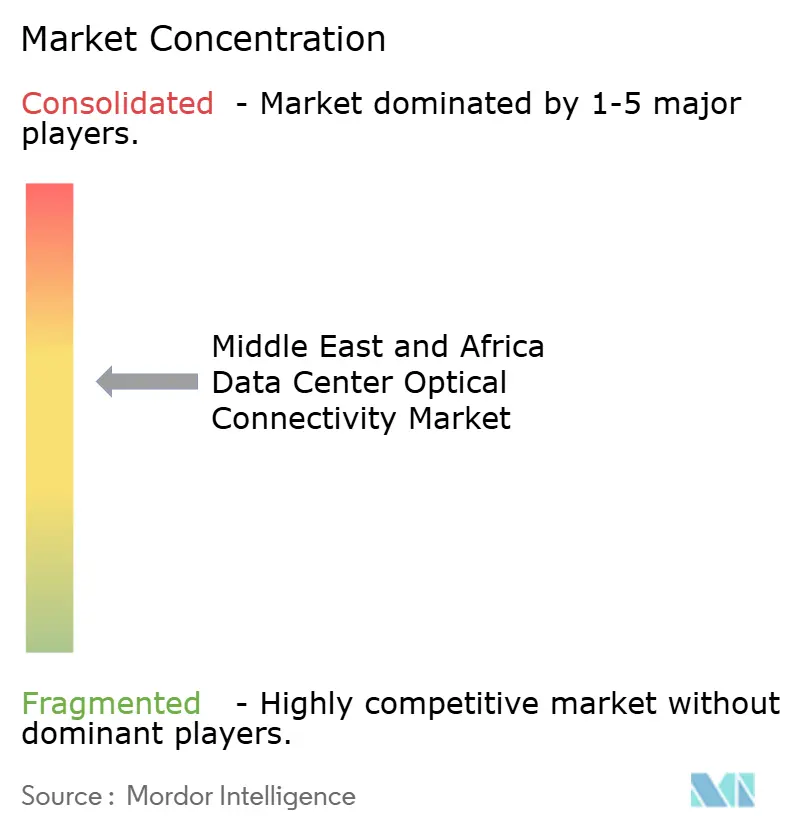
| Market Concentration | Medium |
Major Players *Disclaimer: Major Players sorted in no particular order Image © Mordor Intelligence. Reuse requires attribution under CC BY 4.0. | |
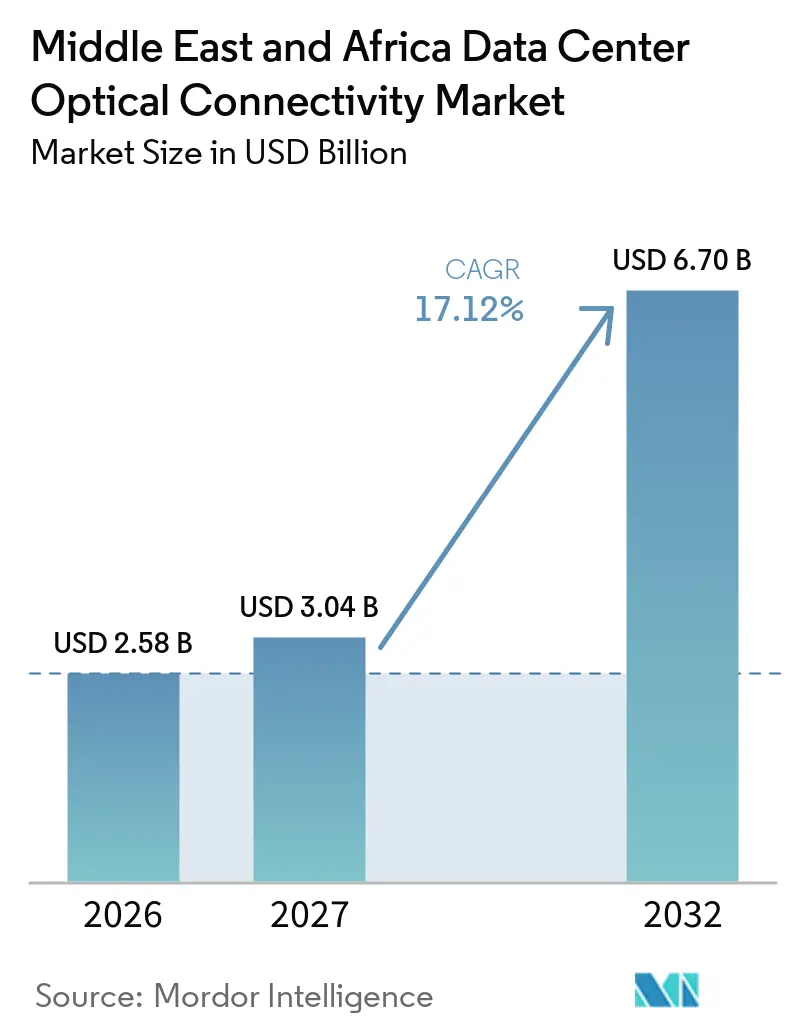
Middle East and Africa Data Center Optical Connectivity Market Analysis by Mordor Intelligence
The Middle East And Africa Data Center Optical Connectivity Market size is expected to grow from USD 2.58 billion in 2026 to USD 3.04 billion in 2027 and is forecast to reach USD 6.70 billion by 2032 at 17.12% CAGR over 2027-2032.
The Middle East and Africa data center optical connectivity market is being shaped by AI data center projects, sovereign cloud programs, and demand for faster data center fabrics. Saudi Arabia and the United Arab Emirates are setting the pace through large AI and cloud capacity plans. Operators are also preparing for 800G and 1.6T connections as GPU clusters require denser links and lower latency. New subsea cable landings are improving the case for data center interconnection near Egypt, the Gulf, and major African hubs. Power reliability, product qualification, and component sourcing will determine how quickly planned capacity becomes operational.
Key Report Takeaways
- By product type, optical transceivers held 42.17% of the Middle East and Africa data center optical connectivity market share in 2026, while optical circuit switches are projected to expand at a 24.71% CAGR through 2032.
- By connectivity architecture, conventional pluggable optics held 78.34% of revenue in 2026, while co-packaged optics are projected to expand at a 23.87% CAGR through 2032.
- By data rate, the up-to-400 Gbps tier accounted for 53.41% of revenue in 2026, while the 1.6 Tbps tier is projected to expand at a 22.97% CAGR through 2032.
- By reach, the 7-100 meters category held 32.83% of revenue in 2026, while the up-to-3-meters category is projected to expand at a 24.46% CAGR through 2032.
- By application, switch-to-switch connectivity held 26.19% of revenue in 2026, while GPU-to-GPU connectivity is projected to expand at a 23.37% CAGR through 2032.
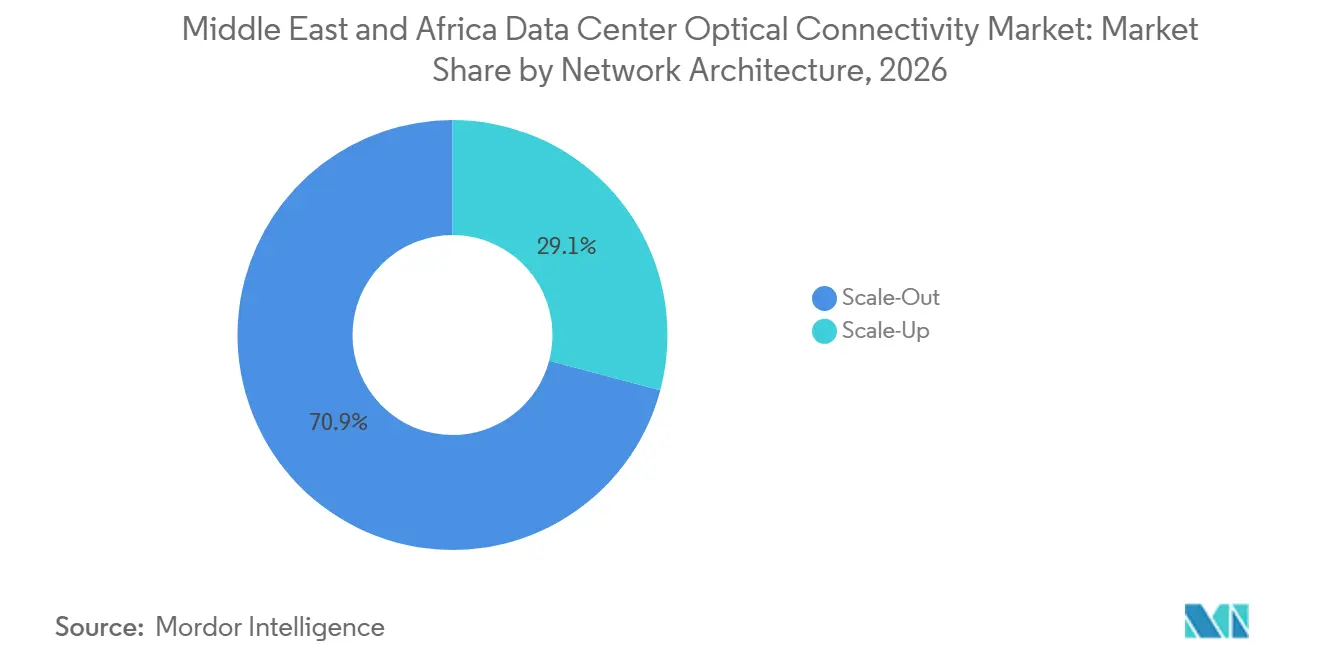
- By network architecture, scale-out held 70.87% of revenue in 2026, while scale-up is projected to expand at a 24.12% CAGR through 2032.
- By data center type, hyperscale data centers held 39.21% of the Middle East and Africa data center optical connectivity market share in 2026 and are projected to expand at a 23.61% CAGR through 2032.
- By country, Saudi Arabia held 28.53% of revenue in 2026, while Egypt is projected to expand at a 25.19% CAGR through 2032.
Note: Market numbers in this report are based on Mordor Intelligence's proprietary estimation framework, which combines nine months of actuals with Q4 projections for base year 2026.
Market Trends and Insights
Drivers Impact Analysis of Middle East and Africa Data Center Optical Connectivity Market*
| Driver | (~) % Impact on CAGR Forecast | Geographic Relevance | Impact Timeline |
|---|---|---|---|
| AI Cluster and Hyperscale Data Center Expansion | +5.5% | Saudi Arabia, United Arab Emirates, with spillover to Egypt, Nigeria, and South Africa | Short term (≤ 2 years) |
| 400G, 800G, and 1.6T Fabric Upgrades | +4.2% | United Arab Emirates and Saudi Arabia, with emerging use in South Africa | Medium term (2-4 years) |
| Sovereign Cloud and Data Residency Deployments | +2.8% | United Arab Emirates, Saudi Arabia, Qatar, and the wider GCC | Medium term (2-4 years) |
| Subsea Cable Landing and Data Center Interconnection Growth | +2.0% | Egypt, United Arab Emirates, Saudi Arabia, South Africa, and Nigeria | Medium term (2-4 years) |
| 5G, Cloud, and Digital Transformation Investment | +1.5% | GCC countries, South Africa, Nigeria, and Egypt | Long term (≥ 4 years) |
| Regional Energy-Efficient Optical Transport Modernization | +1.0% | United Arab Emirates, Saudi Arabia, Qatar, and Kuwait | Long term (≥ 4 years) |
| Source: Mordor Intelligence | |||
AI Cluster and Hyperscale Data Center Expansion
AI-focused data center programs are creating direct demand for denser optical fabrics across the Middle East and Africa data center optical connectivity market. AI training requires frequent exchanges between accelerators, switches, and storage, which increases the number of high-speed links compared with conventional cloud workloads. The same shift supports inter-campus connections when power limits or site design require computing to be distributed across locations. Vendors that can support both local fabrics and long-distance data center links are therefore better positioned for large AI campus projects. This demand gives the Middle East and Africa data center optical connectivity market a longer procurement cycle because network capacity must be installed before AI clusters can operate at scale.
400G, 800G, and 1.6T Fabric Upgrades
The move from 400G to 800G and 1.6T interfaces is changing equipment specifications in the Middle East and Africa data center optical connectivity market. AI racks can exceed 100 kW, which places pressure on switching capacity and makes higher-speed interfaces more relevant. Broadcom introduced its Taurus BCM83640 as a 3 nm 400G-per-lane optical PAM-4 DSP designed for 1.6T transceivers and 102.4T switching systems.[1] Marvell also expanded its optical DSP portfolio for 1.6T links, which strengthens the component supply base for large AI fabric deployments. These upgrades require operators to assess fiber type, thermal design, testing capacity, and interoperability before they change a production fabric. The transition will favor facilities that are being built for AI workloads and can specify high-speed optics at the design stage.
Sovereign Cloud and Data Residency Deployments
Sovereign cloud programs create a separate source of demand for the Middle East and Africa data center optical connectivity market. Domestic data residency, key management, and regulatory requirements can require a dedicated cloud environment rather than a shared international region. These deployments need their own server-to-switch, switch-to-switch, and inter-campus optical connections. The commercial launch of e& Sovereign Launchpad in 2025 established a regional example of a sovereign cloud environment backed by AWS. Government and regulated enterprise workloads can therefore support new capacity even where general cloud spending is uneven. This driver is particularly relevant to Gulf operators that need compliant domestic platforms while also building capacity for AI services.
Subsea Cable Landing and Data Center Interconnection Growth
Subsea cable developments are raising the value of high-capacity data center interconnection within the Middle East and Africa data center optical connectivity market. Cable landing stations need resilient terrestrial links to colocation sites and cloud campuses. The Africa-1 cable system connects Egypt, Saudi Arabia, and the United Arab Emirates across a 10,000 km route, supporting new traffic aggregation points in these markets. Ooredoo and du are also advancing the Fiber in the Gulf cable project, which is intended to connect Gulf markets through a high-capacity regional system. Such links increase the need for coherent transport and high-speed interfaces between landing sites and inland data centers. The effect is strongest in locations that can combine cable access, reliable power, and carrier-neutral facilities.
Restraints Impact Analysis of Middle East and Africa Data Center Optical Connectivity Market*
| Restraint | (~) % Impact on CAGR Forecast | Geographic Relevance | Impact Timeline |
|---|---|---|---|
| Unreliable Power and Backup-Energy Requirements | -1.5% | Sub-Saharan Africa, especially Nigeria and South Africa, with spillover to Egypt | Medium term (2-4 years) |
| High Installation, Qualification, and Maintenance Costs | -1.2% | Africa and early-stage GCC markets | Medium term (2-4 years) |
| Import Dependence, Tariffs, and Long Qualification Cycles | -0.9% | United Arab Emirates and Saudi Arabia procurement hubs | Medium term (2-4 years) |
| Signal Integrity and Thermal Constraints at 800G and Above | -0.7% | United Arab Emirates and Saudi Arabia hyperscale AI clusters | Medium term (2-4 years) |
| Source: Mordor Intelligence | |||
Unreliable Power and Backup-Energy Requirements
Power reliability remains a practical constraint on data center development in several African markets. Operators must budget for backup generation and fuel when grid service cannot support continuous high-density compute. The International Energy Agency expects global data center electricity demand to more than double by 2030, with AI being a major source of additional demand.[2] This pressure is more difficult to manage where transmission systems and local generation do not expand with digital infrastructure. It can delay new facilities and lead operators to limit port density or defer high-cost optical upgrades. Power planning is therefore part of the purchasing decision for the Middle East and Africa data center optical connectivity market, rather than a separate site-level issue.
High Installation, Qualification, and Maintenance Costs
High-speed optical systems require more work than purchasing modules and inserting them into switches. Product conformity reviews, laboratory testing, firmware validation, and field interoperability checks can lengthen deployment schedules. A new 800G or 1.6T platform may also require upgrades to cabling, cooling, and monitoring systems. Co-packaged optics add another layer of coordination because switch, optical, and thermal designs are more closely connected. These requirements can be difficult for smaller colocation operators that do not maintain specialist optical engineering teams. They may continue using established pluggable platforms longer, even when higher integration would lower power use over time.
*Our forecasts treat driver/restraint impacts as directional, not additive. The impact forecasts reflect baseline growth, mix effects, and variable interactions.
Middle East and Africa Data Center Optical Connectivity Market Segment Analysis
By Product Type:
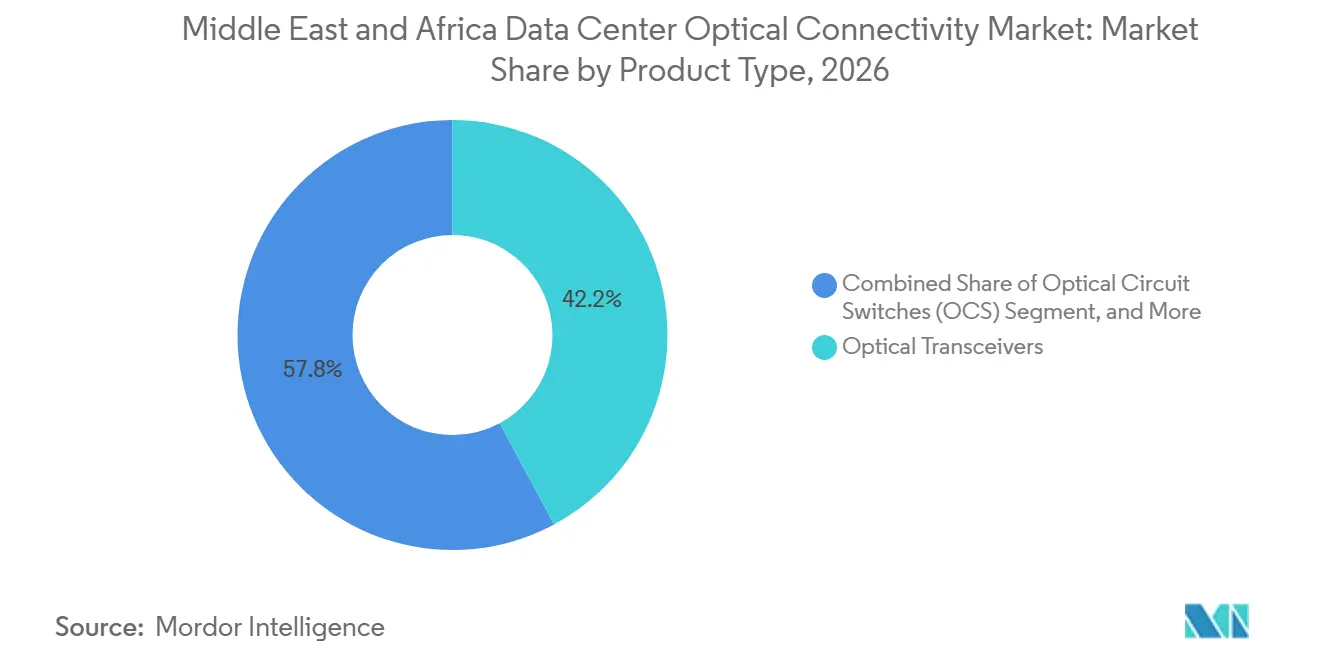
Optical Circuit Switches Lead the Highest-Growth Product CategoryOptical transceivers held 42.17% of the Middle East and Africa data center optical connectivity market size in 2026. This position reflects the large installed base of 100G and 400G pluggable modules across Gulf and African facilities. Active optical cables, cable assemblies, connectors, and interconnect assemblies support rack, row, and structured-cabling requirements. Their demand increases with the size of new facilities and the number of ports deployed. Optical circuit switches are projected to expand at a 24.71% CAGR through 2032. They can change paths between endpoints without conventional packet switching at every step. This makes them relevant to AI systems that need flexible, high-bandwidth connections among many GPUs. Marvell and Lumentum demonstrated optical circuit switching with 1.6T, coherent-lite, and 800G modules at OFC 2026. The demonstration supports the technical readiness of this approach for future AI fabrics.
The product mix will remain broad because no single component category serves every connection in a data center. Transceivers will continue to support most switch ports because they are replaceable and supported by mature supply channels. Optical circuit switches address a different requirement, which is rapid reconfiguration across AI clusters. Coherent introduced OCS-optimized transceivers that provide additional insertion-loss headroom for 400G and 800G applications. This gives operators a product path for switch architectures that include an optical circuit switching layer. Procurement teams must still test these combinations with their selected servers, switches, and network software. The Middle East and Africa data center optical connectivity market will therefore continue to use conventional products while specialized AI projects introduce advanced switching designs. Suppliers with validated interoperability data can reduce the qualification burden for regional operators.

By Connectivity Architecture:
Integrated Platforms Gain Ground Alongside Pluggable OpticsConventional pluggable optics accounted for 78.34% of revenue in 2026. Their lead comes from serviceability, well-established supply channels, and compatibility with front-panel switching equipment. Operators can replace a failed module without changing the switchboard or wider system. Linear pluggable optics, near-packaged optics, and co-packaged optics address rising power and bandwidth needs through closer integration. Co-packaged optics are projected to expand at a 23.87% CAGR through 2032. NVIDIA has described co-packaged optics as a way to improve power efficiency in AI factory networks. These systems reduce electrical path lengths between switching silicon and optical engines. Their deployment is most relevant to new high-density facilities that can plan cooling and service processes from the beginning.
The change in architecture does not mean that pluggable optics will quickly lose their installed-base advantage. Existing data centers need field-replaceable parts and familiar maintenance practices. Ciena introduced the Vesta 200 6.4T CPX in February 2026 and stated that the pluggable optical engine can reduce power consumption by up to 70% in certain applications. This type of offering can provide a step toward more integrated optical designs without a full redesign of the switching system. Near-packaged designs may also be considered when operators want better density but need more serviceability than a full co-packaged design. The Middle East and Africa data center optical connectivity market will likely have a mixed architecture base because AI campuses and older enterprise facilities have different requirements. Vendor support, repair procedures, and local technical capability will influence which architectures move into production. This gives systems integrators an important role in helping operators manage several technology generations at once.
By Data Rate:
The 1.6 Tbps Tier Adds the Fastest Revenue MomentumThe up-to-400 Gbps tier held 53.41% of the Middle East and Africa data center optical connectivity market size in 2026. It serves many existing enterprise, colocation, and cloud facilities that are not yet built around dense AI clusters. These systems use established 100G, 200G, and 400G connections for leaf-spine and server access networks. The 800 Gbps tier is becoming more relevant for high-capacity spine layers in Gulf hyperscale projects. The 1.6 Tbps tier is projected to expand at a 22.97% CAGR through 2032. Its adoption is tied to higher switch ASIC capacity and the need to reduce the number of ports required for a given fabric bandwidth. Broadcom’s 400G-per-lane DSP supports 1.6T transceiver designs that can connect to 102.4T switches. These technical advances make the 1.6T tier more practical for operators planning large AI clusters.
The regional data-rate mix will differ between advanced Gulf campuses and many African enterprise facilities. Saudi Arabia and the United Arab Emirates are likely to specify 800G and 1.6T interfaces in new AI-oriented designs. Other facilities will retain 100G to 400G infrastructure where workloads and power availability do not justify a full fabric change. Above-1.6T products remain an early roadmap category rather than a broad deployment category within the forecast period. Marvell stated that its 1.6T optical DSP portfolio supports the next stage of AI data center connectivity. These products create a component supply path for systems that will need even higher speeds later. The Middle East and Africa data center optical connectivity market must therefore support two operating realities, one centered on high-speed AI fabrics and another centered on mature cloud and enterprise networks. Suppliers will need different commercial and support models for these customer groups.
By Reach:
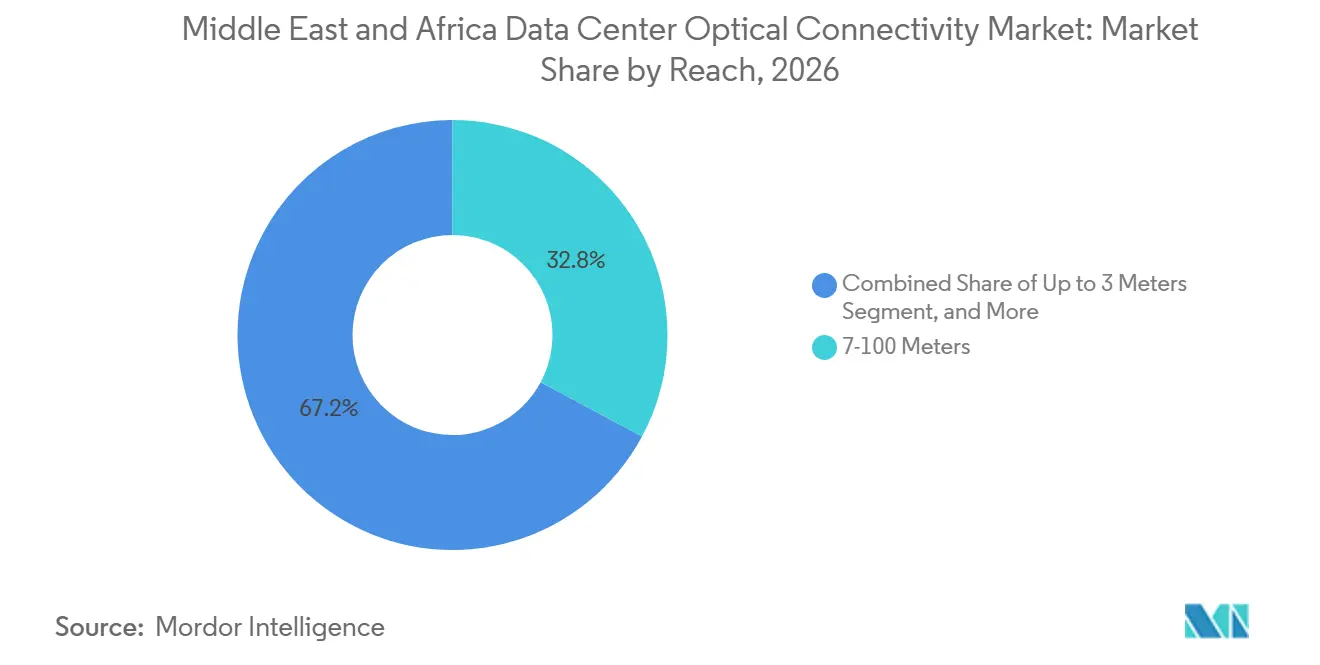
Very-Short-Range Links Gain Importance in Dense AI RacksThe 7-100 meters category held 32.83% of revenue in 2026. It covers many switch-to-server and leaf-to-spine connections within conventional data center layouts. The 100-500 meters and above-500 meters categories serve campus connections and data center interconnection requirements. The up-to-3-meters category is projected to expand at a 24.46% CAGR through 2032. AI clusters are increasing the need for direct, low-latency links within GPU racks and across adjacent equipment. Active optical cables and integrated optical approaches compete in this distance range. Their lower reach does not reduce their importance because the number of short links can be very high in a dense cluster. The Middle East and Africa data center optical connectivity market is therefore gaining demand from both short internal links and longer campus links.
Very-short-reach products will be purchased through a different cycle from traditional structured cabling. They are often tied to GPU server orders, rack layouts, and switch choices. This relationship means that server vendors, chip suppliers, and network equipment suppliers can influence optical selection. A shift from copper links to optical links can improve reach and support higher bandwidth as rack density rises. It also requires teams to manage connector cleaning, bend limits, testing, and spare inventory at a much larger scale. For larger distances, data center operators will continue to use single-mode fiber and coherent transport where the connection extends beyond an equipment row or campus building. Cable landing and sovereign cloud sites provide a separate need for longer-reach data center interconnection. This range diversity means that product suppliers must offer a portfolio rather than a single high-speed module. It also gives the Middle East and Africa data center optical connectivity market several demand paths as facility designs become more varied.
By Application:
GPU-to-GPU Links Set the Fastest Application Growth RateSwitch-to-switch connectivity held 26.19% of revenue in 2026. This reflects the volume of spine and leaf connections required across hyperscale and colocation facilities. Server-to-switch links remain a large application because every compute server needs network access. Storage connectivity supports data-intensive enterprise and cloud environments. Data center interconnection is becoming more important where sovereign cloud capacity is spread across multiple sites. GPU-to-GPU connectivity is projected to expand at a 23.37% CAGR through 2032. AI training clusters need direct high-speed communications among accelerators, which differ from conventional server traffic patterns. Ayar Labs introduced an optical UCIe chiplet for AI scale-up architectures, with 8 Tbps of bandwidth for GPU-to-GPU connections.
GPU-to-GPU designs require very low latency and can increase the number of optical connections per cluster. This creates a distinct opportunity within the Middle East and Africa data center optical connectivity market as regional AI campuses move beyond basic cloud capacity. GPU-to-switch links will also rise because larger AI clusters need more switching capacity around each group of accelerators. Switch-to-switch links will remain essential because they connect the wider fabric and support traffic between compute, storage, and external services. DCI links will benefit from sovereign cloud architectures that distribute compliant workloads over several sites. These use cases need different optical power levels, reach specifications, and management systems. Network teams will need to plan the application fabric as an integrated whole rather than buying connectivity for each layer separately. The resulting procurement process will place more value on interoperability tests and reference designs. It will also favor vendors that can show performance across the server, switch, and transport layers.
By Network Architecture:
Scale-Up Adds a Dedicated AI Fabric to the Installed Scale-Out BaseScale-out held 70.87% of revenue in 2026. It represents the common Ethernet spine-leaf architecture used to distribute general cloud, storage, and enterprise workloads. Its large base reflects the region’s installed facilities rather than a lack of interest in AI fabrics. Scale-up architecture is projected to expand at a 24.12% CAGR through 2032. AI training needs close communication among GPUs that operate as a tightly connected group. This requirement can be difficult to meet through a conventional scale-out fabric alone. Scale-up networks use purpose-built interconnect approaches to support dense accelerator communication. They are likely to become a core part of newly built AI data centers in the Gulf.
Most large operators will use scale-up and scale-out architectures together rather than select only one model. Scale-out networks can continue to serve general cloud traffic, storage, and user-facing applications. Scale-up networks can support the specific traffic pattern of training and inference clusters. This approach supports the need to link AI campuses, national cloud sites, and edge locations. The Middle East and Africa data center optical connectivity market can therefore benefit from parallel investment in both architecture types. Suppliers should avoid presenting scale-up as a direct substitute for all existing network equipment. Instead, they must help operators connect separate fabrics while maintaining consistent visibility, security, and operations. The ability to manage this combined environment may become a major factor in vendor selection.
By Data Center Type:
Hyperscale Facilities Lead on Both Current Scale and GrowthHyperscale data centers held 39.21% of revenue in 2026. They are also projected to expand at a 23.61% CAGR through 2032. This is the only segmentation type in which the same category leads on both current share and future growth. Gulf hyperscale projects are deploying large greenfield facilities designed for cloud and AI workloads. Such facilities can incorporate 800G and 1.6T fabrics in their original designs. Colocation sites are also expanding to serve hyperscalers and enterprises that need carrier-neutral capacity. Enterprise data centers remain relevant to financial services and other regulated sectors with sensitive workloads. Edge and micro data centers are smaller but can support local processing where metropolitan backhaul is limited.
The type of facility changes the optics purchasing process. Hyperscale operators often qualify products directly and place large orders once a design is approved. Colocation providers must support several tenants with different speeds, security, and connection requirements. Enterprise sites may prioritize reliability, maintenance simplicity, and gradual upgrades over the newest interface speed. Edge sites need compact equipment and efficient connections because space and power are constrained. ISO/IEC 22237 and ASHRAE guidance help shape data center design choices that affect power density and equipment conditions.[3] The Middle East and Africa data center optical connectivity market must serve these different operating models without assuming that all sites will move to the same technology at the same time. Vendors that offer compatible products across facility types can maintain relationships as customers expand from enterprise sites into colocation or hyperscale capacity.
Geography Analysis
Saudi Arabia and United Arab Emirates Data Center Optical Connectivity Market
Saudi Arabia held 28.53% of regional revenue in 2026, making it the largest national segment in the Middle East and Africa data center optical connectivity market. AWS has committed to invest more than USD 5.3 billion in Saudi Arabia by 2030 to develop cloud infrastructure in the country.[4] The United Arab Emirates is a regional technology leader for high-speed coherent optics and advanced AI facilities. e& UAE deployed Ciena’s WaveLogic 6 Extreme 1.6 Tb/s coherent optics for its DWDM network, supporting hyperscalers, neoscalers, and data center operators.
South Africa and Nigeria Data Center Optical Connectivity Market
South Africa remains the most mature data center hub in sub-Saharan Africa. MTN announced a partnership to develop 150 MW of AI-ready data center capacity across South Africa and Nigeria through Africa Data Hub Holding Limited. Nigeria offers a large digital customer base, but must manage persistent power and backhaul constraints. The African Development Bank approved a USD 200 million loan for Nigeria’s Project Bridge fiber program, which aims to expand the national fiber backbone. The Middle East and Africa data center optical connectivity market will expand in Africa unevenly because fiber access and dependable power vary widely by city and country.
MEA Data Center Optical Connectivity Market
Egypt is projected to expand at a 25.19% CAGR through 2032, the fastest national rate in the region. The Africa-1 system has landing points in Egypt, Saudi Arabia, and the United Arab Emirates, reinforcing Egypt’s role in regional traffic exchange. Vodafone Business, Elsewedy Electric, and Cassava Technologies announced an Egypt data center project with an initial 20 MW capacity and a planned expansion to 200 MW. Qatar, Kuwait, Oman, Kenya, and Morocco offer additional openings as sovereign cloud, regional fiber, and cable projects develop.
Competitive Landscape
The Middle East and Africa data center optical connectivity market has a moderately consolidated component layer and a broader set of suppliers in cabling, connectors, and integration. Coherent, Lumentum, Marvell, and Broadcom supply important optical components and DSP platforms for high-speed systems. Corning, Sumitomo Electric, Furukawa Electric, Amphenol, TE Connectivity, and Molex serve cable, fiber, connector, and assembly requirements. Nokia and Ciena are important in coherent transport and optical network control for carrier and data center interconnection projects. Import restrictions and longer qualification cycles can alter supplier choices, particularly for projects that need certified 800G and 1.6T equipment.
Product strategy is shifting from individual modules toward interoperable system designs. Coherent launched PhotonLink in September 2026, bringing co-packaged optics, near-packaged optics, pluggable transceivers, and optical circuit switching into a unified platform. Marvell presented 2 nm optical technology demonstrations at ECOC 2026, covering optical PAM4 and coherent interfaces for AI infrastructure. Ciena also launched its Vesta 200 CPX to address data center AI power requirements.
Cisco and NVIDIA announced an ultra-dense small form-factor pluggable module in October 2026, designed around 400 Gb/s per lane and 12.8 Tbps capacity in an OSFP-sized footprint. The collaboration includes TE Connectivity and Amphenol for connectors and cages. Arista announced its XPO high-density liquid-cooled pluggable optics platform in March 2026, with 12.8 Tbps modules and 204.8 Tbps rack-unit density. These moves show that switching, optical, and physical interconnect suppliers are coordinating earlier in the design process. The Middle East and Africa data center optical connectivity market will need vendors that can align these platforms with the operational needs of Gulf AI campuses and African colocation sites.
Middle East and Africa Data Center Optical Connectivity Industry Leaders
-
Coherent Corp.
-
Broadcom Inc.
-
Nokia Corporation
-
Ciena Corporation
-
Lumentum Holdings Inc.
- *Disclaimer: Major Players sorted in no particular order
Middle East and Africa Data Center Optical Connectivity Market Companies Covered in this Report
- Coherent Corp.
- Cisco Systems, Inc.
- Broadcom Inc.
- Nokia Corporation
- Ciena Corporation
- Lumentum Holdings Inc.
- Marvell Technology, Inc.
- Intel Corporation
- Amphenol Corporation
- TE Connectivity plc
- Molex LLC
- Corning Incorporated
- CommScope Holding Company, Inc.
- Sumitomo Electric Industries, Ltd.
- FURUKAWA ELECTRIC CO., LTD.
- Huawei Technologies Co., Ltd.
- Arista Networks, Inc.
- InnoLight Technology Corporation
- Accelink Technologies Co., Ltd.
- Yangtze Optical Fibre and Cable Joint Stock Limited Company
Recent Industry Developments in Middle East and Africa Data Center Optical Connectivity Market
- August 2026: MTN confirmed a strategic partnership with a UAE-based data center investment platform to jointly develop 150 MW of AI-ready data center capacity across South Africa and Nigeria through Africa Data Hub Holding Limited, representing a major commitment to sub-Saharan AI optical connectivity infrastructure demand.
- July 2026: The African Development Bank approved a USD 200 million loan toward Nigeria’s Project Bridge fiber expansion, which targets extending the country’s national fiber backbone. Broader fiber coverage directly enables optical connectivity demand at the data center layer by improving backhaul economics for operators in Lagos and other commercial centers.
- October 2025: e& UAE and Huawei established the region’s first Optical Innovation Centre for AI Networks in the United Arab Emirates, successfully trialing hollow-core fiber for DCI at 128 Tbps per fiber with one-third lower latency per kilometer, a technology demonstration with direct implications for ultra-low-latency AI campus interconnects in Abu Dhabi and Dubai.
- September 2025: e& UAE deployed Ciena’s Reconfigurable Line System and Waveserver platform equipped with WaveLogic 6 Extreme 1.6 Tb/s coherent optics for a future-ready DWDM network serving hyperscalers, neoscalers, and data center operators across the United Arab Emirates.
Middle East and Africa Data Center Optical Connectivity Market Report Scope
The Middle East and Africa data center optical connectivity refers to high-speed fiber-optic components, cables, and transceivers engineered to facilitate high-bandwidth, low-latency data transmission within and between data centers across the region.
The Middle East and Africa Data Center Optical Connectivity Market Report is Segmented by Product Type (Optical Transceivers, Active Optical Cables, Fiber-Optic Cable Assemblies, Optical Connectors, Optical Interconnect Assemblies, and Optical Circuit Switches), Connectivity Architecture (Conventional Pluggable Optics, Linear Pluggable Optics (LPO/LRO), Near-Packaged Optics (NPO), and Co-Packaged Optics (CPO)), Data Rate (Up to 400 Gbps, 800 Gbps, 1.6 Tbps, and Above 1.6 Tbps), Reach (Up to 3 Meters, 3-5 Meters, 5-7 Meters, 7-100 Meters, 100-500 Meters, and Above 500 Meters), Application (GPU-to-Switch, GPU-to-GPU, Switch-to-Switch, Server-to-Switch, Storage Connectivity, and Data Center Interconnect), Network Architecture (Scale-Up and Scale-Out), Data Center Type (Hyperscale, Colocation, Enterprise, and Edge and Micro Data Centers), and Country (Saudi Arabia, United Arab Emirates, South Africa, Nigeria, Egypt, and Rest of Middle East and Africa). The Market Forecasts are Provided in Terms of Value (USD).
Segmentation Overview
| Optical Transceivers |
| Active Optical Cables |
| Fiber-Optic Cable Assemblies |
| Optical Connectors |
| Optical Interconnect Assemblies |
| Optical Circuit Switches |
| Conventional Pluggable Optics |
| Linear Pluggable Optics (LPO/LRO) |
| Near-Packaged Optics (NPO) |
| Co-Packaged Optics (CPO) |
| Up to 400 Gbps |
| 800 Gbps |
| 1.6 Tbps |
| Above 1.6 Tbps |
| Up to 3 Meters |
| 3-5 Meters |
| 5-7 Meters |
| 7-100 Meters |
| 100-500 Meters |
| Above 500 Meters |
| GPU-to-Switch |
| GPU-to-GPU |
| Switch-to-Switch |
| Server-to-Switch |
| Storage Connectivity |
| Data Center Interconnect |
| Scale-Up |
| Scale-Out |
| Hyperscale |
| Colocation |
| Enterprise |
| Edge and Micro Data Centers |
| Saudi Arabia |
| United Arab Emirates |
| South Africa |
| Nigeria |
| Egypt |
| Rest of Middle East and Africa |
| By Product Type | Optical Transceivers |
| Active Optical Cables | |
| Fiber-Optic Cable Assemblies | |
| Optical Connectors | |
| Optical Interconnect Assemblies | |
| Optical Circuit Switches | |
| By Connectivity Architecture | Conventional Pluggable Optics |
| Linear Pluggable Optics (LPO/LRO) | |
| Near-Packaged Optics (NPO) | |
| Co-Packaged Optics (CPO) | |
| By Data Rate | Up to 400 Gbps |
| 800 Gbps | |
| 1.6 Tbps | |
| Above 1.6 Tbps | |
| By Reach | Up to 3 Meters |
| 3-5 Meters | |
| 5-7 Meters | |
| 7-100 Meters | |
| 100-500 Meters | |
| Above 500 Meters | |
| By Application | GPU-to-Switch |
| GPU-to-GPU | |
| Switch-to-Switch | |
| Server-to-Switch | |
| Storage Connectivity | |
| Data Center Interconnect | |
| By Network Architecture | Scale-Up |
| Scale-Out | |
| By Data Center Type | Hyperscale |
| Colocation | |
| Enterprise | |
| Edge and Micro Data Centers | |
| By Country | Saudi Arabia |
| United Arab Emirates | |
| South Africa | |
| Nigeria | |
| Egypt | |
| Rest of Middle East and Africa |
Key Questions Answered in the Report
What is the Middle East and Africa data center optical connectivity market size?
The market is projected to expand from USD 2.58 billion in 2026 and USD 3.04 billion in 2027 to USD 6.70 billion by 2032, at a 17.12% CAGR.
What is driving demand for data center optical connectivity in the Middle East and Africa?
AI clusters, sovereign cloud capacity, faster 800G and 1.6T fabrics, and subsea cable-linked data center interconnection are the main demand factors.
Which product category has the largest share in 2026?
Optical transceivers lead with 42.17% of revenue in 2026, while optical circuit switches have the highest forecast CAGR at 24.71%.
Which country leads regional demand for optical data center connections?
Saudi Arabia holds the largest country share at 28.53% in 2026, supported by cloud, AI, and data center investment.
Which country is expected to expand fastest through 2032?
Egypt is projected to expand at a 25.19% CAGR, supported by its subsea cable role and new data center capacity plans.
Why are 800G and 1.6T optical interfaces becoming important?
These interfaces support the higher port capacity and lower latency requirements of dense GPU clusters and large AI data center fabrics.