
Middle East and Africa Data Center On-Site Power Generation Market Size and Share
Market Overview
| Study Period | 2021 - 2032 |
|---|---|
| Forecast Data Period | 2027 - 2032 |
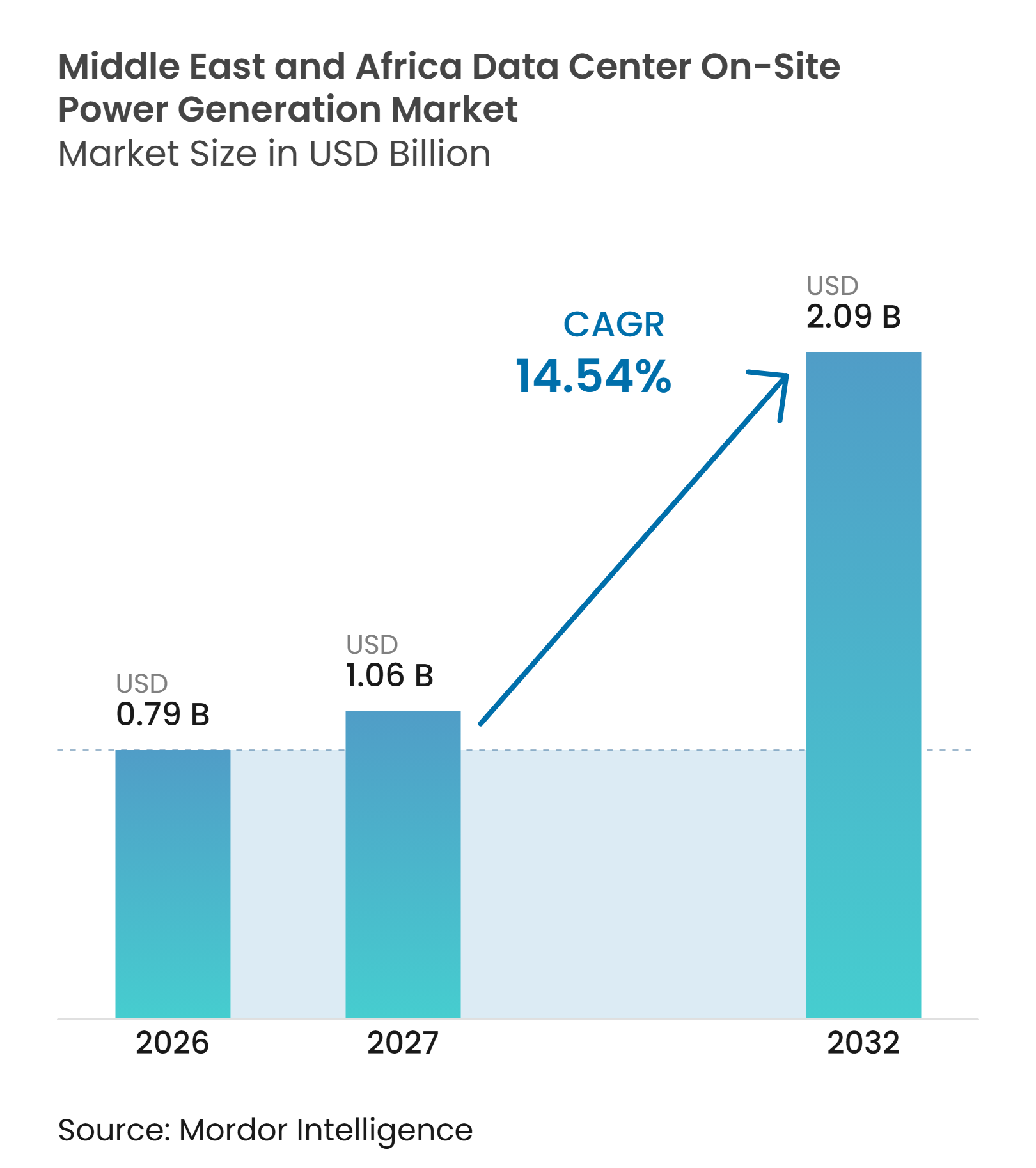
| Base Year Market Size (2026) | USD 0.79 Billion |
| Market Size (2027) | USD 1.06 Billion |
| Market Size (2032) | USD 2.09 Billion |
| Growth Rate (2027 - 2032) | 14.54 % |
| Market Concentration | Medium |
Major Players *Disclaimer: Major Players sorted in no particular order Image © Mordor Intelligence. Reuse requires attribution under CC BY 4.0. | |
Middle East and Africa Data Center On-Site Power Generation Market Analysis by Mordor Intelligence
The Middle East and Africa data center on-site power generation market size is projected to expand from USD 0.79 billion in 2026 and USD 1.06 billion in 2027 to USD 2.09 billion by 2032, registering a CAGR of 14.54% between 2027 and 2032. Installed generation capacity is expected to rise from 2.78 million MW in 2026 to 3.39 million MW in 2027 and 7.52 million MW by 2032, at a 17.27% volume CAGR. Faster capacity additions than value expansion point to lower equipment costs per installed MW, especially for diesel and reciprocating gas systems. The Middle East and Africa data center on-site power generation market is being reshaped by AI workloads that require more power per rack and by long waits for grid connections. This makes behind-the-meter generation a core part of facility planning rather than a backup-only purchase. GCC hyperscale tenders increasingly favor prompt delivery, fuel flexibility, and lifecycle operating costs, while African sites place greater value on dependable prime power.
Key Report Takeaways
- By generation technology, diesel generator sets held 46.03% of the Middle East and Africa data center on-site power generation market share in 2026, while fuel cells are projected to expand at a 15.73% CAGR through 2032.
- By installed generation capacity, the 1-5 MW category held a 34.12% share in 2026, while above-20 MW systems are projected to expand at a 15.33% CAGR through 2032.
- By fuel type, diesel held a 46.27% share in 2026, while hydrogen and hydrogen blends are projected to expand at a 15.56% CAGR through 2032.
- By application, emergency backup power held a 37.92% share in 2026 in the Middle East and Africa data center on-site power generation, while temporary and bridge power is projected to expand at a 15.12% CAGR through 2032.
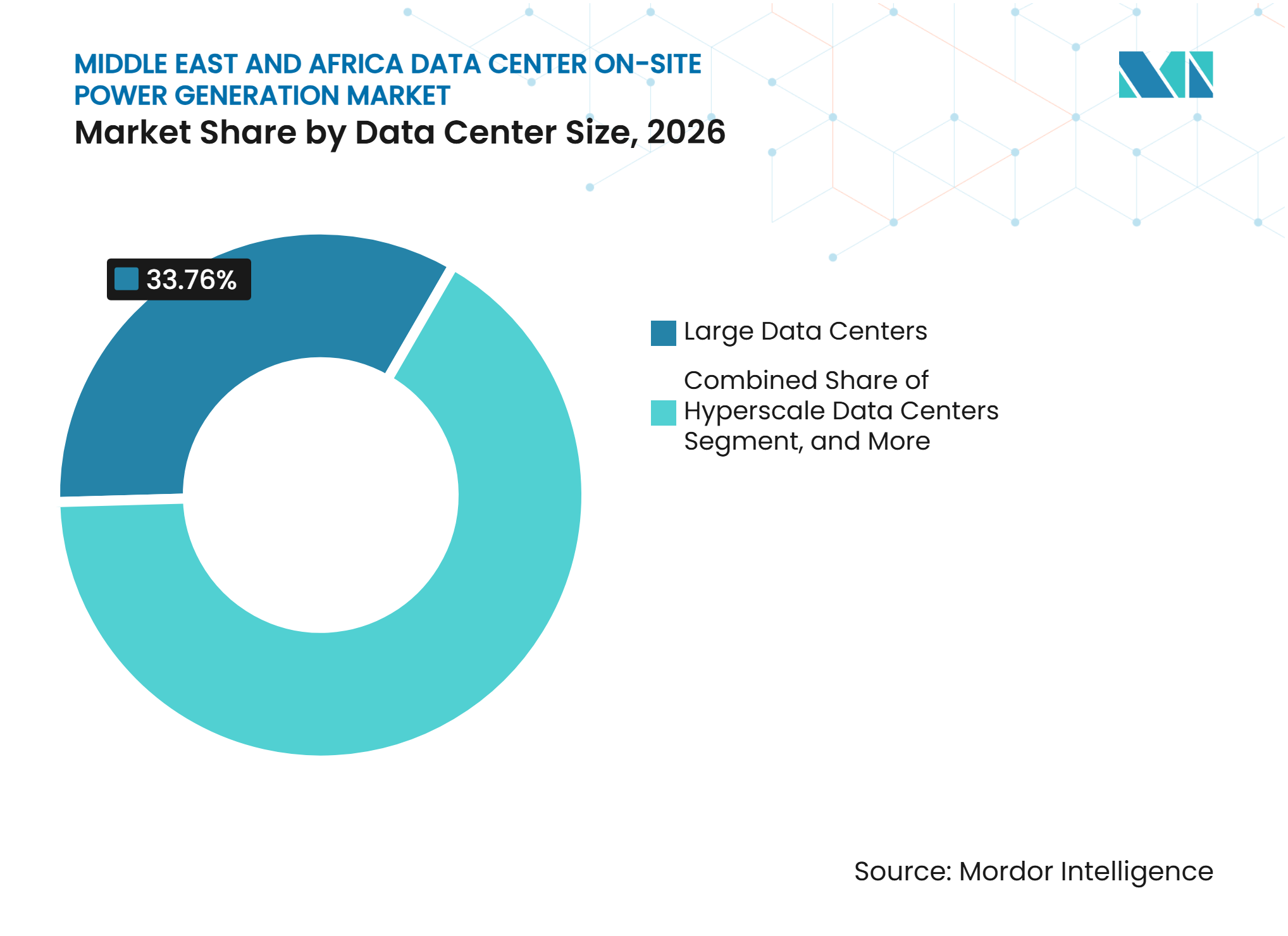
- By data center size, large facilities held a 33.76% share in 2026, while hyperscale facilities are projected to expand at a 15.31% CAGR through 2032.
- By data center type, cloud service providers held a 39.19% share in 2026. The supplied data does not identify the fastest-growing data center type.
- By geography, Saudi Arabia held 29.74% of the Middle East and Africa data center on-site power generation market share in 2026 and is projected to expand at a 15.58% CAGR through 2032.
Note: Market numbers in this report are based on Mordor Intelligence's proprietary estimation framework, which combines nine months of actuals with Q4 projections for base year 2026.
Market Trends and Insights
Drivers Impact Analysis of Middle East and Africa Data Center On-Site Power Generation Market*
| Driver | (~) % Impact on CAGR Forecast | Geographic Relevance | Impact Timeline |
|---|---|---|---|
| AI and Hyperscale Power-Density Growth | +4.5% | Global, concentrated in GCC core markets, Saudi Arabia and UAE | Short term (≤ 2 years) |
| Grid Interconnection Delays and Capacity Shortages | +3.2% | Sub-Saharan Africa and secondary GCC markets | Medium term (2-4 years) |
| Government-Backed Digital and Cloud Programs | +2.8% | Saudi Arabia, UAE, Egypt, and South Africa | Medium term (2-4 years) |
| Sovereign AI and Data Localization Investment | +1.8% | Saudi Arabia, UAE, South Africa, Egypt, and Morocco | Long term (≥ 4 years) |
| Oil-Field Waste-Gas-to-Power Opportunities | +0.9% | Oman, Saudi Arabia, UAE, and Nigeria | Medium term (2-4 years) |
| Subsea Cable Densification and Regional Data Traffic | +0.7% | Egypt, South Africa, and UAE | Long term (≥ 4 years) |
| Source: Mordor Intelligence | |||
AI and Hyperscale Power-Density Growth
AI server racks consume 30-100 kW, compared with 3-10 kW for conventional workloads, which changes power planning at new facilities.[1] At these densities, large campuses can create load swings that challenge local connections, raising the value of on-site systems in the Middle East and Africa data center on-site power generation market. GPU delivery schedules can arrive 12-18 months before supporting power infrastructure, so operators often reserve generation capacity before grid permits are complete. New Gulf facilities increasingly specify N+2 diesel configurations and 30-40 hours of fuel storage to maintain service during disruption. Bloom Energy reported that 61% of surveyed data center developers planned to bring their own power when grid supply could not meet their requirements.
Grid Interconnection Delays and Capacity Shortages
The International Energy Agency stated that grid connection constraints put around 20% of planned global data center projects at risk of delay.[2] Long grid connection waits can leave developers seeking power capacity before utility infrastructure is ready. Transmission and distribution losses of 18-25% in several East and West African countries reinforce the need for controlled on-site supply.[3] The World Economic Forum has called for facilities above 10 MW of IT load to submit electricity-demand forecasts during grid connection applications. The forum also states that behind-the-meter generation can accelerate deployment by 12-36 months, which makes it commercially important for the Middle East and Africa data center on-site power generation market.
Government-Backed Digital and Cloud Programs
Saudi Arabia's data center sector has expanded 6 times since Vision 2030 began, with investment exceeding SAR 16 billion (USD 4.26 billion). The country had an estimated 222 MW of IT power capacity in Q1 2025 and plans to add 760 MW by 2030. The UAE has a USD 46.1 billion data center pipeline, and capacity is expected to increase from 358 MW to 950 MW by 2028. State-backed programs reduce financing risk for large power packages and strengthen the case for multi-year equipment contracts. In April 2025, IFC backed Raxio Group with USD 100 million in facilities across Ethiopia and Angola, supporting demand for reliable local power.
Sovereign AI and Data Localization Investment
Data localization rules direct investment toward domestic sites, including locations where grid infrastructure has not kept pace with digital policy. Saudi Arabia's data center regulations combine sovereignty requirements with infrastructure standards, which supports local facility investment. Morocco announced a 500 MW facility in Dakhla with a USD 60 million plan, including renewable power, placing a large load in a location with limited grid access. Cassava Technologies and Accenture agreed in September 2025 to advance sovereign AI cloud services across South Africa, Egypt, Kenya, Morocco, and Nigeria. This siting pattern gives jurisdictional control priority over grid quality and embeds generation requirements in early facility designs. It therefore supports longer-term demand across the Middle East and Africa data center on-site power generation market.
Restraints Impact Analysis of Middle East and Africa Data Center On-Site Power Generation Market*
| Restraint | (~) % Impact on CAGR Forecast | Geographic Relevance | Impact Timeline |
|---|---|---|---|
| High Upfront Capital Cost and Integration Complexity | -1.8% | Pan-MEA, concentrated in Sub-Saharan Africa and secondary GCC cities | Medium term (2-4 years) |
| Natural Gas Supply and Pipeline Capacity Constraints | -0.9% | Sub-Saharan Africa inland markets and non-GCC Middle East | Long term (≥ 4 years) |
| Permitting, Environmental Compliance, and Local Technical Skills Gaps | -0.6% | Sub-Saharan Africa, Egypt, and secondary GCC markets | Medium term (2-4 years) |
| Desert Cooling Loads and Water Scarcity | -0.5% | GCC and North Africa | Short term (≤ 2 years) |
| Source: Mordor Intelligence | |||
High Upfront Capital Cost and Integration Complexity
Generator-heavy projects in Sub-Saharan Africa can allocate 15-25% of total development cost to on-site power systems. Fuel logistics, civil works, imported equipment, and specialist commissioning increase the financial commitment for each facility. This encourages operating leases and temporary power contracts, which preserve capital for IT equipment but increase long-term service spending. Local supply chains often lack the specialized materials, equipment, and commissioning expertise needed for advanced power systems. Combining engines, fuel cells, batteries, and automatic transfer switches requires expertise that remains concentrated in Gulf cities, adding cost to the Middle East and Africa data center on-site power generation market.
Natural Gas Supply and Pipeline Capacity Constraints
Gas pipeline infrastructure remains limited outside coastal Nigeria and a small number of African subregional projects. This separates inland markets that remain dependent on diesel from corridors that can use gas systems with lower fuel costs. The Atlantic Council reported that African gas-to-power projects face high initial costs and financing challenges unless tied to large export projects. In the GCC, shortages of gas turbines have extended supply pressure even where gas access is better. These conditions keep diesel as the short-term default and position hydrogen blends and renewable fuels as longer-term options in the Middle East and Africa data center on-site power generation market.
*Our forecasts treat driver/restraint impacts as directional, not additive. The impact forecasts reflect baseline growth, mix effects, and variable interactions.
Middle East and Africa Data Center On-Site Power Generation Market Segment Analysis
By Generation Technology:
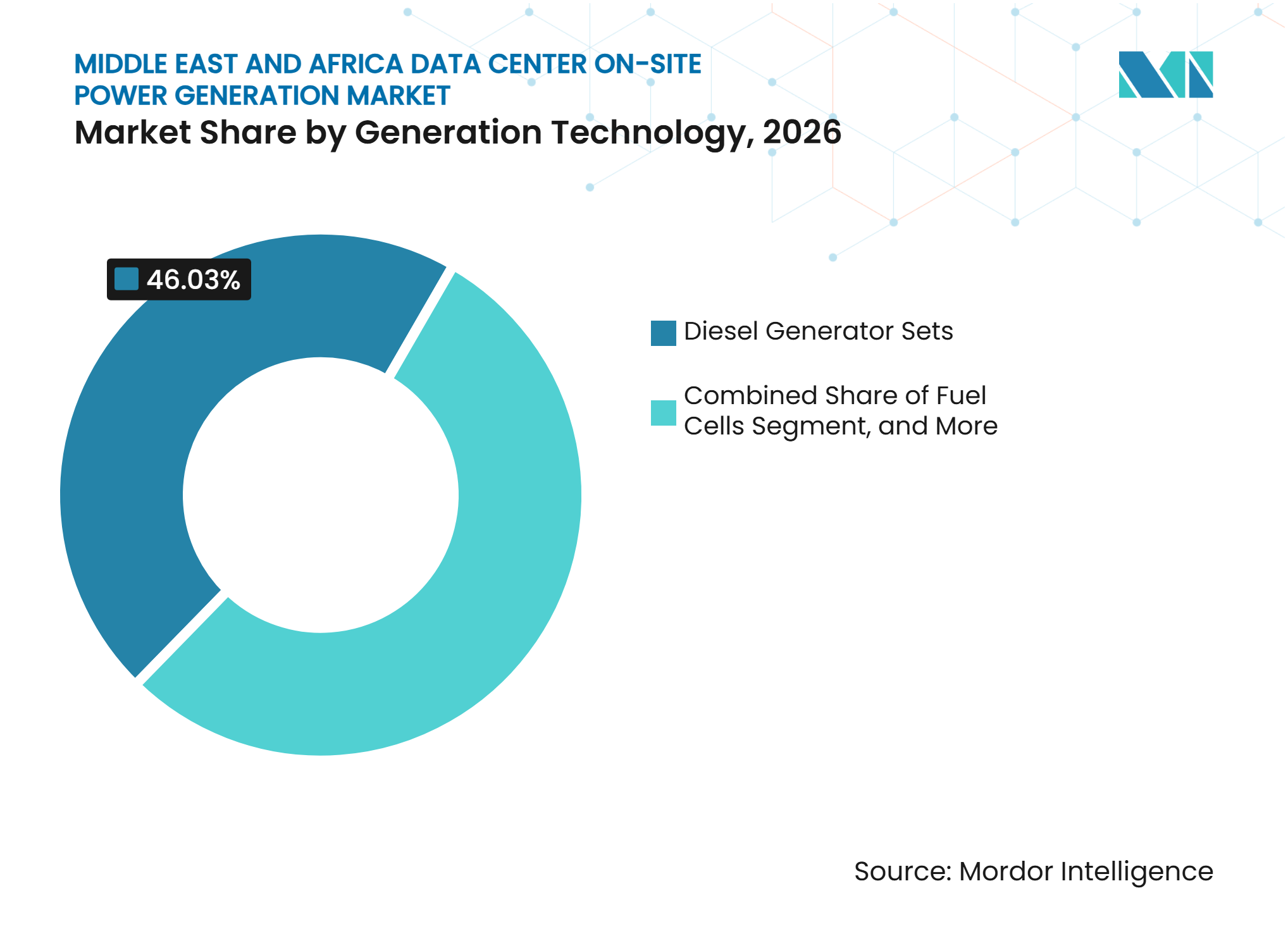
Diesel Retains the Largest Installed Base While Fuel Cells Gain GroundDiesel generator sets held 46.03% of the Middle East and Africa data center on-site power generation market share in 2026. Their rapid start capability, established service channels, and familiar fuel supply arrangements remain important across GCC and Sub-Saharan African locations. Natural gas generator sets, gas turbines, and reciprocating gas engines account for much of the remaining demand. Gas systems are more attractive in pipeline-served GCC locations because they can lower fuel costs and reduce local emissions. Hybrid diesel-battery systems are becoming increasingly relevant at edge and colocation sites, where space constraints limit conventional configurations.
Fuel cells are projected to expand at a 15.73% CAGR through 2032, making them the fastest-growing generation technology. Bloom Energy found that 47% of data center developers were actively considering fuel cells, indicating broader evaluation of fuel cells for primary power roles. A 1.5 MW hydrogen PEMFC deployment at a Microsoft data center met ISO 8528-5 transient standards in a study published in November 2025. Systems that can operate on diesel, natural gas, hydrotreated vegetable oil, or hydrogen blends provide procurement flexibility where fuel supply choices remain uncertain. That flexibility helps suppliers compete for resilience-led projects in the Middle East and Africa data center on-site power generation market.



By Installed Generation Capacity:
Large Systems Support Hyperscale ConstructionThe 1-5 MW category held 34.12% of the Middle East and Africa data center on-site power generation market size in 2026. It reflects legacy colocation and enterprise facilities that add power in increments as IT load expands. Below-1 MW solutions generally serve small edge and enterprise sites through standard diesel equipment. The above-5-20 MW range supports expanding colocation campuses in secondary GCC cities and emerging African hubs. Each range has different procurement needs, service arrangements, and delivery schedules.
Above-20 MW systems are projected to expand at a 15.33% CAGR through 2032. Hyperscale campuses now plan power requirements in 100 MW or 200 MW blocks from the beginning of a project. Cummins Arabia delivered 73.2 MW across 4 Saudi hyperscale sites in June 2025, using 36 enclosed gensets and completing the work within 7 months. The systems were certified for 50°C conditions and Uptime Institute data center specifications. The segment is divided between standardized, price-led equipment below 20 MW and integration-led projects above that threshold, where lead times for reciprocating engines can reach 12-18 months.
By Fuel Type:
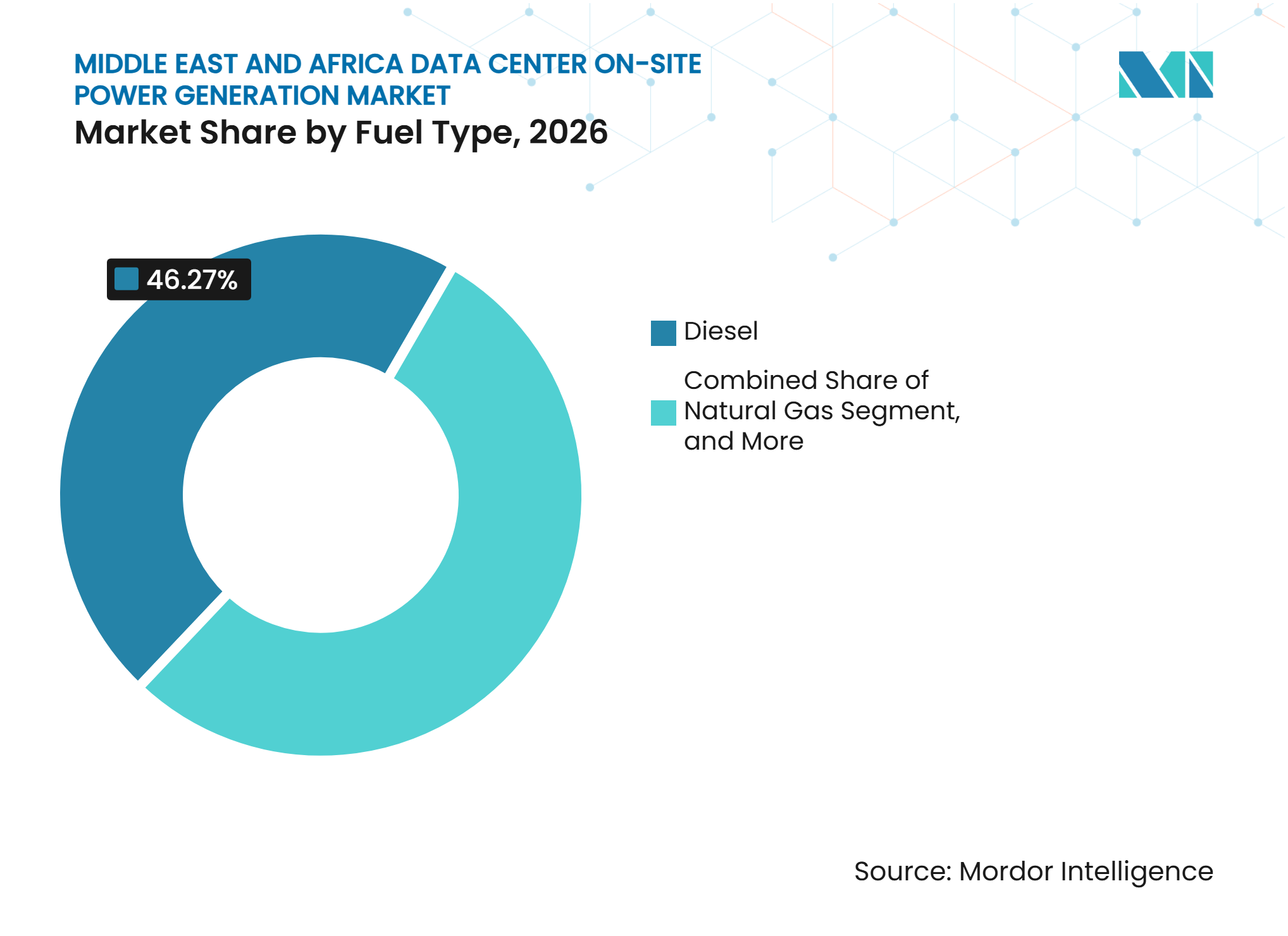
Diesel Leads While Hydrogen Options Move Beyond TrialsDiesel held 46.27% of the Middle East and Africa data center on-site power generation market share by fuel type in 2026. Its distribution network extends across regional markets and gives operators a practical choice where alternatives are limited. Natural gas is the main option in pipeline-connected GCC locations because of its lower carbon intensity and fuel-cost benefits. However, heavy gas turbine supply backlogs can run from 2-5 years, which restricts equipment availability. Renewable fuels and biogas remain smaller categories, although hydrotreated vegetable oil can be used as a drop-in diesel substitute without generator modification.
Hydrogen and hydrogen blends are projected to expand at a 15.56% CAGR through 2032. In May 2026, SHPT shipped fuel cell products for Egypt's first data center hydrogen emergency power supply project. An IEEE paper published in October 2025 described a green hydrogen DC microgrid at a 1 MW NEOM facility that operated with zero grid imports over a full year. Hydrogen Europe reported that the sector is already considering hydrotreated vegetable oil retrofits and e-fuels such as e-methanol. These developments indicate an incremental fuel transition rather than a rapid replacement of diesel systems.

By Application:
Backup Remains Central While Bridge Power Extends Its RoleEmergency backup power held 37.92% of the Middle East and Africa data center on-site power generation market size in 2026. Tier III and Tier IV facilities require at least N+1 generator redundancy, supporting a durable base of demand. Prime and continuous power applications are more common where grid quality cannot support a facility on its own. In some Sub-Saharan locations, recurring grid outages require on-site equipment to support daily operations. In these locations, on-site systems serve a primary operating role rather than a contingency function.
Temporary and bridge power is projected to expand at a 15.12% CAGR through 2032. The application is supported by the gap between available IT equipment and completed grid connections. Extended grid connection waits encourage operators to commission bridge capacity for 24-48 months before permanent systems are ready. These longer deployments are changing rental contracts from short emergency coverage to multi-year service arrangements. Wärtsilä reported close to 800 MW of data center power orders in 2025, including a meaningful bridge-power component. The boundary between temporary and prime power is therefore becoming less distinct.
By Data Center Size:
Hyperscale Projects Change Procurement RequirementsLarge facilities held 33.76% of the Middle East and Africa data center on-site power generation market share by data center size in 2026. These facilities set many equipment specifications and commercial terms for the supply chain. Small and medium data centers remain numerous across Africa, where enterprise and government operations are important. Their individual procurement volumes are lower than those of large campuses. Their demand is nevertheless significant because on-site systems are often included from initial design.
Hyperscale facilities are projected to expand at a 15.31% CAGR through 2032. Construction began on the 480 MW Hexagon data center in Saudi Arabia in January 2026, showing the scale of new power requirements. The African Energy Chamber expects African data center demand to reach 2 GW by 2030 and support USD 10 billion-USD 20 billion of energy investment. GCC hyperscalers are also considering generators as active participants in microgrids that manage grid charges and load shedding. This changes maintenance requirements and the commercial value of generator fleets.
By Data Center Type:
Cloud Service Providers Concentrate Power DemandCloud service providers held 39.19% of the Middle East and Africa data center on-site power generation market share by data center type in 2026. They are the largest individual buyers of local generation capacity in the GCC and in emerging African markets. Colocation operators centralize power procurement for enterprise and government tenants who outsource infrastructure operations. Enterprise and edge sites form a more dispersed demand base, particularly where carrier-neutral colocation capacity is limited. In these locations, on-site supply is usually embedded in original facility planning.
Cloud service provider demand influences supplier strategy because a preferred-supplier position can lead to multi-hundred-MW commitments in one buying cycle. Wärtsilä recorded close to 800 MW of data center-related power orders in 2025, a scale that would previously have been distributed among many enterprise customers. This concentration shortens procurement cycles and places greater value on delivery certainty. It also makes standardized service coverage important for global cloud operators. Equipment suppliers in the Middle East and Africa data center on-site power generation industry must balance a small number of large accounts with the broader needs of colocation and enterprise sites.
Geography Analysis
Saudi Arabia held 29.74% of the Middle East and Africa data center on-site power generation market share in 2026 and is projected to expand at a 15.58% CAGR through 2032. Saudi Arabia has a material planned expansion of IT power capacity through 2030, and large AI data center programs support dedicated generation at major sites. The UAE has a substantial pipeline of new data center capacity that supports local power procurement, including the G42 Stargate campus, where the first phase was expected to contribute 200 MW by mid-2026. Gulf facilities face summer conditions reaching 50°C, increasing cooling loads and total site power requirements.
South Africa is a leading Sub-Saharan data center location and has a mature base of critical IT infrastructure. Its Electricity Regulation Amendment Act has removed licensing caps on private power generation, thereby supporting captive generation options. Egypt is a subsea cable hub with more than 10 new cable projects, including 2Africa, EAGLE, and Africa-1, that are scheduled to be completed between 2025 and 2027. Egypt's hydrogen emergency power project shows an early effort to diversify from diesel-only backup. Israel has a growing regional capacity pipeline and strong power reliability requirements, favoring more complex, multi-technology architectures.
The Rest of Middle East and Africa includes Nigeria, Kenya, Oman, Morocco, and Ethiopia, where demand conditions differ but on-site power dependence is often high. Nigeria receives around 4 hours of grid supply per day, and diesel can account for up to 60% of operators' expenditure. Morocco's planned 500 MW Dakhla facility will require dedicated power because of its remote location. In Oman, Aggreko and InoWatti signed a 2026 memorandum on modular flare-gas-to-power systems for high-density computing. Africa is expected to require 2 GW of data center capacity by 2030, making dependable local supply integral to future projects.
Competitive Landscape
Market Concentration
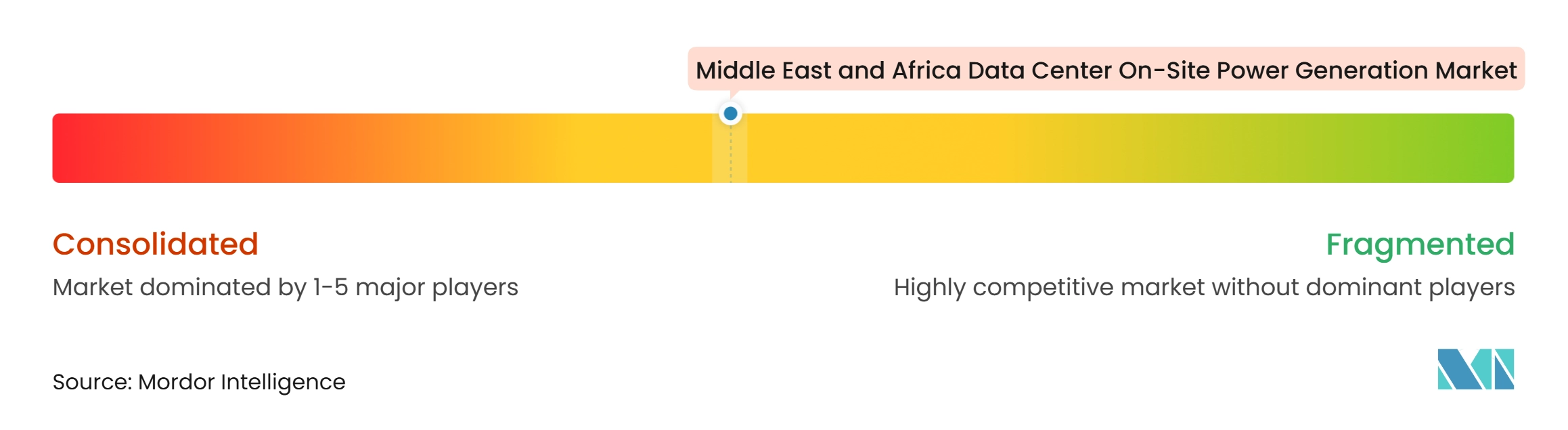
The Middle East and Africa data center on-site power generation market is moderately consolidated in technology platforms but fragmented in project delivery. Global manufacturers use local distribution partners and regional specialists to serve smaller and mid-sized operators. Heavy-duty and aeroderivative turbine suppliers compete for very large projects. Reciprocating-engine and fuel-cell providers focus on 1-20 MW deployments with shorter delivery schedules. Modular temporary-power providers address bridge requirements created by grid delays.
GE Vernova's aeroderivative turbine orders rose by 33% in the first 9 months of 2025, and its gas power equipment backlog exceeded 116 GW by Q2 2026. This backlog can favor engine suppliers that can deliver within 12-18 months instead of multi-year turbine lead times. Bloom Energy expanded its Oracle partnership in April 2026 to provide up to 2.8 GW of solid-oxide fuel cell capacity. The Caterpillar-led hydrogen PEMFC project at a Microsoft data center established safety and performance reference points for future hydrogen qualifications. These moves show that suppliers are competing for primary-power roles as well as backup contracts.
Opportunity remains in flare-gas-to-compute projects, temporary installations above 20 MW, and long-term maintenance of African diesel fleets. Aggreko and InoWatti's Oman agreement may provide a commercial model for oil-field-linked computing in Oman, the UAE, and Nigeria. INNIO extended its partnership with Aggreko through 2031, committing at least 450 MW of Jenbacher Type 4 engine capacity for 2027 and adding the J620 platform from 2028. Providers that combine equipment, fuel flexibility, and long-term service can build stronger positions. The available information does not provide combined market shares for leading companies, so a quantitative market concentration score cannot be established from the supplied evidence.
Middle East and Africa Data Center On-Site Power Generation Industry Leaders
-
Caterpillar Inc.
-
Cummins Inc.
-
Rolls-Royce Power Systems AG
-
Bloom Energy Corporation
-
Rehlko
- *Disclaimer: Major Players sorted in no particular order
Middle East and Africa Data Center On-Site Power Generation Market Companies Covered in this Report
- Caterpillar Inc.
- Cummins Inc.
- Rolls-Royce Power Systems AG
- Bloom Energy Corporation
- Rehlko
- Generac Holdings Inc.
- GE Vernova Inc.
- Siemens Energy AG
- Wärtsilä Corporation
- INNIO N.V.
- Everllence SE
- Baker Hughes Company
- Mitsubishi Heavy Industries, Ltd.
- FuelCell Energy, Inc.
- Doosan Enerbility Co., Ltd.
- Aggreko plc
- Atlas Copco AB
- Himoinsa, S.L.
- Aksa Power Generation
- Yanmar Holdings Co., Ltd.
- Saudi Power Transformers Company
- Khazna Data Centers
- Africa Data Centres
- Teraco Data Environments (Pty) Ltd
- Gulf Data Hub
- center3
- Rack Centre Limited
- Raya Data Center
Recent Industry Developments in Middle East and Africa Data Center On-Site Power Generation Market
- October 2026: INNIO N.V. and Aggreko extended their strategic partnership through 2031, with INNIO committing to supply at least 450 MW of Jenbacher Type 4 engine capacity in 2027 and access to agreed capacity levels through the remainder of the agreement, the partnership added the J620 engine platform from 2028, expanding fuel flexibility and power density for data center and critical power applications globally, including MEA markets where Aggreko holds a significant operational footprint.
- May 2026: SHPT shipped hydrogen fuel cell power generation products for Egypt's first data center hydrogen emergency power supply project, serving the country's largest mobile operator, the system integrates PEM water electrolysis hydrogen production, solid-state hydrogen storage, and fuel cell generation to provide 2 hours of uninterrupted backup power, establishing a reference deployment for hydrogen-based backup in an African market.
- April 2026: Bloom Energy expanded its partnership with Oracle to supply up to 2.8 GW of solid-oxide fuel cell capacity, with the agreement positioning fuel cells as primary-power architecture for hyperscale facilities rather than emergency backup, marking a significant escalation in the commercial scale of fuel cell deployments for data centers.
- January 2026: Construction began on Saudi Arabia's Hexagon 480 MW data center developed by SDAIA in Riyadh, representing one of the largest single-facility power demand events in the kingdom's current data center build-out cycle and directly creating demand for multi-hundred-megawatt on-site generation systems in the GCC's largest market.
Middle East and Africa Data Center On-Site Power Generation Market Report Scope
The Middle East and Africa Data Center On-Site Power Generation Market Report comprises solutions that enable data centers to generate electricity within or adjacent to their facilities to ensure a reliable, resilient, and uninterrupted power supply. These systems support operational continuity by reducing dependence on external grids, mitigating the risk of power outages, and addressing the growing energy demands of digital infrastructure. The market includes technologies designed for backup, primary, and continuous power generation, helping operators enhance energy security, optimize operational efficiency, support sustainability objectives, and meet the increasing power requirements of modern, high-density computing environments.
The Middle East and Africa Data Center On-Site Power Generation Market is Segmented by Generation Technology (Diesel Generator Sets, Natural Gas Generator Sets, Gas Turbines, Reciprocating Gas Engines, Fuel Cells, and Other Generation Technologies), Installed Generation Capacity (Below 1 MW, 1–5 MW, 5–20 MW, and Above 20 MW), Fuel Type (Diesel, Natural Gas, Renewable Fuels and Biogas, Hydrogen and Hydrogen Blends, and Other Fuel Types), Application (Emergency Backup Power, Prime Power, Continuous Power, and Temporary and Bridge Power), Data Center Size (Small, Medium, Large, and Hyperscale), Data Center Type (Colocation, Cloud Service Providers, and Enterprise and Edge), and Geography (Saudi Arabia, United Arab Emirates, South Africa, Israel, Egypt, and Rest of the Middle East and Africa). The Market Forecasts are Provided in Terms of Value (USD) and Volume (MW).
Segmentation Overview
| Diesel Generator Sets |
| Natural Gas Generator Sets |
| Gas Turbines |
| Reciprocating Gas Engines |
| Fuel Cells |
| Other Generation Technologies |
| Below 1 MW |
| 1-5 MW |
| Above 5-20 MW |
| Above 20 MW |
| Diesel |
| Natural Gas |
| Renewable Fuels and Biogas |
| Hydrogen and Hydrogen Blends |
| Other Fuels |
| Emergency Backup Power |
| Prime Power |
| Continuous Power |
| Temporary and Bridge Power |
| Small |
| Medium |
| Large |
| Hyperscale |
| Colocation |
| Cloud Service Providers (CSPs) |
| Enterprise and Edge |
| Saudi Arabia |
| United Arab Emirates |
| South Africa |
| Israel |
| Egypt |
| Rest of the Middle East and Africa |
| By Generation Technology | Diesel Generator Sets |
| Natural Gas Generator Sets | |
| Gas Turbines | |
| Reciprocating Gas Engines | |
| Fuel Cells | |
| Other Generation Technologies | |
| By Installed Generation Capacity | Below 1 MW |
| 1-5 MW | |
| Above 5-20 MW | |
| Above 20 MW | |
| By Fuel Type | Diesel |
| Natural Gas | |
| Renewable Fuels and Biogas | |
| Hydrogen and Hydrogen Blends | |
| Other Fuels | |
| By Application | Emergency Backup Power |
| Prime Power | |
| Continuous Power | |
| Temporary and Bridge Power | |
| By Data Center Size | Small |
| Medium | |
| Large | |
| Hyperscale | |
| By Data Center Type | Colocation |
| Cloud Service Providers (CSPs) | |
| Enterprise and Edge | |
| By Geography | Saudi Arabia |
| United Arab Emirates | |
| South Africa | |
| Israel | |
| Egypt | |
| Rest of the Middle East and Africa |
Key Questions Answered in the Report
What is the Middle East and Africa data center on-site power generation market size?
The market is projected to increase from USD 0.79 billion in 2026 to USD 2.09 billion by 2032, with a 14.54% CAGR from 2027 to 2032.
What is driving demand for on-site data center power in the region?
AI rack density, delayed grid connections, sovereign cloud programs, and data localization requirements are increasing demand for resilient local power.
Which generation technology has the largest share?
Diesel generator sets held a 46.03% share in 2026 because they offer rapid start capability and established fuel and service networks.
Which power technology is projected to expand fastest?
Fuel cells are projected to expand at a 15.73% CAGR through 2032 as operators evaluate them for resilient primary-power applications.
Why is temporary and bridge power becoming more important?
Temporary and bridge power is projected to expand at a 15.12% CAGR through 2032 because grid connections can take more than 4 years in primary locations.
Which country leads regional demand?
Saudi Arabia held 29.74% share in 2026 and is projected to expand at a 15.58% CAGR through 2032, supported by large AI and cloud projects.