
Middle East and Africa Data Center Grid Infrastructure and Interconnection Market Size and Share
Market Overview
| Study Period | 2021 - 2032 |
|---|---|
| Forecast Data Period | 2027 - 2032 |
| Base Year Market Size (2026) | USD 1.05 Billion |
| Market Size (2027) | USD 2.44 Billion |
| Market Size (2032) | USD 5.34 Billion |
| Growth Rate (2027 - 2032) | 16.96 % |
| Market Concentration | Medium |
Major Players *Disclaimer: Major Players sorted in no particular order Image © Mordor Intelligence. Reuse requires attribution under CC BY 4.0. | |
Middle East and Africa Data Center Grid Infrastructure and Interconnection Market Analysis by Mordor Intelligence
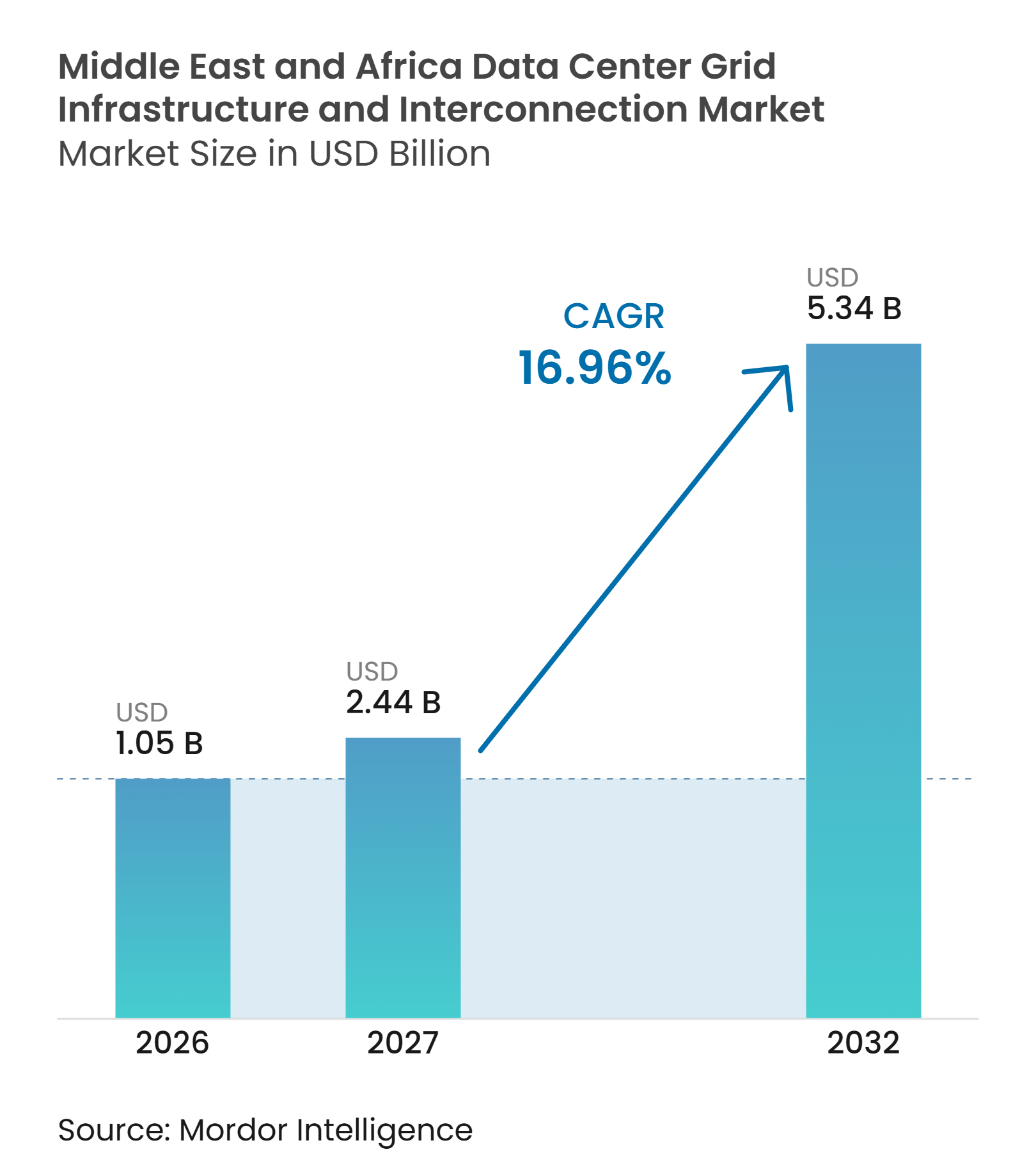
The Middle East and Africa data center grid infrastructure and interconnection market size is projected to expand from USD 1.05 billion in 2026 to USD 2.44 billion in 2027, and to USD 5.34 billion by 2032, registering a CAGR of 16.96% between 2027 and 2032. The sharp change between 2026 and 2027 reflects committed spending as projects move into grid connection, substation, and transmission contracts. Grid access has become a scheduling issue for large campuses because an early connection can determine when computing capacity enters service. Higher electricity use by AI-focused facilities is increasing the need for equipment and networks capable of meeting large, variable loads. The Middle East and Africa data center grid infrastructure and interconnection market is supported by sovereign digital programs, hyperscale investment, and renewable power procurement. Long equipment lead times and water constraints are likely to shape project designs and procurement schedules.
Key Report Takeaways
- By interconnection project type, new grid connections held 42.93% of the Middle East and Africa data center grid infrastructure and interconnection market share in 2026, while dedicated transmission infrastructure is projected to expand at a 17.76% CAGR through 2032.
- By infrastructure component, substations and switchyards accounted for 30.24% of the Middle East and Africa data center grid infrastructure and interconnection market size in 2026, while grid connection, control, and monitoring systems are projected to expand at a 17.98% CAGR through 2032.
- By voltage level, high-voltage installations held 45.85% of the market in 2026, while extra-high-voltage installations are projected to expand at a 17.74% CAGR through 2032.
- By data center size, hyperscale facilities accounted for 48.78% of the market in 2026 and are projected to grow at a 17.53% CAGR through 2032.
- By data center type, cloud service providers held 43.41% of the market in 2026 and are projected to expand at a 17.62% CAGR through 2032.
- By geography, Saudi Arabia accounted for 45.51% of the regional total in 2026 and is projected to grow at an 18.34% CAGR through 2032.
Note: Market numbers in this report are based on Mordor Intelligence's proprietary estimation framework, which combines nine months of actuals with Q4 projections for base year 2026.
Market Trends and Insights
Drivers Impact Analysis of Middle East and Africa Data Center Grid Infrastructure and Interconnection Market*
| Driver | (~) % Impact on CAGR Forecast | Geographic Relevance | Impact Timeline |
|---|---|---|---|
| AI and Hyperscale Data Center Expansion | +4.0% | Global, concentrated in Saudi Arabia and UAE | Short term (≤ 2 years) |
| Government-Led Digital Infrastructure and Sovereign Cloud Programs | +3.0% | Saudi Arabia, UAE, Egypt, Qatar, South Africa | Medium term (2-4 years) |
| Data Center Concentration in High-Growth Power Corridors | +2.5% | Saudi Arabia, UAE | Short term (≤ 2 years) |
| Renewable Power Procurement and Utility-Scale Grid Investment | +2.0% | Saudi Arabia, UAE, South Africa, Morocco | Medium term (2-4 years) |
| Self-Build Interconnection Models for Large Data Center Campuses | +1.5% | Saudi Arabia, UAE | Medium term (2-4 years) |
| Increasing Power Density From Accelerated Computing and Liquid-Cooled Infrastructure | +1.2% | Global, with spillover to Middle East and Africa core markets | Long term (≥ 4 years) |
| Source: Mordor Intelligence | |||
AI and Hyperscale Data Center Expansion
AI computing requires much larger connections than earlier cloud facilities. Demand in the Middle East and Africa data center grid infrastructure and interconnection market is concentrated in a small number of campuses, which increases the scale of each required substation and transmission upgrade. The planned 1 GW first cluster of the Stargate UAE project illustrates the size of a single new load center. A facility of this size needs utility-side reinforcement and cannot rely on standard distribution arrangements. Variable AI training workloads also increase the need for controls that manage power quality and changing demand. The Middle East and Africa data center grid infrastructure and interconnection market, therefore, favors suppliers that can combine high-voltage equipment with responsive controls.
Government-Led Digital Infrastructure and Sovereign Cloud Programs
Public digital strategies create fixed delivery dates for data center capacity and the related grid connection. Saudi Arabia's National Data Center Strategy set a 1.5 GW target for nationally hosted data center capacity by 2030. The target requires parallel planning of transmission, substations, and local distribution capacity. Abu Dhabi's Unified Government Data Center brought more than 40 government entities together in a single AI-ready facility in 2025.[1] Middle East and Africa data center grid infrastructure and interconnection market projects make connection timing a public implementation requirement rather than only a private commercial decision. The Middle East and Africa data center grid infrastructure and interconnection market gains visibility when government programs establish capacity targets and operating deadlines.
Data Center Concentration in High-Growth Power Corridors
Saudi Arabia and the UAE are concentrating large data center projects within a limited number of power corridors. This pattern can strain existing transmission headroom before individual campuses are built. A single project can require multiple voltage levels, dedicated substations, and new transmission works. HUMAIN's Riyadh development has brought utility collaboration into the early stage of campus planning. Concentration in the Middle East and Africa data center grid infrastructure and interconnection market also raises the value of suppliers that already understand local protection and interconnection requirements. The Middle East and Africa data center grid infrastructure and interconnection market is likely to see more bilateral arrangements between utilities, operators, and equipment providers in these corridors.
Renewable Power Procurement and Utility-Scale Grid Investment
Large data center projects are increasingly linked to renewable power procurement. Renewable generation supporting the Middle East and Africa data center grid infrastructure and interconnection market needs transmission, substations, and control systems that can move variable power to the campus connection point. DataVolt's planned 1.5 GW campus at Oxagon was designed around renewable energy and green hydrogen. This relationship can align data center construction with renewable generation and grid reinforcement. It also increases the importance of monitoring systems that can balance changing supply and demand. The Middle East and Africa data center grid infrastructure and interconnection market can benefit when long-term power agreements give utilities clearer demand signals for network investment.
Restraints Impact Analysis of Middle East and Africa Data Center Grid Infrastructure and Interconnection Market*
| Restraint | (~) % Impact on CAGR Forecast | Geographic Relevance | Impact Timeline |
|---|---|---|---|
| Long Lead Times for High-Voltage Equipment and Grid Studies | -3.5% | Global, acute in Middle East and Africa | Short term (≤ 2 years) |
| Water Scarcity and Thermal Constraints in Arid Data Center Clusters | -2.0% | Saudi Arabia, UAE, Qatar, Egypt | Medium term (2-4 years) |
| Fragmented Utility, Data Sovereignty, and Connection Approval Frameworks | -1.5% | Africa, broader Middle East and Africa outside GCC | Long term (≥ 4 years) |
| Limited Availability of Specialized High-Voltage Engineering, Commissioning, and Grid-Operations Talent | -1.0% | Africa, emerging Middle East and Africa markets | Medium term (2-4 years) |
| Source: Mordor Intelligence | |||
Long Lead Times for High-Voltage Equipment and Grid Studies
Long delivery schedules for high-voltage transformers, switchgear, and related equipment can delay the energization of large campuses. Suppliers are allocating manufacturing capacity years ahead, so project sponsors need to reserve equipment early. The constraint is especially important where grid studies and approvals have not handled large digital loads before. Hitachi Energy has identified connection delays as a risk for planned data center capacity as demand for power infrastructure rises.[2] Projects that secure transformer slots and complete utility studies early have a clearer path to delivery. The Middle East and Africa data center grid infrastructure and interconnection market may reward standardized equipment and modular designs that shorten on-site commissioning.
Water Scarcity and Thermal Constraints in Arid Data Center Clusters
Arid operating conditions can increase the electricity required for cooling. Operators may choose dry cooling or liquid cooling when water availability limits evaporative approaches. Those choices can increase the grid-side capacity required for a given level of IT load. The planned Oxagon campus includes cooling and renewable energy design as part of its infrastructure model. Thermal design can therefore influence substation sizing, backup arrangements, and the structure of the grid connection. The Middle East and Africa data center grid infrastructure and interconnection market must account for cooling loads alongside computing loads when designing power infrastructure.
*Our forecasts treat driver/restraint impacts as directional, not additive. The impact forecasts reflect baseline growth, mix effects, and variable interactions.
Middle East and Africa Data Center Grid Infrastructure and Interconnection Market Segment Analysis
By Interconnection Project Type:
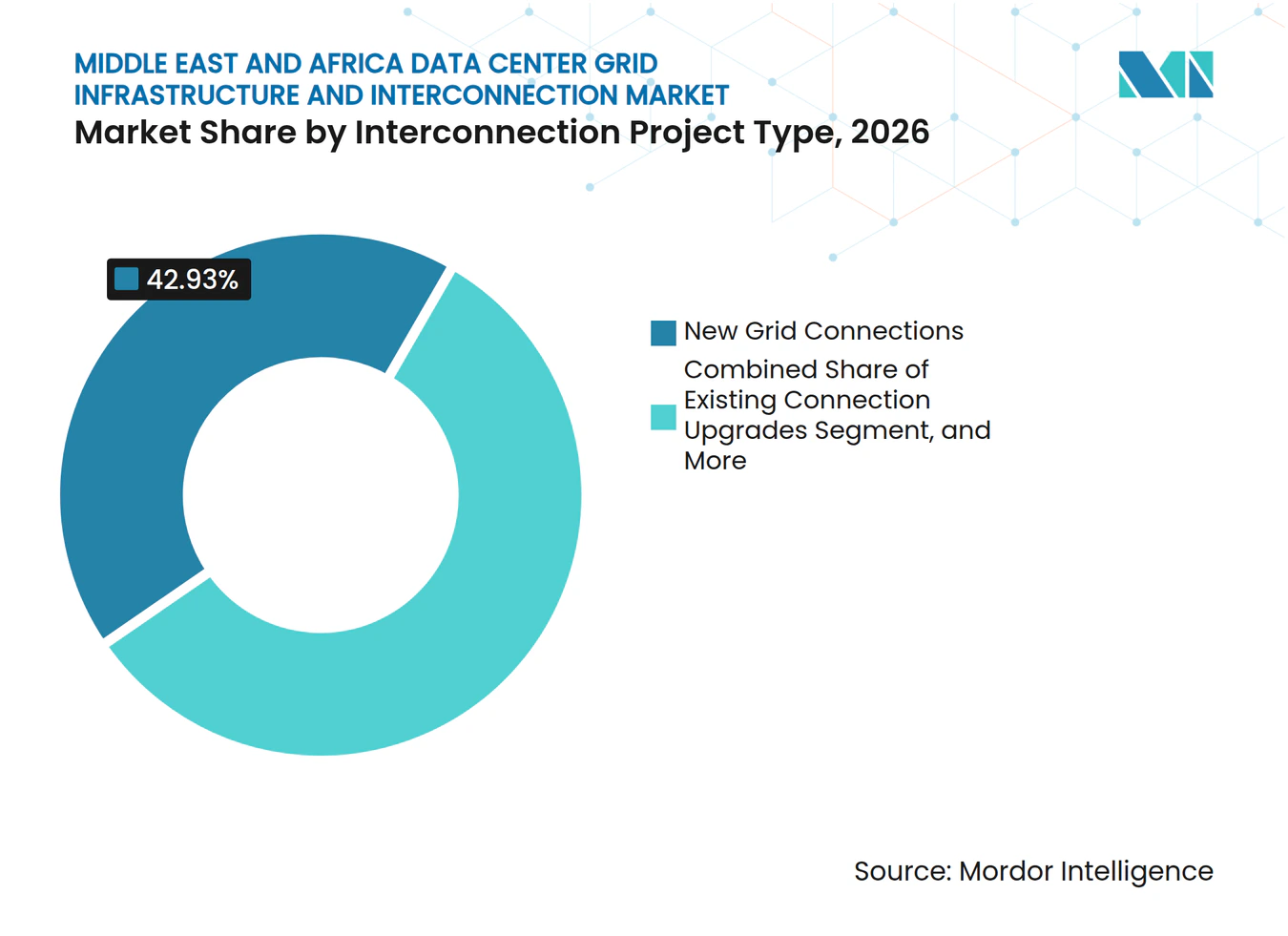
New Connections Anchor Current Build-OutNew grid connections held 42.93% of the Middle East and Africa data center grid infrastructure and interconnection market size in 2026. The result reflects the early stage of large data center construction in Saudi Arabia, the UAE, and South Africa. Many announced facilities need an initial entry point to the grid before later expansion phases can proceed, including the equipment, studies, and works required to establish that point of supply. Operators increasingly seek dedicated arrangements where existing utility capacity cannot support a large new campus. This approach gives developers greater control over schedule and connection configuration while allowing the connection design to match the campus development plan.
Dedicated transmission infrastructure is projected to expand at a 17.76% CAGR through 2032. Giga campuses above 500 MW may need purpose-built links rather than shared utility corridors. The planned Riyadh campus for HUMAIN includes dedicated 380 kV, 132 kV, and 33 kV network infrastructure and a 2,000 MVA bulk supply point. Existing connection upgrades and substation upgrades serve operators that add capacity at established sites, while dedicated links remain dependent on utility coordination because private systems must still connect to national networks. This creates a role for bilateral agreements that combine utility planning with developer-led infrastructure.



By Infrastructure Component:
Substations Lead Revenue as Controls Gain ImportanceSubstations and switchyards held 30.24% of the market in 2026. They form the essential boundary between transmission systems and campus distribution networks. Each large connection requires transformation, switching, protection, and safe isolation, with value rising as voltage and redundancy requirements increase. Substation design also sets the practical limits for later campus expansion, making early engineering choices important for both capital cost and time to energization.
Grid connection, control, and monitoring systems are projected to expand at a 17.98% CAGR through 2032. AI workloads can change power demand quickly, which makes visibility and automated response more important. Monitoring systems help operators coordinate site demand with grid requirements and renewable generation. Schneider Electric has reported that AI server rack density has moved far beyond earlier data center designs, supporting the need for more capable electrical controls. Transformers, lines, cables, and protection systems remain central to the component mix. The faster control-system trajectory reflects the need to manage fluctuating demand rather than only deliver more capacity.
By Voltage Level:
High Voltage Leads as Extra-High Voltage Gains GroundHigh-voltage installations held 45.85% of the market in 2026. They are widely used for Gulf campuses that require bulk supply in the 100 MW to 400 MW range. A 132 kV supply point and high-capacity transformer bank can support this level of demand. High voltage provides a practical balance between capacity, equipment availability, and project complexity, and it fits the connection architecture of many facilities now moving through energization. This segment will continue to serve large colocation and cloud campuses.
Extra-high-voltage installations are projected to expand at a 17.74% CAGR through 2032, as connections above 220 kV become more relevant for very large sites that cannot efficiently use lower-voltage arrangements. Saudi Arabia has advanced 380 kV substation contracts to support renewable integration under Vision 2030. These voltage levels can reduce the need for multiple parallel connections at giga campuses. They also require more rigorous protection, metering, and power-quality engineering. Low- and medium-voltage systems will remain necessary within campuses and for smaller enterprise and edge sites.
By Data Center Size:
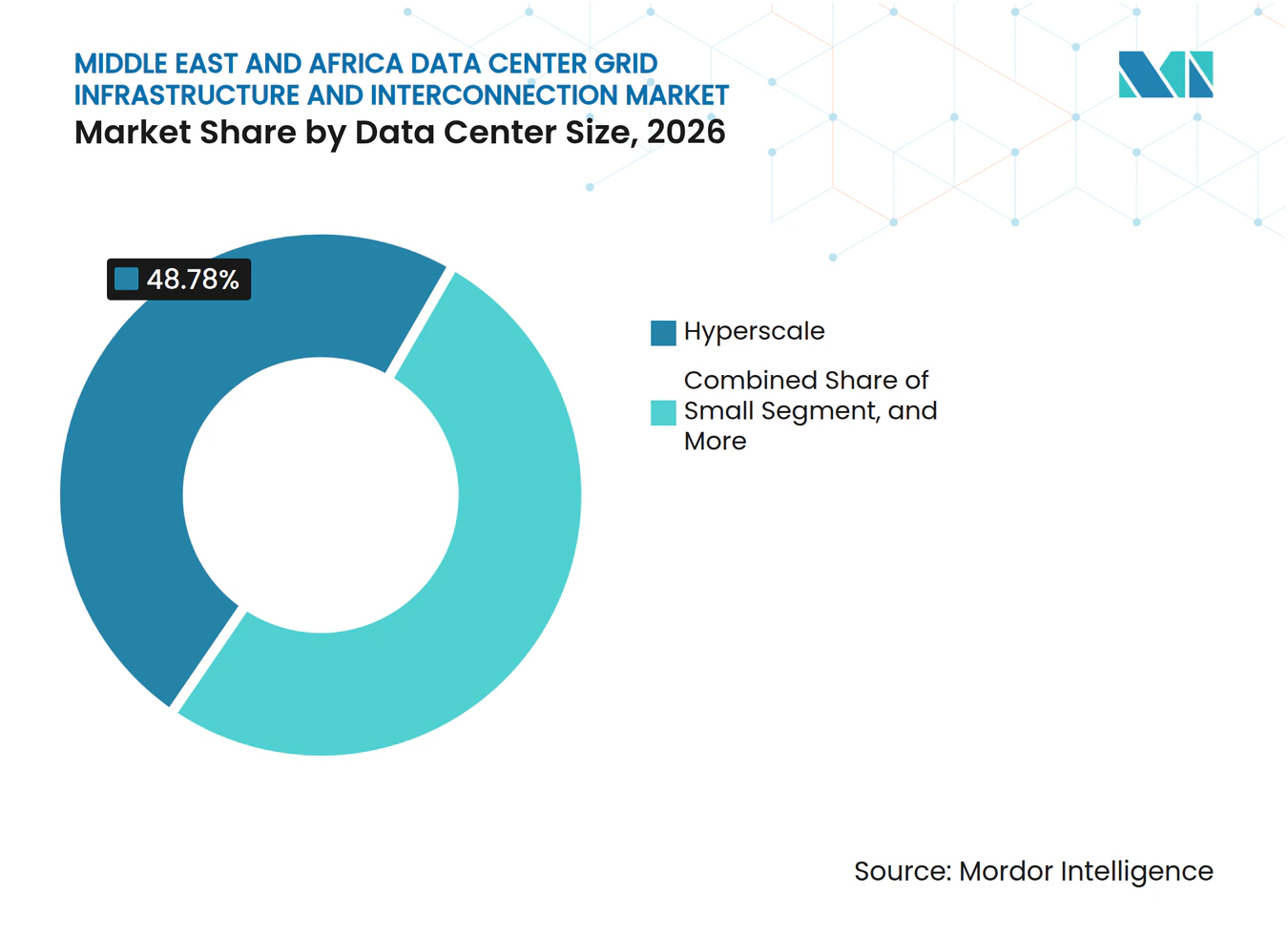
Hyperscale Facilities Combine Scale and Fast ExpansionHyperscale facilities held 48.78% of the market in 2026. Their power demand gives them a larger infrastructure value than their project count alone would suggest, since a single large connection can require investment comparable with many smaller enterprise sites. This group includes campuses built for large cloud platforms and AI computing, while small, medium, and large data centers make up the remaining demand base. Large sites in the 10 MW to 100 MW range also remain important for phased colocation development.
The hyperscale segment is projected to expand at a 17.53% CAGR through 2032. This trajectory reflects projects with capacity measured in hundreds of megawatts or more. The center3 and HUMAIN joint venture announced a program for up to 1 GW of AI data center capacity, beginning with an initial 250 MW. Hyperscale projects require early alignment among developers, utilities, and equipment suppliers. Their scale can turn a site-level engineering decision into a regional transmission planning issue. As a result, high-capacity substations and dedicated links are likely to remain important parts of project scope.

By Data Center Type:
Cloud Providers Lead Grid InvestmentCloud service providers held 43.41% of the market in 2026. These operators can support long-term power agreements and dedicated connection structures, and their campuses are often designed for dense compute loads and phased capacity additions. This creates recurring demand for grid infrastructure as each phase is energized. Colocation facilities are the next important group and add distributed demand across multiple locations, while enterprise and edge facilities account for the remaining portion and often serve local reliability, sovereignty, or latency needs.
Cloud service providers are projected to expand at a 17.62% CAGR through 2032. Their ability to contract renewable power can link campus development to solar and wind investment. The 1 GW center3 and HUMAIN program shows how cloud, AI, and colocation models can combine within a single development. These blended models require planning for AI training demand rather than the mixed load profile of a conventional colocation site. They also require sophisticated protection and reactive power management. The data center type segmentation is therefore becoming less distinct at the largest projects.
Geography Analysis
Saudi Arabia accounted for 45.51% of the regional total in 2026 and is projected to grow at an 18.34% CAGR through 2032. The country combines sovereign capital, relatively low-cost energy, and a national digital agenda, while its 2030 target of 1.5 GW of national data center capacity provides a clear basis for additional transmission and substation planning. Large AI campuses are likely to rely on dedicated high-voltage infrastructure and early engagement with utilities, and renewable energy projects can help meet their electricity demand. Saudi Arabia, therefore, remains central to the region's planned grid-connection activities.
The UAE is the second-largest geography and has a pipeline that includes large AI and government facilities. Its existing digital infrastructure and regulatory capacity support a range of cloud and colocation projects, while the Unified Government Data Center in Abu Dhabi shows the role of public-sector consolidation in demand for AI-ready capacity. South Africa is the most developed sub-Saharan market and benefits from cable landing points and a more established colocation base. Grid reliability concerns continue to increase demand for resilient electrical design and on-site support systems.
Egypt and Qatar are emerging locations for sovereign and renewable-linked data center development. Egypt's position between Europe and the Gulf supports its role as a potential regional connection point, while Qatar is developing sovereign data infrastructure aligned with National Vision 2030. Israel's technology sector and data sovereignty requirements support demand for resilient connections and enhanced monitoring, while Morocco has also pursued renewable-powered data center development, and other African markets can require microgrids or private networks where public supply is less reliable. These markets broaden the Middle East and Africa data center grid infrastructure and interconnection market beyond the major Gulf locations while keeping project delivery closely tied to local grid conditions.
Competitive Landscape
Market Concentration
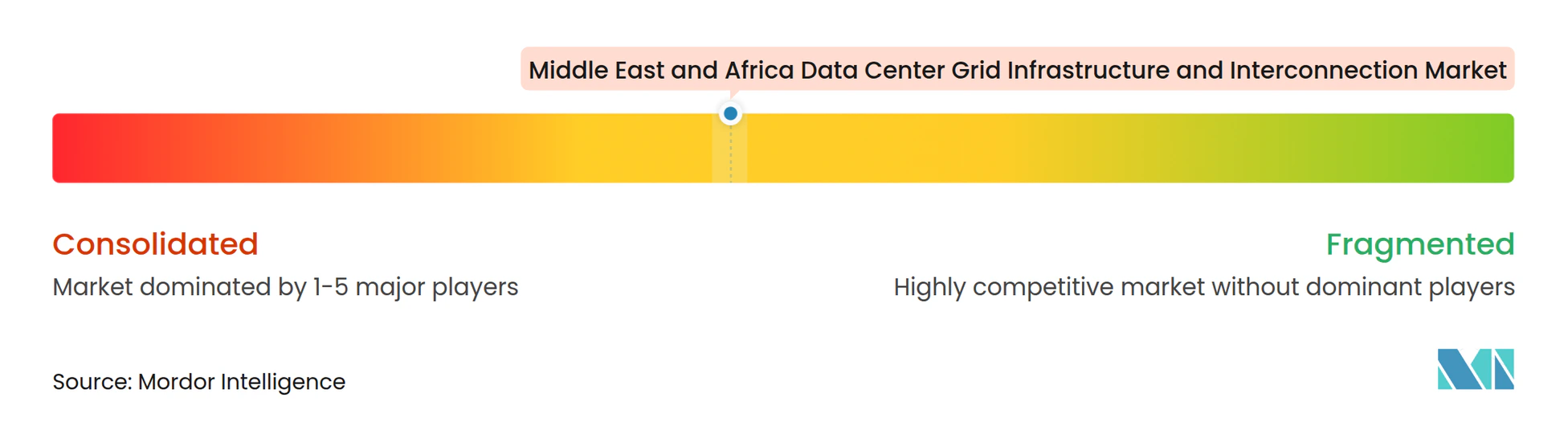
The Middle East and Africa data center grid infrastructure and interconnection market is moderately concentrated among global suppliers of transformers, substations, switchgear, and power management systems. ABB, Siemens Energy, Hitachi Energy, Schneider Electric, and Eaton have broad capabilities across the main equipment categories. Their regional presence and utility relationships can influence vendor selection for high-voltage projects, while smaller suppliers can compete in localized engineering, installation, and specialized systems. Extra-high-voltage projects require proven equipment and established compliance processes, which gives established suppliers an advantage when project schedules are tight.
Siemens Energy and Eaton announced a partnership in June 2025 to provide integrated modular data center power solutions.[3] The partnership combines modular power plant concepts with power management systems to address the gap between building completion and grid energization, and ABB also signed a memorandum with Specialist Services in the UAE for integrated modular substation designs. Eaton began construction of an advanced manufacturing and engineering center in Dubai in October 2025, adding local manufacturing and engineering support. These actions show a focus on modular delivery, local support, and shorter deployment schedules.
Regional operators are also building more direct grid infrastructure capability. center3's capacity program and its joint venture with HUMAIN bring operator requirements closer to equipment and utility planning. Equipment compliance with Saudi and UAE connection standards remains an important qualification requirement, and the opportunity lies in linking grid-side monitoring with controls inside the data center. Suppliers that can coordinate these systems may be better positioned for AI-focused sites.
Middle East and Africa Data Center Grid Infrastructure and Interconnection Industry Leaders
-
Siemens Energy
-
Hitachi Energy Ltd
-
Schneider Electric SE
-
ABB Ltd
-
Elsewedy Electric S.A.E.
- *Disclaimer: Major Players sorted in no particular order
Middle East and Africa Data Center Grid Infrastructure and Interconnection Market Companies Covered in this Report
- ABB Ltd
- Schneider Electric SE
- Siemens Energy AG
- Hitachi Energy Ltd
- Eaton Corporation plc
- General Electric Company
- Mitsubishi Electric Corporation
- Elsewedy Electric S.A.E.
- Vertiv Holdings Co
- Cummins Inc.
- Caterpillar Inc.
- Legrand SA
- Johnson Controls International plc
- Rittal GmbH and Co. KG
- STULZ GmbH
- Khazna Data Centers
- center3
- Gulf Data Hub
- Digital Realty Trust, Inc.
- Equinix, Inc.
- Teraco Data Environments (Pty) Ltd
- Vantage Data Centers
- Africa Data Centres
- DataVolt
- MEEZA QSTP LLC
- Mobily
- Quantum Switch Tamasuk
Recent Industry Developments in Middle East and Africa Data Center Grid Infrastructure and Interconnection Market
- October 2026: HUMAIN and DataVolt advanced an AI infrastructure framework with Nebius for the planned giga campus in NEOM's Oxagon, establishing an initial commercial offtake agreement under which Nebius is expected to deploy NVIDIA-powered computing infrastructure to offtake capacity from the 100 MW currently under construction as part of the planned 360 MW first phase. The agreement represents the first commercial anchor tenant commitment for the project and is expected to accelerate infrastructure delivery timelines.
- September 2026: Vodafone Business, Cassava Technologies, and Elsewedy Electric signed a USD 1 billion agreement to establish Africa Data Centers Egypt, Egypt's first sovereign AI data center, with an initial 20 MW capacity expanding to 200 MW. The project is expected to attract USD 200 million in foreign direct investment in its first phase and will be powered by Nvidia technology.
- August 2026: HUMAIN and DataVolt launched construction of a 100 MW AI data center at Oxagon, NEOM, representing the first tranche of a 360 MW first phase of the planned 1.5 GW net-zero campus. The facility is designed to integrate renewable energy sources, innovative cooling technologies, and high-density compute clusters, with the first 100 MW expected operational in 2028.
- February 2026: South African President Ramaphosa announced ZAR 50 billion (USD 2.7 billion) in data center investment expected over 3 years, citing 55 data centers already built and major expansion programs from Teraco, Vantage Data Centers, and hyperscalers including AWS, Google, and Microsoft.
Middle East and Africa Data Center Grid Infrastructure and Interconnection Market Report Scope
The Middle East and Africa Data Center Grid Infrastructure and Interconnection Market refers to the market for electrical infrastructure, equipment, and grid connectivity solutions that supply reliable, sufficient power to data centers across the region.
The Middle East and Africa Data Center Grid Infrastructure and Interconnection Market Report is Segmented by Interconnection Project Type (New Grid Connections, Existing Connection Upgrades, Dedicated Transmission Infrastructure, and Substation and Grid Interconnection Upgrades), Infrastructure Component (Substations and Switchyards, Power Transformers, Transmission Lines and Cables, Switchgear and Protection Systems, and Grid Connection, Control and Monitoring Systems), Voltage Level (Low and Medium Voltage, High Voltage, and Extra-High Voltage), Data Center Size (Small, Medium, Large, and Hyperscale), Data Center Type (Colocation, Cloud Service Providers [CSPs], and Enterprise and Edge), and Geography (Saudi Arabia, United Arab Emirates, South Africa, Israel, Egypt, Qatar, and and Rest of Middle East and Africa). The Market Forecasts are Provided in Terms of Value (USD).
Segmentation Overview
| New Grid Connections |
| Existing Connection Upgrades |
| Dedicated Transmission Infrastructure |
| Substation and Grid Interconnection Upgrades |
| Substations and Switchyards |
| Power Transformers |
| Transmission Lines and Cables |
| Switchgear and Protection Systems |
| Grid Connection, Control, and Monitoring Systems |
| Low and Medium Voltage |
| High Voltage |
| Extra-High Voltage |
| Small |
| Medium |
| Large |
| Hyperscale |
| Colocation |
| Cloud Service Providers (CSPs) |
| Enterprise and Edge |
| Saudi Arabia |
| United Arab Emirates |
| South Africa |
| Israel |
| Egypt |
| Qatar |
| Rest of the Middle East and Africa |
| By Interconnection Project Type | New Grid Connections |
| Existing Connection Upgrades | |
| Dedicated Transmission Infrastructure | |
| Substation and Grid Interconnection Upgrades | |
| By Infrastructure Component | Substations and Switchyards |
| Power Transformers | |
| Transmission Lines and Cables | |
| Switchgear and Protection Systems | |
| Grid Connection, Control, and Monitoring Systems | |
| By Voltage Level | Low and Medium Voltage |
| High Voltage | |
| Extra-High Voltage | |
| By Data Center Size | Small |
| Medium | |
| Large | |
| Hyperscale | |
| By Data Center Type | Colocation |
| Cloud Service Providers (CSPs) | |
| Enterprise and Edge | |
| By Geography | Saudi Arabia |
| United Arab Emirates | |
| South Africa | |
| Israel | |
| Egypt | |
| Qatar | |
| Rest of the Middle East and Africa |
Key Questions Answered in the Report
What is the size of the Middle East and Africa data center grid infrastructure and interconnection market?
The market is projected at USD 2.44 billion in 2027 and is forecast to reach USD 5.34 billion by 2032, with a 16.96% CAGR.
Which country leads data center grid infrastructure activity in the region?
Saudi Arabia held 45.51% of 2026 value and is projected to expand at an 18.34% CAGR through 2032.
Why do hyperscale facilities require different grid infrastructure?
Their large, variable power needs can require dedicated transmission links, high-voltage substations, and grid control systems.
Which infrastructure component is expanding fastest?
Grid connection, control, and monitoring systems are projected to expand at a 17.98% CAGR through 2032.
What is the main constraint on new high-voltage projects?
Long lead times for transformers, switchgear, and grid studies can delay energization unless equipment and approvals are secured early.
How does renewable procurement affect new data center connections?
Renewable power agreements can require coordinated investment in transmission, substations, and controls between generation sites and data center campuses.