
Middle East and Africa Data Center Energy Storage and Microgrids Market Size and Share
Market Overview
| Study Period | 2021 - 2032 |
|---|---|
| Forecast Data Period | 2027 - 2032 |
| Base Year Market Size (2026) | USD 0.47 Billion |
| Market Size (2027) | USD 0.58 Billion |
| Market Size (2032) | USD 1.41 Billion |
| Growth Rate (2027 - 2032) | 19.44 % |
| Market Concentration | Medium |
Major Players *Disclaimer: Major Players sorted in no particular order Image © Mordor Intelligence. Reuse requires attribution under CC BY 4.0. | |
Middle East and Africa Data Center Energy Storage and Microgrids Market Analysis by Mordor Intelligence
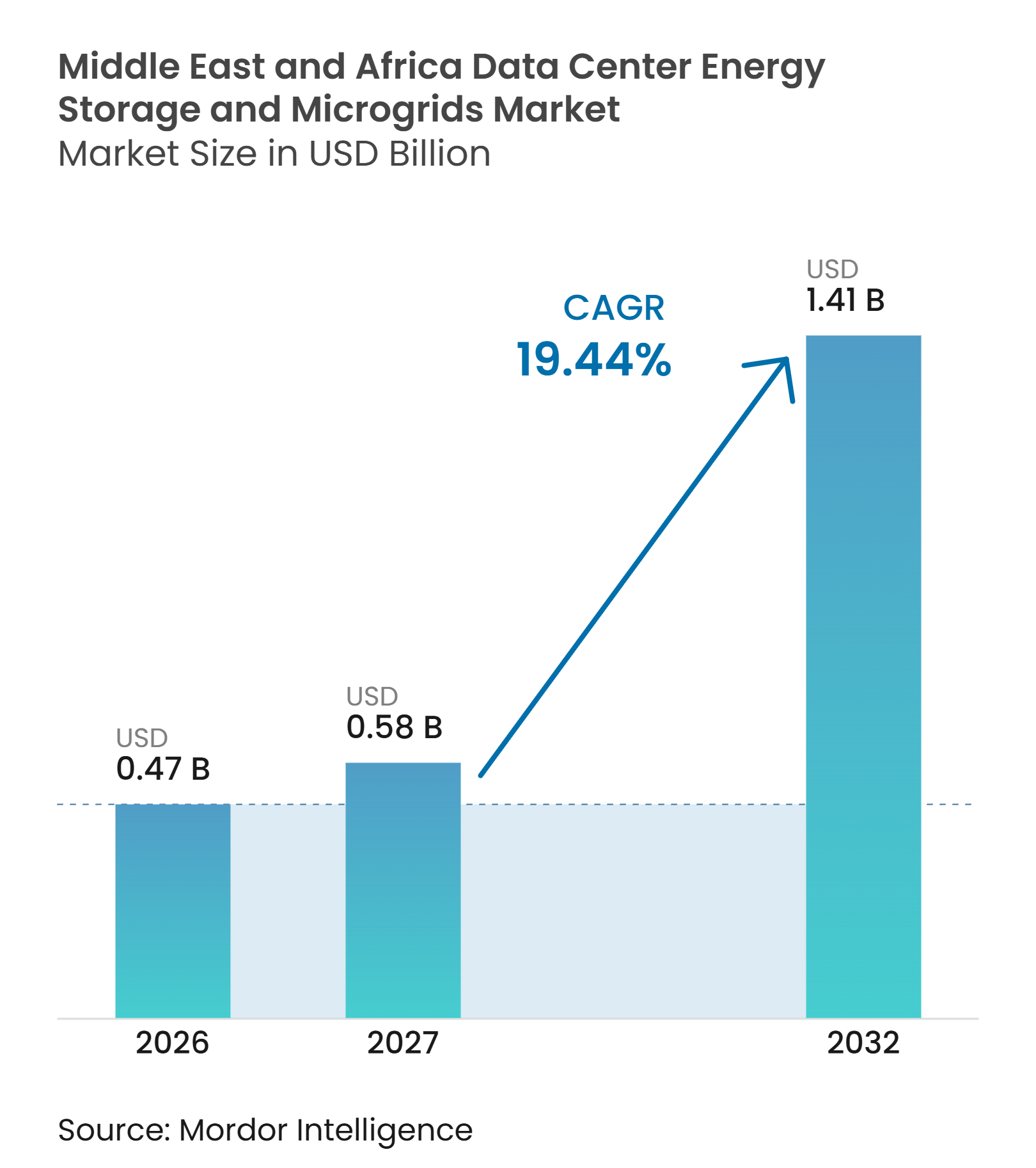
The Middle East and Africa data center energy storage and microgrids market size is projected to expand from USD 0.47 billion in 2026 and USD 0.58 billion in 2027 to USD 1.41 billion by 2032, registering a CAGR of 19.44% between 2027 and 2032. AI-led capacity additions in Gulf Cooperation Council countries are increasing demand for dependable on-site power systems. Grid connection lead times and uneven supply quality are prompting operators to integrate storage, generation, and controls into a single system. Large solar and battery projects in Saudi Arabia and the UAE are also improving the operating case for renewable power at data center sites. Suppliers are responding through integrated designs that combine utility supply, batteries, solar power, and backup generation. The Middle East and Africa data center energy storage and microgrids market, therefore, offers opportunities for providers that can meet performance, safety, and local delivery requirements.
Key Report Takeaways
- By solution type, integrated microgrid solutions held 30.43% of the Middle East and Africa data center energy storage and microgrids market share in 2026 and are projected to expand at a 20.43% CAGR through 2032.
- By storage technology, lithium-ion batteries held 68.12% revenue share in 2026, while flow batteries are expected to expand at a 20.46% CAGR through 2032.
- By microgrid configuration, grid-connected microgrids accounted for 53.67% revenue share in 2026 of the Middle East and Africa data center energy storage and microgrids market, while hybrid grid-connected and islandable microgrids are projected to expand at a 20.07% CAGR through 2032.
- By primary energy source, grid electricity accounted for 46.22% revenue share in 2026, while solar power is expected to expand at a 20.61% CAGR through 2032.
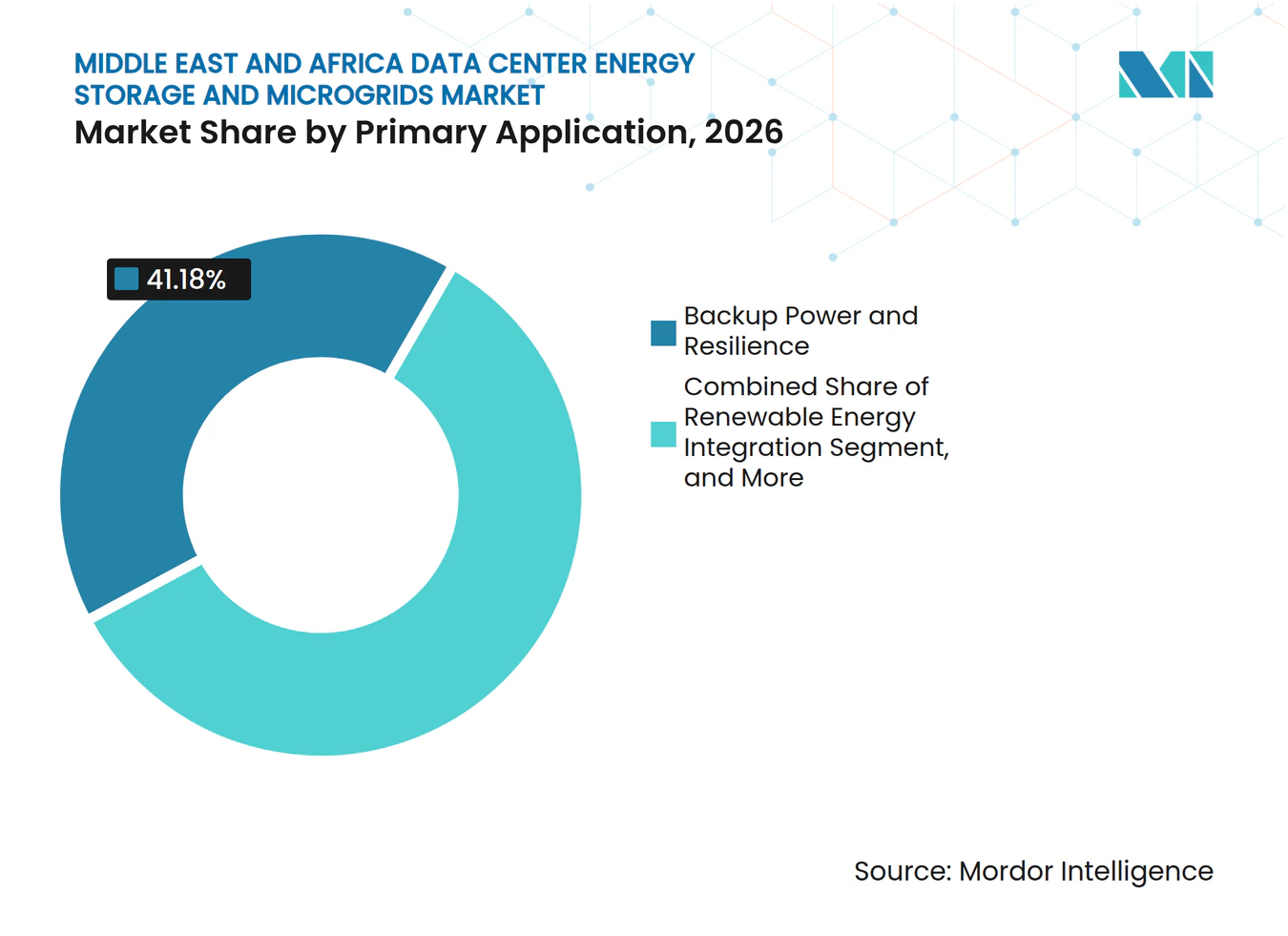
- By primary application, backup power and resilience accounted for 41.18% of revenue in 2026, while renewable energy integration is projected to expand at a 20.38% CAGR through 2032.
- By data center size, large facilities accounted for 37.88% revenue share in 2026, while hyperscale facilities are expected to expand at a 20.30% CAGR through 2032.
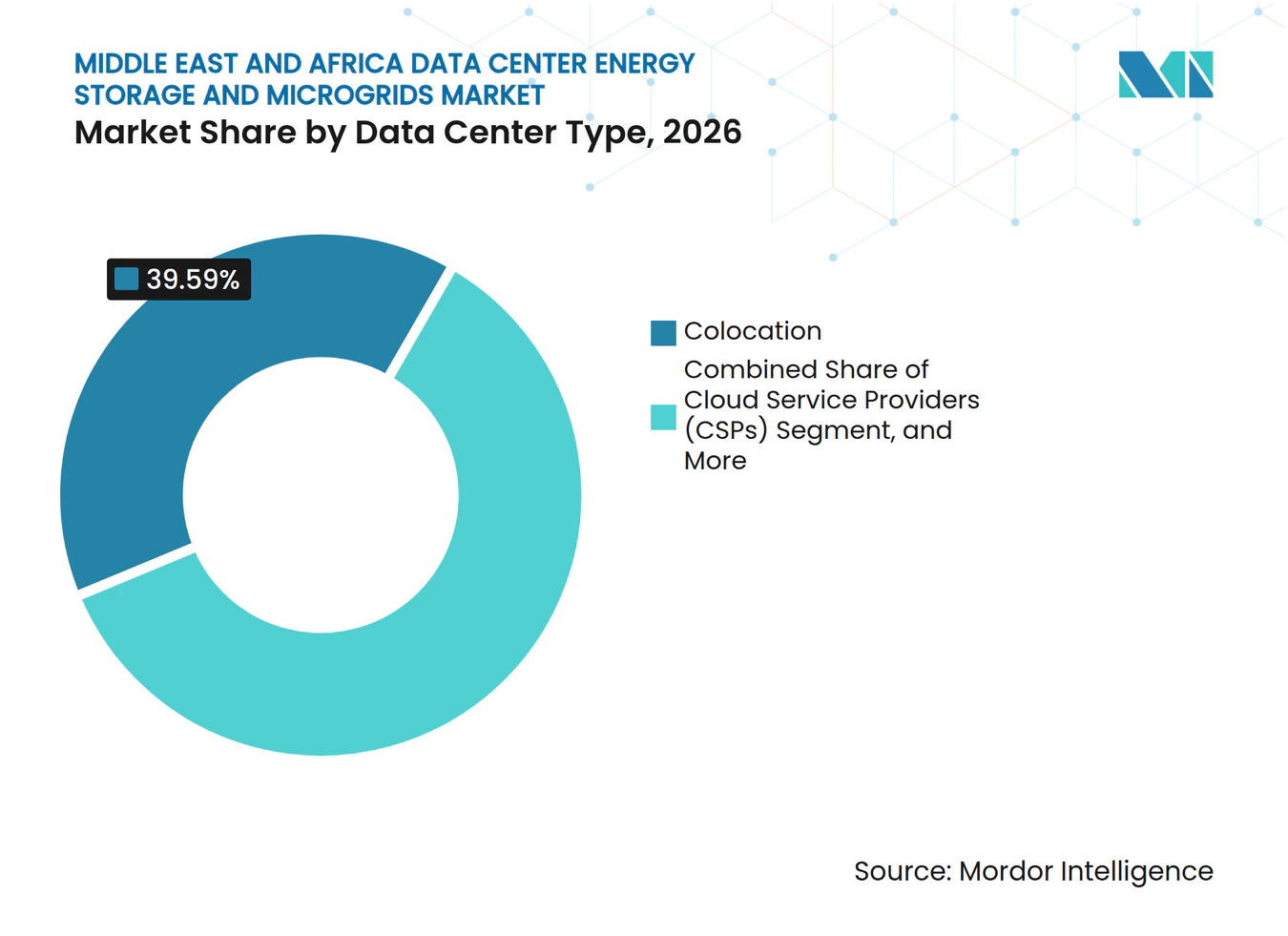
- By data center type, colocation facilities held 39.59% revenue share in 2026, while cloud service providers are projected to expand at a 20.02% CAGR through 2032.
- By geography, Saudi Arabia accounted for 28.41% of revenue in 2026 and is expected to expand at a 20.74% CAGR through 2032 in the Middle East and Africa data center energy storage and microgrids market.
Note: Market numbers in this report are based on Mordor Intelligence's proprietary estimation framework, which combines nine months of actuals with Q4 projections for base year 2026.
Market Trends and Insights
Drivers Impact Analysis of Middle East and Africa Data Center Energy Storage and Microgrids Market*
| Driver | (~) % Impact on CAGR Forecast | Geographic Relevance | Impact Timeline |
|---|---|---|---|
| Hyperscale and AI Data Center Capacity Expansion | +5.2% | Saudi Arabia and UAE, with spillover to Qatar and Egypt | Short term (≤ 2 years) |
| Rising Grid Reliability and Backup Autonomy Requirements | +3.8% | South Africa, sub-Saharan Africa, and Gulf countries | Short term (≤ 2 years) |
| Government-Led Digital Economy and Data Sovereignty Programs | +3.2% | Saudi Arabia, UAE, Egypt, and Israel | Medium term (2-4 years) |
| Renewable Energy and Battery Storage Procurement by Gulf Economies | +3.0% | Saudi Arabia, UAE, GCC countries, and Egypt | Medium term (2-4 years) |
| Declining Lithium-Ion Storage Costs and Improving System Efficiency | +2.5% | Global, with primary uptake in Saudi Arabia and UAE | Short term (≤ 2 years) |
| Data Center Microgrids Responding to Grid-Connection Constraints | +2.1% | South Africa, sub-Saharan Africa, and the wider MEA region | Medium term (2-4 years) |
| Source: Mordor Intelligence | |||
Hyperscale and AI Data Center Capacity Expansion
Saudi Arabia's data center IT capacity rose from 68 MW in 2021 to 467 MW in the first quarter of 2026, driven by a rapid national buildout. The Ministry of Communications and Information Technology set a 1.5 GW data center capacity target for 2030 through the National Data Center Strategy. AMD and HUMAIN announced a USD 10 billion collaboration in May 2025 to deploy 500 MW of AI computing capacity over 5 years.[1] Such facilities are a major source of demand within the Middle East and Africa data center energy storage and microgrids market because they require storage systems that manage rapid changes in power demand and maintain service during grid events. The Middle East and Africa data center energy storage and microgrids market benefits from these requirements, which favor systems designed as a single power architecture. The NEOM and DataVolt agreement for a USD 5 billion AI facility also underscores the scale of dedicated energy infrastructure required for new campuses.
Rising Grid Reliability and Backup Autonomy Requirements
South African data center operators have placed a high value on resilient power because electricity disruptions have affected business continuity. Battery systems can bridge short interruptions and reduce dependency on generator operation when integrated with uninterruptible power supply equipment. Schneider Electric stated that microgrids can manage backup energy systems more effectively, where load shedding remains a concern. In Gulf countries, high-density AI workloads can also create power-quality challenges that require responsive controls and storage. This means resilience has become a core design requirement rather than an add-on for the Middle East and Africa data center energy storage and microgrids market. Schneider Electric commissioned 2 microgrid sites for MIS SAHAYEB Datacenters in Dammam during 2025, integrating photovoltaic power, the utility grid, and generators.
Government-Led Digital Economy and Data Sovereignty Programs
Public programs are creating a clearer pipeline for data center capacity across the region. Saudi Arabia's strategy links the expansion of digital infrastructure to cloud services and AI development. The Stargate UAE partnership announced plans for a 5 GW AI campus in Abu Dhabi, with an initial 200 MW phase expected in 2026. National programs encourage greater scrutiny of uptime, local processing, and continuity requirements. Those requirements shape procurement in the Middle East and Africa data center energy storage and microgrids market before facilities begin operations. The Middle East and Africa data center energy storage and microgrids market gains from this link between digital policy and critical power investment.
Renewable Energy and Battery Storage Procurement by Gulf Economies
Gulf utility-scale procurement supports the Middle East and Africa data center energy storage and microgrids market by building a deeper supply base for batteries, inverters, and project delivery. Masdar announced a UAE project that combines 5.2 GW of solar capacity with 19 GWh of battery storage to provide 1 GW of continuous renewable power. BYD also signed an agreement with the Saudi Electricity Company to supply 12.5 GWh of energy storage in February 2025. These projects show that solar and batteries can be financed at a scale relevant to large digital campuses. Their equipment and delivery experience can reduce execution risk for data center developers. The Middle East and Africa data center energy storage and microgrids market is supported as operators seek a cleaner supply without compromising resilience.
Restraints Impact Analysis of Middle East and Africa Data Center Energy Storage and Microgrids Market*
| Restraint | (~) % Impact on CAGR Forecast | Geographic Relevance | Impact Timeline |
|---|---|---|---|
| High Capital and Lifecycle Costs for Redundant Power Architectures | -1.8% | MEA region, especially enterprise and mid-market colocation operators | Long term (≥ 4 years) |
| Grid Interconnection Delays and Limited Distribution-Network Visibility | -1.2% | South Africa, sub-Saharan Africa, and MEA region | Medium term (2-4 years) |
| Shortage of Specialized Power and Microgrid Operations Talent | -0.9% | MEA region, with acute gaps in Riyadh, Abu Dhabi, and Johannesburg | Medium term (2-4 years) |
| Battery Safety, Fire Protection, and Permitting Complexity | -0.7% | Global, with specific compliance burdens in UAE and Saudi Arabia | Short term (≤ 2 years) |
| Source: Mordor Intelligence | |||
High Capital and Lifecycle Costs for Redundant Power Architectures
Integrated power systems require batteries, inverters, controls, generators, and site works in addition to conventional redundancy. This raises the initial cost for enterprise and smaller colocation projects. Operators also face battery equipment replacement planning for frequently used systems to manage volatile AI loads. The burden can delay projects where customers cannot support hyperscale-level power budgets. The Middle East and Africa data center energy storage and microgrids market can therefore favor large developers with stronger financing and long-term tenant commitments. A modular design can limit early-stage expenditure in the Middle East and Africa data center energy storage and microgrids market, but it does not eliminate the need for safe and reliable redundancy.
Battery Safety, Fire Protection, and Permitting Complexity
Large lithium-ion installations need comprehensive fire detection, ventilation, testing, and emergency response planning. NFPA 855 provides requirements for the installation of stationary energy storage systems, including provisions relevant to battery fire risk.[2] Local approval processes may vary as regulators adapt international practices to local buildings and infrastructure. Suppliers with tested system designs and documented safety procedures can have an advantage during permitting. However, compliance can lengthen project schedules and increase delivery costs. The Middle East and Africa data center energy storage and microgrids market must balance rapid deployment targets with consistent safety controls.
*Our forecasts treat driver/restraint impacts as directional, not additive. The impact forecasts reflect baseline growth, mix effects, and variable interactions.
Middle East and Africa Data Center Energy Storage and Microgrids Market Segment Analysis
By Solution Type:
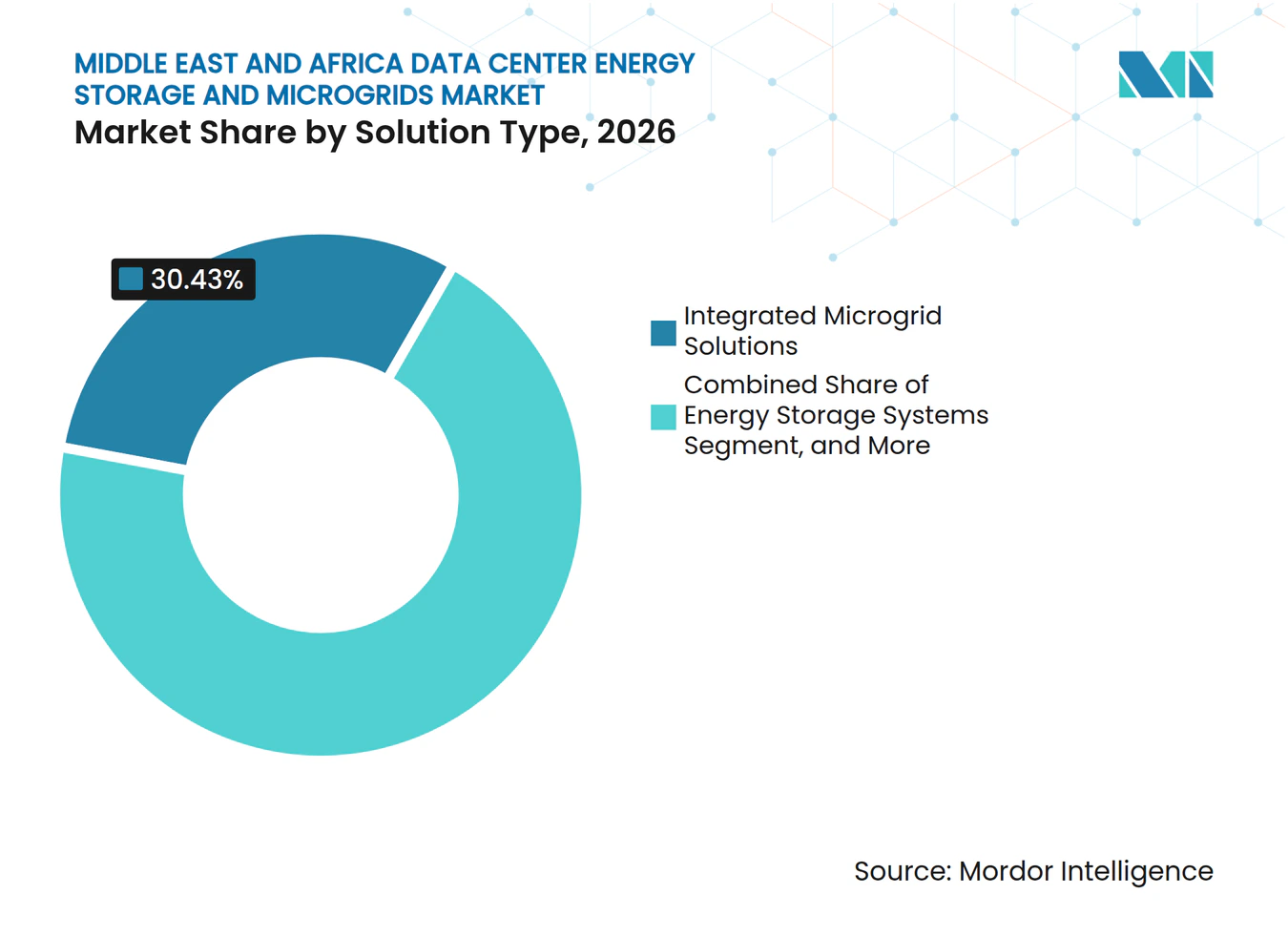
Integrated Microgrids Lead Complex Energy DemandIntegrated microgrid solutions accounted for 30.43% of revenue in 2026. These solutions combine power generation assets, battery energy storage systems, control platforms, and grid management capabilities within a single operating design. This integrated approach enables operators to commission capacity more efficiently when utility supply is constrained or when grid connections face delays. It also simplifies project execution by reducing the need to coordinate multiple equipment providers and system interfaces. In addition, integrated solutions assign a single supplier responsibility for overall system performance, reliability, and operational coordination.
Integrated microgrid solutions are projected to expand at a 20.43% CAGR through 2032. Their growth is supported by the increasing need for resilient, efficient, and centrally managed power systems across applications with critical energy requirements. Control software plays a central role by coordinating solar generation, battery dispatch, grid supply, and backup equipment in response to operating conditions. This coordination helps optimize the use of available energy resources while maintaining power continuity. An IEEE study of a 1 MW NEOM data center microgrid achieved zero modeled grid imports, demonstrating the potential for integrated control and generation systems to reduce reliance on the utility grid. ABB stated that its Infinitus DC architecture can reduce conversion losses by more than 5%, highlighting the efficiency benefits of integrated system architectures.



By Storage Technology:
Lithium-Ion Leads While Flow Batteries ExpandLithium-ion batteries accounted for 68.12% of storage technology revenue in 2026. Their leading position reflects well-established supply chains, mature product offerings, and extensive operational experience across critical power applications. These batteries are widely deployed because they offer high energy density, relatively compact footprints, and reliable performance for data center backup and energy storage requirements. Lithium-iron-phosphate systems are becoming increasingly relevant at larger sites, particularly where operators prioritize thermal stability, safety, and longer operating life. Tesla increased Megapack capacity from 3.9 MWh to 5 MWh in its latest platform, supporting the deployment of larger-scale battery storage installations.
Flow batteries are projected to expand at a 20.46% CAGR through 2032. Their growth is supported by their ability to provide long-duration energy storage and withstand repeated charge-discharge cycles with limited performance degradation. These characteristics make flow batteries suitable for applications that require extended backup durations and frequent cycling. A 2025 technical review assessed their suitability for AI data center applications, highlighting their potential to meet the growing power reliability requirements of high-density computing facilities. Lead-acid batteries and flywheels will retain narrower roles in the market, particularly in applications where established operating practices, lower upfront costs, or rapid-response capabilities are required.
By Microgrid Configuration:
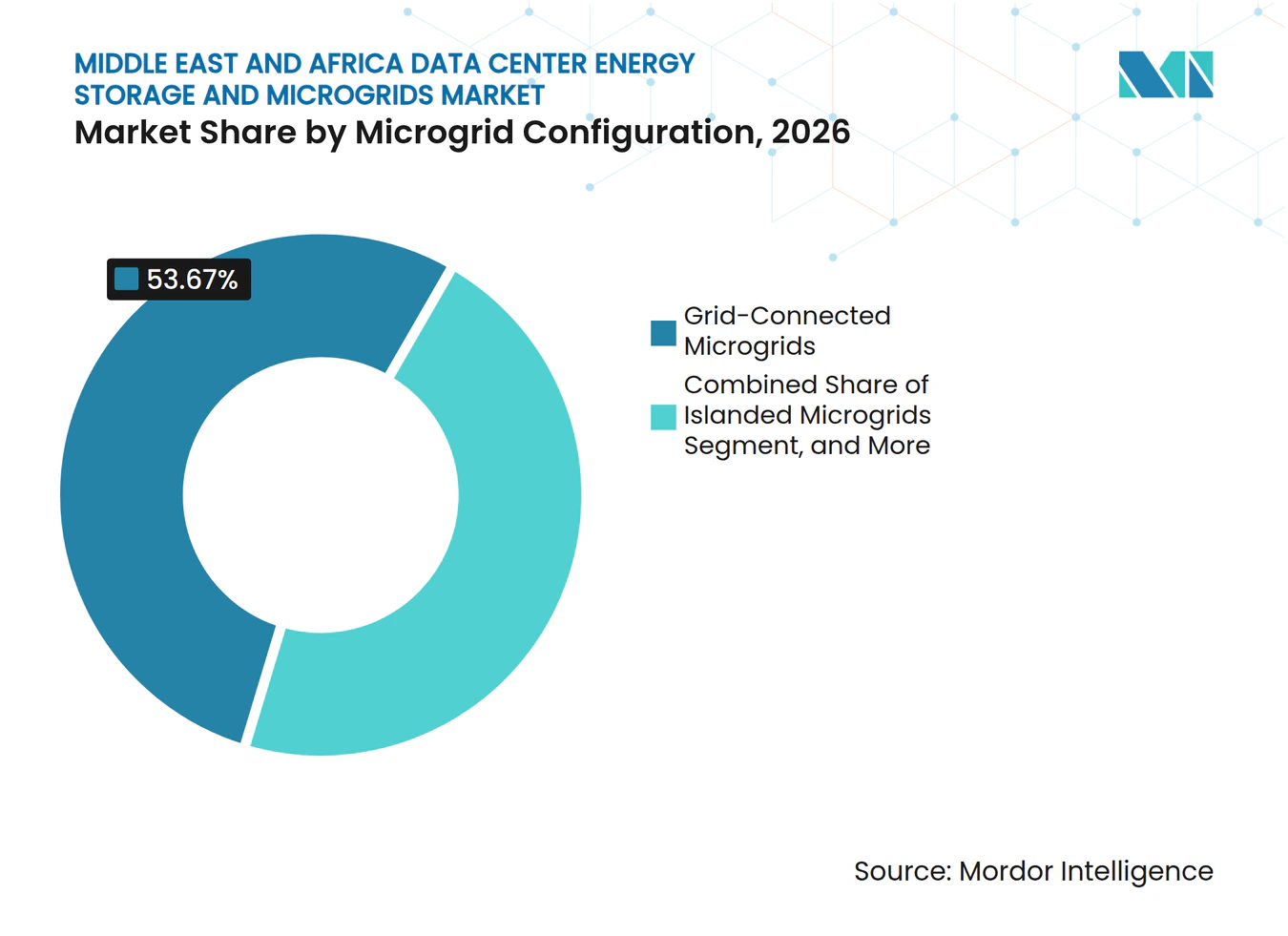
Hybrid Designs Improve Operational FlexibilityGrid-connected microgrids accounted for 53.67% of revenue in 2026, making them the leading configuration within the market. These systems serve sites with utility access that require additional operational resilience, improved power quality, and greater integration of renewable energy sources. Batteries support peak-demand management, help maintain power quality, and provide backup power during short-duration disruptions, while the utility grid continues to supply electricity under normal operating conditions. This configuration remains prevalent across mature Gulf data center locations, where operators can leverage established utility infrastructure while strengthening on-site power reliability.
Hybrid grid-connected and islandable microgrids are expected to expand at a 20.07% CAGR through 2032. These systems combine the benefits of grid connectivity with the ability to operate independently when required. They can separate from the grid during an outage or other disruption, allowing critical data center loads to remain powered by on-site generation and storage, and reconnect once grid conditions normalize. Dii Desert Energy identified integrated renewable generation and storage as a resilient approach for data centers, particularly where uninterrupted operations are essential. Islanded systems will remain important for remote locations that lack dependable grid access and require self-sufficient power infrastructure.

By Primary Energy Source:
Solar Power Gains a Larger RoleGrid electricity accounted for 46.22% of primary energy source revenue in 2026. It remains the foundational power supply for many data center facilities developed before large-scale renewable energy projects became widely available. These facilities continue to rely on grid power for their day-to-day electricity requirements, particularly in locations with established utility infrastructure. Diesel and natural gas retain essential backup roles where grid coverage is limited or where operators require additional power reliability during utility disruptions. Energy storage systems improve power quality, support backup requirements, and reduce generator operating hours at these sites, helping operators manage demand more efficiently.
Solar power is projected to expand at a 20.61% CAGR through 2032. High solar irradiation levels and land availability support the deployment of solar-plus-storage systems across Gulf countries. These conditions enable operators to use solar generation as an increasingly important source of electricity for data center operations. An IEEE study reported a 50% renewable energy fraction in its modeled NEOM data center design, demonstrating the potential for integrating renewable energy in large-scale facilities. Teraco signed a wind power purchase agreement in 2025 alongside its solar development, reflecting the use of complementary renewable energy sources to support data center power requirements.
By Primary Application:
Resilience Remains the Leading Use CaseBackup power and resilience accounted for 41.18% of revenue in 2026. Batteries provide immediate power support during outages or disruptions, bridging the gap while generators start, synchronize, and stabilize. South African operators use this configuration to reduce dependence on generator-based power during grid disruptions and to improve continuity for critical operations. Peak shaving and load shifting represent secondary applications in locations where electricity tariff structures create measurable cost-saving opportunities.
Renewable energy integration is expected to expand at a 20.38% CAGR through 2032. Energy storage makes intermittent solar and wind generation more usable for data centers and other facilities with continuous workload requirements by helping balance supply and demand. Tenant commitments to procure or use renewable power are shifting storage's role beyond a purely resilience-focused solution. Grid services may create additional value for storage operators where market regulations, participation rules, and technical standards permit these systems to support grid operations.
By Data Center Size:
Hyperscale Facilities Drive New Storage DemandLarge data centers accounted for 37.88% of revenue in 2026. Their substantial revenue share reflects the presence of established data center campuses across key regional hubs, including Dubai, Johannesburg, Riyadh, and Tel Aviv. These facilities support a broad range of customer requirements, serving enterprise clients, cloud service providers, and public-sector organizations. Large campuses also provide the scale needed to accommodate significant IT loads and centralized infrastructure requirements. Small and medium-sized sites remain relevant for localized enterprise deployments and edge computing applications, where proximity to users and lower capacity requirements are important.
Hyperscale data centers are projected to expand at a 20.30% CAGR through 2032. This growth is supported by increasing demand for large-scale cloud capacity and AI-driven computing infrastructure. HPE reported that AI workloads can require 30-120 kW per rack, compared with 5-15 kW for conventional racks. These substantially higher rack power densities increase the need for responsive power conversion systems, energy storage, and backup equipment to support variable and intensive workloads. Developers must incorporate power architecture considerations early in the project, as retrofitting existing facilities to support high-density workloads can be costly and operationally complex.
By Data Center Type:
Colocation Leads While Cloud Providers AccelerateColocation facilities held a 39.59% revenue share in 2026. Their multi-tenant operating model supported the region's early data center expansion by allowing multiple customers to share secure, resilient infrastructure. Vertiv documented a MENA provider that expanded its capacity from 1 MW to 6 MW while maintaining Tier III-certified infrastructure. These facilities require modular power systems that can support phased capacity additions while preserving uptime, redundancy, and service continuity for tenants.
Cloud service providers are projected to expand at a 20.02% CAGR through 2032. Their facilities must coordinate utility supply, renewable energy sources, energy storage systems, and standby generation to support continuous operations and manage rising power requirements. ISO 27001 and Uptime Institute Tier requirements influence critical-power system specifications, particularly for reliability, redundancy, and operational resilience. Microsoft has announced a regional cloud infrastructure investment across the Gulf, supporting the development of cloud capacity and associated critical power infrastructure.
Geography Analysis
Saudi Arabia
Saudi Arabia held 28.41% of the Middle East and Africa data center energy storage and microgrids market share in 2026 and is projected to expand at a 20.74% CAGR through 2032. Its National Data Center Strategy targets 1.5 GW of capacity by 2030. The capacity target is increasing demand for reliable on-site power and renewable integration. NEOM and DataVolt signed a USD 5 billion agreement for an AI project in February 2025. BYD's 12.5 GWh storage agreement with Saudi Electricity Company shows the scale of local battery procurement.
UAE, Qatar, and Israel
The UAE has shifted from a backup-led model toward solar and battery integration for large digital facilities. Masdar's solar-and-storage project provides a reference for continuous renewable power at scale. Khazna Data Centers and Siemens signed a memorandum in September 2026 covering 800 VDC power architectures and digital twins. Qatar's data center financing and Israel's high-density digital infrastructure support demand for dependable power systems. Compliance with local electricity rules and data protection obligations remains an important factor.
South Africa and Egypt
South Africa's data center storage demand is shaped by the need for operational resilience. Teraco's February 2025 wind power agreement added another renewable source alongside its solar development. The country's wheeling framework can help large users source renewable power from remote generation sites. Egypt is developing through renewable capacity additions and connectivity infrastructure, including AMEA Power's 300 MWh battery energy storage system at Kom Ombo, commissioned in July 2025 with support from the International Finance Corporation.
Competitive Landscape
Market Concentration
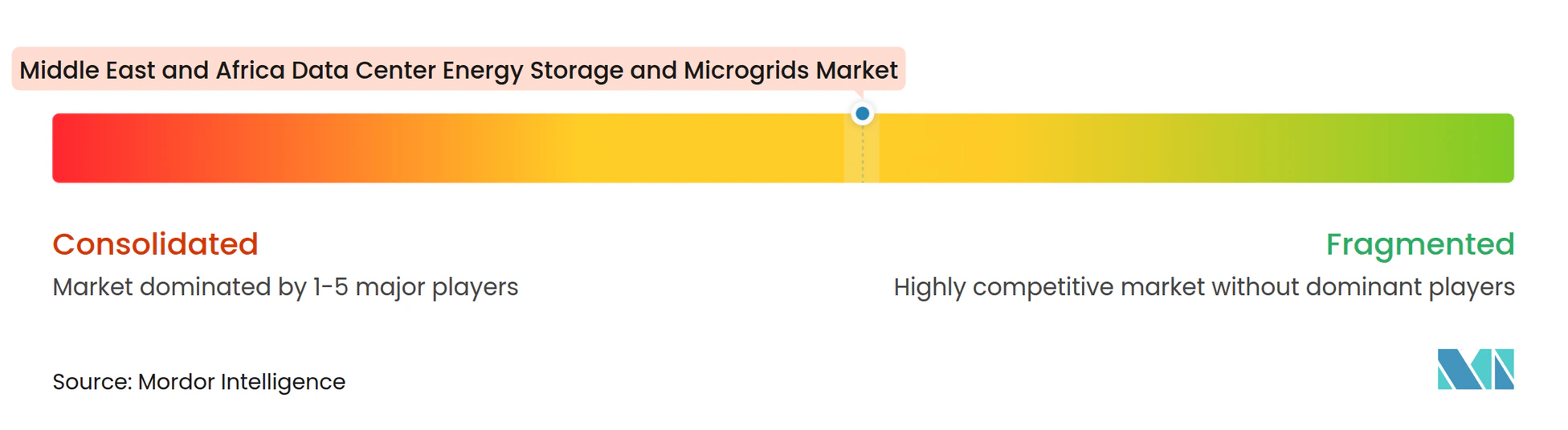
The Middle East and Africa data center energy storage and microgrids market is moderately fragmented, and includes global power specialists, battery suppliers, and systems integrators. Schneider Electric, Eaton, ABB, Siemens Energy, and Vertiv compete for critical-power and integration assignments. BYD and Sungrow are important suppliers in large Gulf battery projects. Local execution capability and regulatory readiness can be as important as equipment performance.
Eaton and Siemens Energy formed a partnership in June 2025 to provide integrated on-site data center power.[3] Their offering combined power management equipment with a modular generation concept. ABB introduced its Infinitus DC portfolio in 2025 for source-to-rack DC architectures. Rolls-Royce introduced fast-start MTU gas generator sets for data centers in October 2025. These actions show a shift from discrete equipment delivery toward coordinated critical-power solutions.
The market has room for islandable systems in grid-constrained African locations. Long-duration storage may also find demand where AI loads require frequent cycling. Suppliers must demonstrate dependable service, safety systems, and compatibility with local codes. No combined market share for leading suppliers is available in the supplied information. Competition, therefore, remains distributed between established integrators and component specialists.
Middle East and Africa Data Center Energy Storage and Microgrids Industry Leaders
-
Schneider Electric SE
-
Vertiv Holdings Co
-
Eaton Corporation plc
-
ABB Ltd.
-
Huawei Technologies Co., Ltd.
- *Disclaimer: Major Players sorted in no particular order
Middle East and Africa Data Center Energy Storage and Microgrids Market Companies Covered in this Report
- Schneider Electric SE
- Vertiv Holdings Co
- Eaton Corporation plc
- ABB Ltd.
- Huawei Technologies Co., Ltd.
- Cummins Inc.
- Caterpillar Inc.
- Delta Electronics, Inc.
- Legrand SA
- Socomec Group
- Siemens Energy AG
- Sungrow Power Supply Co., Ltd.
- Tesla, Inc.
- BYD Co., Ltd.
- Fluence Energy, Inc.
- Wärtsilä Oyj
- Saft Groupe S.A.
- Mitsubishi Electric Corporation
- Rolls-Royce plc
- Aggreko plc
Recent Industry Developments in Middle East and Africa Data Center Energy Storage and Microgrids Market
- October 2026: Al Masaood Power Division highlighted its 316 MW backup power scope for a major UAE hyperscale data center project powered by mtu, a Rolls-Royce Solutions brand, at DCD Connect MENA 2026 in Dubai. The project marked the largest data center undertaking for the division and reflected the role of dependable backup power in UAE hyperscale infrastructure.
- September 2026: Khazna Data Centres and Siemens signed a Memorandum of Understanding at the UAE-Germany Business Forum in Munich to advance next-generation AI data center technologies, including 800 VDC power architectures and digital twin applications for infrastructure optimization. The MoU included an Emirati engineering talent development initiative.
- September 2026: Masdar and EWEC reached financial close on the USD 6.1 billion round-the-clock renewable project pairing 5.2 GW of solar with 19 GWh of batteries, targeting commercial operations in 2027. BYD was contracted to supply 11.275 GWh and Sungrow to supply 7.5 GWh of storage capacity for the Abu Dhabi project.
- July 2026: Qatar's MEEZA secured USD 438.7 million in project financing for data center portfolio expansion, with M-Vault 6, 7, and 8 adding 44 MW to bring the portfolio beyond 60 MW, directly expanding capacity requiring backup storage systems.
Middle East and Africa Data Center Energy Storage and Microgrids Market Report Scope
The Middle East and Africa data center energy storage and microgrids market encompasses technologies and solutions that enable reliable, efficient, and resilient power management for data center operations. These solutions help maintain an uninterrupted power supply, optimize energy consumption, integrate renewable energy sources, and reduce dependence on conventional grid electricity through advanced storage and localized power generation systems.
The Middle East and Africa Data Center Energy Storage and Microgrids Market Report is Segmented by Solution Type (Energy Storage Systems, Microgrid Control Systems, Distributed Generation Systems, Integrated Microgrid Solutions, and Power Conversion Systems), Storage Technology (Lithium-Ion Batteries, Flow Batteries, Lead-Acid Batteries, Flywheel Energy Storage, and Other Storage Technologies), Microgrid Configuration (Grid-Connected Microgrids, Islanded Microgrids, and Hybrid Grid-Connected and Islandable Microgrids), Primary Energy Source (Grid Electricity, Solar Power, Wind Power, Fuel Cells, and Other Energy Sources), Primary Application (Backup Power and Resilience, Peak Shaving and Loaf Shifting, Renewable Energy Integration, Energy Cost Optimization, and Grid Services), Data Center Size (Hyperscale, Large, Medium, and Small), Data Center Type (Cloud Service Providers, Colocation, and Enterprise and Edge Data Centers), and Geography (Saudi Arabia, United Arab Emirates, South Africa, Israel, Egypt, Qatar and Rest of Middle East and Africa). The Market Forecasts are Provided in Terms of Value (USD).
Segmentation Overview
| Integrated Microgrid Solutions |
| Energy Storage Systems |
| Microgrid Control Systems |
| Distributed Generation Systems |
| Power Conversion Systems |
| Lithium-Ion Batteries |
| Lead-Acid Batteries |
| Flow Batteries |
| Flywheel Storage |
| Other Storage Technologies |
| Grid-Connected Microgrids |
| Islanded Microgrids |
| Hybrid Grid-Connected and Islandable Microgrids |
| Grid Electricity |
| Diesel and Natural Gas |
| Solar Power |
| Wind Power |
| Fuel Cells |
| Other Energy Sources |
| Backup Power and Resilience |
| Peak Shaving and Load Shifting |
| Renewable Energy Integration |
| Grid Services |
| Energy Cost Optimization |
| Small |
| Medium |
| Large |
| Hyperscale |
| Colocation |
| Cloud Service Providers (CSPs) |
| Enterprise and Edge |
| Saudi Arabia |
| United Arab Emirates |
| South Africa |
| Israel |
| Egypt |
| Qatar |
| Rest of Middle East and Africa |
| By Solution Type | Integrated Microgrid Solutions |
| Energy Storage Systems | |
| Microgrid Control Systems | |
| Distributed Generation Systems | |
| Power Conversion Systems | |
| By Storage Technology | Lithium-Ion Batteries |
| Lead-Acid Batteries | |
| Flow Batteries | |
| Flywheel Storage | |
| Other Storage Technologies | |
| By Microgrid Configuration | Grid-Connected Microgrids |
| Islanded Microgrids | |
| Hybrid Grid-Connected and Islandable Microgrids | |
| By Primary Energy Source | Grid Electricity |
| Diesel and Natural Gas | |
| Solar Power | |
| Wind Power | |
| Fuel Cells | |
| Other Energy Sources | |
| By Primary Application | Backup Power and Resilience |
| Peak Shaving and Load Shifting | |
| Renewable Energy Integration | |
| Grid Services | |
| Energy Cost Optimization | |
| By Data Center Size | Small |
| Medium | |
| Large | |
| Hyperscale | |
| By Data Center Type | Colocation |
| Cloud Service Providers (CSPs) | |
| Enterprise and Edge | |
| By Geography | Saudi Arabia |
| United Arab Emirates | |
| South Africa | |
| Israel | |
| Egypt | |
| Qatar | |
| Rest of Middle East and Africa |
Key Questions Answered in the Report
What is the Middle East and Africa data center energy storage and microgrids market size?
The market is valued at USD 0.47 billion in 2026, is projected at USD 0.58 billion in 2027, and is expected to reach USD 1.41 billion by 2032 at a 19.44% CAGR.
Which country has the largest regional share?
Saudi Arabia held 28.41% revenue share in 2026 and is projected to expand at a 20.74% CAGR through 2032.
Which energy storage technology leads deployment?
Lithium-ion batteries led the storage technology segment with 68.12% revenue share in 2026.
What is the fastest-expanding storage technology?
Flow batteries are projected to expand at a 20.46% CAGR through 2032, supported by long-duration and repeated-cycling characteristics.
Why are integrated microgrids important for data centers?
They combine storage, generation, controls, and grid management to support resilience, renewable integration, and faster deployment.
What is driving solar-plus-storage adoption in the region?
Large solar and battery projects, high solar resources, and data center requirements for dependable low-carbon power are supporting adoption.