
Middle East and Africa America Data Center Disaster Resilience and Business Continuity Market Size and Share
Market Overview
| Study Period | 2021 - 2032 |
|---|---|
| Forecast Data Period | 2027 - 2032 |
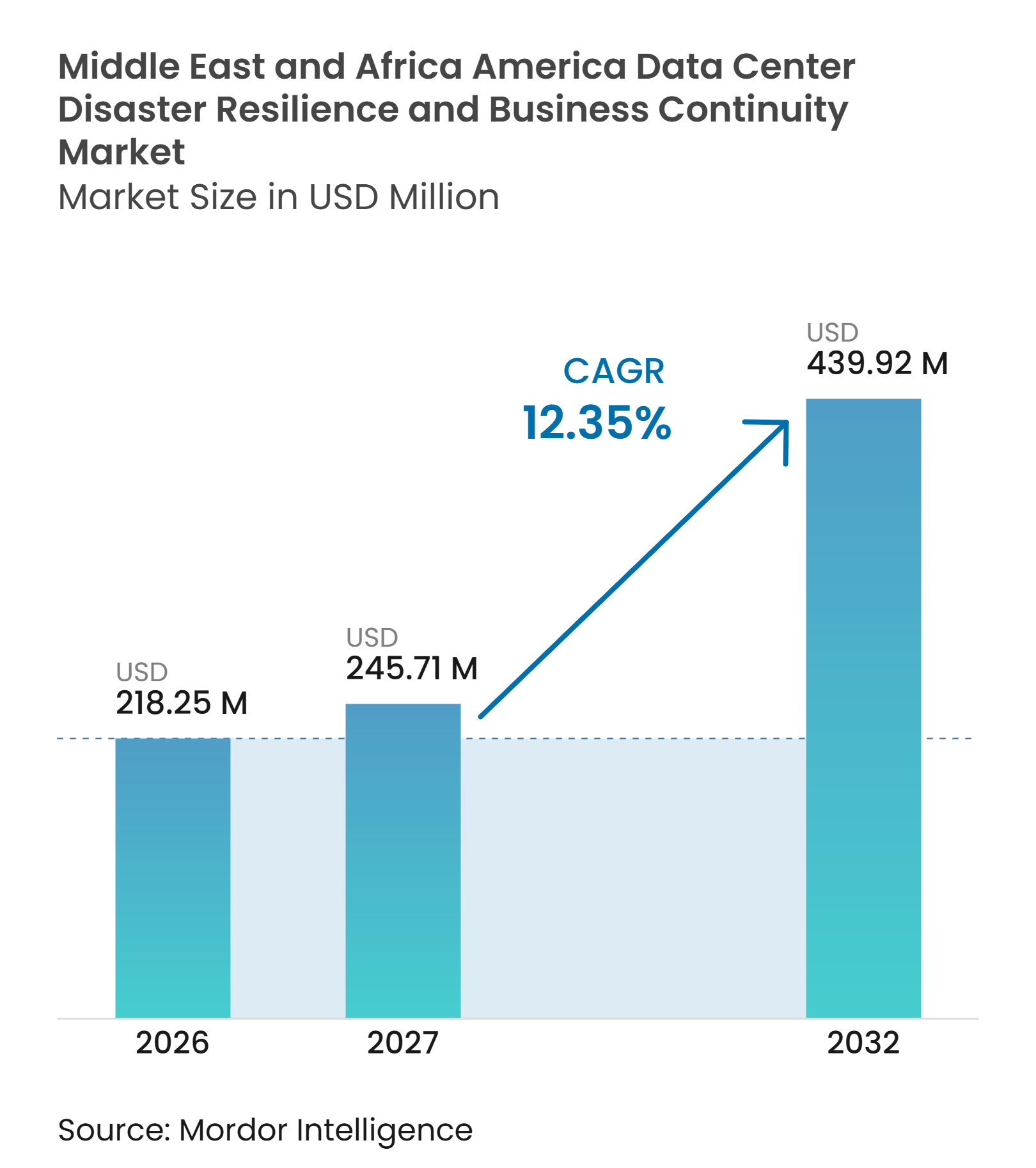
| Base Year Market Size (2026) | USD 218.25 Million |
| Market Size (2027) | USD 245.71 Million |
| Market Size (2032) | USD 439.92 Million |
| Growth Rate (2027 - 2032) | 12.35 % |
| Market Concentration | Medium |
Major Players *Disclaimer: Major Players sorted in no particular order Image © Mordor Intelligence. Reuse requires attribution under CC BY 4.0. | |
Middle East and Africa America Data Center Disaster Resilience and Business Continuity Market Analysis by Mordor Intelligence
The MEA data center disaster resilience and business continuity market size was valued at USD 218.25 million in 2026 and estimated to expand from USD 245.71 million in 2027 to reach USD 439.92 million by 2032, at a CAGR of 12.35% during the forecast period (2027-2032). The MEA data center disaster resilience and business continuity market is moving beyond a narrow compliance role because organizations now need essential digital services to remain available during cyber, infrastructure, and physical disruptions. Regulatory requirements in Saudi Arabia and the UAE are making a tested recovery capability a direct procurement requirement for government and financial institutions. New sovereign cloud, hyperscale, edge, and colocation capacity is increasing the number of facilities and workloads that require recovery planning. Physical events in the Gulf have also made site location, provider concentration, and geographic separation central considerations for continuity design. Vendors that combine local delivery capability with automated recovery tools and compliance support are positioned to address the MEA data center disaster resilience and business continuity market opportunity.
Key Report Takeaways
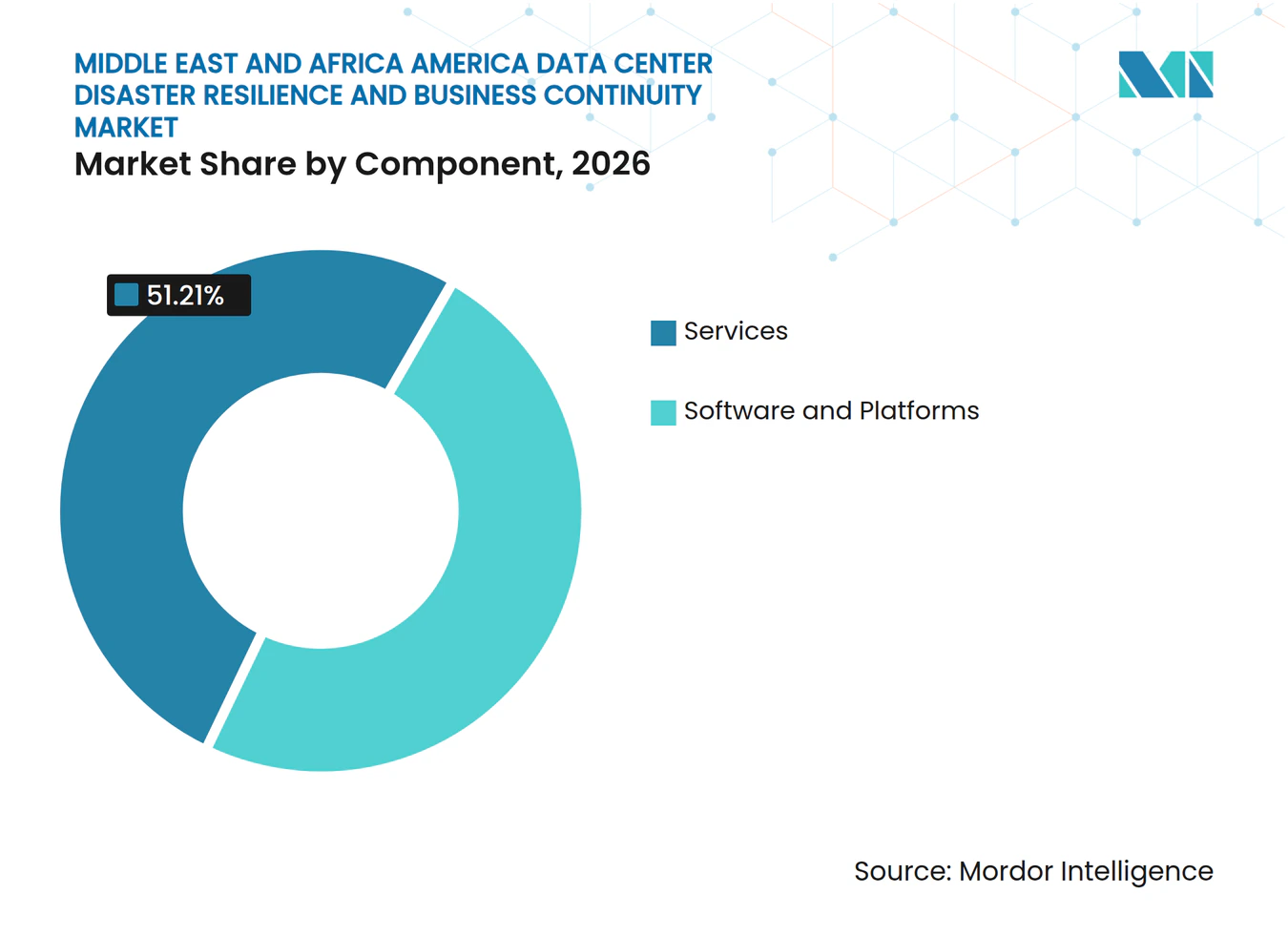
- By component, Services held a 51.21% revenue share in the Middle East and Africa data center disaster resilience and business continuity market in 2026, while Software and Platforms are projected to expand at a 12.76% CAGR through 2032.
- By deployment mode, Cloud accounted for 46.18% of revenue in 2026 and is projected to grow at a 12.73% CAGR through 2032.
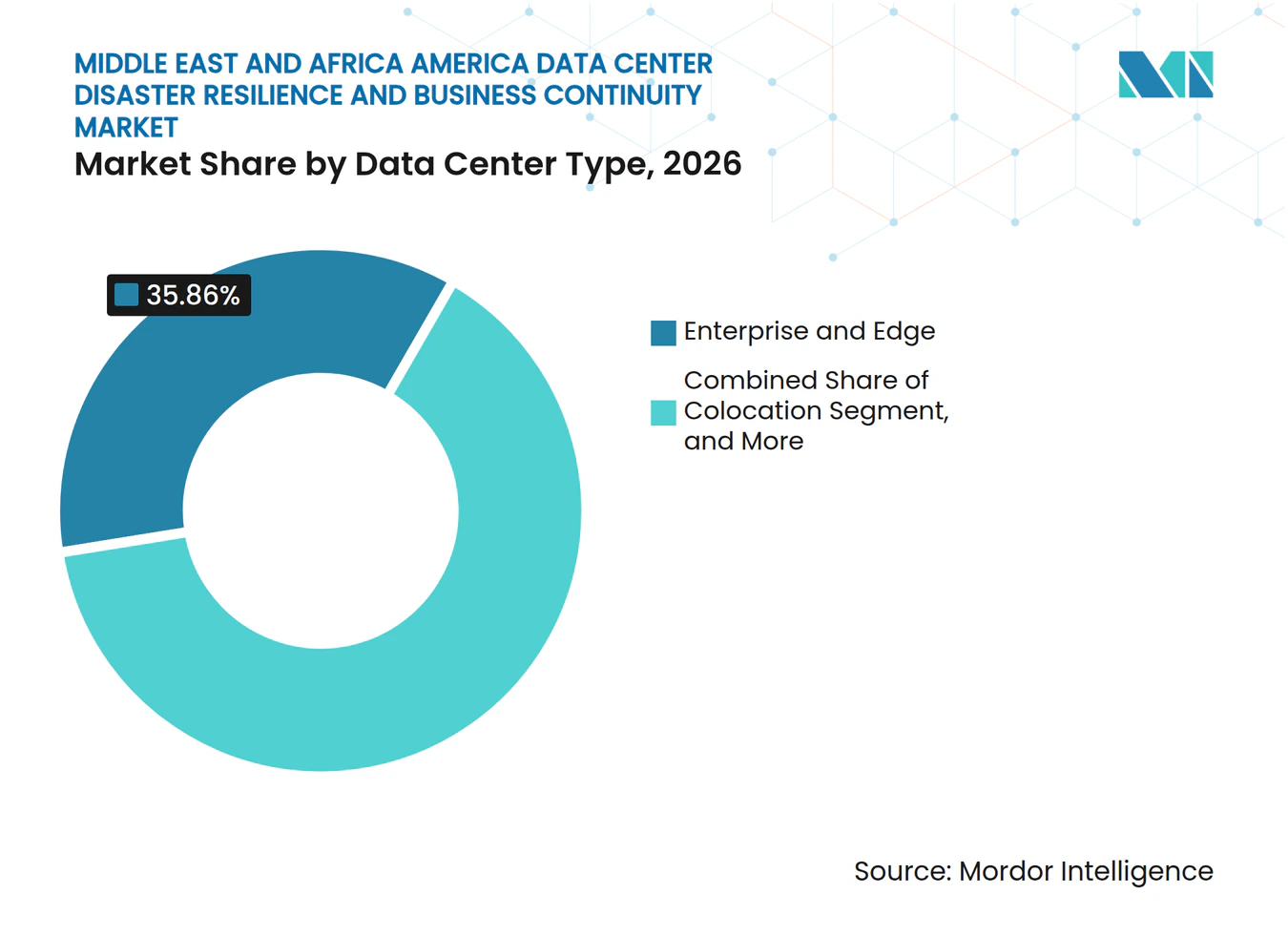
- By data center type, Enterprise and Edge Data Centers accounted for 35.86% of regional revenue in 2026 and are projected to expand at a 12.54% CAGR through 2032.
- By end-user industry, BFSI accounted for 24.32% of regional revenue in 2026, while Energy and Utilities is projected to expand at a 13.89% CAGR through 2032 in the Middle East and Africa data center disaster resilience and business continuity market.
- By geography, Saudi Arabia held 29.69% of the MEA data center disaster resilience and business continuity market share in 2026 and is projected to expand at a 13.12% CAGR through 2032.
Note: Market numbers in this report are based on Mordor Intelligence's proprietary estimation framework, which combines nine months of actuals with Q4 projections for base year 2026.
Market Trends and Insights
Drivers Impact Analysis of Middle East and Africa America Data Center Disaster Resilience and Business Continuity Market*
| Driver | (~) % Impact on CAGR Forecast | Geographic Relevance | Impact Timeline |
|---|---|---|---|
| Rising Regulatory Expectations for Demonstrable Operational Resilience | +3.2% | Saudi Arabia, UAE, broader GCC | Short term (≤ 2 years) |
| Expansion of Sovereign Cloud and Data Residency Requirements | +2.8% | Saudi Arabia, UAE, Egypt, Morocco | Medium term (2-4 years) |
| Increasing Cyberattack Exposure Across Critical Infrastructure | +2.4% | Global, concentrated in GCC and South Africa | Short term (≤ 2 years) |
| Growth of Hyperscale, Cloud, and Edge Data Center Capacity | +1.8% | Saudi Arabia, UAE, South Africa, Rest of MEA | Medium term (2-4 years) |
| Recovery Automation Across Hybrid and Multi-Cloud Environments | +1.4% | UAE, Saudi Arabia, South Africa | Medium term (2-4 years) |
| Fragmented Regional Infrastructure Increasing Demand for In-Region Recovery | +1.0% | Sub-Saharan Africa, Egypt, Rest of MEA | Long term (≥ 4 years) |
| Source: Mordor Intelligence | |||
Rising Regulatory Expectations for Demonstrable Operational Resilience
Regulatory authorities across the Gulf have moved from broad business continuity guidance to controls requiring measurable, auditable resilience outcomes. Saudi Arabia's Digital Government Authority issued Version 4.0 of its controls in September 2025, requiring a dedicated continuity manager, formal business impact analyses, monthly availability reporting, and annual exercises for cyberattacks, fires, and supply chain outages. The Saudi Central Bank requires financial institutions to establish approved alternative data centers with equivalent security controls at primary and secondary locations and to verify them at least annually. These requirements turn continuity spending into a mandatory part of governance rather than a discretionary technology purchase. Organizations that cannot demonstrate a tested recovery capability face regulatory exposure, as well as operational and reputational consequences. ISO 22301 alignment, the Saudi Central Bank Cyber Security Framework, and the DGA Raqmi Portal classification process shape eligibility and buying decisions in the MEA data center disaster resilience and business continuity market.
Expansion of Sovereign Cloud and Data Residency Requirements
Data residency requirements are changing the design of disaster recovery environments across several MEA countries. Saudi Arabia's cybersecurity controls require recovery environments for Restricted-classified workloads to remain within the Kingdom and to meet the same security classification as the primary environment.[1] This requirement limits the use of offshore recovery arrangements for regulated workloads and increases the value of local infrastructure. Egypt requires in-country recovery arrangements for Egyptian personal data, which can make standard cross-border recovery models unsuitable for affected organizations. Morocco's cloud service provider qualification framework requires providers that manage sensitive systems or data to meet business continuity, incident management, and data reversibility standards. Multi-country enterprises, therefore, need geographically distributed recovery capacity that complies with the rules of each operating jurisdiction. This requirement favors platforms and service partners that can manage several compliant recovery environments through a single control plane.
Increasing Cyberattack Exposure Across Critical Infrastructure
Cyber and physical threats have raised the resilience requirements facing data center operators and enterprise users in the region. ZeroFox recorded 209 cyber incidents in MEA during the first quarter of 2026, 64% higher than in the first quarter of 2025, and ransomware accounted for 46% of reported regional incidents. The March 2026 strikes affecting AWS facilities in the UAE and Bahrain showed that physical damage, power failure, and water intrusion can impair digital services alongside cyber events. Wiper malware that leaves systems unbootable also exposes the limitations of recovery plans based only on backup retention. These conditions are increasing demand for immutable storage, automated recovery, and recovery architectures that address both physical and digital disruptions.
Growth of Hyperscale, Cloud, and Edge Data Center Capacity
New data center capacity is creating a larger base of systems that need tested continuity plans, replicated workloads, and alternate operating locations. Aramco Digital, Armada, and Microsoft deployed Galleon edge data centers at Saudi Aramco industrial sites in February 2025, placing resilient computing and artificial intelligence capability closer to production operations. This approach extends continuity planning beyond centralized facilities to oil and gas, manufacturing, and smart-city environments. Organizations must define which services need to remain available under disruption rather than treat infrastructure capacity alone as proof of resilience. The MEA data center disaster resilience and business continuity market therefore benefits as each new hyperscale, cloud, and edge node adds recovery dependencies.
Restraints Impact Analysis of Middle East and Africa America Data Center Disaster Resilience and Business Continuity Market*
| Restraint | (~) % Impact on CAGR Forecast | Geographic Relevance | Impact Timeline |
|---|---|---|---|
| High Implementation and Integration Costs | -1.8% | Across MEA, most acute in emerging African markets | Medium term (2-4 years) |
| Shortage of Specialized Resilience and Recovery Professionals | -1.2% | Sub-Saharan Africa, mid-tier Gulf economies | Long term (≥ 4 years) |
| Inconsistent Power and Connectivity Infrastructure Across African Markets | -0.8% | Sub-Saharan Africa, Egypt | Long term (≥ 4 years) |
| Limited Real-World Testing of Recovery Plans Across Fragmented IT Environments | -0.6% | Across MEA, concentrated in hybrid and multi-cloud deployments | Medium term (2-4 years) |
| Source: Mordor Intelligence | |||
High Implementation and Integration Costs
Integration complexity is the central cost barrier for enterprise adoption of disaster resilience solutions across MEA. Large organizations often operate legacy on-premises systems, several public clouds, and edge deployments that use different recovery tools and monitoring methods. Bringing these systems into a unified continuity program requires advisory services, configuration work, systems integration, and sustained program management. Organizations must map critical services, define disruption tolerances, and design multi-region architectures that align with regulatory expectations before a technology deployment delivers value. This sequence consumes professional services budgets before the benefits of a recovery platform are realized. For mid-market firms in lower-income African countries, the resulting cost structure limits adoption to the enterprise tier even when average contract values increase.
Shortage of Specialized Resilience and Recovery Professionals
The talent challenge reflects a geographic concentration of specialized practitioners rather than a simple shortage of entry-level technology staff. Qualified cloud architects, recovery orchestration specialists, and business continuity managers are concentrated in the UAE and Saudi Arabia. Sub-Saharan Africa and mid-tier Gulf economies face a much smaller pool of experienced practitioners. Veeam and McKinsey found a material gap between organizations' self-assessed resilience maturity and their actual resilience capability. The supply of cloud-native operations talent is not keeping pace with large projects in Saudi Arabia, Egypt's New Administrative Capital, and national data center programs across sub-Saharan Africa. Organizations respond through managed service contracts, delayed live recovery testing, and greater exposure to continuity gaps that may remain undiscovered until disruption occurs.
*Our forecasts treat driver/restraint impacts as directional, not additive. The impact forecasts reflect baseline growth, mix effects, and variable interactions.
Middle East and Africa America Data Center Disaster Resilience and Business Continuity Market Segment Analysis
By Component:
Services Lead Spending While Platforms Accelerate Structural ShiftServices held 51.21% of the MEA data center disaster resilience and business continuity market share in 2026. Advisory work, business impact analysis, managed continuity programs, and plan development account for the largest share of spending. Many organizations have limited internal expertise in resilience, particularly outside the largest Gulf markets. Prescriptive regulatory requirements also create recurring demand for assessments, documentation, exercises, and program updates. The DGA's Version 4.0 controls require recurring availability reporting and annual exercises, which creates regular operational work for service providers. Saudi Central Bank requirements create a similar need for financial institutions to maintain and verify alternative recovery facilities. Managed programs are important where an organization cannot justify a dedicated internal continuity team. This is especially relevant to mid-market firms across African countries, where external delivery partners provide continuity expertise that is difficult to hire directly.
Software and Platforms are projected to expand at a 12.76% CAGR from 2027 to 2032. The segment is supported by a shift toward unified cloud-native platforms that combine cyber recovery and business continuity processes. Commvault and Microsoft formalized a multiyear partnership in June 2026 to make Commvault Cloud Unity available as a native independent software vendor service on Azure. The arrangement allows users to embed backup, recovery, and identity resilience capabilities within Azure environments. ISO 22301-aligned platforms are replacing standalone planning tools for government and BFSI users that need auditable evidence of program maturity. Consolidated platforms can bring recovery workflows, policy evidence, and reporting into a common operating environment. This favors providers that can automate recovery tasks across cloud, on-premises, and hybrid systems. The MEA data center disaster resilience and business continuity industry is therefore shifting toward platforms that reduce manual recovery work while supporting evidence-based compliance.


By Deployment Mode:
Cloud Leads Across Recovery Architecture in MEACloud held 46.18% of regional revenue in 2026. It is also projected to expand at a 12.73% CAGR from 2027 to 2032. Hyperscaler expansion enables the use of managed recovery capacity rather than dedicated secondary sites, which require significant capital spending. The model can provide flexible recovery capacity and reduce the cost of maintaining idle infrastructure. However, regulated Saudi government and financial workloads must use in-Kingdom recovery environments when classification rules apply. This requirement supports demand for sovereign cloud recovery capacity and local cloud regions. Microsoft Saudi Arabia East was available in the fourth quarter of 2026, adding a local option for organizations that need cloud services within the Kingdom. The MEA data center disaster resilience and business continuity market continues to rely on cloud recovery, as it aligns with the expanding cloud footprint and enables more variable operating models.
On-premises deployment remains necessary for classified government information, regulated financial data, and operational technology environments in energy and industrial facilities. Organizations with these workloads often require direct control over hardware, security practices, and recovery locations. Hybrid architecture is gaining relevance as a tiered model for workload placement across sovereign, private, and public environments. High-criticality services can remain in sovereign environments, while moderate-criticality services can use controlled hybrid strategies. Lower-criticality applications can use global cloud scale without the same compliance burden. Hybrid designs can also reduce the risk that a primary site and a nearby recovery site face the same regional event. The March 2026 AWS facility incidents made this risk relevant to Gulf continuity planners. Recovery planning is thus based on service criticality, data classification, and geographic separation rather than on a single deployment choice.
By Data Center Type:
Enterprise and Edge Facilities Drive Resilience ComplexityEnterprise and Edge Data Centers accounted for 35.86% of the MEA data center disaster resilience and business continuity market in 2026 and are projected to expand at a 12.54% CAGR through 2032. The segment is supported by more widespread adoption of distributed computing in oil and gas, manufacturing, and smart-city environments. Each edge location adds a distinct recovery point that may need failover, monitoring, and operational coordination. These facilities often support local operations where service interruptions can have immediate operational effects. Aramco Digital, Armada, and Microsoft deployed Galleon edge data centers at Saudi Aramco sites in February 2025 with Azure IoT Operations, Azure Arc, and Azure Local. The deployment illustrates how resilient computing and safety monitoring are increasingly integrated into field operations. Similar designs are extending across energy, manufacturing, and smart city use cases in the GCC. Providers need automated orchestration because manual recovery methods become more difficult as the number of distributed sites increases.
Cloud service providers offer geo-redundant replication for enterprises that depend on hyperscale platforms. Colocation facilities provide secondary infrastructure in neutral locations with carrier connectivity and a separate operational setting. These sites can help enterprises establish alternate recovery locations without building new facilities. Teraco completed Phase 2 of its JB4 campus near Johannesburg in August 2025, adding 30 MW of critical information technology power capacity and bringing total capacity to 50 MW across 14 data halls. The expansion increased colocation-based disaster recovery capacity for enterprises and public-sector users in southern Africa. Uptime Institute tier standards and related regional frameworks are used as selection benchmarks for regulated recovery workloads. The MEA data center disaster resilience and business continuity market encompasses a range of facility types, as enterprises require different combinations of control, location, connectivity, and managed operations. The choice of facility is tied to workload criticality and the ability to sustain service when a primary environment is unavailable.


By End User Industry:
BFSI Anchors Compliance Demand While Energy and Utilities AcceleratesBFSI held 24.32% of regional revenue in 2026. Banks, insurers, payment organizations, and other financial institutions must maintain tested recovery capabilities in accordance with the requirements of Saudi Arabia and the UAE. The Saudi Central Bank requires approved alternative data centers, while UAE financial institutions face data governance and recovery expectations. These obligations make business continuity a contractual and governance requirement rather than a limited information technology concern. Oman Data Park and First Abu Dhabi Bank signed an agreement in March 2025 covering a Tier 3 disaster recovery site and a formal business continuity planning center. The agreement reflects the role of dedicated recovery capacity in maintaining banking operations during a crisis. Government, healthcare, information technology, and telecommunications users also contribute to demand through different requirements. Government agencies follow DGA exercise schedules, healthcare providers must protect the availability of patient data, and telecom operators manage critical infrastructure obligations.
Energy and Utilities is projected to expand at a 13.89% CAGR from 2027 to 2032. The segment is affected by the convergence of operational technology and information technology in oil and gas, power generation, and smart metering systems. Digital control systems have expanded the range of assets requiring recovery planning. ZeroFox listed energy as one of the 5 MEA sectors targeted for ransomware in the first quarter of 2026. This exposure moves sector users beyond conventional information technology disaster recovery toward recovery methods that address industrial operating systems. Energy operators also use distributed edge facilities, which increases the importance of local resilience and orchestrated failover. Retail, e-commerce, and manufacturing are earlier-stage users with growing needs as payments, inventory, and automation systems become more digital. These organizations increasingly face continuity gaps because operational dependencies expand faster than their existing recovery plans. The MEA data center disaster resilience and business continuity market serves these sectors through plans that reflect their different data, safety, and service availability needs.
Geography Analysis
Saudi Arabia
Saudi Arabia accounted for 29.69% of the MEA data center disaster resilience and business continuity market in 2026 and is projected to grow at a 13.12% CAGR from 2027 to 2032. National artificial intelligence programs support a broader technology infrastructure agenda. SAMA, the National Cybersecurity Authority, and the Digital Government Authority create overlapping recovery requirements for financial institutions, government entities, and restricted workloads. DGA Version 4.0 requires reporting and annual resilience exercises, while the Saudi Central Bank requires approved alternative data centers. In September 2026, the Ministry of Municipalities and Housing approved unified requirements for commercial data centers that cover fire protection, cooling, power backup, and construction standards.[2] Rubrik entered Saudi Arabia through a partnership with Echelon Digital Group in December 2025, and Commvault's partnership with Microsoft increased its local cloud relevance. Local compliance capability, sovereign recovery capacity, and tested recovery processes are central to procurement in Saudi Arabia.
United Arab Emirates
The UAE has a mature digital infrastructure and uses the Central Bank of the UAE and National Electronic Security Authority requirements that require a tested recovery capability and defined recovery time objectives. Financial data recovery environments must be hosted in-country, which makes local facility and cloud choices important for regulated users. The March 2026 incidents affecting AWS facilities in the UAE changed how enterprises assess provider concentration and geographic redundancy. The incidents disrupted nearly 60 cloud services and brought a physical dimension to resilience planning. Enterprises are responding with multi-provider, colocation, and managed continuity arrangements that reduce dependence on a single operating environment. du and Commvault announced a partnership at GITEX Global 2025 to deliver advanced resilience and protection services to UAE enterprise and government users. The MEA data center disaster resilience and business continuity market in the UAE reflects an emphasis on diversified recovery architecture, local compliance, and operational control.
South Africa and Rest of MEA
South Africa anchors enterprise resilience spending in sub-Saharan Africa through its expanding infrastructure base and policy focus. The President stated in February 2026 that 55 data centers had been built in the country, with over ZAR 50 billion expected in new investment over the following 3 years. Microsoft invested ZAR 5.4 billion, equivalent to USD 297 million, in artificial intelligence-ready data center infrastructure, while Visa opened its first African data center in Johannesburg in July 2025 under a ZAR 1 billion investment, equivalent to USD 57 million. Teraco's expanded JB4 campus adds colocation recovery options for southern African users. Morocco's 2025 qualification framework extends demand for compliant cloud recovery services across North Africa. Mauritania's Tier III-certified Nouakchott Data Hub and Angola's national backup data center show growing public-sector investment in other markets. Africa Data Centers Association reported 360 MW of active capacity, 238 MW under construction, and 656 MW planned across Africa in 2026. Power reliability, connectivity, practitioner availability, and local regulation shape the pace at which broader African markets can convert capacity investment into tested resilience programs.
Competitive Landscape
Market Concentration
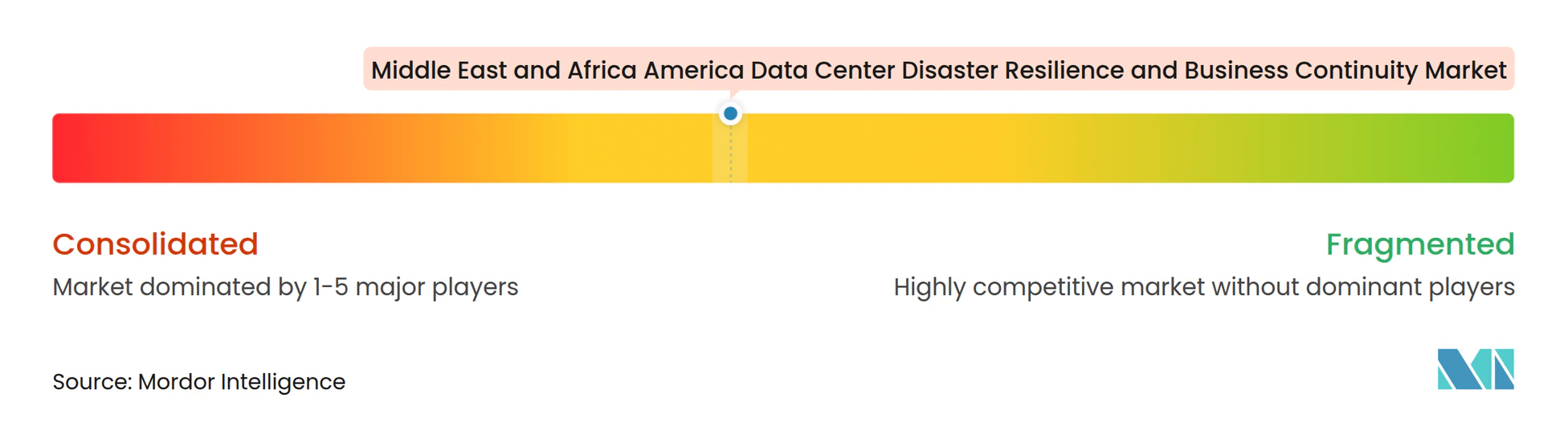
The MEA data center disaster resilience and business continuity market has moderate concentration at the upper tier. It includes global cloud and infrastructure providers such as IBM, Microsoft, AWS, Oracle, and Google. Specialist recovery platform vendors include Veeam, Rubrik, Commvault, and Zerto. Business continuity software providers include Fusion Risk Management, Everbridge, MetricStream, Riskonnect, and ServiceNow. Competition increasingly depends on the ability to coordinate recovery across hybrid and multi-cloud environments without extensive manual intervention. Procurement teams are focused on whether a provider can sequence and automate recovery across dependent systems. Commvault's June 2026 partnership with Microsoft made Cloud Unity available on Azure as a native independent software vendor service. The move reflects an approach that integrates recovery capabilities into the cloud control plane rather than adding them as a separate layer.
Regional players provide a delivery layer that is difficult for global vendors to establish remotely. ZainTECH combines regional regulatory knowledge, government client relationships, and certified technology partnerships. The company was recognized as Veeam's Top-Performing Cloud Partner in the Middle East in August 2025. Africa Data Centers and Teraco provide the physical colocation infrastructure needed for enterprise recovery in sub-Saharan Africa. Teraco's 50 MW JB4 campus provides a larger recovery location for enterprises and public-sector users in southern Africa. Local delivery capability can help providers address country-specific data rules, service expectations, and access to qualified staff. It also helps customers link global recovery tools to a local operating model.
Managed continuity programs for African mid-market organizations remain an opportunity, as many firms lack dedicated internal resilience teams. Automated recovery for operational technology is another opportunity, as energy companies need plans that cover both industrial and information technology environments. Multi-jurisdiction business impact analysis tools are relevant to enterprises operating under different national data rules. ISO 22301 eligibility, National Cybersecurity Authority controls, and alignment with the Saudi Central Bank framework act as meaningful barriers in government and BFSI procurement. Providers without locally credentialed practitioners may find it harder to meet these buyer requirements.[3]
Middle East and Africa America Data Center Disaster Resilience and Business Continuity Industry Leaders
-
Microsoft Corporation
-
International Business Machines Corporation
-
Amazon Web Services, Inc.
-
Saudi Telecom Company
-
ZainTECH
- *Disclaimer: Major Players sorted in no particular order
Middle East and Africa America Data Center Disaster Resilience and Business Continuity Market Companies Covered in this Report
- International Business Machines Corporation
- Microsoft Corporation
- Amazon Web Services, Inc.
- Oracle Corporation
- Google LLC
- VMware LLC
- Veeam Software Group GmbH
- Rubrik, Inc.
- Commvault Systems, Inc.
- Zerto Ltd.
- Acronis International GmbH
- Fusion Risk Management, Inc.
- Everbridge, Inc.
- MetricStream, Inc.
- Riskonnect, Inc.
- ServiceNow, Inc.
- Sungard Availability Services
- Castellan Solutions
- ZainTECH
- Saudi Telecom Company
- Khazna Data Centers
- Africa Data Centres
- Digital Realty Trust, Inc.
- Equinix, Inc.
- Gulf Data Hub
- Teraco Data Environments (Pty) Ltd
Recent Industry Developments in Middle East and Africa America Data Center Disaster Resilience and Business Continuity Market
- September 2026: Saudi Arabia's Ministry of Municipalities and Housing approved unified Municipal Requirements for Commercial Data Centers, mandating Saudi Building Code compliance for fire protection, cooling, power backup, and construction standards for all commercial data center sites, standardizing investor requirements across the Kingdom.
- June 2026: Commvault and Microsoft formalized a multi-year strategic partnership integrating Commvault Cloud Unity as a native ISV service on Microsoft Azure, enabling organizations in Saudi Arabia and the UAE to embed backup, recovery, and identity-resilience capabilities directly within Azure environments.
- May 2026: MEEZA announced multiple strategic partnerships with European and Asian data center and telecommunications providers to expand disaster recovery and business continuity capabilities, enabling cross-border data replication, geographic redundancy, and advanced failover for clients across government, energy, financial services, and healthcare sectors in Qatar.
- March 2026: Drone strikes on AWS data centers in the UAE and Bahrain caused structural damage, power failures, and fire-suppression water intrusion, disrupting nearly 60 cloud services and prompting AWS to advise Middle East customers to migrate workloads to alternate regions, marking the first time commercial data center facilities in the region sustained physical damage in active military conflict.
Middle East and Africa America Data Center Disaster Resilience and Business Continuity Market Report Scope
The Middle East and Africa Data Center Disaster Resilience and Business Continuity Market encompasses the industry that provides software, platforms, and services to help data centers across the region prevent, withstand, respond to, and recover from disasters, cyberattacks, system failures, and operational disruptions.
The Middle East and Africa Data Center Disaster Resilience and Business Continuity Market Report is Segmented by Component (Software and Platforms, and Services), Deployment Mode (Cloud, On-Premises, and Hybrid), Data Center Type (Cloud Service Provider, Colocation, and Enterprise and Edge), End User Industry (BFSI, IT and Telecom, Government and Public Administration, Healthcare and Life Sciences, Manufacturing, Energy and Utilities, and Other End User Industries), and Geography (Saudi Arabia, United Arab Emirates, South Africa, and Rest of Middle East and Africa). The Market Forecasts are Provided in Terms of Value (USD).
Segmentation Overview
| Software and Platforms | Integrated Continuity and Resilience Management Platforms |
| Standalone Business Impact Analysis and Dependency Mapping Software | |
| Standalone Continuity Planning and Documentation Software | |
| Standalone Crisis Response and Incident Coordination Software | |
| Others (Standalone Resilience Exercise and Testing Management Software, etc) | |
| Services | Advisory, Business Impact Analysis, and Resilience Assessment Services |
| Continuity and Crisis Response Plan Development Services | |
| Software Implementation and Systems Integration Services | |
| Resilience Testing, Simulation, and Training Services | |
| Managed Continuity Program Services |
| Cloud |
| On-Premises |
| Hybrid |
| Cloud Service Provider |
| Colocation |
| Enterprise and Edge |
| IT and Telecom |
| BFSI |
| Government and Public Administration |
| Healthcare and Life Sciences |
| Manufacturing |
| Retail and E-Commerce |
| Energy and Utilities |
| Other Industries |
| Saudi Arabia |
| United Arab Emirates |
| South Africa |
| Rest of Middle East and Africa |
| By Component | Software and Platforms | Integrated Continuity and Resilience Management Platforms |
| Standalone Business Impact Analysis and Dependency Mapping Software | ||
| Standalone Continuity Planning and Documentation Software | ||
| Standalone Crisis Response and Incident Coordination Software | ||
| Others (Standalone Resilience Exercise and Testing Management Software, etc) | ||
| Services | Advisory, Business Impact Analysis, and Resilience Assessment Services | |
| Continuity and Crisis Response Plan Development Services | ||
| Software Implementation and Systems Integration Services | ||
| Resilience Testing, Simulation, and Training Services | ||
| Managed Continuity Program Services | ||
| By Deployment Mode | Cloud | |
| On-Premises | ||
| Hybrid | ||
| By Data Center Type | Cloud Service Provider | |
| Colocation | ||
| Enterprise and Edge | ||
| By End User Industry | IT and Telecom | |
| BFSI | ||
| Government and Public Administration | ||
| Healthcare and Life Sciences | ||
| Manufacturing | ||
| Retail and E-Commerce | ||
| Energy and Utilities | ||
| Other Industries | ||
| By Geography | Saudi Arabia | |
| United Arab Emirates | ||
| South Africa | ||
| Rest of Middle East and Africa | ||
Key Questions Answered in the Report
What is the size of the MEA data center disaster resilience and business continuity market?
The market is valued at USD 218.25 million in 2026 and is expected to reach USD 439.92 million by 2032, at a 12.35% CAGR from 2027 to 2032.
What is driving demand for data center disaster resilience in MEA?
Regulatory controls, data residency requirements, cyber incidents, and new cloud and edge capacity are raising the need for tested recovery capability.
Which component holds the largest share in the MEA data center disaster resilience and business continuity market?
Services holds the largest share at 51.21% in 2026 because organizations need advisory support, continuity planning, testing, and managed delivery.
Which deployment approach leads disaster recovery demand in MEA?
Cloud leads with a 46.18% share in 2026 and is projected to expand at a 12.73% CAGR through 2032.
Which end user sector is expanding fastest for disaster resilience solutions?
Energy and Utilities is projected to expand at a 13.89% CAGR through 2032, supported by operational technology and information technology convergence.
Which country leads regional demand for continuity solutions?
Saudi Arabia holds 29.69% of the regional total in 2026 and is projected to expand at a 13.12% CAGR through 2032.