
Middle East and Africa Data Center Counter-Drone and Airspace Security Market Size and Share
Market Overview
| Study Period | 2021 - 2032 |
|---|---|
| Forecast Data Period | 2027 - 2032 |
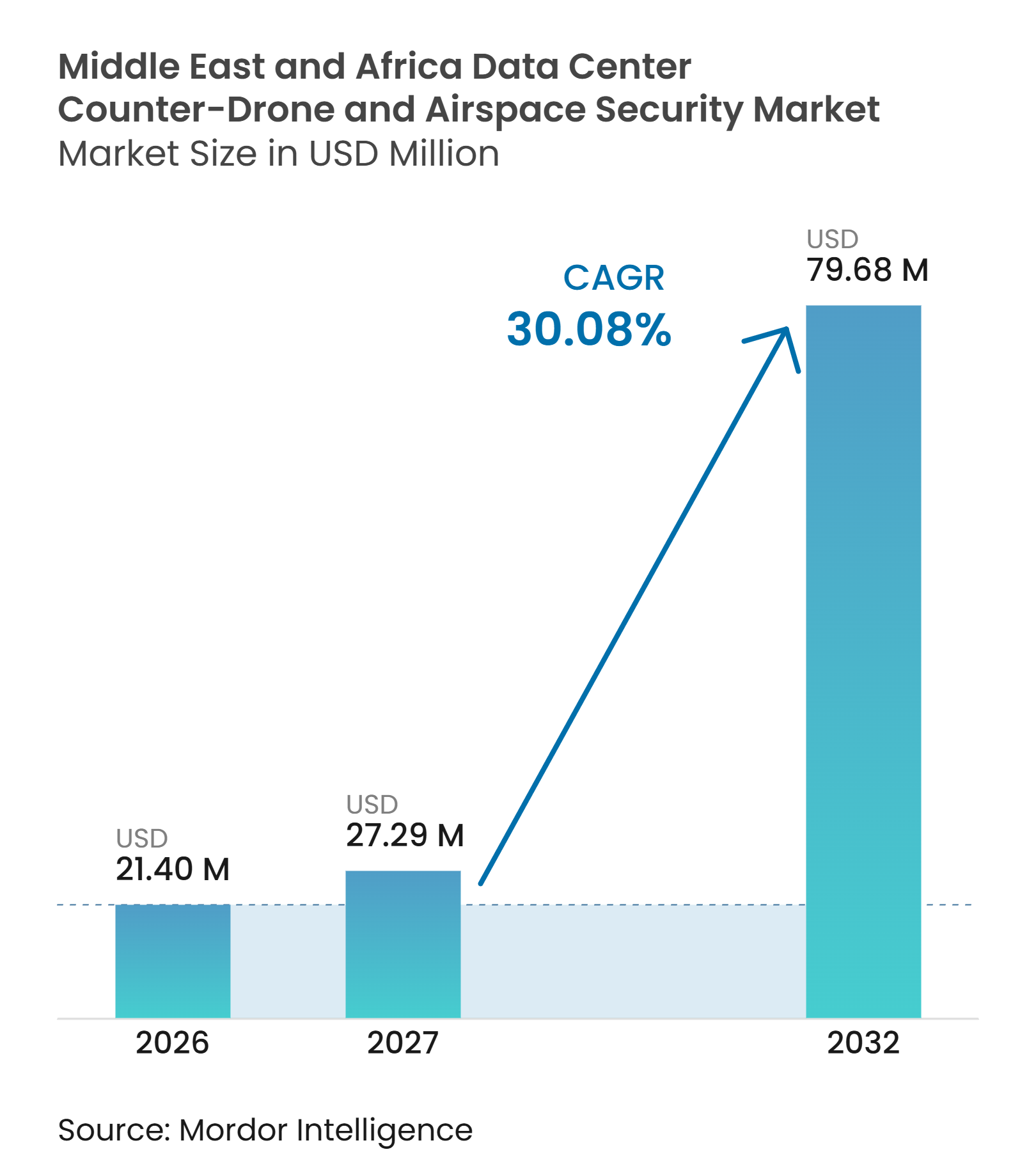
| Base Year Market Size (2026) | USD 21.40 Million |
| Market Size (2027) | USD 27.29 Million |
| Market Size (2032) | USD 79.68 Million |
| Growth Rate (2027 - 2032) | 30.08 % |
| Market Concentration | Medium |
Major Players *Disclaimer: Major Players sorted in no particular order Image © Mordor Intelligence. Reuse requires attribution under CC BY 4.0. | |
Middle East and Africa Data Center Counter-Drone and Airspace Security Market Analysis by Mordor Intelligence
The Middle East and Africa data center counter-drone and airspace security market size is projected to expand from USD 21.40 million in 2026 and USD 29.44 million in 2027 to USD 79.68 million by 2032, registering a CAGR of 30.08% between 2027 to 2032. The Middle East and Africa data center counter-drone and airspace security market is being shaped by the need to protect fixed digital assets as large AI and cloud campuses are added across the region. New data center capacity raises the value of assets that need persistent coverage, while the disruption risk from unauthorized drones makes airspace protection part of site resilience planning. Operators are increasingly weighing hardware cost against the potential cost of an outage, data recovery, and delayed customer service. The Middle East and Africa data center counter-drone and airspace security market also benefits from stronger links between national critical-infrastructure programs and commercial site security requirements. Competition is moving toward integrated systems that can combine detection, verification, and response while operating in hot, dusty, and coastal environments.
Key Report Takeaways
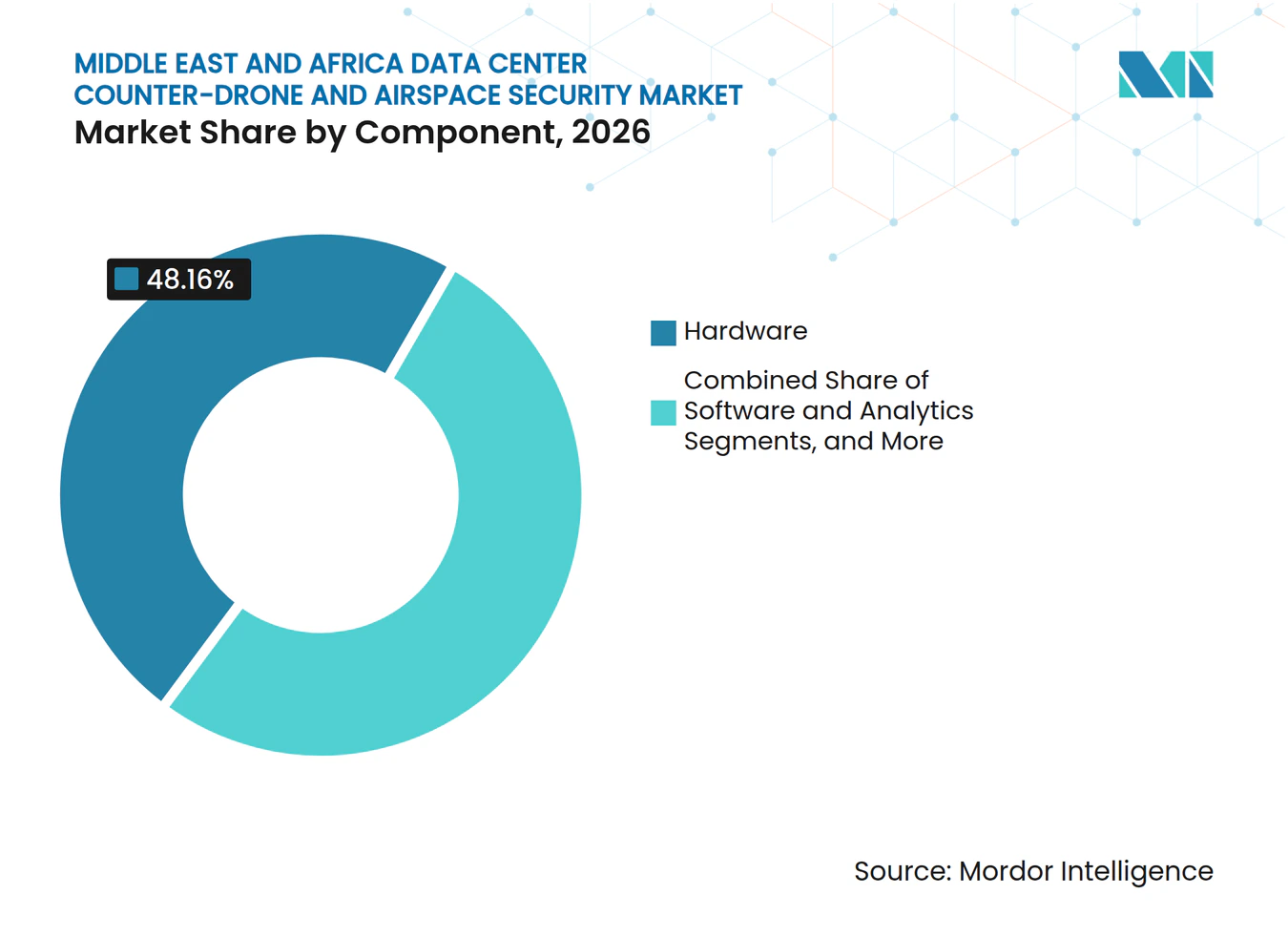
- By component, hardware held 48.16% of the Middle East and Africa data center counter-drone and airspace security market share in 2026, while software and analytics is projected to expand at a 31.53% CAGR through 2032.
- By technology, integrated multi-sensor systems held 34.56% revenue share in 2026 and are projected to expand at a 31.72% CAGR through 2032.
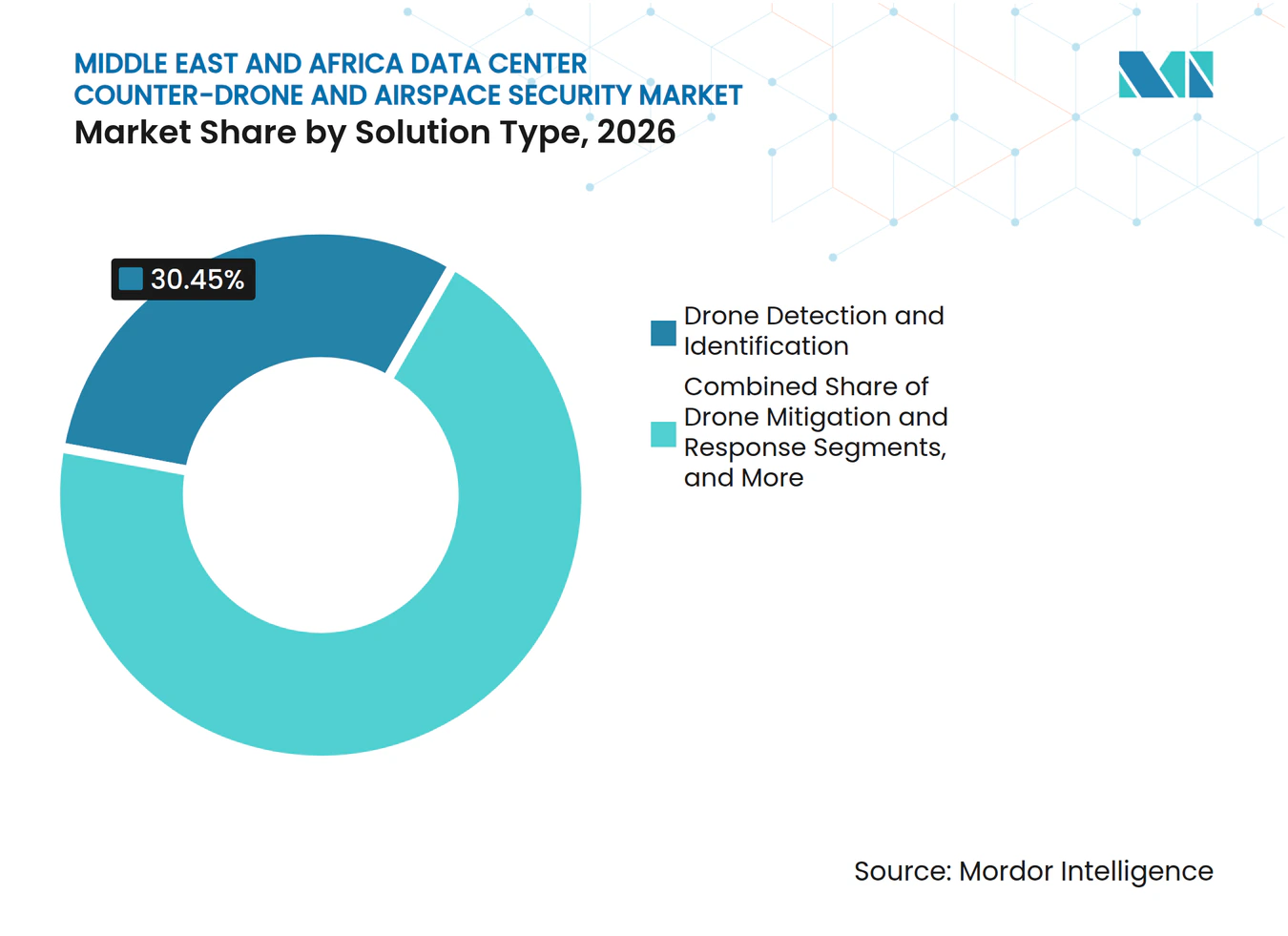
- By solution type, drone detection and identification held 30.45% revenue share in 2026, while drone mitigation and response is projected to expand at a 31.84% CAGR through 2032.
- By deployment type, fixed installations held 74.34% revenue share in 2026, while mobile and portable systems are projected to expand at a 31.91% CAGR through 2032.
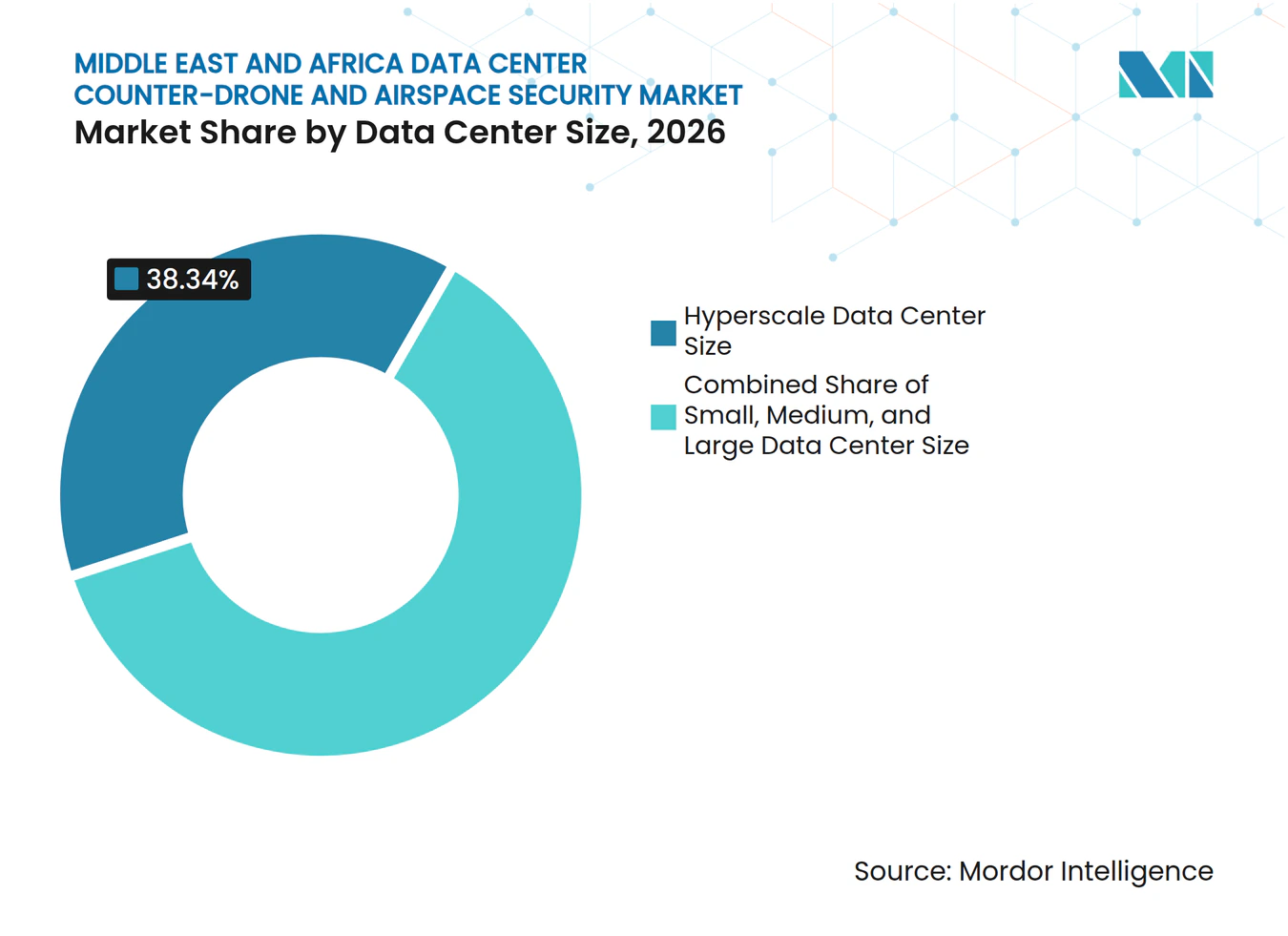
- By data center size, hyperscale facilities held 38.34% revenue share in 2026 and are projected to expand at a 31.25% CAGR through 2032.
- By data center type, colocation operators held 38.45% revenue share in 2026, while cloud service providers are projected to expand at a 31.42% CAGR through 2032.
- By geography, Saudi Arabia held 32.56% revenue share in 2026 and is projected to expand at a 31.49% CAGR through 2032.
Note: Market numbers in this report are based on Mordor Intelligence's proprietary estimation framework, which combines nine months of actuals with Q4 projections for base year 2026.
Market Trends and Insights
Drivers Impact Analysis of Middle East and Africa Data Center Counter-Drone and Airspace Security Market*
| Driver | (~) % Impact on CAGR Forecast | Geographic Relevance | Impact Timeline |
|---|---|---|---|
| Expansion of Hyperscale and Sovereign AI Data Center Capacity | +8.2% | Saudi Arabia, UAE, South Africa | Short term (≤ 2 years) |
| Rising Critical-Infrastructure Protection Spending | +6.8% | Saudi Arabia, UAE | Short term (≤ 2 years) |
| Increasing Drone Proliferation Around Restricted Airspace | +5.9% | Saudi Arabia, UAE, with spill-over to Rest of MEA | Medium term (2-4 years) |
| Demand for Layered Detection and Automated Response | +4.6% | Global, UAE and Saudi Arabia early adopters | Medium term (2-4 years) |
| AI-Enabled Data Center Campuses Creating New Local Airspace Exposure | +3.1% | Saudi Arabia, UAE, South Africa | Long term (≥ 4 years) |
| Heat, Dust, and Coastal Conditions Increasing Need for Sensor Redundancy | +2.0% | GCC core, spill-over to coastal MEA | Long term (≥ 4 years) |
| Source: Mordor Intelligence | |||
Expansion of Hyperscale and Sovereign AI Data Center Capacity
New hyperscale campuses create defined locations that require continuous airspace monitoring. Humain and Saudi Arabia's National Infrastructure Fund established a USD 1.2 billion financing framework for 250 MW of capacity in January 2026.[1] DataVolt also signed a USD 5 billion agreement with NEOM's Oxagon for a 1.5 GW net-zero campus in February 2025.[2] These projects extend the physical footprint that operators need to protect, including power, cooling, communications, and control systems beyond the main building. The Middle East and Africa data center counter-drone and airspace security market therefore gains from each new campus because sensor arrays, command software, and response equipment are acquired for the site. The capacity buildout also favors systems that can expand as individual campuses add halls, substations, and adjoining support infrastructure.
Rising Critical-Infrastructure Protection Spending
Protection spending is moving beyond conventional perimeter security as public authorities and operators assess drone-related risks to critical assets. Commercial campuses can benefit when national programs build local experience with radar, detection, command-and-control, and interceptor technologies. The Middle East and Africa data center counter-drone and airspace security market is supported by this transfer of operating knowledge because the same sites require reliable detection and verified incident response. EDGE Group received a UAE Ministry of Defence contract worth AED 227 million, equivalent to USD 61.8 million, for GPS-PROTECT anti-jamming systems in February 2025.[3] Operators completing protection upgrades early can avoid the added cost and operational disruption that follow retrofitting after a threat event. Their procurement decisions increasingly account for resilience, insurance review, and customer confidence rather than equipment price alone.
Increasing Drone Proliferation Around Restricted Airspace
Unauthorized drone activity around restricted airspace creates a persistent monitoring requirement for large data campuses. The threat includes commercially available platforms as well as aircraft that operate with limited or no conventional control-link emissions. The Middle East and Africa data center counter-drone and airspace security market is affected because an operator cannot treat the site boundary as the full security boundary when an aerial platform can approach from outside the perimeter. Detection must identify the aircraft, establish whether it poses a risk, and pass a usable alert to trained personnel. The required operating model is more demanding at campuses with shared utility infrastructure because a single disruption can affect several tenants. This pushes buyers toward systems that maintain coverage across a wider airspace volume and remain useful when the threat pattern changes.
Demand for Layered Detection and Automated Response
A single sensor type does not provide complete coverage in the operating conditions common across the Gulf. The Middle East and Africa data center counter-drone and airspace security market is therefore moving toward combinations of radar, passive radio-frequency sensing, electro-optical and infrared cameras, and acoustic sensors. Each layer addresses a different limitation, with radar supporting physical detection and cameras helping teams verify the object before escalation. Automated workflows can bring sensor observations into one operational view and reduce the delay between detection, classification, and an approved response. DroneShield's October 2026 update added improved RF-optical sensor fusion and coordinated response capabilities across connected DroneSentry-X Mk2 units. These capabilities allow operators to improve the performance of installed systems through software changes rather than replacing the full hardware base.
Restraints Impact Analysis of Middle East and Africa Data Center Counter-Drone and Airspace Security Market*
| Restraint | (~) % Impact on CAGR Forecast | Geographic Relevance | Impact Timeline |
|---|---|---|---|
| High System Cost and Long Procurement Cycles | -4.8% | Global, smaller MEA buyers most exposed | Medium term (2-4 years) |
| Spectrum, Safety, and Countermeasure Authorization Constraints | -3.6% | UAE, Saudi Arabia, South Africa | Short term (≤ 2 years) |
| False Alarms and Sensor Performance Degradation in Harsh Environments | -2.7% | GCC core, coastal MEA | Medium term (2-4 years) |
| Limited Regional C-UAS Operations and Maintenance Talent | -1.9% | Rest of MEA, emerging markets | Long term (≥ 4 years) |
| Source: Mordor Intelligence | |||
High System Cost and Long Procurement Cycles
Integrated counter-drone deployments require capital for sensors, software, communications, installation, training, and ongoing support. Large public contracts show the investment required for fully networked detection and response systems, while smaller commercial buyers may need phased procurement. Long approval and contracting processes can delay protection even when the operational need is clear. The Middle East and Africa data center counter-drone and airspace security market faces this constraint most directly among small and medium operators that cannot absorb the full initial cost. Vendor financing, subscription-based software, and mobile systems can lower the initial commitment, but they do not remove the need for qualified installation and operating staff. Buyers also need to evaluate how added security spending interacts with insurance, financing, and facility upgrade budgets.
Spectrum, Safety, and Countermeasure Authorization Constraints
Commercial operators may be able to deploy passive sensing sooner than active countermeasures. Active technologies can affect legitimate aviation and communications activity, so their use depends on approval and coordination with national authorities. The Middle East and Africa data center counter-drone and airspace security market is shaped by these limits because a buyer may install detection first and add a response layer later. This creates a practical advantage for non-emitting technologies that identify and track the threat without affecting surrounding spectrum. A clear operating procedure is also needed to define who assesses the alert, who contacts authorities, and who authorizes any countermeasure. The resulting compliance work can lengthen deployment schedules, especially for multi-site operators that work across several jurisdictions.
*Our forecasts treat driver/restraint impacts as directional, not additive. The impact forecasts reflect baseline growth, mix effects, and variable interactions.
Middle East and Africa Data Center Counter-Drone and Airspace Security Market Segment Analysis
By Component:
Hardware Anchors a Shifting Technology StackHardware held 48.16% of the Middle East and Africa data center counter-drone and airspace security market share in 2026 because first-generation deployments require physical sensors and command equipment. Radar arrays, radio-frequency direction finders, electro-optical and infrared camera masts, communications links, and control consoles establish the initial detection layer. These assets require site surveys, network integration, power supply planning, and environmental protection before the analytics layer can deliver value. The hardware position reflects the need for permanent equipment at facilities that operate continuously. SIGN4L's Skyshield architecture combines X-band radar, optronic sensors, and direction finders in a single stack for Ministry of Defence requirements. The design illustrates why buyers value equipment that can consolidate sensing functions at a fixed site.
Software and analytics is projected to expand at a 31.53% CAGR through 2032 as buyers seek to make installed sensors more useful. This category supports threat classification, alert management, data retention, and the integration of feeds from different sensor types. The software layer can help security teams distinguish a drone alert from other activity before escalation. It also creates recurring requirements for updates, cyber protection, user access controls, and system interoperability. The Middle East and Africa data center counter-drone and airspace security industry consequently gives providers an incentive to pair hardware shipments with longer-term platform support. Integration and support services will remain important because operators need training, maintenance, and assistance in connecting airspace tools with the rest of the security operation.



By Technology:
Sensor Fusion Reshapes Detection ArchitectureIntegrated multi-sensor systems held 34.56% of the Middle East and Africa data center counter-drone and airspace security market share in 2026 and are projected to expand at a 31.72% CAGR through 2032. Their position reflects the limits of relying on one detection method in environments with heat, dust, visual clutter, and varied radio-frequency conditions. Passive radio-frequency sensing can identify many remotely piloted threats, but it may not identify an aircraft operating without an active control link. Radar can detect non-cooperative physical objects, while electro-optical and infrared systems support verification in daylight and low-light conditions. Acoustic systems can provide passive rotor-signature information where local noise conditions permit. A combined system gives the operator several ways to verify a potential threat before it is treated as an incident.
Radar-based and radio-frequency detection remain material parts of the technology mix because they solve different operating needs. Radar offers wider-area physical surveillance, while radio-frequency tools examine communication links used by many commercial drones. Electro-optical and infrared detection is gaining relevance as thermal imaging and classification capabilities improve. DroneShield reported that its October 2026 software release improved thermal camera classification accuracy by 44%. Acoustic sensing remains useful where a passive, non-emitting layer is needed, although high ambient noise around cooling equipment can limit performance. The Middle East and Africa data center counter-drone and airspace security market is therefore likely to reward vendors that show how their sensors work together under local site conditions.
By Solution Type:
Detection-First Design Gives Way to Response PlatformsDrone detection and identification held 30.45% of the Middle East and Africa data center counter-drone and airspace security market share in 2026. The figure reflects the early stage of many commercial deployments, where operators first establish the ability to find and identify an approaching aircraft. Detection systems can often be introduced before active mitigation because they present fewer spectrum and aviation approval issues. Tracking and classification add information on location, direction, and likely behavior without necessarily engaging the aircraft. This helps the security team separate an incidental flight from an approach that requires immediate coordination. DroneShield integrated Sentrycs technology into its DroneSentry-C2 platform in 2026 to support detection, identification, and geolocation without jamming.
Drone mitigation and response is projected to expand at a 31.84% CAGR through 2032 as customers move beyond detection toward a complete response process. The transition depends on authorization, safety procedures, trained operators, and coordination with public authorities. Integrated platforms can reduce the burden of connecting multiple products and can make accountability clearer for the buyer. They may also support a common operating picture for security, operations, and external response teams. The Middle East and Africa data center counter-drone and airspace security market will continue to include detection-led projects, especially where active countermeasures remain restricted. Over time, the business case for response tools strengthens when operators need protection for critical power, cooling, and communications assets at the same campus.

By Deployment Type:
Fixed Sites Dominate While Mobility Gains GroundFixed installations held 74.34% of the Middle East and Africa data center counter-drone and airspace security market share in 2026. Permanent campuses require continuous airspace coverage, established power connections, networked command stations, and protective housings that can withstand local weather conditions. Fixed systems allow operators to map coverage carefully around buildings, access roads, cooling yards, substations, and other critical areas. They are appropriate for data facilities because the protected asset remains in one location for its operating life. Navcontrol-G is a stationary GNSS jamming and spoofing system described as having a 50-kilometer range against GPS-unprotected platforms. The example shows why permanent placement can be important where a system relies on a defined operating envelope.
Mobile and portable systems are projected to expand at a 31.91% CAGR through 2032. Construction sites can need coverage before permanent sensors, cables, and command rooms are commissioned. Portable equipment can also help operators investigate a threat direction that falls outside the fixed coverage design. This makes mobile systems useful for phased campus development and temporary protection during system maintenance. DroneShield stated that its DroneSentry-X Mk2 installation and acceptance under a U.S. program was completed within an 80-day delivery-to-operational-capability cycle in September 2026. The Middle East and Africa data center counter-drone and airspace security market will need both fixed and mobile equipment because new facilities can remain exposed during the gap between construction and full commissioning.
By Data Center Size:
Hyperscale Demand Pulls Premium Protection SpendingHyperscale facilities held 38.34% of the Middle East and Africa data center counter-drone and airspace security market share in 2026 and are projected to expand at a 31.25% CAGR through 2032. These campuses contain large concentrations of computing capacity, shared utilities, and customer workloads. The cost of a full protection system can represent a smaller share of a multi-hundred-megawatt project than it does for a smaller facility. Blackstone and Humain signed a USD 3 billion partnership for AirTrunk in October 2025 to develop, finance, and operate data centers in Saudi Arabia. This project scale helps explain why integrated airspace security can be included in wider site-resilience planning.
Small and medium data centers have lower penetration because cost and procurement complexity can be proportionately harder to manage. Large-scale facilities sit between these groups and may favor phased deployments or supplier financing. Hyperscale customers can more readily justify layered systems because an outage can affect a broad group of tenants and services. They also require security technology to work across a larger physical perimeter and a more complex set of critical support assets. The Middle East and Africa data center counter-drone and airspace security market is consequently becoming more concentrated around providers that can demonstrate capability at large campus scale. Those providers must still show that their products can be maintained and updated throughout the long operating life of the data center.
By Data Center Type:
Colocation Leads While Cloud Service Providers Expand FastestColocation operators held 38.45% of the Middle East and Africa data center counter-drone and airspace security market share in 2026. Their multi-tenant role creates an obligation to provide comprehensive facility protection when many customers share the same physical infrastructure. Airspace security can be treated as part of a broader service commitment because individual tenants cannot fully manage risk outside their leased space. Colocation providers also need to show robust controls to public-sector and enterprise customers with sensitive workloads. This supports demand for systems that link alerts to existing physical security and incident-management procedures. The Middle East and Africa data center counter-drone and airspace security industry can address this need with centralized monitoring that serves several facilities from one security function.
Cloud service providers are projected to expand at a 31.42% CAGR through 2032. Their sites support high volumes of data and applications, which makes continuity planning a central operational concern. Cloud providers are also likely to face scrutiny from enterprise customers that need evidence of resilience across the full facility environment. Microsoft, Google Cloud, and Oracle are operating or developing Saudi Arabia infrastructure, creating a larger base of cloud assets within the region. The Middle East and Africa data center counter-drone and airspace security market benefits as these companies and their partners assess security controls across distributed infrastructure. The expansion of cloud campuses also increases the value of command platforms that provide a consistent operating view across several locations.
Geography Analysis
Saudi Arabia held 32.56% of the Middle East and Africa data center counter-drone and airspace security market share in 2026 and is projected to expand at a 31.49% CAGR through 2032. The country combines a large pipeline of AI and hyperscale capacity with a need to protect high-value infrastructure. Saudi Arabia had more than 467 MW of operational data center capacity in early 2026, compared with 68 MW in 2021. It also accounted for nearly 50% of upcoming regional data center power capacity. The U.S.-Saudi Red Sands exercise in September 2025 involved more than 300 personnel and 20 counter-drone systems, including radar, acoustic, and geolocation equipment. This experience supports an ecosystem in which commercial operators can draw on regional familiarity with layered detection and response.
The UAE represents the second-largest regional position because it combines data center demand, an active defense-industrial base, and established airspace security activity. EDGE Group opened its Coyote production facility at Tawazun Industrial Park in May 2026, supporting local interceptor manufacturing. Tawazun Council and Saab UAE signed a drone-detection RandD agreement in November 2025. Local production and research can shorten supply chains and create support capabilities for infrastructure operators. The country also has data center sites that need security approaches consistent with national aviation and telecommunications requirements.
South Africa is treating data center resilience as a more prominent infrastructure issue, particularly in Cape Town and Johannesburg. Its commercial drone framework provides a starting point for detection and reporting procedures, even though licensing for active countermeasures remains complex. The Rest of Middle East and Africa includes Kuwait, Qatar, Jordan, Nigeria, Kenya, Egypt, and other emerging digital infrastructure locations. These markets will need dedicated airspace security as their data center density increases. The Middle East and Africa data center counter-drone and airspace security market can expand across these locations once buyers identify clear requirements, establish operating procedures, and secure approval for the appropriate response tools.
Competitive Landscape
Market Concentration
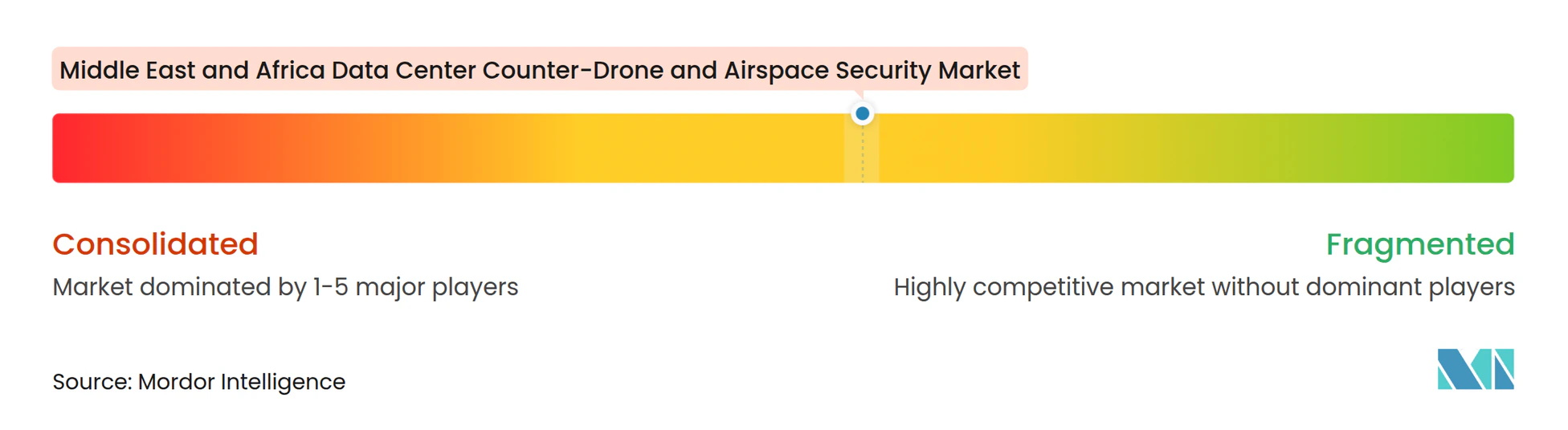
The Middle East and Africa data center counter-drone and airspace security market is moderately fragmented. RTX Corporation, Thales, Northrop Grumman Corporation, Leonardo S.p.a., Lockheed Martin Corporation, and EDGE Group PJSC have established positions through defense relationships and systems-integration capabilities. DroneShield Limited, Sentrycs Ltd., and Fortem Technologies, Inc. compete with software-defined tools, configurable architectures, and shorter deployment cycles. The market concentration score is 3 out of 10 because the available material describes a moderately fragmented supplier field and provides no combined top-player market share that would support a higher score. The result is a competitive environment where buyers can select between large integrators and specialist providers. This mix can help data center operators match their procurement approach to the technical, regulatory, and service requirements of each site.
EDGE Group holds a distinct regional position because it serves sovereign customers and commercial infrastructure buyers. Its Al Haris-X AESA radar was unveiled at the Dubai Airshow 2025 with AI-based target classification for up to 10,000 simultaneous tracks. The company also provides a regional alternative for buyers seeking equipment that is developed and supported locally. DroneShield launched DroneSentry-C2 Enterprise in October 2025 to connect dispersed deployments through one operational network. This approach is relevant to operators that need oversight across several campuses rather than a single facility. The Middle East and Africa data center counter-drone and airspace security market therefore includes both platform vendors and specialists focused on a narrower part of the detection and response chain.
Competitive strategies center on sensor performance, open software integration, and local manufacturing or support partnerships. Buyers need systems that can combine third-party sensor feeds with a practical command interface. They also value suppliers that can help them navigate authorization and coordinate with local authorities. MBDA and Fortem Technologies extended their counter-drone partnership in October 2026, allowing Fortem's DroneHunter interceptors and FireThorn effector to be offered within MBDA's SKY WARDEN architecture. This development offers infrastructure buyers a choice between net-capture and kinetic response options. The market is likely to favor companies that can prove system performance in regional operating conditions while offering a credible path for maintenance, software updates, and compliant deployment.
Middle East and Africa Data Center Counter-Drone and Airspace Security Industry Leaders
-
EDGE Group PJSC
-
RTX Corporation
-
Dedrone by Axon
-
Israel Aerospace Industries Ltd.
-
Leonardo S.p.a.
- *Disclaimer: Major Players sorted in no particular order
Middle East and Africa Data Center Counter-Drone and Airspace Security Market Companies Covered in this Report
- EDGE Group PJSC
- RTX Corporation
- Dedrone by Axon
- Israel Aerospace Industries Ltd.
- Leonardo S.p.a.
- Thales
- HENSOLDT AG
- Saab AB
- DroneShield Limited
- Fortem Technologies, Inc.
- Sentrycs Ltd.
- Lockheed Martin Corporation
- Northrop Grumman Corporation
- Airbus SE
- Elbit Systems Ltd.
- EOS Defence Systems Pty Ltd
- KALDAS PJSC
- Africa Data Centres (Pty) Ltd.
- Teraco Data Environments (Pty) Ltd.
- Khazna Data Centers LLC
Recent Industry Developments in Middle East and Africa Data Center Counter-Drone and Airspace Security Market
- October 2026: MBDA and Fortem Technologies extended their strategic C-UAS partnership, enabling Fortem's DroneHunter autonomous interceptors and the co-developed FireThorn kinetic effector to be offered within MBDA's SKY WARDEN air defense architecture, creating scalable options from net-capture low-collateral defeat to hard-kill kinetic engagement for infrastructure operators.
- January 2026: Humain and Saudi Arabia's National Infrastructure Fund signed a USD 1.2 billion financing framework for 250 MW of hyperscale AI data center capacity in the Kingdom, directly expanding the at-risk asset base requiring dedicated airspace security coverage within the forecast period.
- November 2025: Tawazun Council and Saab UAE signed an RandD agreement at the Dubai Airshow 2025 for a joint drone detection technology program at Saab's Tawazun Industrial Park facility, targeting sovereign in-country counter-drone sensor capability for UAE critical infrastructure protection.
- October 2025: DroneShield launched DroneSentry-C2 Enterprise, a SaaS command-and-control platform linking geographically dispersed counter-drone deployments, including data centers, airports, and military installations, into a single operational network with centralized alert management.
Middle East and Africa Data Center Counter-Drone and Airspace Security Market Report Scope
The Middle East and Africa Counter-Drone and Airspace Security Market refers to the regional industry focused on technologies, platforms, and managed services designed to detect, identify, track, assess, and mitigate unauthorized or malicious unmanned aerial vehicles (UAVs) and related low-altitude airborne threats across critical infrastructure, government facilities, military installations, airports, energy assets, public venues, and border-security environments.
The Middle East and Africa Data Center Counter-Drone and Airspace Security Market encompasses hardware, software, and services for detecting, identifying, tracking, monitoring, and mitigating unauthorized drones across data centers in the Saudi Arabia, United Arab Emirates, South Africa, and Rest of Middle East and Africa. The market is Segmented by Component (Hardware, Software and Analytics, and Integration and Support Services), Technology (Radar-Based Detection, Radio Frequency Detection, Electro-Optical and Infrared Detection, Acoustic Detection, and Integrated Multi-Sensor Systems), Solution Type (Drone Detection and Identification, Drone Tracking and Classification, Airspace Monitoring and Alerting, Drone Mitigation and Response, and Integrated Counter-Drone Platforms), Deployment Type (Fixed Installations, and Mobile and Portable Systems), Data Center Size (Small, Medium, Large, and Hyperscale), Data Center Type (Colocation, Cloud Service Providers (CSPs), and Enterprise and Edge), Geography (Saudi Arabia, United Arab Emirates, South Africa, and Rest of Middle East and Africa). The Market Forecasts are Provided in Terms of Value (USD).
Segmentation Overview
| Hardware |
| Software and Analytics |
| Integration and Support Services |
| Radar-Based Detection |
| Radio Frequency Detection |
| Electro-Optical and Infrared Detection |
| Acoustic Detection |
| Integrated Multi-Sensor Systems |
| Drone Detection and Identification |
| Drone Tracking and Classification |
| Airspace Monitoring and Alerting |
| Drone Mitigation and Response |
| Integrated Counter-Drone Platforms |
| Fixed Installations |
| Mobile and Portable Systems |
| Small |
| Medium |
| Large |
| Hyperscale |
| Colocation |
| Cloud Service Providers (CSPs) |
| Enterprise and Edge |
| Saudi Arabia |
| United Arab Emirates |
| South Africa |
| Rest of Middle East and Africa |
| By Component | Hardware |
| Software and Analytics | |
| Integration and Support Services | |
| By Technology | Radar-Based Detection |
| Radio Frequency Detection | |
| Electro-Optical and Infrared Detection | |
| Acoustic Detection | |
| Integrated Multi-Sensor Systems | |
| By Solution Type | Drone Detection and Identification |
| Drone Tracking and Classification | |
| Airspace Monitoring and Alerting | |
| Drone Mitigation and Response | |
| Integrated Counter-Drone Platforms | |
| By Deployment Type | Fixed Installations |
| Mobile and Portable Systems | |
| By Data Center Size | Small |
| Medium | |
| Large | |
| Hyperscale | |
| By Data Center Type | Colocation |
| Cloud Service Providers (CSPs) | |
| Enterprise and Edge | |
| By Geography | Saudi Arabia |
| United Arab Emirates | |
| South Africa | |
| Rest of Middle East and Africa |
Key Questions Answered in the Report
What is the size of the Middle East and Africa data center counter-drone and airspace security market?
The market is projected at USD 21.40 million in 2026, USD 29.44 million in 2027, and USD 79.68 million by 2032, with a 30.08% CAGR for 2027-2032.
What is driving demand for data center counter-drone systems in the Middle East and Africa?
New hyperscale and AI campus construction, the need to protect critical infrastructure, and demand for layered detection are key demand factors.
Which technology segment leads data center airspace security?
Integrated multi-sensor systems held 34.56% share in 2026 and are projected to expand at a 31.72% CAGR through 2032.
Why are fixed installations important for data center protection?
Fixed installations held 74.34% share in 2026 because permanent campuses need continuous coverage, reliable power, and weather-protected sensing equipment.
Which country has the largest regional opportunity for counter-drone systems?
Saudi Arabia held 32.56% share in 2026 and is projected to expand at a 31.49% CAGR through 2032, supported by hyperscale capacity development.
What should data center operators consider before deploying active countermeasures?
Operators need to consider spectrum authorization, aviation safety, approved response procedures, and coordination with national authorities.