
Middle East and Africa Data Center Construction Materials Supply Chain Market Size and Share
Market Overview
| Study Period | 2021 - 2032 |
|---|---|
| Forecast Data Period | 2027 - 2032 |
| Base Year Market Size (2026) | USD 1.09 Billion |
| Market Size (2027) | USD 1.23 Billion |
| Market Size (2032) | USD 2.07 Billion |
| Growth Rate (2027 - 2032) | 10.97 % |
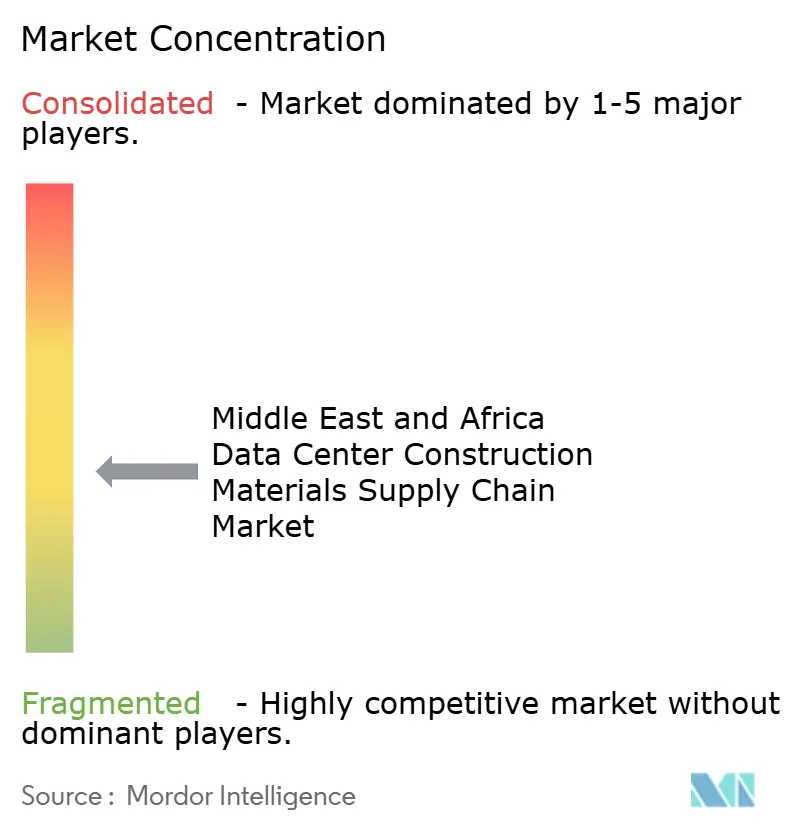
| Market Concentration | Medium |
Major Players *Disclaimer: Major Players sorted in no particular order Image © Mordor Intelligence. Reuse requires attribution under CC BY 4.0. | |
Middle East and Africa Data Center Construction Materials Supply Chain Market Analysis by Mordor Intelligence
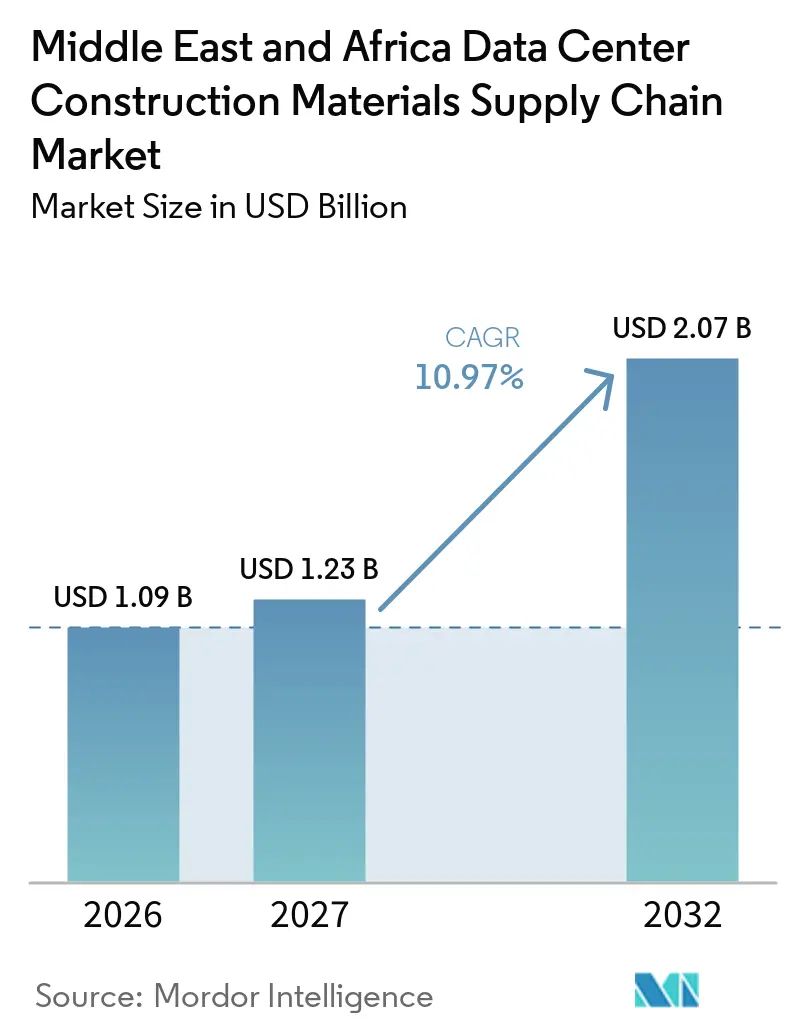
The Middle East and Africa data center construction materials supply chain market size is projected to expand from USD 1.09 billion in 2026 and USD 1.23 billion in 2027 to USD 2.07 billion by 2032, registering a CAGR of 10.97% between 2027 to 2032. Sovereign investment, cloud-region construction, and national artificial intelligence programs are driving demand for steel, concrete, precast systems, insulation, and specialized building products across the region. Procurement is becoming more planned because operators are reserving material capacity well before construction begins. Data localization requirements also support projects that would not be driven by commercial cloud demand alone. Higher reliability requirements for government facilities raise the specification level for structural, thermal, and protective materials. The Middle East and Africa data center construction materials supply chain market therefore rewards suppliers that can provide consistent quality, documented environmental performance, and dependable delivery schedules.
Key Report Takeaways
- By material type, structural steel and reinforcement steel held 31.80% of the Middle East and Africa data center construction materials supply chain market in 2026, while precast concrete is projected to expand at an 11.48% CAGR through 2032.
- By construction phase, structural construction accounted for 40.77% of material demand in 2026, while site preparation and civil works are projected to expand at an 11.70% CAGR through 2032.
- By procurement model, EPC-led procurement held 51.42% of material demand in 2026, while direct procurement by developers and operators is projected to expand at a 12.31% CAGR through 2032.
- By data center size, hyperscale facilities accounted for 41.87% of the Middle East and Africa data center construction materials supply chain market in 2026 and are projected to expand at a 12.74% CAGR through 2032.
- By data center type, colocation operators held 49.12% of material demand in 2026, while cloud service providers are projected to expand at a 13.26% CAGR through 2032.
- By geography, Saudi Arabia accounted for 38.91% of the Middle East and Africa data center construction materials supply chain market in 2026 and is projected to expand at a 13.10% CAGR through 2032.
Note: Market numbers in this report are based on Mordor Intelligence's proprietary estimation framework, which combines nine months of actuals with Q4 projections for base year 2026.
Market Trends and Insights
Drivers Impact Analysis of Middle East and Africa Data Center Construction Materials Supply Chain Market*
| Driver | (~) % Impact on CAGR Forecast | Geographic Relevance | Impact Timeline |
|---|---|---|---|
| Hyperscale and Cloud Infrastructure Expansion | +3.8% | Global, concentrated in Saudi Arabia and UAE | Short term (≤ 2 years) |
| AI-Ready Data Center Construction | +2.5% | Global, Saudi Arabia, UAE, and South Africa | Medium term (2-4 years) |
| Government Digital Economy and Sovereign Cloud Programs | +2.0% | Saudi Arabia and UAE, secondary in Nigeria and South Africa | Medium term (2-4 years) |
| Submarine Cable Connectivity and Regional Interconnection | +0.9% | GCC nations, East Africa, and Nigeria | Medium term (2-4 years) |
| Renewable Energy Integration and Sustainable Data Center Development | +0.8% | Saudi Arabia, UAE, and South Africa | Long term (≥ 4 years) |
| Prefabricated and Modular Construction for Accelerated Delivery | +0.7% | UAE and Saudi Arabia, with wider regional application | Short term (≤ 2 years) |
| Source: Mordor Intelligence | |||
Hyperscale and Cloud Infrastructure Expansion
Hyperscale construction is the largest demand source for the Middle East and Africa data center construction materials supply chain market. Cloud providers need large quantities of structural steel, concrete, cable-support systems, and weather-resistant building products for new campuses. Regional power capacity stood at 1.2 GW in 2025 and is expected to reach 3.3 GW within 5 years, which supports a sustained construction pipeline. Long project pipelines allow developers to coordinate orders for standard materials much earlier than in conventional commercial construction. This favors producers that can reserve production slots and deliver the same specification across repeated building phases. Colocation providers located near hyperscale campuses also use similar procurement practices when they add capacity or upgrade existing halls.
The change is not limited to higher material volumes. Major operators are establishing direct relationships with manufacturers of steel, cable, and electrical systems, reducing dependence on several layers of distribution. Direct engagement allows site teams to manage lead times and quality records more closely, especially where repeated structural modules are required. It also makes smaller suppliers more dependent on their ability to meet fixed delivery dates and certification requirements. Large campuses can require materials in consecutive waves, so a missed delivery can affect several connected construction packages. The Middle East and Africa data center construction materials supply chain market is consequently shifting toward fewer but larger purchasing relationships.
AI-Ready Data Center Construction
Facilities designed for high-density artificial intelligence workloads require more demanding thermal and structural specifications than standard cloud facilities. The added cooling equipment increases demand for copper components, stainless steel pipes, pressure-rated sleeves, and high-performance insulation. Saudi Arabia’s operating data center capacity rose from 68 MW in 2021 to 467 MW in the first quarter of 2026, with artificial intelligence infrastructure forming a larger part of new capacity. Builders must account for heavier equipment loads, more complex heat-management systems, and tighter tolerances around floor penetrations. These requirements affect the material bill of quantities before equipment is installed. They also make quality assurance during construction more important for facility reliability.
Cooling design now influences product selection for façades, insulation, floors, and internal containment systems. Suppliers that understand data center operating conditions can participate earlier in the design process instead of entering only at the supply stage. The use of liquid cooling requires closed-loop systems, protective underlays, and leak-control measures that are not central to conventional office construction. Advanced cooling can reduce water use by up to 92% compared with traditional evaporative methods, according to a report citing Schneider Electric. This shift gives materials suppliers a reason to link product performance with both thermal efficiency and water management. In the Middle East and Africa data center construction materials supply chain market, AI-ready designs are therefore extending the role of materials beyond basic structural supply.
Government Digital Economy and Sovereign Cloud Programs
Government programs in Saudi Arabia and the UAE are adding large procurement requirements that are separate from private cloud expansion. Saudi Arabia’s national strategy targets 1.5 GW of domestic data center capacity by 2030. Sovereign facilities often require Tier III or Tier IV reliability, which raises requirements for structural resilience, fire protection, redundancy, and tested installation systems. These projects can create concentrated purchasing activity because public infrastructure programs are planned around national digital policies and data-residency needs. They also encourage local contractors and material suppliers to develop records of compliance with security and technical specifications. The result is a more stable source of demand for qualified producers and EPC contractors.
The UAE Sovereign Launchpad became commercially available in November 2025 through e& and Amazon Web Services. The service was endorsed by the UAE Cybersecurity Council and supports regulated users in healthcare, financial services, education, government, and other sectors.[1] Such programs create a direct need for facilities located within national borders. Local data residency requirements mean that capacity cannot always be substituted with infrastructure in another jurisdiction. Construction specifications are also likely to be more controlled because government workloads require clear reliability and security standards. The Middle East and Africa data center construction materials supply chain market benefits when policy commitments become physical data center projects.
Submarine Cable Connectivity and Regional Interconnection
Submarine cables influence data center construction because landing points and connected urban corridors become more attractive for cloud and colocation investment. Ooredoo’s Fiber in Gulf project is designed to connect 7 GCC countries with 24 fiber pairs and a capacity of up to 720 Tbps. Greater network resilience improves the business case for facilities that require low-latency regional connections. This can direct construction demand toward coastal and near-shore areas that previously had limited appeal for large campuses. Materials suppliers can benefit when development clusters emerge around cable landings, industrial zones, and grid connection points. The pattern is especially relevant in GCC markets, Egypt, Kenya, and Nigeria.
The completed 2Africa cable system connects 33 countries and includes Egypt, Saudi Arabia, and several Sub-Saharan African markets. New international capacity supports local cloud regions, carrier-neutral sites, and enterprise connectivity services. Data-protection rules can add to this effect where public or financial data must remain in-country. Cable links alone do not create data center demand, but they remove a critical connectivity constraint from site selection. Developers can then assess land, power, permits, and material availability with greater confidence. The Middle East and Africa data center construction materials supply chain market gains from this wider network foundation because new locations require full civil and structural works.
Restraints Impact Analysis of Middle East and Africa Data Center Construction Materials Supply Chain Market*
| Restraint | (~) % Impact on CAGR Forecast | Geographic Relevance | Impact Timeline |
|---|---|---|---|
| Grid Reliability and Utility Connection Delays | -0.6% | Saudi Arabia, Nigeria, and South Africa, less acute in UAE | Medium term (2-4 years) |
| Cooling Water Scarcity and Water Management Constraints | -0.5% | GCC region, most acute in Saudi Arabia and Kuwait | Long term (≥ 4 years) |
| Imported Material Dependence and Foreign Exchange Exposure | -0.4% | Nigeria and Sub-Saharan Africa, secondary in Saudi Arabia | Medium term (2-4 years) |
| Shortage of Certified Data Center Construction and Commissioning Specialists | -0.3% | Global, most acute in Sub-Saharan Africa | Short term (≤ 2 years) |
| Source: Mordor Intelligence | |||
Grid Reliability and Utility Connection Delays
Grid connection constraints can delay projects even after land, permits, and construction materials are ready. This changes the sequence in which contractors purchase steel, concrete, backup-power structures, and supporting civil works. The GCC Interconnection Authority has stated plans for USD 3.5 billion of investment to expand regional interconnection capacity. Until new capacity is available, developers may need to plan material delivery around grid readiness rather than their preferred construction schedule. In Nigeria, reliance on self-generation can create further need for fuel-storage areas, substation pads, and protected enclosures. These added requirements complicate project design and raise the number of packages that must be coordinated.
Utility requirements also differ by jurisdiction. Saudi Arabia’s power and water regulator and UAE utilities affect connection processes, capacity allocations, and operating conditions for large loads. Developers must therefore integrate utility discussions into early engineering decisions. Suppliers may receive changing order schedules where power availability moves the construction program. This uncertainty is difficult for smaller distributors that cannot hold inventory for long periods. The Middle East and Africa data center construction materials supply chain market faces a planning challenge when physical construction is ready before a facility can obtain firm power.
Cooling Water Scarcity and Water Management Constraints
Water scarcity affects data center design in much of the Gulf and changes the type of materials required for cooling infrastructure. Saudi Arabian data centers consume an estimated 15 billion liters of water each year, according to an Arab News report. Operators face pressure to reduce their dependence on desalinated water and to demonstrate responsible water management. This places greater importance on closed-loop piping, waterproof membranes, containment products, and durable roof systems. It can also increase scrutiny of leakage, corrosion resistance, and the maintenance life of cooling-related materials. Materials decisions are therefore connected to operating water performance rather than only initial construction cost.
Research in the Journal of the American Water Works Association identifies substantial water needs and environmental concerns associated with data center cooling in water-constrained regions.[2] Heated discharge and salinity are among the issues that regulators and operators must consider. Saudi Arabia’s Circular Carbon Economy framework and the UAE Green Agenda 2030 add policy context for lower-resource infrastructure choices. Liquid cooling may ease direct water demand, but it requires more specialized internal systems and reliable containment. Suppliers that can document durability, water resistance, and environmental attributes are better placed for these projects. Water constraints remain a long-term limit on facility design, especially where rapid expansion depends on more intensive cooling methods.
*Our forecasts treat driver/restraint impacts as directional, not additive. The impact forecasts reflect baseline growth, mix effects, and variable interactions.
Middle East and Africa Data Center Construction Materials Supply Chain Market Segment Analysis
By Material Type:
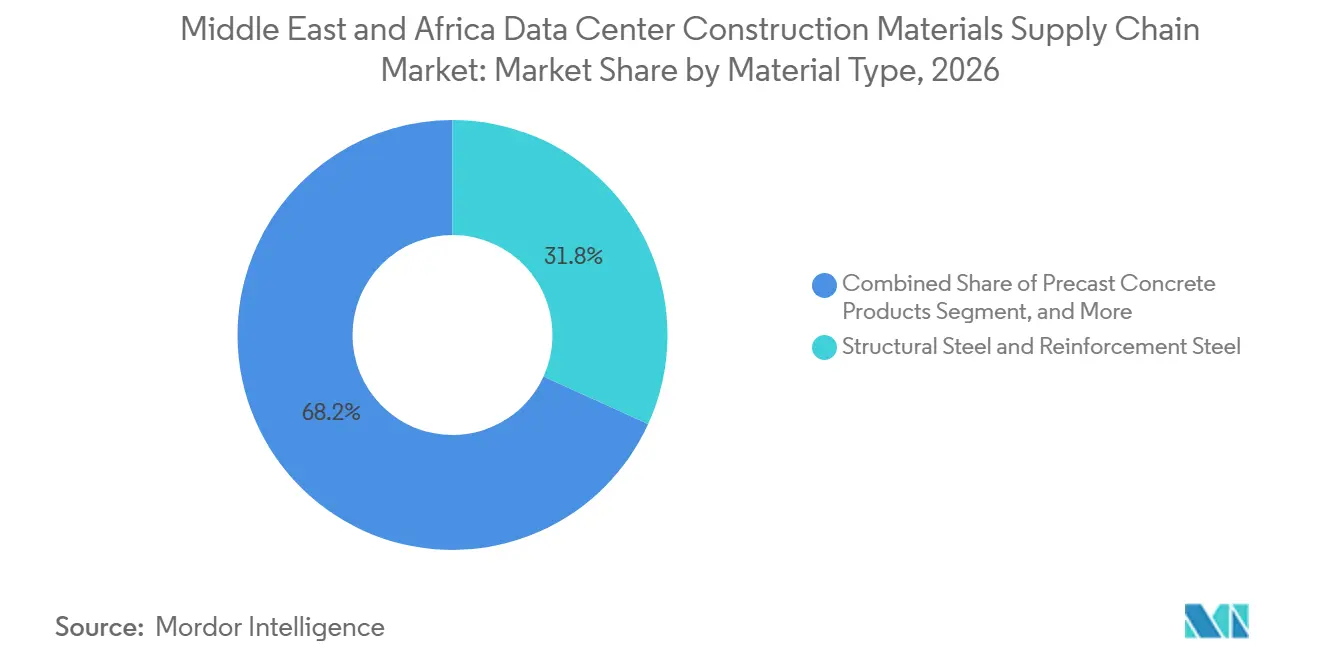
Structural Steel Anchors Demand and Precast Concrete AcceleratesStructural steel and reinforcement steel accounted for 31.80% of the Middle East and Africa data center construction materials supply chain market size in 2026. Large campuses need heavy-load floors, reinforced frames, modular support structures, and strong cable-management systems. ArcelorMittal states that up to 75% of tube demand in a data center can be concentrated in cooling infrastructure, rack structures, and cable management.[3] Cooling infrastructure alone can represent 35-40% of tube demand within this group. These uses explain why steel consumption rises with high-density and AI-ready designs. Structural materials also need consistent certification and dimensional quality because repeated modules leave little scope for site-level variation. Steel remains central to facilities that need speed, load capacity, and repeatable construction details.
Precast concrete is projected to expand at an 11.48% CAGR through 2032. It supports off-site manufacturing while site preparation and foundation work continue in parallel. Elematic states that industrialized precast methods can reduce data center construction time by 30-50% and reduce on-site labor needs by up to 65%. This delivery model is valuable where government and cloud projects have tight completion schedules. Precast products also offer predictable quality for foundations, walls, beams, slabs, and other repeated elements. Insulation, façades, cladding, and waterproofing remain important supporting material groups because facilities must manage heat gain, moisture, and fire performance. Within the Middle East and Africa data center construction materials supply chain industry, the shift toward precast systems rewards producers with local manufacturing capacity and reliable transport arrangements.

By Construction Phase:
Structural Construction Dominates and Site Preparation Leads GrowthStructural construction represented 40.77% of materials demand in 2026. Steel frames, reinforced concrete, precast units, and supporting components account for a large share of the bill of materials before equipment installation begins. This phase determines the basic resilience, load capacity, and layout flexibility of a data center campus. It also requires close coordination between civil contractors, structural engineers, and specialist suppliers. Errors at this stage can affect later installation of cooling, power, and cable systems. Developers therefore place high value on tested products and suppliers that can support repeatable construction methods. The Middle East and Africa data center construction materials supply chain market relies heavily on this phase because the region’s new facilities are typically large greenfield projects.
Site preparation and civil works are projected to expand at an 11.70% CAGR through 2032. New campuses require grading, earthworks, drainage, roads, foundations, fencing, and below-grade utility routes before vertical construction starts. Greenfield activity in Saudi Arabia, the UAE, Nigeria, and South Africa creates demand for these early works. Precast elements can be produced off-site while civil work continues, reducing idle time between project stages. This places pressure on project managers to coordinate several material streams at once. Building-envelope materials also receive greater attention as operators seek stronger fire resistance and thermal performance. Interior fit-out has a smaller material value, yet raised floors, anti-static surfaces, cable containment, and equipment supports become more complex in AI-ready facilities.
By Procurement Model:
EPC Consolidation Continues and Direct Procurement DisruptsEPC-led procurement held 51.42% of material demand in 2026. Developers use EPC contracts to combine design, construction, procurement, and delivery accountability under an experienced contractor. This model is well suited to large facilities where delays in one component can affect the full construction schedule. EPC firms can use longstanding supplier relationships to reserve steel, cement, and specialty-product capacity ahead of site mobilization. Their scale also helps them manage inspection records, delivery coordination, and warranty requirements across multiple packages. The Middle East and Africa data center construction materials supply chain market share held by EPC-led procurement reflects the value placed on schedule certainty and integrated risk management. Contractors with strong regional supplier networks are particularly important when several megaprojects compete for the same materials.
Direct procurement by developers and operators is projected to expand at a 12.31% CAGR through 2032. Large buyers increasingly want direct visibility into lead times, product specifications, inventory, and pricing for critical materials. The approach can help them secure production capacity before detailed construction begins. It can also support standing orders and centralized storage where high-demand products have long delivery windows. Direct procurement does not remove the need for EPC contractors, because installation, coordination, and quality management still require specialist capabilities. Instead, it changes which party has the earliest relationship with a material producer. Distributor and supplier-led procurement remains relevant in Sub-Saharan Africa, where local distribution networks and import procedures are important for obtaining specialized products.
By Data Center Size:
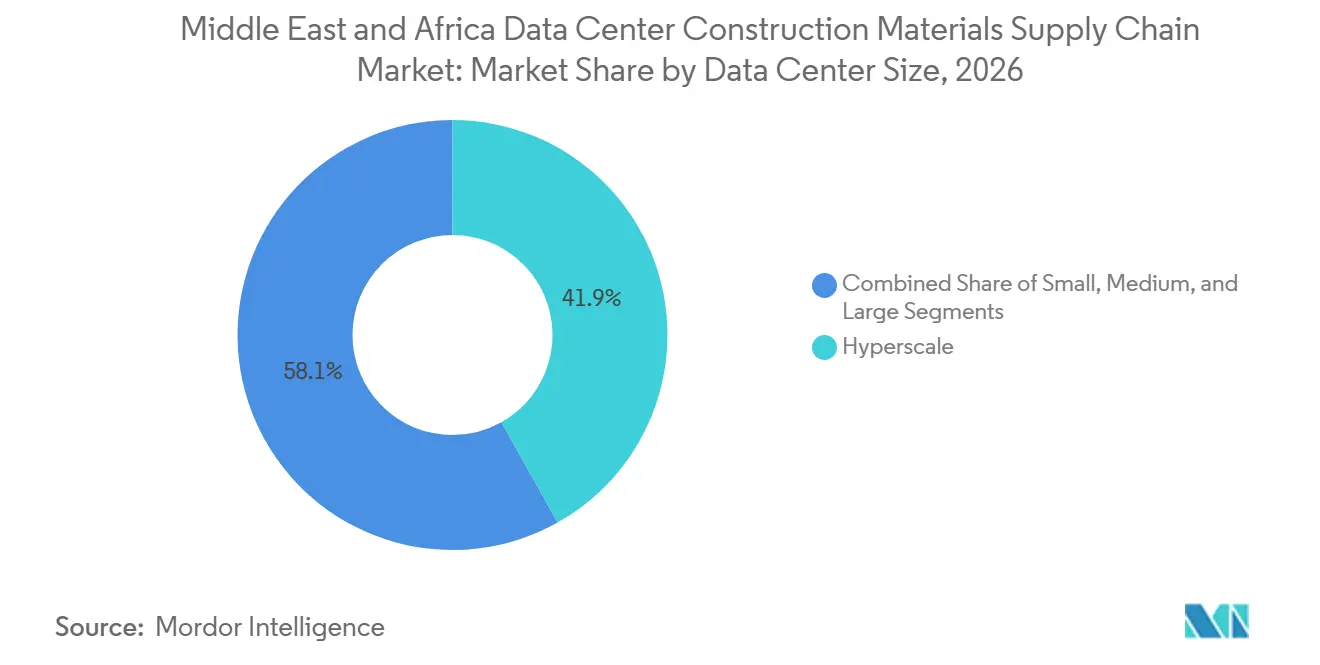
Hyperscale Defines DemandHyperscale facilities accounted for 41.87% of material demand in 2026. Their large footprints require repeated structural bays, extensive foundations, service corridors, protected cable routes, and cooling infrastructure. Standardized specifications can increase the value of suppliers that deliver matching products across every project phase. Hyperscale projects also require materials to be available in large quantities at fixed intervals. This favors manufacturers with nearby production, tested logistics, and well-documented quality systems. Saudi Arabia’s HUMAIN began construction of data centers in Riyadh and Dammam in 2025, with initial capacity of up to 100 MW at each site. Such projects illustrate how a small number of large facilities can shape regional purchasing schedules.
Hyperscale construction is projected to expand at a 12.74% CAGR through 2032. Its demand profile goes beyond volume because each project needs consistent structural, thermal, and protective materials. Large data centers form the next important size group and can be designed for later expansion to hyperscale density. This creates multiple procurement cycles for suppliers that win the early construction phases. Medium and small facilities, including edge deployments, remain relevant in secondary GCC cities and Sub-Saharan African markets. Their growth is more sensitive to local grid conditions and the availability of specialist contractors. The Middle East and Africa data center construction materials supply chain market continues to depend on a mix of large campuses and more dispersed facilities, although hyperscale projects set the highest specification bar.
By Data Center Type:
Colocation Leads and Cloud Service Providers AccelerateColocation operators held 49.12% of material demand in 2026. Mature campuses in Dubai, Abu Dhabi, Riyadh, and Johannesburg are adding capacity and upgrading facilities for higher computing densities. These sites need structural improvements, new cooling paths, expanded cable infrastructure, and stronger internal protection systems. Their carrier-neutral role makes them useful connection points for cloud providers and enterprise customers. Expansion work can take place within existing operating environments, so suppliers must meet strict requirements for delivery timing and installation safety. Colocation demand also supports materials consumption through modernization projects, not only new-build facilities. This creates a steadier stream of orders for selected construction products.
Cloud service providers are projected to expand at a 13.26% CAGR through 2032. Sovereign cloud requirements can lead providers to build dedicated in-country capacity rather than rely on cross-border infrastructure. The e& and Amazon Web Services Sovereign Launchpad shows how regulated workloads can be linked to national cloud platforms. Cloud projects require resilient structures, physical security features, and materials that meet high reliability expectations. Enterprise and edge deployments are smaller but are distributed more widely across the region. du announced an AI Park in Dubai that targets up to 1 GW of liquid-cooled capacity over 5 years.[4] The convergence of sovereign, cloud, and enterprise needs broadens the types of facilities requiring specialized construction materials.
Geography Analysis
Saudi Arabia
Saudi Arabia accounted for 38.91% of the Middle East and Africa data center construction materials supply chain market size in 2026 and is projected to expand at a 13.10% CAGR through 2032. Capacity increased from 68 MW in 2021 to 467 MW in the first quarter of 2026, with cumulative sector investment exceeding SAR 16 billion (USD 4.26 billion). This expansion is linked to national digital programs, sovereign cloud needs, and the creation of more local computing capacity. Large public projects increase requirements for reinforced concrete, structural steel, fire protection, and secure building systems. Saudi regulators influence project timing through grid connection and large-load requirements. The national data center strategy supports 1.5 GW of domestic capacity by 2030. Producers that can provide certified materials and coordinate with EPC contractors are positioned to benefit from the country’s high-volume pipeline.
Sustainability and resource management are becoming material-selection factors in Saudi Arabia. Water scarcity favors cooling systems with lower direct water use and raises demand for durable containment and piping products. Operators must also consider the reliability implications of high-density artificial intelligence facilities. Local-content expectations can encourage closer relationships between developers, contractors, and regional producers. The scale of planned facilities can allow suppliers to establish longer production runs and more predictable delivery schedules. At the same time, competition from other Gulf megaprojects can affect access to steel, cement, glass, and aluminum. Saudi Arabia remains the clearest example of a country where policy, capacity targets, and project scale are shaping the materials supply chain together.
United Arab Emirates
The UAE is a mature regional hub for colocation and cloud connectivity, which supports demand for premium construction materials. Its location on routes linking Asia, Europe, and Africa reinforces its role in regional data traffic. Facilities in the country are increasingly built to meet high availability and sustainability expectations. The Department of Government Enablement partnered with e& to establish an AI-ready Unified Government Data Center in Khalifa City to serve more than 40 government entities. This type of project requires resilient structures, specialized cooling provisions, and controlled installation quality. The UAE’s regulatory influence is strong because public-sector digital platforms and cybersecurity requirements guide where sensitive data is hosted.
Sustainability specifications are also affecting the country’s pipeline. Turner and Townsend was appointed in 2025 to manage du’s hyperscale facility in Dubai, which targets LEED Gold certification. This direction favors lower-carbon concrete, efficient insulation, and products with clear environmental documentation. The UAE has an active market for modular and precast construction because project owners often prioritize speed and repeatable quality. Its mature logistics networks make it easier to consolidate material orders and coordinate imports. Government cloud and artificial intelligence programs continue to generate demand alongside commercial colocation expansion. The country remains a benchmark for high-specification facilities within the Middle East and Africa data center construction materials supply chain market.
Africa and Remaining Markets
Nigeria and South Africa provide different forms of opportunity across the region. Nigeria has attracted major investment from global and regional operators as demand for local digital services and artificial intelligence capacity increases. Equinix announced its LG3 data center in Lagos in November 2025, representing a USD 22 million first phase within a planned USD 100 million program.[5] Local supply chains can be fragmented, which raises the importance of distributors, import coordination, and secure storage. Grid reliability and foreign-exchange exposure can affect construction plans and material purchasing. These constraints create an opening for suppliers that can provide predictable local service and technical support.
South Africa remains a key location because Johannesburg and Cape Town host cloud regions from several international providers. It has more established data center and construction capabilities than many neighboring markets. Operators still need access to certified contractors and specialty materials for high-density facilities. Egypt, Kenya, Qatar, Oman, Bahrain, and Kuwait can benefit from new international cable systems and national digital programs. The completed 2Africa system supports broader connectivity across several of these countries. Mixed markets require different supply strategies because their power systems, local production bases, regulations, and logistics conditions vary widely. The Middle East and Africa data center construction materials supply chain market will depend on regional sourcing models rather than a single standardized approach.
Competitive Landscape
The Middle East and Africa data center construction materials supply chain market is moderately fragmented in specialty products such as insulation, roofing, waterproofing, and façade systems. Structural steel and cement have a more concentrated production base because fewer regional producers operate at the required scale. Holcim, ArcelorMittal, Heidelberg Materials, and Emirates Steel Arkan have established production capacity and relationships with major projects. EPC contractors have a strong role because their supplier networks allow early reservation of materials. This can make access to production slots more difficult for new or smaller project entrants. The competitive position of a supplier therefore depends on product capability, delivery reliability, certification, and its ability to work with EPC procurement schedules.
Holcim is advancing ECOPact concrete and ECOPlanet cement, product lines that the company states can reduce CO₂ emissions by at least 30%. This aligns with rising demand for environmental documentation on premium projects. Lafarge Emirates Cement and du signed a strategic Industry 4.0 memorandum of understanding in October 2025 to pursue digital twin, maintenance, and productivity initiatives in UAE cement manufacturing. Owens Corning also collaborated with Northstar Enterprise and Defense in October 2025 to integrate composite and insulation technologies into modular data center systems. These moves show that producers are seeking earlier involvement in design and modular-system decisions. Suppliers that can support lower-carbon, high-performance, and modular construction are strengthening their relevance to data center developers.
ArcelorMittal’s XCarb label is used for recycled and renewably produced steel products, including its data center tubular solutions. Environmental management requirements, including ISO 14001, can make this type of product documentation more important during supplier selection. White-space opportunities remain in green construction materials, precast systems adapted to liquid-cooling layouts, and local supply chains in Nigeria and South Africa. New modular suppliers can compete by producing standardized components in controlled factory environments. This can reduce the need for large on-site labor teams and support more consistent quality control. Competition is likely to remain mixed, with strong regional producers in structural materials and a wider group of specialty suppliers pursuing specification-led opportunities.
Middle East and Africa Data Center Construction Materials Supply Chain Industry Leaders
-
Holcim Ltd
-
Saint-Gobain
-
Kingspan Group plc
-
ArcelorMittal S.A.
-
Dangote Cement Plc
- *Disclaimer: Major Players sorted in no particular order
Middle East and Africa Data Center Construction Materials Supply Chain Market Companies Covered in this Report
- Holcim
- Saint-Gobain
- Sika AG
- Kingspan Group plc
- Etex Group
- ArcelorMittal S.A.
- Emirates Steel Arkan PJSC
- Saudi Basic Industries Corporation
- Lafarge Emirates Cement
- Dangote Cement Plc
- Arabian Cement Company
- National Cement Company PJSC
- Buzzi S.p.A.
- Heidelberg Materials AG
- Owens Corning
- ROCKWOOL A/S
- Carlisle Companies Incorporated
- Soprema Group
- BlueScope Steel Limited
- Orascom Construction PLC
- ALEC Engineering and Contracting LLC
- AECOM
- AtkinsRéalis Group Inc.
- Turner Construction Company
- Laing O’Rourke
Recent Industry Developments in Middle East and Africa Data Center Construction Materials Supply Chain Market
- October 2026: Egyptian contractor Hassan Allam Construction and India’s Sterling & Wilson have won an estimated SAR 750 million (USD 200 million) contract to build the first phase of a data center project in Riyadh. The scope includes civil, architectural, and mechanical, electrical, and plumbing (MEP) works, infrastructure works, and other associated works.
- October 2026: ArcelorMittal Europe - Tubular Products published detailed data center tubular solutions guidance confirming that up to 75% of tube demand within a facility concentrates in cooling infrastructure, rack structures, and cable management, with cooling infrastructure alone accounting for 35-40% of total tube demand. The disclosure positions ArcelorMittal's XCarb® recycled and renewably produced label as aligned with waste-heat recovery and low-embodied-carbon requirements that are increasingly embedded in data center construction specifications across the MEA region.
- September 2026: KPC Precast officially became the first precast concrete manufacturer in the Middle East to localize and deploy CarbonCure technology. The move aims to cut emissions across the region’s construction and built environment sectors.
- April 2026: AESG announced the expansion of its Mission Critical division in the GCC market, broadening its data center offering to full multidisciplinary integrated design delivery. Having already delivered 27 data centers across multiple regions, the move positions the firm to deliver end-to-end support across the full data center delivery lifecycle. The expansion comes as the GCC data center market accelerates at pace.
Middle East and Africa Data Center Construction Materials Supply Chain Market Report Scope
The Middle East and Africa data center construction materials supply chain market encompasses the end-to-end procurement, cross-border logistics, and distribution of structural, architectural, and specialized materials required for data center development across the Middle East and Africa region
The Middle East and Africa Data Center Construction Materials Supply Chain Market Report is Segmented by Material Type (Structural Steel and Reinforcement Steel, Cement, Concrete, and Aggregates, Precast Concrete Products, Roofing and Waterproofing Materials, Insulation Materials, Façade and Cladding Materials, Flooring and Interior Construction Materials, and Other Construction Materials), Construction Phase (Site Preparation and Civil Works, Structural Construction, Building Envelope and Roofing, and Interior and Fit-Out Works), Procurement Model (Direct Procurement by Data Center Developers and Operators, Engineering, Procurement, and Construction-Led Procurement, and Distributor and Supplier-Led Procurement), Data Center Size (Small, Medium, Large, and Hyperscale), Data Center Type (Colocation, Cloud Service Providers [CSPs], and Enterprise / Edge), and Country (Saudi Arabia, United Emirates Arab, South Africa, Nigeria, and Rest of Middle East and Africa). The Market Forecasts are Provided in Terms of Value (USD).
Segmentation Overview
| Structural Steel and Reinforcement Steel |
| Cement, Concrete, and Aggregates |
| Precast Concrete Products |
| Roofing and Waterproofing Materials |
| Insulation Materials |
| Façade and Cladding Materials |
| Flooring and Interior Construction Materials |
| Other Construction Materials |
| Site Preparation and Civil Works |
| Structural Construction |
| Building Envelope and Roofing |
| Interior and Fit-Out Works |
| Direct Procurement by Data Center Developers and Operators |
| Engineering, Procurement, and Construction-Led Procurement |
| Distributor and Supplier-Led Procurement |
| Small |
| Medium |
| Large |
| Hyperscale |
| Colocation |
| Cloud Service Providers (CSPs) |
| Enterprise / Edge |
| Saudi Arabia |
| United Arab Emirates |
| South Africa |
| Nigeria |
| Rest of Middle East and Africa |
| By Material Type | Structural Steel and Reinforcement Steel |
| Cement, Concrete, and Aggregates | |
| Precast Concrete Products | |
| Roofing and Waterproofing Materials | |
| Insulation Materials | |
| Façade and Cladding Materials | |
| Flooring and Interior Construction Materials | |
| Other Construction Materials | |
| By Construction Phase | Site Preparation and Civil Works |
| Structural Construction | |
| Building Envelope and Roofing | |
| Interior and Fit-Out Works | |
| By Procurement Model | Direct Procurement by Data Center Developers and Operators |
| Engineering, Procurement, and Construction-Led Procurement | |
| Distributor and Supplier-Led Procurement | |
| By Data Center Size | Small |
| Medium | |
| Large | |
| Hyperscale | |
| By Data Center Type | Colocation |
| Cloud Service Providers (CSPs) | |
| Enterprise / Edge | |
| By Country | Saudi Arabia |
| United Arab Emirates | |
| South Africa | |
| Nigeria | |
| Rest of Middle East and Africa |
Key Questions Answered in the Report
What is the size of the Middle East and Africa data center construction materials supply chain market?
The market size is USD 1.09 billion in 2026 and is projected to reach USD 2.07 billion by 2032, at a 10.97% CAGR from 2027 to 2032.
Which material has the largest role in data center construction across the Middle East and Africa?
Structural steel and reinforcement steel held 31.80% of demand in 2026 because large campuses need heavy-load framing, cooling supports, and cable-management structures.
Why is precast concrete important for regional data center projects?
Precast concrete is projected to expand at an 11.48% CAGR through 2032 because off-site production can shorten construction schedules and reduce on-site labor needs.
Which procurement model is used most often for data center materials?
EPC-led procurement held 51.42% of demand in 2026 because it combines design, material purchasing, and project delivery responsibilities.
Why is Saudi Arabia a leading destination for data center construction materials?
Saudi Arabia accounted for 38.91% of demand in 2026 and is supported by national capacity targets, sovereign programs, and expanding local cloud infrastructure.
How are AI workloads changing material requirements for data centers?
AI-ready facilities require higher-performance cooling, insulation, piping, containment, and structural systems to manage denser computing loads.