
Middle East and Africa Data Center Automation Market Size and Share
Market Overview
| Study Period | 2021 - 2032 |
|---|---|
| Forecast Data Period | 2027 - 2032 |
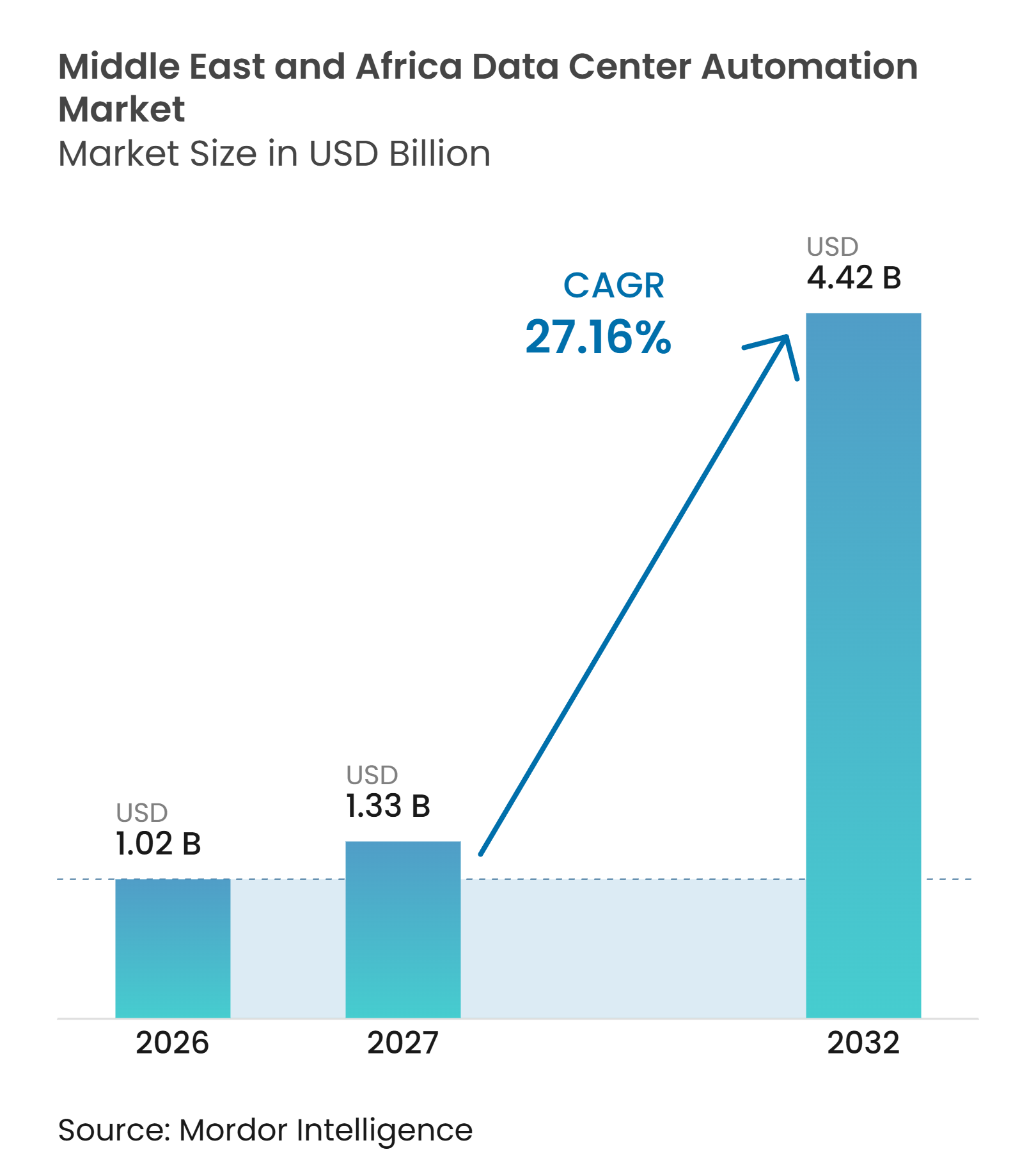
| Base Year Market Size (2026) | USD 1.02 Billion |
| Market Size (2027) | USD 1.33 Billion |
| Market Size (2032) | USD 4.42 Billion |
| Growth Rate (2027 - 2032) | 27.16 % |
| Market Concentration | Medium |
Major Players *Disclaimer: Major Players sorted in no particular order Image © Mordor Intelligence. Reuse requires attribution under CC BY 4.0. | |
Middle East and Africa Data Center Automation Market Analysis by Mordor Intelligence
The Middle East and Africa Data Center Automation Market size is expected to grow from USD 1.02 billion in 2026 to USD 1.33 billion in 2027 and is forecast to reach USD 4.42 billion by 2032 at 27.16% CAGR over 2027-2032. Sovereign AI programs, cloud regions, and digital government projects are increasing the operational scale of facilities across the region. Operators are moving toward software-defined controls because large facilities require continuous oversight of power, cooling, equipment, and access systems. The Middle East and Africa data center automation market also benefits from data-residency requirements that make compliance controls part of infrastructure design. High ambient temperatures and unreliable power in several African markets make energy and thermal management central considerations in purchasing. Competition is strongest where vendors can combine equipment, software, integration, and regional service support.
Key Report Takeaways
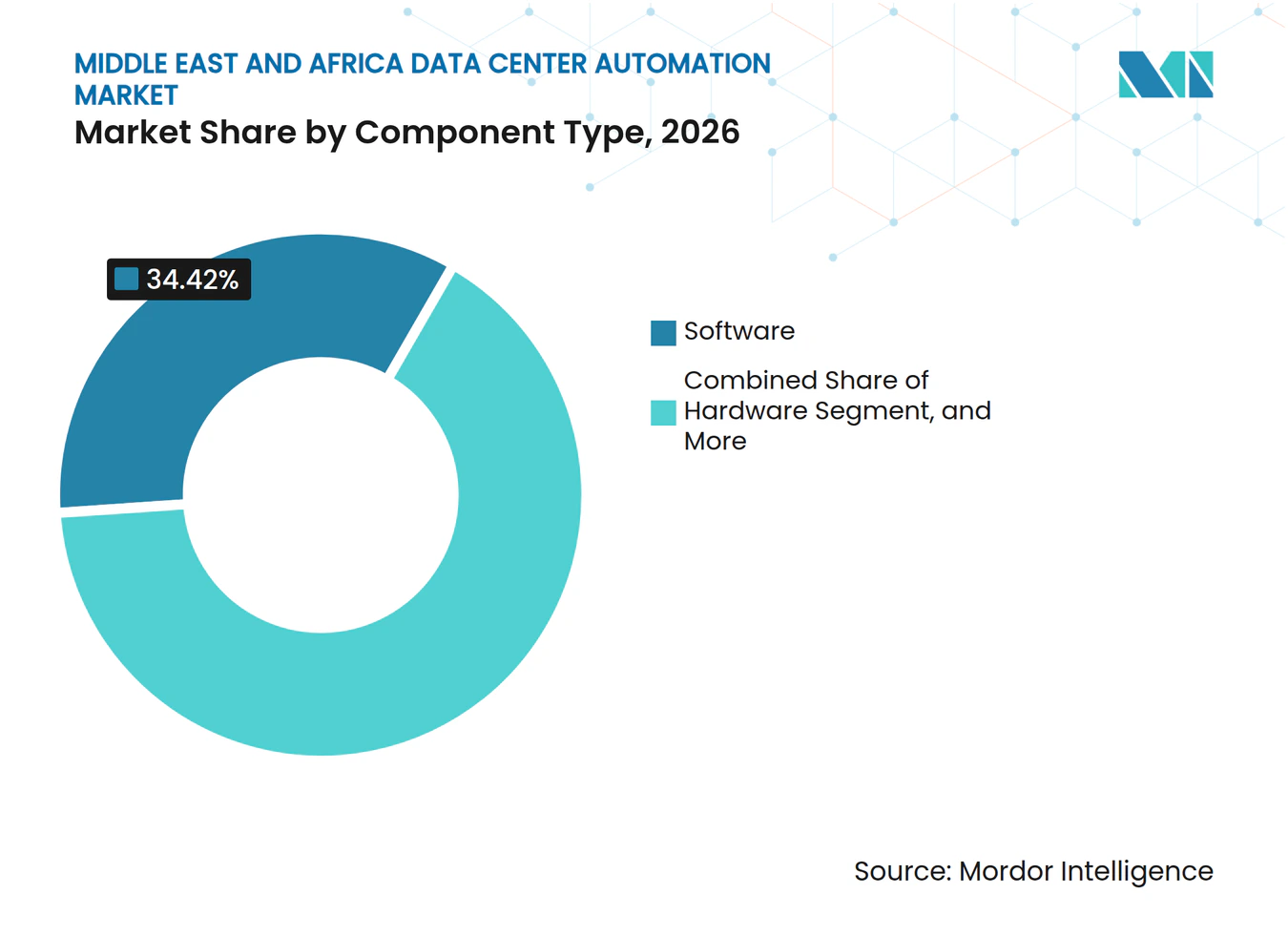
- By component type, software held 34.42% of the Middle East and Africa data center automation market share in 2026 and is expected to expand at a 19.01% CAGR through 2032.
- By data center size, hyperscale facilities accounted for 45.31% of the Middle East and Africa data center automation market size in 2026 and are projected to advance at a 19.18% CAGR through 2032.
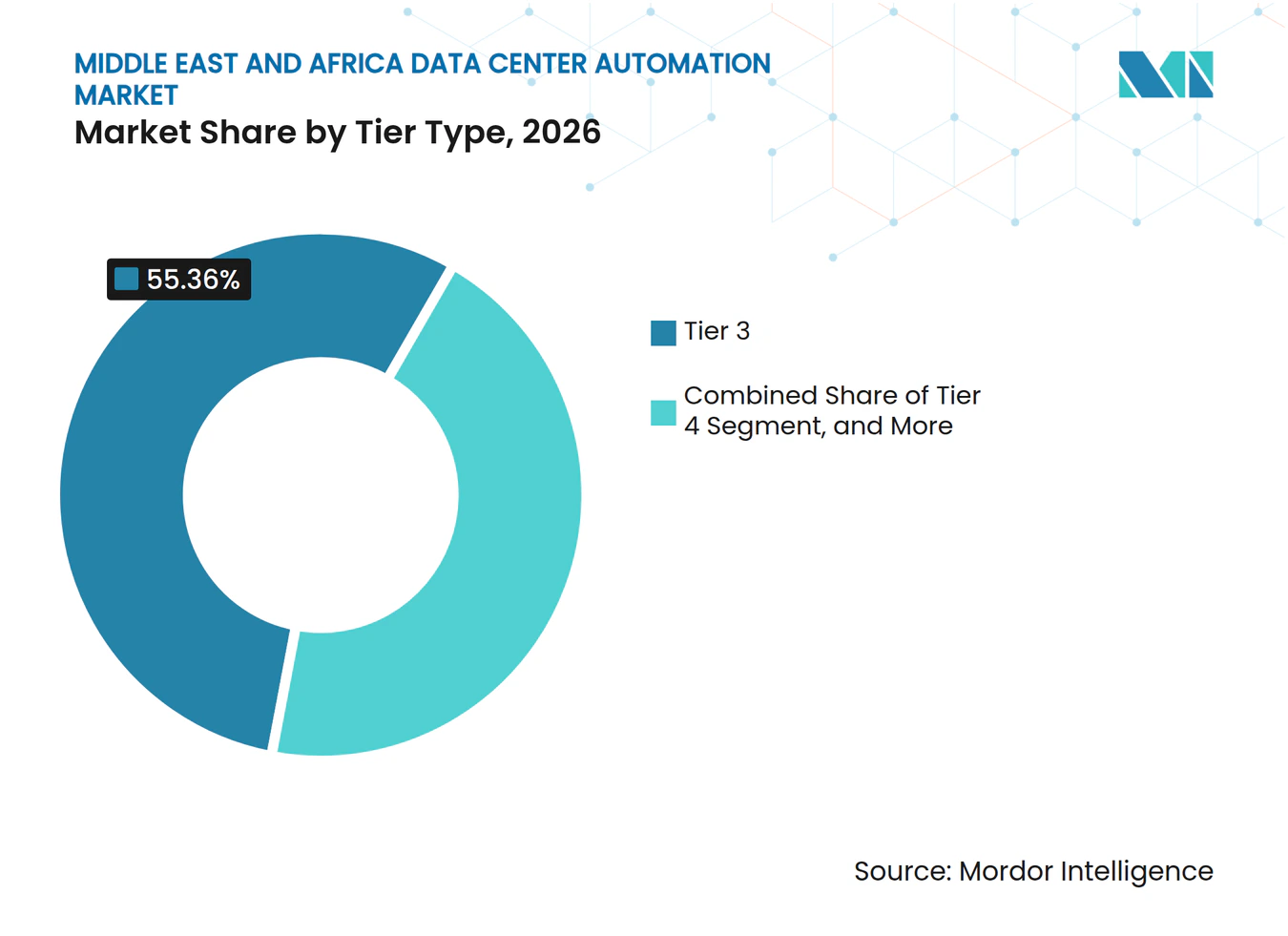
- By tier type, Tier 3 facilities held 55.36% of the Middle East and Africa data center automation market share in 2026, while Tier 4 facilities are expected to register an 18.96% CAGR through 2032.
- By geography, Saudi Arabia accounted for 26.13% of revenue in 2026, while Nigeria is projected to record a 19.57% CAGR through 2032.
Note: Market numbers in this report are based on Mordor Intelligence's proprietary estimation framework, which combines nine months of actuals with Q4 projections for base year 2026.
Market Trends and Insights
Drivers Impact Analysis of Middle East and Africa Data Center Automation Market*
| Driver | (~) % Impact on CAGR Forecast | Geographic Relevance | Impact Timeline |
|---|---|---|---|
| AI and Hyperscale Data Center Expansion | +7.8% | GCC core, Saudi Arabia and UAE, with spillover to Egypt and South Africa | Short term (≤ 2 years) |
| Cloud, 5G, and Digital Government Adoption | +3.9% | GCC, Egypt, Nigeria, and South Africa | Medium term (2-4 years) |
| Data Localization and Sovereign Cloud Requirements | +3.1% | Saudi Arabia and UAE, expanding across MEA | Medium term (2-4 years) |
| Energy Efficiency and Sustainability Requirements | +2% | MEA, with high intensity in the GCC | Medium term (2-4 years) |
| Remote-Site Workforce Constraints Increasing Automation Demand | +0.8% | Sub-Saharan Africa, with secondary relevance in GCC interior sites | Short term (≤ 2 years) |
| High-Density AI Rack Deployment Requiring Automated Thermal Optimization | +0.6% | Saudi Arabia and UAE hyperscale campuses, with emerging demand in South Africa | Long term (≥ 4 years) |
| Source: Mordor Intelligence | |||
AI and Hyperscale Data Center Expansion
Sovereign AI programs in the Gulf are concentrating demand for advanced automation in a small number of very large campuses. HUMAIN is developing computing capacity through agreements with Nvidia, AWS, and Blackstone, while the Stargate AI campus in the UAE is advancing a 5 GW cluster, with its first phase expected to be online in 2026. Facilities at this scale operate extensive networks of sensors, power distribution equipment, and cooling nodes. Human teams cannot evaluate that volume of operating data quickly enough during fast-changing power or thermal conditions. The Middle East and Africa data center automation market, therefore, places greater value on integrated platforms that coordinate cooling, energy distribution, alarms, and equipment states. Vendors capable of supporting liquid-cooled, GPU-dense installations can meet the operating requirements of these large facilities.
Cloud, 5G, and Digital Government Adoption
National digital programs are creating recurring demand for multi-tenant capacity, which increases automation procurement by facility operators. AWS planned to invest more than USD 5.3 billion in Saudi Arabian cloud infrastructure and expects its first Saudi Arabia Region to launch in December 2026. New cloud regions require integrated building controls and infrastructure management systems to meet service commitments. 5G deployment also introduces dispersed edge sites that must be managed with the same discipline as core facilities. Digital government programs in Egypt and Nigeria raise the need for monitored access, auditable workflows, and local data handling. These conditions broaden the Middle East and Africa data center automation market beyond a narrow focus on large central campuses.
Data Localization and Sovereign Cloud Requirements
Data residency rules are increasing demand for infrastructure that provides local storage and controlled access. Saudi Arabia’s Personal Data Protection Law became fully enforceable in September 2024, and the National Data Management Office issued implementing rules that guide data handling.[1] In-country infrastructure requires controls that document access, classify information, and retain auditable operating records. Automation platforms can bring these functions together with facility monitoring and infrastructure management. The UAE has a layered regulatory environment, including Federal Decree-Law No. 45 of 2021 and sector-specific requirements. The Middle East and Africa data center automation market benefits when compliance functions are embedded in the control environment rather than added after facility deployment.
Energy Efficiency and Sustainability Requirements
High temperatures across the Gulf increase the energy required to cool computing equipment. Khazna Data Centers reported that its facilities target a power usage effectiveness value of 1.5 or lower and disclosed energy-efficiency measures in its ESG reporting. Cooling optimization, thermal mapping, and dynamic power scheduling can reduce unnecessary consumption without rebuilding an entire facility. The UAE’s Net Zero 2050 strategy and Saudi Arabia’s net-zero commitment are also shaping procurement expectations for government-linked projects. In African facilities that depend on captive generation, closer power management can directly reduce operating costs. Energy management is thus becoming a core operating requirement for the Middle East and Africa data center automation market.
Restraints Impact Analysis of Middle East and Africa Data Center Automation Market*
| Restraint | (~) % Impact on CAGR Forecast | Geographic Relevance | Impact Timeline |
|---|---|---|---|
| High Initial Automation and Integration Costs | -2.4% | Pan-MEA, most pronounced in sub-Saharan Africa and among smaller GCC operators | Short term (≤ 2 years) |
| Legacy-System Interoperability and Cybersecurity Risks | -1.6% | Broad MEA, concentrated in markets with older enterprise data center stock | Medium term (2-4 years) |
| Grid Interconnection and Power Availability Delays | -1.1% | Sub-Saharan Africa, Nigeria, South Africa, and Egypt secondary cities | Medium term (2-4 years) |
| Shortage of Regional Commissioning and Automation Specialists | -0.7% | Sub-Saharan Africa, with some impact in GCC interior markets | Long term (≥ 4 years) |
| Source: Mordor Intelligence | |||
High Initial Automation and Integration Costs
Comprehensive automation programs require spending on controllers, licenses, system integration, and commissioning. The cost is particularly difficult for smaller operators that must first fund basic power reliability improvements. Brownfield projects often need custom engineering and protocol bridging before modern controls can be connected. Those requirements extend deployment timelines and weaken the immediate financial case for retrofits. Smaller co-location providers in Nigeria, Egypt, and South Africa can therefore prioritize power equipment over automation sophistication. Modular and consumption-priced offerings can make the Middle East and Africa data center automation market more accessible to these operators.
Legacy-System Interoperability and Cybersecurity Risks
Many existing facilities use controls installed across several generations of equipment. Connecting programmable logic controllers, direct digital controllers, and proprietary building systems requires protocol conversion, firmware updates, and network segmentation. These steps take time and require specialized implementation skills. The resulting connection of formerly isolated systems also creates cybersecurity responsibilities. Saudi Arabia’s Essential Cybersecurity Controls set requirements for governance and technical safeguards that affect these projects.[2] Operators with older assets may defer integration until they can secure qualified technical support.
*Our forecasts treat driver/restraint impacts as directional, not additive. The impact forecasts reflect baseline growth, mix effects, and variable interactions.
Middle East and Africa Data Center Automation Market Segment Analysis
By Component Type:
Software Platforms Lead the Operational StackSoftware accounted for 34.42% of the Middle East and Africa data center automation market in 2026 and is expected to expand at a 19.01% CAGR through 2032. Hyperscale and large co-location operators are selecting platforms that provide estate-wide visibility rather than separate monitoring tools. These platforms can connect building management systems, data center infrastructure management, digital twins, and analytics in a shared operating environment. This design enables teams to assess power, cooling, capacity, security, and equipment conditions from a single interface. In February 2026, Khazna Data Centers contracted with Presight to deploy an AI-powered unified command-and-control platform across its portfolio. The deployment includes IoT monitoring, digital twin models, incident management, carbon tracking, and cross-site benchmarking. It illustrates why software has a leading role as facility estates become more geographically distributed. The Middle East and Africa data center automation industry is moving toward platforms that support coordinated actions rather than passive data collection.
Services remain important because many facilities were designed before AI-grade rack densities became common. Retrofit and modernization projects require field assessment, design work, commissioning, and ongoing technical support. Hardware demand remains durable in new construction because sensors, gateways, controllers, remote I/O, and human-machine interfaces are necessary at the facility edge. However, hardware can lose relative share when operators place more value on software subscriptions and data-driven functions. Gateways and communication devices have a distinct role because they allow legacy instruments to join newer architectures without complete replacement. This helps operators phase upgrades while preserving usable equipment. Service providers can also help smaller facilities implement a practical control baseline before pursuing more complex digital-twin programs. These needs keep the component mix broad even as software leads the Middle East and Africa data center automation market.



By Data Center Size:
Hyperscale Facilities Take the Largest Share of Automation SpendingHyperscale facilities accounted for 45.31% of the Middle East and Africa data center automation market size in 2026 and are projected to advance at a 19.18% CAGR through 2032. Their leading position reflects large automation budgets at individual sites and the complexity of managing extensive sensor networks. A hyperscale campus requires coordinated supervision of power systems, thermal equipment, security, capacity, and maintenance activity. This requirement becomes more demanding as AI workloads increase power density and cooling requirements. In June 2026, Vertiv, Edge-Serve, Integrated Roots Company Ltd., and Saudi Electricity’s PDC signed a framework agreement for converged power and thermal infrastructure across Gulf campuses. The agreement links development, construction, and power supply in a coordinated program. It shows how large-scale projects increasingly treat operating infrastructure as an integrated system. The Middle East and Africa data center automation market benefits from this coordinated approach, as cross-site control becomes increasingly important as campuses expand.
Large data centers are the next important group, as telecommunications firms, financial institutions, and regional cloud providers require high availability. These facilities may not need hyperscale capacity, but they still require Tier 3-class operating discipline. Medium-scale deployments are also expanding in Egypt and South Africa as co-location demand reaches beyond primary metro locations. MTN Nigeria launched the first phase of its Dabengwa Sifiso Data Center in July 2025, providing 4.5 MW and 780 Tier III racks in partnership with Dell Technologies. The project demonstrates the reliability expectations influencing automation procurement at mid-tier African facilities. Small facilities include 5G edge nodes operated by telecommunications companies and public agencies. They need distributed monitoring that connects remote sites to a central operating environment. Each facility size, therefore, has a different buying pattern within the Middle East and Africa data center automation market.
By Tier Type:
Tier 3 Leads While Tier 4 Gains MomentumTier 3 facilities held 55.36% of the tier-type segment in 2026, while Tier 4 facilities are projected to expand at an 18.96% CAGR through 2032. Tier 3 has historically been the preferred redundancy standard for co-location and enterprise data centers in the GCC and South Africa. Its broad installed base supports consistent demand for infrastructure monitoring, preventive maintenance, and remote operating controls. Tier 4 designs are gaining attention where sovereign AI programs require concurrent maintainability. These facilities need every key subsystem to remain available during maintenance or equipment failures. They therefore require more granular sensor coverage, redundancy in control, and automated failover processes. The International Data Center Authority identified the Middle East as a major opportunity for AI data centers and noted the region’s adoption of Tier 4 standards. The higher operating requirements of Tier 4 facilities translate into greater automation spending per megawatt. This supports continued demand in the data center automation market in the Middle East and Africa.
Tier 1 and Tier 2 facilities present a significant retrofit opportunity as data residency rules bring more workloads to local infrastructure. These sites often need basic data center infrastructure management, environmental monitoring, and remote access control before more advanced controls. Their cost sensitivity makes cloud-managed monitoring subscriptions particularly relevant. A subscription model can provide visibility without requiring an immediate major systems replacement. It also creates a path for operators to add analytics and automated controls as their requirements mature. This segment is especially relevant in markets where many facilities were built for traditional enterprise workloads. Vendors that offer clear upgrade paths can address the needs of operators at different maturity levels. The breadth of requirements from Tier 1 through Tier 4 supports varied demand across the Middle East and Africa data center automation industry.

Geography Analysis
Saudi Arabia and United Arab Emirates Data Center Automation Market
Saudi Arabia accounted for 26.13% of regional revenue in 2026, giving it the leading share of the Middle East and Africa data center automation market. The country’s National Data Center Strategy targets up to 1.5 GW of capacity by 2030, while sovereign data requirements support local infrastructure development.[3] HUMAIN’s program, AWS’s planned Saudi region, and the DataVolt project at NEOM’s Oxagon are raising requirements for power management, cooling, and compliance controls. HUMAIN and DataVolt announced plans in August 2026 to develop 100 MW within a planned 360 MW AI data center project at NEOM. The UAE is also a major location because of the Stargate AI campus and Khazna’s hyperscale plans. Its intelligent infrastructure projects are increasing the need for automation designed into new facilities from the outset.
Africa Data Center Automation Market
South Africa remains the largest sub-Saharan data center location, accounting for more than 60% of the continent’s operational capacity in 2026. In March 2025, Microsoft announced a ZAR 5.4 billion (USD 300 million) investment to expand its South African cloud infrastructure. Nigeria is projected to register a 19.57% CAGR through 2032, the fastest rate among the geographic markets presented. Grid availability constraints make automated management of captive generation a direct operational need for Nigerian data center operators. Egypt benefits from submarine cable connectivity and attracts co-location demand for Arabic-language workloads. These conditions give each country a different path to adopting automation in the Middle East and Africa data center automation market.
MEA Data Center Automation Market
The Rest of the Middle East and Africa includes Qatar, Oman, Kenya, Morocco, and Ghana. Qatar’s Brookfield-Qai venture began construction of a 100 MW compute center in Doha in February 2026. The project highlights demand for infrastructure that can coordinate power, cooling, and operating equipment at scale. African data center facilities often operate above global power-usage-effectiveness norms, which supports the business case for energy-management controls. Kenya is emerging as a renewable-energy-backed location with planned green campus development involving Microsoft and G42. These markets extend the Middle East and Africa data center automation market beyond the region’s established Gulf and South African hubs.
Competitive Landscape
Market Concentration
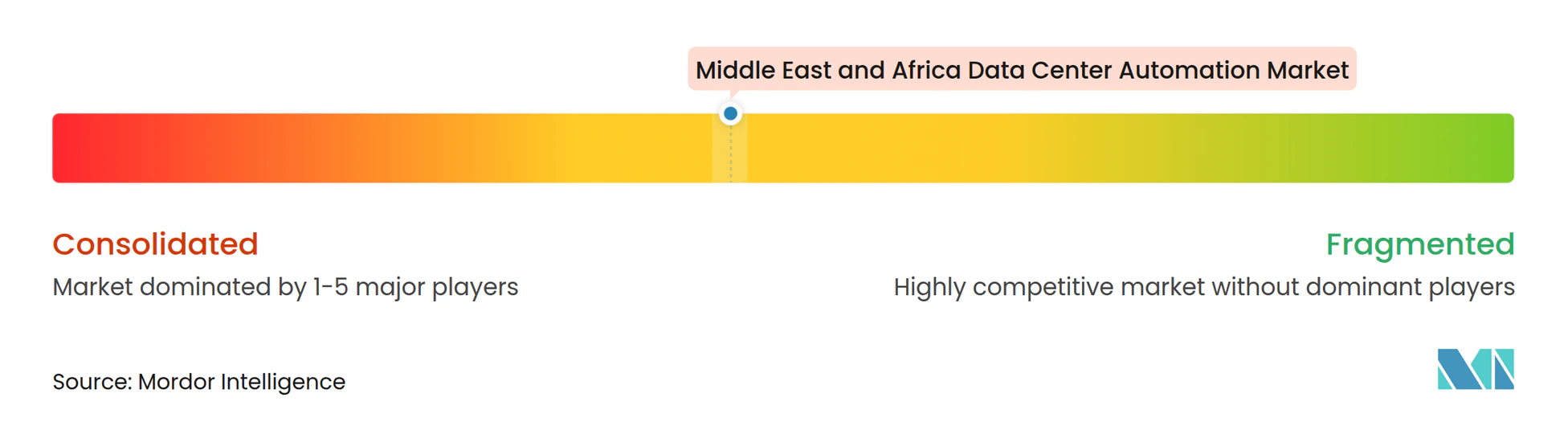
Schneider Electric, Vertiv, Siemens AG, ABB, and Honeywell have strong positions because they combine infrastructure equipment, software, engineering capability, and established service networks. The Middle East and Africa data center automation market is moderately concentrated among these global technology vendors. It is more fragmented when regional system integrators and AI-focused software providers are included. Large vendors can supply connected power, cooling, control, and monitoring systems through a common delivery model. ABB disclosed in December 2025 that it was working with Nvidia on an 800-volt direct-current architecture for data centers. The work addresses the power requirements expected from higher-density computing environments. Schneider Electric introduced software-defined medium-voltage switchgear in September 2026, extending software control into power-system operation. These moves show that vendors are integrating physical infrastructure with software control.
Software is the most contested part of the Middle East and Africa data center automation market. Presight and Phaidra are competing for accounts that need AI-assisted optimization at sophisticated Gulf facilities. Khazna’s contract with Presight illustrates a regional operator’s interest in a unified command platform across multiple locations. Honeywell strengthened its data center power management position through a global collaboration with LS Electric in October 2025.[4] The partnership combines power equipment with software functions that support predictive maintenance. IBM and Cisco also compete in the control plane through hybrid-cloud orchestration and software-defined networking. Their participation extends automation beyond traditional data center infrastructure management systems.
Opportunity remains at both ends of the demand spectrum. Gigawatt-scale AI facilities require integrated management of thermal systems, power equipment, access controls, and compliance processes. Smaller Tier 1 and Tier 2 sites need simpler cloud-managed monitoring that can be implemented at a lower cost. Honeywell’s Forge platform and its memorandum of understanding with Kortech address critical infrastructure projects in Egypt, Saudi Arabia, and the UAE. Regional operators may also develop proprietary operating capabilities as their facilities and data resources increase. This creates a competitive environment in which technological depth, integration skills, and local delivery capacity all matter.
Middle East and Africa Data Center Automation Industry Leaders
-
Schneider Electric SE
-
Vertiv Group Corp.
-
Siemens AG
-
Huawei Technologies Co., Ltd.
-
ABB Ltd.
- *Disclaimer: Major Players sorted in no particular order
Middle East and Africa Data Center Automation Market Companies Covered in this Report
- Schneider Electric SE
- Vertiv Group Corp.
- Siemens AG
- ABB Ltd.
- Eaton Corporation plc
- Johnson Controls International plc
- Honeywell International Inc.
- Huawei Technologies Co., Ltd.
- Cisco Systems, Inc.
- International Business Machines Corporation
- Microsoft Corporation
- Dell Technologies Inc.
- Hewlett Packard Enterprise Company
- Oracle Corporation
- Equinix, Inc.
- Digital Realty Trust, Inc.
- Khazna Data Centers
- Gulf Data Hub
- Africa Data Centres
- Raxio Group
- Moro Hub
- MEEZA QSTP LLC
- Rack Centre Limited
- ST Telemedia Global Data Centres
Recent Industry Developments in Middle East and Africa Data Center Automation Market
- October 2026: Saudi Arabia's SDAIA published draft amendments to the Implementing Regulations of the Personal Data Protection Law, proposing an express in-country data storage requirement under Article 23. If adopted after the public consultation period closing November 5, 2026, organizations using offshore or cross-border infrastructure would need to redesign storage architectures and procure compliant automation platforms with built-in governance capabilities.
- September 2026: Schneider Electric unveiled the world's first software-defined medium-voltage switchgear at YOTTA 2026 and deployed it live in a colocation facility with Equinix. The RM AirSeT 38 platform extends from 24 kV to 38 kV, enabling operators to reconfigure power systems at software speed without downtime, directly addressing power capacity requirements of next-generation AI-grade hyperscale campuses.
- August 2026: HUMAIN and DataVolt expanded their partnership to co-develop 100 MW of a 360 MW AI data center at NEOM's Oxagon. The project integrates sustainable power design with high-density compute infrastructure and reinforces Saudi Arabia's ambition to position NEOM as a sovereign AI compute hub powered by clean energy.
- June 2026: Vertiv signed a multi-party framework agreement with Edge-Serve, Integrated Roots Company Ltd., and the Saudi Electricity Project Development Company, PDC, to deploy converged power and thermal infrastructure across GCC hyperscale campuses. The agreement integrates facility development, construction execution, and power supply into a coordinated program to reduce on-site engineering complexity.
Middle East and Africa Data Center Automation Market Report Scope
The Middle East and Africa Data Center Automation Market encompasses the hardware, software, and services used to automate and manage data center operations, improve efficiency, and optimize infrastructure performance across data center sizes and tier classifications in the region.
The Middle East and Africa Data Center Automation Market Report is Segmented by Component Type (Hardware, Software, and Services), Data Center Size (Hyperscale, Large, Medium, and Small), Tier Type (Tier 1 and 2, Tier 3, and Tier 4), and Geography (Saudi Arabia, United Arab Emirates, South Africa, Nigeria, Egypt, and Rest of Middle East and Africa). The Market Forecasts are Provided in Terms of Value (USD).
Segmentation Overview
| Hardware | Programmable Logic Controllers (PLCs) |
| Direct Digital Controllers (DDCs) | |
| Remote I/O and Field Controllers | |
| Sensors and Monitoring Devices | |
| Gateways and Communication Devices | |
| Human Machine Interface (HMI) Panels | |
| Other Automation Hardware (Others include industrial PCs (IPCs), edge controllers, protocol converters, industrial network switches, embedded automation controllers, among others) | |
| Software | Building Management and Automation Systems (BMS/BAS) |
| Supervisory Control and Data Acquisition (SCADA) | |
| Data Center Infrastructure Management (DCIM) | |
| Digital Twin Platforms | |
| Analytics and Optimization Software | |
| Other Automation Software (Others include engineering and configuration software, historian software, alarm management software, among others) | |
| Services | Design and Consulting Services |
| System Integration Services | |
| Installation and Commissioning Services | |
| Monitoring, Maintenance, and Support Services | |
| Retrofit and Modernization Services |
| Hyperscale |
| Large |
| Medium |
| Small |
| Tier 1 and 2 |
| Tier 3 |
| Tier 4 |
| Saudi Arabia |
| United Arab Emirates |
| South Africa |
| Nigeria |
| Egypt |
| Rest of the Middle East and Africa |
| By Component Type | Hardware | Programmable Logic Controllers (PLCs) |
| Direct Digital Controllers (DDCs) | ||
| Remote I/O and Field Controllers | ||
| Sensors and Monitoring Devices | ||
| Gateways and Communication Devices | ||
| Human Machine Interface (HMI) Panels | ||
| Other Automation Hardware (Others include industrial PCs (IPCs), edge controllers, protocol converters, industrial network switches, embedded automation controllers, among others) | ||
| Software | Building Management and Automation Systems (BMS/BAS) | |
| Supervisory Control and Data Acquisition (SCADA) | ||
| Data Center Infrastructure Management (DCIM) | ||
| Digital Twin Platforms | ||
| Analytics and Optimization Software | ||
| Other Automation Software (Others include engineering and configuration software, historian software, alarm management software, among others) | ||
| Services | Design and Consulting Services | |
| System Integration Services | ||
| Installation and Commissioning Services | ||
| Monitoring, Maintenance, and Support Services | ||
| Retrofit and Modernization Services | ||
| By Data Center Size | Hyperscale | |
| Large | ||
| Medium | ||
| Small | ||
| By Tier Type | Tier 1 and 2 | |
| Tier 3 | ||
| Tier 4 | ||
| By Geography | Saudi Arabia | |
| United Arab Emirates | ||
| South Africa | ||
| Nigeria | ||
| Egypt | ||
| Rest of the Middle East and Africa | ||
Key Questions Answered in the Report
What is the size of the Middle East and Africa data center automation market?
The Middle East and Africa data center automation market size is USD 1.02 billion in 2026 and is projected to reach USD 4.42 billion by 2032.
What is driving demand for data center automation in the Middle East and Africa?
Sovereign AI capacity, cloud-region investment, data-residency controls, and energy-management needs are increasing demand for automated infrastructure operations.
Which component leads regional data center automation spending?
Software leads with a 34.42% share in 2026 and is projected to expand at a 19.01% CAGR through 2032.
Which facility size has the highest automation demand?
Hyperscale facilities lead with a 45.31% share in 2026 and are expected to advance at a 19.18% CAGR through 2032.
Which country leads regional automation demand?
Saudi Arabia leads with 26.13% of regional revenue in 2026, supported by large AI and cloud infrastructure programs.
Why are energy controls important for regional data centers?
High temperatures, cooling requirements, and unreliable power in several markets make real-time power and thermal controls important for operating costs and resilience.