
Middle East and Africa Container Homes Market Size and Share
Market Overview
| Study Period | 2021 - 2032 |
|---|---|
| Forecast Data Period | 2027 - 2032 |
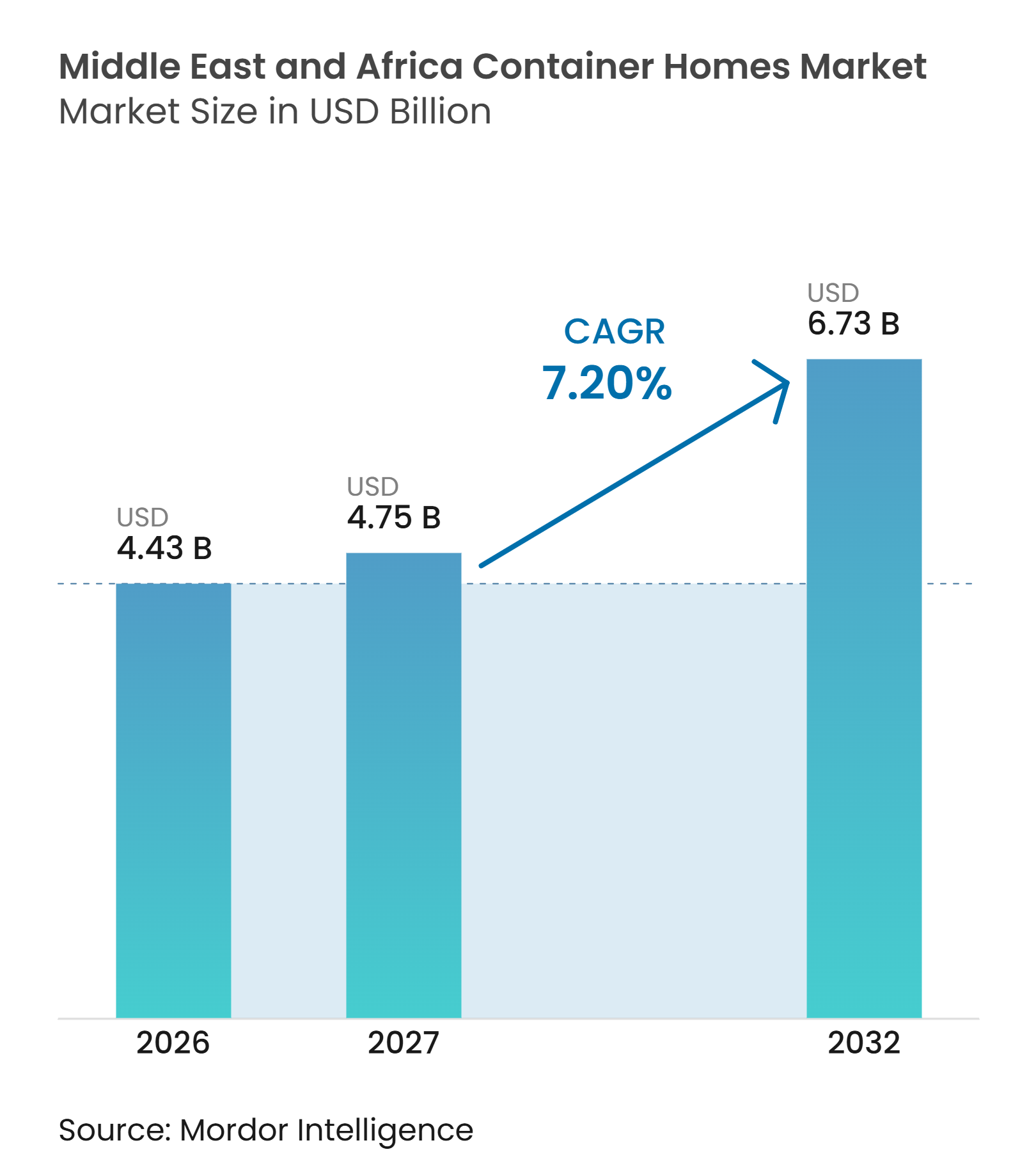
| Base Year Market Size (2026) | USD 4.43 Billion |
| Market Size (2027) | USD 4.75 Billion |
| Market Size (2032) | USD 6.73 Billion |
| Growth Rate (2027 - 2032) | 7.20 % |
| Market Concentration | Medium |
Major Players *Disclaimer: Major Players sorted in no particular order Image © Mordor Intelligence. Reuse requires attribution under CC BY 4.0. | |
Middle East and Africa Container Homes Market Analysis by Mordor Intelligence
The Middle East And Africa Container Homes Market size is projected to be USD 4.43 billion in 2026, USD 4.75 billion in 2027, and reach USD 6.73 billion by 2032, growing at a CAGR of 7.20% from 2027 to 2032.
The Middle East and Africa container homes market is supported by separate but connected sources of demand, including large workforce camps in the Gulf and housing needs across African cities. Saudi Arabia’s project pipeline creates repeat demand for standardized accommodation, while emergency deployments require units that can be installed quickly and later used for longer-term housing. Offsite construction policies in the United Arab Emirates and Saudi Arabia favor suppliers that can demonstrate factory quality, thermal performance, and dependable delivery. High heat conditions in the Gulf raise the cost of permanent units, and limited mortgage and insurance access restricts household adoption in several African countries. These conditions give the Middle East and Africa container homes market an opportunity to grow through institutional buyers, public procurement, and local manufacturing rather than through household purchases alone.
Key Report Takeaways
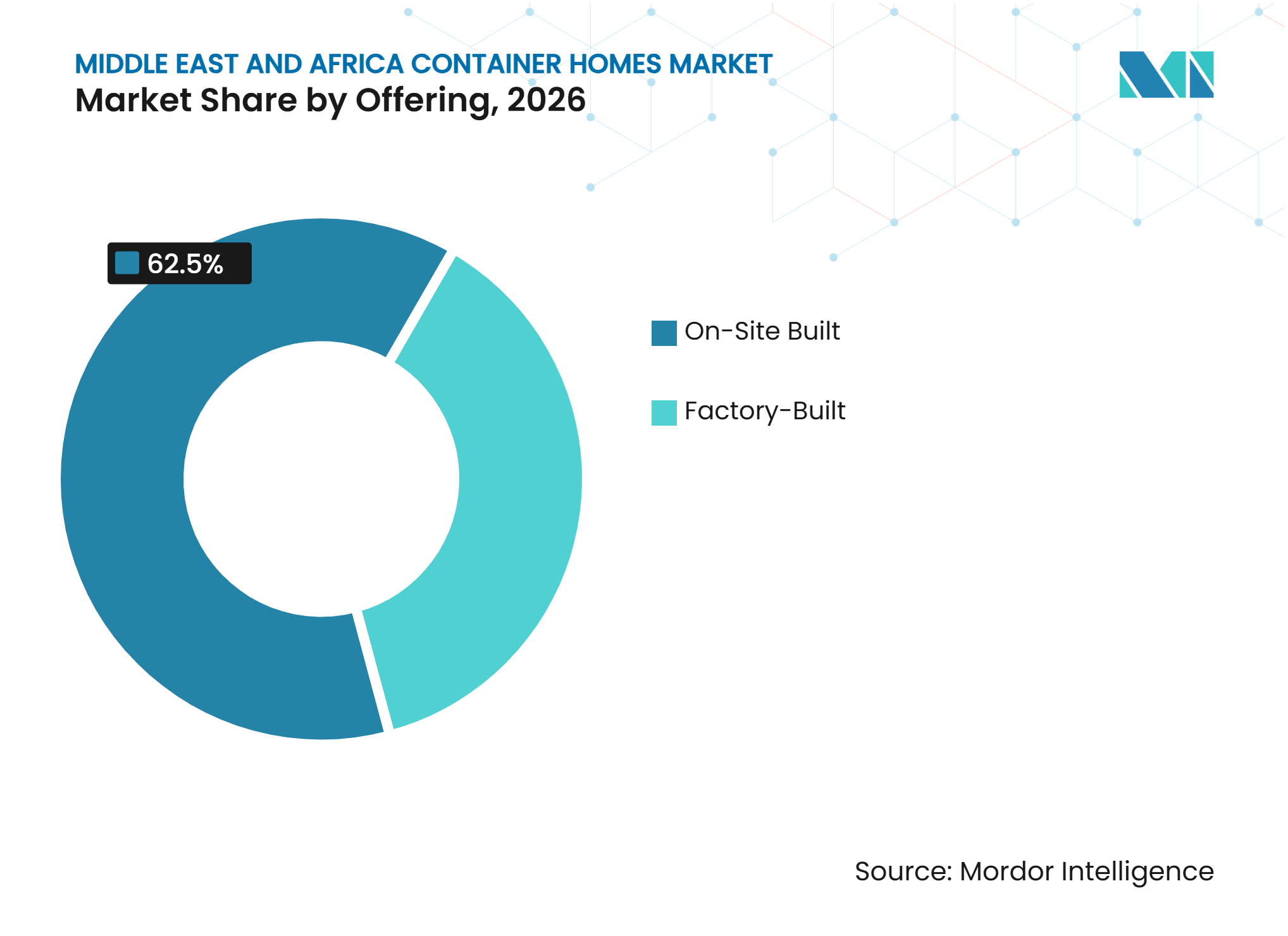
- By offering, on-site built units held 62.5% of the Middle East and Africa container homes market share in 2026, while factory-built formats are forecast to grow at a 7.95% CAGR through 2032.
- By construction type, fixed units held 52.5% of the Middle East and Africa container homes market share in 2026, while movable structures are forecast to grow at an 8.45% CAGR through 2032.
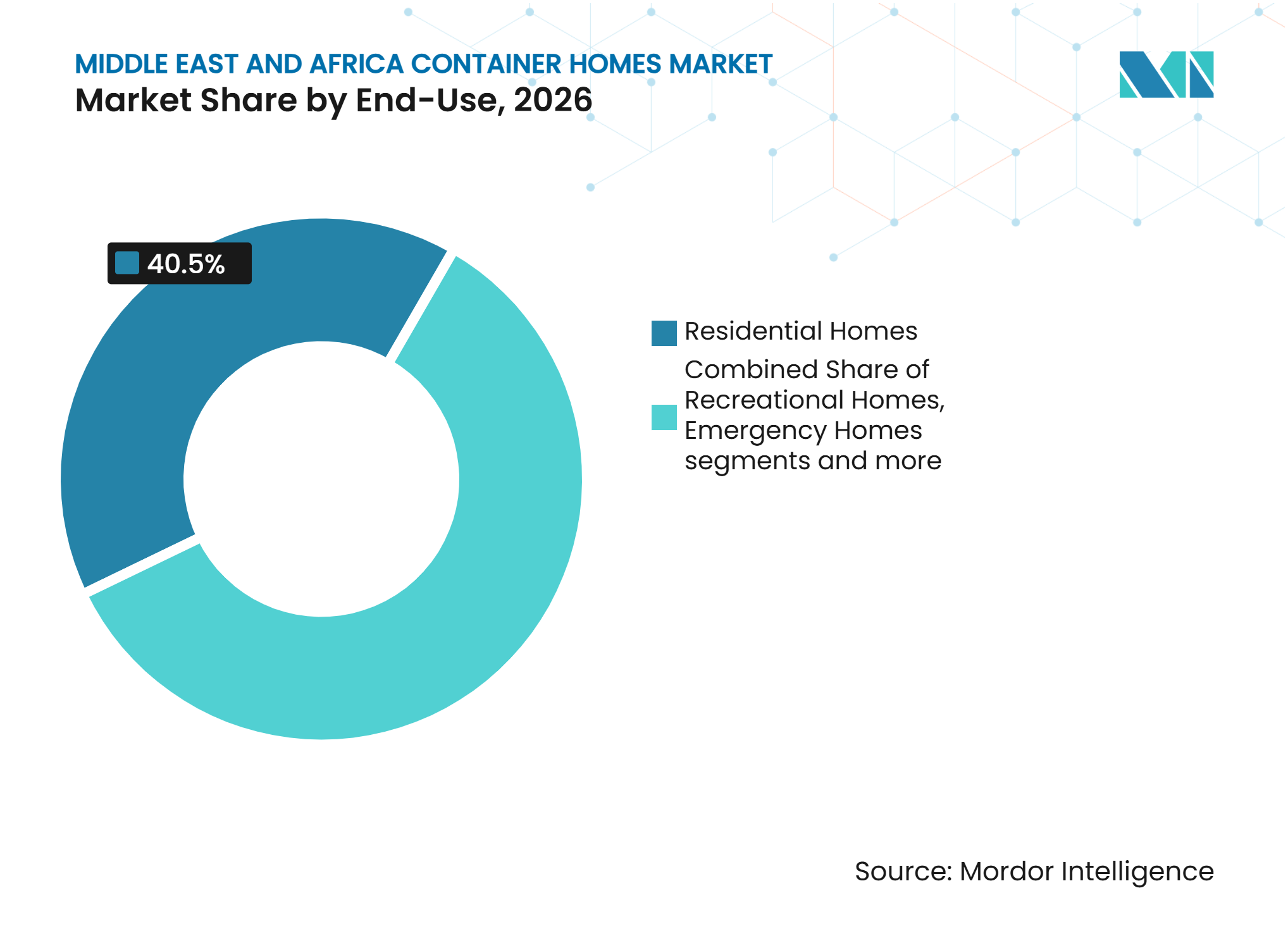
- By end use, residential homes accounted for 40.5% of the Middle East and Africa container homes market size in 2026, while emergency homes are forecast to grow at an 8.75% CAGR through 2032.
- By country, Saudi Arabia held 34% of the Middle East and Africa container homes market share in 2026 and is forecast to grow at an 8.1% CAGR through 2032.
Note: Market numbers in this report are based on Mordor Intelligence's proprietary estimation framework, which combines nine months of actuals with Q4 projections for base year 2026.
Market Trends and Insights
Drivers Impact Analysis of Middle East and Africa Container Homes Market*
| Driver | (~) % Impact on CAGR Forecast | Geographic Relevance | Impact Timeline |
|---|---|---|---|
| Remote Worker and Project-Site Accommodation | +3.0% | Saudi Arabia, United Arab Emirates, Gulf Cooperation Council, South Africa, Nigeria | Short term (≤ 2 years) |
| Disaster Relief, Refugee, and Resettlement Housing | +1.5% | Middle East and Africa, with concentration in conflict-adjacent and climate-vulnerable areas | Short term (≤ 2 years) |
| Affordable Housing Shortfalls and Public Procurement | +1.2% | Sub-Saharan Africa, North Africa, and Gulf social housing programs | Medium term (2-4 years) |
| Modular and Prefabricated Construction Expansion | +1.0% | Saudi Arabia, United Arab Emirates, and South Africa | Medium term (2-4 years) |
| Rapid-Deployment Social Infrastructure | +0.8% | Nigeria, South Africa, and the rest of Middle East and Africa | Long term (≥ 4 years) |
| Source: Mordor Intelligence | |||
Remote Worker and Project-Site Accommodation for Giga-Projects, Mining, And Energy
Saudi Arabia’s large construction programs have made workforce accommodation a major buyer category for the Middle East and Africa container homes market. Projects such as NEOM, Qiddiya, Red Sea Global, Diriyah Gate, and ROSHN need accommodation that can be procured in large volumes and installed to uniform standards. The Qiddiya Contractors Camp has a USD 1.1 billion value and capacity for 40,000 workers in modular cold-formed steel structures, showing the scale of site housing required for a single development. In February 2026, Smart Accommodation for Residential Complexes Company signed heads of terms with MAWREF for a proposed 12,000-bed North Riyadh project valued at USD 178 million. Saudi Building Code requirements, Saudi Arabian Standards Organization requirements, and Saudi Aramco specifications make compliance a central part of supplier selection for site structures.
Mining also supports demand outside Gulf construction corridors. Gold, platinum, and chrome operations in Gauteng and Mpumalanga need semi-permanent accommodation near extraction areas. Operators often prefer assets they can relocate or retain across project phases. That operating model is less dependent on the mortgage access that limits household demand. It also places value on durable structures with predictable maintenance requirements. This recurring need gives the Middle East and Africa container homes market a source of demand that is tied to resource projects rather than housing cycles.
Disaster Relief, Refugee, and Resettlement Housing
Emergency shelter demand creates a separate route to market for container-based units. The International Organization for Migration reported that nearly 2 million people in Gaza needed urgent shelter assistance in 2026[1]. Governments are considering container housing as a first-response option because units can be transported, connected to services, and configured for family use. Turkey’s commitment to supply 20,000 container homes and the United Arab Emirates' plan for a temporary housing complex in southern Gaza illustrate this public response. The Middle East and Africa container homes market benefits when units are specified for later conversion into semi-permanent community housing. A longer usable life can improve the value proposition for government and humanitarian buyers.
Emergency procurement does not follow the same process as a conventional residential purchase. Buyers need immediate production capacity, transport coordination, and basic services that can operate in difficult locations. Suppliers must also meet requirements for safety, ventilation, sanitation, and weather protection. These conditions favor standardized systems that have already been tested in similar environments. They can also encourage framework agreements with manufacturers able to deliver repeated orders. The need for rapid deployment therefore supports suppliers with proven logistics and project-management capability.
Affordable Housing Shortfalls and Public Procurement
Africa’s housing shortage provides a sustained reason for governments to consider modular building methods. UN-Habitat reported in April 2026 that Africa’s housing deficit exceeded 51 million units and could reach 130 million units by 2030[2]. The same policy setting supports solutions that can be delivered faster than conventional construction and used in growing urban areas. The Africa Affordable Housing Compact, launched at the Second Africa Urban Forum, seeks to mobilize financing for bankable housing solutions. Container formats can be relevant where reduced excavation and lighter foundation needs lower the construction burden. Their role is strongest when land, infrastructure connections, and finance are coordinated through a public program.
The scale of the deficit does not automatically create household sales. Land costs and limited infrastructure continue to shape what can be delivered in major cities. Public agencies can create more predictable demand through social housing, community housing, and serviced-site programs. Standardized unit designs may help authorities compare quality and cost across suppliers. This approach also allows developers to combine container modules with other prefabricated elements. The Middle East and Africa container homes market can therefore serve broader public housing plans when procurement rules accept non-traditional building systems.
Modular and Prefabricated Construction Expansion
Government support for offsite construction is strengthening the operating case for factory production. Dubai Holding Asset Management began work on the 390-unit Lantana Hills community in May 2026, with 85% of construction planned offsite using DuBox and DuPod systems. This project shows how modular methods are extending beyond temporary camps into permanent residential communities. Group AMANA also delivered 1,404 modular concrete studios for Red Sea Global across 27 buildings. Factory work can reduce on-site labor needs and support more consistent production quality. These characteristics strengthen demand for factory-built options in the Middle East and Africa container homes market.
Regulatory acceptance remains important because permanent uses need defined quality requirements. Buyers increasingly look for factory certification and documented compliance before choosing a supplier. This favors manufacturers that can repeat approved designs rather than redesign units for each tender. It also encourages capacity investment near major project zones. Local manufacturing can reduce lead times and provide closer support during installation. The result is a more organized market for modular systems, especially in Saudi Arabia and the United Arab Emirates.
Restraints Impact Analysis of Middle East and Africa Container Homes Market*
| Restraint | (~) % Impact on CAGR Forecast | Geographic Relevance | Impact Timeline |
|---|---|---|---|
| Thermal And Climate-Performance Requirements | -1.5% | Saudi Arabia, United Arab Emirates, and Gulf Cooperation Council | Short term (≤ 2 years) |
| Limited Mortgage, Insurance, And Valuation Infrastructure | -1.2% | Sub-Saharan Africa, with early impact in Nigeria and South Africa | Medium term (2-4 years) |
| Fragmented Permitting And Building-Code Requirements | -0.8% | Nigeria and the rest of the Middle East and Africa, with improvement in the United Arab Emirates and Saudi Arabia | Medium term (2-4 years) |
| Import Dependence, Logistics Costs, And Currency Volatility | -0.7% | Nigeria, South Africa, and the rest of the Middle East and Africa | Long term (≥ 4 years) |
| Source: Mordor Intelligence | |||
Thermal and Climate-Performance Requirements in Gulf High-Heat Zones
Gulf climate conditions increase the technical requirements for permanent container structures. Temperatures above 45°C require stronger insulation, mechanical ventilation, and reflective cladding than lower-cost temporary units. Suppliers must account for local rules on building performance, electrical systems, and fire safety. The difference between a short-duration site unit and a permanent home can therefore be substantial. This distinction raises costs for buyers that require certified long-term accommodation. It also places a premium on suppliers that can pre-engineer units for Gulf conditions.
Thermal compliance affects both design and procurement. Manufacturers need repeatable insulation details and reliable installation methods to meet buyer expectations. A regional factory can have an advantage when it has established processes for the required specifications. Smaller importers may face extra design work and reduced margins on projects with strict requirements. These pressures can delay purchases when buyers compare certified products with lower-specification alternatives. The Middle East and Africa container homes market will remain sensitive to how regulators distinguish between temporary and permanent structures.
Limited Mortgage, Insurance, and Valuation Infrastructure
Limited finance infrastructure restricts private residential demand in several Sub-Saharan African countries. Banks may not treat movable or non-traditional structures as standard mortgage security. Insurers and valuers also need recognized methods to assess these homes. As a result, affordability at the unit level does not guarantee access for prospective buyers. The restraint is most serious in markets where cash purchases are uncommon. It reduces the part of the Middle East and Africa container homes market that can depend on individual homeownership.
Public procurement, employer housing, and institutional buyers can partly offset this limitation. Those buyers evaluate use, delivery time, and lifecycle costs rather than mortgage eligibility. Standardized appraisal and insurance practices would improve household access over time. Regulatory participation could also clarify when a container home is treated as permanent real estate. Until then, firms may need to offer payment structures that fit local buyer conditions. The lack of finance support keeps formal residential demand below the level suggested by housing shortages alone.
*Our forecasts treat driver/restraint impacts as directional, not additive. The impact forecasts reflect baseline growth, mix effects, and variable interactions.
Middle East and Africa Container Homes Market Segment Analysis
By Offering:
Factory-Built Formats Gain Regulatory and Procurement MomentumOn-site built units held 62.5% of the Middle East and Africa container homes market share in 2026. Their position reflects conditions at remote project sites, mining areas, and emergency locations where roads, crane access, and site readiness can be limited. On-site methods allow contractors to adapt structures to the available space and timing. They can also avoid transporting fully assembled volumetric units over difficult routes. This remains useful where an employer needs accommodation close to active work areas. The segment’s share shows that practical installation conditions still shape procurement decisions.
Factory-built formats are forecast to grow at a 7.95% CAGR through 2032. Their growth is supported by the value of repeatable quality, documented production methods, and reduced on-site work. Group AMANA reported a 30% reduction in construction time and a 35% reduction in on-site workforce for its Amaala Staff Village delivery. The Middle East and Africa container homes industry is likely to favor certified factories as permanent uses increase. Factory production can also give buyers clearer schedules for large programs. On-site construction will remain relevant, but factory-built systems are better placed where procurement requires consistency across many units.


By Construction Type:
Redeployable Assets Support Project MobilityFixed units accounted for 52.5% of the Middle East and Africa container homes market size in 2026. They are suited to residential, hospitality, and emergency uses where relocation is not planned. Local authorities may also require permanent foundations for long-term occupancy. Fixed structures give users a stable base for utility connections and community services. These features keep them important for developments intended to remain in place. The segment benefits when buyers need a durable structure rather than a temporary project asset.
Movable structures are forecast to grow at an 8.45% CAGR through 2032. Giga-project operators use them to shift accommodation as construction phases move across a large site. The Steel Frame Building Association reported that Tamimi PEB produces more than 90 modules daily across Jubail and NEOM facilities, supporting large camp requirements[3]. Redeployment can reduce the risk that an owner leaves assets unused after a work package ends. Mining operators also value movable structures when site rights have a defined life. This makes mobility a core purchasing factor in the Middle East and Africa container homes market.
By End Use:
Residential Homes Lead While Emergency Homes Expand FasterResidential homes accounted for 40.5% of the Middle East and Africa container homes market size in 2026. The segment includes private and public housing needs where speed of construction is important. It also includes developments that use modular elements to reduce on-site work. Demand varies widely because household finance, land access, and permitting differ across the region. Permanent residential projects require higher confidence in comfort, safety, and long-term serviceability. These requirements favor suppliers able to show compliance and maintain their units after handover.
Emergency homes are forecast to grow at an 8.75% CAGR through 2032. Displacement, conflict, and climate events create situations where public bodies need safe accommodation in a short period. IOM’s reported Gaza shelter needs show the scale of such demand in the region. Units designed for later conversion into community housing can offer more useful life after the immediate response. Recreational homes are also appearing in hospitality projects in the United Arab Emirates, South Africa, Kenya, and Morocco. Nursing applications remain limited because clinical settings need more demanding health infrastructure.


Geography Analysis
Saudi Arabia
Saudi Arabia held 34% of the Middle East and Africa container homes market share in 2026 and is forecast to grow at an 8.1% CAGR through 2032. NEOM, Red Sea Global, Qiddiya, Diriyah Gate, and ROSHN need accommodation that can be delivered faster than conventional site construction. The country’s project pipeline supports both worker camps and residential construction activity. The proposed 12,000-bed North Riyadh project has an estimated value of USD 178 million and covers 150,000 square meters. Saudi Building Code and Saudi Arabian Standards Organization requirements influence supplier qualification. The Sakani program shows continued housing activity outside giga-projects, with 90,836 families occupying their first homes in the first 9 months of 2026. Local capacity and certified production are therefore strategic priorities for suppliers serving the Kingdom.
United Arab Emirates
The United Arab Emirates is developing a broader mix of permanent residential, hospitality, and commercial modular uses. Dubai Holding Asset Management started the 390-unit Lantana Hills project at Dubai Science Park in May 2026. The USD 185 million contract plans for 85% offsite construction and a handover in the second half of 2027. This type of development moves modular construction beyond temporary site use. It also signals demand for higher-quality finishes and reliable production control. Thermal performance, building safety, and permanent-use requirements influence product design in the country. The United Arab Emirates offers suppliers a market where compliance and design capability can matter as much as delivery speed. Local manufacturing policies may further support regional supply chains.
South Africa, Nigeria, And the Rest of Middle East and Africa
South Africa and Nigeria have different demand patterns within the Middle East and Africa container homes market. South Africa combines a large affordable housing backlog with recurring mining accommodation needs in Gauteng and Mpumalanga. Mining sites also value solar-ready structures because energy reliability remains a practical concern. Nigeria’s potential is tied to housing needs, but permitting differs across 36 states and makes institutional projects harder to coordinate. In January 2026, Nigeria and Saudi Arabia discussed housing cooperation at the Real Estate Future Forum in Riyadh. Ghana, Kenya, and Rwanda offer emerging private residential demand, while wider regional demand includes humanitarian and remote-site procurement. UN-Habitat’s Nairobi Declaration supports time-bound housing delivery commitments by African Union member states.
Competitive Landscape
Market Concentration

The Middle East and Africa container homes market has moderate fragmentation. Regional fabricators compete with international specialists and manufacturers that supply flat-pack or volumetric units for large engineering, procurement, and construction contracts. Regional suppliers benefit when they understand local specifications and have established relationships with project owners. International firms often need local delivery partners to meet licensing and project requirements. Chinese manufacturers remain relevant in large procurement programs that require standardized modules. The competitive position of each supplier depends on certification, production scale, logistics, and project execution.
Technology is becoming a stronger differentiator in the Middle East and Africa container homes market. Tamimi PEB uses automated cold-formed steel wall-framing lines at its Jubail and NEOM facilities, which the Steel Frame Building Association reported improved productivity by 35% and enabled delivery of units that are 95% complete. Group AMANA demonstrated another strategic approach through its 1,404-studio Red Sea Global delivery. The Lantana Hills project also gives Group AMANA a high-profile residential project in the United Arab Emirates. These moves show that manufacturing capability and delivery experience can create an advantage in institutional tenders. Suppliers without established compliance credentials may struggle to match approved systems.
Procurement practices also shape competition. Large contractors can seek 5,000 to 10,000 units for a single project, which encourages preferred-supplier arrangements and longer-term purchase commitments. This can improve planning for manufacturers but reduces the number of opportunities for smaller suppliers. Africa’s mining corridors still have room for local assembly partnerships where imported units face logistics costs and currency exposure. Companies that establish regional production can reduce shipping complexity and offer faster maintenance support. No combined market share for leading companies was supplied, so the evidence supports a moderate competitive description rather than a highly concentrated one.
Middle East and Africa Container Homes Industry Leaders
-
Aldamegh Portable Houses Factory
-
Saudind
-
Mokamela Prefab
-
Red Sea International
-
Bab Al Qasar Prefab House
- *Disclaimer: Major Players sorted in no particular order
Middle East and Africa Container Homes Market Companies Covered in this Report
- Aldamegh Portable Houses Factory
- Saudind
- Mokamela Prefab
- Red Sea International
- Bab Al Qasar Prefab House
- TSSC Group
- Dune Modular
- Kazema
- Arshia Prefab
- Karmod
- Big Box Containers
- Abacus Space Solutions
- Sogeco Living SA
- Afripanel
- Kwikspace Modular Buildings
- Dune Modular
- CGCH (China Green Container House)
- GS Housing
- Heshi (Hebei) Integrated Housing Co., Ltd
- Max Prefab House Co., Ltd
Recent Industry Developments in Middle East and Africa Container Homes Market
- August 2026: CIMC Modular Building Systems shipped 104 fully finished volumetric modular units to Riyadh for the Earth Hotels project, the company’s first Middle East hospitality-sector modular deployment. With over 75% of hotel rooms built using modular methods and an opening scheduled for early 2027, the project validates factory-manufactured modular structures as a viable route for the Kingdom’s expanding hospitality pipeline.
- May 2026: Dubai Holding Asset Management broke ground on the 390-unit Lantana Hills residential community at Dubai Science Park, appointing Group AMANA as main contractor under a USD 185 million agreement, with 85% of construction planned offsite using DuBox and DuPod modular systems and handover targeted for the second half of 2027.
- February 2026: Smart Accommodation for Residential Complexes Company signed heads of terms with MAWREF Company for a proposed 12,000-bed worker accommodation project in North Riyadh. The estimated development cost is USD 178 million, covering 150,000 square meters, with the first operational phase targeted for the first quarter of 2029.
Middle East and Africa Container Homes Market Report Scope
Segmentation Overview
| Factory-Built |
| On-Site Built |
| Fixed |
| Movable |
| Residential Homes |
| Recreational Homes |
| Emergency Homes |
| Nursing Homes |
| United Arab Emirates |
| Saudi Arabia |
| South Africa |
| Nigeria |
| Rest of Middle East & Africa |
| By Offering | Factory-Built |
| On-Site Built | |
| By Construction Type | Fixed |
| Movable | |
| By End-Use | Residential Homes |
| Recreational Homes | |
| Emergency Homes | |
| Nursing Homes | |
| By Country | United Arab Emirates |
| Saudi Arabia | |
| South Africa | |
| Nigeria | |
| Rest of Middle East & Africa |
Key Questions Answered in the Report
What is the projected value of the Middle East and Africa container homes market by 2032?
The market is projected to reach USD 6.73 billion by 2032, expanding at a 7.2% CAGR from 2027.
Which country leads demand for container homes in the Middle East and Africa?
Saudi Arabia held a 34% share in 2026 and is forecast to grow at an 8.1% CAGR through 2032.
Why are factory-built container homes gaining use in the region?
Factory-built systems support repeatable quality, lower on-site labor needs, and compliance-focused procurement for permanent projects.
What is driving demand for emergency container homes?
Displacement and disaster response needs are raising public demand for fast, transportable, and adaptable housing units.
Which end use is growing fastest through 2032?
Emergency homes are forecast to expand at an 8.75% CAGR through 2032.
What limits private container home purchases in African countries?
Limited mortgage, insurance, and valuation systems constrain homeownership even when a structure is affordable to build.