
Middle East and Africa Commercial Roofing Market Size and Share
Market Overview
| Study Period | 2021 - 2032 |
|---|---|
| Forecast Data Period | 2027 - 2032 |
| Base Year Market Size (2026) | USD 3.04 Billion |
| Market Size (2027) | USD 3.25 Billion |
| Market Size (2032) | USD 4.56 Billion |
| Growth Rate (2027 - 2032) | 7.00 % |
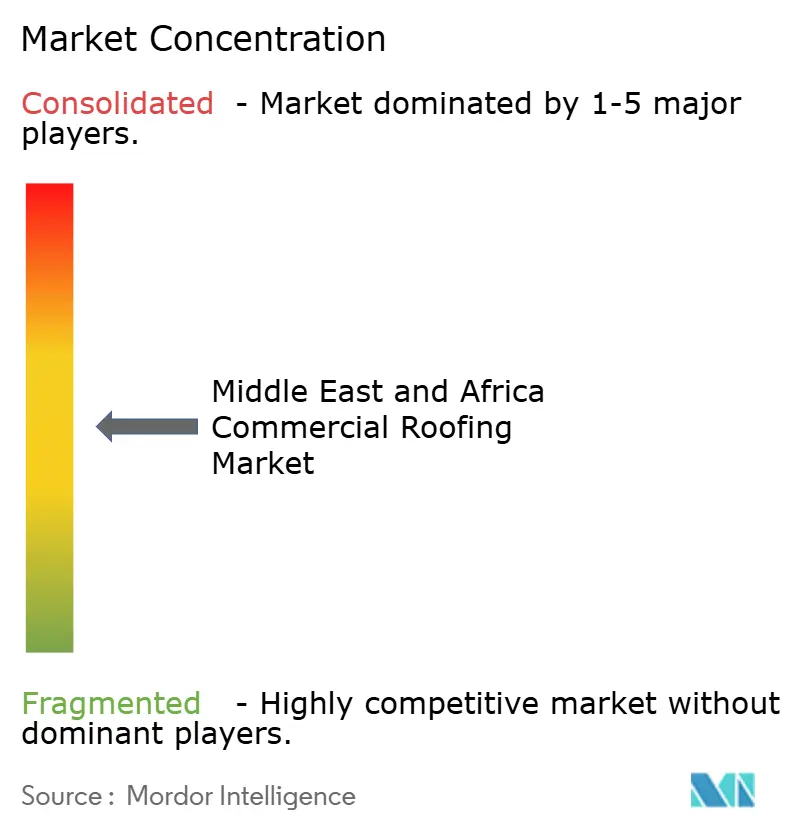
| Market Concentration | Medium |
Major Players *Disclaimer: Major Players sorted in no particular order Image © Mordor Intelligence. Reuse requires attribution under CC BY 4.0. | |
Middle East and Africa Commercial Roofing Market Analysis by Mordor Intelligence
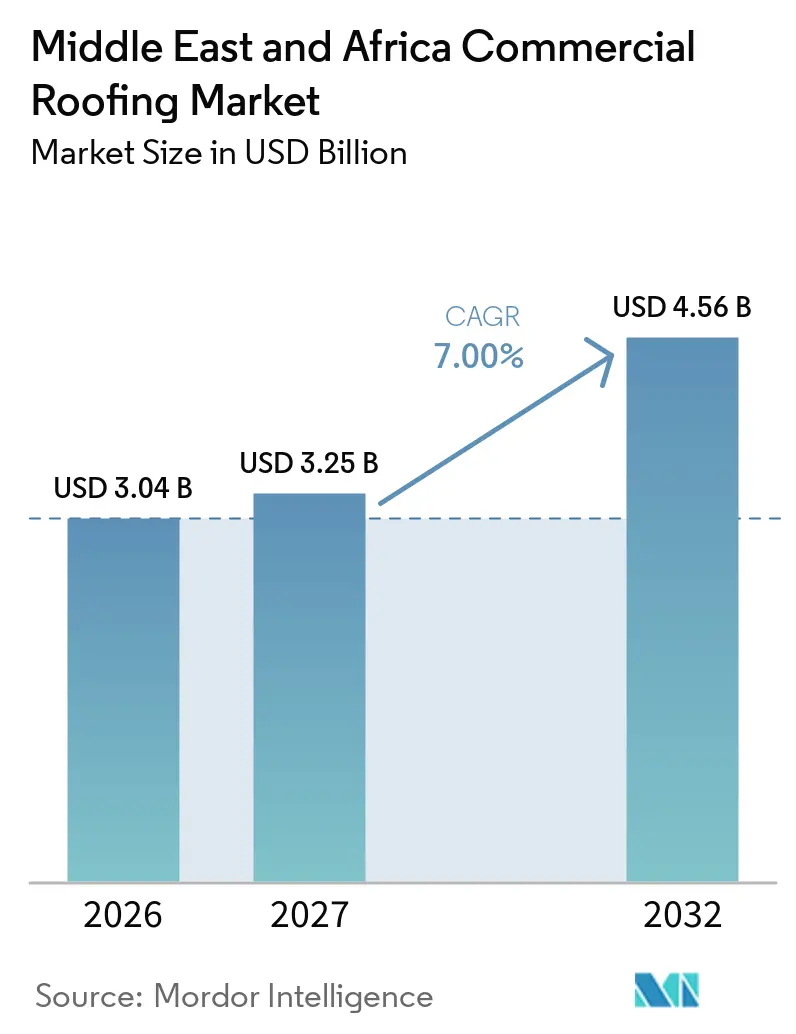
The Middle East And Africa Commercial Roofing Market size is expected to increase from USD 3.04 billion in 2026 to USD 3.25 billion in 2027 and reach USD 4.56 billion by 2032, growing at a CAGR of 7% over 2027-2032.
Public investment in airports, ports, special economic zones, and logistics parks is expanding the pipeline for large roof systems across the region. These developments bring roofing decisions earlier into project design because long-span structures require coordinated choices on drainage, insulation, waterproofing, access, and maintenance. Energy rules are also moving project specifications toward insulated, reflective, and waterproof roof assemblies rather than basic replacement products. Manufacturers with local technical support, certified installers, regional production, and practical warranty administration are better placed to serve complex projects and manage the handover process. The Middle East and Africa commercial roofing market therefore benefits from a mix of new construction volume, higher-value replacement work, and a growing need for performance documentation in established urban areas.
Key Report Takeaways
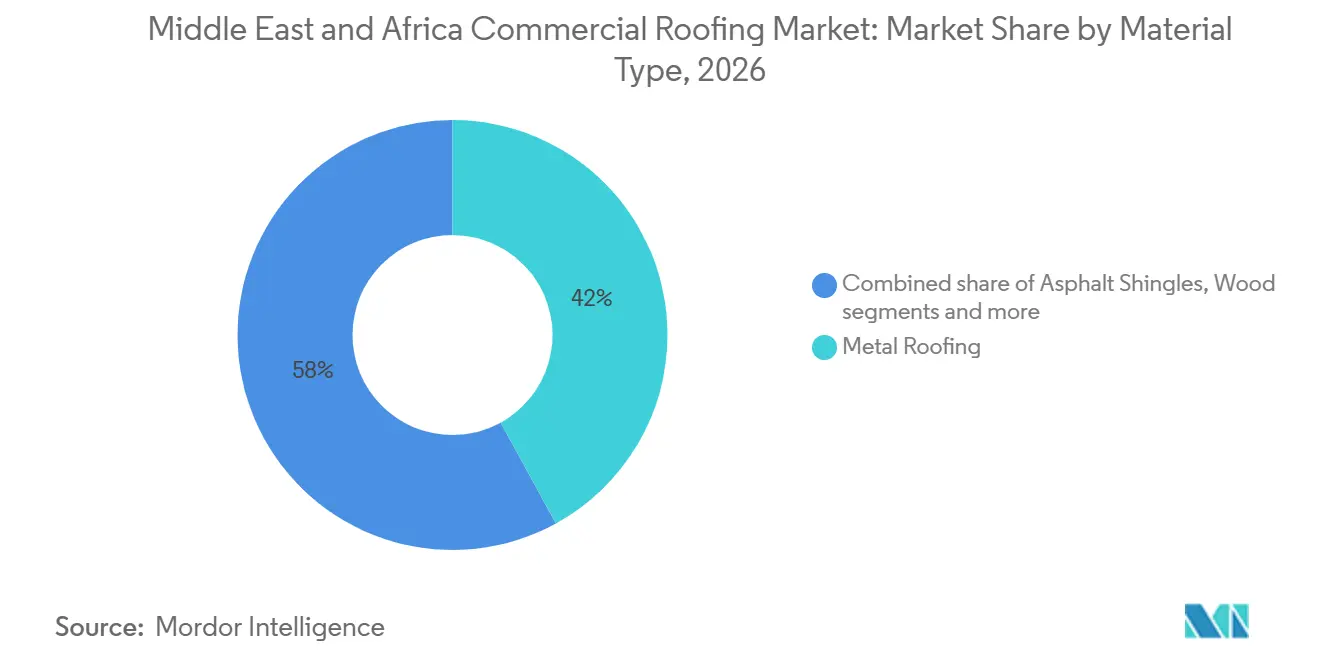
- By material type, metal roofing held 42.00% of the Middle East and Africa commercial roofing market share in 2026, while single-ply membranes are forecast to grow at a 7.50% CAGR through 2032.
- By construction type, new construction held 78.00% of the Middle East and Africa commercial roofing market share in 2026 and is forecast to grow at a 7.60% CAGR through 2032.
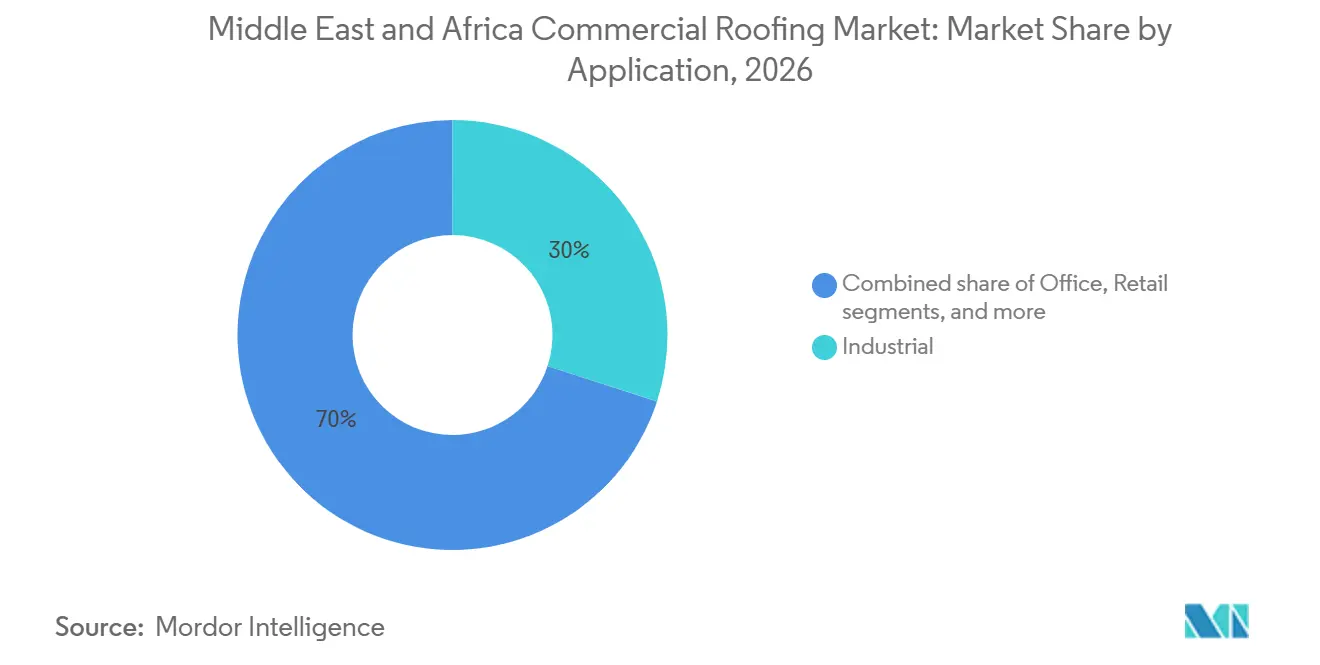
- By application, industrial accounted for 30.00% of the Middle East and Africa commercial roofing market size in 2026 and is forecast to grow at a 7.80% CAGR through 2032.
- By geography, Saudi Arabia held 28.00% of the Middle East and Africa commercial roofing market share in 2026, while the United Arab Emirates is forecast to grow at an 8.00% CAGR through 2032.
Note: Market numbers in this report are based on Mordor Intelligence's proprietary estimation framework, which combines nine months of actuals with Q4 projections for base year 2026.
Market Trends and Insights
Drivers Impact Analysis of Middle East and Africa Commercial Roofing Market*
| Drivers | (~) % Impact on CAGR Forecast | Geographic Relevance | Impact Timeline |
|---|---|---|---|
| Airport, Free-Zone, and Logistics-Hub Construction | +2% | Saudi Arabia, UAE, Turkey, Egypt | Short term (≤ 2 years) |
| Reflective and Insulated Roof Demand in Hot Climates | +1.5% | Saudi Arabia, UAE, North Africa | Medium term (2-4 years) |
| Industrial Diversification and Special Economic Zones | +1.2% | Saudi Arabia, UAE, Egypt, South Africa | Medium term (2-4 years) |
| Green-Building Requirements in New Urban Districts | +1% | UAE, Saudi Arabia, Turkey | Long term (≥ 4 years) |
| Port, Warehouse, and Data-Center Development | +0.8% | Saudi Arabia, UAE, Egypt, Nigeria | Short term (≤ 2 years) |
| Lightweight Roof Systems for Rapid-Build Facilities | +0.6% | GCC countries and wider MEA | Short term (≤ 2 years) |
| Source: Mordor Intelligence | |||
Airport, Free-Zone, and Logistics-Hub Construction Supports Near-Term Demand
Airport, free-zone, and logistics-hub construction creates a steady project pipeline for the Middle East and Africa commercial roofing market. Saudi Arabia and the UAE continue to place logistics capacity at the center of their wider diversification programs. Large facilities require long-span, insulated, and waterproof roof systems that can be installed over broad warehouse and terminal footprints. This requirement favors suppliers that can provide engineering support, product documentation, and installer training alongside materials. The concentration of buildings within airport and port districts can also improve procurement visibility because several facilities are planned within the same development area. These project clusters create repeat demand for roof systems through construction, fit-out, and later maintenance work.
Reflective and Insulated Roof Demand Changes Material Requirements
High temperatures are increasing demand for roofing systems that combine insulation, waterproofing, and reflective surfaces. The Middle East and Africa commercial roofing market is affected by rules that connect roof performance with building energy outcomes. Saudi and UAE requirements encourage material choices that reduce solar heat gain and support building efficiency objectives. Ras Al Khaimah issued Barjeel 13 Green Building Regulations in July 2025, extending green-building requirements into relevant local jurisdictions[1]. Developers are therefore more likely to select complete roof assemblies instead of applying a surface coating alone. This preference raises the importance of system compatibility among membranes, insulation, vapor control layers, and roof finishes.
Industrial Diversification and Special Economic Zones Expand New Construction
Industrial diversification is supporting factory, assembly, storage, and processing projects across several Middle East and African countries. The Middle East and Africa commercial roofing market gains from projects that require durable roof systems for manufacturing and logistics facilities. Special economic zones can draw international occupiers that seek uniform construction standards across their regional operations. These occupiers often need insulated panels or membranes that meet documented thermal, fire, and waterproofing requirements. New industrial projects also encourage local contractors to develop capabilities in larger roof assemblies and more specialized installation methods. The resulting contractor base can support future replacement work after the initial phase of development has ended.
Green-Building Requirements Shape Long-Term Specifications
Green-building requirements are moving commercial roof specifications toward measurable thermal and reflectance performance. The Middle East and Africa commercial roofing market is exposed to this change because roof assemblies have a direct role in cooling demand and building-envelope performance. Abu Dhabi City Municipality reported in January 2025 that 304 projects in design and 81 projects in construction had met Estidama Pearl Rating standards, showing that green-building compliance is embedded in project delivery[2]. Regulatory change is most meaningful when it is reflected in planning approval, procurement documents, and project warranties. Suppliers with local technical teams can help developers interpret these requirements and specify suitable systems. This role can improve supplier access to early-stage design decisions, rather than limiting them to price-based material supply. Over time, common performance requirements may also encourage investment in regional manufacturing and certification capacity.
Restraints Impact Analysis of Middle East and Africa Commercial Roofing Market*
| Restraints | (~) % Impact on CAGR Forecast | Geographic Relevance | Impact Timeline |
|---|---|---|---|
| Extreme Heat and Material-Storage Constraints | -0.8% | Saudi Arabia, UAE, North Africa | Short term (≤ 2 years) |
| Limited Local Production of Specialty Membranes | -0.6% | GCC countries and sub-Saharan Africa | Medium term (2-4 years) |
| Water Scarcity Limiting Green-Roof Applications | -0.5% | Arabian Peninsula and North Africa | Long term (≥ 4 years) |
| Developer Concentration and Tendering Volatility | -0.4% | Saudi Arabia, UAE, Egypt | Medium term (2-4 years) |
| Shortage of Certified Applicators Outside Principal Cities | -0.3% | Africa and secondary GCC cities | Medium term (2-4 years) |
| Source: Mordor Intelligence | |||
Extreme Heat, Water Limits, and Installation Constraints Reduce Productivity
Extreme summer temperatures reduce the workable installation period for several roofing materials and application methods. In the Middle East and Africa commercial roofing market, high temperatures can affect adhesive curing, material storage, and the timing of hot-work activities. Contractors need stronger site planning and protected storage to keep heat-sensitive materials within product requirements. Water scarcity also limits the practical use of green-roof systems in the Arabian Peninsula and North Africa, even where these systems could support broader building objectives. These conditions favor contractors with established heat-management procedures, reliable logistics, and experience with local site rules. They can also slow the adoption of newer systems that have narrow application temperature ranges.
Supply Dependence, Tender Volatility, and Installer Gaps Constrain Delivery
Limited local production of specialty membranes leaves many projects dependent on imported thermoplastic polyolefin, ethylene propylene diene monomer, and polyvinyl chloride systems. This exposure can add freight, currency, and lead-time risk to the Middle East and Africa commercial roofing market. Tendering volatility can compound this risk where project timing and contractor appointments change after materials have been specified. A shortage of certified applicators outside principal cities can further limit the use of premium systems in developing locations. Pleko's 2025 collaboration with Protan shows how local distribution and technical support can partly address access to specialty systems[3]. Broader local manufacturing and installer training would reduce these constraints, although both require sustained project volumes.
*Our forecasts treat driver/restraint impacts as directional, not additive. The impact forecasts reflect baseline growth, mix effects, and variable interactions.
Middle East and Africa Commercial Roofing Market Segment Analysis
By Material Type:
Metal Roofing Leads Industrial Demand While Single-Ply Membranes AdvanceMetal roofing held 42.00% of the Middle East and Africa commercial roofing market size in 2026. Its position reflects demand from warehouses, airport structures, factories, and special economic zone facilities that need wide roof spans and quick installation. Standing-seam systems and insulated sandwich panels are suited to these building types because they combine weather protection with thermal performance. Their established contractor base also supports consistent use across major new-build projects. In Turkey, industrial roof construction continues to provide a material base that aligns with demand from Gulf logistics and manufacturing projects. The similarity in building needs across these areas supports continued use of metal systems in regional commercial work.
Single-ply membranes are forecast to grow at a 7.50% CAGR through 2032, making them the fastest-growing material group. Thermoplastic polyolefin, ethylene propylene diene monomer, and polyvinyl chloride membranes are relevant for flat roofs that require reflectance and waterproofing performance. Their compatibility with rooftop solar photovoltaic mounting systems also supports their use on new logistics and commercial facilities. Bituminous and modified bitumen membranes remain relevant in conventional flat-roof projects, especially where installer familiarity and local supply are important. Asphalt shingles, clay and concrete tiles, and wood remain more limited choices for heritage areas, villa projects, and pitched-roof applications. Spray polyurethane foam and liquid-applied coatings also retain a role where reroofing access or building operations make full replacement difficult.

By Construction Type:
New Construction Dominates While Replacement Work Raises ValueNew construction held 78.00% of the Middle East and Africa commercial roofing market size in 2026 and is forecast to grow at a 7.60% CAGR through 2032. This position reflects the continuing build-out of infrastructure, industrial districts, airports, and warehouses across the GCC, Turkey, and parts of Africa. New projects allow developers to integrate insulation, membranes, solar-ready detailing, and drainage into the original design. They also give system suppliers an opportunity to influence specifications before contractor tendering begins. This early involvement can increase the value of technical support and warranty offers. It can also reduce the emphasis on standalone material pricing when projects involve more complex building-envelope requirements.
Reroofing and replacement account for a smaller share of volume, but they can carry greater material value per square meter. Older commercial buildings often need full upgrades when existing bitumen sheets or early metal systems reach the end of their service life. Replacement projects may require insulation, vapor control, reflectance, and waterproofing to be addressed together to meet current building expectations. In South Africa, mature logistics and retail properties provide a base for replacement demand as owners look for lower cooling costs and improved durability. Turkey's reconstruction and retrofit activity also supports roof-system work where building performance and certification are part of wider upgrading programs. These conditions give the Middle East and Africa commercial roofing industry a recurring source of demand alongside the larger new-construction base.
By Application:
Industrial Sets the Pace for GrowthIndustrial accounted for 30.00% of the Middle East and Africa commercial roofing market size in 2026. This application group is forecast to grow at a 7.80% CAGR through 2032, which is the highest growth rate among the applications listed in the supplied research. Warehouses need large, continuous roof surfaces that protect inventory, manage heat, and support efficient internal operations. The growth of port-side storage, airport logistics zones, and free-zone facilities therefore creates a direct need for insulated and waterproofed roof assemblies. Rooftop solar planning can add another design consideration because roof surfaces need suitable load paths and system compatibility. These requirements support demand for products that are designed as integrated assemblies rather than as individual layers.
Retail properties continue to use membranes and liquid-applied systems on flat decks, particularly where owners are managing cooling requirements and scheduled maintenance. Office construction in Riyadh and Abu Dhabi can create demand for systems that support green-building objectives and formal project documentation. Healthcare, hospitality, and education assets form the remaining application group and have their own performance needs related to continuity of operations and building comfort. These facilities can require careful installation scheduling because roofs must be upgraded with limited disruption to occupants. Premium systems can be attractive where longer warranties and lower maintenance needs are important to property owners. The Middle East and Africa commercial roofing market can therefore serve varied applications, even though logistics facilities remain the main growth area.
Geography Analysis
Saudi Arabia held 28.00% of the Middle East and Africa commercial roofing market share in 2026. Its leading position reflects large-scale construction linked to industrial diversification, logistics facilities, and national infrastructure plans. Warehouse, airport, and industrial-city projects favor insulated metal panels and engineered membrane systems. National thermal requirements and green-building objectives also increase the importance of roof performance in commercial project design. Sika acquired Gulf Seal, a Riyadh-based producer of bituminous waterproofing membranes, in November 2025. The acquisition shows that international suppliers see local manufacturing and established distribution as important in Saudi Arabia.
The UAE is forecast to grow at an 8.00% CAGR through 2032, the fastest rate among the geographies in the supplied research. Dubai's airport and logistics development, together with the Jebel Ali Port hinterland, supports demand for broad commercial roof systems. Abu Dhabi's planning process also embeds green-building expectations in relevant projects. Abu Dhabi City Municipality reported in January 2025 that 304 projects in design and 81 projects in construction had met Estidama Pearl Rating standards. This setting favors suppliers that can demonstrate thermal performance, installation quality, and warranty support.
Turkey has an important role as both a commercial roofing demand center and a potential supply base for the wider region. Metal roofing is widely used in the country's industrial construction, which aligns with demand patterns in GCC logistics and manufacturing projects. South Africa has a more mature commercial building base and offers replacement opportunities in logistics and retail properties. Egypt's development programs and Nigeria's logistics facilities add demand, but installer capacity can limit premium membrane adoption in some locations. Qatar, Oman, Kuwait, and Bahrain provide additional volume from maintenance programs and selective large projects. The Middle East and Africa commercial roofing market remains regionally diverse, so suppliers need different product, distribution, and technical-support approaches by country.
Competitive Landscape
The Middle East and Africa commercial roofing market has a mixed competitive structure, with global system suppliers competing alongside regional manufacturers and local fabricators. Competition is based on system design, regional service, installer networks, certified warranties, and material availability, as well as price. Sika, Kingspan, Saint-Gobain, Soprema, and Carlisle are among the global companies relevant to specification-led projects in the supplied research. Large commercial tenders tend to favor companies that can support design teams and document product performance. Local fabricators remain important because they understand tendering procedures and contractor relationships. This creates room for both international brands and regional participants.
Sika strengthened its Saudi Arabian footprint through the November 2025 acquisition of Gulf Seal. In March 2026, Sika closed the acquisition of Akkim, expanding its adhesives and sealants reach across Turkey and related regional markets. These moves support a wider strategy of building local product and distribution capability near major growth areas. Pleko also entered a strategic collaboration with Protan in July 2025 to distribute PVC and TPO roofing and waterproofing systems in the Middle East. This arrangement combines locally available support with European single-ply membrane technology. Such partnerships can improve access to specialty products where local manufacturing remains limited.
Technology and service quality are becoming clearer ways to differentiate in the Middle East and Africa commercial roofing market. Suppliers that offer solar-compatible surfaces, digital warranty records, and building information modeling documentation can be more relevant on complex projects. Firms with technical teams in secondary GCC cities and African markets may find opportunities where direct coverage by global brands is less extensive. Regional production can also help suppliers respond to lead-time and freight concerns that affect imported membranes. However, premium products still depend on certified installation and consistent project supervision. The strongest competitive positions are therefore likely to combine proven materials with local execution capability.
Middle East and Africa Commercial Roofing Industry Leaders
-
Holcim
-
Saint-Gobain
-
Sika AG
-
Kingspan Group plc
-
Soprema Group
- *Disclaimer: Major Players sorted in no particular order
Middle East and Africa Commercial Roofing Market Companies Covered in this Report
- Holcim
- Saint-Gobain
- Sika AG
- Kingspan Group plc
- Soprema Group
- Etex Group
- BlueScope Steel
- TechnoNICOL Corporation
- Carlisle Companies Incorporated
- GAF Materials Corporation
- Owens Corning
- Johns Manville
- IKO Industries Ltd.
- BMI Group
- RENOLIT SE
- Atlas Roofing Corporation
- Duro-Last Inc.
- Versico Roofing Systems
- Tremco Construction Products Group
- Firestone Building Products (Elevate)
Recent Industry Developments in Middle East and Africa Commercial Roofing Market
- July 2026: Mawani, the Saudi Ports Authority, signed 7 logistics-center agreements worth USD 267 million at Jeddah Islamic Port and the Al Khumrah zone. JD Logistics committed USD 187 million for a 93,000-square-meter port-side facility with refrigerated and dry warehouses, creating near-term demand for large-span insulated commercial roofing.
- June 2026: Dubai Aviation Engineering Projects advanced the USD 18.5 billion Al Maktoum International Airport for 2032 operations. Facade and roofing packages covering 1.5 million square meters were among the contracts being prepared for award.
- March 2026: Sika AG closed its acquisition of Akkim, a Turkey-based adhesives and sealants manufacturer, strengthening its distribution reach across Eastern Europe, Central Asia, the Middle East, and North Africa and expanding its MEA commercial roofing-adjacent product portfolio.
Middle East and Africa Commercial Roofing Market Report Scope
Segmentation Overview
| Asphalt Shingles |
| Clay & Concrete Tiles |
| Metal Roofing |
| Bituminous / Modified Bitumen Membranes |
| Single-Ply Membranes (TPO, EPDM, and PVC) |
| Wood |
| Others |
| New Construction |
| Reroofing and Replacement |
| Retail |
| Office |
| Industrial |
| Others |
| Saudi Arabia |
| United Arab Emirates |
| Turkey |
| South Africa |
| Nigeria |
| Egypt |
| Rest of Middle East |
| By Material Type | Asphalt Shingles |
| Clay & Concrete Tiles | |
| Metal Roofing | |
| Bituminous / Modified Bitumen Membranes | |
| Single-Ply Membranes (TPO, EPDM, and PVC) | |
| Wood | |
| Others | |
| By Construction Type | New Construction |
| Reroofing and Replacement | |
| By Application | Retail |
| Office | |
| Industrial | |
| Others | |
| By Countries | Saudi Arabia |
| United Arab Emirates | |
| Turkey | |
| South Africa | |
| Nigeria | |
| Egypt | |
| Rest of Middle East |
Key Questions Answered in the Report
What is the value of commercial roofing demand in the Middle East and Africa?
It is valued at USD 3.04 billion in 2026, USD 3.25 billion in 2027, and is projected to reach USD 4.56 billion by 2032 at a 7.00% CAGR. Public infrastructure, logistics facilities, energy-performance rules, and replacement projects support this outlook.
Which material has the largest share in Middle East and Africa commercial roofing?
Metal roofing leads with a 42.00% share in 2026, supported by warehouse, airport, and industrial construction. Long spans, quick installation, and thermal performance make it appropriate for many large commercial structures.
Which roof material is growing fastest across the region?
Single-ply membranes are forecast to grow at a 7.50% CAGR through 2032 because they support reflective roofs and rooftop solar photovoltaic systems. The category includes thermoplastic polyolefin, ethylene propylene diene monomer, and polyvinyl chloride systems.
Why are logistics facilities important for commercial roof suppliers?
Industrial and logistics facilities held 30.00% of revenue in 2026 and are forecast to grow at a 7.80% CAGR through 2032. These buildings require broad, continuous roof surfaces with insulation, waterproofing, drainage, and solar-ready features.
Which country leads demand for commercial roofing in the region?
Saudi Arabia leads with a 28.00% share in 2026, supported by industrial, logistics, and infrastructure development. Its project base also increases demand for regional manufacturing, technical support, and established installation capacity.
Which geography is expected to grow fastest through 2032?
The United Arab Emirates is forecast to grow at an 8.00% CAGR, supported by airport, logistics, and green-building activity. Suppliers that can demonstrate thermal performance and reliable warranty support are well positioned for specification-driven projects.