
Middle East and Africa Cargo Insurance Market Size and Share
Market Overview
| Study Period | 2021 - 2032 |
|---|---|
| Forecast Data Period | 2027 - 2032 |
| Base Year Market Size (2026) | USD 1.38 Billion |
| Market Size (2027) | USD 1.5 Billion |
| Market Size (2032) | USD 1.9 Billion |
| Growth Rate (2027 - 2032) | 4.80 % |
| Market Concentration | Low |
Major Players *Disclaimer: Major Players sorted in no particular order Image © Mordor Intelligence. Reuse requires attribution under CC BY 4.0. | |
Middle East and Africa Cargo Insurance Market Analysis by Mordor Intelligence
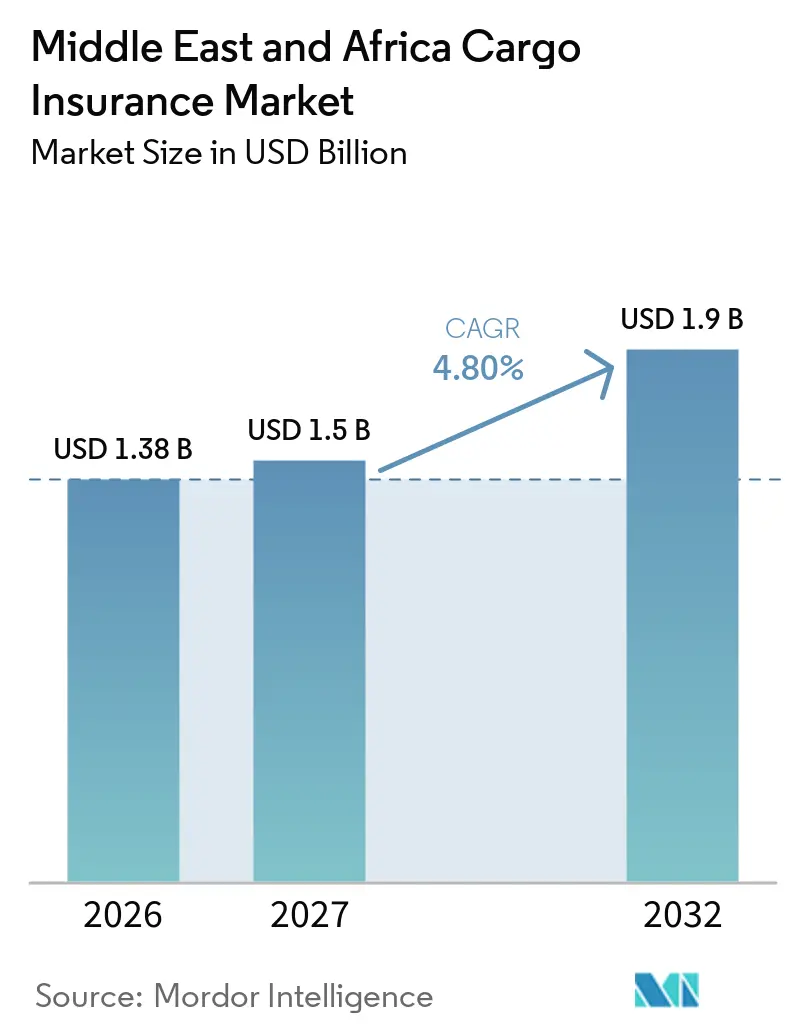
The Middle East And Africa Cargo Insurance Market size is expected to increase from USD 1.38 billion in 2026 to USD 1.5 billion in 2027 and reach USD 1.9 billion by 2032, growing at a CAGR of 4.80% over 2027-2032.
Growth reflects a broader move toward formal insurance cover for freight that had previously been uninsured. Regulatory requirements in Kenya and local placement rules in Saudi Arabia are bringing more shipments into formal premium pools. IUMI reported global marine cargo premiums of USD 24.2 billion in 2025, a 6.9% increase, while the Middle East accounted for 3.53% of global marine premiums and the United Arab Emirates contributed 2.8% of global cargo premiums. Competitive strategies increasingly focus on specialist war-risk cover, digital access for smaller exporters, and product designs that cover sea, storage, and inland transit in one policy. The Middle East and Africa cargo insurance market also faces uneven risk conditions because geopolitical disruption raises demand for cover while increasing the cost of insurance for shippers.
Key Report Takeaways
- By mode of transport, sea cargo captured 67.6% of the Middle East and Africa cargo insurance market share in 2026, while air cargo is projected to grow at a 7.5% CAGR through 2032.
- By cargo profile, containerized cargo held a 40.2% share of the Middle East and Africa cargo insurance market size in 2026, while project, heavy-lift, and out-of-gauge cargo is forecast to grow at a 7.8% CAGR through 2032.
- By trade scope, cross-border import, export, and entrepôt insurance accounted for 80.3% of the Middle East and Africa cargo insurance market share in 2026, while domestic inland transit is projected to grow at a 6.8% CAGR through 2032.
- By distribution channel, brokers and agents captured 62.1% of the Middle East and Africa cargo insurance market share in 2026, while online and digital platforms are projected to grow at 11.7% CAGR through 2032.
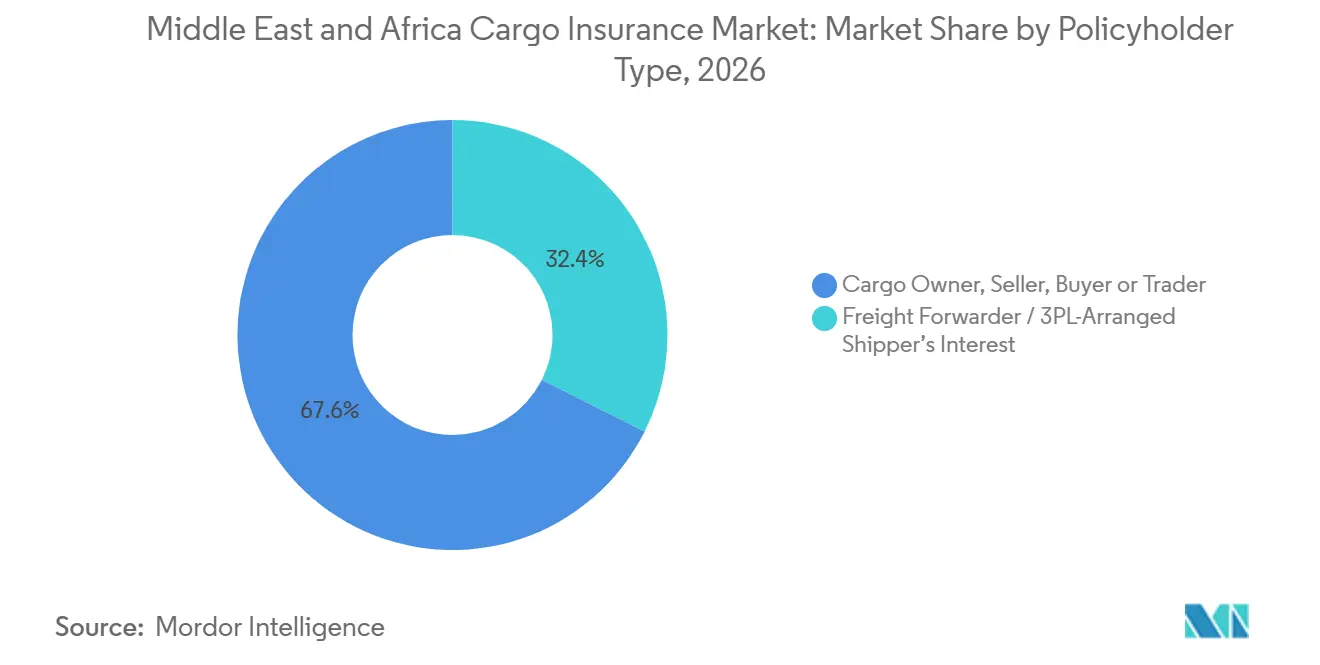
- By policyholder type, cargo owner, seller, buyer, or trader-arranged cover accounted for 67.6% of the Middle East and Africa cargo insurance market share in 2026, while freight forwarder and 3PL-arranged shipper’s interest is projected to grow at 7.5% CAGR through 2032.
- By end-user industry, energy and bulk commodities captured 25.8% of the Middle East and Africa cargo insurance market share in 2026, while electronics and high-value manufactured goods are projected to grow at 8.5% CAGR through 2032.
- By geography, the United Arab Emirates held 45.4% of the Middle East and Africa cargo insurance market share in 2026, while Saudi Arabia is projected to grow at a 7.5% CAGR through 2032.
Note: Market numbers in this report are based on Mordor Intelligence's proprietary estimation framework, which combines nine months of actuals with Q4 projections for base year 2026.
Market Trends and Insights
Drivers Impact Analysis of Middle East and Africa Cargo Insurance Market*
| Driver | (~) % Impact on CAGR Forecast | Geographic Relevance | Impact Timeline |
|---|---|---|---|
| International Trade, Re-Exports, and Logistics Hubs | +1.5% | Global, with outsized effect in the United Arab Emirates and Saudi Arabia | Medium term (2-4 years) |
| Infrastructure, Energy, Mining, and Industrial Project Cargo Investment | +1.0% | Saudi Arabia, United Arab Emirates, Nigeria, and South Africa | Long term (≥ 4 years) |
| Geopolitical Disruption, Maritime Rerouting, and War-Risk Demand | +0.7% | Middle East and Africa core, with spillover to global reinsurance markets | Short term (≤ 2 years) |
| E-Commerce, Cross-Border Shipments, and High-Value Cargo | +0.8% | United Arab Emirates, Saudi Arabia, and Nigeria | Medium term (2-4 years) |
| Local Marine Cargo Insurance and Trade-Finance Requirements | +0.6% | Kenya, with early gains in Mombasa, Nairobi, and Riyadh | Medium term (2-4 years) |
| Port, Free-Zone, Warehousing, and Supply-Chain Infrastructure | +0.5% | Saudi Arabia, United Arab Emirates, and the Rest of MEA | Long term (≥ 4 years) |
| Source: Mordor Intelligence | |||
Growth in International Trade, Re-Exports, and Regional Logistics Hubs
The expansion of regional trade and multimodal logistics infrastructure is supporting demand for cargo insurance across the Middle East and Africa. In May 2025, Jebel Ali Free Zone (Jafza) reported a record USD 190 billion in trade over the preceding 12 months, representing 15% year-on-year growth. Its integration with Jebel Ali Port and access to sea, air, and land transport routes reinforce Dubai's role as a redistribution hub for goods moving between Asia, Africa, Europe, and the Middle East. Saudi Arabia's ports handled approximately 8.32 million twenty-foot equivalent units (TEUs) in 2025, up 10.58% year-on-year, including 1.93 million transshipment TEUs[1]. These trade flows increase the potential exposure of insured goods to loss or damage during international transit, transshipment, port handling, and onward inland transportation.
Geopolitical Disruptions, Maritime Rerouting, and Demand for War-Risk Coverage
Geopolitical tensions affecting the Arabian Gulf, Red Sea, and surrounding shipping corridors are increasing the importance of specialist war-risk insurance in the MEA cargo insurance market. In June 2025, war-risk premiums for shipments to the Middle East Gulf reportedly increased to approximately 0.5% of insured vessel value from 0.2%–0.3% a week earlier, reflecting escalating Iran-Israel tensions and concerns about maritime security. In May 2026, DP World launched an end-to-end cargo war-risk insurance solution covering ocean or air transit, port storage, and inland delivery, with limits of up to USD 400 million per shipment and USD 1 million per inland movement[2]. Such solutions address potential gaps between separate transit policies and support demand for broader coverage as shippers and insurers reassess routes, accumulation exposures, exclusions, and policy terms.
Expansion of E-Commerce, Cross-Border Shipments, and High-Value Cargo
The growth of e-commerce and cross-border fulfilment is expanding the volume of goods moving through regional logistics networks and creating opportunities for cargo insurers. The United Arab Emirates' e-commerce market reached AED 42.2 billion (USD 11.5 billion) in 2025, increasing from AED 17.6 billion (USD 4.8 billion) in 2020 and recording a 19% average annual growth rate over the five-year period[3]. Separately, Dubai Customs processed approximately 18.2 million transactions through its air cargo centres in the first half of 2026, up nearly 53% from the same period in 2025, while shipment weight increased by approximately 47% to 1.3 million tonnes[4]. These indicators demonstrate growth in digital commerce and air-cargo processing. Greater movement of electronics, consumer goods, and other valuable merchandise creates potential demand for cover against theft, physical damage, handling losses, and transit disruption. Insurers can respond through shipment-specific limits, appropriate valuation clauses, and coverage tailored to warehouse-to-customer distribution chains.
Expansion of Infrastructure, Energy, Mining, and Industrial Project Cargo
Infrastructure development and logistics investment are creating cargo insurance opportunities associated with the transportation of construction materials, industrial machinery, power equipment, and other project cargo across the Middle East and Africa. Saudi Arabia's logistics development programme targets 59 logistics centres covering more than 100 million square metres by 2030, with facilities intended to support domestic distribution, exports, and e-commerce. The Kingdom also targets annual air-freight capacity of 4.5 million tonnes as part of its wider aviation and logistics ambitions. The movement of oversized machinery, energy infrastructure components, and industrial equipment can require specialist cover for loading, unloading, heavy-lift operations, inland transit, and temporary storage. These requirements create opportunities for insurers able to assess high-value consignments, route-specific hazards, handling procedures, and project schedules.
Restraints Impact Analysis of Middle East and Africa Cargo Insurance Market*
| Restraint | (~) % Impact on CAGR Forecast | Geographic Relevance | Impact Timeline |
|---|---|---|---|
| Elevated War-Risk Premiums and Volatile Maritime Trade Routes | -0.5% | Middle East and Africa core, with global reinsurance market spillover | Short term (≤ 2 years) |
| Cargo Theft, Fraud, and Limited Loss-Prevention Infrastructure | -0.3% | Nigeria, South Africa, and the Rest of Africa | Medium term (2-4 years) |
| Fragmented Insurance Regulation and Local-Admitted Placement Requirements | -0.4% | National, with specific challenges in Kenya, Nigeria, and Saudi Arabia | Medium term (2-4 years) |
| Low Insurance Penetration and Underinsurance Among Smaller Importers | -0.4% | Africa, including Nigeria, South Africa, and the Rest of MEA | Long term (≥ 4 years) |
| Source: Mordor Intelligence | |||
Elevated War-Risk Premiums and Volatile Maritime Trade Routes
Geopolitical tensions and maritime route disruptions are increasing insurance costs and complicating underwriting across the Middle East and Africa cargo insurance market. In March 2026, Howden Re reported that marine hull war-risk premiums for vessels transiting the Strait of Hormuz had risen from approximately 0.25% of insured vessel value before the conflict to as much as 3% for vessels linked to the United States, United Kingdom, or Israel. Insurers may also revise coverage terms or issue cancellation notices as security conditions deteriorate. In August 2026, marine insurer Gard issued a war-risk cancellation notice affecting specified covers in the Indian Ocean, Gulf of Aden, and Red Sea following action by its reinsurers. Diversions around the Cape of Good Hope can extend transit times, increase freight costs, and prolong cargo exposure to loss or damage, potentially reducing insurance affordability for cost-sensitive traders.
Cargo Theft, Fraud, and Limited Loss-Prevention Infrastructure
Cargo theft, fraudulent collection arrangements, and security weaknesses along inland transport corridors create underwriting and claims-management challenges in parts of Africa. A cargo theft report published in April 2026 by TT Club and BSI Consulting identified South Africa among the countries experiencing high levels of cargo theft in 2025, with incidents involving truck hijacking, deception, and organized criminal activity. In Nigeria, a May 2026 enforcement operation by the Presidential Enabling Business Environment Council targeted illegal checkpoints and extortion along the Apapa port corridor, highlighting operational challenges affecting cargo movement around Lagos. These risks can increase demand for theft-specific coverage, stronger carrier due diligence, shipment tracking, secure parking, and effective claims investigation. Limited shipment visibility and inconsistent risk controls can make loss frequency and severity more difficult to assess, influencing premiums, deductibles, policy conditions, and available underwriting capacity.
*Our forecasts treat driver/restraint impacts as directional, not additive. The impact forecasts reflect baseline growth, mix effects, and variable interactions.
Middle East and Africa Cargo Insurance Market Segment Analysis
By Mode of Transport:
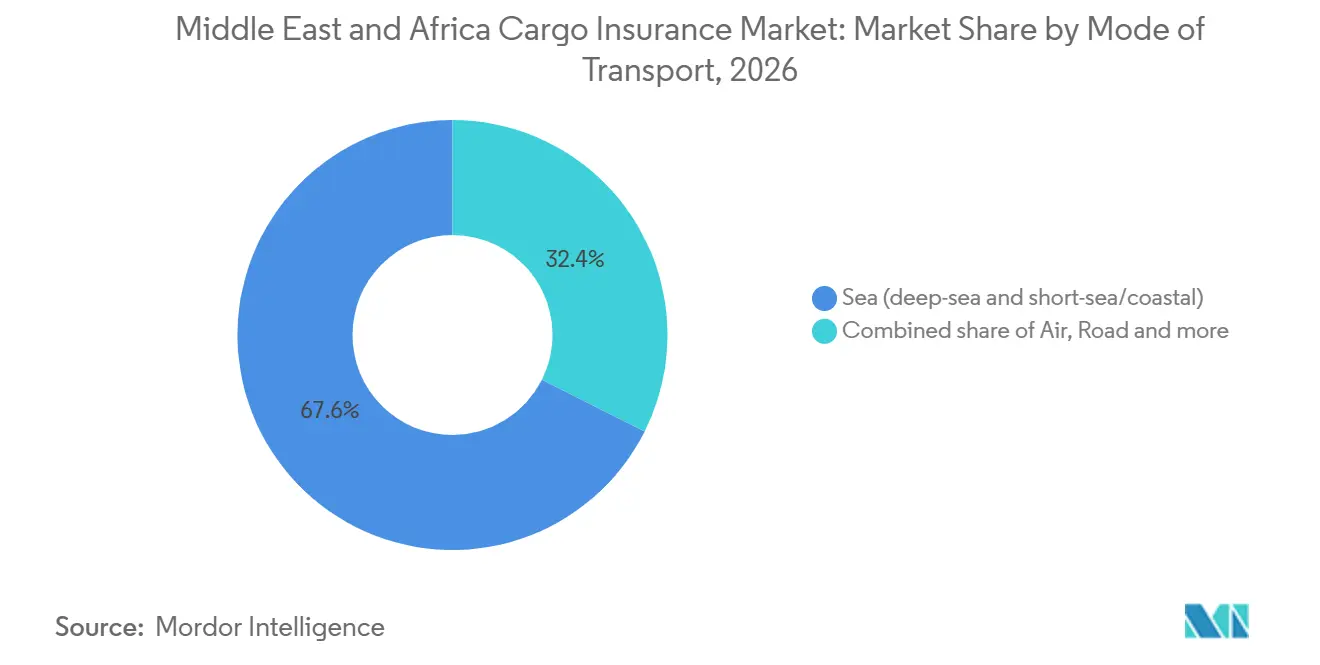
Sea Freight Retains Primacy as Air Channels AccelerateSea cargo captured 67.6% of the Middle East and Africa cargo insurance market share in 2026. Major maritime gateways such as Jebel Ali, Jeddah Islamic Port, and the Port of Salalah support containerized, bulk, and transshipment trade across regional and international shipping routes. Ocean shipments can involve substantial insured values, extended transit periods, multiple handling points, and exposure to maritime hazards. War-risk pricing and additional coverage requirements can also influence marine insurance costs during periods of geopolitical disruption.
Air cargo is projected to grow at a 7.5% CAGR through 2032. Dubai Customs processed approximately 18.2 million air-cargo customs transactions in the first half of 2026, while shipment weight reached 1.3 million tonnes, an increase of approximately 47% year-on-year. Road transport supports regional distribution and cross-border movements, while Saudi Arabia is developing its railway network to exceed 8,000 km. Multimodal shipments require insurers to assess the risks associated with each transport leg, including transfers between vessels, aircraft, trucks, and rail services.
By Cargo Profile:
Containerized Cargo Leads While Project Cargo Commands Premium RatesContainerized cargo held 40.2% of the Middle East and Africa cargo insurance market in 2026. Containerized shipments support regional imports, exports, and re-exports of manufactured goods, consumer products, machinery, and other commercial merchandise. Insurance requirements depend on cargo value, packaging, transit conditions, exclusions, and policy wording. Under the International Chamber of Commerce's Incoterms rules, insurance obligations vary by trade term. Under CIF, the seller generally arranges minimum insurance under Institute Cargo Clauses (C), whereas CIP requires broader minimum cover under Institute Cargo Clauses (A), subject to the applicable rules and agreement.
Project, heavy-lift, and out-of-gauge cargo is projected to grow at 7.8% CAGR through 2032. Saudi Arabia's infrastructure and industrial development programmes create potential demand for specialist coverage involving machinery, power equipment, heavy lifting, route surveys, and temporary storage. Dry and liquid bulk cargo remain important because of the region's commodity trade, while vehicle imports and exports support demand for automotive cargo insurance. DP World reported that its Dubai terminals handled approximately 1.5 million vehicles in 2025, an increase of more than 18% year-on-year.
By Trade Scope:
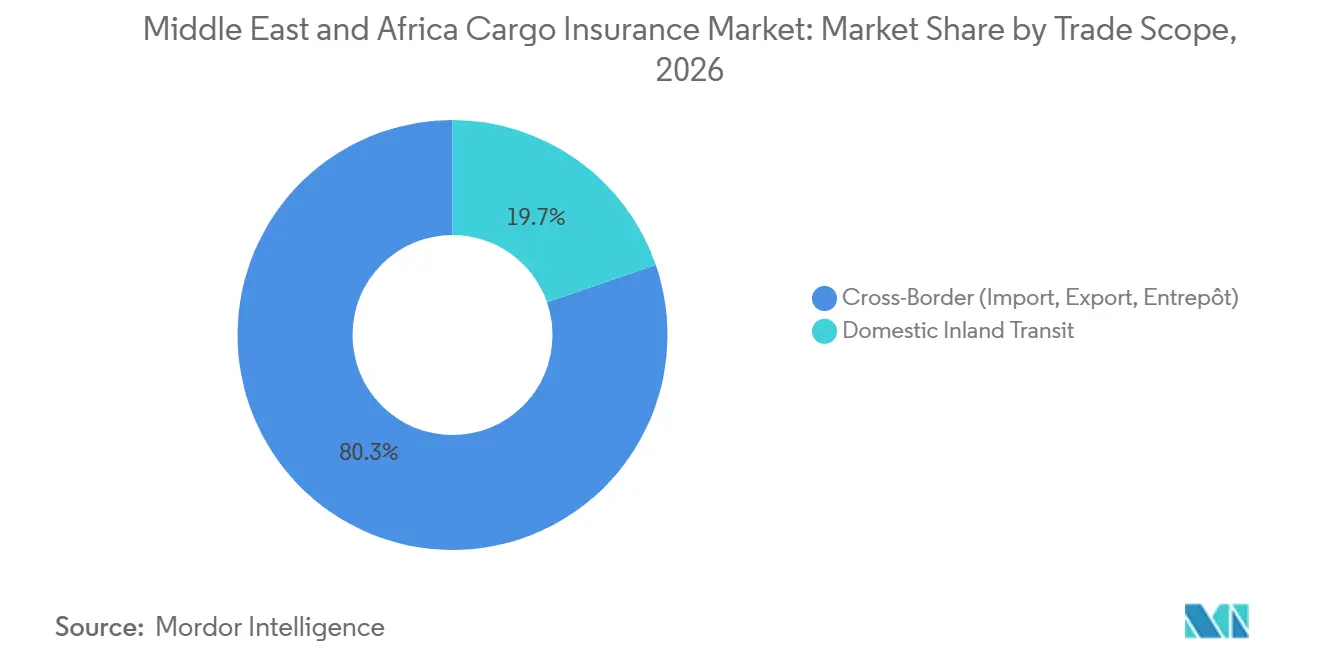
Cross-Border Flows Dominate While Domestic Transit FormalizesCross-border import, export, and entrepôt cover accounted for an 80.3% share in 2026. International trade and re-export activity generate cargo exposures across multiple jurisdictions, ports, and transport modes. Goods moving through the United Arab Emirates may transfer between maritime, air, and road networks before reaching their final markets, creating different insurance requirements along the supply chain. Coverage can be arranged through a single policy or separate policies, depending on the insured's program and policy wording.
Domestic inland transit is projected to grow at a 6.8% CAGR through 2032. Kenya's digital marine cargo insurance procedure connects insurance acquisition for imported consignments with customs-related processes, supporting digital administration of marine cargo cover. Saudi Arabia's logistics development and regional distribution infrastructure also create potential demand for inland transit protection. Wider regional trade integration may increase the need for insurance across warehouse-to-warehouse and port-to-inland movements.
By Distribution Channel:
Broker Primacy Holds While Digital Platforms Reshape AccessBrokers and agents captured a 62.1% share in 2026. Brokers support cargo insurance placements involving multinational supply chains, complex project shipments, war-risk endorsements, and specialist coverage requirements. They help clients compare policy terms, assess exclusions, coordinate local insurance arrangements, and access international underwriting capacity where appropriate. These services remain important for complex commercial risks that require individual underwriting and negotiation.
Online and digital platforms are projected to grow at 11.7% CAGR through 2032. Application programming interface-connected systems can streamline quotations, policy issuance, certificate management, and renewals for standard shipments. Kenya's digital marine cargo insurance process illustrates how online systems can connect insurance issuance with customs-related procedures. Digital distribution can improve access for smaller importers and exporters by reducing administrative burdens.
By Policyholder Type:
Cargo Owners Lead While 3PL-Arranged Coverage Gains MomentumCargo owner, seller, buyer, or trader-arranged cover accounted for a 67.6% share in 2026. Cargo owners, sellers, buyers, and traders arrange insurance according to their contractual responsibilities, ownership interests, financing requirements, and exposure to transit losses. Under CIF, the seller generally arranges minimum cargo insurance, while under other trade terms the buyer may need to arrange cover independently. Banks may also require evidence of insurance where specified by financing agreements or documentary credit conditions.
Freight forwarder and 3PL-arranged shipper's interest is projected to grow at 7.5% CAGR through 2032. Logistics providers can facilitate cargo insurance through integrated freight management and shipment services, although the insured party and beneficiary depend on the policy structure. In Saudi Arabia, Tawuniya and TT Club established a partnership supporting a specialist liability insurance product for transport and logistics operators.
By End-User Industry:
Energy Anchors the Market While Electronics Accelerates FastestEnergy and bulk commodities captured a 25.8% share in 2026. The region's oil, gas, petrochemical, and commodity trade generates demand for insurance covering goods moving between production facilities, storage terminals, ports, and international buyers. These shipments can involve substantial insured values and exposure to handling damage, fire, leakage, contamination, and transit disruption. War-risk conditions can further influence the availability and cost of cover for cargo moving through exposed maritime corridors.
Electronics and high-value manufactured goods are projected to grow at an 8.5% CAGR through 2032. Consumer electronics, semiconductors, and other valuable manufactured products moving through Dubai's logistics hubs create potential demand for coverage against theft, physical damage, and handling losses. Food and agricultural products may require temperature-sensitive transit protection, while chemicals and pharmaceuticals can require specialized handling provisions and product-specific policy terms. Automotive goods, retail merchandise, machinery, and construction materials also contribute to cargo insurance demand across the region.
Geography Analysis
The United Arab Emirates held a 45.4% share in 2026. Its position reflects multimodal trade activity, re-exports, and the concentration of regional insurance and financial services, including the Dubai International Financial Centre. The United Arab Emirates e-commerce sector reached AED 42.2 billion (USD 11.5 billion) in 2025, according to Forbes Middle East. However, Jebel Ali's container throughput fell to approximately 3.145 million TEUs in the first half of 2026, down 59.5% year-on-year, reflecting significant disruption to operations. In July 2026, DP World announced plans to develop two terminals in Fujairah under a 50-year concession. The Al Rugaylat container and multi-purpose terminal is designed to handle up to 2.5 million TEUs annually, while the Dibba terminal will add general-cargo capacity.
Saudi Arabia is projected to grow at a 7.5% CAGR through 2032. The Kingdom's logistics development program and port investments are expanding the movement of construction materials, industrial equipment, energy-related cargo, and consumer goods. Saudi Arabia's logistics strategy targets USD 57 billion in logistics-sector revenue by 2030, while port and logistics infrastructure development supports demand for marine and inland transit insurance. Local reinsurance requirements also influence how cargo insurers allocate risk and purchase reinsurance capacity.
South Africa, Nigeria, and the Rest of MEA form a smaller but strategically important base for the Middle East and Africa cargo insurance market. South African cargo owners face exposure to port congestion, inland transit disruption, and cargo theft, creating potential demand for integrated transit and stock-throughput protection. In Nigeria, the government and the United Nations Development Programme launched an intra-African air-cargo corridor with Uganda Airlines in May 2025, connecting Nigerian exporters with markets including Uganda, Kenya, and South Africa. The initiative reduced freight rates by as much as 50% in some instances, with further reductions of up to 50%–75% reported for eligible consolidated shipments. African airlines recorded 10.1% year-on-year air-cargo demand growth in December 2025 and 6.0% growth for the full year, according to the International Air Transport Association. Oman, Qatar, Bahrain, Kuwait, and East African economies also contribute through maritime trade, regional distribution, and investment in logistics infrastructure.
Competitive Landscape
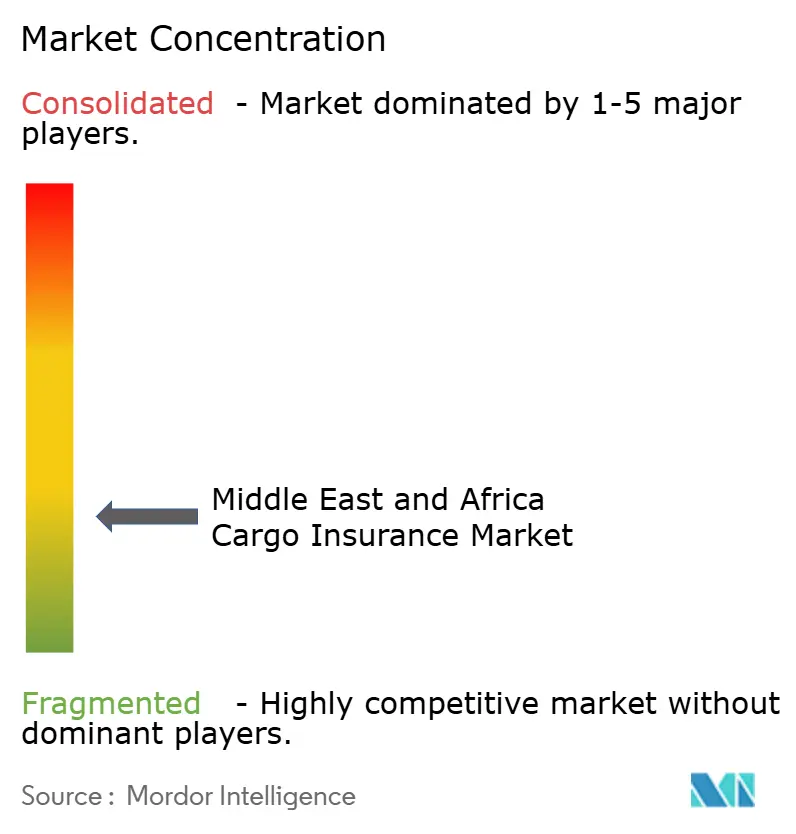
The Middle East and Africa cargo insurance market is fragmented, with international insurers, regional carriers, local insurance companies, and specialist underwriters competing across marine cargo and related transit risks. Allianz Commercial, AIG, AXA XL, Chubb, and Zurich compete for multinational accounts and complex commercial risks through international underwriting networks and regional insurance hubs. GIG Gulf, Orient Insurance, Abu Dhabi National Insurance Company, and Qatar Insurance Company serve regional clients through their respective marine and commercial insurance offerings. Market participants differentiate themselves through underwriting expertise, geographic reach, broker relationships, claims management, and access to reinsurance capacity.
Competition increasingly centres on specialised policy design, digital distribution, and the ability to manage changing maritime risks. In May 2026, DP World introduced an end-to-end cargo war-risk insurance solution covering ocean or air transit, port storage, and inland delivery under a single policy. In Saudi Arabia, TT Club and Tawuniya developed a specialist transport and logistics liability insurance solution to address the needs of logistics operators. These developments illustrate how providers are expanding specialised offerings rather than competing solely on premium rates.
The Middle East and Africa cargo insurance market also presents opportunities in digital per-consignment policies, coverage for small and medium-sized exporters, and specialised protection for temperature-sensitive goods and transit disruptions. Digital platforms can simplify policy issuance and certificate management, while specialist insurers can develop tailored coverage for cargo theft, high-value shipments, and geopolitical exposure. Established carriers retain advantages in underwriting experience, broker networks, claims capabilities, and reinsurance access, but regional and specialist providers continue to compete for individual accounts and underserved risks. Differences in regulation, transport infrastructure, security conditions, and cargo composition across the Middle East and Africa limit the ability of a small number of insurers to dominate every market segment. Overall, competition remains fragmented, with differentiation driven by local market access, technical expertise, product flexibility, and the ability to manage route-specific risks.
Middle East and Africa Cargo Insurance Industry Leaders
-
American International Group, Inc.
-
Allianz SE
-
Chubb Limited
-
AXA XL
-
Zurich Insurance Group Ltd
- *Disclaimer: Major Players sorted in no particular order
Middle East and Africa Cargo Insurance Market Companies Covered in this Report
- American International Group, Inc. (AIG)
- Allianz Commercial
- AXA XL
- Chubb Limited
- Zurich Insurance Group
- Tokio Marine HCC
- Assicurazioni Generali S.p.A.
- HDI Global SE
- QBE Insurance Group Limited
- Liberty Specialty Markets
- Starr Insurance Companies
- Berkshire Hathaway Specialty Insurance
- Sompo International
- GIG Gulf
- Sukoon Insurance
- Abu Dhabi National Insurance Company PJSC (ADNIC)
- Orient Insurance PJSC
- Qatar Insurance Company Q.P.S.C. (QIC)
- Santam Limited
Recent Industry Developments in Middle East and Africa Cargo Insurance Market
- July 2026: The Saudi Ports Authority (Mawani) signed seven agreements with national and international companies to establish and expand logistics centres at Jeddah Islamic Port and Al Khomrah, with investments approaching USD 267 million. According to GCC Business News, the agreements brought the cumulative number of logistics centres developed by Mawani to 34, with total investments exceeding USD 3.73 billion. The expansion is intended to strengthen warehousing, cargo consolidation, re-export, and port-linked logistics capacity.
- May 2026: DP World launched an end-to-end cargo war-risk insurance solution for Middle East trade routes, providing continuous coverage across ocean or air transit, port storage, and inland delivery. The solution offers limits of up to USD 400 million per shipment and USD 1 million per inland movement, with zero deductibles on valid claims. It is designed to address gaps in conventional policies that may cover only individual transit legs.
- March 2026: Chubb outlined the structure of the USD 20 billion Gulf Maritime Insurance Facility established in partnership with the United States International Development Finance Corporation (DFC). Chubb was named lead underwriter for the facility, which provides war-risk insurance covering vessel hulls, protection and indemnity liabilities, and cargo for eligible vessels transiting the Strait of Hormuz. DFC announced Chubb's lead-underwriter role on 11 March 2026.
- October 2025: DP World reported that Jebel Ali Port handled a record 630,000 tonnes of breakbulk cargo during October 2025, its highest monthly volume in nearly two decades. Higher imports of iron and steel for projects including the Dubai Metro Blue Line and Dubai World Central Airport expansion, alongside rising sugar exports, contributed to the record.
Middle East and Africa Cargo Insurance Market Report Scope
Segmentation Overview
| Sea (Deep-Sea and Short-Sea / Coastal) |
| Inland Waterway |
| Road |
| Rail |
| Air |
| Containerized Cargo |
| Dry Bulk Cargo |
| Liquid Bulk Cargo |
| Break-Bulk and General Cargo |
| Project, Heavy-Lift and Out-of-Gauge |
| Rolling Cargo / Ro-Ro |
| Cross-Border (Import, Export, Entrepôt) |
| Domestic Inland Transit |
| Brokers and Agents |
| Direct Insurers |
| Online and Digital Platforms |
| Cargo Owner, Seller, Buyer or Trader |
| Freight Forwarder / 3PL-Arranged Shipper’s Interest |
| Food, Beverage, and Agri-Commodities |
| Energy and Bulk Commodities |
| Chemicals and Pharmaceuticals |
| Automotive and Industrial Equipment |
| Electronics and High-Value Manufactured Goods |
| Retail, Consumer Goods, and E-Commerce |
| Construction and Infrastructure Project Owners |
| Others |
| United Arab Emirates |
| Saudi Arabia |
| South Africa |
| Nigeria |
| Rest of Middle East and Africa |
| By Mode of Transport | Sea (Deep-Sea and Short-Sea / Coastal) |
| Inland Waterway | |
| Road | |
| Rail | |
| Air | |
| By Cargo Profile | Containerized Cargo |
| Dry Bulk Cargo | |
| Liquid Bulk Cargo | |
| Break-Bulk and General Cargo | |
| Project, Heavy-Lift and Out-of-Gauge | |
| Rolling Cargo / Ro-Ro | |
| By Trade Scope | Cross-Border (Import, Export, Entrepôt) |
| Domestic Inland Transit | |
| By Distribution Channel | Brokers and Agents |
| Direct Insurers | |
| Online and Digital Platforms | |
| By Policyholder Type | Cargo Owner, Seller, Buyer or Trader |
| Freight Forwarder / 3PL-Arranged Shipper’s Interest | |
| By End-User Industry | Food, Beverage, and Agri-Commodities |
| Energy and Bulk Commodities | |
| Chemicals and Pharmaceuticals | |
| Automotive and Industrial Equipment | |
| Electronics and High-Value Manufactured Goods | |
| Retail, Consumer Goods, and E-Commerce | |
| Construction and Infrastructure Project Owners | |
| Others | |
| By Country | United Arab Emirates |
| Saudi Arabia | |
| South Africa | |
| Nigeria | |
| Rest of Middle East and Africa |
Key Questions Answered in the Report
What is the projected value of cargo insurance in the Middle East and Africa by 2032?
The Middle East and Africa cargo insurance market is projected to reach USD 1.90 billion by 2032, from USD 1.50 billion in 2027.
Which transport mode has the largest share in the region?
Sea cargo leads with 67.6% share in 2026 because maritime gateways support bulk, containerized, and hydrocarbon trade.
Which channel is expected to grow fastest?
Online and digital platforms are projected to grow at 11.7% CAGR through 2032 as digital certificate systems and portals expand access to standard cover.
Why is Saudi Arabia an important growth area?
Saudi Arabia is projected to grow at 7.5% CAGR through 2032, supported by port activity, logistics investment, and local insurance requirements.
What risks affect cargo insurance pricing in the region?
War-risk premiums, route disruption, theft, fraud, and gaps in tracking or port security can raise costs and limit insurance use.
Which end-user group is growing fastest?
Electronics and high-value manufactured goods are projected to grow at 8.5% CAGR through 2032 because these goods require specialized all-risk protection.