
Middle East and Africa Building Inspection Services Market Size and Share
Market Overview
| Study Period | 2020 - 2031 |
|---|---|
| Forecast Data Period | 2026 - 2031 |
| Base Year Market Size (2025) | USD 0.78 Billion |
| Market Size (2026) | USD 0.84 Billion |
| Market Size (2031) | USD 1.21 Billion |
| Growth Rate (2026 - 2031) | 7.57 % |
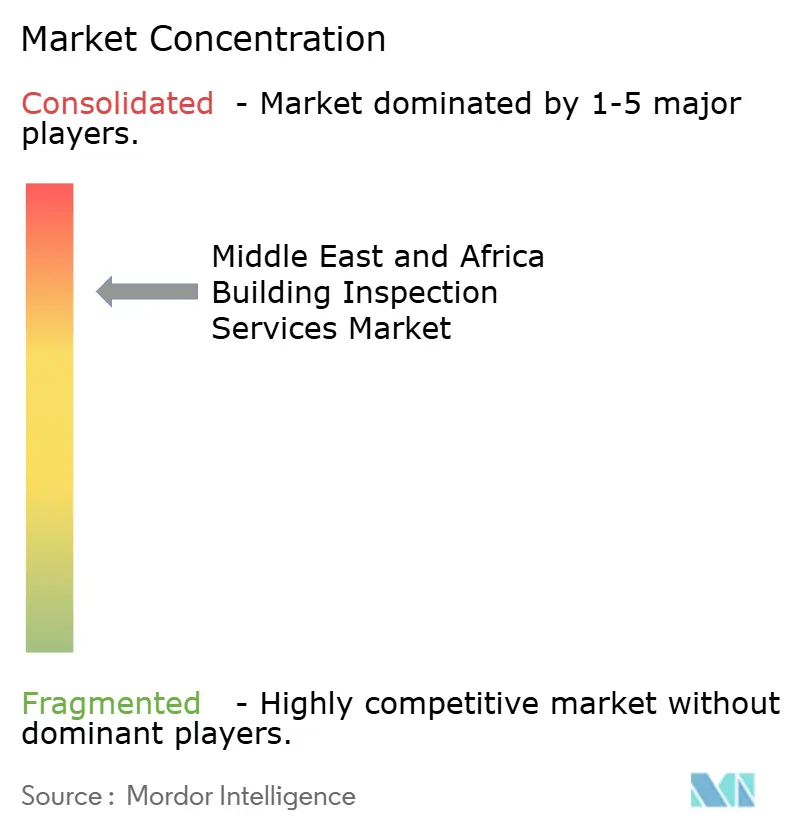
| Market Concentration | High |
Major Players *Disclaimer: Major Players sorted in no particular order Image © Mordor Intelligence. Reuse requires attribution under CC BY 4.0. | |
Middle East and Africa Building Inspection Services Market Analysis by Mordor Intelligence
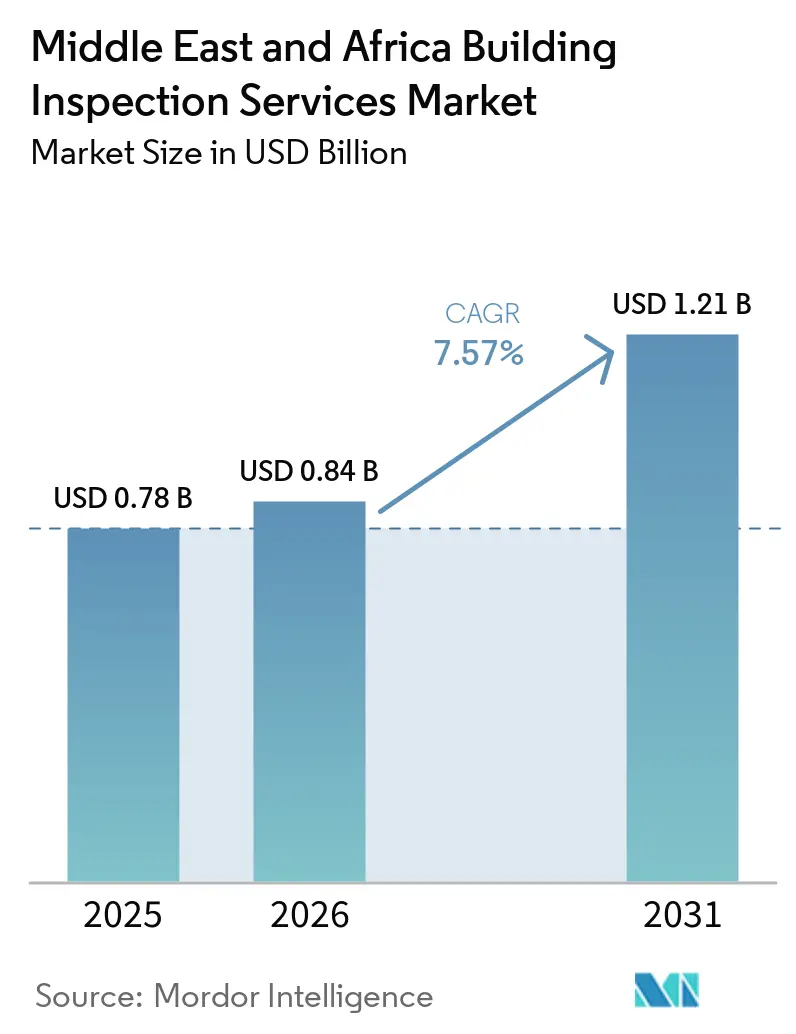
The Middle East And Africa Building Inspection Services Market size was valued at USD 0.78 billion in 2025 and is estimated to grow from USD 0.84 billion in 2026 to reach USD 1.21 billion by 2031, at a CAGR of 7.57% during the forecast period (2026-2031). Regulated construction activity in the Gulf Cooperation Council and sub-Saharan Africa supports demand for independent building checks. In Saudi Arabia, government initiatives accounted for 86% of committed project spending value in 2025, which supports a continuing pipeline of inspection work. Dubai Law No. 3 of 2026 requires periodic quality and safety reviews for buildings that are at least 20 years old, making inspection a continuing obligation for parts of the existing building stock. The Middle East and Africa building inspection services market is also moving toward outsourced delivery, insurance-linked reviews, and digital reporting. Providers that can combine accredited inspection teams with drone surveys and clear digital records are better placed to serve complex projects.
Key Report Takeaways
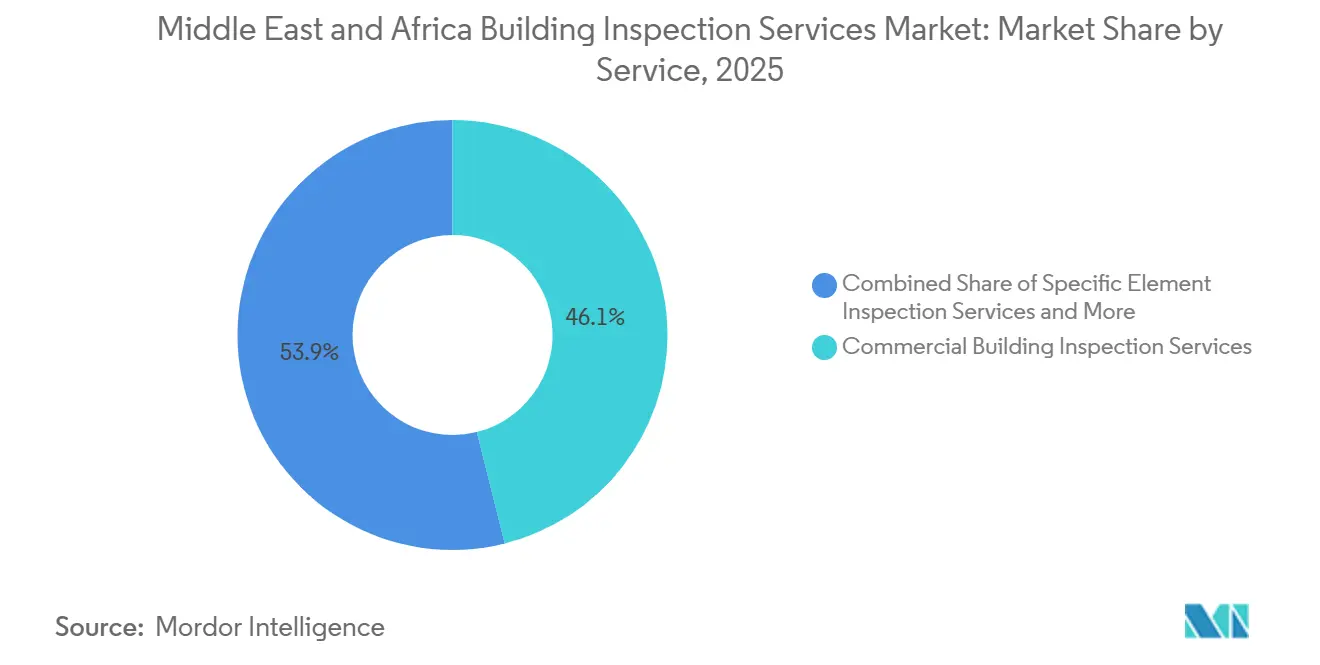
- By service, commercial building inspection services led with 46.1% of the Middle East and Africa building inspection services market share in 2025, while other specialized services are forecast to grow at a 10.1% CAGR through 2031.
- By sourcing type, outsourced services held 61.3% of the Middle East and Africa building inspection services market share in 2025, while recording the highest projected CAGR of 9.2% through 2031.
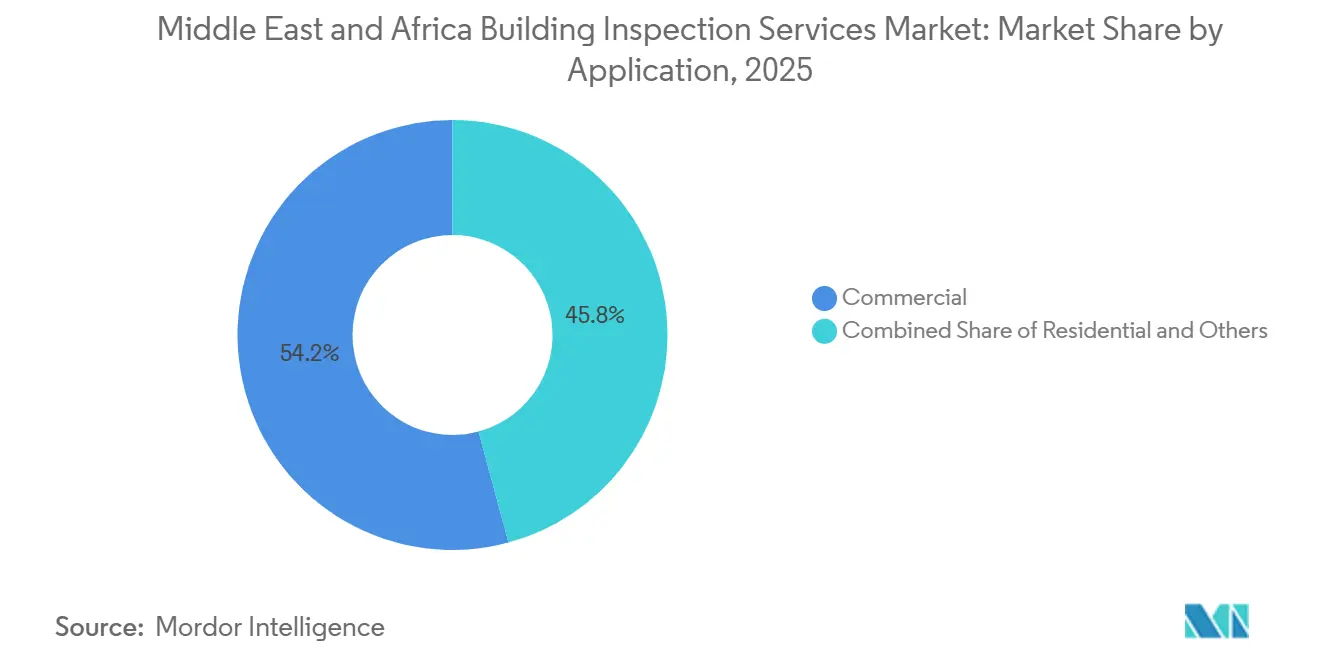
- By application, commercial applications accounted for 54.2% of the Middle East and Africa building inspection services market share in 2025, while other applications are advancing at a 12% CAGR through 2031.
- By end user, government and municipalities held 34.8% of the Middle East and Africa building inspection services market share in 2025, while facility-management firms are forecast to expand at a 10.4% CAGR through 2031.
- By geography, the United Arab Emirates held 29.6% of the Middle East and Africa building inspection services market share in 2025, while Saudi Arabia is forecast to grow at a 9.4% CAGR through 2031.
Note: Market size and forecast figures in this report are generated using Mordor Intelligence’s proprietary estimation framework, updated with the latest available data and insights as of January 2026.
Middle East and Africa Building Inspection Services Market Trends and Insights
Drivers Impact Analysis*
| Drivers | (~) % Impact on CAGR Forecast | Geographic Relevance | Impact Timeline |
|---|---|---|---|
| Urban, Tourism, and Infrastructure Megaprojects | +2.5% | Saudi Arabia, United Arab Emirates, Egypt, Morocco | Short term (≤ 2 years) |
| Fire, Life-Safety, and Occupancy Requirements | +1.8% | United Arab Emirates, Saudi Arabia, and spillover to the Gulf Cooperation Council | Short term (≤ 2 years) |
| High-Rise, Mixed-Use, and Hospitality Development | +1.5% | United Arab Emirates, Saudi Arabia, South Africa | Medium term (2-4 years) |
| Green-Building and Energy-Efficiency Programs | +1% | Gulf Cooperation Council, with wider regional relevance | Medium term (2-4 years) |
| Digital Snagging and Handover for Developer Portfolios | +0.8% | United Arab Emirates-led, with spillover to Saudi Arabia and Egypt | Short term (≤ 2 years) |
| Remote Inspection of Industrial and Desert Assets | +0.7% | Saudi Arabia, United Arab Emirates, Nigeria | Long term (≥ 4 years) |
| Source: Mordor Intelligence | |||
Urban, Tourism, and Infrastructure Megaprojects
Saudi Arabia’s committed construction pipeline provides a broad base for building inspection work across power, housing, and hospitality projects. Government-aligned initiatives represented 86% of the Kingdom’s committed project spending value in 2025, tying a large share of project activity to public delivery programs. The Middle East and Africa building inspection services market benefits where project owners need documented checks during construction and at handover. Long-term public delivery arrangements place independent inspection within municipal permit and excavation processes. Morocco’s 2026 public investment program and preparations for the 2030 World Cup extend demand for structured inspection work into North Africa. These active construction programs make inspection demand less dependent on a single project’s schedule.
Fire, Life-Safety, and Occupancy Requirements
Fire and life-safety rules are increasing the frequency of inspections for occupied buildings in the United Arab Emirates. Dubai Civil Defense requirements cover alarm testing, sprinkler flow, fire-pump operation, emergency lighting, and exit-route clearance. The United Arab Emirates Fire and Life Safety Code was updated through Circular No. 3 of 2026, including revised fire-barrier specifications and requirements for buildings between 150 and 500 square meters. The Abu Dhabi Civil Defense Authority required certification for Class G contractors working with firestop and through-penetration systems in June 2025[1]. The Middle East and Africa building inspection services market gains recurring work as owners and facility managers must maintain compliance after occupancy. This turns inspection from a permit-stage activity into an operating requirement for many assets.
High-Rise, Mixed-Use, and Hospitality Development
High-rise, mixed-use, and hospitality schemes need broader inspection coverage than standard residential buildings. Projects in NEOM, including Oxagon, Sindalah, and residential community phases, require inspection and test plans, nonconformance reporting, and quality systems across mechanical, civil, building services, and structural work[2]. Applus+ delivered quality assurance services for a major Jeddah giga project in 2025 after earlier work on 141 residential buildings in the Eastern Province Municipality[3]. The Middle East and Africa building inspection services market, therefore, has opportunities that continue through several stages of complex construction. Dubai handovers between 2022 and 2025 also create later snagging needs as assets move through their defect-liability periods. Specialist providers can address these requirements with consistent reporting across multiple technical scopes.
Green-Building and Energy-Efficiency Programs
Green-building programs add inspection needs before occupancy and during performance verification. The Gulf Standard GSO 3000:2025 adopted the Global Sustainability Assessment System as a regional standard for sustainable buildings across the Gulf Cooperation Council. Green Business Certification Inc. MENA reported nearly 4,600 projects pursuing Leadership in Energy and Environmental Design certification across the Middle East and North Africa. Those projects require document review, commissioning checks, and performance verification by accredited parties. The Afreximbank Abuja African Trade Centre received Leadership in Energy and Environmental Design Platinum certification in December 2025, showing the presence of certified commercial assets outside the Gulf. The Middle East and Africa building inspection services market can serve this work when it has personnel with relevant technical credentials.
Restraints Impact Analysis*
| Restraints | (~) % Impact on CAGR Forecast | Geographic Relevance | Impact Timeline |
|---|---|---|---|
| Limited Availability of Locally Qualified Inspectors | -0.6% | Middle East and Africa, most acute in sub-Saharan Africa | Short term (≤ 2 years) |
| Variation in Regulatory Enforcement Across Markets | -0.5% | Sub-Saharan Africa and parts of North Africa | Medium term (2-4 years) |
| Project-Cycle Dependence and Uneven Procurement | -0.4% | Gulf Cooperation Council and Egypt | Long term (≥ 4 years) |
| Unclear Ownership of Digital Inspection Data | -0.3% | United Arab Emirates and Saudi Arabia | Medium term (2-4 years) |
| Source: Mordor Intelligence | |||
Limited Availability of Locally Qualified Inspectors
The limited supply of locally qualified inspectors constrains service capacity, particularly outside established Gulf markets. The Project Management Institute projected that the Middle East and North Africa could require up to 330,794 construction project management professionals by 2035 under its high-growth scenario. It also identified a possible shortfall of 111,737 professionals that could delay infrastructure delivery. Building inspection employers need engineering knowledge alongside drone operation, digital inspection, and data-handling skills. The Middle East and Africa building inspection services market may face longer wait times and higher costs where firms rely on internationally recruited staff. The constraint is particularly material in secondary African cities where accredited inspectors remain scarce.
Variation in Regulatory Enforcement Across Markets
Differences in enforcement produce uneven conditions across the region. Strong enforcement supports repeat inspection volumes, while weaker local enforcement can leave providers competing mainly on price. South Africa launched its National Built Environment and Construction Safety Framework in July 2026 and identified fragmented oversight among municipalities, professional councils, and labor departments. Nigeria’s Council for the Regulation of Engineering approved a national strategy in 2025 that included digital compliance and verification tools and stricter practicing-license enforcement. The Middle East and Africa building inspection services market requires providers to invest in local accreditation and stakeholder engagement, where regulatory systems are still developing. This slows expansion in areas where demand has not yet become a consistent legal obligation.
*Our forecasts treat driver/restraint impacts as directional, not additive. The impact forecasts reflect baseline growth, mix effects, and variable interactions.
Segment Analysis
By Service: Commercial Services Lead, While Specialized Work Expands
Commercial building inspection services accounted for 46.1% of service revenue in 2025. Their position reflects the concentration of office, retail, hospitality, and mixed-use assets in Dubai, Abu Dhabi, Riyadh, and Johannesburg. These properties require repeat checks for fire safety, building services, structural condition, and post-occupancy compliance. The Middle East and Africa building inspection services market has a stable commercial base because many of these obligations recur during asset operation. Home inspection services remain relevant where property sales are active, and buyers seek pre-purchase reviews. Saudi Arabia’s ROSHN-led affordable housing program also supports demand for residential property inspection.
Other specialized services are forecast to grow at a 10.1% CAGR between 2026 and 2031. This category includes drone-based façade review, thermal imaging, digital snagging, and digital-twin delivery. Bureau Veritas provides General Civil Aviation Authority-approved drone services in the United Arab Emirates, producing geo-referenced 3-dimensional models and annotated defect maps that can connect with Building Information Modelling outputs. Specific element inspection services for fire suppression systems, lifts, and façade cladding also give property owners focused options when a full-building review is not needed. Digital snagging and 360-degree reality-capture tools can improve the continuity of records during refurbishment work. These methods make inspection records more useful for facility-management teams and reduce reliance on paper reports.

By Sourcing Type: Outsourced Delivery Has a Structural Lead
Outsourced services captured 61.3% of the Middle East and Africa building inspection services market size in 2025. They are also the fastest-growing sourcing type, with a forecast 9.2% CAGR through 2031. Asset owners are using independent providers within project governance and integrated facility-management contracts rather than buying inspections only when a problem arises. This approach can combine inspection, maintenance, and compliance responsibilities within a single service arrangement. The Middle East and Africa building inspection services market benefits when these contracts set ongoing review schedules. Outsourcing also gives clients access to accredited teams and specialist equipment without building every capability internally.
In-house services remain important for government-controlled assets and large industrial operators that maintain their own quality teams. Saudi Arabia’s municipal model supports the use of private providers for building permits and excavation inspection. The Saudi Building Code requires inspection activities to be conducted by accredited conformity-assessment entities listed by the Saudi Standards, Metrology, and Quality Organization. That requirement raises the technical standard for internal teams as well as external firms. The sourcing choice depends on an owner’s ability to maintain accredited staff and the required infrastructure. The continued move toward contracted delivery indicates that independent inspection is becoming a core part of the built-asset operating model.
By Application: Commercial Properties Form the Core Demand Base
Commercial applications represented 54.2% of the Middle East and Africa building inspection services market size in 2025. Office towers, retail centers, hotels, and mixed-use projects generate repeated work for fire safety, structural assessments, and sustainability checks. These assets have several inspection events during their operating life, which reduces exposure to short-term changes in new project starts. Commercial property owners also need records that can support occupancy, maintenance, and insurance requirements. The Middle East and Africa building inspection services market is supported by the large volume of actively managed commercial property in major Gulf cities. Residential activity adds further work through housing delivery, sales, and later defect review.
Other applications are forecast to grow at a 12% CAGR between 2026 and 2031. This group covers industrial facilities, petrochemical plants, logistics assets, and infrastructure-adjacent sites. Desert conditions and offshore facilities make aerial and remote inspection useful for detecting cracks, corrosion, and water ingress without extensive scaffolding. SGS joined Tawuniya’s Inherent Defects Insurance program in Saudi Arabia in June 2026 as a technical inspection service provider for design-document reviews, critical-stage inspections, and risk-definition reports. Industrial and insurance-linked work gives specialist providers roles beyond conventional building handover. The category’s faster growth reflects the need for inspection in technically demanding operating environments.
By End User: Government Demand Is Largest, and Facility Management Is Growing Fastest
Government and municipalities represented 34.8% of end-user demand in 2025. This position reflects state ownership of many large regional projects and the public sector’s role in enforcing construction and occupancy rules. Public entities also need inspection capacity for permits, excavation, public buildings, and infrastructure-linked developments. Real-estate agencies, brokers, property owners, and investors form dependable mid-tier demand groups through transactions and defect-liability management. Insurance and financial institutions have a smaller role but can require inspection as part of policy or lending processes. The Middle East and Africa building inspection services market has a broad client base because inspection supports both regulation and asset stewardship.
Facility-management firms are forecast to grow at a 10.4% CAGR between 2026 and 2031. Integrated facility-management contracts place inspection duties alongside maintenance, compliance monitoring, and building operations. BEEAH launched integrated facility-management services for net-zero buildings in Sharjah in October 2025, using artificial intelligence, the Internet of Things, and cloud-based systems for inspection and compliance monitoring. The Middle East Facility Management Association and Real Estate Regulatory Agency, Ajman, signed an agreement in June 2024 to formalize training pathways for outsourced facility management in residential towers. Facility-management providers can use embedded inspection capabilities to offer a more complete operating service. This model changes inspection from episodic purchasing into a regular contract item.
Geography Analysis
The United Arab Emirates held 29.6% of regional revenue in 2025, the largest geographic position in the Middle East and Africa building inspection services market. Its position reflects dense regulation and a large base of managed commercial, residential, and mixed-use property. Bureau Veritas received an inspection services contract from ADNOC for the TA’ZIZ Chemicals Industrial Zone in Al Ruwais in January 2026, covering local and global source inspection across 5 countries. Dubai Law No. 3 of 2026 requires quality and safety certificates for buildings at least 20 years old, with reviews covering structural integrity, exterior cladding, mechanical, electrical, and plumbing systems, and fire compliance. The law includes fines up to USD 272,329 for noncompliance, and repeat violations can result in USD 544,658. Digital infrastructure also supports drone surveys, defect classification, and Building Information Modelling-connected reporting.
Saudi Arabia is forecast to grow at a 9.4% CAGR from 2026 to 2031, the fastest geographic rate in the Middle East and Africa building inspection services market. Government initiatives accounted for 86% of committed project spending value in 2025, supporting work linked to power, housing, tourism, and large-scale infrastructure. Delivery schedules for the 2029 Asian Winter Games, 2030 World Expo, and 2034 FIFA World Cup support continuing inspection needs. Third-party checks are becoming more closely integrated with local permit and excavation processes. Egypt’s new-cities program supports building handover needs, while Nigeria is strengthening formal oversight. Nigeria is strengthening formal oversight as it develops more structured approaches to compliance.
South Africa and the Rest of the Middle East and Africa provide medium-term opportunities as inspection governance becomes more formal. South Africa’s July 2026 safety framework addresses fragmented built-environment oversight and supports clearer professional requirements. The Construction Industry Development Board amendment proposal includes a Construction Fund and expanded National Home Builders Registration Council oversight for public projects. Kenya issued its National Framework on Building Inspections, Audits, and Safety Testing Services in April 2026, extending mandatory inspection obligations to new buildings nationwide. The framework requires county governments to harmonize their approaches within 18 months of commencement. These developments can strengthen demand for accredited services in markets outside the Gulf.
Competitive Landscape
The Middle East and Africa building inspection services market is moderately consolidated among global operators, while regional specialists remain important in several African markets. SGS, Bureau Veritas, Intertek, TÜV Rheinland, DEKRA, and RINA cover a wide range of inspection requirements. Their coverage does not fully overlap in sub-Saharan Africa, where local companies often have stronger relationships and lower cost structures. Competition depends on accreditation, technical coverage, local delivery capacity, and clear reporting. Global providers are strongest where clients need consistent practices across several countries.
Bureau Veritas extended its quality compliance agreement for NEOM projects and received the Abu Dhabi National Oil Company TA’ZIZ inspection contract in January 2026. The NEOM work covers infrastructure, renewable energy, rail, and airport projects, while the TA’ZIZ mandate includes on-site and global source inspection across 5 countries. SGS joined Tawuniya’s Inherent Defects Insurance program in Saudi Arabia in June 2026 as a technical inspection service provider. This gives SGS a role in design-document reviews, critical-stage inspections, and risk-definition reporting for insured construction projects. These moves show how leading providers are seeking recurring work through large projects and insurance-linked services.
Technology is becoming an important point of competition in the Middle East and Africa building inspection services market. Bureau Veritas uses General Civil Aviation Authority-approved drones in the United Arab Emirates to develop 3-dimensional models that can connect with Building Information Modelling records. Digital tools can reduce the need for scaffold-based façade reviews and retain inspection information for later maintenance and compliance work. Nigeria, Kenya, and francophone West Africa offer opportunities for firms that can combine local accreditation with digital delivery. Qualified inspectors and clear data arrangements will remain necessary as building rules and inspection requirements become more formal across the region.
Middle East and Africa Building Inspection Services Industry Leaders
-
SGS Group
-
Bureau Veritas
-
Intertek Group plc
-
TÜV Rheinland AG
-
DEKRA SE
- *Disclaimer: Major Players sorted in no particular order
Recent Industry Developments
- June 2026: South Africa’s Department of Public Works and Infrastructure launched the National Built Environment and Construction Safety Framework, mandating building-erection compliance, inspector certification aligned with SANS 17024, and introducing the Public Infrastructure Confidence Index as a formal regulatory performance benchmark.
- June 2026: SGS joined Tawuniya’s Inherent Defects Insurance Program in Saudi Arabia as a Technical Inspection Service provider, covering design-document reviews, inspections at critical project stages, and Risk Definition reporting for insured construction projects Kingdom-wide.
- March 2026: Dubai promulgated Law No. 3 of 2026 on the Quality and Safety of Buildings, mandating quality and safety certificates for all buildings 20 years or older, with inspection scope covering structural integrity, cladding, mechanical, electrical, and plumbing systems, and fire compliance. Fines range up to USD 272,329 and double on repeat violations.
Middle East and Africa Building Inspection Services Market Report Scope
| Home Inspection Services |
| Specific Element Inspection Services |
| Commercial Building Inspection Services |
| Other Specialised Services |
| In-House Services |
| Outsourced Services |
| Residential |
| Commercial |
| Other Applications |
| Real-Estate Agencies and Brokers |
| Property Owners and Investors |
| Government and Municipalities |
| Insurance and Financial Institutions |
| Facility-Management Firms |
| Saudi Arabia |
| United Arab Emirates |
| Nigeria |
| Egypt |
| South Africa |
| Rest of Middle East and Africa |
| By Service | Home Inspection Services |
| Specific Element Inspection Services | |
| Commercial Building Inspection Services | |
| Other Specialised Services | |
| By Sourcing Type | In-House Services |
| Outsourced Services | |
| By Application | Residential |
| Commercial | |
| Other Applications | |
| By End User | Real-Estate Agencies and Brokers |
| Property Owners and Investors | |
| Government and Municipalities | |
| Insurance and Financial Institutions | |
| Facility-Management Firms | |
| By Countries | Saudi Arabia |
| United Arab Emirates | |
| Nigeria | |
| Egypt | |
| South Africa | |
| Rest of Middle East and Africa |
Key Questions Answered in the Report
What is the forecast growth rate for building inspection services in the Middle East and Africa?
The Middle East and Africa building inspection services market is forecast to grow at a 7.57% CAGR from 2026 to 2031.
Which service category has the largest share of regional revenue?
Commercial building inspection services held 46.1% of service revenue in 2025.
Which sourcing model is growing fastest in regional inspection services?
Outsourced services are both the largest sourcing type at 61.3% in 2025 and the fastest growing, at a 9.2% CAGR through 2031.
Which application is forecast to expand most quickly?
Other applications, including industrial and infrastructure-adjacent inspection, are forecast to grow at a 12% CAGR through 2031.
Which country is growing fastest for building inspection providers?
Saudi Arabia is forecast to record a 9.4% CAGR from 2026 to 2031.
What is driving facility-management demand for inspections?
Integrated facility-management contracts include compliance and inspection duties, supporting a 10.4% CAGR for facility-management firms through 2031.