
Market Overview
| Study Period | 2021 - 2031 |
|---|---|
| Forecast Data Period | 2026 - 2031 |
| Base Year Market Size (2025) | USD 0.76 Billion |
| Market Size (2026) | USD 0.8 Billion |
| Market Size (2031) | USD 1.03 Billion |
| Growth Rate (2026 - 2031) | 5.22 % |
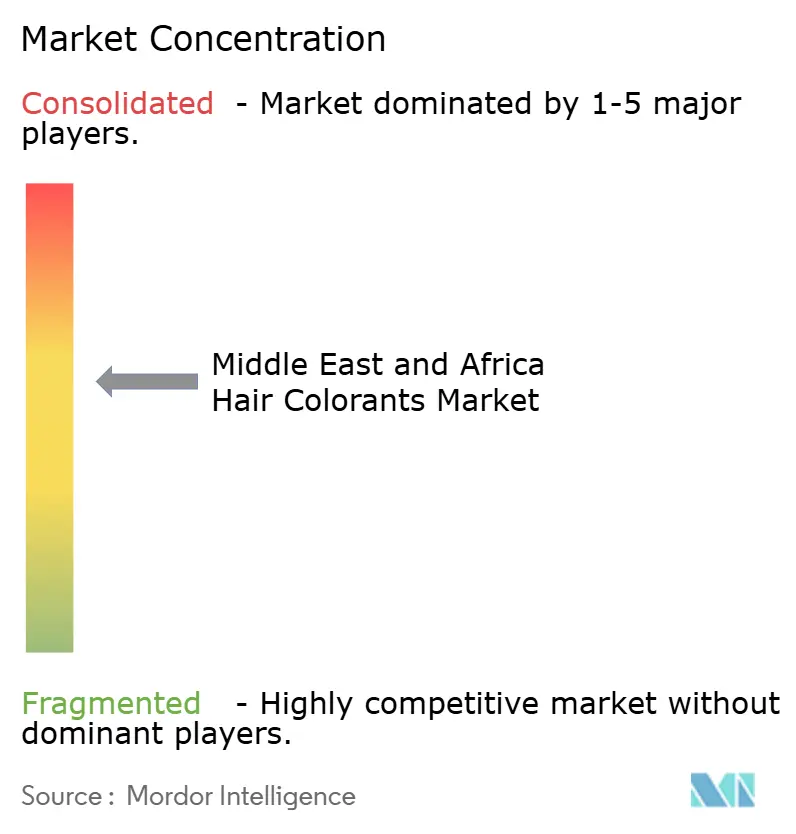
| Market Concentration | Medium |
Major Players *Disclaimer: Major Players sorted in no particular order Image © Mordor Intelligence. Reuse requires attribution under CC BY 4.0. | |
Middle East and Africa Hair Colorants Market Analysis by Mordor Intelligence
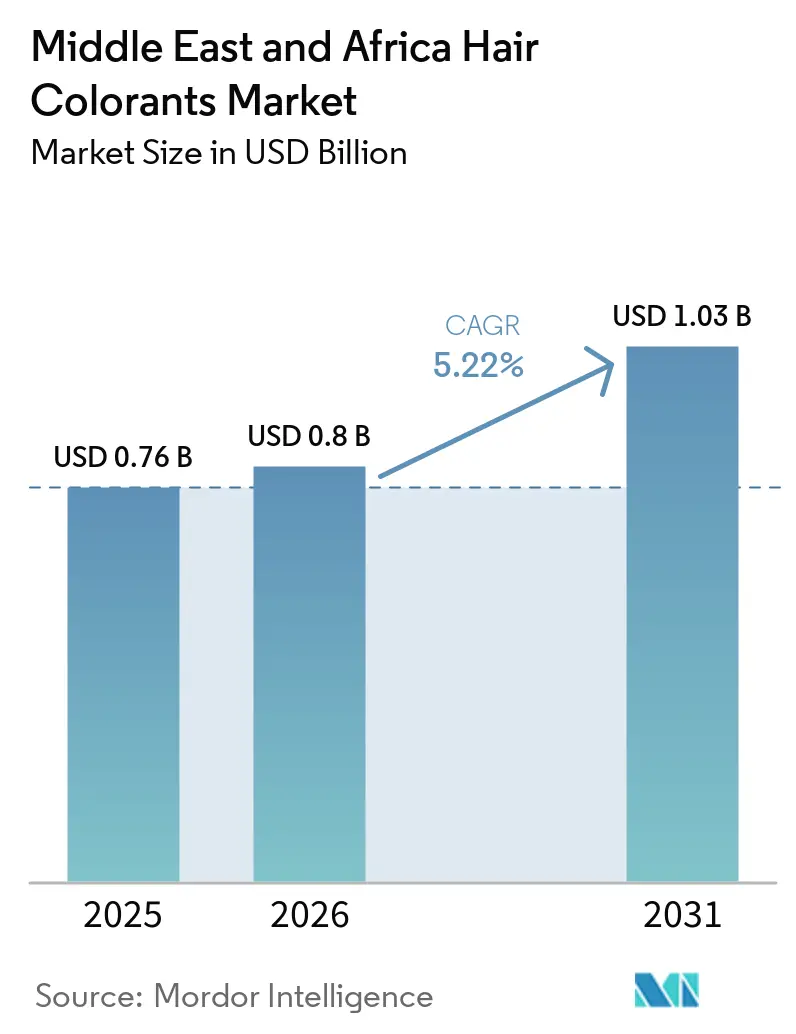
The Middle East and Africa hair colorants market size was valued at USD 0.76 billion in 2025 and is projected to reach USD 0.80 billion by 2026 and USD 1.03 billion by 2031, growing at a CAGR of 5.22% from 2026 to 2031. The Middle East and Africa hair colorants market is supported by urbanization, higher disposable income in GCC and North African economies, and greater spending on personal care, which together broaden the base of consumers willing to buy branded hair coloring products. First-time adoption among younger urban consumers and men in Sub-Saharan Africa distinguishes the Middle East and Africa hair colorants market from more mature markets, where category participation is already more established, and growth can depend more heavily on replacement or trend-driven purchases. Recurring grey coverage needs create a steadier base of demand than fashion-led color purchases, since consumers often seek a dependable result, a familiar shade, and an application routine they can repeat without extensive salon intervention.
Key Report Takeaways
- By product type, permanent colorants held 49.52% of the Middle East and Africa hair colorants market share in 2025, while temporary colorants are the fastest-growing format at 6.48% from 2026 to 2031.
- By price range, mass-tier products held 72.34% of the Middle East and Africa hair colorants market share in 2025, while premium-tier colorants are the fastest-growing price segment at 6.78% from 2026 to 2031.
- By category, conventional colorants held 71.22% of the Middle East and Africa hair colorants market share in 2025, while organic and natural colorants are projected to grow at a 7.17% CAGR through 2031.
- By distribution channel, supermarkets and hypermarkets held 38.57% of the Middle East and Africa hair colorants market share in 2025, while online retail stores are projected to grow at a 7.22% CAGR through 2031.
- By geography, Saudi Arabia held 35.12% of the Middle East and Africa hair colorants market share in 2025, while South Africa is projected to grow at a 7.04% CAGR through 2031.
Note: Market size and forecast figures in this report are generated using Mordor Intelligence’s proprietary estimation framework, updated with the latest available data and insights as of January 2026.
Middle East and Africa Hair Colorants Market Trends and Insights
Drivers Impact Analysis*
| Driver | (~) % Impact on CAGR Forecast | Geographic Relevance | Impact Timeline |
|---|---|---|---|
| Rising Demand for Grey Hair Coverage | +1.3% | Most acute in GCC, Turkey, North Africa | Short term (≤ 2 years) |
| Increasing Male Grooming and Colorant Adoption | +0.8% | UAE, Saudi Arabia, Turkey, Egypt | Medium term (2–4 years) |
| Rising Popularity of Natural and Herbal Formulations | +0.9% | UAE, Egypt, Morocco, South Africa | Medium term (2–4 years) |
| Social Media and Celebrity Beauty Influence | +0.7% | GCC, Egypt, Turkey, South Africa | Short term (≤ 2 years) |
| Expanding Aging Population in the Region | +0.5% | Turkey, Morocco, Egypt, Algeria, Tunisia | Long term (≥ 4 years) |
| Growth of Professional Salon Services | +0.6% | UAE, Saudi Arabia, South Africa, Egypt | Medium term (2–4 years) |
| Source: Mordor Intelligence | |||
Rising Demand for Grey Hair Coverage
Grey hair coverage provides recurring demand because consumers use colorants for a practical personal-care need. The population aged 65 years and above represented 5.19% of the MENA population in 2025 [1]. The World Bank expects this age group to reach 12% of the regional population by 2050 [2]. The Middle East and Africa hair colorants market therefore has a larger pool of consumers who may seek regular grey coverage over time. Religious practices that encourage covering grey hair can further position hair coloring as part of regular grooming for some consumers. This pattern favors products that offer reliable coverage, clear shade results, and repeatable application at home or in salons.
Rising Popularity of Natural and Herbal Formulations
Henna-based and ammonia-free products are moving from heritage use toward a more organized commercial category in the Middle East and Africa hair colorants market. Consumer interest in halal-certified products extends beyond Muslim consumers and can support premium demand in South Africa and Turkey. Research on herbal hair dye formulations discusses scalp nourishment, hair strengthening, and improved texture as relevant product attributes. These attributes support a clearer performance case for herbal alternatives, particularly where consumers are concerned about allergens. Natural formulations can also use familiar regional ingredients to build trust without depending only on a premium label. The opportunity is strongest where brands can demonstrate consistent color performance and support their claims with credible certification.
Social Media and Celebrity Beauty Influence
Social platforms are an important discovery channel for hair color ideas among urban consumers in the Middle East and Africa hair colorants market. Research on social media and aesthetic norms indicates that digital exposure can influence beauty aspirations. Content that uses local cultural references can be more relevant to consumers than a direct translation of global creative material. L'Oréal Professionnel used the Gourmand Browns campaign in Egypt to link brown shades with coffee, cinnamon, and chocolate references. The campaign involved 6 hair professionals and 6 regional influencers, connecting salon activity with consumer-facing communication. Such activity can help brands move consumers from shade discovery toward salon appointments or product purchases.
Expanding Aging Population in the Region
Population aging reinforces the need for grey coverage across several parts of the Middle East and Africa hair colorants market. The projected rise in the older population is relevant to Turkey, Morocco, Egypt, Algeria, and Tunisia. These markets combine a growing need for recurring color maintenance with established consumer interest in personal grooming. Demand is likely to favor permanent formats when consumers prioritize durable coverage and predictable results. Brands can respond through straightforward shade selection, repeat-purchase support, and products suited to at-home application. This helps the Middle East and Africa hair colorants market maintain demand even when fashion-oriented purchases change more quickly.
Restraints Impact Analysis*
| Restraint | (~) % Impact on CAGR Forecast | Geographic Relevance | Impact Timeline |
|---|---|---|---|
| Allergic Reactions and Scalp Sensitivity Concerns | -0.3% | Global, particularly acute in professional salon segment across MEA | Short term (≤ 2 years) |
| Stringent Regulations on Cosmetic Ingredients | -0.5% | Saudi Arabia (SFDA), Egypt (EDA), Nigeria (NAFDAC) | Short to Medium term (≤ 4 years) |
| Availability of Counterfeit and Low-Quality Products | -0.5% | Nigeria, Egypt, Tanzania, Rest of Sub-Saharan Africa | Medium term (2–4 years) |
| Environmental Concerns over Chemical Waste Disposal | -0.2% | South Africa, UAE, GCC | Long term (≥ 4 years) |
| Source: Mordor Intelligence | |||
Stringent Regulations on Cosmetic Ingredients
Ingredient controls can raise reformulation, documentation, and import requirements for suppliers in the Middle East and Africa hair colorants market. Saudi Arabia issued updates in 2025 that added 3 substances to its restricted list and 21 substances to its prohibited list. The updates apply to imported cosmetic products, with non-compliant imports barred from January 2026 and a sell-through period extending to January 2028. These requirements can increase lead times and raise the burden on smaller suppliers. Multinationals with established reformulation processes can respond more quickly than smaller regional companies. Compliance capabilities may therefore become a more important part of supplier selection and brand positioning.
Allergic Reactions and Scalp Sensitivity Concerns
Scalp sensitivity concerns can limit the use of permanent colorants and increase interest in alternative formats. A 2025 review found that products labeled PPD-free may still not be safe for sensitized consumers because of cross-reactive compounds. This finding limits the value of simple PPD-free claims and raises the need for clearer product information. Consumers concerned about reactions may choose temporary or semi-permanent formats before committing to permanent color. The issue is particularly relevant in salons, where repeated exposure also affects professionals. Brands that offer clear instructions, patch-test guidance, and credible ingredient communication can address a barrier to repeat use.
*Our forecasts treat driver/restraint impacts as directional, not additive. The impact forecasts reflect baseline growth, mix effects, and variable interactions.
Segment Analysis
By Product Type: Permanent Formats Lead, Temporary Variants Gain Traction
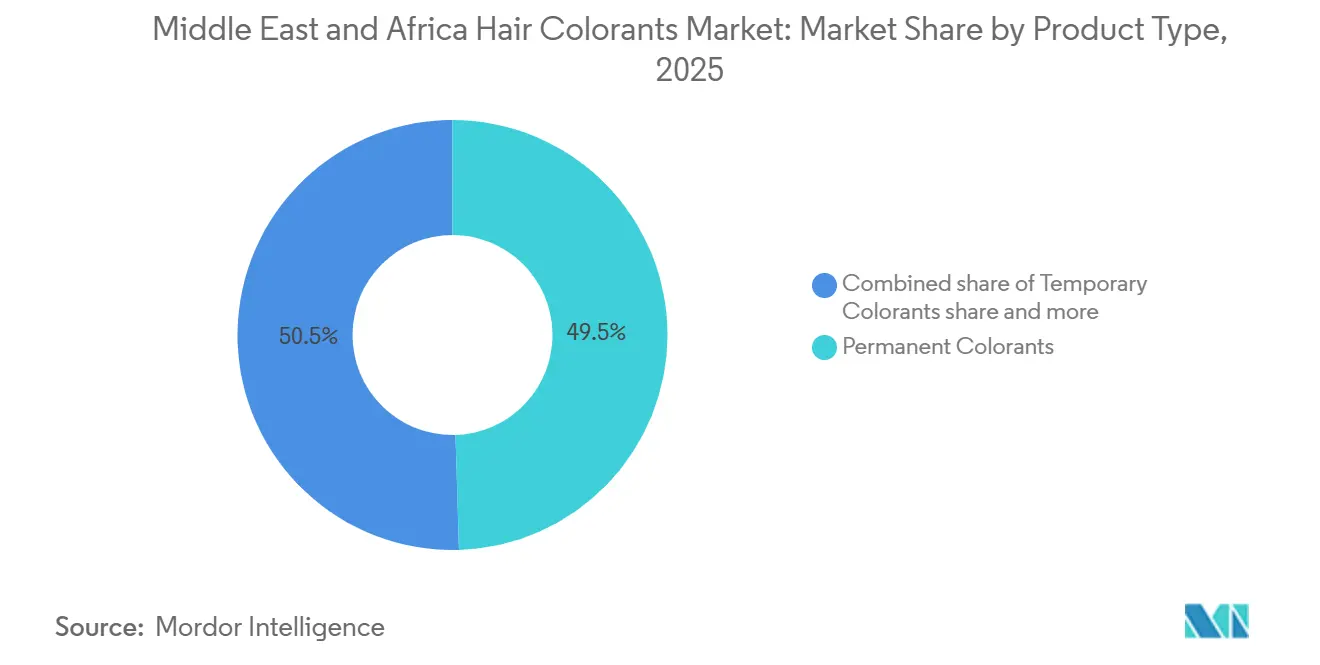
Permanent colorants held 49.52% of the Middle East and Africa hair colorants market share in 2025, reflecting their central role in reliable grey coverage, routine color maintenance, and the established professional salon service model. For many buyers, permanent colorants provide a familiar choice when long-lasting results and regular maintenance are more important than experimenting with temporary fashion shades. The salon channel treats permanent coloring as a standard service, which supports the format's position and helps consumers obtain shade matching, application support, and repeat color services. Semi-permanent products serve consumers who want a tone refresh without a full oxidative process, allowing them to manage their appearance with less commitment to a fixed result. This is particularly relevant for younger urban women in GCC markets, where salon use, online beauty discovery, and interest in manageable color changes can occur together.
Temporary colorants are the fastest-growing product format at 6.48% from 2026 to 2031 in the Middle East and Africa hair colorants market, indicating demand for flexible products that can suit changing beauty preferences and more cautious ingredient choices. Concern about PPD sensitivity is contributing to interest in products that avoid permanent oxidative chemistry, especially for consumers who want to limit perceived exposure while retaining access to hair color. Manufacturers are offering color-depositing shampoos and wash-out glosses for consumers who value simpler application, shorter wear periods, and a less permanent change to their hair color. Bleachers and highlighters remain concentrated in salons because they need greater skill, careful processing, and shade management, resulting in limited home use across much of the region. Color-melting techniques that combine balayage and highlights can support demand for professional highlighting services, particularly when regional hair professionals present the results through social media content.

By Price Range: Mass Tier Anchors the Market While Premium Trading-Up Accelerates
Mass-tier products captured 72.34% of the Middle East and Africa hair colorants market share in 2025, making accessible pricing central to regional volume and to everyday purchasing across many consumer groups. Egypt, Nigeria, Morocco, and lower-income GCC consumer groups remain important volume bases for this tier, where affordable products must still meet expectations on visible coverage and convenient home use. Grey coverage, color durability, and ease of application are key purchase factors for value-oriented households, particularly when consumers are buying a product for a recurring need rather than an occasional fashion change. Established brands maintain loyalty by delivering consistent results through widely available supermarket distribution, which reduces the effort needed to find a familiar product and shade. Mass products also provide the base from which suppliers can encourage consumers to trade up when they see a clear benefit in formulation, convenience, or professional-style results.
Premium-tier colorants are the fastest-growing price segment at 6.78% from 2026 to 2031 in the Middle East and Africa hair colorants market, as more consumers seek products that combine better ingredient communication with salon-style performance at home. Growth is linked to income gains in the GCC, online product discovery, and greater attention to ingredient quality, which give consumers more reasons to compare products beyond price alone. The main pathway is trading up from mass products to professional-grade or salon-quality formulations for use at home, rather than a complete replacement of value-oriented purchasing behavior. Henkel launched Creme Supreme by Schwarzkopf in May 2025 as a 3-step coloration process positioned to deliver professional-grade results at an accessible price, creating a tangible premium option for existing users. This approach shows how product design can support premium migration while retaining value-conscious consumers who still need clear performance and easy application.
By Category: Organic Formulations Accelerate Beyond Niche Status
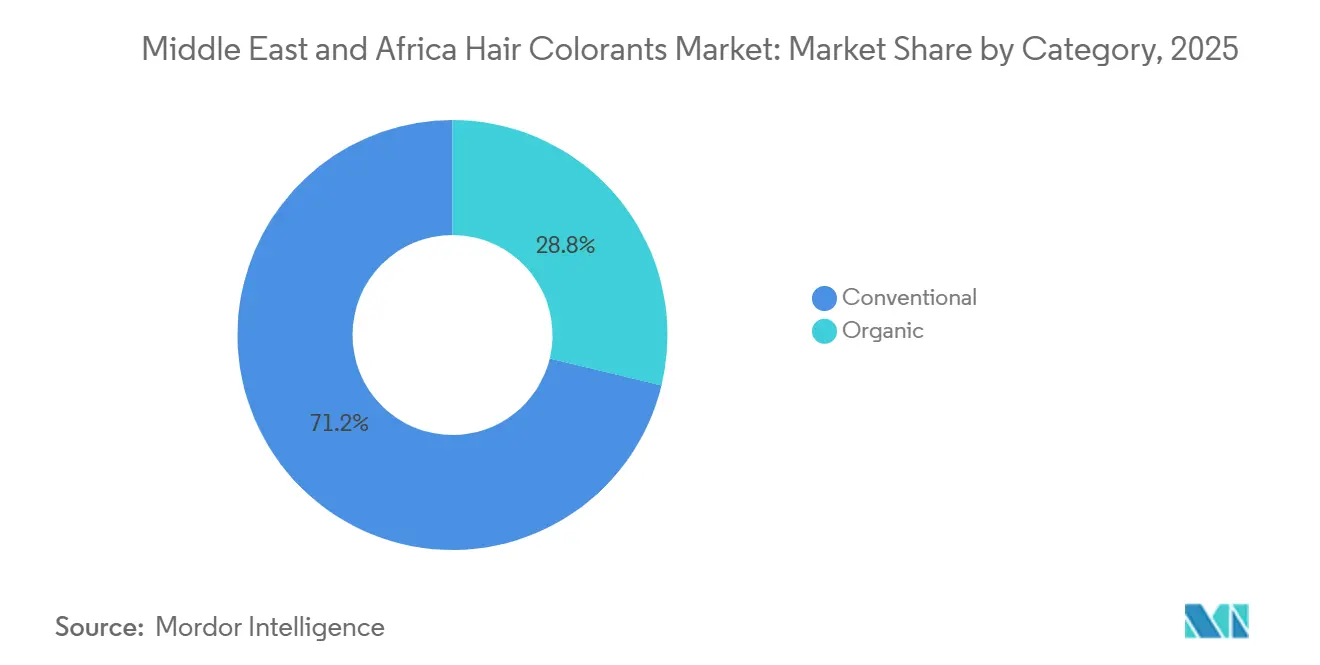
Conventional colorants held 71.22% of the Middle East and Africa hair colorants market share in 2025 because salons value application speed, predictable developer ratios, and familiar performance across a wide range of routine color services. Conventional products also retain an advantage where organic alternatives have not reached price parity, or where consumers remain uncertain about the consistency of herbal shades and processing results. Their established performance supports the needs of consumers seeking dependable grey coverage, allowing salons and at-home users to select products with known application steps and expected outcomes. The category remains important in professional services, where processing time and consistent results affect salon operations, appointment planning, and customer satisfaction with each service visit. It is therefore likely to remain the larger category over the forecast period, even as interest in alternative and hybrid formulations continues to build.
Organic and natural colorants are projected to grow at a 7.17% CAGR through 2031, making them the fastest-growing formulation category as ingredient concerns and heritage familiarity influence consumer choices. Henna has a long history of use in the region, which provides familiarity for consumers considering herbal options and gives suppliers a culturally recognizable point of reference. Halal certification can serve as a quality signal for Muslim and non-Muslim premium consumers, helping products communicate a broader proposition around formulation and assurance. Research on herbal dyes supports the relevance of ingredients such as amla, indigo, and hibiscus to the product proposition, including benefits that consumers may associate with scalp and hair care [3]. Hybrid products that combine conventional developer systems with plant-derived colorant inputs represent a potential way to balance performance, processing consistency, and ingredient expectations without asking consumers to make an all-or-nothing choice.
By Distribution Channel: Digital Commerce Reshapes Category Access
Supermarkets and hypermarkets held 38.57% of the Middle East and Africa hair colorants market share in 2025 because of their broad reach, familiar shopping environment, and convenience for routine personal-care purchases. These outlets place hair colorants alongside other personal-care purchases, which supports regular replenishment and allows consumers to compare familiar brands, shades, and price points in one visit. Health and beauty specialty stores add value through shade consultation and sensitivity-related guidance, which can be helpful for consumers seeking an alternative to a usual permanent product. Pharmacies appeal to consumers seeking lower-allergen products and professional guidance, while also providing a setting that reinforces the importance of careful product selection. Direct-selling networks remain useful where modern retail coverage is limited and where personal recommendations can influence the choice of brand, shade, and product format.
Online retail stores are projected to grow at a 7.22% CAGR through 2031, the fastest rate among distribution channels, as consumers increasingly use digital platforms to compare brands and purchase preferred shades. Digital retail gives niche organic brands access to consumers even when they cannot meet supermarket order requirements, increasing visibility for smaller suppliers and specialized product lines. Social commerce on TikTok and Instagram can shorten the path from shade discovery to purchase, particularly when creator content makes a product's application or visual result easier to understand. This favors brands with responsive influencer networks and a clear online assortment, because consumers can move quickly from inspiration to a specific format or shade. Online purchase data can also improve planning for repeat purchases and shade preferences, helping suppliers refine stock availability and communication with consumers.
Geography Analysis
Saudi Arabia held 35.12% of the Middle East and Africa hair colorants market share in 2025, supported by high income, a young consumer base, and a growing beauty ecosystem that supports both retail and professional demand. Vision 2030 supports the development of beauty services and related professional activity in the country, creating a stronger setting for salon education, service quality, and product availability. The UAE is the other major Gulf market, and its expatriate population creates demand for a broad selection of shades, formats, and products suited to different hair needs. Both countries provide an opportunity to move existing consumers from mass products to premium, professional-grade, or halal-certified alternatives when products offer a clear and relevant benefit. These markets reward products that combine visible results with ingredients and formats suited to individual preferences, especially where consumers can learn about products through salons and digital channels.
Egypt, Turkey, Nigeria, and Morocco provide distinct growth opportunities for the Middle East and Africa hair colorants market, with different consumer profiles, retail conditions, and service cultures shaping the route to market. Egypt combines a large consumer base with salon use and influencer-led interest in fashion colors, giving brands a reason to balance functional coverage products with more expressive shade offerings. Turkey is both a consumption market and a regional distribution hub with consumers familiar with professional coloring products and European brand portfolios. Nigeria's urban middle class is creating demand for branded hair colorants, although currency volatility and counterfeit products complicate operations, pricing, and supply continuity. Morocco, together with Algeria and Tunisia, adds a North African base shaped by urban premium demand, tourism-related consumption, and established beauty practices.
South Africa is projected to grow at a 7.04% CAGR through 2031, the fastest geographic rate in the Middle East and Africa hair colorants market, supported by varied hair needs and relatively developed retail conditions. Its diverse hair texture profile creates demand for products tailored to varied hair needs, including formulations that consider moisture retention and reduced damage for Afro-textured hair. Modern retail and e-commerce are more developed than in much of Sub-Saharan Africa, giving brands more routes to reach consumers and making new product discovery more accessible. The A-Beauty movement directs attention to colorants compatible with Afro-textured hair and to ingredients such as shea butter, baobab oil, and marula oil. East and Central African markets remain earlier-stage but offer a positive long-term demand base as organized retail expands and branded personal-care products become more available.
Competitive Landscape
The Middle East and Africa hair colorants market includes L'Oréal, Henkel through Schwarzkopf, and Wella, prominent in professional salons, while regional, direct-selling, and specialist brands serve mass consumer channels. Competition is based on more than formulation because companies also use salon education, virtual shade tools, local partnerships, and social commerce to build access and maintain consumer relationships. These capabilities can strengthen relationships with salons and consumers over time, particularly when suppliers connect training, product information, and local communication consistently. L'Oréal's 2025 Big Bang Beauty Tech Innovation Program offers startup commercial pilots across 35 SAPMENA markets, providing a route to evaluate technology and beauty concepts in the region. The program illustrates how larger companies can connect their regional operations with outside technology and beauty innovation while retaining a practical link to commercial activity.
The Middle East and Africa hair colorants market has opportunities in halal-certified permanent colorants for grey coverage, men's quick-application products, and formulas for Afro-textured hair, all of which respond to specific regional needs. These needs are not equally served by mainstream product portfolios, leaving room for companies that can adapt formulation, communication, and distribution to each consumer group. Men's home-use formats can be offered through e-commerce and barbershop channels where quick application is important and where simpler use can encourage repeat purchase. Products for South Africa and Nigeria can prioritize damage avoidance and moisture retention for Afro-textured hair, addressing hair needs that are not always reflected in standard imported ranges. Counterfeit goods remain a barrier because they reduce formal sales, complicate brand management, and affect consumer confidence in branded products.
Companies are responding with traceability, serialized labeling, and retail-exclusive distribution to limit counterfeit exposure and make authorized products easier for consumers and retailers to identify. L'Oréal signed an agreement to acquire Color Wow in June 2025, adding a premium professional haircare asset to its portfolio and strengthening its presence in a related professional category. The transaction supports L'Oréal's professional products portfolio and its planned global expansion, including Middle East and Africa, where premium haircare can complement salon-related color services. Henkel's Creme Supreme launch is another example of a company using a differentiated format to support premium positioning in the region while offering a structured process for home users. The competitive environment therefore favors suppliers that can combine trusted results, compliant formulations, credible routes to market, and communication that responds to the needs of specific local consumer groups.
Middle East and Africa Hair Colorants Industry Leaders
-
Henkel AG & Co. KGaA
-
Wella Company
-
Revlon, Inc.
-
Godrej Consumer Products Limited
-
L'Oréal S.A.
- *Disclaimer: Major Players sorted in no particular order
Recent Industry Developments
- June 2025: L’Oréal signed an agreement to acquire Color Wow, a fast-growing premium professional haircare brand. The acquisition strengthens L’Oréal’s professional products portfolio with a premium haircare asset earmarked for global expansion, including the Middle East and Africa.
- May 2025: Henkel launched Creme Supreme by Schwarzkopf, its global flagship coloration product and the market’s first 3-step coloration process, directly supporting Henkel’s GCC strategy of migrating its mass-tier consumer base into premium coloration.
Middle East and Africa Hair Colorants Market Report Scope
The Middle East and Africa Hair Colorants Market is Segmented by Product Type (Bleachers, Highlighters, Permanent Colorants, Semi-Permanent Colorants, and Temporary Colorants), by Price Range (Mass and Premium), by Category (Organic and Conventional), by Distribution Channel (Supermarkets/Hypermarkets, Health and Beauty Stores, Online Retail Stores, and Other Distribution Channels), and by Geography (Saudi Arabia, United Arab Emirates, Nigeria, Egypt, Morocco, Turkey, South Africa, and the Rest of the Middle East and Africa). The Market Forecasts are Provided in Terms of Value (USD).
By Product Type
| Bleachers |
| Highlighters |
| Permanent Colorants |
| Semi-Permanent Colorants |
| Temporary Colorants |
By Price Range
| Mass |
| Premium |
By Category
| Organic |
| Conventional |
By Distribution Channel
| Supermarkets/Hypermarkets |
| Health and Beauty Stores |
| Online Retail Stores |
| Other Distribution Channels |
By Geography
| Saudi Arabia |
| United Arab Emirates |
| Nigeria |
| Egypt |
| Morocco |
| Turkey |
| South Africa |
| Rest of Middle East and Africa |
| By Product Type | Bleachers |
| Highlighters | |
| Permanent Colorants | |
| Semi-Permanent Colorants | |
| Temporary Colorants | |
| By Price Range | Mass |
| Premium | |
| By Category | Organic |
| Conventional | |
| By Distribution Channel | Supermarkets/Hypermarkets |
| Health and Beauty Stores | |
| Online Retail Stores | |
| Other Distribution Channels | |
| By Geography | Saudi Arabia |
| United Arab Emirates | |
| Nigeria | |
| Egypt | |
| Morocco | |
| Turkey | |
| South Africa | |
| Rest of Middle East and Africa |
Key Questions Answered in the Report
What is the projected value of the Middle East and Africa hair colorants market?
The Middle East and Africa Hair Colorants Market is projected to register a CAGR of 5.22% during the forecast period (2026-2031).
Which product type leads hair colorants sales in Middle East and Africa?
Permanent colorants lead with 49.52% share in 2025, supported by demand for grey coverage and professional salon services.
Which hair colorant formulation is growing fastest in Middle East and Africa?
Organic and natural colorants are projected to expand at a 7.17% CAGR through 2031.
Which sales channel has the strongest growth outlook?
Online retail stores are expected to grow at a 7.22% CAGR through 2031, helped by digital product discovery and social commerce.