
Microplastic Fillers Market Size and Share
Market Overview
| Study Period | 2022 - 2032 |
|---|---|
| Market Size (2027) | USD 3.64 Billion |
| Market Size (2032) | USD 4.5 Billion |
| Growth Rate (2027 - 2032) | 4.37 % |
| Fastest Growing Market | Asia-Pacific |
| Largest Market | Asia-Pacific |
| Market Concentration | Low |
Major Players *Disclaimer: Major Players sorted in no particular order Image © Mordor Intelligence. Reuse requires attribution under CC BY 4.0. | |
Microplastic Fillers Market Analysis by Mordor Intelligence
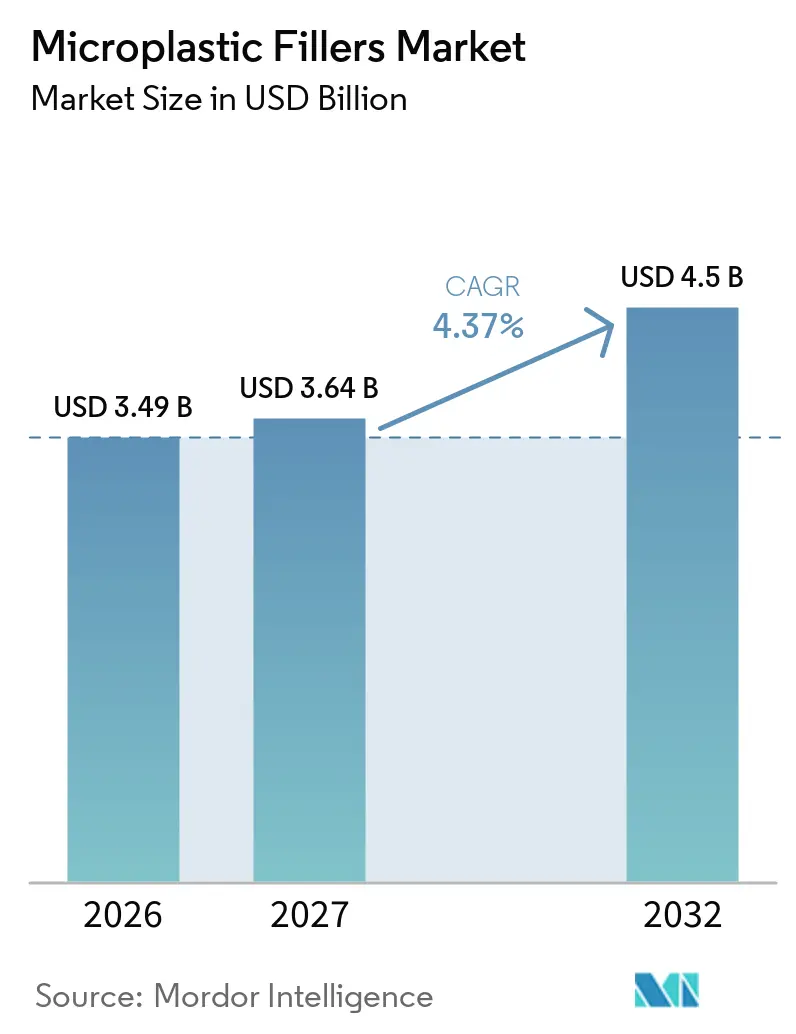
The Microplastic Fillers Market size was valued at USD 3.49 billion in 2026 and is estimated to grow from USD 3.64 billion in 2027 to USD 4.50 billion by 2032, at a CAGR of 4.37% during the forecast period (2027-2032). The microplastic fillers market is supported by demand for lighter polymer components, thin packaging films, and materials that enable predictable processing. Polyethylene grades remain relevant due to their compatibility with established compounding equipment and low moisture absorption. Producers are also responding to demand for per- and polyfluoroalkyl substances (PFAS)-free processing aids, circular packaging additives, and alternatives for regulated cosmetic applications. Regulatory restrictions in Europe are limiting the use of intentionally added particles, particularly in personal care products. Feedstock price fluctuations continue to influence costs, favoring suppliers with integrated access to polymers.
Key Report Takeaways
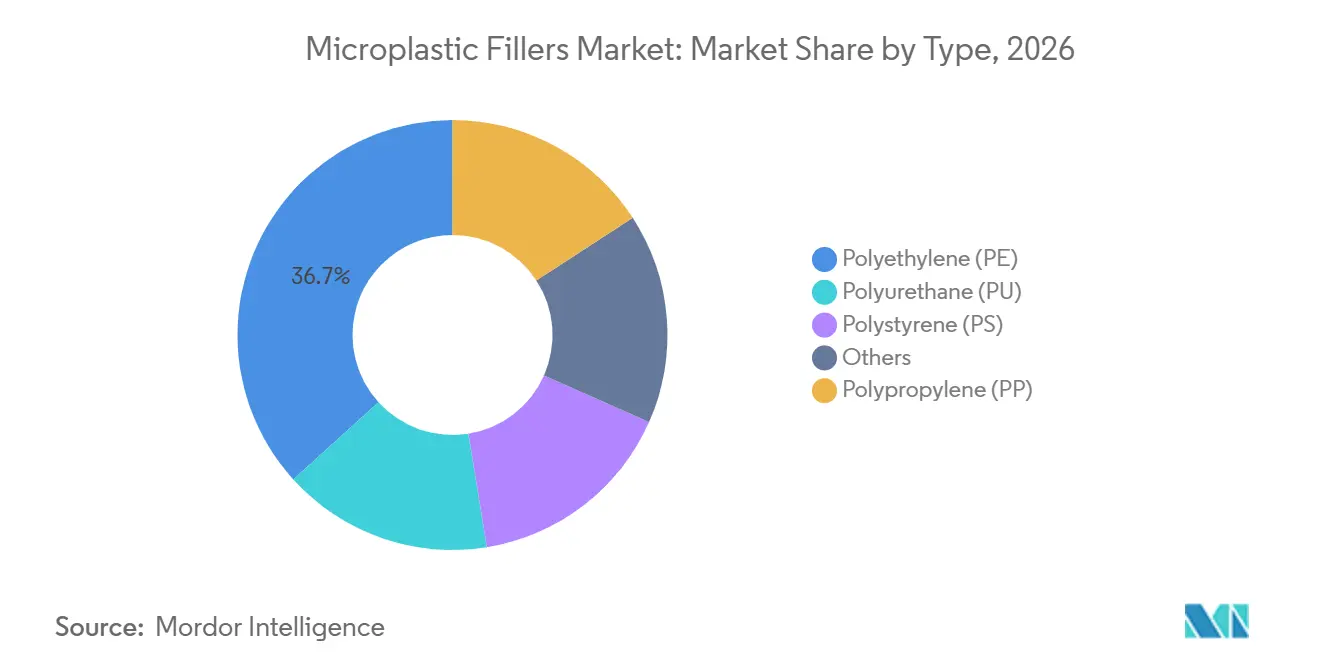
- By type, polyethylene held 36.73% of the market share in 2026 and is forecast to grow at a 5.06% CAGR through 2032.
- By form, powder accounted for 40.11% of the market share in 2026 and is projected to expand at a 5.21% CAGR through 2032.
- By function, fillers held 45.47% market share in 2026, while rheology modification is forecast to record a 5.47% CAGR through 2032.
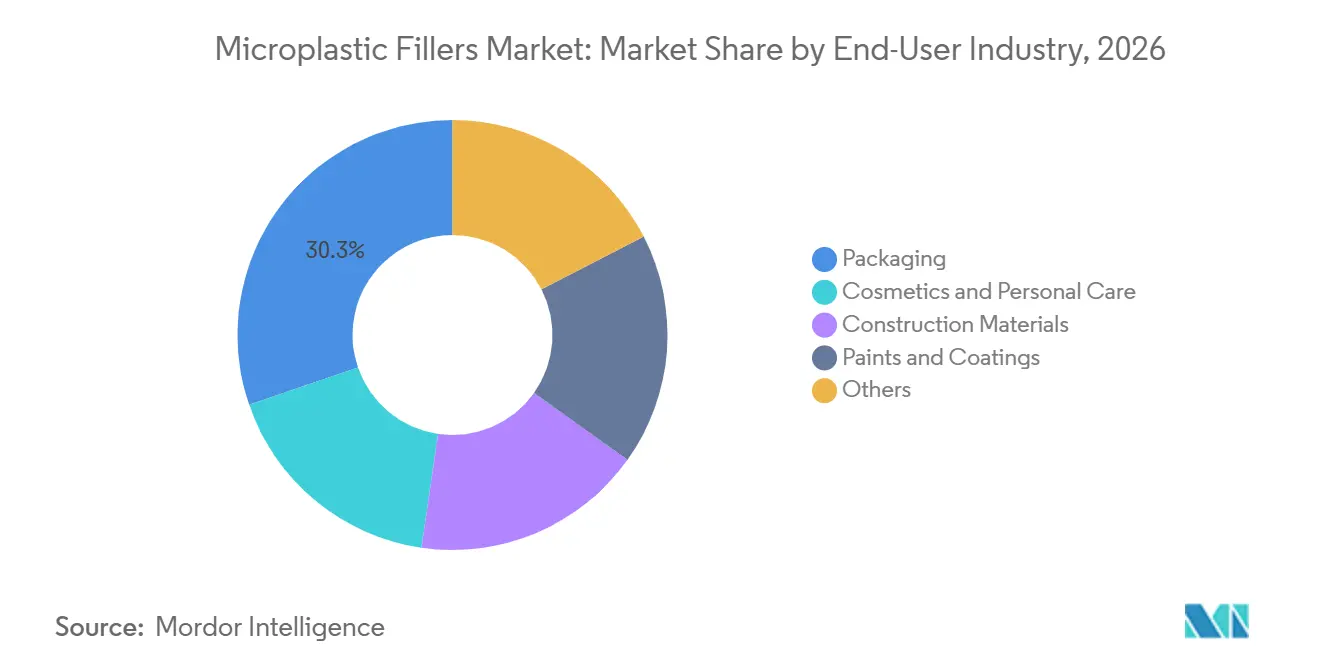
- By end-user industry, packaging accounted for 30.26% market share in 2026, while cosmetics and personal care are forecast to grow at a 5.69% CAGR through 2032.
- By geography, Asia-Pacific held 43.62% market share in 2026 and is projected to grow at a 5.33% CAGR through 2032.
Note: Market numbers in this report are based on Mordor Intelligence's proprietary estimation framework, which combines nine months of actuals with Q4 projections for base year 2026.
Market Trends and Insights
Drivers Impact Analysis of Microplastic Fillers Market*
| Drivers | (~) % Impact on CAGR Forecast | Geographic Relevance | Impact Timeline |
|---|---|---|---|
| Lightweighting of Automotive, Electric Vehicle (EV), and Industrial Components | +1.1% | Global, concentrated in Asia-Pacific, North America, and Europe | Medium term (2-4 years) |
| Packaging Demand for Barrier Performance and Material Reduction | +1.0% | Global, with Asia-Pacific as the core and spillover to the Middle East and Africa | Short term (≤ 2 years) |
| Customizable Particle Engineering for Application-Specific Performance | +0.6% | North America and Europe, with selective Asia-Pacific adoption | Long term (≥ 4 years) |
| Cost and Processing Efficiency Versus Conventional Fillers | +0.8% | Global, strongest in Asia-Pacific and South America | Medium term (2-4 years) |
| Expansion of Specialty Coatings, Cosmetics, and Personal Care Formulations | +0.5% | Asia-Pacific, Europe, and North America | Long term (≥ 4 years) |
| Source: Mordor Intelligence | |||
Lightweighting of Automotive, Electric Vehicle (EV), and Industrial Components
High-Density Polyethylene (HDPE) and Polypropylene (PP) powder fillers are increasingly used in automotive components where lower weight must be balanced with impact resistance. Electric vehicle (EV) battery packaging, structural brackets, and underbody panels are driving demand for materials that reduce component mass without compromising structural integrity. A 2025 study found that foamed HDPE containing thermally expandable microspheres achieved a 5.75% density reduction while retaining tensile strength of 22.6 MPa under optimized injection molding conditions. The same study noted that a 10% reduction in vehicle curb weight can reduce braking distance by 5%. Vehicle programs set material specifications early in the design process, which gives suppliers with application engineering support a stronger position in the Microplastic Fillers Market. This demand also extends to industrial equipment and molded components, where transport and energy use are material cost considerations.
Packaging Demand for Barrier Performance and Material Reduction
Packaging converters are reducing film thickness and adopting mono-material structures while maintaining oxygen and moisture barrier performance. These conditions increase the value of Polyethylene (PE)-compatible filler grades that help preserve stiffness in thinner films. Dow introduced INNATE TF 220 resin in June 2025 for biaxially oriented polyethylene films used in flexible packaging[1]. This launch indicates that PE-based packaging structures are becoming more important for food and consumer goods applications. The Microplastic Fillers Market can benefit converters who need materials that run on existing high-output film lines. Packaging demand is strongest in Asia-Pacific, where e-commerce activity and domestic packaging production continue to expand the application base.
Customizable Particle Engineering for Application-Specific Performance
Particle engineering allows suppliers to offer grades with controlled size distributions, surface treatments, and particle shapes. Hollow microspheres can reduce weight in construction adhesives, surface-modified polyethylene (PE) powders can improve wetting in waterborne coatings, and narrow-cut polystyrene (PS) grades can support more uniform layer deposition in additive manufacturing feedstocks. Research published in 2025 described how machine learning can shorten the screening process for plastic additives with improved environmental properties. Faster screening may reduce the time needed to validate specialized filler grades for specific uses. This favors companies that combine polymer production, particle engineering, and formulation support.
Cost and Processing Efficiency Versus Conventional Fillers
Microplastic fillers, particularly PE and PP powders, compete directly with mineral fillers such as calcium carbonate, talc, and wollastonite on a delivered cost-per-performance-unit basis. They continue to hold an advantage in applications where moisture sensitivity, surface defects, or density penalties disqualify mineral fillers. Petrochemical analysts at Nexant ECA noted that naphtha-derived polyolefin costs dropped materially in the first half of 2025 as crude oil retreated below USD 65 per barrel, temporarily widening the cost gap between microplastic fillers and mineral alternatives in price-sensitive Asia-Pacific markets. Processing efficiency is an additional consideration: PE microparticles disperse more readily in low-viscosity resin systems and require less energy-intensive mixing than plate-like mineral fillers. This is directly relevant to electrified compounding lines where energy cost is a controllable margin factor.
Restraints Impact Analysis of Microplastic Fillers Market*
| Restraints | (~) % Impact on CAGR Forecast | Geographic Relevance | Impact Timeline |
|---|---|---|---|
| Regulatory Restrictions on Intentionally Added Microplastics | -1.2% | Europe, with spillover to North America, including California | Short term (≤ 2 years) |
| Environmental Persistence and Release During Use and Disposal | -0.8% | Global | Long term (≥ 4 years) |
| Petroleum Feedstock Volatility and Supply-Chain Exposure | -0.6% | Global, concentrated in Asia-Pacific import-dependent producers | Medium term (2-4 years) |
| Performance and Cost Gap of Bio-Based and Biodegradable Substitutes | -0.5% | Europe, North America, Japan | Long term (≥ 4 years) |
| Source: Mordor Intelligence | |||
Regulatory Restrictions on Intentionally Added Microplastics
Regulation (EU) 2023/2055 is a central compliance issue for producers of intentionally added synthetic polymer microparticles. The European Commission states that the restriction introduces phased measures covering several product groups and uses. The European Chemicals Agency (ECHA) began accepting reports on microplastic emissions in 2025, with the first annual submissions due by May 31, 2026. For cosmetics, restrictions apply to rinse-off products from October 2027, leave-on products from October 2029, and makeup products from October 2035. The European Commission estimates that the restriction could prevent 500,000 tons of microplastic releases over 20 years, with an aggregate cost of up to EUR 19 billion (~USD 21.33 billion). These requirements reduce the accessible European personal care market within the Microplastic Fillers Market and increase reporting obligations for industrial suppliers.
Environmental Persistence and Release During Use and Disposal
Environmental persistence creates reputational and operational concerns across consumer-facing polymer value chains. A 2025 study reported that polymer identity has a stronger influence on fragmentation and secondary microplastic generation than specific UV exposure conditions. The research examined polypropylene (PP), polyethylene (PE), and thermoplastic polyurethane (TPU) and found differences in particle-size distributions under simulated weathering. Japan's National Institute for Environmental Studies reported in 2025 that tire-derived microplastics were found at 32 of 36 freshwater and coastal sites surveyed nationwide, with concentrations exceeding predicted no-effect levels at 30 of those sites[2]. Although tire-derived particles are not intentional fillers, these findings increase scrutiny of polymer particle emissions and affect demand for more contained applications and substitute materials.
*Our forecasts treat driver/restraint impacts as directional, not additive. The impact forecasts reflect baseline growth, mix effects, and variable interactions.
Microplastic Fillers Market Segment Analysis
By Type:
Polyethylene Holds the Largest Share and the Highest Growth RatePolyethylene held 36.73% of the Microplastic Fillers Market share by type in 2026 and is forecast to grow at a 5.06% CAGR through 2032. This reflects PE's use across several product formats and end uses. PE is processed using standard melt-processing equipment and has low moisture absorption. Suppliers offer Low-Density Polyethylene (LDPE), Linear Low-Density Polyethylene (LLDPE), and High-Density Polyethylene (HDPE) grades for different stiffness, impact, and flow requirements. A 2025 HDPE study showed that microsphere-modified material could reduce density by more than 5% while maintaining tensile strength above 22 MPa.
Polypropylene is the next significant type for automotive and industrial compounding applications. Polyurethane is used in specialty foam and coating formulations where softness or abrasion resistance is required. Polystyrene and other polymers serve smaller applications in consumer electronics, industrial adhesives, and specialized molded products. Nouryon completed a 2025 capacity expansion for triethylaluminum at Jiaxing, China, doubling the output of a co-catalyst used in PE and PP polymerization. This investment supports continued upstream focus on polyolefin supply chains and helps maintain PE's cost position in the Microplastic Fillers Market.

By Form:
Powder Leads Through Dispersion and Processing AdvantagesPowder accounted for 40.11% of the Microplastic Fillers Market share in 2026 and is projected to grow at a 5.21% CAGR through 2032. Its higher surface-area-to-volume ratio supports filler dispersion and matrix interaction. Powder can be used at loading levels that retain processing performance. In compounding operations, powder grades can lower die pressure and reduce melt fracture compared with pelletized alternatives. These characteristics are relevant for blown-film and injection-molding lines operating at high output.
Fibers serve as structural reinforcement in technical textiles and nonwovens, where the length-to-diameter ratio affects tensile performance. Other forms include hollow microspheres and porous beads used in thermal insulation, specialty coatings, and drug-delivery applications. Powder grades have historically provided slip, opacity, and exfoliation in cosmetics and personal care products. European restrictions limit some cosmetic applications, but packaging and industrial applications remain relevant to the Microplastic Fillers Market. Reporting and labeling requirements can add administrative costs in regulated applications without changing powder's central role in non-regulated compounding applications.
By Function:
Fillers Led Demand While Rheology Modification ExpandsThe fillers function segment accounted for 45.47% of the Microplastic Fillers Market share in 2026. It has the broadest application base, ranging from cost-focused construction compounds to automotive parts requiring mechanical performance. Rheology modification is forecast to grow at a 5.47% CAGR through 2032, the highest rate among functional categories. Demand is linked to flow control in waterborne paints, adhesives, and high-solids coatings. These materials are selected where conventional thickeners cause haze or excessive shear sensitivity.
Evonik launched TEGO Res 1100 in March 2025, a methacrylate copolymer that improves plastic-film deinking at 40°C. This type of additive reflects how circularity and performance requirements are shaping formulation work. Exfoliation fillers are subject to restrictions in rinse-off personal care products under the EU framework. Other functions include controlled-release encapsulation and vibration-damping composites in automotive components. Functional diversity supports a shift from extension toward applications that require more precise material performance.
By End-User Industry:
Packaging Leads While Cosmetics and Personal Care Grow FasterPackaging accounted for 30.26% of the Microplastic Fillers Market share in 2026. PE microparticle fillers are used in barrier films, flexible pouches, and rigid containers across consumer and industrial applications. Cosmetics and personal care are forecast to record a 5.69% CAGR through 2032. Growth is concentrated in Asia-Pacific and the Middle East, where regulatory timelines differ from those in Europe, and demand for premium skincare and color cosmetics is expanding. This contrast between packaging scale and beauty growth gives suppliers reason to maintain distinct grades for regulated and non-regulated uses.
Construction materials provide a stable demand for polypropylene (PP) and polyurethane (PU) in sealants and insulation compounds. Paints and coatings use microparticles for texture finishes, where particle size can affect surface roughness and abrasion resistance. Other end uses include electronics encapsulants and 3D-printing feedstocks, which can require narrow size distributions and high particle sphericity. Daicel launched BELLOCEA BS7 in 2025 as a biodegradable cosmetic texture improver, reflecting demand for alternative materials in personal care. The Microplastic Fillers Market continues to depend on packaging output, while substitutes and reformulation shape product development for beauty applications.
Geography Analysis
APAC Microplastic Fillers Market
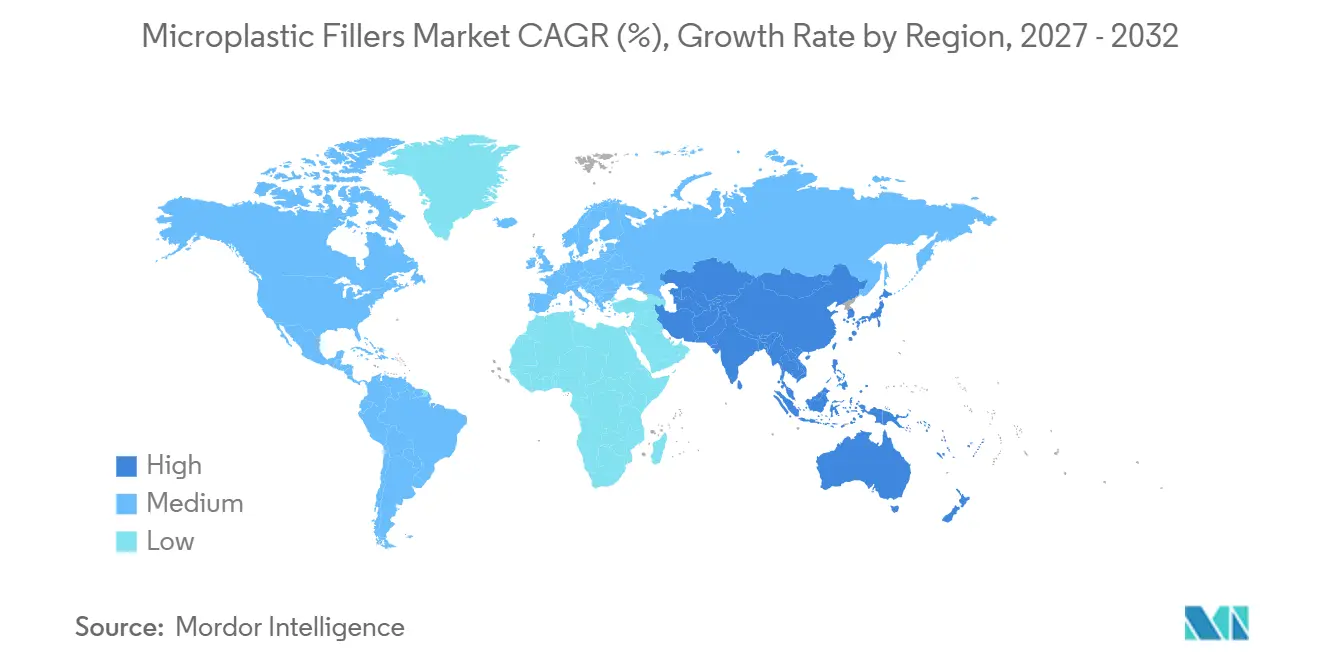
Asia-Pacific held 43.62% of the Microplastic Fillers Market share in 2026 and is forecast to grow at a 5.33% CAGR through 2032. China's polymer compounding base in the Yangtze River Delta and Pearl River Delta supports demand across packaging, automotive, and industrial applications. The OECD reported that plastic use in Asia has risen nearly ninefold since the early 2000s and now accounts for close to one-third of global plastic consumption. India and Southeast Asia contribute to demand through domestic packaging manufacturing. Japan and South Korea support precision-grade applications in electronics and automotive compounding.
North America Microplastic Fillers Market
North America is the second-largest region in the Microplastic Fillers Market, driven by the use of lightweight polymers in both conventional and electric vehicles. Covestro announced a 2026 investment to expand polycarbonate compounding capacity in Hebron, Ohio, for automotive, electronics, and healthcare applications. LyondellBasell approved a 400,000 metric tons per year propylene expansion at Channelview, Texas, in 2025, with startup planned for late 2028. These investments strengthen the regional availability of materials used in specialty compounding. Regulatory action on cosmetic microbeads continues to direct formulation work toward compliant alternatives.
EMEA and South America Microplastic Fillers Market
Europe faces the strongest regulatory pressure in the Microplastic Fillers Market. The European Chemicals Agency (ECHA)'s reporting system requires annual submissions of microplastics emissions beginning in 2026. The European Parliament and Council reached an agreement in April 2025 on pellet-loss measures, including certification requirements for larger operators. Europe continues to support demand for specialty coatings, medical compounding, and automotive interior applications. South America, the Middle East, and Africa represent smaller markets, supported by Brazil's packaging and agricultural film sectors, infrastructure expansion, consumer goods demand, and Gulf polyolefin production hubs.
Competitive Landscape
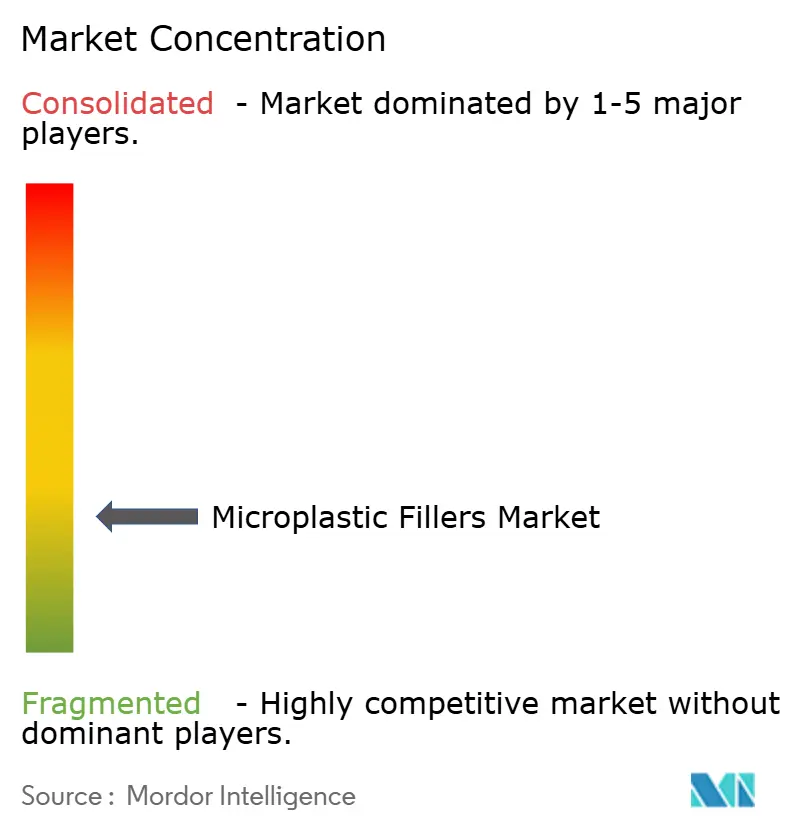
The microplastic fillers market is fragmented. Dow, LyondellBasell, ExxonMobil, BASF, and INEOS hold integrated positions in PE and PP production. Their scale and access to feedstocks provide a cost advantage for high-volume grades. Evonik, Clariant, and Honeywell compete through formulation, processing aids, and application support. As a result, large producers focus on supply reliability and scale, while specialty companies emphasize performance differentiation to support higher-value applications.
Regulatory compliance is becoming central to competitive strategies in the microplastic fillers market. In September 2025, Dow launched DOWSIL 5-1050 Polymer Processing Aid (PPA) as an alternative to fluoropolymer-based processing aids for film packaging, stating that it meets FDA 21 Code of Federal Regulations (CFR) 174.5 and EU 10/2011 food-contact requirements. In February 2025, Evonik introduced the Purocel series to help prepare plastic-waste pyrolysis oil for use in steam crackers. Also in 2025, LyondellBasell invested in its Frankfurt Innovation Center to develop capabilities for sorting, decontamination, and compounding of post-consumer polyolefin recyclates. These developments link product innovation with recyclability and customer compliance requirements.
Opportunities remain in precision particle engineering for additive manufacturing, specialty coatings, and advanced polymer compounds. Controlled sphericity and narrow size distributions can differentiate a grade where standard compounding margins are limited. Asia-Pacific waterborne coatings also present demand for synthetic polymer rheology modifiers that meet local formulation and compliance requirements. The competitive landscape remains broad because end-use requirements vary across polymers, particle forms, and regions. Conventional PE and PP microparticles retain a cost advantage in large-scale applications, even as suppliers invest in bio-based and biodegradable alternatives. The microplastic fillers market combines high-volume commodity supply with specialized application development and rewards suppliers that can deliver consistent material supply and targeted formulation support.
Microplastic Fillers Industry Leaders
-
CLARIANT
-
Dow
-
BASF
-
Eastman Chemical Company
-
Covestro AG
- *Disclaimer: Major Players sorted in no particular order
Microplastic Fillers Market Companies Covered in this Report
- BASF
- CLARIANT
- Covestro AG
- Dow
- DuPont
- Eastman Chemical Company
- Evonik Industries AG
- Exxon Mobil Corporation
- Honeywell International Inc.
- Huntsman International LLC
- INEOS
- Lamberti S.p.A.
- LyondellBasell Industries Holdings B.V.
- Mitsubishi Chemical Corporation
- Nouryon
Recent Industry Developments in Microplastic Fillers Market
- October 2025: Nouryon completed a capacity expansion for metal alkyls (triethylaluminum) at its Jiaxing, China facility, doubling its production capacity of this PE/PP polymerization co-catalyst used in microplastic filler manufacturing. The company also announced that modified methylaluminoxane (MMAO) production for polyolefin elastomers will begin at the same site in 2027. An organic peroxides innovation center in Tianjin is scheduled to open in 2026 to support local customers.
- September 2025: LyondellBasell invested in new R&D capabilities at its Frankfurt Innovation Center, installing a flake sorter, decontamination systems, extrusion, downstream degassing, and purification units. These additions are intended to develop sorting, decontamination, and compounding technologies for post-consumer polyolefin recyclates, including microplastic fillers, under near-industrial conditions.
Global Microplastic Fillers Market Report Scope
Microplastic fillers are small, engineered or fragmented synthetic polymer particles (5 millimeters or smaller) added to commercial and industrial formulations to modify physical properties such as texture, flow, weight, viscosity, or durability. These particles are used across a range of industries, including personal care, paints and coatings, plastics, rubber, and construction, where they serve functional roles such as improving product consistency, reducing material costs, and enhancing mechanical performance.
The microplastic fillers market is segmented by type, form, function, end-user industry, and geography. By type, the market is segmented into polyethylene (PE), polypropylene (PP), polyurethane (PU), polystyrene (PS), and others. By form, the market is segmented into powder, fibers, and others. By function, the market is segmented into fillers, rheology modification, exfoliation, and others. By end-user industry, the market is segmented into packaging, cosmetics and personal care, construction materials, paints and coatings, and others. The report also covers market sizes and forecasts for the global microplastic fillers across 15 countries in major regions. The market sizes and forecasts are provided in terms of value (USD).
Segmentation Overview
| Polyethylene (PE) |
| Polypropylene (PP) |
| Polyurethane (PU) |
| Polystyrene (PS) |
| Others |
| Powder |
| Fibers |
| Others |
| Fillers |
| Rheology Modification |
| Exfoliation |
| Others |
| Packaging |
| Cosmetics and Personal Care |
| Construction Materials |
| Paints and Coatings |
| Others |
| Asia-Pacific | China |
| India | |
| Japan | |
| South Korea | |
| ASEAN Countries | |
| Rest of Asia-Pacific | |
| North America | United States |
| Canada | |
| Mexico | |
| Europe | Germany |
| United Kingdom | |
| France | |
| Italy | |
| NORDIC Countries | |
| Rest of Europe | |
| South America | Brazil |
| Argentina | |
| Rest of South America | |
| Middle East and Africa | Saudi Arabia |
| South Africa | |
| Rest of Middle East and Africa |
| By Type | Polyethylene (PE) | |
| Polypropylene (PP) | ||
| Polyurethane (PU) | ||
| Polystyrene (PS) | ||
| Others | ||
| By Form | Powder | |
| Fibers | ||
| Others | ||
| By Function | Fillers | |
| Rheology Modification | ||
| Exfoliation | ||
| Others | ||
| By End-User Industry | Packaging | |
| Cosmetics and Personal Care | ||
| Construction Materials | ||
| Paints and Coatings | ||
| Others | ||
| By Geography | Asia-Pacific | China |
| India | ||
| Japan | ||
| South Korea | ||
| ASEAN Countries | ||
| Rest of Asia-Pacific | ||
| North America | United States | |
| Canada | ||
| Mexico | ||
| Europe | Germany | |
| United Kingdom | ||
| France | ||
| Italy | ||
| NORDIC Countries | ||
| Rest of Europe | ||
| South America | Brazil | |
| Argentina | ||
| Rest of South America | ||
| Middle East and Africa | Saudi Arabia | |
| South Africa | ||
| Rest of Middle East and Africa | ||
Key Questions Answered in the Report
What is current market size of Microplastic Fillers Market?
The Microplastic Fillers Market size was valued at USD 3.49 billion in 2026 and is estimated to grow from USD 3.64 billion in 2027 to USD 4.50 billion by 2032, at a CAGR of 4.37% during the forecast period (2027-2032).
Why is powder the leading form for microplastic fillers?
Powder held a 40.11% share in 2026 because it supports dispersion and processing in high-output compounding, blown film, and injection-molding lines.
Which end-user application has the largest share?
Packaging held a 30.26% share in 2026, supported by use in barrier films, flexible pouches, and rigid containers.
Which region is growing fastest for microplastic fillers?
Asia-Pacific held a 43.62% share in 2026 and is projected to grow at a 5.33% CAGR through 2032.