
Microchannel Heat Exchanger Market Size and Share
Market Overview
| Study Period | 2021 - 2031 |
|---|---|
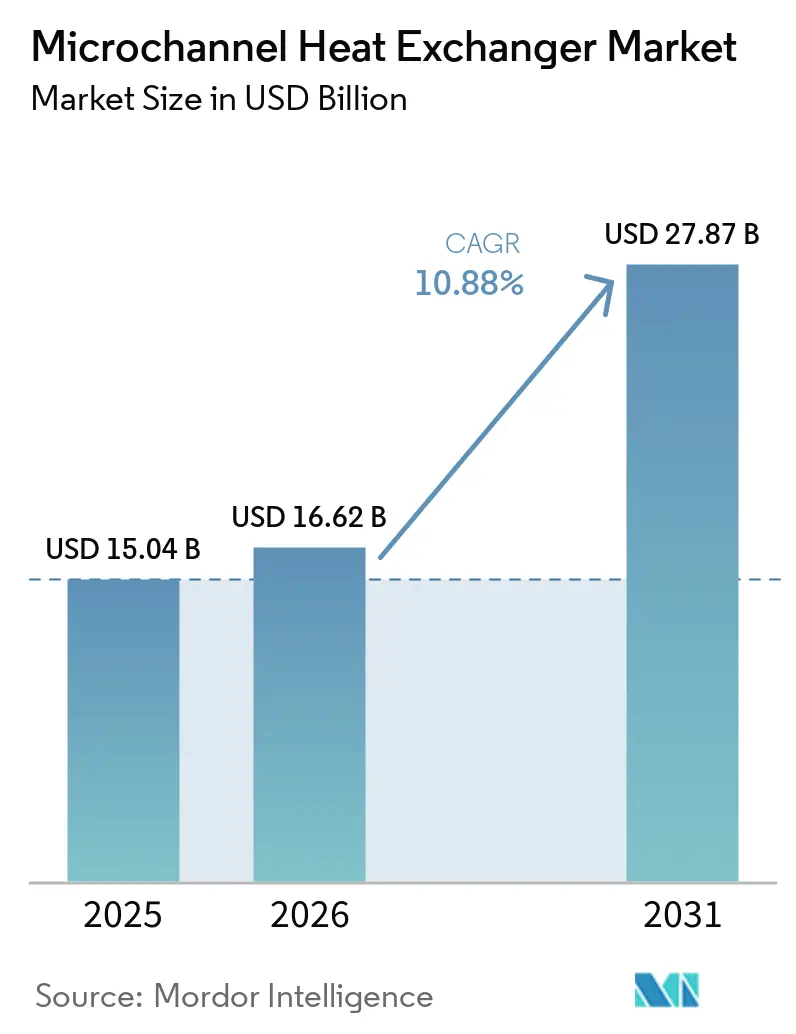
| Market Size (2026) | USD 16.62 Billion |
| Market Size (2031) | USD 27.87 Billion |
| Growth Rate (2026 - 2031) | 10.88 % |
| Fastest Growing Market | Asia-Pacific |
| Largest Market | North America |
| Market Concentration | Medium |
Major Players *Disclaimer: Major Players sorted in no particular order Image © Mordor Intelligence. Reuse requires attribution under CC BY 4.0. | |
Microchannel Heat Exchanger Market Analysis by Mordor Intelligence
The Microchannel Heat Exchanger Market size is expected to increase from USD 15.04 billion in 2025 to USD 16.62 billion in 2026 and reach USD 27.87 billion by 2031, at a CAGR of 10.88% over 2026-2031. Refrigerant rules, heat pump deployment, electric vehicle thermal systems, and data center cooling are raising demand for compact heat-transfer equipment. These demand sources rely on lower refrigerant charge, compact geometry, and high surface-area-to-volume performance. This combination makes the microchannel heat exchanger market less dependent on a single end use than in earlier cycles. Suppliers are responding through compatible refrigerant designs, coatings, custom geometry, and long-term original equipment manufacturer qualifications. Capacity, corrosion performance, and refrigerant validation remain important limits on how quickly supply can respond.
Key Report Takeaways
- By component, condensers held 46.4% of the microchannel heat exchanger market share in 2025, while water coils are projected to grow at an 11.6% CAGR through 2031.
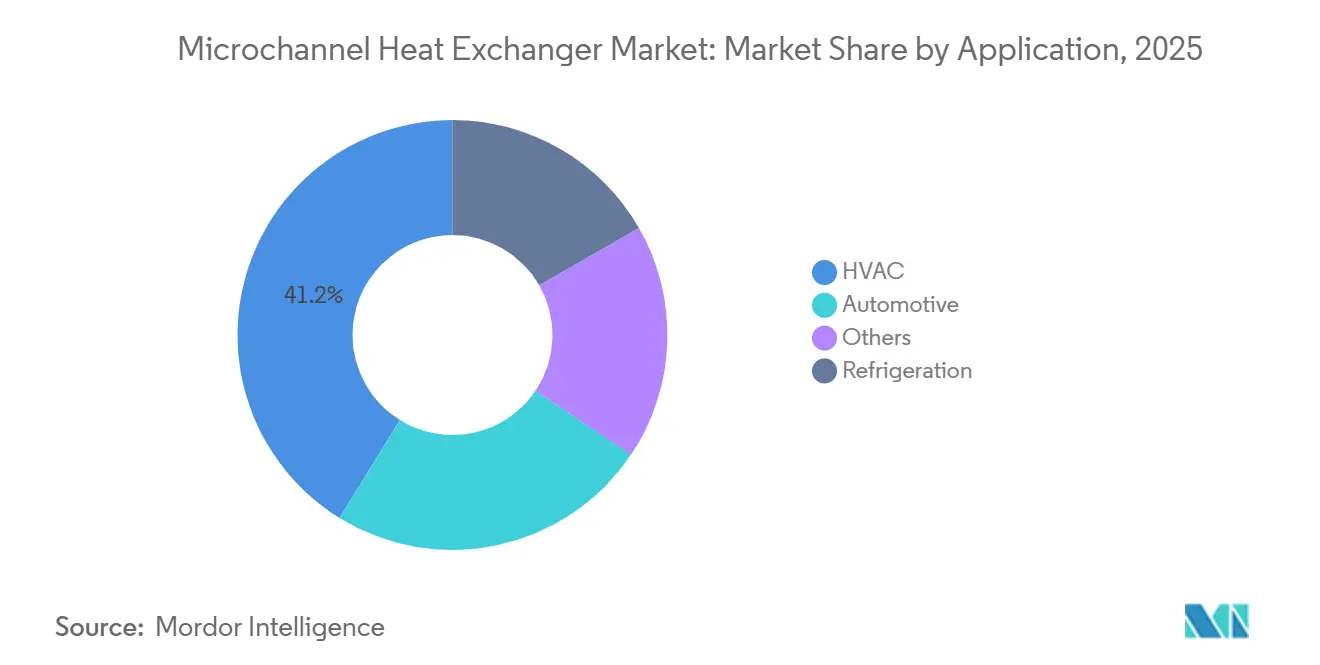
- By application, HVAC accounted for 41.2% of the microchannel heat exchanger market share in 2025, while automotive applications are forecast to grow at a 10.9% CAGR through 2031.
- By product type, air handling units held 34.3% of the microchannel heat exchanger market share in 2025, while heat pumps are projected to advance at an 11.4% CAGR through 2031.
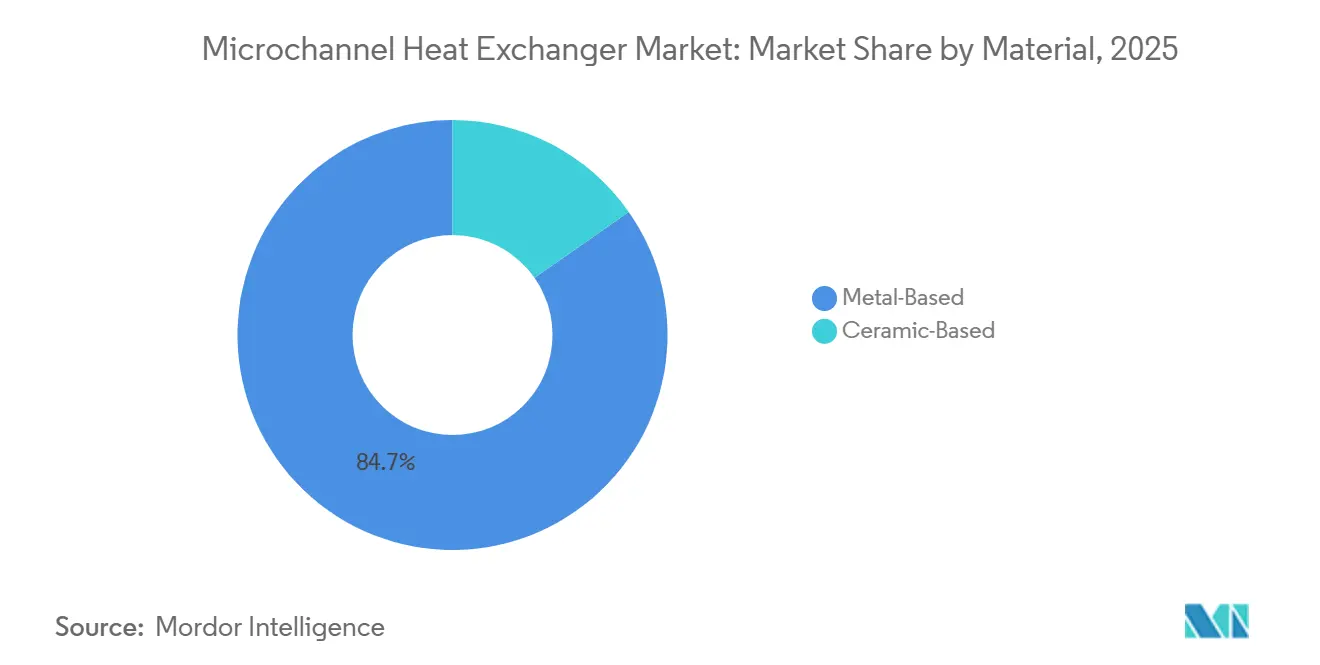
- By material, metal-based products accounted for 84.7% of the microchannel heat exchanger market share in 2025 and are forecast to grow at an 11.9% CAGR through 2031.
- By geography, North America held 31.2% of revenue in 2025, while Asia-Pacific is forecast to grow at a 12.2% CAGR through 2031.
Note: Market size and forecast figures in this report are generated using Mordor Intelligence’s proprietary estimation framework, updated with the latest available data and insights as of January 2026.
Global Microchannel Heat Exchanger Market Trends and Insights
Drivers Impact Analysis*
| Driver | % Impact on CAGR Forecast | Geographic Relevance | Impact Timeline |
|---|---|---|---|
| Energy-Efficiency Regulations and Refrigerant-Reduction Requirements | +2.50% | Global, concentrated in EU and North America | Medium term (2-4 years) |
| HVACR Replacement and Heat-Pump Deployment | +2.80% | Global, strongest in Europe, North America, and China | Medium term (2-4 years) |
| Automotive Electrification and Higher Thermal Loads | +2.20% | Global, strongest in APAC (China) and Europe | Medium term (2-4 years) |
| AI Data-Center Cooling and Rising Rack Power Density | +1.80% | North America, APAC core; spill-over to EU | Short term (≤ 2 years) |
| Retrofit-Ready Corrosion-Resistant Coils for Harsh Climates | +0.90% | MEA, coastal Southeast Asia, and Gulf States | Long term (≥ 4 years) |
| Additive and Automated Manufacturing for Application-Specific Geometries | +0.60% | North America and EU | Long term (≥ 4 years) |
| Source: Mordor Intelligence | |||
HVACR Replacement and Heat Pump Deployment
Heat pump adoption is creating a durable replacement cycle for the microchannel heat exchanger market. The International Energy Agency projects that global heat pump sales will more than double by 2035 under stated policy scenarios. More than 20% of U.S. households used heat pumps as their primary heating equipment in 2026[1]International Energy Agency, “Heat Pump Monitor 2026: Trends and Market Opportunities,” International Energy Agency, iea.org.. Japan's industrial heat pump capacity reached 650 MW in 2024, compared with 290 MW a decade earlier. Heat pump coils must work as condensers and evaporators, so stable drainage through frosting and defrosting cycles is becoming a basic product requirement. Kaltra introduced a reversible microchannel evaporator coil in October 2025 to address this operating condition.
Automotive Electrification and Higher Thermal Loads
Vehicle electrification is increasing the thermal duties handled by the microchannel heat exchanger market. A typical electric vehicle platform uses 3-5 microchannel components across battery, inverter, and cabin-conditioning systems. A 2025 study found that optimized manifold microchannel heat sinks reduced thermal resistance by 2.8% and pumping power by 27.3% compared with conventional microchannel designs. Hanon Systems supplied a 16 kg Highly Integrated Cooling Entity module for BMW's electric iX3 in March 2026. The assembly combines an eCompressor, water-cooled condenser, internal heat exchanger, chiller, lines, valves, and sensors. This move toward integrated systems concentrates procurement among suppliers that can meet brazing, leak-testing, and system engineering requirements.
Energy Efficiency Regulations and Refrigerant Reduction Requirements
Refrigerant policy is expanding the addressable replacement base for the microchannel heat exchanger market. EU Regulation 2024/573 took effect in March 2024 and restricts the servicing of certain air-conditioning equipment and heat pumps using refrigerants with a global warming potential of 2,500 or more from January 2026[2]European Commission, “Regulation (EU) 2024/573 of the European Parliament and of the Council on Fluorinated Greenhouse Gases,” EUR-Lex, eur-lex.europa.eu.. Lower refrigerant charge can help equipment designs work within safety limits for A2L and other flammable refrigerants. U.S. rules also place limits on higher-global-warming-potential refrigerants in new HVAC equipment. Germany's 2025 heating rules support heat pumps in new residential construction, which supports demand for heat-pump-grade coil designs. Early qualification for A2L and ultra-low-global-warming-potential refrigerants can therefore strengthen a supplier's position before equipment replacement accelerates.
AI Data Center Cooling and Rising Rack Power Density
Higher rack density is creating a separate source of demand for the microchannel heat exchanger market. NVIDIA GB200 NVLink72 configurations reached 190-230 kW per rack, while next-generation configurations target 600 kW to 1 MW. A 2026 peer-reviewed study validated manifold microchannel heat exchangers at heat dissipation levels up to 208 W/cm² for GPU-class packages[3]Hamidreza Saffari et al., “High-Heat-Flux Liquid Cooling of Electronics with Manifold Microchannels: Thermal-Hydraulic Optimization and Experimental Validation,” International Journal of Heat and Mass Transfer, doi.org.. HRL Laboratories also reported that hierarchical manifold designs can expand single-phase liquid cooling capacity for current and future artificial intelligence chips[4]HRL Laboratories, “Low-Chill: Hierarchical Manifolds for Data Center Chip Cooling,” HRL Laboratories, hrl.com.. Modine announced a USD 4 billion long-term capacity agreement through 2029 with a hyperscale customer in May 2026, supported by a USD 165 million upfront capacity payment. These commitments favor water coils and liquid-cooling components supported by multi-year capacity planning rather than seasonal order patterns.
Restraints Impact Analysis*
| Restraint | % Impact on CAGR Forecast | Geographic Relevance | Impact Timeline |
|---|---|---|---|
| Precision Manufacturing and Specialized Brazing Cost | -1.80% | Global; higher cost pressure in North America and EU | Medium term (2-4 years) |
| Durability, Fouling, and Corrosion Risk | -0.80% | MEA, Southeast Asia, and coastal markets globally | Long term (≥ 4 years) |
| Pressure-Drop and Pumping-Power Trade-Offs in High-Density Channels | -0.50% | Global; concentrated in industrial and data center use | Medium term (2-4 years) |
| Qualification Gaps for Flammable and Ultra-Low-GWP Refrigerants | -0.70% | EU and North America | Medium term (2-4 years) |
| Source: Mordor Intelligence | |||
Precision Manufacturing and Specialized Brazing Cost
Controlled-atmosphere brazing remains a practical barrier to entry in the microchannel heat exchanger market. The process requires controlled furnace conditions, and narrow temperature deviations can weaken joint fatigue performance. A high-volume controlled-atmosphere brazing line requires multi-million-dollar investment and lengthy equipment lead times. Multiport tube extrusion also requires precise tolerances that many adjacent heat exchanger manufacturers do not have. Labor, equipment, and material costs are particularly high in North America and Europe. Automation can lower costs through fin stacking and tube insertion, but investment in automation is also limited by available capital.
Durability, Fouling, and Corrosion Risk
Corrosion remains a material adoption concern for the microchannel heat exchanger market in coastal and industrial settings. Research from the University of Illinois found that external corrosion can raise airside thermal resistance by up to 350% in uncoated units after accelerated testing. The same work found bare-sample brazed-joint survival ranging from 0-16% in the test conditions. Narrow channels improve heat transfer but can make cleaning difficult in applications with scale-forming or particle-laden fluids. E-coating, sacrificial zinc layers, and external nano-coatings can improve protection, but uniform coating of complex channels remains difficult. Kaltra expanded its corrosion-resistant water coil range in May 2026 for data center and free-cooling installations facing demanding water chemistry and coastal conditions.
*Our forecasts treat driver/restraint impacts as directional, not additive. The impact forecasts reflect baseline growth, mix effects, and variable interactions.
Segment Analysis
By Component: Condensers Anchor Revenue as Water Coils Scale into Hydronic and Data Center Demand
Condensers held 46.4% of the microchannel heat exchanger market share in 2025. Their leading position reflects their role as the main air-side heat rejection component in split systems, rooftop equipment, and light-industrial refrigeration. The installed base gives condenser suppliers a replacement cycle that can support demand when new construction slows. Evaporators form the second-largest component group. They are used in heat pump indoor coils, electric vehicle cabin conditioning, and commercial refrigeration banks. Other components include auxiliary heat-rejection and subcooler circuits.
Water coils are forecast to grow at 11.6% CAGR from 2026 to 2031, the strongest component outlook in the microchannel heat exchanger market. Growth follows hydronic cooling expansion in data centers and liquid-circuit integration in heat pumps. Demand is linked to hyperscale capital commitments more than to housing starts or seasonal construction cycles. Kaltra expanded its water coil portfolio in May 2026 with thicker-wall multiport tubes, sacrificial zinc layers, nano-scale coatings, and one-piece headers. The product targets U.S. data centers, air handling units, and free-cooling systems. Free-cooling designs can reduce mechanical chiller operation and raise the importance of reliable water-side performance.
By Application: HVAC Sets the Volume Floor as Automotive Thermal Complexity Drives Premium Demand
HVAC held 41.2% of the microchannel heat exchanger market size in 2025. The application benefits from ongoing substitution of conventional fin-and-tube coils in efficient equipment. Heat pump installations replacing fossil-fuel heating systems also support demand. Refrigeration is the second application category and includes cold chain logistics, supermarkets, and process cooling. Lower refrigerant charge is important in many refrigeration installations. Industrial process cooling and data center cooling sit within the other applications category.
Automotive applications are projected to advance at a 10.9% CAGR through 2031 in the microchannel heat exchanger market. Battery thermal management, inverter cooling, and multi-circuit cabin conditioning create demand for integrated systems. DENSO maintained patent activity covering electric vehicle heat-exchanger designs and corrosion management for aluminum cooling circuits in 2024 and 2025. The Sanhua and Danfoss joint venture in Hangzhou serves residential and commercial air-conditioning equipment makers with microchannel condenser and evaporator products. Automotive designs require stronger pressure-cycle durability, lower weight, broader fluid compatibility, and more complex integration than many HVAC applications. These requirements make entry more difficult for suppliers that only serve HVAC customers.


By Product Type: AHUs Define Volume as Heat Pumps Capture Highest Growth and Margin Premium
Air handling units held 34.3% of the microchannel heat exchanger market share in 2025. They are used in commercial and institutional buildings where compact coils must support heating, cooling, and dehumidification. Fan coil units are widely used in hospitality, offices, and high-rise residential buildings where space is limited. Chillers and other equipment types complete the product mix. Chillers increasingly use microchannel condensers to lower refrigerant inventory in large commercial and district cooling systems. These established product groups keep demand broad across building types.
Heat pumps are forecast to grow at 11.4% CAGR through 2031, making them the fastest-growing product type in the microchannel heat exchanger market. Residential and light-commercial electrification programs in Europe and North America support the outlook. The coil must reverse between condenser and evaporator service during the year. Kaltra's October 2025 coil launch addressed frost, defrost, and reversible-duty performance. The IEA expects global heat pump sales to exceed twice their current level by 2035. Reversible, heat-pump-certified coils are therefore becoming an entry requirement for suppliers pursuing this equipment category.
By Material: Metal-Based Segment Spans Both Volume Leadership and Fastest Growth
Metal-based products held 84.7% of the microchannel heat exchanger market size in 2025 and are forecast to grow at 11.9% CAGR through 2031. Aluminum alloys dominate this category because they combine thermal conductivity, low weight, and controlled-atmosphere brazing compatibility. The material is used across HVAC, refrigeration, and automotive applications. Alloy selection is becoming more specialized as use cases diversify. Standard air-side condenser designs often use 3102 alloy. Electric vehicle liquid cooling needs higher corrosion resistance and structural performance in water-glycol conditions.
Ceramic-based designs represented the remaining 15.3% of the microchannel heat exchanger market share in 2025. They are concentrated in high-temperature and high-pressure applications where aluminum is less suitable. These applications include supercritical carbon dioxide cycles, advanced nuclear cooling, and aerospace thermal systems. A 2025 study demonstrated 3D-printed ceramic manifold microchannel heat sinks for water-cooled, high-temperature conditions. China's GB/T 47194-2026 standard, effective September 1, 2026, addresses materials, design, manufacturing, inspection, and additive manufacturing for microchannel heat exchangers. The standard may shorten qualification cycles for non-aluminum materials in Chinese industrial and energy applications.
Geography Analysis
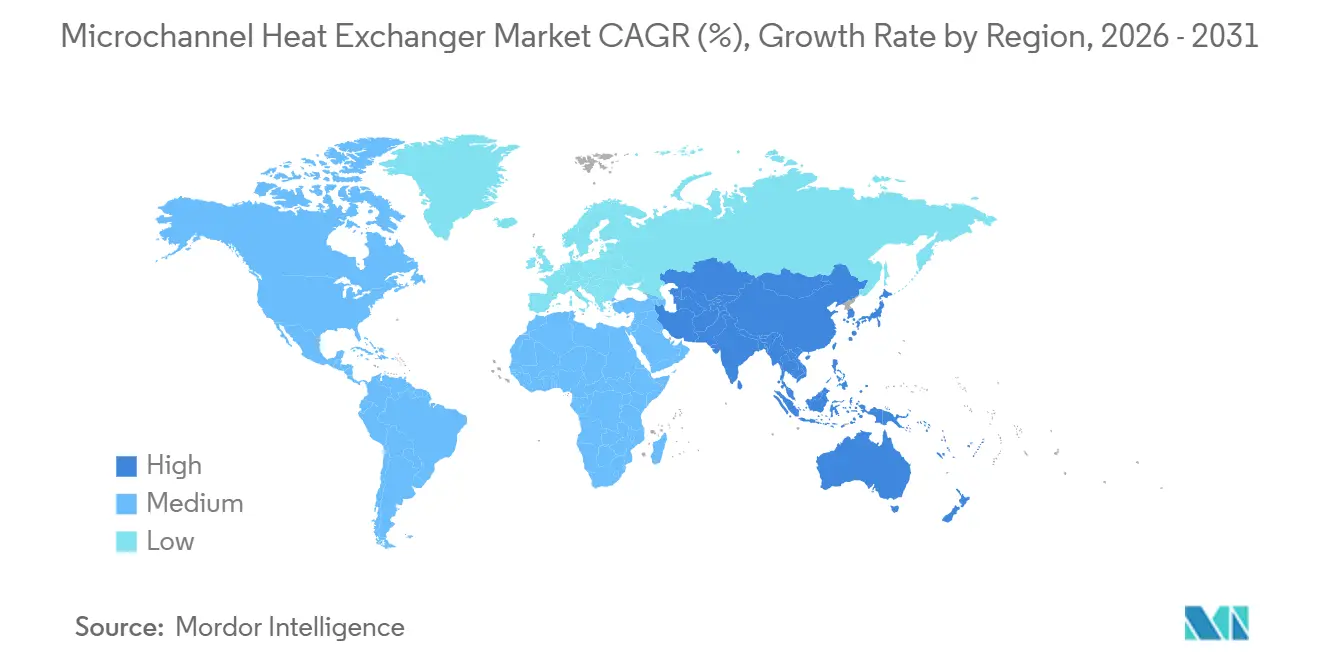
North America held 31.2% of the microchannel heat exchanger market share in 2025. U.S. energy conservation standards for commercial package air conditioners and heat pumps support a continuing equipment replacement cycle. More than 20% of U.S. households used heat pumps as their primary heating equipment in 2026. Data center cooling adds another demand channel that does not closely follow residential construction. Modine opened a 155,000-square-foot facility in Wisconsin during 2025 as part of a USD 100 million capacity investment. Canada adds residential electrified-heating demand, while Mexico contributes light-commercial and industrial HVAC volume.
Europe remains a technically demanding region for the microchannel heat exchanger market because its refrigerant policy is stringent. France, Germany, and Italy led European heat pump unit sales in 2025. The IEA reported a recovery in European heat pump markets during 2026 after contraction in 2024, with strong growth in Germany and Sweden. Germany's heating rules reinforce demand for heat-pump-ready equipment. DunAn's MPHX product has been deployed in Sweden and other European locations for low-charge R290 systems. The 2027 restriction on higher-global-warming-potential refrigerants in certain new monoblock heat pumps is accelerating compliant product qualification.
Asia-Pacific is forecast to expand at 12.2% CAGR from 2026 to 2031, the fastest regional rate in the microchannel heat exchanger market. China is the world's largest heat pump market, and urbanization in India, Vietnam, Indonesia, and Thailand supports commercial HVAC installation. China's 2026 standard can raise product consistency and shorten qualification processes across its supplier base. Japan's industrial heat pump capacity of 650 MW supports specialized industrial demand. DunAn opened vehicle thermal management and heat exchanger facilities in Thailand in January 2026. South America offers targeted refrigeration and residential air-conditioning demand, while the Middle East and Africa require corrosion-protected designs for district cooling and coastal climates.

Competitive Landscape
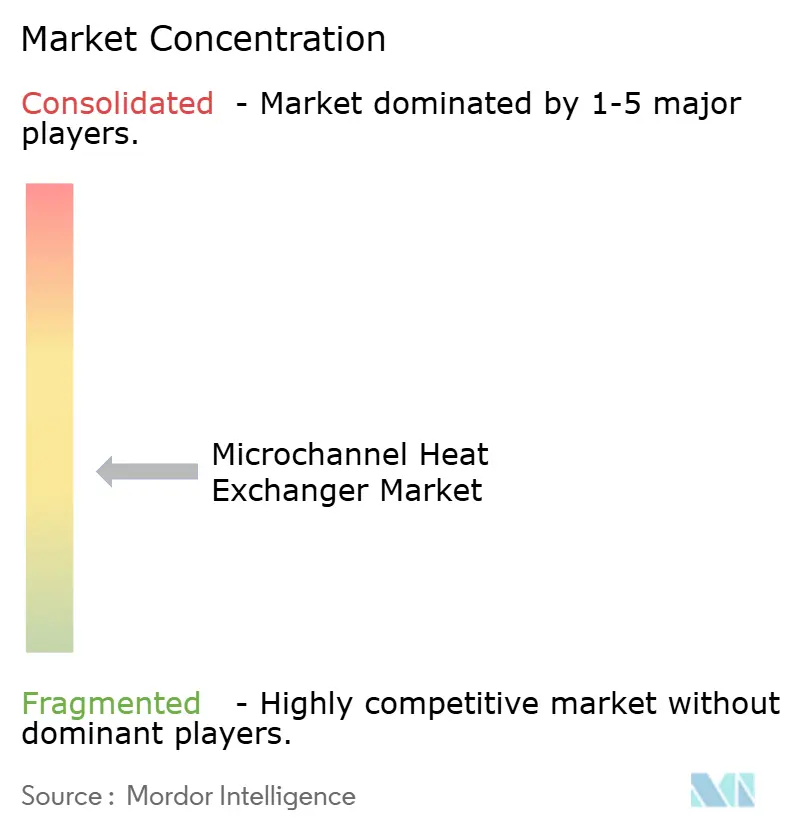
The microchannel heat exchanger market is semi-consolidated. Suppliers defend positions through refrigerant compatibility, original equipment manufacturer qualifications, coating technology, and precise manufacturing capability. Large thermal management groups compete with dedicated microchannel specialists and automotive component suppliers. Chinese producers, including Sanhua and Zhejiang DunAn, are expanding through heat pump supply programs in Europe and manufacturing investment in Southeast Asia. Their scale and rapid geometry customization are important in standard residential applications. Western suppliers remain better placed in some specialized products that require complex validation, corrosion performance, or system integration.
Kaltra has pursued application-specific products across several cycles. It introduced A2L-compatible low-charge coil geometry in June 2024 and reversible heat-pump coils in October 2025. It expanded its corrosion-resistant water coil line for data centers and free-cooling uses in May 2026. Sanhua received U.S. Patent 12546539 in February 2026 for a heat exchange apparatus that integrates a refrigerant adjustment container with the header system. Daikin received U.S. Patent 12583042 in March 2026 for a laminated and brazed header assembly used in heat pump equipment. These actions raise the qualification burden on competing designs.
Additive manufacturing represents an opening for suppliers seeking custom geometry without conventional tooling. A 2025 study demonstrated artificial intelligence-assisted rapid prototyping of 3D-printed microchannel heat exchangers with application-specific channels. This approach can reduce prototype time from weeks to days. It does not yet match conventional brazing on cost at high production volume. Capacity investment in controlled-atmosphere brazing, leak testing, and coating lines remains central for high-volume production. Suppliers active in HVAC, automotive, and data center cooling are better protected from changes in any single end-use cycle. Market concentration score: 5 out of 10, as the field includes large groups, specialists, and integrated automotive suppliers, with no top-player combined-share data showing the thresholds for a more concentrated score.
Microchannel Heat Exchanger Industry Leaders
Alfa Laval AB
Zhejiang DUNAN Artificial Environment Co. Ltd.
Daikin Industries Ltd.
API Heat Transfer Inc.
Danfoss A/S
- *Disclaimer: Major Players sorted in no particular order

Recent Industry Developments
- May 2026: Modine Manufacturing Company announced a USD 4 billion Long-Term Capacity Agreement through 2029 with a strategic hyperscale data center customer for Airedale by Modine cooling solutions. The customer paid USD 165 million upfront to fund capacity investments required to meet the supply commitment, reflecting the degree to which major data center operators are securing long-duration thermal management supply rather than relying on spot procurement.
- May 2026: Kaltra expanded its microchannel water coil product line with a new corrosion-resistant multiport tube generation featuring thicker walls, a sacrificial zinc protective layer, and nano-scale coatings on both internal and external tube surfaces. The product launch targets U.S. data centers, air handling units, industrial facilities, and free-cooling applications requiring long service life in aggressive water chemistry and coastal environments.
- March 2026: Hanon Systems announced the supply of its Highly Integrated Cooling Entity module for BMW's fully electric iX3, consolidating 7 refrigerant-circuit components, including eCompressor, water-cooled condenser, internal heat exchanger, chiller, and AC lines, into a single 16 kg assembly. The module dynamically manages thermal demands across fast charging, high-performance driving, and extreme weather simultaneously, representing a new architecture standard for EV thermal integration.
- February 2026: MAHLE GmbH introduced HeatX Range+, an EV heat-recovery system that captures heat from outgoing cabin air through the AC evaporator and uses it to preheat incoming fresh air via R1234yf refrigerant, reducing cabin heating energy demand by up to 20% and extending cold-weather driving range by 10 km.


Global Microchannel Heat Exchanger Market Report Scope
A microchannel heat exchanger (MCHE) is a compact heat transfer device that uses multiple small-diameter channels to efficiently transfer heat between two fluids, typically a refrigerant and air or another liquid. The channels’ small hydraulic diameter creates a high surface-area-to-volume ratio, enabling efficient heat transfer while reducing refrigerant use, material consumption, and space requirements. Manufacturers commonly construct MCHEs from aluminum or aluminum alloys. These heat exchangers typically comprise flat multi-port tubes, fins, headers, and manifolds. They are widely used in HVAC and refrigeration systems, automotive thermal management, heat pumps, air conditioning systems, and industrial cooling applications.
The microchannel heat exchanger market is segmented by component, application, product type, material, and geography. By component, the market is segmented into evaporator, condenser, water coil, and others. By application, the market is segmented into HVAC, automotive, refrigeration, and others. By product type, the market is segmented into air handling units, heat pumps, fan coil units, chillers, and others. By material, the market is segmented into metal-based and ceramic-based. The report also covers the market size and forecasts for the global microchannel heat exchanger market across 26 countries in key regions. For each segment, the market sizing and forecasts have been provided on the basis of value (USD).
| Evaporator |
| Condenser |
| Water Coil |
| Other Components |
| HVAC |
| Automotive |
| Refrigeration |
| Others |
| Air Handling Units |
| Heat Pumps |
| Fan Coil Units |
| Chillers |
| Other Product Types |
| Metal-Based |
| Ceramic-Based |
| North America | United States |
| Canada | |
| Mexico | |
| Europe | Germany |
| France | |
| Italy | |
| Spain | |
| United Kingdom | |
| Poland | |
| Russia | |
| Rest of Europe | |
| Asia-Pacific | China |
| India | |
| Japan | |
| South Korea | |
| Australia | |
| Indonesia | |
| Vietnam | |
| Thailand | |
| Rest of Asia-Pacific | |
| South America | Brazil |
| Argentina | |
| Chile | |
| Rest of South America | |
| Middle East and Africa | Saudi Arabia |
| United Arab Emirates | |
| Egypt | |
| South Africa | |
| Morocco | |
| Rest of Middle East and Africa |
| By Component | Evaporator | |
| Condenser | ||
| Water Coil | ||
| Other Components | ||
| By Application | HVAC | |
| Automotive | ||
| Refrigeration | ||
| Others | ||
| By Product Type | Air Handling Units | |
| Heat Pumps | ||
| Fan Coil Units | ||
| Chillers | ||
| Other Product Types | ||
| By Material | Metal-Based | |
| Ceramic-Based | ||
| By Geography | North America | United States |
| Canada | ||
| Mexico | ||
| Europe | Germany | |
| France | ||
| Italy | ||
| Spain | ||
| United Kingdom | ||
| Poland | ||
| Russia | ||
| Rest of Europe | ||
| Asia-Pacific | China | |
| India | ||
| Japan | ||
| South Korea | ||
| Australia | ||
| Indonesia | ||
| Vietnam | ||
| Thailand | ||
| Rest of Asia-Pacific | ||
| South America | Brazil | |
| Argentina | ||
| Chile | ||
| Rest of South America | ||
| Middle East and Africa | Saudi Arabia | |
| United Arab Emirates | ||
| Egypt | ||
| South Africa | ||
| Morocco | ||
| Rest of Middle East and Africa | ||


Key Questions Answered in the Report
What is the projected value of microchannel heat exchangers by 2031?
The sector is forecast to reach USD 27.87 billion by 2031, growing at a 10.88% CAGR from 2026.
Which component has the strongest growth outlook?
Water coils are projected to grow at an 11.6% CAGR through 2031, supported by data center hydronic cooling and heat pump liquid circuits.
Why are microchannel coils important for heat pumps?
They can reduce refrigerant charge and fit compact equipment designs. Heat-pump coils also need reliable reversible operation through frosting and defrosting cycles.
Which application is growing the fastest?
Automotive applications are forecast to grow at a 10.9% CAGR through 2031 as electric vehicles add battery, inverter, and cabin thermal management functions.
Which region is expanding most quickly?
Asia-Pacific is forecast to grow at a 12.2% CAGR through 2031, supported by China and expanding commercial HVAC demand across South and Southeast Asia.
What are the main risks for suppliers?
High controlled-atmosphere brazing costs, corrosion, fouling, pressure-drop trade-offs, and refrigerant qualification gaps can limit deployment.
Page last updated on:





