
Mexico Project Logistics Market Size and Share
Market Overview
| Study Period | 2020 - 2031 |
|---|---|
| Forecast Data Period | 2026 - 2031 |
| Base Year Market Size (2025) | USD 1.24 Billion |
| Market Size (2026) | USD 1.31 Billion |
| Market Size (2031) | USD 1.69 Billion |
| Growth Rate (2026 - 2031) | 5.19 % |
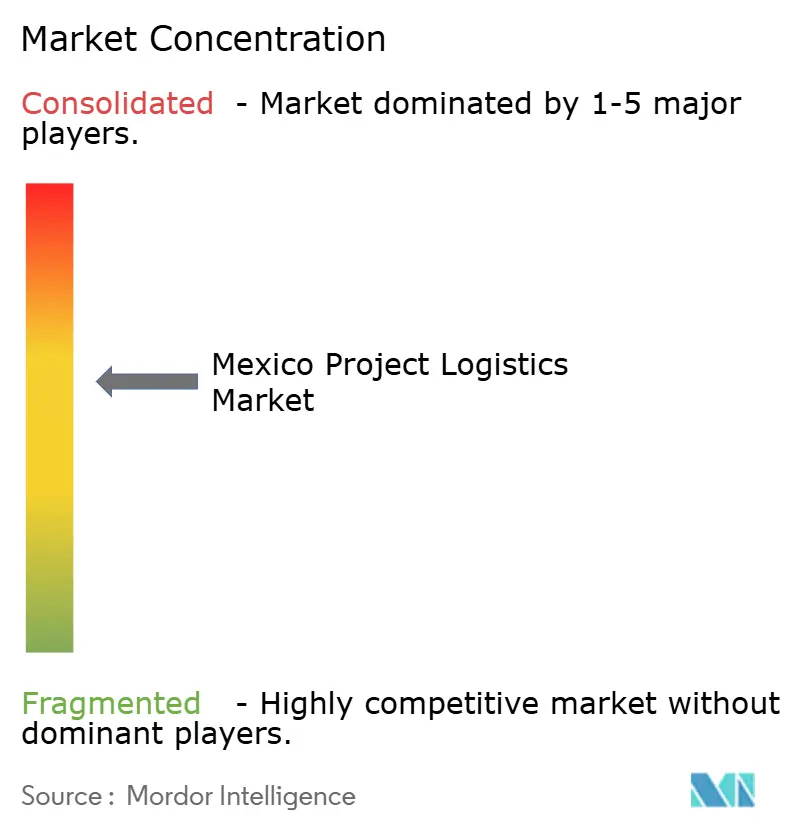
| Market Concentration | Medium |
Major Players *Disclaimer: Major Players sorted in no particular order Image © Mordor Intelligence. Reuse requires attribution under CC BY 4.0. | |
Mexico Project Logistics Market Analysis by Mordor Intelligence
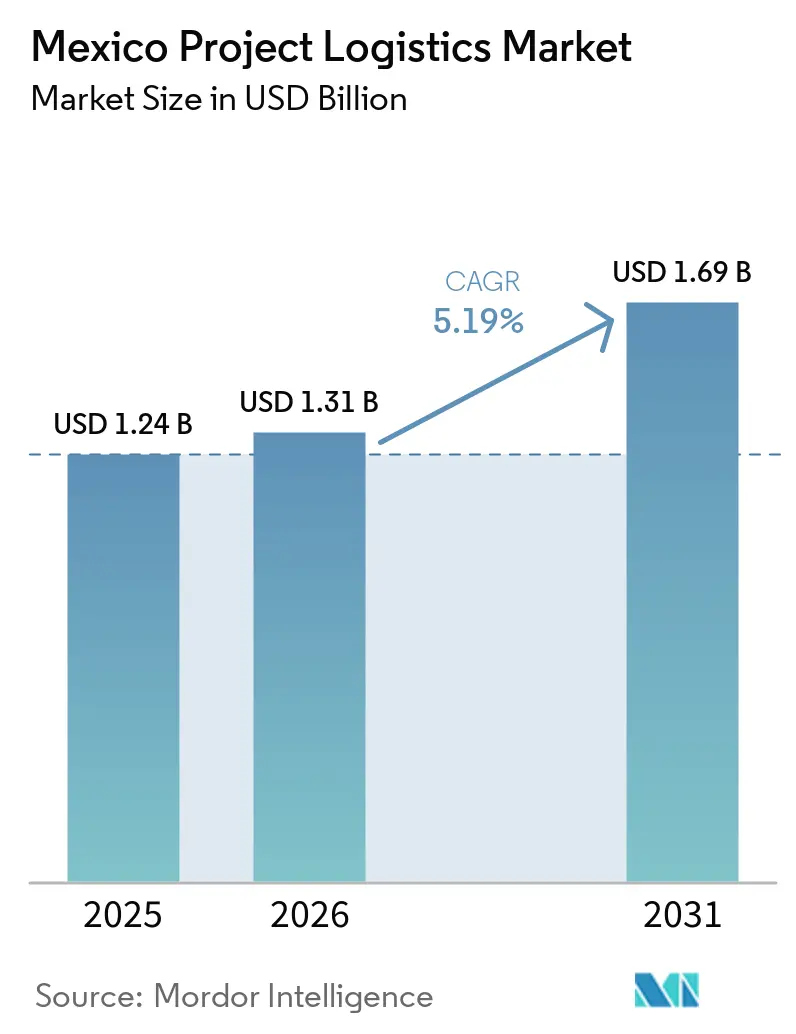
The Mexico project logistics market size was valued at USD 1.24 billion in 2025, and is estimated to grow from USD 1.31 billion in 2026 to reach USD 1.69 billion by 2031 at a CAGR of 5.19% during the forecast period (2026-2031).
Nearshoring investment is increasing demand for equipment imports, plant installation, utility upgrades, and later expansion work. Renewable power projects and grid upgrades are also increasing the need for specialized handling of large and sensitive equipment. Port and border capacity projects can improve the timing and reliability of project deliveries. Providers that combine route planning, permits, transport, and site coordination can address a broader set of client needs. Security exposure, permit delays, and trade-rule uncertainty continue to make local operating knowledge important in the Mexico project logistics market.
Key Report Takeaways
- By service, transportation held 68.25% of the Mexico project logistics market share in 2025, while value-added services are forecast to grow at a 5.97% CAGR through 2031.
- By transportation mode, road freight held 51.43% of the Mexico project logistics market size in 2025, while air freight is forecast to grow at a 5.77% CAGR through 2031.
- By cargo type, breakbulk held 35.05% of the Mexico project logistics market share in 2025, while oversized cargo is forecast to grow at a 5.76% CAGR through 2031.
- By end-user industry, energy generation and transmission held 34.28% of the Mexico project logistics market size in 2025, while aerospace and defense is forecast to grow at a 6.47% CAGR through 2031.
Note: Market size and forecast figures in this report are generated using Mordor Intelligence’s proprietary estimation framework, updated with the latest available data and insights as of January 2026.
Mexico Project Logistics Market Trends and Insights
Drivers Impact Analysis*
| Driver | (~) % Impact on CAGR Forecast | Geographic Relevance | Impact Timeline |
|---|---|---|---|
| Nearshoring-Led Industrial Project Expansion | +1.5% | Bajio, Monterrey, Guadalajara, and northern border states | Medium term (2-4 years) |
| Renewable Energy and Grid Modernization Cargo | +1.2% | Yucatan, Campeche, Tamaulipas, Oaxaca, and Gulf and Pacific coasts | Long term (≥ 4 years) |
| Port and Border-Corridor Capacity Expansion | +0.8% | Tamaulipas, Nuevo Leon, Colima, Michoacan, and Veracruz | Medium term (2-4 years) |
| Multimodal Integration for Heavy and Oversized Cargo | +0.7% | National, focused on the Isthmus of Tehuantepec and Pacific-Atlantic corridors | Medium term (2-4 years) |
| Last-Mile Route Engineering for Industrial Corridors | +0.5% | Bajio corridors and northern manufacturing hubs | Short term (≤ 2 years) |
| Digital Permit, Route-Survey, and Project-Control-Tower Adoption | +0.4% | National | Short term (≤ 2 years) |
| Source: Mordor Intelligence | |||
Nearshoring-Led Industrial Project Expansion
Mexico project logistics market demand is supported by new factories that require more than an initial delivery of imported machinery. Factory commissioning is followed by expansion modules, utility work, production-line additions, and nearby supplier-park construction. These activities can extend the logistics requirement across several years after an investment decision and create separate jobs at different project stages. AMPIP reported 82 industrial parks under construction and 491 operating parks, which together hosted more than 4,000 companies across over 90 million square meters of built space[1]. The pipeline requires delivery of heavy equipment, modular structures, utility materials, and specialized installation components across established and emerging manufacturing corridors. Supplier clustering in Bajio, Monterrey, and Guadalajara also creates smaller specialized shipments that still require route planning, reliable site access, and regulatory compliance.
Renewable Energy and Grid Modernization Cargo
The Mexico project logistics market is gaining a more complex energy cargo requirement as battery energy storage systems join wind and transformer movements. The June 2026 mixed-development tender awarded 7.41 GW of renewable capacity, and the applicable planning framework requires projects to include grid-scale battery storage[2]. Battery units require temperature management, careful handling, and equipment transport planning alongside the established needs of wind and grid cargo. The La Esperanza Solar project in Campeche began construction in August 2026 with a 420 MWdc solar plant and a 150 MW storage system. Its peninsular location increases the need to review inland access, equipment staging, and final delivery arrangements before cargo reaches the port. SENER's Electricity Sector Development Plan for 2025-2039 calls for 19,954 MW of renewable additions and 5,000 MW of storage by 2030, giving operators a clearer basis for long-term capacity planning.
Port and Border-Corridor Capacity Expansion
Border and port investment can reduce delays that affect the timing of specialized deliveries in the Mexico project logistics market. Tamaulipas began construction on the World Trade Bridge expansion in Nuevo Laredo during the second half of 2026. The crossing is planned to increase from 8 to 18 commercial cargo lanes, which can improve capacity at a key connection for industrial freight. Tamaulipas officials estimate that the corridor handles 50% of Mexico's cargo transport. APM Terminals committed more than USD 350 million to advance Phase III at Lazaro Cardenas in response to congestion at Manzanillo. The investment points to infrastructure capacity as a constraint on how quickly freight networks can support new factories, energy projects, and project cargo movements.
Multimodal Integration for Heavy and Oversized Cargo
The Interoceanic Corridor of the Isthmus of Tehuantepec began full operations in 2026 with a 1,200-kilometer rail connection between Salina Cruz and Coatzacoalcos. The route creates an additional option for project cargo moving to southern and southeastern Mexico, where transport choices have been more limited. Development Poles along the corridor are intended to support automotive, energy, semiconductor, and pharmaceutical activity. Each location can require inbound equipment, site deliveries, and logistics support as construction and commissioning progress. CMA CGM also launched a block-train service linking Lazaro Cardenas, Manzanillo, Veracruz, and inland destinations. Its 4 weekly departures are intended to reduce port dwell time and offer more predictable transit windows for cargo with fixed project schedules.
Restraints Impact Analysis*
| Restraint | (~) % Impact on CAGR Forecast | Geographic Relevance | Impact Timeline |
|---|---|---|---|
| Multi-Jurisdictional Permit and Clearance Complexity | -0.7% | National, most acute across central and southern authority overlaps | Medium term (2-4 years) |
| Limited Heavy-Lift Infrastructure Outside Core Corridors | -0.5% | Southern Mexico and secondary corridors outside Monterrey, Bajio, and Pacific port hubs | Long term (≥ 4 years) |
| Last-Mile Road, Bridge, and Utility-Interference Constraints | -0.4% | National, concentrated in rural, mountainous, and secondary urban corridors | Short term (≤ 2 years) |
| Security, Detention, and Weather-Related Schedule Volatility | -0.6% | Central Mexico and Bajio for security, and the Gulf Coast and Yucatan Peninsula for weather | Short term (≤ 2 years) |
| Source: Mordor Intelligence | |||
Multi-Jurisdictional Permit and Clearance Complexity
The Mexico project logistics market operates within a permitting system that involves federal, state, and municipal authorities. SICT issues general permits for oversized and overweight transport, while state agencies handle route approvals, and municipalities can control specific road sections. The sequence can delay movements that cross several jurisdictions because permissions, engineering information, and local conditions need to be addressed in order. Loads above 90 metric tons generally require 45-60 days for permits, route surveys, bridge assessments, and utility clearances. Operators need to also account for holiday-period permit suspensions, including Christmas and Holy Week, when preparing a delivery calendar. Northern industrial states often have more established operating relationships, while central and southern routes can carry a higher administrative burden.
Security, Detention, and Weather-Related Schedule Volatility
A delay involving a transformer, turbine nacelle, or reactor vessel can interrupt a construction schedule well beyond the value of the cargo itself. According to report in March 2026, cargo theft caused MXN 7 billion (USD 389.41 million) economic loss annually in Mexico[3]. The National Guard's Zero Cargo Transportation Thefts program has used Vehicle Inspection Towers on selected routes to support monitoring and enforcement. Coverage is focused on major highways, while remote energy and industrial locations can depend on secondary roads with fewer protections. Tropical cyclones can disrupt Gulf Coast port discharge schedules, and high temperatures can restrict heavy-haul movements during warmer periods. Project owners, therefore, increasingly expect alternative routes, schedule buffers, and cargo monitoring as part of a delivery plan rather than as optional services.
*Our forecasts treat driver/restraint impacts as directional, not additive. The impact forecasts reflect baseline growth, mix effects, and variable interactions.
Segment Analysis
By Service: Transportation Leads Current Revenue While Value-Added Services Expand
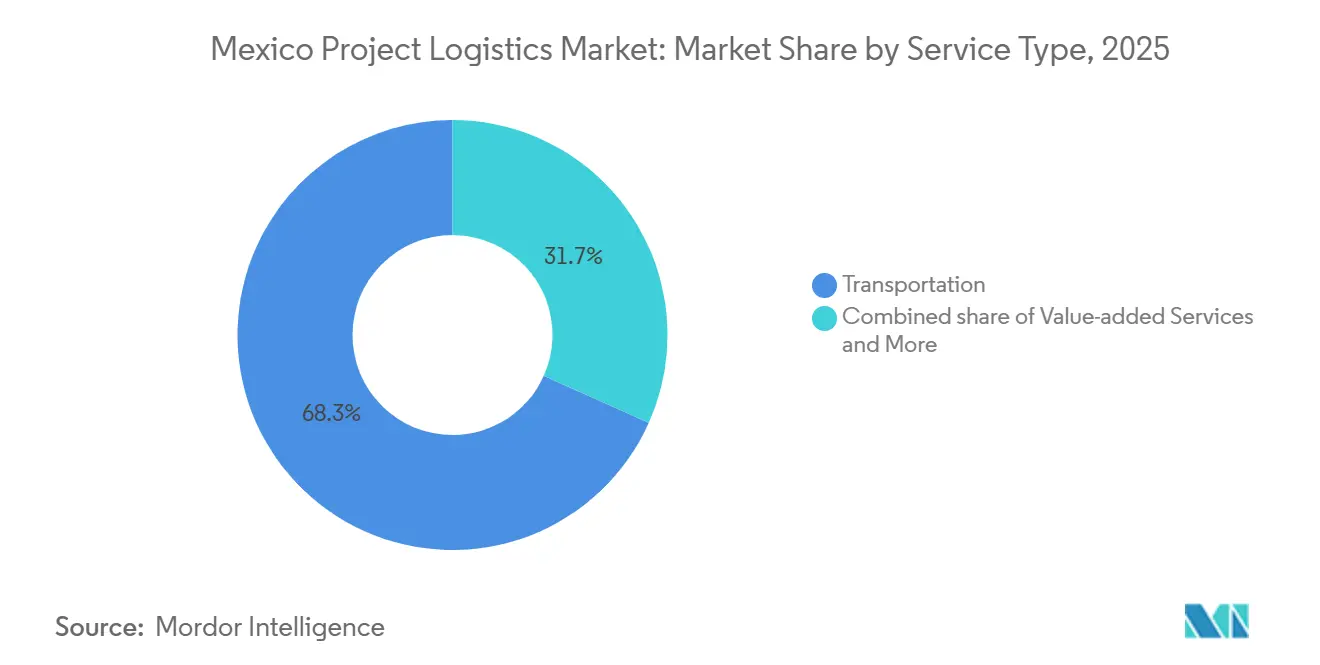
Transportation held 68.25% of the Mexico project logistics market share in 2025 and remained the largest service component of the Mexico project logistics market. Its position reflects the cost, planning effort, and specialized equipment needed to move engineered cargo from a port to a project site. Road haulage is central because highway corridors link deepwater ports with inland industrial parks, while oversized loads require permits and experienced operators. Rail gained importance when the Interoceanic Corridor became operational in early 2026 and created a route between the Pacific and Gulf coasts. Sea and inland waterways provide the entry role at Manzanillo, Altamira, Lazaro Cardenas, and Veracruz, where the condition and timing of cargo discharge shape subsequent delivery work.
Value-added services are forecast to grow at a 5.97% CAGR from 2026 to 2031. Project owners are seeking contracts that bring transportation, route engineering, customs management, cargo monitoring, and site coordination into a single service arrangement. This model reduces the need for clients to manage several providers during a time-sensitive equipment move and aligns delivery responsibility with project milestones. Ferrovalle selected INFORM's Syncrotess Optimization Plus platform for Smart Yard management at its Mexico City intermodal hub in September 2026. The deployment shows that coordinated cargo control, including visibility across rail and yard activity, is becoming a practical requirement for complex projects.

By Transportation Mode: Road Haulage Leads While Air Freight Gains Importance
Road freight held 51.43% of the Mexico project logistics market size in 2025, making it the leading transportation mode in the Mexico project logistics market. Most large cargo unloaded at a seaport needs to complete its final leg by road because manufacturing plants, energy facilities, and infrastructure sites are generally inland. Operators use self-propelled modular transporters, low-bed convoys, and specialized trailers to match the weight, dimensions, and road conditions of each shipment. Road movements face demanding permit requirements because federal and state approvals can both be needed, and route work can include bridge and utility reviews. Established permit-management capability and local operating experience, therefore, remain practical advantages for providers serving this mode.
Air freight is forecast to grow at a 5.77% CAGR from 2026 to 2031. Aerospace and defense manufacturing needs documented custody, controlled handling, and short transit times for precision parts moving between Mexican production clusters and customers in the United States. Queretaro, Chihuahua, Baja California, Sonora, and Nuevo Leon support these time-sensitive flows as the cargo mix includes more engine components and high-precision rotating parts. Sea and inland waterways remain essential for wind nacelles, transformers, and modular plant equipment because ports begin the wider project cargo sequence. DSV deployed electric trucks on the Dallas-Laredo route in early 2026, indicating an early move toward lower-emission road operations on an important cross-border gateway.
By Cargo Type: Breakbulk Holds the Largest Position While Oversized Cargo Grows
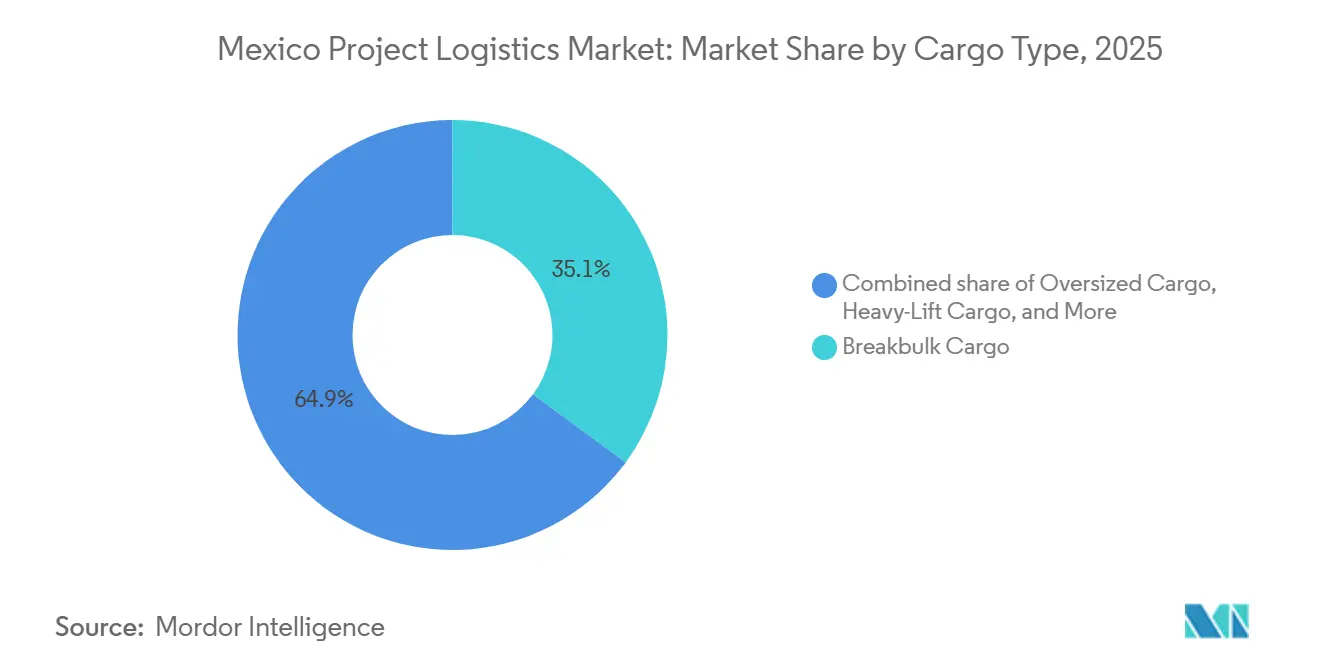
Breakbulk held 35.05% of the Mexico project logistics market share in 2025, giving it the largest cargo-type position in the Mexico project logistics market. Industrial presses, process columns, heat exchangers, modular skids, and transmission towers frequently cannot be containerized and need specialized berth discharge and shore-crane work. Each load also needs an engineered inland transport plan that accounts for dimensions, weight, road access, and delivery conditions at the project site. Nearshoring and energy construction create recurring breakbulk movements across industrial, power, and offshore supply chains. The Trion ultra-deepwater oil project requires offshore equipment to move through Altamira in 2026, while heavy-lift work also includes reactor vessels, compressor skids, and turbine-generator positioning.
Oversized cargo is forecast to grow at a 5.76% CAGR from 2026 to 2031. Wind blades measuring 60-70 meters and nacelles weighing more than 100 metric tons place added pressure on port handling, road access, and route engineering. The Dolores Wind Farm in Nuevo Leon received 65-meter blades in November 2025 through Texas ports before delivery under multi-agency permits. The 2026 renewable tender is creating additional planned movements in Yucatan, Tamaulipas, Oaxaca, and Campeche, where established heavy-haul capacity is more limited. Providers who prepare route surveys, utility plans, permits, staging, and delivery schedules before equipment arrives can better manage these projects.
By End-User Industry: Energy Leads Demand While Aerospace and Defense Grows Fastest
Energy generation and transmission held 34.28% of revenue in 2025, leading end-user demand in the Mexico project logistics market. Renewable developments, grid modernization, LNG projects, and oil and gas maintenance each need specialized cargo support and frequently require different handling and safety procedures. Sempra Infrastructure shipped its first LNG cargo from ECA LNG Phase 1 in Ensenada in July 2026 after a project requiring cryogenic equipment delivery and marine operations. Civil works also began for the URSUS Energy LNG project in the Coatzacoalcos II Development Pole in early 2026, adding a future cargo point in southern Mexico. Construction and infrastructure programs provide related work through port upgrades, road projects, utility installations, and industrial-park development.
Aerospace and defense is forecast to grow at a 6.47% CAGR from 2026 to 2031. Clusters in Queretaro, Chihuahua, Baja California, Sonora, and Nuevo Leon serve companies including GE Aerospace, Airbus, Bombardier, and Safran. These operations require precision handling, documented quality controls, and compliance with aerospace and defense requirements, which favor carefully managed transport arrangements. GE Aerospace invested USD 44.7 million in its Hermosillo and Saltillo facilities during 2026, while factory commissioning and expansion also support demand from manufacturing clients. Oil, gas, and mining continue to generate breakbulk and heavy-lift needs for maintenance, exploration, and offshore development work.
Geography Analysis
Northern Mexico is the country's most developed project logistics zone, supported by a large concentration of manufacturing investment and cross-border freight activity. The Monterrey-Saltillo corridor supports automotive and heavy-industry expansion, which requires machinery deliveries and permit coordination. The Laredo-Nuevo Laredo crossing handles 50% of Mexico's cargo transport and is a central gateway for the Mexico project logistics market. Construction on the World Trade Bridge expansion to 18 commercial lanes began in the second half of 2026, and the work might relieve pressure at a crossing that was heavily used and essential to cross-border projects[4]. Baja California adds a Pacific Coast route for aerospace cargo, LNG support, and port-related work.
The Bajio region includes Queretaro, Guanajuato, Aguascalientes, and San Luis Potosi. It has drawn sustained manufacturing investment and new industrial-park construction, while AMPIP's 82-project pipeline creates delivery work for modular equipment, production lines, and utility installations. These shipments can feed the Mexico project logistics market as facilities move from construction to commissioning. Guadalajara adds demand for controlled transportation of cleanroom equipment, server infrastructure, and high-value electronics. Mexico City and the surrounding State of Mexico require complex urban delivery planning and are also a major cargo-theft concentration area.
The Gulf Coast and southeastern regions center on Veracruz, Altamira-Tampico, and the Isthmus of Tehuantepec. They support oil, gas, LNG, and energy-infrastructure activity that requires large components to move from ports to challenging sites. The Interoceanic Corridor improved access to Oaxaca, Chiapas, Tabasco, and Veracruz in 2026, and its Development Poles are intended to attract energy, automotive, and pharmaceutical investment. Maersk opened an integrated logistics hub in Guadalajara in March 2026 to strengthen movement from Pacific entry points toward inland destinations, while Campeche and Yucatan are gaining new demand as renewable development expands.
Competitive Landscape
The Mexico project logistics market is moderately concentrated. Global multimodal providers compete with domestic heavy-haul specialists. Domestic firms often have local permit knowledge, established corridor relationships, and specialized equipment that can take years to develop and can be difficult to replace quickly. Global providers are building warehousing, cross-border capacity, and multimodal platforms. Their aim is to offer a broader service arrangement to clients who prefer a single provider.
A.P. Moller-Maersk opened a logistics depot near the Port of Manzanillo in December 2025. The site covers 31,000 square meters and is designed to reduce first- and last-mile bottlenecks. Maersk also developed an integrated logistics hub in Guadalajara during March 2026, connecting Pacific gateways with inland industrial destinations. Ferrovalle's September 2026 agreement with INFORM added Smart Yard management at its Mexico City intermodal hub. The arrangement supports better coordination of rail freight movements and site operations.
Domestic specialists are modernizing equipment with hydraulic gantries, self-propelled modular transporters, and 48-axle configurations. These tools support in-plant rigging and complex corridor movements, and global integrators may still subcontract this engineering-intensive work. GPS tracking and dashcams are basic features, while route risk, permit status, weather, and cargo-condition data are being brought together through digital control systems. Customs pre-clearance arrangements can also reduce port dwell time. Southern Development Poles and the Yucatan renewable belt remain areas where providers can build local capacity before project awards create larger demand.
Mexico Project Logistics Industry Leaders
-
A.P. Moller - Maersk
-
DHL Group
-
Kuehne+Nagel International AG
-
DSV A/S
-
GEODIS
- *Disclaimer: Major Players sorted in no particular order
Recent Industry Developments
- July 2026: CMA CGM agreed to acquire FedEx Supply Chain. The transaction may nearly triple CEVA Logistics' North American contract logistics footprint by adding approximately 150 warehouses and 20,000 employees across more than 240 locations, strengthening CMA CGM's ability to serve Mexico's nearshoring-driven industrial project pipeline with integrated ocean-to-inland logistics.
- February 2026: DHL Supply Chain entered into a five-year strategic alliance with Robust.AI to deploy Carter collaborative robots across its retail logistics operations in Mexico. This was the first deployment of this robotic technology in DHL's Latin American operations and established the infrastructure for broader robotic automation expansion across the Americas region.
- December 2025: A.P. Moller – Maersk inaugurated a USD 15 million logistics depot spanning 31,000 square meters near the Port of Manzanillo. The facility was designed to reduce first- and last-mile bottlenecks between Mexico's busiest container port and its inland industrial distribution corridors.
- May 2025: Tradelossa completed the transport of a 282-ton power transformer from the Port of Altamira, Tamaulipas, to a client facility in Apodaca, Nuevo Leon. The operation used a 48-axle configuration with a Faktor 5 girder bridge beam system across 450 kilometers, demonstrating the engineering capabilities that Mexico's domestic heavy-haul specialists bring to critical energy infrastructure projects.
Mexico Project Logistics Market Report Scope
| Transportation | Road |
| Rail | |
| Air | |
| Sea and Inland Waterways | |
| Warehousing, Distribution and Inventory Management | |
| Value-added Services |
| Oversized (Out-of-Gauge) Cargo |
| Heavy-Lift Cargo |
| Breakbulk Cargo |
| Others |
| Oil and Gas, Mining and Quarrying |
| Energy Generation and Transmission (Includes Renewable Energy) |
| Construction and Infrastructure |
| Manufacturing and Industrial Plants |
| Aerospace and Defense |
| Others (Maritime and Shipbuilding, Telecommunications, etc.) |
| By Service | Transportation | Road |
| Rail | ||
| Air | ||
| Sea and Inland Waterways | ||
| Warehousing, Distribution and Inventory Management | ||
| Value-added Services | ||
| By Cargo Type | Oversized (Out-of-Gauge) Cargo | |
| Heavy-Lift Cargo | ||
| Breakbulk Cargo | ||
| Others | ||
| By End-User Industry | Oil and Gas, Mining and Quarrying | |
| Energy Generation and Transmission (Includes Renewable Energy) | ||
| Construction and Infrastructure | ||
| Manufacturing and Industrial Plants | ||
| Aerospace and Defense | ||
| Others (Maritime and Shipbuilding, Telecommunications, etc.) |
Key Questions Answered in the Report
What is the projected value of the Mexico project logistics market by 2031?
The Mexico project logistics market is forecast to reach USD 1.69 billion by 2031, from USD 1.31 billion in 2026. The forecast reflects a 5.19% CAGR during 2026-2031.
What is driving demand for project logistics services in Mexico?
Nearshoring, renewable energy projects, grid investment, and port and border improvements are increasing demand for specialized cargo services.
Which service segment leads project logistics revenue in Mexico?
Transportation led with 68.25% revenue share in 2025 because project cargo requires engineered movement from ports to final sites.
Which transportation mode has the largest role in Mexico?
Road freight held 51.43% share in 2025 because most oversized equipment needs road delivery to inland facilities.
Which end-user sector has the largest demand for these services?
Energy generation and transmission led with 34.28% revenue share in 2025, supported by power, grid, LNG, and oil and gas projects.
What are the main operating challenges for providers in Mexico?
Permit coordination, cargo security, road constraints, and weather disruptions can affect delivery timing and project planning.