
Mexico Prefabricated Product Logistics Market Size and Share
Market Overview
| Study Period | 2020 - 2031 |
|---|---|
| Forecast Data Period | 2026 - 2031 |
| Base Year Market Size (2025) | USD 577.76 Million |
| Market Size (2026) | USD 590.41 Million |
| Market Size (2031) | USD 808.91 Million |
| Growth Rate (2026 - 2031) | 6.50 % |
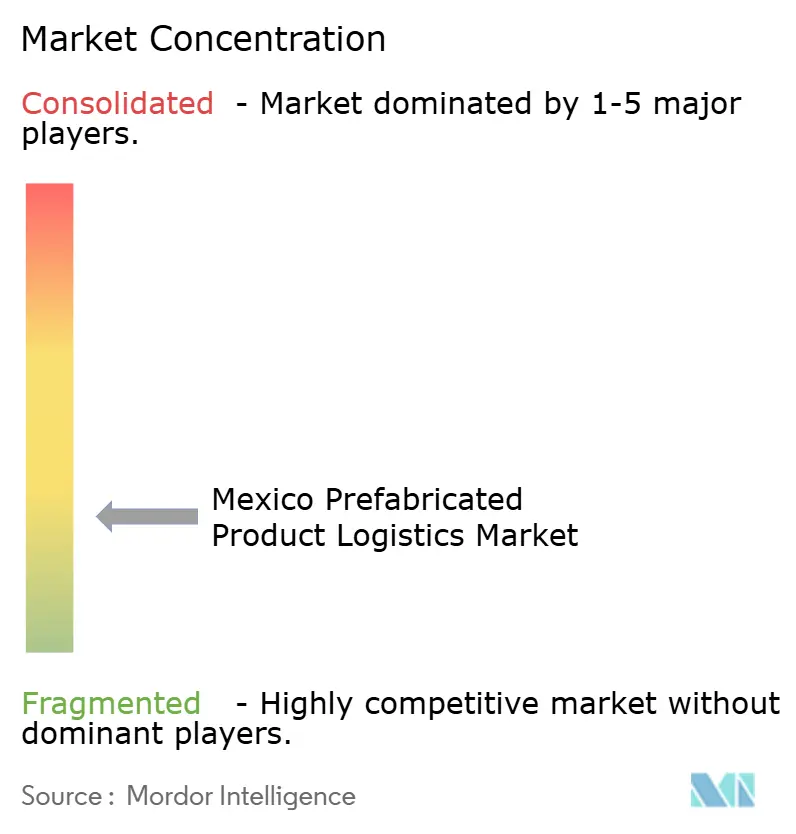
| Market Concentration | Low |
Major Players *Disclaimer: Major Players sorted in no particular order Image © Mordor Intelligence. Reuse requires attribution under CC BY 4.0. | |
Mexico Prefabricated Product Logistics Market Analysis by Mordor Intelligence
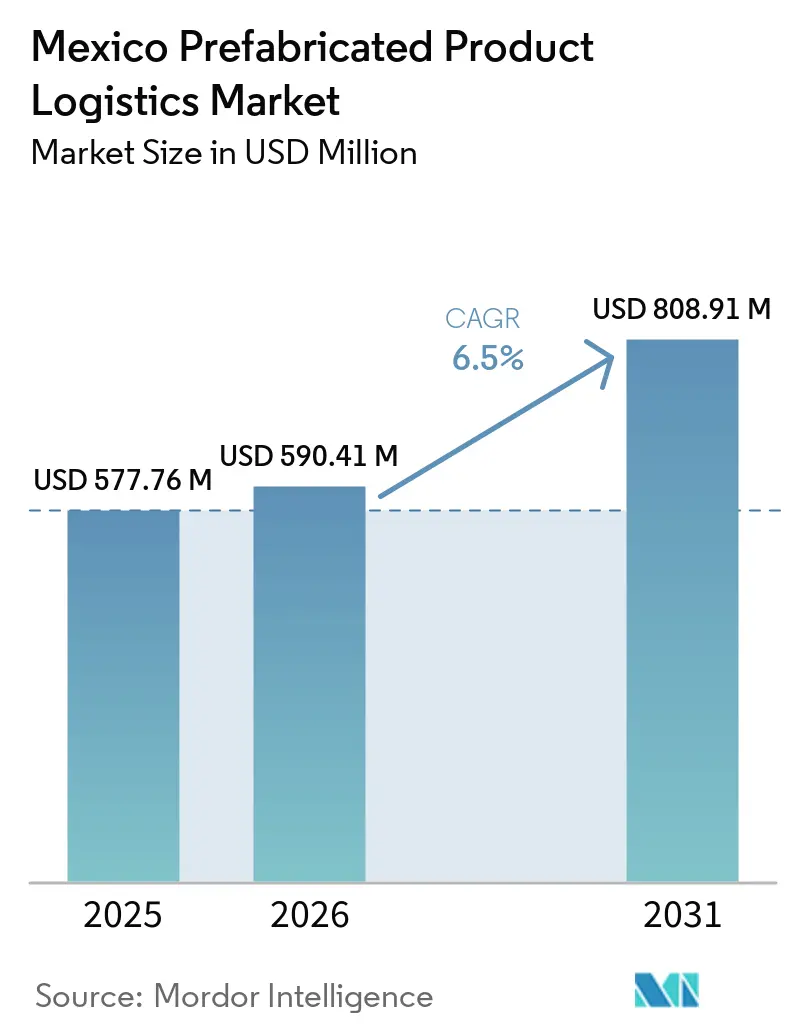
The Mexico prefabricated product logistics market size was valued at USD 577.76 million in 2025 and is estimated to grow from USD 590.41 million in 2026 to reach USD 808.91 million by 2031, at a CAGR of 6.50% during the forecast period (2026-2031).
Mexico remained the United States' largest goods trading partner, and bilateral goods trade reached USD 872.8 billion in 2025, supporting cross-border manufacturing activity that requires dependable movement of factory-built systems.[1]Office of the United States Trade Representative, “Mexico,” Office of the United States Trade Representative, ustr.gov Nearshoring continued to support demand for factory-built structural systems, especially where developers needed rapid site preparation and installation. The Mexico prefabricated product logistics market, therefore, depended on transport capacity, staging, permits, and coordination with construction schedules rather than standard freight capacity alone. Operators that combined factory release, delivery sequencing, and installation support could address a gap left by carriers that focused only on transport. Permit requirements and cargo-security exposure continued to add cost and planning pressure for large and high-value loads.
Key Report Takeaways
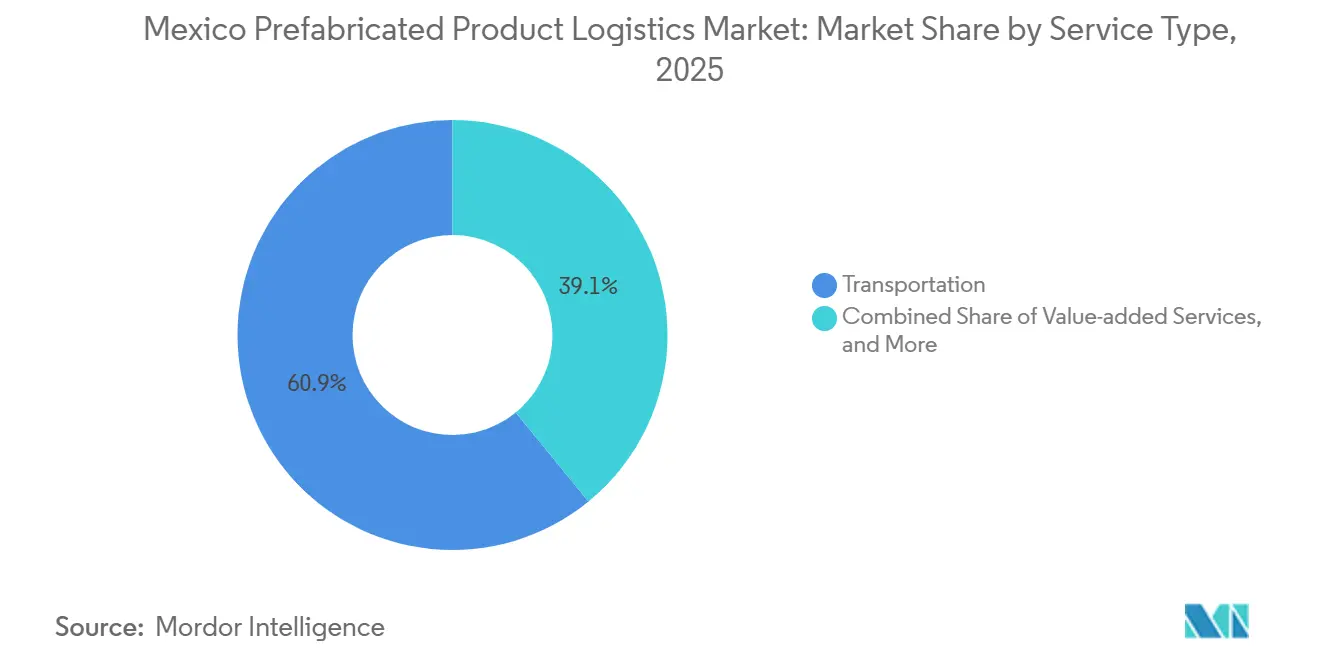
- By service, transportation held 60.90% of the Mexico prefabricated product logistics market share in 2025, while value-added services are forecast to grow at an 8.80% CAGR through 2031.
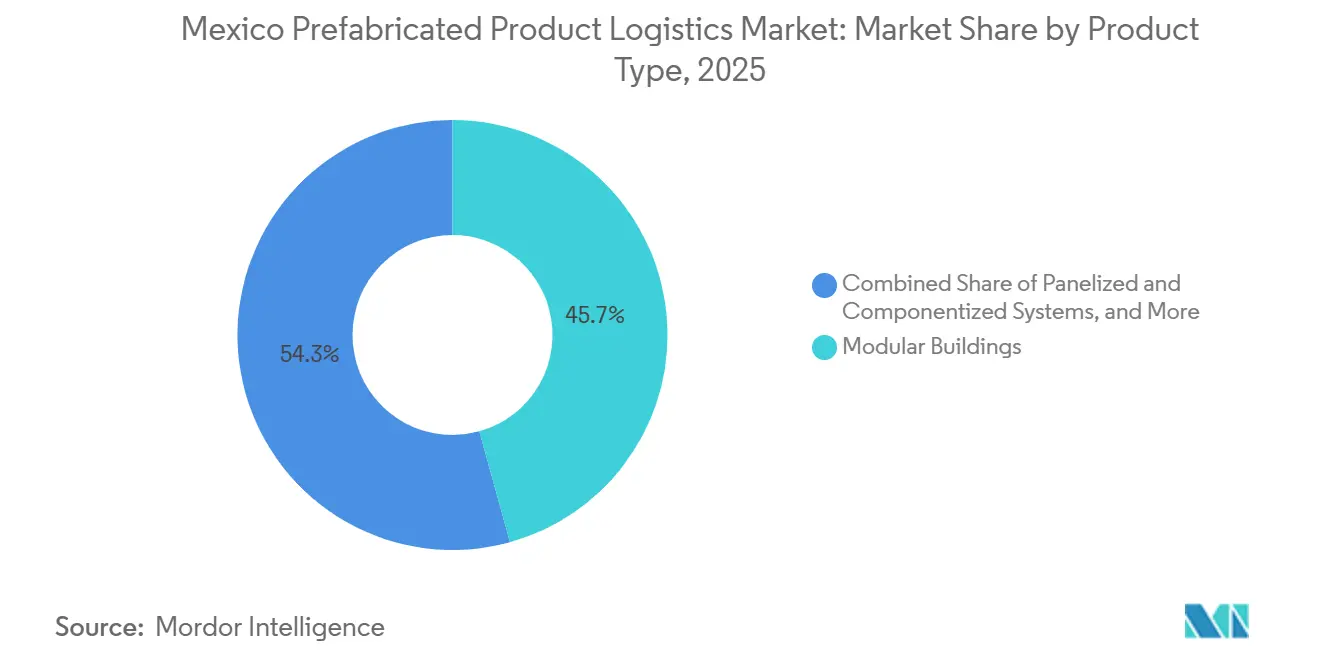
- By product type, modular buildings held 45.65% of the Mexico prefabricated product logistics market size in 2025, while panelized and componentized systems are forecast to grow at an 8.45% CAGR through 2031.
- By application, residential buildings held 52.15% of the Mexico prefabricated product logistics market share in 2025, while commercial buildings are forecast to grow at a 7.95% CAGR through 2031.
Note: Market size and forecast figures in this report are generated using Mordor Intelligence’s proprietary estimation framework, updated with the latest available data and insights as of January 2026.
Mexico Prefabricated Product Logistics Market Trends and Insights
Drivers Impact Analysis*
| Driver | (~) % Impact on CAGR Forecast | Geographic Relevance | Impact Timeline |
|---|---|---|---|
| Nearshoring-Driven Industrial Prefab Demand | +2.0% | National, concentrated in Nuevo Leon, Tamaulipas, Chihuahua, Sonora, and the Bajio region | Short term (≤ 2 years) |
| E-Commerce and Distribution-Center Expansion | +1.4% | National, with early gains in Nuevo Leon metro, Mexico City metro, and Guadalajara | Short term (≤ 2 years) |
| Housing and Infrastructure Delivery Pressure | +1.1% | National, with programs running across all 32 states | Medium term (2-4 years) |
| Faster Project Completion and Reduced Site Labor Requirements | +0.7% | National | Short term (≤ 2 years) |
| Sequenced Delivery and Factory-to-Site Integration | +0.5% | Industrial corridors in northern border states and the Bajio region | Medium term (2-4 years) |
| Demand for Relocatable and Reconfigurable Structures | +0.4% | National, driven by mining and industrial sectors in Sinaloa, Zacatecas, and Sonora | Long term (≥ 4 years) |
| Source: Mordor Intelligence | |||
Nearshoring-Driven Industrial Prefab Demand
The Mexico prefabricated product logistics market benefited from industrial construction linked to nearshoring. Factory-built structures supported projects where companies sought faster occupancy than conventional site-built methods could provide. Modular and panel-based systems required carriers to coordinate production completion, loading, route access, and installation windows. This need favored providers that could plan the entire move from factory release through site delivery. Northern border states and the Bajio region remained important because their industrial corridors connected suppliers, factories, and export destinations. The Mexico prefab product logistics market also gained from projects moving beyond the largest industrial centers when developers selected locations with suitable utilities and transport access.
E-Commerce and Distribution-Center Expansion
E-commerce activity continued to support the construction of distribution centers and fulfillment facilities. Prefab steel and panel structures suited projects where the operating date was closely tied to lease commitments and logistics planning. These facilities needed the movement of completed structural sections within narrow delivery and craning windows. The Mexico prefabricated product logistics market consequently placed greater value on sequenced delivery rather than on point-to-point hauling alone. Delays caused by permits or route restrictions could leave cranes and installation crews idle, raising the cost carried by logistics providers. Providers who planned factory release, overland movement, and site access together could better manage these project risks.
Housing and Infrastructure Delivery Pressure
Mexico's Housing for Well-being Program targeted 600,000 homes during President Sheinbaum's 6-year term. Infonavit committed USD 8.5 billion to housing construction in 2025 under the program.[2]“Mexico Construction,” International Trade Administration, trade.gov This housing pipeline supported recurring movement of prefab panels, foundations, and modular interior units across Mexico. The Mexico prefab product logistics market benefited because high-volume housing programs need repeatable routes, predictable equipment availability, and disciplined delivery timing. Plan Mexico, announced in June 2026, committed MXN 523 billion (USD 29.09 billion) for 44 highway and road projects covering 5,100 kilometers, strengthening the road infrastructure relevant to heavy transport. Standardized housing designs and procurement requirements may further support repeatable transport needs for companies that invest in appropriate fixtures and handling procedures.
Faster Project Completion and Reduced Site Labor Requirements
Mexico's commercial driver vacancy rate stood at 14% in mid-2026.[3]“Plan Mexico Road Infrastructure Program 2026-2030,” Gobierno de Mexico, gob.mx The shortage left 90,000 trucks idle and constrained available freight capacity. Prefab product transport could consolidate separate material deliveries into fewer specialized moves for each project. This made the Mexico prefab product logistics market relevant to clients seeking to use limited driver capacity more efficiently. The average age of Mexico's cargo fleet was 19.5 years in January 2026, further limiting the general freight fleet suitable for heavy structural elements. Operators with flatbeds, lowboy trailers, crane-equipped vehicles, and trained crews could serve loads that general carriers could not safely handle.
Restraints Impact Analysis*
| Restraint | (~) % Impact on CAGR Forecast | Geographic Relevance | Impact Timeline |
|---|---|---|---|
| Oversized-Load Permitting and Route-Planning Complexity | -0.9% | National, with concentrated friction on cross-state routes and border corridors | Short term (≤ 2 years) |
| Fragmented Carrier Base and Limited Specialized Handling Capacity | -0.7% | National | Medium term (2-4 years) |
| Cargo Theft and Security Exposure on Long-Haul Corridors | -0.6% | Center and West regions, State of Mexico, Puebla, Guanajuato, and Jalisco | Short term (≤ 2 years) |
| Interface Failures Between Design, Transport, Lifting, and Installation | -0.4% | National | Long term (≥ 4 years) |
| Source: Mordor Intelligence | |||
Oversized-Load Permitting and Route-Planning Complexity
Mexico's SICT governed oversized transport through NOM-012-SCT-2-2017 and NOM-040-SCT-2-2012. The standards set weight, dimension, and escort requirements for loads that exceeded federal highway limits. Modular sections wider than 3.30 meters required pilot vehicles, advance notification, and, for certain loads, National Guard coordination. A federal framework reduced differences among state permit rules, but it also concentrated processing at the federal level. Route surveys, bridge-load calculations, and daytime movement limits added time to delivery plans. The Mexico prefab product logistics market favored carriers that had established approvals, route knowledge, and pilot-vehicle relationships.
Fragmented Carrier Base and Limited Specialized Handling Capacity
Small family-owned operators formed much of Mexico's heavy transport base. Many lacked the capital for hydraulic-suspension lowboys, telescopic trailers, self-erecting cranes, and other equipment used for specialized prefab movements. In mid-2026, 44% of Mexican freight carriers identified labor as their principal operational challenge.[4]“Prefabricated Buildings Trade Data Q2 2026,” Data Mexico, economia.gob.mx Irregular geometry, high centers of gravity, and sequence-sensitive assembly requirements increased the difficulty of transporting prefab loads. End clients, therefore, needed to coordinate several providers for transport, lifting, and installation support. The Mexico prefab product logistics market remained constrained by specialized equipment availability, even where demand for off-site construction was strong.
*Our forecasts treat driver/restraint impacts as directional, not additive. The impact forecasts reflect baseline growth, mix effects, and variable interactions.
Segment Analysis
By Service: Road Transport Anchors Revenue as Value-Added Services Outpace Growth
Transportation held 60.90% of the Mexico prefabricated product logistics market share in 2025. Road transport formed the largest part of this service group because industrial corridors and project sites depended mainly on highway access. Truck movements could connect manufacturing plants directly to northern industrial parks and construction sites. Rail retained a secondary role in transportation, particularly where project schedules could accommodate intermodal handling. Sea and inland waterways served coastal or port-adjacent sites where water access supported the movement of large components. Air freight remained a premium option for urgent structural parts when project-delay costs exceeded the higher transport cost.
Value-added services are forecast to grow at an 8.80% CAGR from 2026 to 2031. Clients increasingly required staged arrivals, crane-window coordination, unloading supervision, and factory-hold management when sites were not ready. These activities protected components from weather exposure, damage, and untimely site delivery. Warehousing and storage also supported manufacturers that needed to hold elements between production and installation. The Mexico prefabricated product logistics industry increasingly required service providers to manage delivery readiness as well as physical movement. Carriers that did not provide these services often relied on specialist coordinators, widening the addressable service need beyond basic transport contracts.



By Product Type: Modular Leads Share as Panelized Systems Capture the Fastest Growth
Modular buildings held 45.65% of the Mexico prefabricated product logistics market size in 2025. Fully assembled volumetric structures were widely used in industrial and commercial construction, where schedule pressure and labor constraints were significant. These units moved as complete 3-dimensional loads and required fewer, more complex deliveries. Specialized carriers, therefore, received greater revenue per delivery than they would from many smaller materials movements. Flexpace by COMMOSA designed modules that shipped up to 112 square meters of finished floor area on 1 truck platform. This handling profile showed why modular logistics differed from the movement of flat panels and smaller components.
Panelized and componentized systems are forecast to grow at an 8.45% CAGR from 2026 to 2031. Flat panels could be stacked more efficiently and generally fit within standard legal vehicle dimensions. Their load profile reduced permitting complexity and allowed a broader group of carriers to participate. Demand for prefab concrete panels, prestressed spancrete panels, and precast facade systems supported this product category across residential, commercial, and infrastructure work. Mexico exported USD 33.5 million in prefabricated buildings during Q2 2026, with Chihuahua and Baja California accounting for a notable share of activity. Other prefab types, including pre-engineered metal buildings and hybrid structural systems, continued to serve energy, agribusiness, and mining projects with different route and weight requirements.
By Application: Residential Volume Drives Market Scale While Commercial Builds Fastest
Residential buildings held 52.15% of the Mexico prefabricated product logistics market size in 2025. Federal housing targets supported demand for light panels, precast foundations, and modular bathroom and kitchen units. The 600,000-home program created a multiyear delivery requirement across locations with different transport conditions. Residential jobs carried lower logistics volume per site than major industrial projects. However, their frequency and geographic reach gave carriers more consistent equipment utilization. Providers with route coverage across metropolitan and peri-urban corridors could serve several project types within the same network.
Commercial buildings are forecast to grow at a 7.95% CAGR from 2026 to 2031. Warehouses, data centers, distribution facilities, and logistics hubs supported demand for high-value prefab delivery and lifting work. These projects commonly required lowboy transport and on-site equipment for structural beams and slab panels. Delivery sequencing mattered because large elements had to reach the site in the order required for installation. Industrial, infrastructure, and institutional projects represented the remaining applications, including bridge beams, airport and port expansions, and mining camp facilities. The Mexico prefab product logistics market may benefit when commercial developers use prefab systems to support compressed project schedules.
Geography Analysis
Northern Mexico recorded the highest prefabricated product logistics throughput in 2026. Monterrey, Tijuana-Mexicali, Ciudad Juarez, and Hermosillo-Nogales formed important locations for industrial construction and cross-border manufacturing. The Mexico prefabricated product logistics market share of northern corridors reflected demand for steel warehouses, modular administrative buildings, and precast industrial floors. Road transport was the primary mode because highways connected factories, industrial parks, and border crossings at Laredo, Nogales, and El Paso. These crossings also supported component flows for manufacturers serving Mexico and the United States. Security exposure on routes between northern manufacturing areas and central project sites added insurance and planning requirements.
The Bajio region was a secondary and fast-accelerating logistics zone. Guadalajara, Queretaro, and Guanajuato benefited from automotive and advanced manufacturing activity. The region required modular plant expansions and panelized systems for supply-chain facilities. Its inland position increased reliance on multiday road movements from central manufacturing locations. That condition raised the importance of in-transit staging and warehousing within the Mexico prefab product logistics market. Security protocols and insurance remained important for operators moving through the Bajio corridor.
Central and Southeastern Mexico had a different logistics profile. Mexico City generated demand from commercial, mixed-use, residential high-rise, and office construction using precast frames and panelized facade systems. The State of Mexico accounted for 18% of national cargo theft incidents in Q2 2026, increasing security and route-control requirements for loads moving through the corridor. The Yucatan Peninsula emerged as a location for infrastructure-scale prefab deliveries in Quintana Roo, Yucatan, and Campeche. Mexico committed MXN 157 billion (USD 8.73 billion) to expand the national rail network in 2025. The rail program may support additional intermodal options for regional construction materials during the forecast period.
Competitive Landscape
The Mexico prefabricated product logistics market was fragmented, with no single national-scale operator dominating project revenue. Regional carriers handled much of the physical movement of prefab loads. Competition included specialized heavy-transport and lifting companies as well as prefab manufacturers that operated integrated logistics capabilities. Integrated providers could manage manufacturing tolerances, delivery timing, craning, and assembly through 1 contract. This arrangement gave end clients a clearer accountability point than separate general freight carriers could provide. Established permits, route authorizations, and trained pilot-vehicle partnerships also created barriers for new carriers entering oversized-load work.
Mecano used an integrated approach on the Tren Maya Tramo 5 Sur project in Quintana Roo. The company opened a field production facility, managed delivery and installation sequencing, and sustained output above 70 structural beams per week. Flexpace by COMMOSA supported modular construction with transportable finished units designed for industrial and commercial use. These examples showed how manufacturers could pair product design with logistics planning. Providers operating in northern Mexico can address nearshoring-linked project volume. Providers that added permit management, staged delivery, and site-window coordination could build longer client relationships.
A project can involve production in central Mexico, permitting movement across several states, and crane installation at a northern industrial site. Many operators did not manage this sequence from end to end. Logistics coordination using building information modeling may help align element sequence and site-window requirements within a shared project process. The 14% commercial driver vacancy rate and the aging fleet increased the value of certified drivers and specialized equipment. Companies that develop a trained driver base, proprietary equipment, and reliable coordination procedures may differentiate in this fragmented setting.
Mexico Prefabricated Product Logistics Industry Leaders
Trucks Pret
Transportes Mucino
TRANS NEYNO, S.A. de C.V.
Gruas Transportes Maniobras y Servicios, S.A. de C.V.
Mecano
- *Disclaimer: Major Players sorted in no particular order

Recent Industry Developments
- August 2026: Prefamovil e Infraestructura formalized a strategic alliance with DEACERO, a Mexican high-strength steel manufacturer, for the Nuevo Puente de la Unidad, a 3-kilometer viaduct over open water. The collaboration combined DEACERO's prestressing steel technology with Prefamovil's on-site mobile production model, deploying a precast plant directly at the project site to maintain structural element sequencing under extreme logistical and environmental conditions.
- August 2026: Mecano completed its infrastructure contract for Tramo 5 Sur of the Tren Maya in Playa del Carmen, Quintana Roo. The scope included opening a dedicated on-site precast concrete production facility, managing full logistics and installation sequencing for each structural element, and sustaining output of more than 70 structural beams per week.
- June 2026: Flexpace by COMMOSA secured and executed a modular retail contract with 7-Eleven Mexico, delivering a Japan-themed branded pop-up store at Punto Valle, The Town Center, Monterrey. The project deployed Flexpace modular construction technology for a complete, fitted-out retail space installed in a compressed timeline.
- August 2025: ANIPPAC, in collaboration with the Camara Mexicana de la Industria de la Construccion, organized the Encuentro Nacional de Construccion con Prefabricados de Concreto at Expo Guadalajara. Prefamovil e Infraestructura and Grupo DLC Prefabricados participated in the 2-day event to align on industrialized construction standards and develop commercial partnerships across Mexico's infrastructure pipeline.


Mexico Prefabricated Product Logistics Market Report Scope
| Transportation | Road |
| Rail | |
| Air | |
| Sea and Inland Waterways | |
| Warehousing and Storage | |
| Value-Added Services |
| Modular Buildings |
| Panelized and Componentized Systems |
| Other Prefab Types |
| Residential Buildings |
| Commercial Buildings |
| Others |
| By Service | Transportation | Road |
| Rail | ||
| Air | ||
| Sea and Inland Waterways | ||
| Warehousing and Storage | ||
| Value-Added Services | ||
| By Product Type | Modular Buildings | |
| Panelized and Componentized Systems | ||
| Other Prefab Types | ||
| By Application | Residential Buildings | |
| Commercial Buildings | ||
| Others |


Key Questions Answered in the Report
What is the Mexico prefab product logistics market size in 2026?
The Mexico prefab product logistics market size is USD 590.41 million in 2026 and is forecast to reach USD 808.91 million by 2031.
What is driving demand for prefab logistics in Mexico?
Nearshoring, housing delivery, distribution-center construction, and the need for faster project completion support demand for specialized transport and coordination.
Which service segment leads prefab product logistics in Mexico?
Transportation led with 60.90% of revenue in 2025, while value-added services are forecast to grow at an 8.80% CAGR through 2031.
Which prefab product type is growing fastest in Mexico?
Panelized and componentized systems are forecast to grow at an 8.45% CAGR from 2026 to 2031.
Which application has the largest demand for prefab logistics?
Residential buildings held 52.15% of revenue in 2025, supported by federal housing delivery targets.
What are the main risks for prefab transport providers in Mexico?
Oversized-load permits, limited specialized equipment, cargo-security exposure, and coordination failures can increase cost and delay installation schedules.
Page last updated on:





