
Mexico Metal Forming Equipment Market Size and Share
Market Overview
| Study Period | 2020 - 2031 |
|---|---|
| Forecast Data Period | 2026 - 2031 |
| Base Year Market Size (2025) | USD 0.3 Billion |
| Market Size (2026) | USD 0.31 Billion |
| Market Size (2031) | USD 0.34 Billion |
| Growth Rate (2026 - 2031) | 1.86 % |
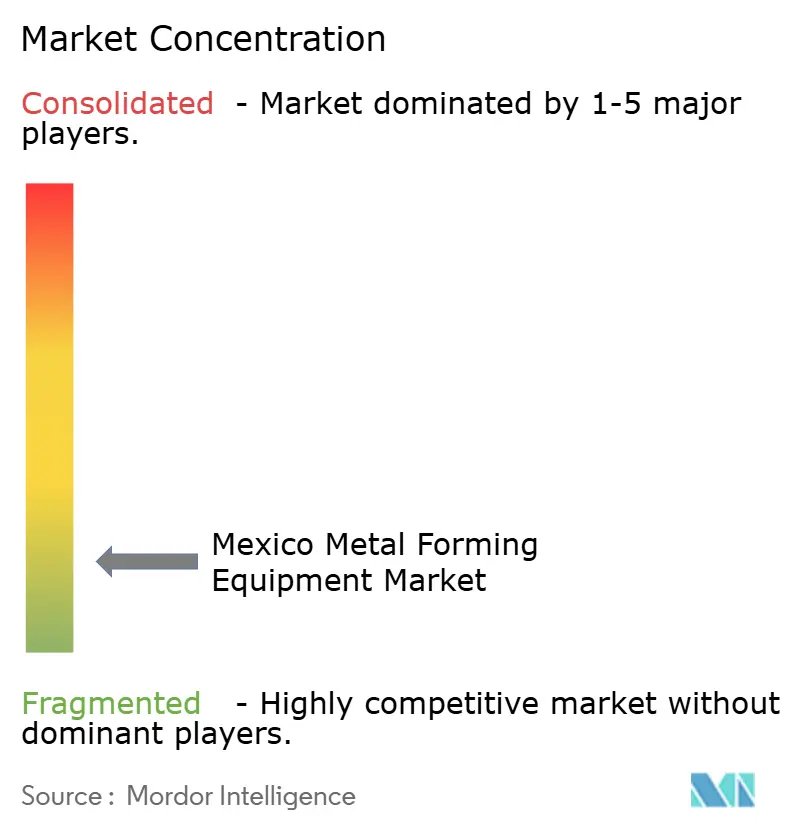
| Market Concentration | Low |
Major Players *Disclaimer: Major Players sorted in no particular order Image © Mordor Intelligence. Reuse requires attribution under CC BY 4.0. | |
Mexico Metal Forming Equipment Market Analysis by Mordor Intelligence
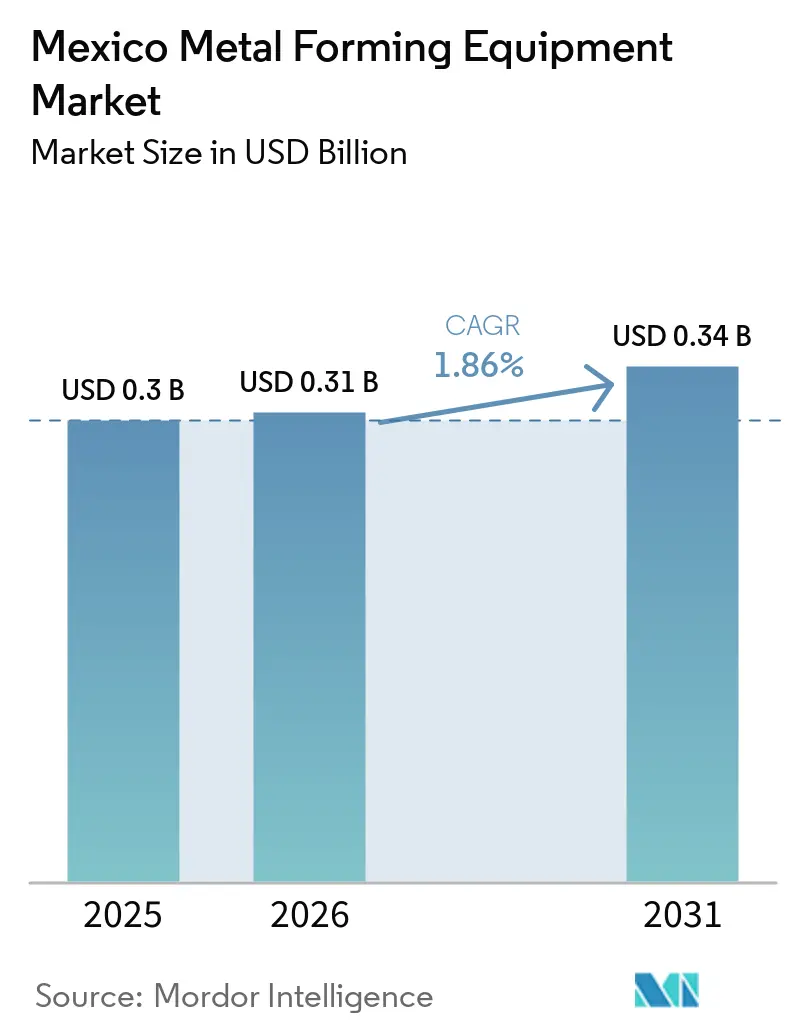
The Mexico Metal Forming Equipment Market size is expected to increase from USD 0.3 billion in 2025 to USD 0.31 billion in 2026 and reach USD 0.34 billion by 2031, growing at a CAGR of 1.86% over 2026-2031.
Mexico’s metal forming equipment market is supported by expanding and modernizing manufacturing activity, particularly across automotive, aerospace, appliances, and industrial equipment. Mexico produced approximately 3.95 million light vehicles in 2025, sustaining demand for stamping, bending, and forming systems, while manufacturing investment is driving greater adoption of automated and precision equipment. Machinery and production-equipment investment is projected to exceed USD 2.2 billion in 2026, reflecting continued capacity expansion across automotive, appliances, and medical equipment. Nearshoring and supplier localization are further encouraging Tier 1 and Tier 2 manufacturers to expand domestic forming capacity, while electrification is increasing requirements for aluminum, high-strength steel, battery components, and lightweight structures. Consequently, manufacturers are increasingly shifting toward CNC, servo-electric, automated, and digitally connected forming systems offering greater precision, flexibility, and traceability. Despite constraints from high capital costs, skilled-labor requirements, infrastructure limitations, and trade-policy uncertainty, ongoing manufacturing expansion and equipment modernization are supporting sustained demand for metal forming equipment.
Key Report Takeaways
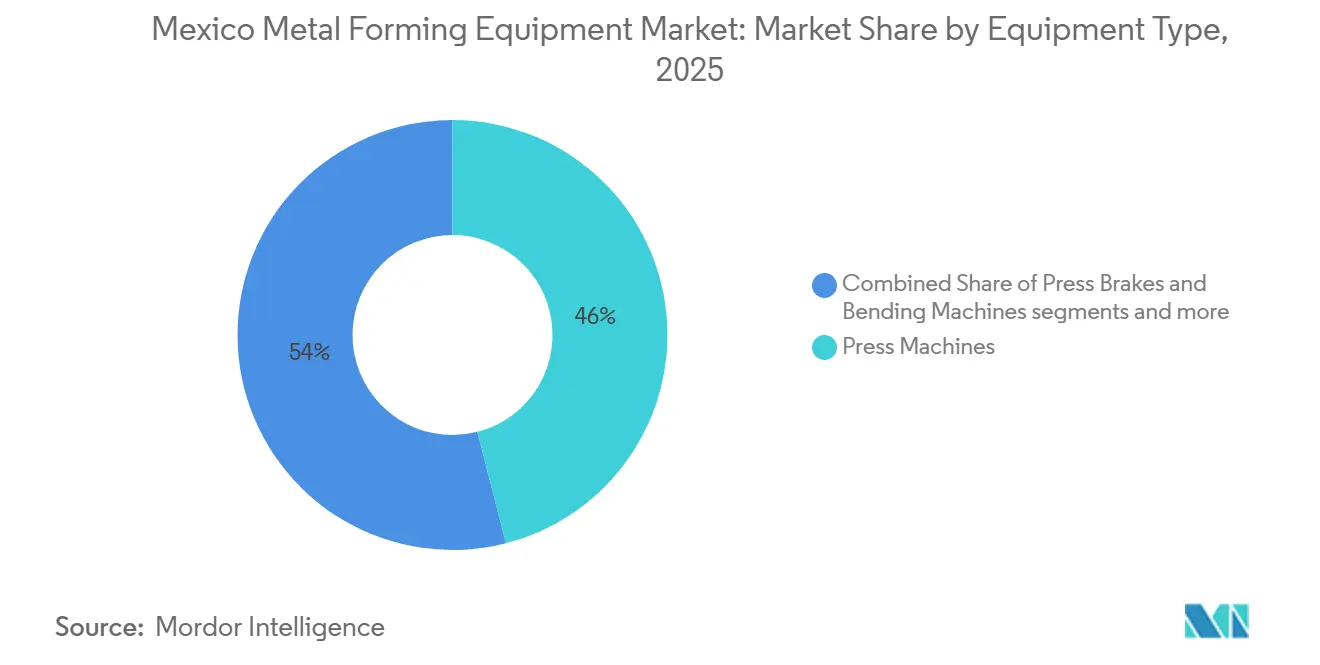
- By equipment type, press machines held 46% of the Mexico metal forming equipment market share in 2025, while servo-electric presses are projected to grow at a 4.5% CAGR through 2031.
- By forming process, stamping and punching held 35% of Mexico metal forming equipment market size demand in 2025, while bending is forecast to grow at a 3.8% CAGR through 2031.
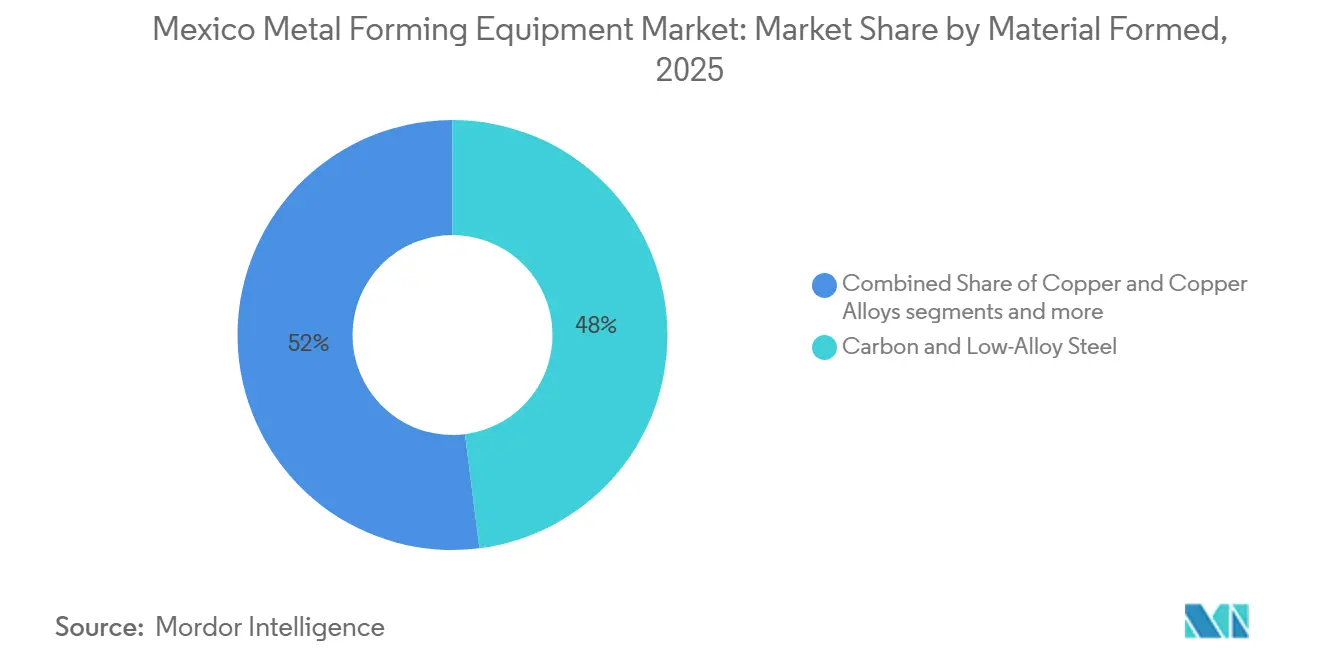
- By material formed, carbon and low-alloy steel held 48% of demand in 2025, while aluminum and aluminum alloys are forecast to grow at a 4.2% CAGR through 2031.
- By end-use industry, automotive and transportation held 46% of demand in 2025, while aerospace and defense is forecast to grow at a 4.4% CAGR through 2031.
Note: Market size and forecast figures in this report are generated using Mordor Intelligence’s proprietary estimation framework, updated with the latest available data and insights as of January 2026.
Mexico Metal Forming Equipment Market Trends and Insights
Drivers Impact Analysis*
| Driver | % Impact on CAGR Forecast | Geographic Relevance | Impact Timeline |
|---|---|---|---|
| Nearshoring and USMCA-Driven Supplier Localization | +0.55% | National; concentrated in the Northern Corridor and the Bajío | Short term (≤ 2 years) |
| Automotive Electrification and Lightweight Component Production | +0.40% | Nuevo León, Guanajuato, San Luis Potosí, Aguascalientes | Medium term (2-4 years) |
| Aerospace Manufacturing Expansion in Northern and Central Mexico | +0.30% | Chihuahua, Sonora, Querétaro, Coahuila | Long term (≥ 4 years) |
| Automation and Industry 4.0 Adoption to Offset Labor Constraints | +0.22% | National, North Mexico, and Bajío core | Medium term (2-4 years) |
| Domestic Tooling Localization and Shorter Program Lead Times | +0.15% | Northern Corridor, Bajío, Puebla | Short term (≤ 2 years) |
| Installed-Base Modernization and Cross-Border Aftermarket Support | +0.10% | National, Northern Corridor dominant | Short term (≤ 2 years) |
| Source: Mordor Intelligence | |||
Nearshoring and USMCA-Driven Supplier Localization
USMCA's labor value content requirement, 40% of passenger vehicle value from facilities paying at least USD 16 per hour, compels stamping and forming operations to localize in Mexico rather than source from Asia. Mexico attracted a record USD 40.87 billion in FDI in 2025; crucially, new equity capital nearly tripled as a share of total FDI, from 6% to 16%, indicating greenfield forming capacity is displacing brownfield-only expansions. USMCA certification utilization for Mexico-to-United States exports climbed from approximately 45% in early 2025 to 85-89% by year-end, driven by United States tariffs of 25%+ on non-qualifying goods. This shift accelerates the retirement of analog mechanical press lines in favor of servo-electric systems that generate part-level digital records required by USMCA customs certification audits. Plan México's 35-91% immediate fixed-asset tax deductions directly subsidize press equipment acquisitions and shorten payback periods for nearshoring-aligned forming operations.
Automotive Electrification and Lightweight Component Production
EV assembly in Mexico reached 206,870 units in 2024 and grew 72.27% in early 2025, with the EV supply base expanding to more than 439 active companies, a 37.1% increase in seven months. Kia's USD 649 million investment in Pesquería, Nuevo León, to produce the all-electric EV3, with assembly beganin August 2026, signals sustained Tier 1 body-structure and battery-enclosure forming capacity investment in the region. BMW Group's investment of EUR 800 million (USD 902.9 million) in San Luis Potosí for Neue Klasse EV production from 2027, including an 80,000 m² high-voltage battery assembly building, generates demand for aluminum forming and deep-draw battery-enclosure equipment. EV structural components typically require press tonnages 15-25% higher than equivalent ICE-era steel parts, systematically migrating buyers toward larger-capacity servo platforms. LINDE + WIEMANN's roll-forming facility opened in San Luis Potosí in March 2026 to supply BMW's iX3, illustrating how OEM platform decisions translate directly into Tier 1 forming equipment investment cycles.
Aerospace Manufacturing Expansion in Northern and Central Mexico
Mexico's aerospace sector generated approximately USD 11 billion in exports in 2025, up from USD 10.7 billion in 2024, with manufacturing representing 79% of sector revenue across nearly 400 companies; local content remains below 10% of global aerospace supply chains. GE Aerospace's approximately MXN 1.3 billion (USD 67.7 million) 2025-2026 Mexico investment covers large-scale forming machinery, specialized tooling, and calibration systems in Hermosillo and Saltillo. Embraer México's August 2026 manufacturing launch in Chihuahua over 1,200 direct jobs cements a state generating approximately MXN 16.96 billion (USD 882.8 million) in aerospace output (36% of Mexico's total) and exports exceeding USD 2 billion annually in 2025. Safran's 12-plant Chihuahua cluster and GKN Aerospace's 160,000 ft² facility require precision titanium and aluminum forming equipment with sub-millimeter tolerances, which anchors procurement to premium European and Japanese vendors.
Automation and Industry 4.0 Adoption to Offset Labor Constraints
The Secretaría de Economía's Talento Mexicano initiative targets automation, robotics, and semiconductor skills, acknowledging that workforce constraints are compressing output capacity across high-precision forming operations. Tier 2 and Tier 3 stampers are adopting in-die sensing and servo-feed automation to compensate for the inability to staff second and third shifts with qualified tool-and-die setters, compressing payback periods for digital press integration below what capital cost analysis alone would predict. Plan México's Fast-Track Investment Decree, effective May 2026, guarantees 30-day approvals for strategic supply-chain investments, accelerating import clearance for servo-electric press and robotic press-tending systems. At FABTECH Mexico 2026, AIDA demonstrated integrated NC1 press and automated zigzag feed lines, representing the bundled automation-plus-forming packages now preferred by Mexican stamping operations.
Restraints Impact Analysis*
| Restraint | % Impact on CAGR Forecast | Geographic Relevance | Impact Timeline |
|---|---|---|---|
| High Capital Costs and Extended Return on Investment | -0.30% | National | Long term (≥ 4 years) |
| Shortage of Skilled Tool-and-Die, Controls, and Maintenance Personnel | -0.22% | Northern Mexico, Bajío | Long term (≥ 4 years) |
| Regional Power Quality, Heat and Dust Exposure in Northern Manufacturing Corridors | -0.12% | Sonora, Chihuahua, Nuevo León, Coahuila, Tamaulipas | Medium term (2-4 years) |
| Technology Obsolescence Risk from ICE-to-EV Production Reconfiguration | -0.10% | Northern Mexico, Bajío | Medium term (2-4 years) |
| Source: Mordor Intelligence | |||
High Capital Costs and Extended Return on Investment
Servo-electric and large-tonnage hydraulic press lines represent the dominant capital expenditure in a metal-forming program, creating a structural tension between upgrade ambitions and the financial discipline of mid-tier Mexican suppliers. Plan México's 35-91% immediate fixed-asset tax deductions for qualifying advanced manufacturing investments implicitly acknowledge that payback periods without fiscal support are prohibitively long. Total fixed assets in Mexico's manufacturing industry reached MXN 4,189,745 million (USD 218.1 billion) in 2024, growing 3.2%, while the value of products elaborated grew only 2.1%, a diverging ratio that directly extends ROI timelines for new press equipment. CONUEE's NOM-016-ENER-2025 mandates updated energy efficiency thresholds for three-phase induction motors from 0.746 kW to 373 kW used in press drive systems, adding a certification compliance layer that increases total procurement cost and qualification time. Large OEM-affiliated stampers can access supply-chain financing and Plan México incentives; Tier 2 and Tier 3 independent job shops, where the capital cost barrier is most acute, largely remain on aging mechanical lines with limited access to structured equipment credit.
Shortage of Skilled Tool-and-Die, Controls, and Maintenance Personnel
Mexico imported over USD 3.4 billion in molds and dies in 2024, primarily from China, the United States, and Germany a dependence Clúster de Herramentales attributed at TECMA 2025 to a structural absence of domestic talent in die design, tool-and-die manufacturing, and CNC programming. Plan México targets training 200,000 technicians, yet the Secretaría de Economía acknowledges the objective will be limited if technical institutions continue operating with outdated equipment and curricula misaligned with servo-press, PLC, and in-die sensing requirements. INEGI's EMIM recorded a 0.3% month-on-month manufacturing employment decline in May 2025, with technicians and production workers declining at the same rate, precisely as nearshoring demands greater numbers of skilled press setters and die maintenance personnel. The Talento Mexicano program's focus on automation and robotics, while directionally correct, under-addresses the tool-and-die maintenance sub-specializations that form the immediate Tier 2 bottleneck in northern Mexico.
*Our forecasts treat driver/restraint impacts as directional, not additive. The impact forecasts reflect baseline growth, mix effects, and variable interactions.
Segment Analysis
By Equipment Type: Press Dominance Persists, Servo Lines Set New Value Benchmarks
Press machines commanded 46.00% of the Mexico metal forming equipment market in 2025, a position reinforced by the automotive industry's reliance on large-tonnage mechanical and servo tandem stamping lines for body panel and structural component production across plants in Nuevo León, Guanajuato, and Puebla. The migration within the press category from conventional mechanical and hydraulic configurations toward servo-electric architectures forecast at a 4.50% CAGR through 2031 is the most significant value-creating shift underway in this segment, as servo presses carry average selling prices 35-50% higher than equivalent-tonnage mechanical lines and generate recurring digital service and software revenues. Wiegel's recent installation of a 300-metric-ton AIDA direct-drive servo press at its Silao, Guanajuato facility for high-speed stamping applications covering bus bars, terminals, and e-mobility components illustrates the equipment-upgrade cycle now moving through the mid-tier automotive supply base. ANDRITZ Schuler's January 2026 launch of HFA fineblanking presses co-developed with Feintool, offering combined energy efficiency and output improvements, positions the segment toward customers in northern Mexico producing precision safety-critical components for both ICE and EV platforms.
Press brakes and bending machines form the second-largest equipment category, gaining share through fabricators serving aerospace, electrical enclosures, and construction segments. Forging equipment, roll-forming lines, hydroforming systems, and wire and tube forming equipment collectively address specialty applications across energy, aerospace, and commercial vehicle supply chains. Regulatory influence is relevant here: NOM-016-ENER-2025 mandates updated energy efficiency standards for three-phase induction motors up to 373 kW the motor class that drives the majority of forming press spindles requiring equipment buyers in Mexico to verify compliance certification before import, which effectively raises the specification floor for new press acquisitions and disadvantages legacy mechanical designs with lower-efficiency drive systems.

By Forming Process: Stamping Anchors Volume, Bending Captures Aerospace Premium
Stamping and Punching held a 35.00% share of Mexico's metal forming equipment demand in 2025, driven by the automotive sector's high-volume production of body panels, closures, and structural members across assembly complexes in Saltillo, San Luis Potosí, and Toluca. This segment's share reflects the density of continuous progressive-die stamping lines installed during prior maquiladora expansion cycles, many of which are now candidates for servo-drive retrofit or replacement under nearshoring-linked capital upgrade programs. Deep drawing contributes meaningfully to the segment mix through appliance and aerospace structural part production, while extrusion and roll forming serve aluminum profiles for EV battery-enclosure framing and commercial construction segments.
Bending's 3.80% CAGR forecast through 2031 represents the most dynamic process growth story, driven by a distinct customer profile: aerospace Tier 1 suppliers and electrical-enclosure fabricators who require CNC press brakes capable of sub-0.1 mm angular repeatability for structural airframe ribs and cabinet-quality sheet metal. TRUMPF's July 2026 strategic partnership with Mate Precision Technologies, explicitly targeting sheet metal fabricators in Mexico, the United States, and Canada, expands tooling portfolio access for bending machine operators across the Mexican market and signals the direction of competitive investment toward tooling-ecosystem depth rather than hardware alone. Hydroforming captures growing interest among automotive structural suppliers, replacing conventional multi-piece stamped assemblies with single-piece hollow sections for door rings, pillars, and suspension cross-members on EV platforms, requiring capital-intensive specialized presses at USD 2-5 million per system but offering significant downstream cost savings in joining and assembly.
By Material Formed: Carbon Steel Holds, Aluminum Accelerates
Carbon and Low-Alloy Steel held 48.00% of Mexico's metal forming equipment demand by material in 2025, reflecting the continued dominance of conventional body-in-white stamping across passenger car and light truck assembly programs operating on ICE platforms that will remain in production through at least 2030. Stainless steel forming serves specialized downstream customers in food equipment, medical device, and energy infrastructure fabrication a smaller but premium-margin segment that requires dedicated tooling, die materials, and forming parameters distinct from carbon steel operations, creating incremental equipment differentiation demand. Copper and copper alloy forming equipment serves the electrical connector and bus bar segment, where EV battery management systems and high-voltage wiring harnesses are driving demand for precision forming presses capable of handling thin, high-conductivity strip at high speed.
Aluminum and Aluminum Alloys represent the fastest-growing material category, forecast at a 4.20% CAGR through 2031, with the driver rooted in vehicle lightweighting mandates and EV structural architecture. Kyungshin Cable de México's USD 50 million expansion of its Gómez Palacio, Durango facility in 2025 installing 27 specialized machines for Ford EV battery module production illustrates the equipment investment intensity required to process aluminum battery-module structural components to EV-grade tolerances. LINDE + WIEMANN's San Luis Potosí plant, which uses roll-forming and joining technologies to produce aluminum structural parts for BMW's Neue Klasse, exemplifies the shift in forming equipment specifications toward larger working envelopes, tighter tolerances, and integrated joining capability. Titanium, nickel, and other non-ferrous metals form a niche but fast-growing sub-segment anchored entirely by aerospace. Chihuahua's dense cluster of turbine component manufacturers creates sustained demand for multi-axis forming and forging equipment capable of processing superalloys at elevated temperatures.
By End-Use Industry: Automotive Anchors the Base, Aerospace Reshapes the Mix
Automotive and Transportation held 46.00% of Mexico's metal forming equipment demand in 2025, underpinned by Mexico's position as the United States' largest supplier of auto parts accounting for 46.25% of United States auto parts purchases by late 2025 and by production of 3.95 million vehicles annually from plants in Nuevo León, San Luis Potosí, Puebla, and Guanajuato. The automotive end-use segment is itself bifurcating: legacy ICE-aligned mechanical stamping demand is plateauing, while EV structural and battery-enclosure forming demand is accelerating, creating a simultaneous equipment-retirement and new-investment cycle that is more capital-intensive per unit of output than any prior automotive transition in Mexico's manufacturing history. Industrial Machinery and Capital Equipment, Metal Products and Fabrication, and Electrical and Electronics collectively represent a meaningful share of forming equipment demand, serving contract stamping, structural fabrication, and EV wiring harness component production, respectively.
Aerospace and Defense is the fastest-growing end-use segment at a 4.40% CAGR through 2031, supported by a manufacturing base generating USD 11 billion in exports in 2025 and expanding at a pace that is systematically pulling in higher-precision, higher-value forming equipment than any other segment in the Mexican market. The critical differentiator from automotive is program duration: aerospace forming equipment procurement decisions are tied to 5-15 year component contracts rather than 3-4 year vehicle platform cycles, generating longer and more predictable aftermarket and spare parts revenue streams for OEMs. Medical and Precision Manufacturing, though the smallest end-use segment by volume, commands among the highest per-unit equipment values, as medical device enclosures and implant components require forming systems with ISO 13485-aligned process controls and full material-batch traceability specifications that exclude low-cost mid-market machines and concentrate procurement among premium European and Japanese vendors with validated quality management systems.
Geography Analysis
Northern Mexico encompassing Nuevo León, Chihuahua, Coahuila, Sonora, and Tamaulipas accounts for the largest share of metal forming equipment installations in Mexico, reflecting the corridor's density of automotive OEM plants, aerospace component manufacturers, and cross-border logistics infrastructure. Chihuahua distinguishes itself as the aerospace forming equipment growth epicenter: with Embraer's August 2026 launch, Safran's 12-plant cluster, and GKN Aerospace's 160,000 ft² expanded facility, demand for titanium and aluminum precision forming equipment in the state has reached a scale unmatched elsewhere in Latin America. The northern corridor also presents the market's most acute power infrastructure constraint: 91% of Mexico's industrial parks heavily concentrated in the north have experienced power supply failures, with CFE's national grid reserve margin falling to 3% in peak-load periods, well below the 6% minimum for stable industrial operation. CFE's USD 8.2 billion transmission expansion plan for 2025-2030 targets 92 projects across the northern zone, including Sonora, Chihuahua, Nuevo León, and Tamaulipas, and will materially improve press-line uptime risk profiles if executed on schedule.
BMW's 800 million euro investment in Neue Klasse production at San Luis Potosí, Kia's USD 649 million EV3 conversion in Nuevo León, and the Bajío's dual automotive-aerospace cluster structure are drawing Tier 1 structural suppliers including LINDE + WIEMANN, Kyungshin, and Sungwoo to co-locate press and forming capacity within 150 km of their customer plants. Querétaro holds a distinct position within the Bajío as Mexico's premier aerospace manufacturing cluster outside Chihuahua: Diehl Aviation's 88,000 ft² Querétaro facility, opened in September 2025 to produce Airbus A220 structural parts, illustrates the corridor's capacity to absorb precision aerospace forming equipment procurement at European OEM specification standards. INEGI's DENUE 2026 data identifies Nuevo León (526 units), Jalisco (476), and Guanajuato (456) as the three states with the highest number of machinery and equipment manufacturing establishments, confirming that the Bajío cluster competes directly with northern states in machine shop and forming-equipment value-chain depth.
Central Mexico including Mexico City, Jalisco, Puebla, and Hidalgo and emerging industrial states represent the third geographic tier for forming equipment demand. Puebla hosts Volkswagen's established manufacturing complex and its supply base of structural stampers, driving steady procurement of conventional mechanical press capacity. Jalisco, anchored by Guadalajara's electronics and technology manufacturing hub, generates demand for precision punching and bending equipment serving electrical enclosure and consumer appliance fabrication. Hidalgo's metal fabrication sector contributed MXN 533 million (USD 27.74 million) in forged and stamped production value in 2024, with Coahuila at MXN 459 million (USD 23.89 million) and San Luis Potosí at MXN 370 million (USD 19.26 million) regional output levels that place these states as mid-tier but growing markets for entry-level press and bending equipment.
Competitive Landscape
The Mexico metal forming equipment market exhibits a low level of market concentration. Chinese entrants YANGLI, JIER, and MINGXU have expanded their mid-range installed base since 2024, offering price points 30-40% below European equivalents while building local parts warehousing in northern industrial corridors to narrow the post-sale service gap. ANDRITZ Schuler's September 2025 rebranding to ANDRITZ Schuler Mexico integrates the local subsidiary into the ANDRITZ Group architecture, enabling cross-selling of digital Metris monitoring and metals-processing solutions alongside press equipment. This bundling approach raises switching costs against lower-cost competitors. An addressable white space is digital press-line monitoring for Tier 2 and Tier 3 suppliers, where neither global OEMs nor local service providers currently dominate the retrofit sensor and analytics aftermarket. TRUMPF's July 2026 partnership with Mate Precision Technologies strengthening its tooling portfolio for Mexican, United States, and Canadian fabricators signals a competitive pivot toward tooling-ecosystem lock-in as differentiation beyond hardware.
Smaller local players TecnoPress, Stanser, Preci Industria Metalmecánica, and Prensas y Cilindros compete in maintenance, refurbishment, and entry-level press supply, segments growing as nearshoring creates demand for rapid-response, Spanish-language technical service capacity. ANDRITZ Schuler's January 2026 HFA fineblanking press launch with Feintool drawing on over 800 hydraulic fineblanking systems delivered globally establishes a documented filing-and-patent-backed product position in precision safety-critical component forming for Mexican automotive Tier 1s. Korean entrants Kyungshin and Sungwoo are installing proprietary forming equipment as part of vertically integrated EV facilities in Nuevo León and Durango, creating captive press capacity outside the open market and reducing addressable procurement volumes for traditional vendors.
Mexico Metal Forming Equipment Industry Leaders
-
AIDA Engineering, Ltd.
-
AMADA CO., LTD.
-
Schuler Inc
-
TRUMPF México S. de R.L. de C.V.
-
Bystronic Mexico S.A. de C.V.
- *Disclaimer: Major Players sorted in no particular order
Recent Industry Developments
- August 2026: Embraer México launched manufacturing operations in Chihuahua, creating over 1,200 direct jobs; the state generates approximately 36% of Mexico's total aerospace manufacturing output, with aerospace exports exceeding USD 2 billion in 2025.
- July 2026: TRUMPF entered a strategic partnership with Mate Precision Technologies, expanding its punching and bending tool portfolio for sheet metal fabricators across Mexico, the United States, and Canada, strengthening the aftermarket through tooling-ecosystem lock-in.
- May 2026: Secretaría de Economía's Fast-Track Investment Decree became effective, guaranteeing 30-day regulatory approvals for strategic supply-chain investments, directly reducing capital deployment timelines for advanced forming equipment procurement.
- March 2026: LINDE + WIEMANN inaugurated a roll-forming and joining facility in San Luis Potosí's Millennium Industrial Park to supply structural components for BMW's iX3 Neue Klasse EV platform, with full-scale vehicle production beginning at the BMW plant in February 2027.
Mexico Metal Forming Equipment Market Report Scope
The Mexico Metal Forming Equipment Market is Segmented by Equipment Type (Press Machines, Press Brakes and Bending Machines, and more), by Forming Process (Stamping and Punching, Forging and more), by Material Formed (Carbon and Low-Alloy Steel, Stainless Steel, and more), by End-Use Industry (Automotive and Transportation, Aerospace and Defense, and more). The Market Forecasts are Provided in Terms of Value (USD).
| Press Machines | Mechanical Presses |
| Hydraulic Presses | |
| Servo Presses | |
| Other General-Purpose Presses | |
| Press Brakes and Bending Machines | Hydraulic Press Brakes |
| Servo / Electric Press Brakes | |
| Mechanical Press Brakes | |
| Other Bending Machines | |
| Forging Equipment | Forging Presses |
| Forging Hammers | |
| Upsetting and Heading Machines | |
| Other Forging Equipment | |
| Roll Forming and Plate/Profile Rolling Equipment | Roll Forming Machines |
| Plate Rolling Machines | |
| Section and Profile Rolling Machines | |
| Other Secondary Rolling/Forming Equipment | |
| Wire, Tube and Profile Forming Equipment | Wire and Bar Drawing/Forming Equipment |
| Tube Forming and Bending Equipment | |
| Profile Forming Equipment | |
| Extrusion Presses | |
| Hydroforming Equipment | |
| Other Metal Forming Equipment |
| Stamping and Punching |
| Deep Drawing |
| Bending |
| Forging |
| Rolling and Roll Forming |
| Extrusion |
| Hydroforming |
| Other Forming Processes |
| Carbon and Low-Alloy Steel |
| Stainless Steel |
| Aluminum and Aluminum Alloys |
| Copper and Copper Alloys |
| Titanium, Nickel and Other Non-Ferrous Metals |
| Other Materials |
| Automotive and Transportation |
| Aerospace and Defense |
| Industrial Machinery and Capital Equipment |
| Metal Products and Fabrication |
| Electrical and Electronics |
| Construction and Infrastructure |
| Energy and Power |
| Consumer Appliances and Durable Goods |
| Medical and Precision Manufacturing |
| Other End-Use Industries |
| By Equipment Type | Press Machines | Mechanical Presses |
| Hydraulic Presses | ||
| Servo Presses | ||
| Other General-Purpose Presses | ||
| Press Brakes and Bending Machines | Hydraulic Press Brakes | |
| Servo / Electric Press Brakes | ||
| Mechanical Press Brakes | ||
| Other Bending Machines | ||
| Forging Equipment | Forging Presses | |
| Forging Hammers | ||
| Upsetting and Heading Machines | ||
| Other Forging Equipment | ||
| Roll Forming and Plate/Profile Rolling Equipment | Roll Forming Machines | |
| Plate Rolling Machines | ||
| Section and Profile Rolling Machines | ||
| Other Secondary Rolling/Forming Equipment | ||
| Wire, Tube and Profile Forming Equipment | Wire and Bar Drawing/Forming Equipment | |
| Tube Forming and Bending Equipment | ||
| Profile Forming Equipment | ||
| Extrusion Presses | ||
| Hydroforming Equipment | ||
| Other Metal Forming Equipment | ||
| By Forming Process | Stamping and Punching | |
| Deep Drawing | ||
| Bending | ||
| Forging | ||
| Rolling and Roll Forming | ||
| Extrusion | ||
| Hydroforming | ||
| Other Forming Processes | ||
| By Material Formed | Carbon and Low-Alloy Steel | |
| Stainless Steel | ||
| Aluminum and Aluminum Alloys | ||
| Copper and Copper Alloys | ||
| Titanium, Nickel and Other Non-Ferrous Metals | ||
| Other Materials | ||
| By End-Use Industry | Automotive and Transportation | |
| Aerospace and Defense | ||
| Industrial Machinery and Capital Equipment | ||
| Metal Products and Fabrication | ||
| Electrical and Electronics | ||
| Construction and Infrastructure | ||
| Energy and Power | ||
| Consumer Appliances and Durable Goods | ||
| Medical and Precision Manufacturing | ||
| Other End-Use Industries | ||
Key Questions Answered in the Report
What is the forecast for Mexico metal forming equipment demand?
The Mexico metal forming equipment market is projected to grow from USD 0.31 billion in 2026 to USD 0.34 billion by 2031 at a 1.86% CAGR.
Which equipment category has the largest demand in Mexico?
Press machines led demand with 46% share in 2025, supported by automotive body and structural component production.
Which forming process is expected to grow fastest in Mexico?
Bending is forecast to grow at a 3.8% CAGR through 2031 as aerospace and electrical-enclosure fabricators require CNC press brakes.
Why are aluminum forming systems becoming more important in Mexico?
Aluminum and aluminum-alloy applications are forecast to grow at a 4.2% CAGR through 2031, supported by EV structures and battery systems.
Which end-use sector will grow fastest for metal forming equipment?
Aerospace and defense is projected to grow at a 4.4% CAGR through 2031, supported by precision component manufacturing in northern Mexico and the Bajío.
What factors can limit equipment investment in Mexico?
High capital costs, skills shortages, power-quality concerns, and the change from ICE to EV production can delay purchases and raise operating requirements.