
Market Overview
| Study Period | 2020 - 2031 |
|---|---|
| Forecast Data Period | 2026 - 2031 |
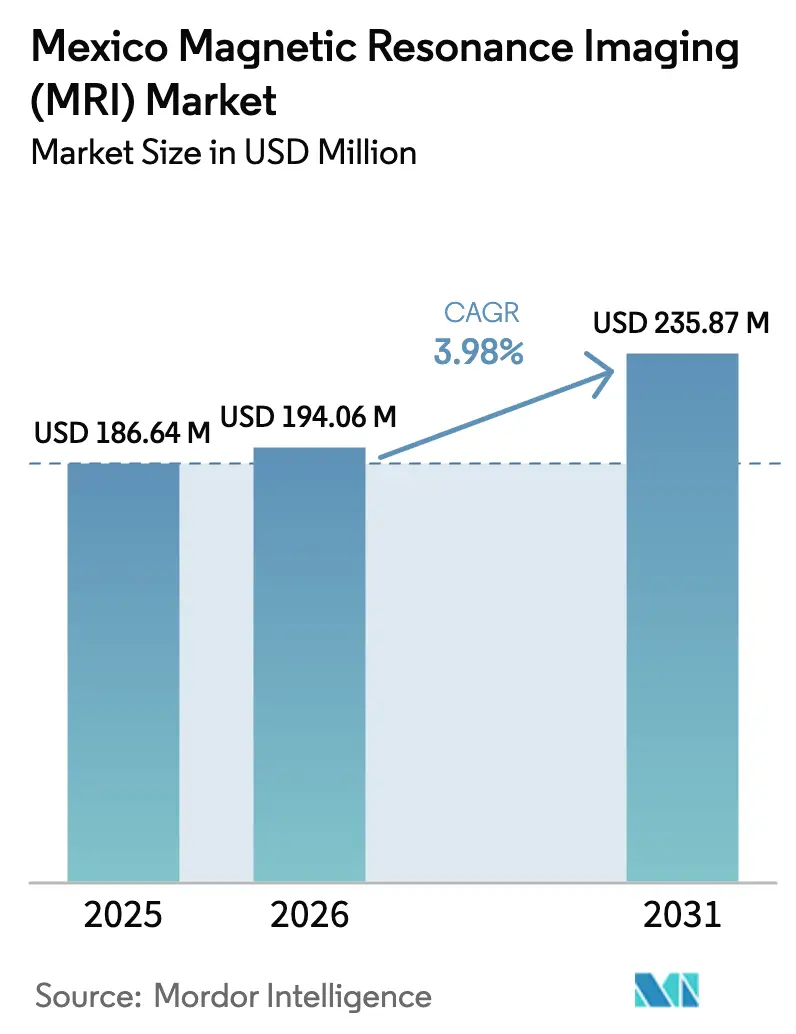
| Base Year Market Size (2025) | USD 186.64 Million |
| Market Size (2026) | USD 194.06 Million |
| Market Size (2031) | USD 235.87 Million |
| Growth Rate (2026 - 2031) | 3.98 % |
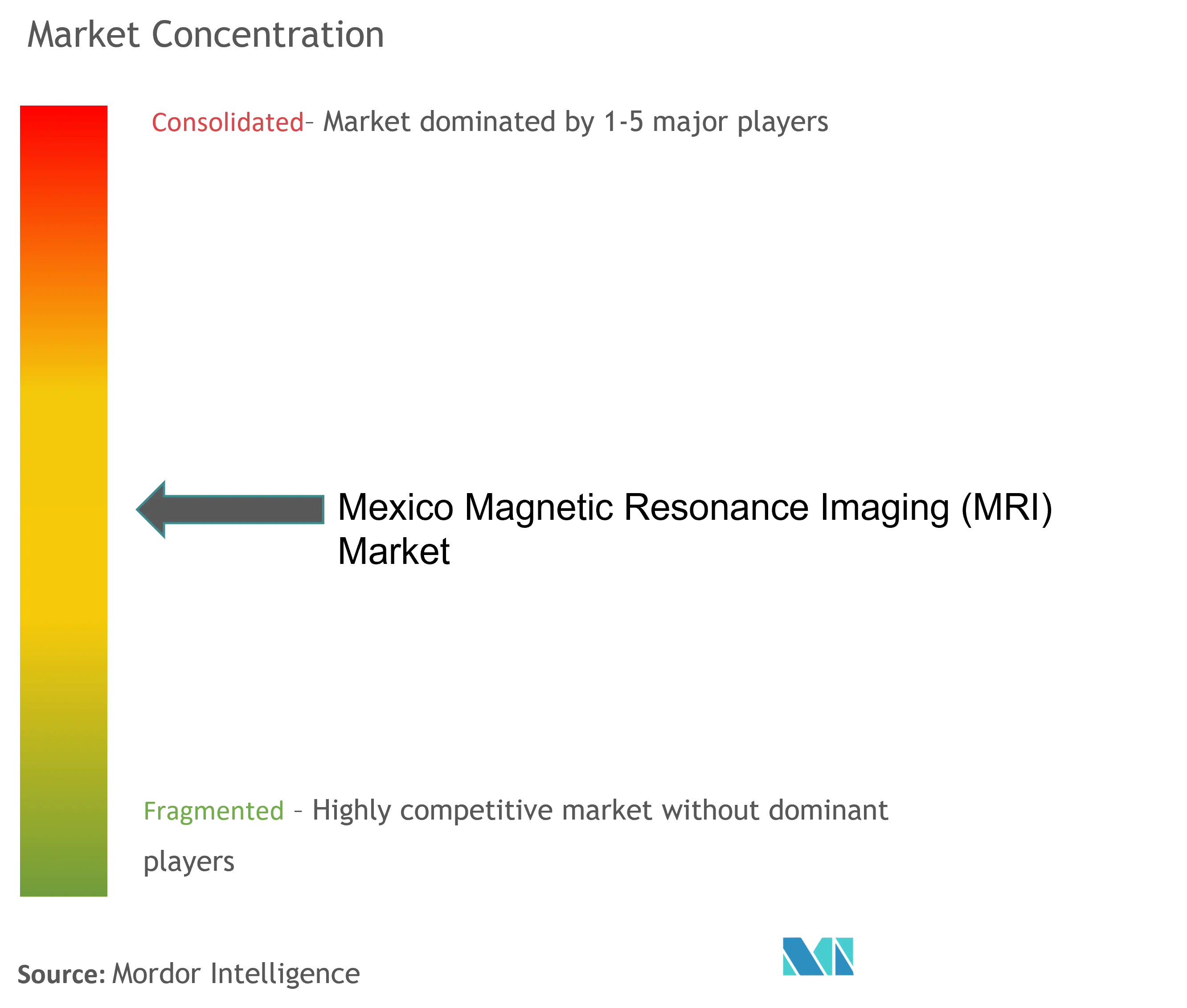
| Market Concentration | Medium |
Major Players *Disclaimer: Major Players sorted in no particular order Image © Mordor Intelligence. Reuse requires attribution under CC BY 4.0. | |
Mexico Magnetic Resonance Imaging (MRI) Market Analysis by Mordor Intelligence
The Mexico MRI market size is expected to grow from USD 186.64 million in 2025 to USD 194.06 million in 2026 and is forecast to reach USD 235.87 million by 2031 at 3.98% CAGR over 2026-2031. Public-sector modernization programs, rising private-hospital spending and USMCA-enabled equipment imports are expanding diagnostic imaging capacity in every major metropolitan area, while AI-enabled scanners reinforce throughput and lower per-study costs. Steady chronic-disease growth, particularly diabetes and cardiovascular conditions, elevates routine MRI utilization rates, and Mexico’s USD 11 billion medical-tourism stream brings incremental demand from 1.4 million international patients who opt for lower-cost scans in Tijuana, Los Cabos and Mexico City. Global vendors are localizing coil and magnet sub-assemblies to capture USMCA origin benefits, while helium-free technologies alleviate cost pressures from peso volatility and supply-chain shocks. Persistent radiologist shortages remain a structural headwind, but nationwide teleradiology roll-outs and AI-driven reporting platforms are beginning to bridge interpretation gaps.
Key Report Takeaways
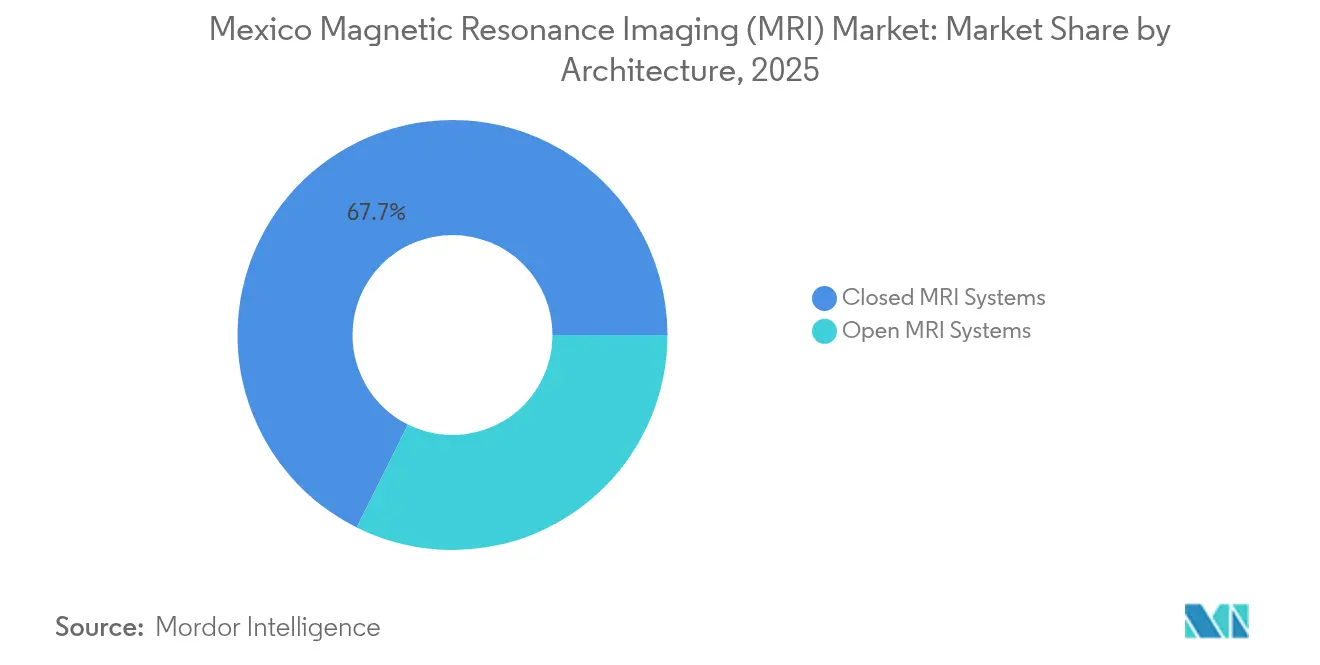
- By architecture, closed systems led with 67.65% of Mexico MRI market share in 2025; open systems are projected to advance at a 4.65% CAGR through 2031.
- By field strength, 1.5 T scanners held 54.55% share of the Mexico MRI market size in 2025, while 3 T and ≥7 T platforms are poised to expand at a 4.60% CAGR to 2031.
- By application, neurology captured 31.85% revenue share in 2025; oncology imaging is forecast to post a 5.05% CAGR between 2026-2031.
Note: Market size and forecast figures in this report are generated using Mordor Intelligence’s proprietary estimation framework, updated with the latest available data and insights as of 2026.
Mexico Magnetic Resonance Imaging (MRI) Market Trends and Insights
Drivers Impact Analysis*
| Driver | (~) % Impact on CAGR Forecast | Geographic Relevance | Impact Timeline |
|---|---|---|---|
| Advancements in MRI System Hardware & AI-Enabled Software | +0.8% | National, with early adoption in Mexico City, Guadalajara, Monterrey | Medium term (2-4 years) |
| Rising Burden of Chronic & Oncological Diseases | +1.2% | National, with higher concentration in urban centers | Long term (≥ 4 years) |
| Expansion of Private Hospitals & Medical-Tourism Clusters | +0.9% | Regional clusters in Los Cabos, Tijuana, Mexico City, Guadalajara | Medium term (2-4 years) |
| Federal Tax Breaks & USMCA Import Incentives for Imaging Devices | +0.6% | National, with manufacturing benefits in border states | Short term (≤ 2 years) |
| Rapid Roll-Out of Teleradiology & PACS Across Secondary Cities | +0.5% | Secondary cities and rural areas nationwide | Medium term (2-4 years) |
| OEM Near-Shoring of Coil & Magnet Sub-Assembly Lines | +0.4% | Northern Mexico manufacturing corridors | Long term (≥ 4 years) |
| Source: Mordor Intelligence | |||
Advancements in MRI Hardware and AI-Enabled Software
Rapid algorithmic innovation is shrinking scan times by up to 50%, allowing facilities to raise daily throughput without adding scanners. Siemens Healthineers’ AI-Rad Companion and Philips’ SmartSpeed Precise platforms sharpen images while trimming protocol length, which directly offsets the radiologist shortfall by reducing repeat studies[1]Siemens Healthineers, “Artificial Intelligence for MRI,” siemens-healthineers.com. Helium-free magnet designs such as Philips BlueSeal systems curb lifetime operating expenses by removing volatile cryogen inputs, and more than 1,000 units have been installed worldwide [2]USA Philips, “Philips Extends Leadership in Virtually Helium-Free MRI,” usa.philips.com . Mexico’s universal electronic-health-record program positions facilities to exploit AI workflow engines that draw on integrated data lakes for automated triage, further lifting scanner productivity. FDA-cleared software such as SwiftMR is vendor-agnostic, enabling hospitals to retrofit legacy fleets instead of replacing entire systems.
Rising Chronic and Oncological Disease Burden
Diabetes affected 16.9% of Mexican adults in 2022 and is projected to climb steadily through 2050, necessitating periodic renal, cardiac and neurologic imaging follow-ups. Cardiovascular mortality increased from 96.7 to 111.7 per 100,000 between 2011-2015, making MRI pivotal for ischemic and structural heart assessments. Cancer incidence stands at 140.9 per 100,000, with breast and prostate leading new-case tallies, and oncology MRI volumes are growing fastest as screening guidelines widen. Chronic kidney disease linked to diabetes impacts 14.5 million residents, driving repeat abdominal MRI studies for disease-progress tracking. Long COVID affects 37% of survivors, adding respiratory and neurologic MRI demand for lingering complications.
Expansion of Private Hospitals and Medical-Tourism Clusters
Hospitales MAC secured USD 160 million to build MRI-equipped hospitals in 17 cities and targets a value-for-money positioning that matches domestic demand with tourist inflows. CHRISTUS Health’s USD 84 million Cabo San Lucas facility will integrate AI-assisted imaging across 75 beds, exemplifying destination-care models focused on comprehensive diagnostics. Los Cabos, Tijuana and Mexico City advertise MRI scans at 60% cost savings versus U.S. rates, drawing 1.4 million annual visitors and fueling out-of-pocket imaging volumes. The Mexican Council for Medical Tourism is harmonizing quality standards, further legitimizing cross-border care and embedding premium MRI packages into bundled surgery offerings. Private providers distinguish themselves with whole-body MRI options priced between USD 273-826, which remain significantly below U.S. cash prices while still supporting healthy margins.
Federal Tax Breaks and USMCA Import Incentives
The USMCA eliminates tariffs on compliant imaging systems, trimming acquisition costs, and it streamlines regulatory definitions, cutting redundant certification expenses. Mexico’s PROSEC scheme further reduces duties on MRI components destined for export, encouraging global vendors to near-shore coil and magnet assembly lines in northern industrial zones. A March 2025 tariff suspension covers half of all USMCA-qualified imports, reducing scanner list prices during public-hospital procurement cycles. However, policymakers have floated 10% tariff surcharges for fully-built scanners, which could add USD 100,000-200,000 to high-end systems and stall replacement schedules. December 2024 regulations allow public buyers to import MRI units without local marketing authorization through BIRMEX, accelerating fleet upgrades but raising intellectual-property concerns among established suppliers.
Restraints Impact Analysis*
| Restraint | (~) Impact on CAGR Forecast | Geographic Relevance | Impact Timeline |
|---|---|---|---|
| High Upfront & Lifecycle Cost of MRI Scanners | -1.1% | National, with greater impact on smaller facilities | Long term (≥ 4 years) |
| Lengthy COFEPRIS Device-Registration & Reimbursement Delays | -0.7% | National regulatory bottleneck | Medium term (2-4 years) |
| Peso Volatility Inflating Lease-Financing Costs | -0.5% | National, with higher impact on import-dependent facilities | Short term (≤ 2 years) |
| Shortage & Uneven Distribution of Trained Radiologists | -0.9% | Rural and secondary cities disproportionately affected | Long term (≥ 4 years) |
| Source: Mordor Intelligence | |||
High Upfront and Lifecycle Cost of MRI Scanners
Premium 3 T platforms require capital outlays above USD 2 million, and facility modifications, helium refills and annual service contracts can double total ownership cost over ten years [3]PAHO, “Mexico – Country Profile,” paho.org. With 41.37% of health spending paid out of pocket, many mid-size hospitals postpone upgrades or resort to refurbished imports that carry shorter warranties. Peso volatility magnifies budgeting risk because most coils, gradients and electronics are priced in U.S. dollars, causing leasing rates to swing alongside exchange-rate shifts. Public institutions face multi-year budget cycles that delay tender launches and prolong replacement of aging 1 T fleets. Helium-free magnets offer energy savings of 40 MWh per year per system, trimming operating expenses yet still demand high sticker prices that challenge cash-constrained providers.
Shortage and Uneven Distribution of Trained Radiologists
Mexico employs roughly 4,000 radiologists for 124 million inhabitants, equating to fewer than one specialist per imaging facility. Urban clusters attract the majority of talent, leaving secondary cities and rural zones reliant on general practitioners or outsourced teleradiology, which raises turnaround times and constrains MRI throughput. Average salaries sit near USD 73,000, which competes poorly with private-practice earnings in the United States and drives emigration of subspecialists. International training collaborations through the World Health Organization provide live case reviews and virtual fellowships, but sustainable knowledge transfer depends on local residency expansions and scholarship funding. Remote-operation platforms enable technologists to steer scanners from centralized hubs while cloud PACS route images to metropolitan readers, yet roll-out momentum hinges on broadband quality and cybersecurity investments.
*Our forecasts treat driver/restraint impacts as directional, not additive. The impact forecasts reflect baseline growth, mix effects, and variable interactions.
Segment Analysis
By Architecture: Closed Leadership and Open-System Momentum
Closed scanners delivered 67.65% of Mexico MRI market revenue in 2025, reflecting hospital preference for higher field strengths and multi-sequence versatility that support complex neuro, cardiac and oncologic protocols. Facilities catering to medical tourists use closed platforms to advertise comprehensive head-to-toe packages that rival premium U.S. imaging centers. Patient-centric design pressures, however, underpin a 4.65% CAGR for open systems through 2031, as claustrophobic, bariatric and pediatric cohorts seek more comfortable environments.
Open platforms led by Fujifilm Aperto Lucent add motion-compensating sequences and permanent magnets that lower energy use, making them attractive for mid-size regional hospitals. Closed systems evolve in parallel; Canon Medical’s Vantage Galan 3 T Supreme Edition integrates AI protocols that slash scan times and minimize helium usage. As facility portfolios widen, executives mix open units for outpatient comfort with closed units for high-throughput tertiary care, anchoring balanced long-term demand across both architectures.



By Field Strength: 1.5 T Sweet Spot with Ultra-High Research Upside
1.5 T platforms captured 54.55% of Mexico MRI market share in 2025, offering cost-effective coverage across neuro, musculoskeletal and body imaging without specialized infrastructure demands. Public insurers favor 1.5 T fleets for standardization, spares interchangeability and reimbursement baselines, solidifying the modality’s entrenched position.
Ultra-high 3 T and ≥7 T units post a 4.60% CAGR to 2031, driven by academic centers and oncology institutes that require diffusion, spectroscopy and functional mapping capabilities unattainable on lower-field magnets. Siemens Healthineers’ MAGNETOM Flow 1.5 T introduces helium-light technology and AI-boosted sequences that blur the line between mid and high field strengths, extending 1.5 T viability. GE HealthCare’s head-only MRI for neuroscience research demonstrates niche demand in cognitive science that relies on ultra-high gradients for microstructural insights. Low-field ≤0.4 T units persist in pediatric wards and mobile trailers, but limited SNR confines their role to adjunct imaging in resource-restricted settings.
By Application: Neurology Dominance with Oncology Acceleration
Neurology retained 31.85% revenue in 2025, supported by aging demographics, stroke prevalence and pioneering psychiatric research such as Dr. Camilo de la Fuente-Sandoval’s glutamate-mapping studies that rely heavily on spectroscopy. Routine brain, spine and peripheral-nerve protocols drive predictable daily volumes and stable scanner revenue streams.
Oncology leads the growth curve with a 5.05% CAGR through 2031 as national screening campaigns expand MRI indications for breast, prostate and liver lesions. Multispectral techniques, dynamic contrast and whole-body diffusion sequences, coupled with emerging manganese-based contrast agents under development by GE HealthCare, deepen oncologic utility. Musculoskeletal studies remain steady due to sports-injury management and orthopedic pre-surgical planning. Cardiac and vascular applications gain momentum from rising atherosclerotic disease, while functional MRI usage spreads in academic psychology departments and pharma trials, diversifying the installed-base workload mix.

Geography Analysis
Greater Mexico City, Guadalajara and Monterrey host most MRI capacity, anchored by flagship public institutes and premium private networks that together conduct the majority of reimbursed scans. These metropolitan regions present the largest clusters of subspecialized radiologists, enabling advanced protocols like cardiac stress MRI and functional neuroimaging. Border cities such as Tijuana leverage physical proximity to California to attract outbound U.S. patients seeking scans at 40-60% price discounts, converting cross-border flows into steady equipment-utilization gains.
Coastal tourist corridors, especially Los Cabos and Cancún, integrate MRI suites into poly-specialty hospitals that package imaging with elective surgery for international clients. Northern industrial hubs benefit from employer-sponsored health plans that reimburse MRI rapidly, reinforcing procurement pipelines for private diagnostic centers. Secondary interior cities, including León and Puebla, receive new IMSS-Bienestar hospitals featuring MRI as the government inaugurates nine hospitals and six Family Medicine Units across 12 states in 2025.
Rural states in the south still depend on mobile MRI programs and periodic teleradiology support due to sparse specialist density. Government broadband initiatives promise higher bandwidth that can support cloud-based PACS and remote operation, gradually narrowing the urban-rural imaging gap. While travel times remain a barrier for some populations, shared-service agreements among regional hospitals are emerging, ensuring that newly acquired scanners generate sustainable case volumes despite distributed demand patterns.
Regulatory Landscape
MRI systems marketed, imported, or used clinically in Mexico fall under COFEPRIS (Comision Federal para la Proteccion contra Riesgos Sanitarios), which oversees sanitary registration and related authorizations through defined filing processes such as COFEPRIS-04-060. As high-risk medical devices, MRI platforms generally require comprehensive technical dossiers covering safety, performance, and quality-system controls, which can slow lead times for new model introductions and upgrades when local dossier readiness is incomplete.
In July 2025, COFEPRIS published an Abbreviated Regulatory Pathway (effective September 1, 2025) that recognizes approvals from selected reference regulators (including the US FDA and Health Canada) to reduce backlogs. For multinational MRI OEMs with existing approvals in reference markets, this reference-dependent pathway can compress Mexico launch sequencing and support faster refresh cycles for 1.5 T and 3 T systems, while providers still manage ongoing compliance across importation, installation documentation, and post-market requirements.
Value Chain Analysis
The Mexico MRI value chain begins with global OEM design and magnet/gradient subsystem sourcing, then moves through localized component manufacturing and final system importation or assembly. After that, distribution, installation, and lifecycle service determine how quickly systems reach routine clinical use. Mexico supports this chain through established medical-device manufacturing clusters in Tijuana (Baja California), Ciudad Juarez (Chihuahua), Monterrey/Apodaca (Nuevo Leon), and the Bajio region, which provide skilled labor, maquiladora infrastructure, and logistics connectivity to the United States under USMCA frameworks.
On the supply side, multinationals use Mexico-based plants and supplier ecosystems to improve parts responsiveness and installed-base uptime. GE HealthCare has manufacturing operations in Apodaca and Ciudad Juarez, and Siemens Healthineers operates a production site in Tijuana connected to its broader supply network. Downstream, local distributors and OEM service teams support COFEPRIS documentation, site planning (including shielding, power, quench/venting), commissioning, and multi-year maintenance contracts. Hospital groups and public providers influence purchasing through tender specifications, financing or leases, and bundled service models that emphasize throughput, reliability, and training continuity.
Competitive Landscape
Global manufacturers dominate the Mexico MRI market through longstanding distributor alliances and established COFEPRIS dossiers that shorten registration timelines. Siemens Healthineers invests USD 314 million in new MRI production lines aimed at fulfilling USMCA origin thresholds, ensuring competitive pricing while bolstering local after-sales parts availability. GE HealthCare focuses on AI-enhanced workflow ecosystems, complementing hardware with predictive maintenance platforms that minimize downtime. Philips leverages helium-free BlueSeal magnets to advertise lower lifecycle costs, courting public buyers sensitive to operational expense overruns.
Canon Medical and Fujifilm capture share in mid-price segments by coupling patient-friendly designs with modular upgrade paths; their emphasis on open and low-noise configurations appeals to outpatient centers. United Imaging, Neusoft and Hyperfine are selectively entering secondary-city tenders with competitively priced bundles that include five-year service plans, although COFEPRIS approval cycles and reimbursement uncertainties temper rapid expansion.
Vendor rivalry increasingly centers on AI software ecosystems, sustainable magnet technology and turnkey teleradiology solutions that offset staffing shortages. Partnerships with local universities for research deployments of ≥7 T systems are strengthening brand visibility in the academic segment, while mobile service providers contract refurbished 1.5 T trailers to rural municipalities to widen population coverage. Across the board, suppliers now bundle remote-scanner operation and cloud PACS to mitigate the radiologist gap and secure long-term service revenues.
Mexico Magnetic Resonance Imaging (MRI) Industry Leaders
FUJIFILM Holdings Corporation
Koninklijke Philips N.V.
GE HealthCare
Siemens Healthcare GmbH
Canon Inc. (Canon Medical Systems Corporation)
- *Disclaimer: Major Players sorted in no particular order

Market Opportunities and Future Outlook
Public-sector consolidation and modernization create a practical whitespace for standardized fleet replacement and multi-site service delivery, particularly where imaging coverage is expanding through systems such as IMSS-Bienestar. The June 2026 IMSS procurement of 17 new MRI systems (split across 1.5 T and 3 T) indicates demand for centrally coordinated deployments that bundle equipment supply with installation and maintenance execution, which benefits OEMs and service providers that can run turnkey programs across multiple hospitals.
Software-enabled productivity is another near-to-midterm opportunity as radiologist capacity remains constrained and providers look for shorter scan times and more predictable reporting workflows. The July 2025 roll-out activity around AI-enabled MRI, including SwiftMR deployments in private radiology networks and Hospital Angeles introducing an AI platform to embed MRI into preventive check-ups, supports commercialization of retrofit AI packages, protocol automation, and enterprise imaging integration. Supply-side localization also matters, since nearshoring and component manufacturing footprints in Mexico, including Siemens Healthineers in Tijuana and GE HealthCare manufacturing in Apodaca, create room for deeper localization of coils, sub-assemblies, and service parts that can reduce downtime risk and improve bid competitiveness under import and origin-rule considerations.
Recent Industry Developments
- June 2026: Mexican Social Security Institute (IMSS) announced the acquisition of 17 new MRI systems, comprising 11 units at 1.5 Teslas and 6 units at 3.0 Teslas. The expanded fleet increases nationwide diagnostic capacity and supports government modernization of public-sector imaging.
- June 2026: Philips announced that IMSS confirmed the acquisition of 12 Philips MRI systems: 6 Ingenia Ambition X (1.5T) and 6 Ingenia Elition X (3T). The upgrade strengthens scanner availability for high-demand centers and supports AI-enabled workflow enhancements.
- June 2026: Siemens Healthcare GmbH confirmed the acquisition of Siemens Magnetom Avanto MRI systems as part of the 17-unit technology upgrade. The inclusion of Siemens systems expands the public sector's modal mix and helps modernize capacity in major cities.


Research Methodology Framework and Report Scope
Market Definition and Coverage
This market tracks the value of MRI systems sold and installed in Mexico, covering equipment demand across care settings where MRI is used for clinical imaging and diagnosis.
Scope exclusions: The sizing excludes imaging services revenue, refurbishment-only transactions without a tracked system sale, and non-MRI modalities such as CT, X-ray, and ultrasound.
Segmentation Overview
- By Architecture
- Closed MRI Systems
- Open MRI Systems
- By Field Strength
- Low-Field (≤0.4 T)
- High-Field (1.5 T)
- Very-High (3 T) & Ultra-High (≥7 T)
- By Application
- Neurology
- Oncology
- Musculoskeletal
- Cardiology & Vascular
- Other Clinical Applications
Data Sources, Market Sizing, and Validation
Desk Research
Desk research was used to set the guardrails of the model and to align assumptions with real-world healthcare activity in Mexico. We reviewed public health spending and facility signals, then mapped them to MRI-relevant demand drivers such as chronic disease burden and diagnostic capacity expansion.
Common source types included official and non-paywalled references such as Mexico health and statistics portals (such as INEGI), international health statistics (such as WHO), OECD health indicators, and scientific literature indexed in public repositories (such as PubMed). We also used association publications, hospital network updates, procurement announcements, and company filings and investor decks to understand product positioning and replacement cycles. For cross-checking, selected paid subscriptions were used for company financials and news screening, plus patent-search tools to sanity check technology direction. The desk sources listed are illustrative, and additional public references were consulted to collect, validate, and clarify data points.
Primary Interviews and Surveys
Primary work focused on validating how MRI demand behaves in Mexico across public hospitals, private hospitals, and imaging centers, and then pressure-testing our assumptions on pricing and upgrade timing. Interviews and surveys were completed with a mix of equipment stakeholders, clinical users, and service and procurement voices, so gaps from desk research could be filled before totals were finalized.
Distribution of primary research fieldwork respondents
| Company type | Respondent position |
|---|---|
| Top tier: 31% | CXOs: 18% |
| Mid tier: 50% | Functional/Unit leaders: 23% |
| Smaller Players: 19% | Managers: 59% |
Market-Sizing & Forecasting
Sizing was built using a combined top-down and bottom-up flow that a client can trace back to demand and pricing blocks. On the top-down side, diagnostic capacity and procedure demand signals were translated into an equipment demand pool, which was then filtered through replacement needs and expansion projects in Mexico.
To keep totals realistic, we corroborated the outputs with selective bottom-up approximations, including sampled system ASP ranges by field strength, channel checks on procurement timing, and roll-ups from a set of suppliers and installers active in the country. Key inputs used in the model included installed base renewal cycles, the mix shift between 1.5T and 3T systems, public versus private purchasing pace, typical magnet and software upgrade behavior, and exchange-rate timing for imported equipment pricing.
Forecasts were developed using scenario analysis supported by expert views, since buying cycles can move with budgets and tender timing. Where bottom-up visibility was patchy, such as for smaller imaging centers, we applied conservative penetration and replacement assumptions, then rechecked the outputs against observed capacity expansion signals.
Data Validation & Update Cycle
Model outputs were checked against independent market signals such as announced hospital expansions, public procurement patterns, and the implied system replacement cadence from installed base estimates. Large variances were flagged, and the assumptions behind ASP, mix, or timing were revisited before sign-off.
Each report goes through multi-step analyst reviews, with re-contact triggers used when primary inputs conflict or when new public updates appear. The report is refreshed annually, and interim updates are made if a material event changes demand, pricing, or purchasing timelines. Before delivery, a final review pass is completed so clients receive the most current view available at that time.
Mordor Intelligence's Mexico Magnetic Resonance Imaging Mri Market Size Compared Against Other Published Estimates
Published market values can differ even when the topic sounds identical, since each publisher makes its own choices on what gets counted and how currency and timing are handled. The largest gaps usually come from scope mixing (systems versus services), year labeling (shipment year versus installation year), and different assumptions on price by field strength.
Some external figures blend MRI equipment with scan fees and service contracts, and they also apply a single average price that does not reflect the real 1.5T versus 3T mix by buyer type. For Mordor Intelligence, only MRI system equipment revenue installed in Mexico is counted, and imaging services and related service revenue are kept out.
Benchmark comparison
| Source | Market Size | Gaps in Research Methodology |
|---|---|---|
| Mordor Intelligence | USD 186.64 M (2025) | |
| Regional Consultancy A | USD 210.00 M (2025) | This figure appears to include a broader spend pool that likely blends equipment with maintenance and software support, and it assumes a higher 3T share, lifting the implied ASP. |
| Trade Journal B | USD 165.00 M (2025) | This estimate seems to rely on shipment timing and a narrower tracked channel set, so installation lags and public tender batches can be undercounted in the stated year. |
Taken together, the comparison shows that including service revenue and choosing shipment timing versus installation timing can move the headline number noticeably. Our approach stays tied to observable equipment demand drivers and practical pricing and mix checks, which makes the final market value easier to replicate and explain when assumptions are updated.


Key Questions Answered in the Report
What CAGR is forecast for the Mexico MRI market through 2031?
The market is projected to grow at a 3.98% CAGR between 2026-2031, reaching USD 235.87 million by the end of the period.
Which MRI architecture is growing fastest in Mexico?
Open systems are advancing at a 4.65% CAGR as hospitals target patient comfort and lower operational complexity.
Why are 1.5 T scanners still prevalent in Mexican hospitals?
They balance diagnostic versatility and acquisition cost, holding 54.55% of 2025 revenue and fitting most reimbursement schedules.
How is medical tourism influencing MRI demand in border regions?
Facilities in Tijuana and Los Cabos attract U.S. patients with 60% lower scan prices, sustaining high scanner utilization rates.
Page last updated on:


 Your data is secure and never sold or shared.


