
Mexico Cash Logistics Market Size and Share
Market Overview
| Study Period | 2020 - 2031 |
|---|---|
| Forecast Data Period | 2026 - 2031 |
| Base Year Market Size (2025) | USD 1.04 Billion |
| Market Size (2026) | USD 1.09 Billion |
| Market Size (2031) | USD 1.54 Billion |
| Growth Rate (2026 - 2031) | 7.04 % |
| Market Concentration | Medium |
Major Players *Disclaimer: Major Players sorted in no particular order Image © Mordor Intelligence. Reuse requires attribution under CC BY 4.0. | |
Mexico Cash Logistics Market Analysis by Mordor Intelligence
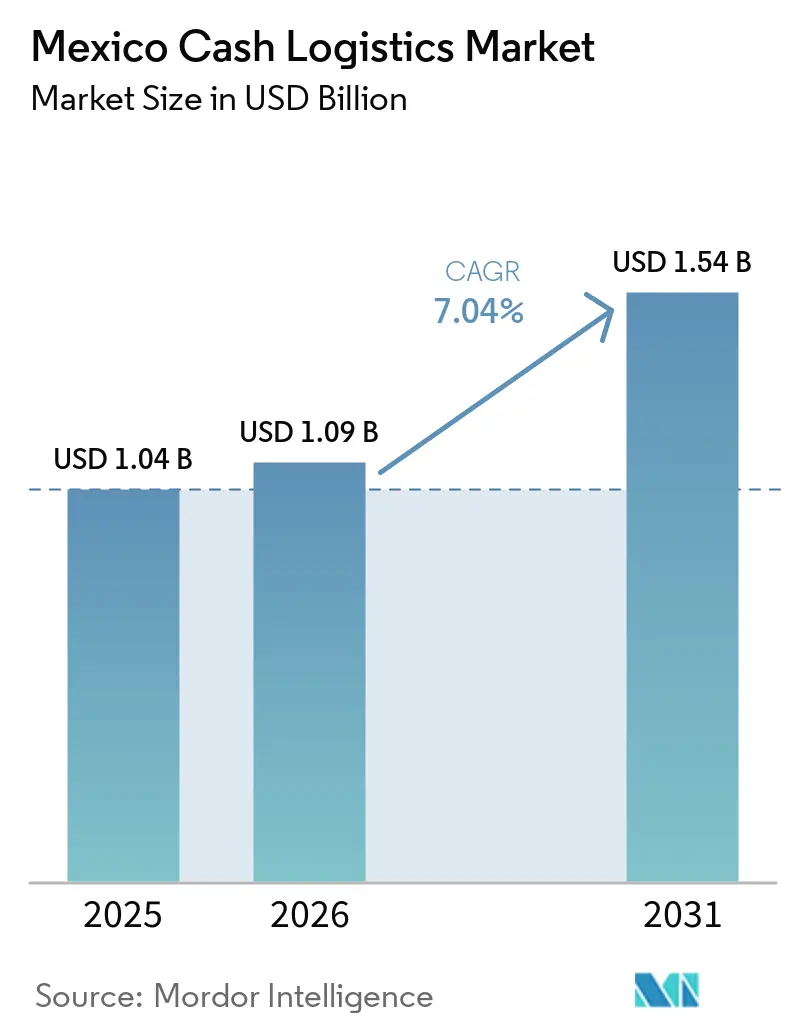
The Mexico cash logistics market size was valued at USD 1.04 billion in 2025 and is estimated to grow from USD 1.09 billion in 2026 to reach USD 1.54 billion by 2031, at a CAGR of 7.04% during the forecast period (2026-2031).
Cash remained central to routine purchases and to many informal business activities, which sustained collection, processing, and distribution requirements across the country. The Mexico cash logistics market also depended on rural underbanking and on remittance recipients who continued to collect or withdraw physical currency. Deposits overtook cash collections in the remittance channel during 2025, which changed the mix of cash-handling needs instead of removing them. ATM replenishment, smart-safe services, and organized retail contracts created opportunities for providers that combined transport with information systems. Security costs and the gradual adoption of account-based payments limited margins and changed route planning requirements.
Key Report Takeaways
- By service type, cash management services held 32.50% of the Mexico cash logistics market share in 2025, while ATM services recorded the highest projected CAGR at 7.90% through 2031.
- By end user, financial institutions held 58.55% the Mexico cash logistics market size in 2025, while retail recorded the highest projected CAGR at 8.20% through 2031.
- By mode of transit, roadways held 90.50% the Mexico cash logistics market share in 2025, while railways recorded the highest projected CAGR at 8.10% through 2031.
Note: Market size and forecast figures in this report are generated using Mordor Intelligence’s proprietary estimation framework, updated with the latest available data and insights as of January 2026.
Mexico Cash Logistics Market Trends and Insights
Drivers Impact Analysis*
| Driver | (~) % Impact on CAGR Forecast | Geographic Relevance | Impact Timeline |
|---|---|---|---|
| Continued Use of Cash in Low-Value and Informal Transactions | +2.1% | National, with highest intensity in central Mexico, State of Mexico, Puebla, and informal-economy hubs | Long term (≥ 4 years) |
| Expansion of ATM and Correspondent-Banking Networks | +1.5% | National, with strongest growth in Oaxaca, Guerrero, and Chiapas | Medium term (2-4 years) |
| Growth of Organized Retail and Cash-Intensive Service Networks | +1.2% | National, led by Mexico City, Guadalajara, Monterrey, and Bajío urban corridors | Medium term (2-4 years) |
| Security Requirements for Cash Collection and Transportation | +0.8% | National, with high relevance in State of Mexico, Puebla, Guanajuato, and San Luis Potosí | Short term (≤ 2 years) |
| Smart-Safe Adoption Enabling Real-Time Liquidity Visibility | +0.6% | Mexico City, Monterrey, and Guadalajara, followed by secondary cities | Medium term (2-4 years) |
| Cash Logistics Integration with Remittance and Cash-on-Delivery Flows | +0.5% | National, concentrated in Michoacán, Jalisco, Guanajuato, and Oaxaca | Medium term (2-4 years) |
| Source: Mordor Intelligence | |||
Continued Use of Cash in Low-Value and Informal Transactions
Cash use remained embedded in low-value purchases and informal work, giving the Mexico cash logistics market a broad base of recurring activity. The 2025 National Financial Inclusion Survey found that 85% of adults used cash for purchases below USD 29.[1]“Política Nacional de Inclusión Financiera 2025-2030,” Gobierno de México, finabien.gob.mx Physical cash, therefore, continued to move through convenience stores, food vendors, construction work, domestic services, and daily-wage payroll channels. Each activity required safe collection, counting, storage, and redistribution before merchants or workers could use the funds. Financial-product ownership did not automatically lead to digital payment use, particularly where devices, connectivity, or confidence remained limited. This pattern kept route density high in areas where formal banking access and informal commerce existed side by side.
The Mexico cash logistics market benefited because informal businesses often handled many small payments each day. Those businesses needed a dependable way to consolidate notes and coins without sending employees to a bank branch. Providers could address that need through scheduled pickups, local cash-processing capacity, and secure delivery services. The demand was geographically dispersed, so nationwide scale was useful but not sufficient on its own. Local knowledge of collection points and operating hours also remained important for service delivery. The same conditions supported cash collection for small retailers, local distributors, and employers with cash-based payroll practices.
Expansion of ATM and Correspondent-Banking Networks
ATM expansion created direct demand for cash replenishment, first-line maintenance, and processing work in the Mexico cash logistics market. New machines required regular currency delivery, reconciliation, service visits, and secure handling of returned cash. These obligations created contracts that were more predictable than single cash-transport trips. They also increased the importance of uptime, route coordination, and monitoring systems. Operators needed well-planned routes to serve networks that extended beyond the largest cities. This supported recurring managed-service arrangements instead of isolated transport assignments.
The National Financial Inclusion Policy for 2025 through 2030 sets access goals that support the expansion of financial-service points.[2]Comisión Nacional Bancaria y de Valores, “Panorama Anual de Inclusión Financiera 2025,” Gobierno de México, cnbv.gob.mx Cash logistics providers could gain work from new machines in municipalities with limited coverage. Operators with established replenishment routes could spread fixed fleet and staffing costs across a larger installed base. This strengthened the commercial value of long-duration ATM management agreements. Machine-network growth also increased the value of prompt maintenance and accurate reconciliation. It favored providers that could meet service requirements across dispersed locations.
Growth of Organized Retail and Cash-Intensive Service Networks
Organized retail expansion extended the addressable customer base for the Mexico cash logistics market beyond banks and public institutions. Chains entering secondary and tertiary cities often operated where banking infrastructure was less developed than in major urban centers. Their stores could receive frequent cash payments even as card and mobile-payment use increased. Daily collections reduced the amount of cash held at each location and improved store-level security. Retailers also wanted timely visibility into funds that had already entered their premises. These requirements favored providers that could combine physical collection with electronic records and account reconciliation.
Smart-safe integration allowed a retailer to record cash on site before an armored vehicle arrived. That model reduced manual aggregation and made collection scheduling more responsive to actual balances. The Mexico cash logistics market could use this approach to improve route planning in store networks with different sales patterns. It also reduced the operational burden on staff who previously carried cash to a branch or prepared it for fixed pickups. Brink’s reported 22% organic growth in AMS and DRS in Q4 2025 and 15% organic growth in Q1 2026. Mexico was cited as a strong Digital Retail Solutions location in the company’s Q1 2026 discussion.
Smart-Safe Adoption Enabling Real-Time Liquidity Visibility
Smart safes changed the operating approach of the Mexico cash logistics market by turning on-site cash balances into usable information. The devices recorded deposits at the point of sale and supported a digital record of cash held by each customer. Operators could use that information to arrange pickups around actual balances instead of relying only on fixed daily schedules. This reduced unnecessary vehicle movements and kept vehicles off higher-risk routes for less time. Retail customers also gained better visibility into funds before physical collection occurred. The service model moved competition toward data, integration, and reliability, as well as transport capacity.
Smart-safe deployment supported a more deliberate allocation of armored capacity across customer routes. The Mexico cash logistics industry could improve pickup economics when it used timely balance data to group collections. Better data also supported reconciliation reporting for customers that required tighter oversight of cash. Retail chains with integrated point-of-sale systems were better placed to adopt this approach. Adoption was likely to begin in major cities where retail chains had the needed systems and volumes. Smaller businesses could benefit if providers made the equipment and related services accessible.
Restraints Impact Analysis*
| Restraint | (~) % Impact on CAGR Forecast | Geographic Relevance | Impact Timeline |
|---|---|---|---|
| Gradual Migration Toward Digital and Account-to-Account Payments | -1.5% | National, with faster adoption in Mexico City, Monterrey, and Guadalajara | Long term (≥ 4 years) |
| Theft, Organized Crime, and Route-Security Exposure | -0.8% | National, with high relevance in State of Mexico, Puebla, Guanajuato, San Luis Potosí, and Veracruz | Short term (≤ 2 years) |
| Shortage of Licensed Armed Personnel and Rising Insurance Costs | -0.6% | National, with greater pressure in states with high crime concentration | Medium term (2-4 years) |
| Urban Congestion and Limited Suitability of Conventional Armored Fleets | -0.4% | Mexico City, Guadalajara, and Monterrey metropolitan areas | Medium term (2-4 years) |
| Source: Mordor Intelligence | |||
Gradual Migration Toward Digital and Account-to-Account Payments
Digital payments created a medium-term constraint because they reduced some physical cash collection and distribution needs. Account-deposit remittances accounted for 50.4% of remittances received in 2025, while cash collections represented 49.6%.[3]“Dinamismo de las Remesas Recibidas en México,” CEMLA, cemla.org CEMLA confirmed that deposits represented 52.7% of remittances during Q1 2026. The shift changed where cash was needed because recipients could withdraw deposited funds through ATMs rather than collect funds directly. It also reduced demand on certain remittance collection routes. The Mexico cash logistics market still served the cash-out process, but its revenue mix became more dependent on ATM and banking-correspondent activity.
The National Financial Inclusion Policy set out the government’s approach to extend access and digital payment options through 2030. Device availability, connectivity, and trust continued to limit the rapid displacement of cash in rural, informal, and lower-income communities. These limits protected near-term demand for physical cash services in many locations. Providers nevertheless needed to prepare for a gradual reduction in cash-intensive transactions in the most digitally connected cities. Their response depended on offering ATM management, smart-safe, and reconciliation services alongside conventional transport. This approach allowed operators to serve changing customer preferences without abandoning physical cash operations.
Theft, Organized Crime, and Route-Security Exposure
Route crime restricted expansion in the Mexico cash logistics market because security costs rose with exposure. INEGI reported 105,459 vehicle thefts in 2025. Smaller providers faced particular pressure because they had fewer vehicles, lower route density, and less capacity to absorb losses. They also faced higher spending on vehicle protection, trained personnel, insurance, and route controls. Fixed-price contracts made it difficult to pass every added cost to customers. This placed more value on scale, disciplined routing, and long-standing customer contracts.
The operational threat remained material on routes in the State of Mexico, Puebla, Guanajuato, and San Luis Potosi. Providers responded with GPS monitoring, more frequent location updates, and route-risk assessment systems. Such investments could protect personnel and cash, but they also increase capital needs. The Mexico cash logistics industry, therefore, faced a security requirement that supported demand for professional services while reducing margins for operators without scale. Security spending also affected fleet replacement decisions and insurance arrangements. Large operators could distribute these costs across more customer routes and a wider asset base.
*Our forecasts treat driver/restraint impacts as directional, not additive. The impact forecasts reflect baseline growth, mix effects, and variable interactions.
Segment Analysis
By Service Type: ATM Networks Drive Structural Service Diversification
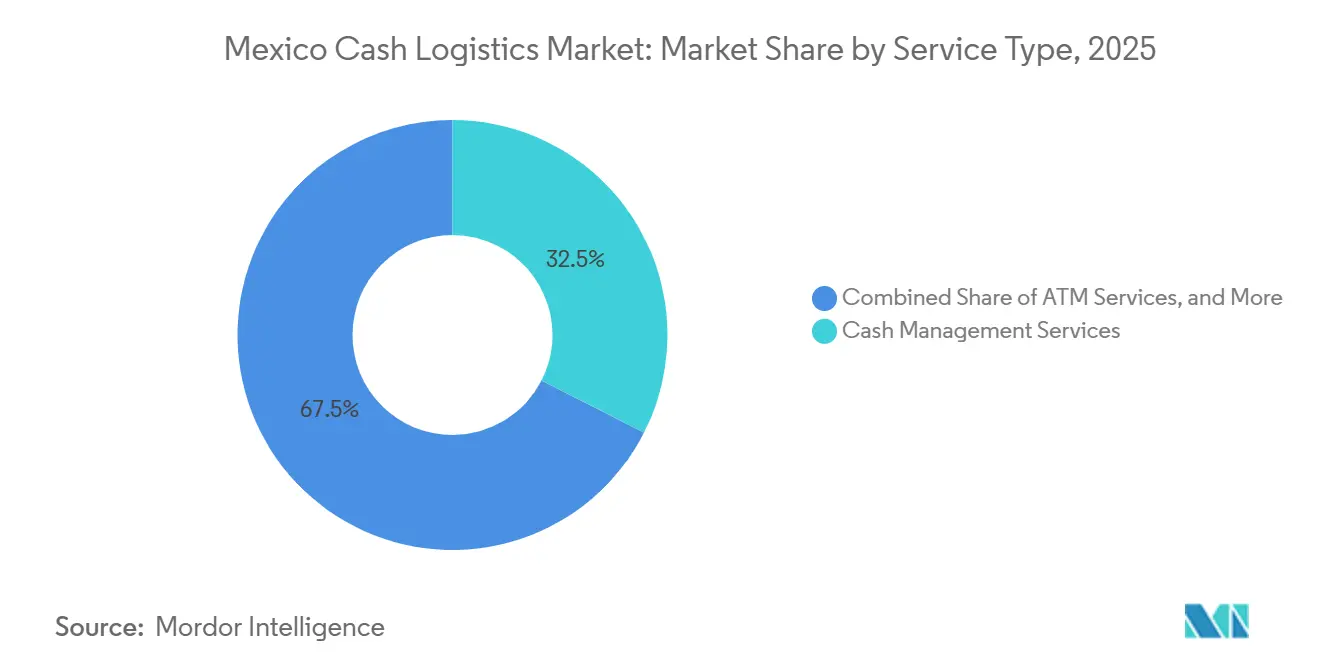
Cash management services held 32.50% of the Mexico cash logistics market share in 2025. The segment benefited from long-duration contracts for vault operations, reconciliation, and cash administration. Financial institutions and public bodies used these services where daily volumes required controlled processing. The work included counting, verification, storage, and reporting before cash was redistributed. Its contract structure gave providers a steadier revenue base than isolated transport assignments. Large customers also valued consistent procedures and documented custody of funds. Cash Management Services remained important because physical currency still circulated through retail, government payments, and bank networks. The Mexico cash logistics market size for this service was supported by the continued need to handle currency after collection. Service quality depended on processing capacity, controls, and integration with customer reporting systems.
ATM services were projected to grow at a CAGR of 7.90% from 2026 to 2031, the fastest rate in this segmentation. The segment covered cash replenishment, first-line maintenance, monitoring, and management of machine networks. GSI managed more than 29,000 ATMs nationally, showing the scale of managed ATM work in Mexico. Operators competed on uptime guarantees, replenishment frequency, response times, and monitoring capabilities. These factors mattered because an unavailable machine could disrupt access to cash in communities with few alternatives. ATM expansion in underserved municipalities created a continuing pipeline of service opportunities. The Mexico cash logistics market shifted toward recurring managed-service contracts as ATM responsibilities expanded. Providers could build stronger revenue visibility when they combined machine servicing with transport and cash processing. This segment rewarded route density, operational discipline, and reliable customer reporting.
Cash-in-transit remained the physical foundation for bank branch collections, retail pickups, ATM replenishment, and delivery routes. It retained a stable role because each managed service still required secure movement of currency. Other Services included payroll distribution and specialized banking-messenger work for customers outside formal digital payroll systems. These services served smaller but consistent needs among businesses that required controlled physical delivery. The service mix became more diverse as customers asked for transport, processing, monitoring, and cash visibility in one arrangement. Brink’s used its AMS and DRS businesses to combine technology-based services with its established logistics activities. The Mexico cash logistics industry therefore increasingly rewarded providers that could deliver a wider operating package. Conventional cash transport remained necessary, but it was less often the only service requested by large accounts.



By End User: Financial Institutions Lead, Retail Accelerates Fastest
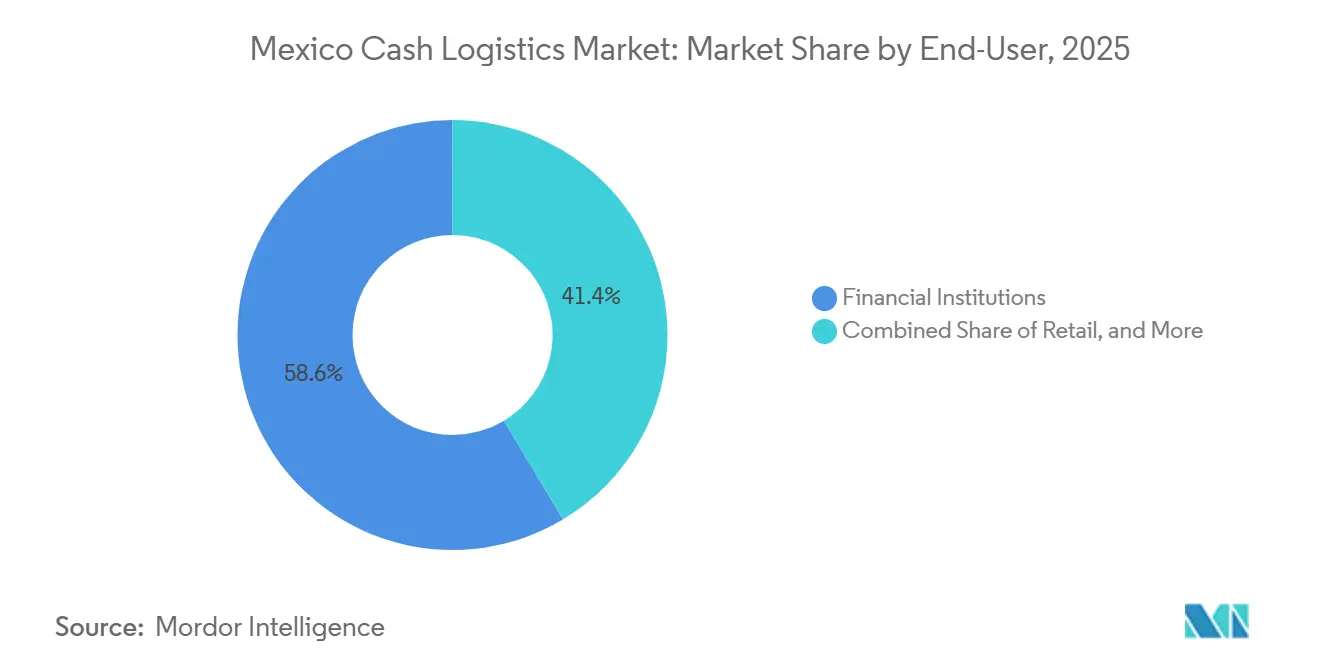
Financial institutions accounted for 58.55% of the Mexico cash logistics market size in 2025. Banks were the principal buyers of vault management, ATM replenishment, branch collection, and cash-processing services at scale. Their operating requirements called for secure custody, accurate reconciliation, and dependable delivery across dispersed service locations. Outsourcing allowed banks to use specialist fleets and processing facilities instead of managing every route internally. The Mexico cash logistics market size for financial institutions reflected the breadth of these recurring service needs. Large banking customers also required formal service levels, detailed reporting, and continuity planning. Their contracts favored providers that had national reach and the ability to manage dense ATM and branch networks. GSI’s ATM footprint illustrated the operational scale that these relationships could require. Financial institutions therefore, remained the largest demand base even as other customer groups increased spending.
Retail was projected to expand at a CAGR of 8.20% from 2026 to 2031, the fastest rate among end users. Organized chains widened their presence in secondary cities and needed more frequent collection from stores with high cash turnover. Smart-safe systems also made the service more structured by recording funds before collection. Retail customers looked for reliable pickups, faster visibility of funds, and less staff exposure to on-site cash. These needs created demand for contracts that combined equipment, collection, processing, and reporting. The segment’s growth did not depend on cash replacing digital payments. Instead, it reflected the operational requirements of stores that continued to receive cash while increasing their scale. The Mexico cash logistics market served these customers through tailored collection schedules and tighter reconciliation. Providers that could align physical service with store data held an advantage in larger retail networks.
Hospitality supported steady demand because hotels, casinos, resorts, and entertainment venues continued to manage cash-intensive activities. Resort locations such as Cancun, Los Cabos, and Puerto Vallarta required careful collections that matched seasonal and daily volume patterns. Government and Public Institutions generated demand through social-program disbursements, municipal payroll, and treasury cash administration. These activities required licensed operators that could fulfill security and compliance requirements across many locations. Digital service expansion altered some payment channels, but physical access remained relevant in communities with limited connectivity. Other End Users included transport operators, utilities, and healthcare networks with recurring cash-handling needs. Together, these customers gave the Mexico cash logistics market a wider demand base beyond financial institutions and retail chains. Their requirements often depended on local delivery conditions, cash volumes, and the availability of nearby banking infrastructure.
By Mode of Transit: Roadways Dominant, Railways Gaining Ground on Security Advantage
Roadways accounted for 90.50% of the Mexico cash logistics market share by mode of transit in 2025. Armored road vehicles handled nearly all domestic cash-in-transit, ATM replenishment, and store collection routes. Their dominance reflected the need to reach bank branches, retail sites, and cash points that were not connected to rail terminals or airports. Road transport also allowed operators to adjust collection timing to a customer’s daily volumes. The fleet was the practical link between local cash generation and centralized processing locations. Roadways supported both metropolitan routes with many stops and longer intercity movements. Their flexibility made them the core delivery method for the Mexico cash logistics market. This mode also carried the highest exposure to route-level crime and urban congestion. Operators needed route planning, vehicle protection, and live monitoring to manage these constraints.
Railways were projected to grow at a CAGR of 8.10% from 2026 to 2031. The growth reflected interest in intermodal options for high-value movements between major financial centers. Rail-linked movements could reduce exposure on selected road corridors where theft risks were elevated. Rail did not replace road transport for last-mile collections or ATM servicing. It instead offered a potential option for certain bulk and interurban movements. The Mexico cash logistics market could use rail where schedules, terminal access, and security controls suited the shipment. Grupo Mexico Transportes invested in drone surveillance and real-time speed monitoring for high-value shipments. These capabilities supported more closely monitored interurban transport arrangements.
Airways remained a small but important option for urgent, high-value movements. Central bank redistribution, mint-to-branch delivery, and emergency ATM replenishment could require air transport in specific situations. Geographic isolation also made air service relevant for some resort and island locations. The mode was constrained by cost and air-cargo security requirements. It could not provide the regular local access offered by an armored road fleet. Airways therefore made a limited contribution but filled needs that other modes could not meet quickly. The Mexico cash logistics market used this mode where speed, location, and shipment value justified the additional cost. The service required close coordination with airport handling and secure ground transport. Its role remained specialized rather than broad-based.
Geography Analysis
Mexico City, Guadalajara, and Monterrey formed the main demand cluster for the Mexico cash logistics market. These cities concentrated financial institutions, organized retail networks, and industrial payroll operations. Mexico City hosted central banking infrastructure, commercial banks, and a large retail footprint that required frequent collections and ATM replenishment. The cities also had dense networks of service points, which supported efficient routes for larger operators. The Mexico cash logistics revenue share was concentrated in these urban areas because daily cash flows were high and customer locations were closely connected. Their scale supported specialized cash-processing facilities and managed ATM services. The same corridors faced elevated route-security costs and congestion that could affect collection schedules. Providers had to balance route density with security planning and fleet availability.
The Bajio region, including Guanajuato, Queretaro, and Aguascalientes, developed as a secondary demand area. Automotive and manufacturing activity supported payroll-related cash handling for workers who remained partly outside digital payroll systems. The region also connected major urban centers through corridors that were important for collections and intercity movements. Cargo theft pressures in Guanajuato and nearby areas increased the importance of risk controls for providers. Southern and coastal states, including Oaxaca, Chiapas, Guerrero, Quintana Roo, and Yucatan, offered growth opportunities because financial access was less developed. The CNBV reported 179 million deposit accounts at the end of 2024, a 10% increase from the prior year, while access gaps persisted in rural southern municipalities.[4]“Ingresos y Egresos por Remesas, Diciembre de 2025,” Banco de México, banxico.org.mx New access points in these locations required cash distribution, ATM replenishment, and correspondent-banking support.
High-remittance states, including Michoacan, Jalisco, Guanajuato, and Oaxaca, had recurring needs for cash-out and ATM replenishment services. Mexico received USD 61.79 billion in remittances during 2025, with USD 30.33 billion collected in cash. Electronic remittances reached USD 15.95 billion in the April through June 2026 quarter, and USD 7.49 billion was collected in cash. Resort markets added specialized collection needs for hospitality and entertainment sites handling high cash volumes. These regional patterns required providers to adapt service models to local access conditions, tourism activity, and security risks. Rural financial-access efforts also supported future demand for cash distribution and managed ATM services.
Competitive Landscape
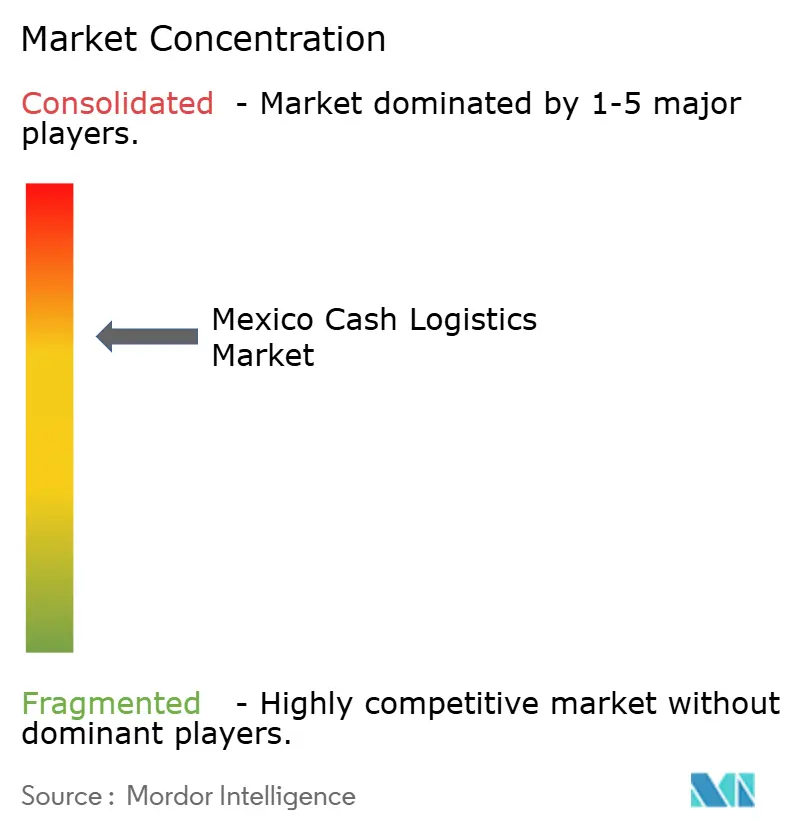
The Mexico cash logistics market is moderately concentrated at the national level. GSI and The Brink’s Company held the largest operational footprints through ATM coverage, route density, and service breadth. GSI operated through COMETRA, SEPSA, Seguritec, Tecnoval, and Tameme, covering cash-in-transit, processing, ATM management, and banking-messenger activities. This integrated structure made it harder for large institutional customers to change providers. It also enabled the company to combine services that might otherwise be contracted separately. The Mexico cash logistics market rewarded that breadth because clients wanted coordinated cash custody, transport, processing, and reporting. National providers could also distribute security and technology costs over larger route networks. Their scale created high service expectations for major bank and retail accounts.
Brink’s pursued a technology-focused strategy through digital retail solutions (DRSs) and ATM services. The company described Mexico as a strong DRS location in its Q1 2026 results, with customer conversion and margin improvement. Brink’s and NCR Atleos announced a definitive acquisition agreement valued at USD 6.6 billion in February 2026. Shareholders approved the transaction in June 2026, and the companies are expecting closing in Q1 2027. NCR Atleos had an installed base of 600,000 ATMs globally, which could expand Brink’s ATM managed-service capacity across markets including Mexico. Brink’s also reported 15,900 vehicles across 51 countries and USD 640 million in cash from operations during 2025.
Regional specialists included SP-Alfamex, Proseval, NSU Proteccion, Transportes Lock, Tolmex Seguridad Privada y Traslado de Valores, and other local providers. These companies competed through route familiarity, flexibility for mid-market customers, and price in areas where national route density was lower. SP-Alfamex continued providing valuables transport, payroll processing, and specialized collection services across Mexico City and regional routes. Proseval continued expanding valuables transport services beyond Mexico City with GPS-tracked armored fleets. Opportunities remained in smart-safe services for small retailers, rail-linked interurban transport, and correspondent-banking support. GPS tracking and data-based route optimization became increasingly necessary to meet enterprise customer expectations.
Mexico Cash Logistics Industry Leaders
Grupo Seguridad Integral (GSI)
The Brink’s Company
Servicio Integral de Seguridad, S.A. de C.V.
Control Central de Vigilancia, S.A. de C.V.
Logistikaz Seguridad Privada, S.A. de C.V.
- *Disclaimer: Major Players sorted in no particular order

Recent Industry Developments
- June 2026: Shareholders of The Brink’s Company and NCR Atleos approved Brink’s previously announced acquisition of NCR Atleos at special meetings held on June 30, 2026. The all-cash-and-stock deal, valued at USD 6.6 billion including assumption of USD 2.6 billion in NCR Atleos’ indebtedness, received Hart-Scott-Rodino antitrust clearance. The transaction is expected to close in Q1 2027. The combination brought NCR Atleos’ 600,000 ATM global installed base into Brink’s AMS and DRS platform, with USD 200 million in annual run-rate cost targeted after closing.
- April 2026: The Brink’s Company amended and extended its existing credit facility on March 31, 2026, supporting its balance sheet before the NCR Atleos transaction. Its Q1 2026 results, released on May 6, 2026, reported AMS and DRS organic revenue growth of 15%, while Latin America was identified as a strong location for DRS conversion and margin improvement.
- February 2026: The Brink’s Company and NCR Atleos jointly announced a definitive merger agreement on February 26, 2026, valuing the transaction at USD 6.6 billion. The deal included USD 2.2 billion in cash, 13.3 million Brink’s shares, and USD 2.6 billion of assumed debt.
- August 2025: The Mexican Intermodal Transport Association (AMTI) and the National Association of Vehicle Tracking and Protection Companies (ANERPV) signed a formal collaboration agreement in July-August 2025 to jointly address insecurity in intermodal transport, relevant to the Railways modality's expansion in cash logistics routing. AMTI data indicated that rail intermodal carries a theft rate of 0.5% on several routes, less than one-tenth the theft exposure on the highest-risk road corridors.


Mexico Cash Logistics Market Report Scope
| Cash-In-Transit |
| Cash Management Services |
| ATM Services |
| Other Services |
| Financial Institutions |
| Retail |
| Hospitality |
| Government and Public Institutions |
| Other End Users |
| Roadways |
| Railways |
| Airways |
| By Service Type | Cash-In-Transit |
| Cash Management Services | |
| ATM Services | |
| Other Services | |
| By End User | Financial Institutions |
| Retail | |
| Hospitality | |
| Government and Public Institutions | |
| Other End Users | |
| By Mode of Transit | Roadways |
| Railways | |
| Airways |


Key Questions Answered in the Report
What was the value of cash logistics services in Mexico in 2026?
The Mexico cash logistics market stood at USD 1.09 billion in 2026 and was forecast to reach USD 1.54 billion by 2031.
What growth rate was forecast for cash logistics services in Mexico?
The sector was forecast to grow at a CAGR of 7.04% from 2026 to 2031.
Which service grew fastest in Mexico’s cash logistics sector?
ATM services was projected to record the highest CAGR at 7.90% through 2031.
Which customer group used cash logistics services most extensively?
Financial institutions held 58.55% share in 2025 because they required ATM replenishment, vault management, and cash-in-transit services.
Why did retail demand for secure cash handling increase?
Retail was projected to grow at 8.20% through 2031 as organized chains expanded and adopted smart-safe and managed collection services.
What transport mode was most used for secure cash movements in Mexico?
Roadways held 90.50% share in 2025 because armored road fleets served most branch, retail, and ATM routes.
Page last updated on:





