
Methyl Soyate Market Size and Share
Market Overview
| Study Period | 2021 - 2031 |
|---|---|
| Market Size (2026) | USD 1 Billion |
| Market Size (2031) | USD 1.35 Billion |
| Growth Rate (2026 - 2031) | 6.14 % |
| Fastest Growing Market | Asia-Pacific |
| Largest Market | Asia-Pacific |
| Market Concentration | Medium |
Major Players *Disclaimer: Major Players sorted in no particular order Image © Mordor Intelligence. Reuse requires attribution under CC BY 4.0. | |
Methyl Soyate Market Analysis by Mordor Intelligence
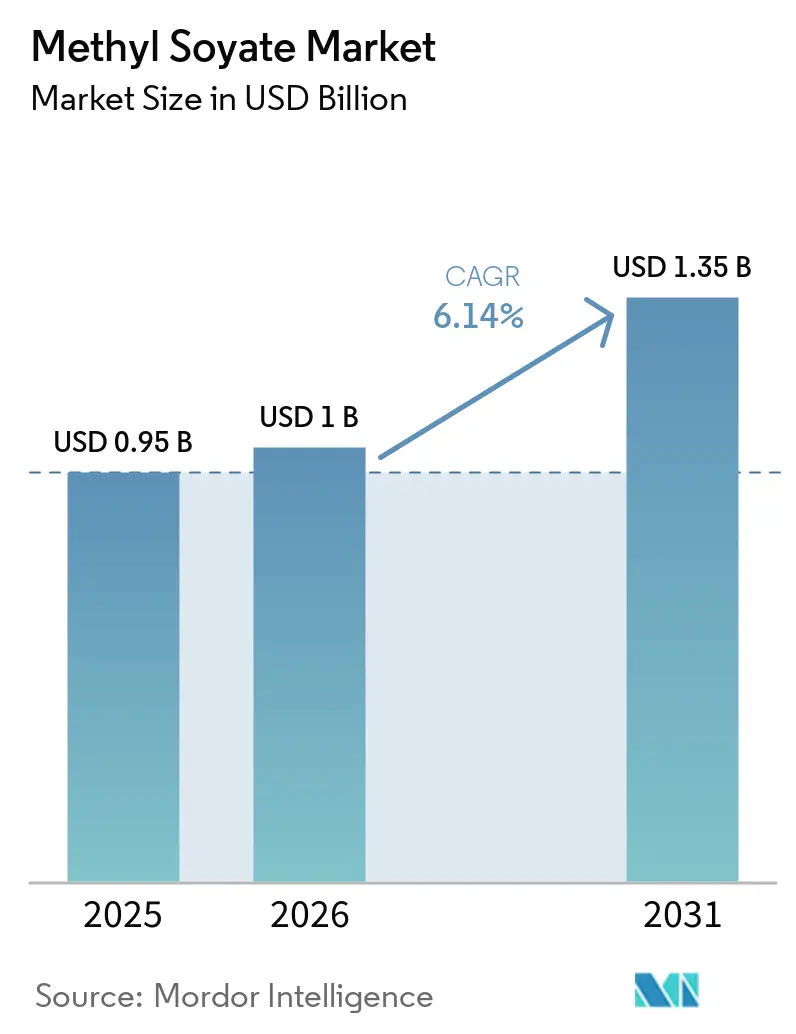
The methyl soyate market size was estimated at USD 0.95 billion in 2025 and is estimated to grow from USD 1.00 billion in 2026 to USD 1.35 billion by 2031, at a CAGR of 6.14% during the forecast period (2026-2031). Methyl soyate is a fatty acid methyl ester derived from soybean oil via transesterification, and it plays a defined role in bio-based chemical formulations. Its low Volatile Organic Compound (VOC) content (below 50 g/L) and absence from the Environmental Protection Agency (EPA) Hazardous Air Pollutant list support substitution in industrial cleaning, paint removal, and degreasing applications. These characteristics enable the material to be used in applications where users seek a bio-based carrier while managing emissions, handling, and cleaning requirements, as well as regulated supply-chain expectations in industrial operations. Tighter air-quality rules, procurement requirements for biodegradable inputs, and additional soybean processing capacity are shaping demand for the methyl soyate market. Producers are using feedstock integration, safety credentials, and formulation capability to protect margins and reach specialized applications, although exposure to soybean oil pricing, cold-weather performance, and competing solvents limits adoption in certain applications.
Key Report Takeaways
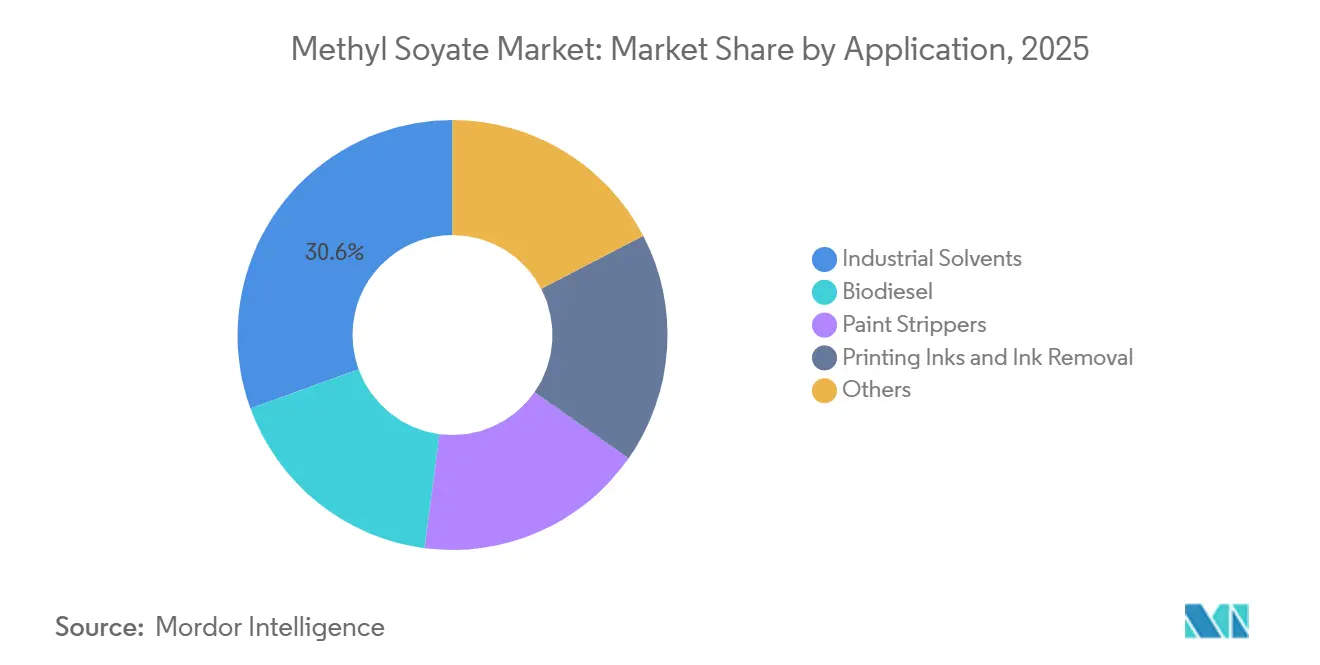
- By application, industrial solvents held 30.56% of global revenue in 2025, while biodiesel is forecast to grow at a 7.23% CAGR through 2031.
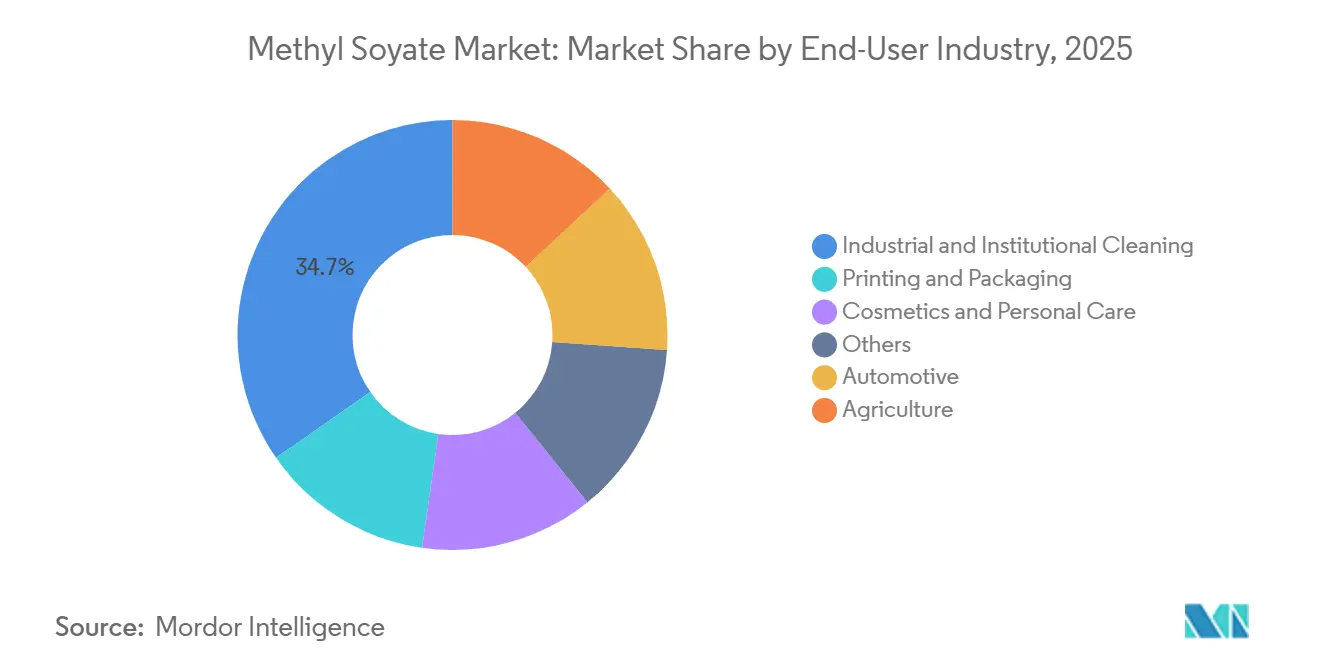
- By end-user industry, Industrial and Institutional Cleaning held 34.67% of global revenue in 2025, while Agriculture is forecast to expand at a 7.54% CAGR through 2031.
- By geography, Asia-Pacific held 35.98% of global revenue in 2025 and is forecast to grow at a 6.89% CAGR through 2031.
Note: Market size and forecast figures in this report are generated using Mordor Intelligence’s proprietary estimation framework, updated with the latest available data and insights as of January 2026.
Market Trends and Insights
Drivers Impact Analysis of Methyl Soyate Market*
| Drivers | (~) % Impact on CAGR Forecast | Geographic Relevance | Impact Timeline |
|---|---|---|---|
| Tightening VOC and Hazardous Air Pollutant Restrictions | +1.8% | Global, the highest intensity in North America and the EU | Short term (≤ 2 years) |
| Biodiesel Blending and Renewable-Fuel Incentives | +1.5% | North America and South America, spillover to APAC | Medium term (2-4 years) |
| Demand for Biodegradable Bio-Based Solvents | +1.2% | Global, early leadership in Europe and North America | Medium term (2-4 years) |
| Expansion of Soybean Processing and Oleochemical Supply | +0.9% | North America, South America, APAC | Long term (≥ 4 years) |
| Safer-Chemical Label Pull-Through in Institutional Procurement | +0.7% | North America, the EU, and spillover to Australia and Japan | Medium term (2-4 years) |
| Source: Mordor Intelligence | |||
Tightening Volatile Organic Compound (VOC) and Hazardous Air Pollutant Restrictions
In January 2025, the EPA finalized amendments to the National VOC Emission Standards for Aerosol Coatings. The rule updated reactivity factors, emission category limits, and electronic compliance reporting requirements. Methyl soyate has a VOC content of less than 50 g/L and does not appear on the EPA Hazardous Air Pollutants (HAPs) list, supporting its use in parts cleaning, paint stripping, and degreasing applications. These properties provide formulators with an alternative when they require solvent performance but face restrictions on conventional petroleum-based inputs.
The methyl soyate market also operates under European Registration, Evaluation, Authorization and Restriction of Chemicals (REACH) and Industrial Emissions Directive requirements, which impose greater scrutiny on conventional solvent choices. Syskem markets methyl soyate under the non-hazardous European Inventory of Existing Commercial Chemical Substances (EINECS) designation 272-898-4 for use in metalworking fluids, resins, and coatings. As a result, formulators can consider the product across several formulation categories rather than limiting its use to a single cleaning application. Once a facility reformulates to comply with a VOC threshold, switching back to a petroleum-based solvent may require additional Toxic Substances Control Act (TSCA) or REACH assessments, increasing switching costs. This provides an operational reason for customers to retain compliant formulations after the initial substitution.
Biodiesel Blending and Renewable-Fuel Incentives
The EPA’s March 2026 Set 2 Renewable Fuel Standard rule established applicable requirements for biomass-based diesel at 9.07 billion Renewable Identification Numbers (RINs) in 2026 and 9.20 billion RINs in 2027. The EPA estimates that biodiesel and renewable diesel production must increase by more than 60% from 2025 levels to meet the rule’s requirements. Soybean methyl ester is an important pathway for biodiesel RIN generation in the United States, directly linking the methyl soyate market to fuel-policy demand.
This relationship ties methyl soyate demand to compliance requirements rather than solely to discretionary industrial purchases. It also increases the market’s sensitivity to fuel-policy implementation and producer capacity decisions. The impact is most pronounced where biodiesel producers can secure soybean oil and process it through existing ester production assets. Shared fuel-grade and industrial-grade production lines can improve asset utilization as transesterification capacity expands. When fuel and solvent demand are both available, producers can allocate operating costs across multiple product outlets. This flexibility may reduce the pricing floor for solvent-grade supply. European blending incentives under the Renewable Energy Directive III (RED III) provide another demand pathway for soybean methyl ester beyond the U.S. program. Together, these policies create a broader demand base, including during periods of weaker general industrial activity.
Expansion of Soybean Processing and Oleochemical Supply
U.S. soybean crush capacity increased from 2.23 billion bushels per year at the beginning of 2023 to 2.55 billion bushels by early 2025. The American Soybean Association reported that announced projects could increase capacity to more than 2.78 billion bushels per year by 2030. In July 2026, ADM announced upgrades at facilities in Indiana, Missouri, Nebraska, and North Dakota, expected to add 700,000 metric tons of annual crush capacity. ADM stated that the upgrades create demand for more than 25 million additional bushels of soybeans annually.
Companies are building new crushing capacity in response to demand for renewable diesel, thereby expanding the supply of soybean oil available for ester production. Increased capacity can provide buyers with a more predictable supply for large-scale solvent formulations. It also enables integrated producers to balance supply across fuel, solvent, and other oleochemical applications. Greater processing capacity can improve feedstock availability for the methyl soyate market and reduce regional basis differences. As supply chains mature, they can also reduce delivered-cost volatility relative to petroleum-based solvents. These factors are most relevant in regions where limited local availability has constrained regular industrial supply.
Demand for Biodegradable Bio-Based Solvents
Institutional and industrial buyers increasingly specify biodegradable and bio-based solvents as supplier qualification requirements. The USDA BioPreferred Program includes a mandatory federal purchasing preference for designated bio-based products, and methyl soyate qualifies as a certified bio-based solvent. Its readily biodegradable profile, low aquatic toxicity, and compatibility with Clean Water Act requirements support its use in cleaning, ink removal, and adhesive stripping applications. These attributes are relevant when buyers must consider wastewater handling alongside solvent performance.
The methyl soyate market is affected when wastewater compliance influences purchasing decisions alongside cleaning performance. This preference is relevant across government, health care, education, and other institutional purchasing channels. It can also contribute to repeat purchases by allowing buyers to retain approved products within established procurement specifications. In June 2025, BASF transitioned its Rheovis range to bio-based ethyl acrylate and reported a product carbon footprint up to 30% lower. In July 2026, BASF expanded its biomass-balanced, International Sustainability and Carbon Certification (ISCC) PLUS-certified architectural coatings additives, indicating closer links between bio-based carrier solvents and certified additive systems. This trend reflects integrated supply chains that combine bio-based carriers with certified additives.
Restraints Impact Analysis of Methyl Soyate Market*
| Restraints | (~) % Impact on CAGR Forecast | Geographic Relevance | Impact Timeline |
|---|---|---|---|
| Soybean Oil Feedstock Price Volatility | -1.4% | Global, most acute in North America and South America | Short term (≤ 2 years) |
| Competition from Alternative Bio-Based and Petroleum-Based Solvents | -1.1% | Global, higher intensity in EU and APAC | Medium term (2-4 years) |
| Cold-Flow and Oxidative-Stability Trade-Offs in Biodiesel | -0.6% | North America and temperate Europe | Medium term (2-4 years) |
| Source: Mordor Intelligence | |||
Soybean Oil Feedstock Price Volatility
Soybean oil serves food and biofuel demand; therefore, its price responds to crop yields, planting decisions, palm oil export policies, and changes in edible oil demand. These factors remain outside the direct control of methyl soyate producers and can rapidly increase input costs. Higher soybean oil prices can raise the delivered cost of methyl soyate to levels comparable to or higher than mineral spirits and naphtha. This limits switching in price-sensitive industrial applications across the methyl soyate market. It can also complicate contract pricing for distributors that do not control soybean oil supply.
Competition among biodiesel, renewable diesel, and solvent producers for the same oil supply can compress biorefinery margins. The American Soybean Association reported that domestic renewable fuel production capacity increased from 791 million gallons per year in 2021 to more than 4,580 million gallons per year in 2025. This expansion intensifies competition for soybean oil during periods of high demand for fuel policy compliance. Consequently, producers without crushing capacity face greater exposure than vertically integrated suppliers.
Competition from Alternative Bio-Based and Petroleum-Based Solvents
The methyl soyate market competes with ethyl lactate, D-limonene, terpene solvents, and fatty acid methyl esters derived from rapeseed and palm oil. It also competes with mineral spirits, naphtha, glycol ethers, and substitutes for methylene chloride. These alternatives vary in evaporation rate, purity, odor, feedstock profile, and delivered cost. Ethyl lactate is used in precision cleaning and pharmaceutical applications, where a lower boiling point and higher purity are important. D-limonene provides comparable solvency and a citrus scent suited to consumer-facing institutional products.
These differences require buyers to assess alternatives based on formulation requirements rather than uniformly replacing one solvent with another. Petroleum-based solvents are still used in parts of Southeast Asia and Africa, where buyers may find it difficult to absorb bio-based premiums without regulatory pressure. Pricing pressure is highest when customers face limited compliance obligations and prioritize immediate purchase costs. However, Hazardous Air Pollutant (HAP) and Volatile Organic Compound (VOC) regulations can increase compliance costs for petroleum-based and chlorinated products, narrowing the net cost gap in applications that require compliant formulations. These regulatory requirements can limit the displacement of established methyl soyate formulations by low-cost alternatives.
*Our forecasts treat driver/restraint impacts as directional, not additive. The impact forecasts reflect baseline growth, mix effects, and variable interactions.
Methyl Soyate Market Segment Analysis
By Application:
Industrial Solvents Anchor Revenue While Biodiesel Pulls AheadIndustrial solvents accounted for 30.56% of the methyl soyate market in 2025, while biodiesel is forecast to grow at a CAGR of 7.23% through 2031. The EPA’s Set 2 rule sets biomass-based diesel applicable requirements at 9.07 billion Renewable Identification Numbers (RINs) for 2026. The EPA estimates that the rule requires U.S. biodiesel and renewable diesel production to increase by more than 60% from 2025 output. Biodiesel represents the fastest-growing application in the supply outlook, while industrial solvents provide the largest revenue base. This policy framework provides the methyl soyate market with a demand channel separate from industrial cleaning and coating applications. Industrial solvents are used in parts cleaning, degreasing, carrier solvents, and adhesive and mastic removal. Methyl soyate has a Kauri-butanol solvency value of 58 and provides cleaning performance without the hazardous air pollutant (HAP) or flammability concerns associated with many petroleum-based alternatives. The combination of cleaning applications and fuel demand diversifies demand for applications.
Paint stripping remains a specialized application as restrictions on dichloromethane drive product reformulation. However, its slower dwell time compared with fast-acting chlorinated products limits its use for heavy-coating removal. Printing inks and ink removal generate demand because methyl soyate is compatible with vegetable oil-based ink systems used in commercial offset printing. This compatibility positions the methyl soyate market in printing formulations that incorporate bio-derived ingredients. In addition, the USDA BioPreferred procurement preference supports public-sector demand for certified bio-based solvents. Biodiesel demand remains subject to technical constraints, including a cloud point of approximately 0°C, a pour point of -3.2°C, and oxidative stability of 4.08 hours. A 2024 review found that these properties limit B100 use in cold regions, while skeletal isomerization remains a laboratory-scale solution[1]N. R. Putra et al., “A Review of Biodiesel Cold Flow Properties and Its Improvement Methods: Towards Sustainable Biodiesel Application,” Energies, mdpi.com. In practice, B20-B30 blending ratios remain the near-term commercial solution. Therefore, demand tracks blended fuel consumption rather than mandates on a one-to-one basis. Higher blend ratios require further technical improvements, and the fuel opportunity develops alongside these performance constraints.



By End-User Industry:
Institutional Cleaning Anchors Demand While Agriculture Outpaces the MarketIndustrial and institutional cleaning accounted for 34.67% of global revenue in 2025, while agriculture is forecast to grow at a CAGR of 7.54% through 2031. Agriculture is growing faster than the overall market because methyl soyate serves as an adjuvant carrier in herbicide, fungicide, and insecticide formulations. Its EPA List 4A inert status supports applications requiring spray coverage, penetration, and rainfastness. Precision agriculture practices, including ultra-low-rate unmanned aerial vehicle (UAV) spraying, require carrier chemistries that maintain droplet coverage. These requirements support the use of methylated vegetable oil derivatives in spray tank mixes. These operating requirements make carrier performance a factor in agricultural adoption rather than positioning methyl soyate solely as a commodity input. The Federal Insecticide, Fungicide, and Rodenticide Act (FIFRA) Section 25(b) provisions favor bio-derived inert carriers over synthetic co-formulants in compliance evaluations. These conditions provide the methyl soyate market with access to conventional and organic crop programs.
Industrial and institutional cleaning retains its leading end-user position through applications in facilities maintenance, parts washing, and institutional kitchen degreasing. Healthcare, government, and education contracts may specify biodegradable solvents that are not hazardous air pollutants (HAPs) as part of green procurement programs. These buyer requirements support the methyl soyate market in applications where safety and disposal requirements influence product selection. The product’s flash point exceeds 360°F, and its biodegradability supports its use in commercial cleaning applications. Automotive applications remain stable, including parts cleaning, asphalt-release agents, and undercoat stripping. Printing and packaging follow broader industrial solvent demand and benefit from methyl soyate’s compatibility with vegetable oil-based inks. Cosmetics and personal care represent a smaller but expanding outlet, as fatty acid methyl ester (FAME)-derived solvents can be used in rinse-off products and natural personal care formulations. Other specialized applications include food-processing equipment cleaning and oil-spill response, where methyl soyate is listed on the EPA National Contingency Plan Product Schedule.
Geography Analysis
APAC Methyl Soyate Market
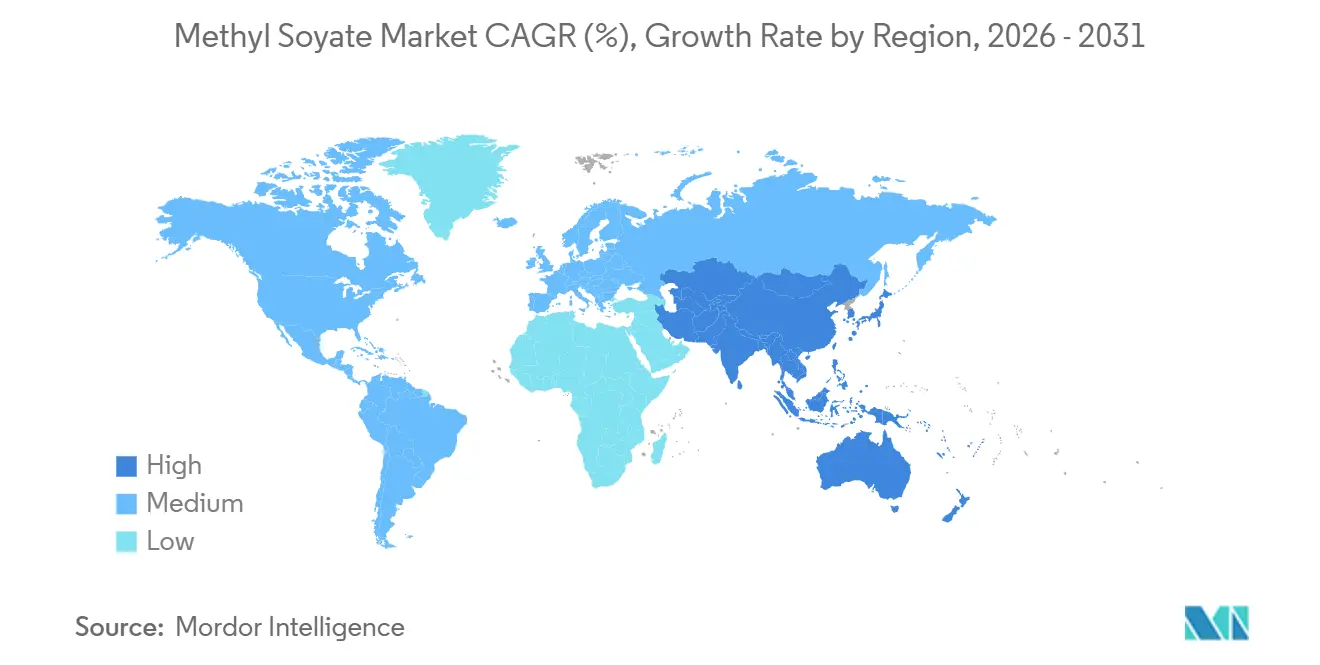
Asia-Pacific held 35.98% of the methyl soyate market share in 2025 and is forecast to grow at a CAGR of 6.89% through 2031. The region ranks first by revenue and CAGR among the geographies analyzed. China is expanding bio-based solvent production in line with its carbon-neutrality commitments, while biodiesel policies and green chemistry standards support demand for fatty acid methyl ester. India is developing downstream oleochemical capacity, and its biodiesel program targets a 5% biodiesel blend in diesel fuel. These production and policy developments support the region’s role in demand generation and downstream processing. Japan’s electronics cleaning and industrial maintenance industries support the adoption of compatible, non-hazardous solvents. Methyl soyate also aligns with Japanese procurement requirements due to its compatibility with Pollutant Release and Transfer Register (PRTR) reporting and non-hazardous chemical classifications. South Korea and other Asia-Pacific countries are generating demand from agricultural adjuvants and cosmetics, with imports meeting demand until local supply capacity expands.
North America and Europe Methyl Soyate Market
North America has a regulation-driven methyl soyate market, supported by the EPA Safer Choice program, National Emission Standards for Hazardous Air Pollutants (NESHAP), and Renewable Fuel Standard requirements. Demand from solvent, fuel, and institutional cleaning applications provides suppliers with multiple routes to reach end users. U.S. soybean crush capacity increased by 14% between early 2023 and early 2025, from 2.23 billion to 2.55 billion bushels annually. ADM’s July 2026 expansion plan adds supply support through 700,000 tons of annual capacity across four facilities. In Europe, REACH compliance and the Industrial Emissions Directive shape the methyl soyate market more than biofuel mandates. Syskem supplies methyl soyate for metalworking fluids and coatings, while BASF markets Agnique ME 18S-U Methyl Soyate globally[2]Syskem GmbH, “Product Specification Methyl Soyate,” Syskem, syskem.de. Reviews of the EU Cosmetics Regulation and REACH candidate lists are expanding the application base as aromatic and chlorinated solvents face stricter restrictions.
MEA and South America Methyl Soyate Market
South America supports methyl soyate feedstock production and processing, with an expanding downstream base. Brazil’s biodiesel blend mandate is B14, while legislative targets aim to raise it to B20 by 2030, supporting soybean methyl ester processing. This domestic requirement provides processors with a demand base while supporting the supply available for other methyl ester applications. Brazil combines domestic biodiesel demand with the potential to supply industrial-grade material for export. Argentina provides another biodiesel supply source, although currency fluctuations and export-tax policies can create feedstock price uncertainty for formulators. The Middle East and Africa are the smallest regional contributors to the methyl soyate market. Saudi Arabia’s Vision 2030 includes the development of bio-based chemicals, while South Africa offers market entry opportunities in institutional cleaning and agricultural adjuvants. Less-developed regulatory infrastructure across the Middle East and Africa limits the compliance-driven substitution effect observed in more regulated economies.

Competitive Landscape
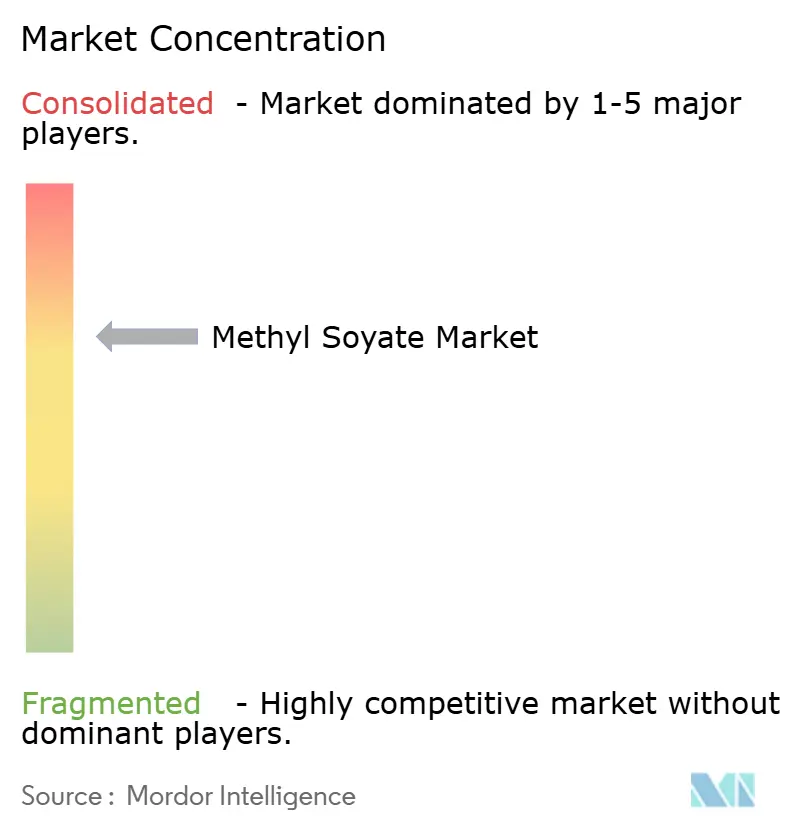
The methyl soyate market is moderately consolidated. ADM, Cargill, and BASF combine feedstock processing or broad distribution networks with formulated product capabilities. This structure helps manage margins amid soybean oil price fluctuations by providing greater supply control than pure distributors do. It also supports a consistent supply for cleaning, coatings, and fuel-linked customers that require approved products. This capability is relevant for customers seeking both a stable feedstock position and product documentation. Vertec BioSolvents serves precision industrial cleaning applications with technical-grade VertecBio Gold 4EG methyl soyate. Specialty suppliers can secure premiums in applications where purity, formulation knowledge, and certifications take priority over commodity pricing. Key competitive priorities include crush capacity, safety credentials, and expansion in Asia-Pacific and South America. In July 2026, BASF expanded its biomass-balanced additives for architectural coatings, supporting the integration of certified bio-based components into coatings supply chains.
Compliance requirements create barriers to entry despite the fragmented supplier base. New suppliers may require 18–36 months to obtain EPA Safer Choice and REACH Substances of Very High Concern (SVHC)-free credentials. These approvals favor producers with established product documentation and regulatory expertise. The required documentation also supports customers who need to demonstrate safer chemical purchasing practices to their buyers. As a result, compliance credentials can influence supplier selection even when multiple materials provide similar solvent performance. This dynamic gives established suppliers in the methyl soyate market an advantage that supplier counts alone may not capture. Smaller formulation specialists, including BioSpan Technologies, are developing blends designed to reduce the dwell time of methyl soyate in aerosol coatings and spot-cleaning applications. Producers that offer Environmental Product Declarations and third-party-verified biogenic carbon data may have improved access to European public procurement programs and US sustainability reporting initiatives. Ag Processing Inc. and Kedia Organic Chemicals are among the regional contenders developing cost-competitive supply positions in Asia-Pacific and South Asian markets.
The methyl soyate market offers opportunities in pharmaceutical-grade materials with International Council for Harmonization (ICH) Q3C-aligned purity specifications and drone adjuvant concentrates that combine methyl soyate with drift-reduction polymers. These technical niches may be more accessible to smaller specialist suppliers than to large agribusiness companies. Their requirements differ from bulk-supply applications because customers require close control over purity, application behavior, and supporting product information. These opportunities depend on formulation development and customer qualification, rather than solely on access to soybean oil. They also require technical support to address changing operating conditions in specialized customer applications. In March 2026, Cargill opened a bio-based ester production facility in Gouda, the Netherlands. The company stated that its USD 30 million investment tripled the European supply of FR3 natural ester product. The investment reflects European demand for bio-based oleochemicals and demonstrates how suppliers are adding regional capacity as customers seek materials that meet performance and sustainability requirements.
Methyl Soyate Industry Leaders
Stepan Company
Cargill, Incorporated
ADM
BASF
Vertec BioSolvents Inc.
- *Disclaimer: Major Players sorted in no particular order
Methyl Soyate Market Companies Covered in this Report
- ADM
- Ag Processing Inc.
- BASF
- BioSpan Technologies, Inc.
- Cargill, Incorporated
- Covalent Chemical LLC
- CREMER North America
- Graham Chemical
- Kedia Organic Chemicals Pvt. Ltd.
- Krishi Oils Limited
- Parchem
- Soy Technologies
- Stepan Company
- Unicon Fibro
- Vertec BioSolvents Inc.

Recent Industry Developments in Methyl Soyate Market
- July 2026: Archer-Daniels-Midland (ADM) announced targeted upgrades at four U.S. oilseed crushing facilities in Frankfort, Indiana; Deerfield, Missouri; Lincoln, Nebraska; and Spiritwood, North Dakota. The upgrades add 700,000 metric tons of annual crushing capacity, increase soybean demand by more than 25 million bushels annually, and support the feedstock supply base for soybean-derived methyl esters in North America.
- May 2026: COFCO announced plans to more than double soybean crushing capacity at its Rondonópolis, Brazil, facility, from 4,500 to approximately 10,000 metric tons per day. Planned annual output includes approximately 350,000 metric tons of biodiesel. The expansion supports China’s investment in Brazilian soy processing for value-added oleochemical exports and increases the global supply of soybean methyl esters.


Global Methyl Soyate Market Report Scope
Methyl soyate is a renewable, bio-based solvent produced by transesterifying soybean oil. It provides an effective, environmentally friendly alternative to conventional petroleum-derived solvents, owing to its low toxicity, high flash point, and 100% biodegradability. Industries widely use methyl soyate as a powerful degreaser, paint stripper, and carrier in formulations for agricultural products and printing inks.
The methyl soyate market is segmented by application, end-user industry, and geography. By application, the market is segmented into industrial solvents, biodiesel, paint strippers, printing inks and ink removal, and others. By end-user industry, the market is segmented into industrial and institutional cleaning, automotive, agriculture, printing and packaging, cosmetics and personal care, and others. The report also covers market size and forecasts for methyl soyate across 15 countries in major regions. The market sizes and forecasts are provided in terms of value (USD).
| Industrial Solvents |
| Biodiesel |
| Paint Strippers |
| Printing Inks and Ink Removal |
| Others |
| Industrial and Institutional Cleaning |
| Automotive |
| Agriculture |
| Printing and Packaging |
| Cosmetics and Personal Care |
| Others |
| Asia-Pacific | China |
| India | |
| Japan | |
| South Korea | |
| Rest of Asia-Pacific | |
| North America | United States |
| Canada | |
| Mexico | |
| Europe | Germany |
| United Kingdom | |
| France | |
| Italy | |
| Rest of Europe | |
| South America | Brazil |
| Argentina | |
| Rest of South America | |
| Middle East and Africa | Saudi Arabia |
| South Africa | |
| Rest of Middle East and Africa |
| By Application | Industrial Solvents | |
| Biodiesel | ||
| Paint Strippers | ||
| Printing Inks and Ink Removal | ||
| Others | ||
| By End-User Industry | Industrial and Institutional Cleaning | |
| Automotive | ||
| Agriculture | ||
| Printing and Packaging | ||
| Cosmetics and Personal Care | ||
| Others | ||
| By Geography | Asia-Pacific | China |
| India | ||
| Japan | ||
| South Korea | ||
| Rest of Asia-Pacific | ||
| North America | United States | |
| Canada | ||
| Mexico | ||
| Europe | Germany | |
| United Kingdom | ||
| France | ||
| Italy | ||
| Rest of Europe | ||
| South America | Brazil | |
| Argentina | ||
| Rest of South America | ||
| Middle East and Africa | Saudi Arabia | |
| South Africa | ||
| Rest of Middle East and Africa | ||


Key Questions Answered in the Report
What is current market size of Methyl Soyate Market?
The methyl soyate market size was estimated at USD 0.95 billion in 2025 and is estimated to grow from USD 1.00 billion in 2026 to USD 1.35 billion by 2031, at a CAGR of 6.14% during the forecast period (2026-2031).
Which methyl soyate application is growing the fastest?
Biodiesel is forecast to grow at a 7.23% CAGR through 2031, supported by renewable fuel requirements. Cold-flow and oxidative-stability limits mean blending remains important for use in colder regions, so commercial demand does not directly equal the stated policy volumes.
Which end-user application drives demand for methyl soyate?
Industrial and Institutional Cleaning held a 34.67% share in 2025, while Agriculture is forecast to grow at a 7.54% CAGR. Cleaning demand is driven by the need for biodegradable and non-HAP procurement, while agricultural demand is linked to adjuvant use in crop-protection formulations.
Which region leads to methyl soyate consumption?
Asia-Pacific held a 35.98% share in 2025 and is forecast to grow at a 6.89% CAGR through 2031. China, India, Japan, and South Korea support demand across several application areas, including solvents, agricultural adjuvants, and bio-based formulations.
Page last updated on:





