
Metaverse In Finance Market Size and Share
Market Overview
| Study Period | 2021 - 2032 |
|---|---|
| Market Size (2027) | USD 231.70 Million |
| Market Size (2032) | USD 491.80 Million |
| Growth Rate (2027 - 2032) | 16.20 % |
| Fastest Growing Market | Asia-Pacific |
| Largest Market | North America |
| Market Concentration | Low |
Major Players *Disclaimer: Major Players sorted in no particular order Image © Mordor Intelligence. Reuse requires attribution under CC BY 4.0. | |
Metaverse In Finance Market Analysis by Mordor Intelligence
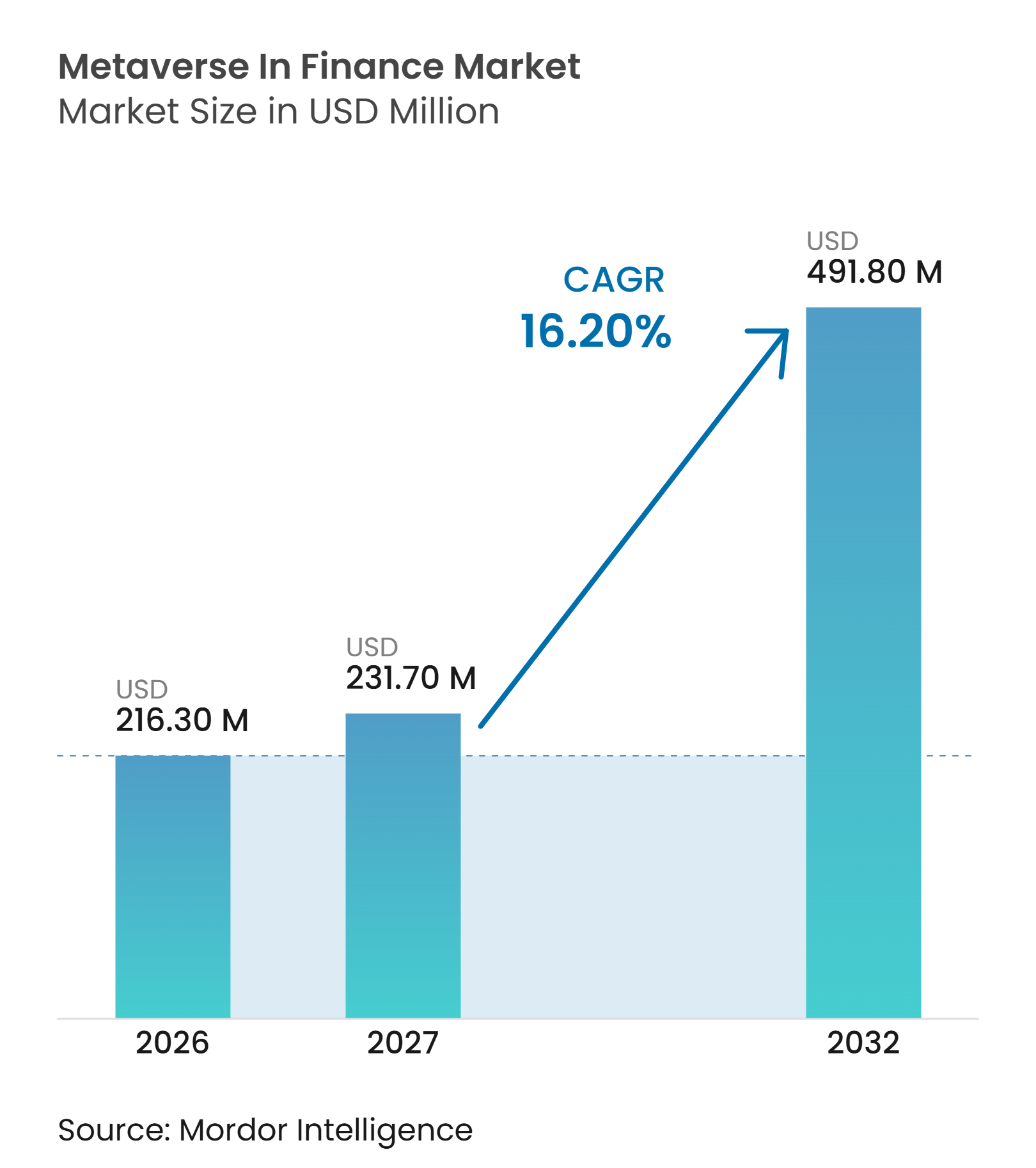
The Metaverse In Finance Market size is expected to grow from USD 216.30 million in 2026 to USD 231.70 million in 2027 and is forecast to reach USD 491.80 million by 2032 at 16.20% CAGR over 2027-2032.
The metaverse in the finance market is shifting from virtual showrooms to tokenized settlement, AI-supported advisory, and virtual collaboration tools. Blockchain payments, spatial computing, and generative AI support practical institutional use cases. Clearer digital asset regulations are reducing uncertainty for controlled deployments. Financial institutions prioritize virtual workspaces and tokenized settlement systems with measurable operational returns. Adoption remains constrained by regulatory uncertainty, hardware availability, customer trust, and uneven commercial returns.
Key Report Takeaways
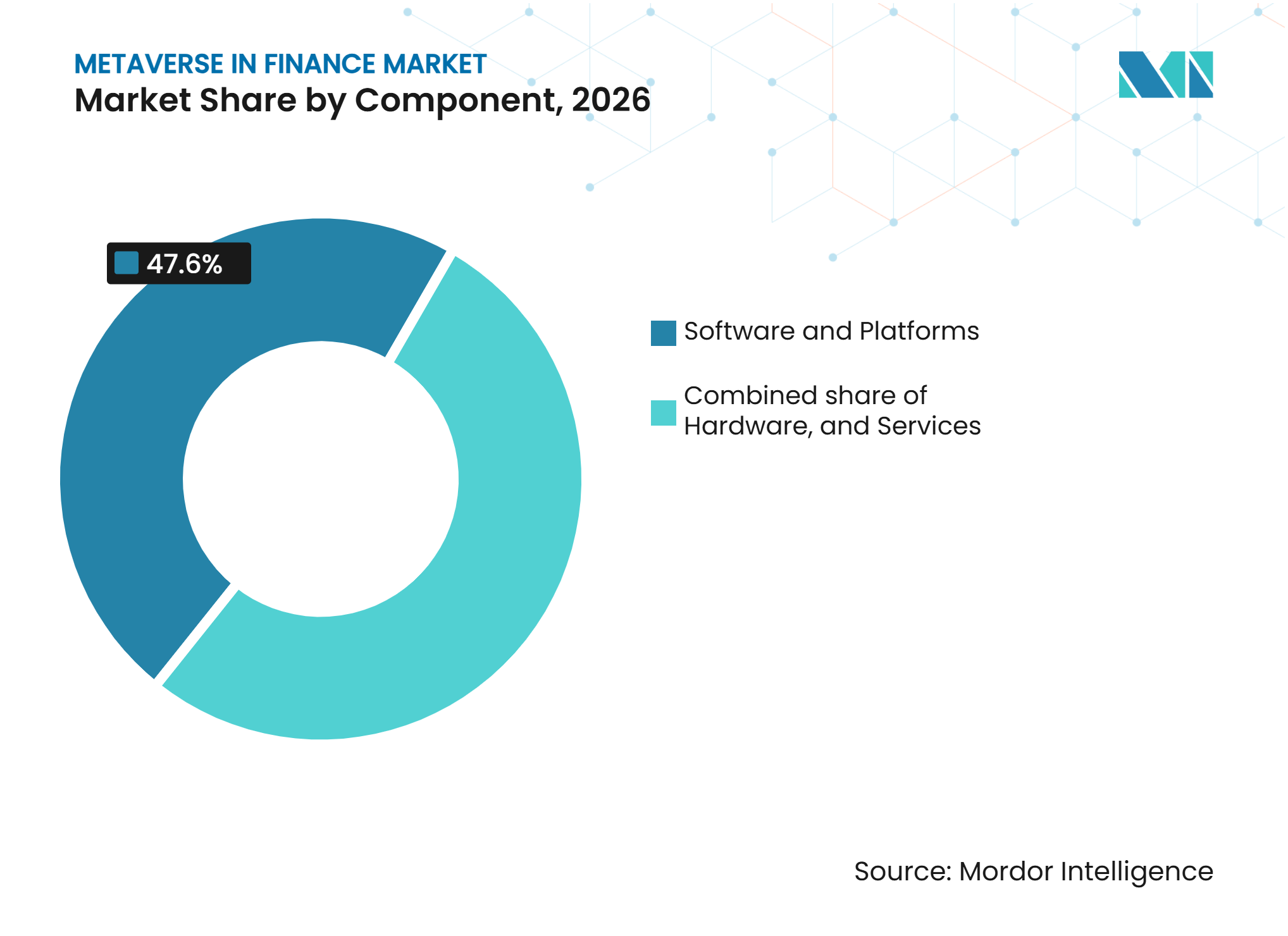
- By component, software and platforms captured 47.6% of the metaverse in finance market share in 2026, while services are projected to grow at a 19.7% CAGR through 2032.
- By application, financial education, training, and institutional collaboration held 41.2% of the metaverse in finance market share in 2026, while metaverse-enabled payments, settlement, and tokenized asset transactions are forecast to grow at a 21.8% CAGR through 2032.
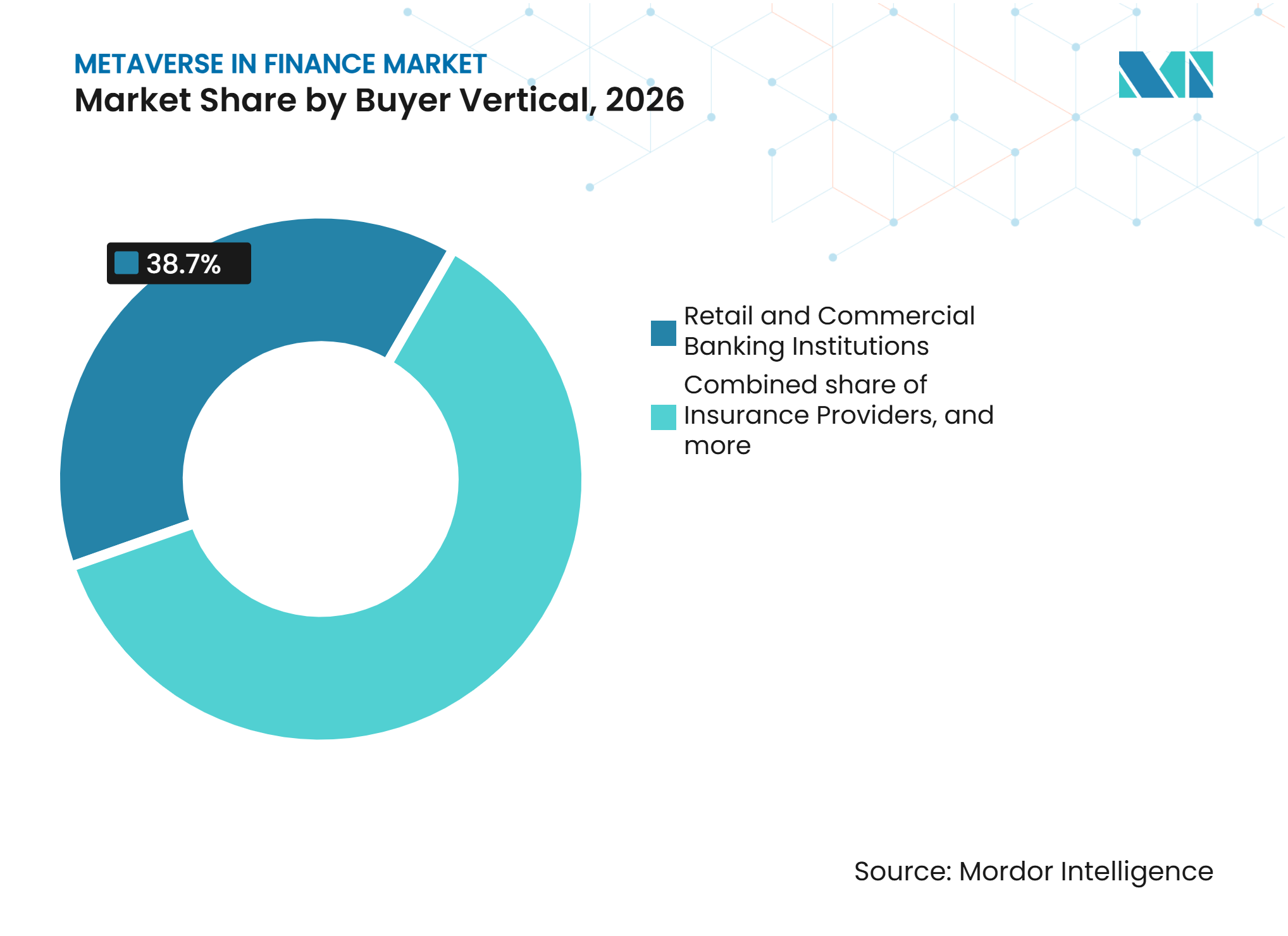
- By buyer vertical, retail and commercial banking institutions accounted for 38.7% of the metaverse in finance market share in 2026, while fintech and digital-asset firms are projected to expand at a 20.6% CAGR through 2032.
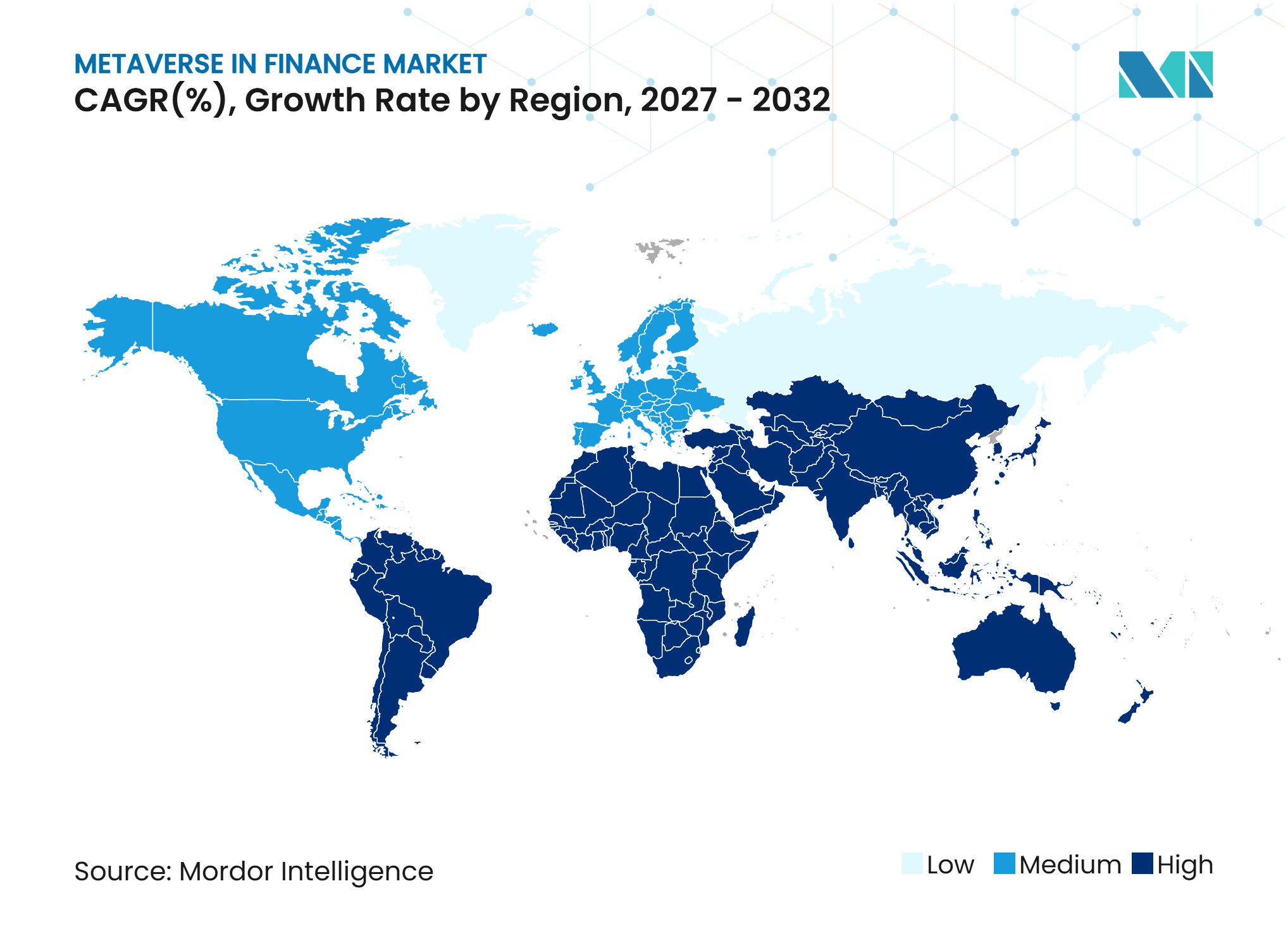
- By geography, North America held 42.4% of the metaverse in finance market share in 2026, while Asia-Pacific is forecast to grow at a 19.2% CAGR through 2032.
Note: Market numbers in this report are based on Mordor Intelligence's proprietary estimation framework, which combines nine months of actuals with Q4 projections for base year 2026.
Market Trends and Insights
Drivers Impact Analysis of Metaverse In Finance Market*
| Driver | (~) % Impact on CAGR Forecast | Geographic Relevance | Impact Timeline |
|---|---|---|---|
| Immersive Virtual Banking and Financial Advisory Services | +3.2% | Global, concentrated in Asia-Pacific and North America | Medium term (2-4 years) |
| Tokenized Assets in Virtual Investment and Trading Environments | +3.5% | Global, strongest in North America, Singapore, Hong Kong, and Japan | Medium term (2-4 years) |
| Immersive Financial Education and Investment Simulations | +2.1% | Global, with spillover to the Middle East, Africa, and South America | Short term (≤ 2 years) |
| Virtual Workspaces for Institutional Collaboration and Employee Training | +1.8% | North America and Europe, with early gains in Asia-Pacific financial hubs | Short term (≤ 2 years) |
| AI-Powered Personalized Financial Services in Virtual Environments | +2.8% | Global, led by Asia-Pacific with spillover to North America and Europe | Medium term (2-4 years) |
| Immersive Customer Engagement and Virtual Product Demonstrations | +1.5% | Global, with early gains in Singapore, Tokyo, Seoul, and Frankfurt | Short term (≤ 2 years) |
| Source: Mordor Intelligence | |||
Expansion of Immersive Virtual Banking and Financial Advisory Services
Virtual banking environments are becoming structured channels for customer engagement in parts of Asia and the Middle East. MUFG Bank launched MUFG Bank Metaverse on July 7, 2025, with anonymous avatar-based financial consultations through TOPPAN Corporation's Powered by Metapa platform[1]. The service is linked with new-format physical branches, which support a hybrid delivery approach rather than a fully separate virtual channel. Financial institutions in the United States are placing more attention on adviser certification and mortgage walkthrough tools, where staff knowledge retention and access for distributed teams can be measured. HSBC has identified AI avatars that process loan applications as an emerging model, building on AI use in fraud detection, transaction monitoring, and risk management.
Integration of Tokenized Financial Assets into Metaverse-Based Investment and Trading Environments
Tokenized assets are becoming an important settlement and ownership layer for immersive financial services. JPMorgan Kinexys Digital Payments and DBS Token Services announced a cross-border tokenized deposit framework in November 2025 for institutional value transfers across banks and public blockchains. The arrangement is designed to support real-time, 24-hour settlement for institutional clients. JPMorgan stated that the Kinexys platform had processed more than USD 4 trillion in cumulative transactions and averaged USD 7 billion per day as of October 2026[2]. Digital-asset infrastructure can combine execution, funding, and settlement in a single transaction, which changes the control requirements for risk and liquidity management. This infrastructure can support payment and ownership functions as virtual financial environments expand.
Demand for Immersive Financial Education and Investment Simulations
Immersive financial education is gaining attention because it can support repeatable engagement without the full operating burden of a virtual branch. Rakuten Securities used an NVIDIA Omniverse ACE-powered 3D avatar assistant to guide first-time investors ahead of a national savings program launch in Japan. The program served a brokerage with 10 million accounts and recorded more than 90% customer interest in future use during its 2-month development cycle. MSU Federal Credit Union launched its Campus Explorer Experience VR game in September 2025 with Michigan State University's Games for Entertainment and Learning Lab[3]. These examples show that learning tools can have clearer near-term use than customer-facing virtual branches. They also support financial literacy and onboarding activities for users who are new to investing.
Adoption of Virtual Financial Workspaces for Institutional Collaboration and Employee Training
Virtual workspaces are an increasingly relevant part of the metaverse in the finance market and are linked to established enterprise software environments. Microsoft retired its standalone Mesh platform on December 1, 2025, and moved 3D collaboration capabilities into Teams Immersive events within Microsoft 365[4]. This approach puts immersive collaboration inside existing identity and compliance systems. Accenture's Nth Floor illustrates how large enterprises use virtual settings for onboarding and training, while its January 2025 acquisition of Percipient's digital twin technology addressed banking modernization in Asia-Pacific. The broader operating model remains important because virtual workspaces require integration with core systems, security controls, and employee workflows. This driver is relevant where financial institutions need to train dispersed staff or run collaborative simulations.
Restraints Impact Analysis of Metaverse In Finance Market*
| Restraint | (~) % Impact on CAGR Forecast | Geographic Relevance | Impact Timeline |
|---|---|---|---|
| Uncertain Commercial Returns From Metaverse-Based Financial Services | -1.2% | Global, most acute in North America and Europe | Short term (≤ 2 years) |
| Limited Customer Adoption of Metaverse-Based Financial Platforms | -1.0% | Global, with intense effects in Asia-Pacific markets with high uncertainty avoidance | Medium term (2-4 years) |
| Regulatory Uncertainty Around Virtual Financial Transactions and Digital Asset Ownership | -0.8% | Global, with the sharpest cross-border gaps in the Middle East, Africa, and South America | Medium term (2-4 years) |
| Cybersecurity, Identity Verification, and Integration Risks in Immersive Financial Platforms | -0.7% | Global, with early mitigation frameworks in Singapore, the European Union, and South Korea | Long term (≥ 4 years) |
| Source: Mordor Intelligence | |||
Uncertain Commercial Returns From Metaverse-Based Financial Services
Consumer-facing financial services in the metaverse in finance market have not yet produced the revenue levels anticipated in earlier investment plans. Retail banking is used infrequently by many customers, and headset-based access can be less convenient than mobile banking. A 2025 study covering the European Union, the United States, China, Singapore, Brazil, and South Korea found that fragmented consumer protection rules and unresolved smart-contract liability can weaken trust and platform engagement. Training, settlement, and advisory simulations show clearer operating benefits for institutional users. However, these use cases address a smaller audience than the consumer banking segment that initially attracted much of the interest. This creates a continued need for institutions to set specific operational objectives before funding new deployments.
Limited Customer Adoption of Metaverse-Based Financial Platforms
Customer adoption of the metaverse in the financial market is constrained by hardware needs, behavioral readiness, and trust in financial institutions' handling of personal information. HSBC's August 2025 survey of more than 500 Hong Kong banking customers found that 80% were willing to use generative AI for financial management. The same survey found that 50% identified privacy as their main concern and 49% expressed skepticism about AI accuracy. Meta announced in January 2026 that it would discontinue commercial Quest headset sales from February 20, 2026. The change places more hardware procurement responsibility on institutions and can slow rollout where centralized device management is needed for compliance.
*Our forecasts treat driver/restraint impacts as directional, not additive. The impact forecasts reflect baseline growth, mix effects, and variable interactions.
Metaverse In Finance Market Segment Analysis
By Component:
Software-Led Spending and Growing Services RequirementsSoftware and platforms held a 47.6% share by component in 2026. Platform licensing and virtual-environment development account for a significant part of current spending by banks, insurers, and asset managers. Many institutions remain in the deployment stage, so recurring software fees form the highest immediate cost. Hardware use faces added uncertainty after Meta ended commercial Quest headset sales in February 2026. This decision narrows the managed enterprise headset channel and increases procurement complexity for organizations that need controlled device environments.
Services is the fastest-growing component, with the metaverse in the finance market segment expected to grow at a 19.7% CAGR from 2027 to 2032. Professional services, system integration, and managed operations are gaining relevance as institutions connect virtual platforms to core banking systems. Implementation also includes compliance processes, identity verification, and anti-money laundering workflows. Institutions using off-the-shelf virtual banking platforms still need specialist support to integrate these environments with their existing controls. AI-related rules can add consulting and governance requirements for virtual financial service components. The component mix is therefore expected to shift as implementation needs become more complex.


By Application:
Training Leads Current Spending While Tokenized Payments AccelerateFinancial education, training, and institutional collaboration held a 41.2% share of the metaverse in the finance market size by application in 2026. This position reflects the clearer operational return from virtual adviser training, onboarding, and institutional collaboration. Rakuten Securities used a 3D assistant to support first-time investors in Japan. MSU Federal Credit Union used a VR game to connect financial literacy with the student experience at Michigan State University. These applications can be delivered in defined learning settings and may be easier to measure than broad consumer virtual banking initiatives.
Metaverse-enabled payments, settlement, and tokenized asset transactions are projected to grow at a 21.8% CAGR through 2032. JPMorgan launched Kinexys Fund Flow in October 2025 to support real-time settlement of private fund flows using tokenized investor information. The first live transaction involved JPMorgan Asset Management, Private Bank, Kinexys Digital Assets, and Citco. Virtual advisory, wealth management, and trading remain secondary applications, especially for private banks and online brokerages. AI-managed transaction workflows can support productivity as institutions expand automation. Payments infrastructure is likely to be central to the metaverse in finance market because it provides the settlement function that other virtual financial services require.
By Buyer Vertical:
Banks Provide Scale While Fintech Firms Grow FasterRetail and commercial banking institutions accounted for 38.7% of the metaverse in finance market share by buyer vertical in 2026. Their position reflects large customer bases, substantial employee training requirements, and continuing investment in blockchain-based payments. Investment banks and capital markets institutions form an important secondary group in tokenized securities issuance and virtual trading simulations. HSBC Orion supports end-to-end digital bond issuance for institutional clients. Insurance providers, asset managers, and wealth managers are using immersive tools more selectively for onboarding and adviser training.
Fintech and digital-asset firms are forecast to expand at a 20.6% CAGR through 2032. These firms can build services within blockchain-enabled and immersive environments instead of adapting older core systems. The Monetary Authority of Singapore launched the BLOOM initiative in October 2025 with Circle, Coinbase, DBS, OCBC, Partior, Stripe, UOB, Ant International, and other participants. The initiative supports work on cross-border wholesale settlement, programmable compliance, and AI-driven payment processes. Fintech participation can influence interoperability practices that larger institutions later adopt. Their growth is also linked to the metaverse in finance market need for payment and tokenization systems that can operate across multiple financial platforms.

Geography Analysis
North America held 42.4% of the metaverse in finance market size in 2026. The region benefits from significant United States institutional investment in blockchain infrastructure and a concentration of technology vendors. United States banks and insurers are using VR-based adviser simulations for distributed sales and training teams. JPMorgan stated that Kinexys had processed more than USD 4 trillion in cumulative transactions and had average daily transaction activity of USD 7 billion as of October 2026. This creates a commercial base for tokenized payment settlement in the United States. Mastercard's work on stablecoin transaction capabilities also supports network-level interoperability for payments.
Asia-Pacific is the fastest-growing regional part of the metaverse in the finance market, with a forecast CAGR of 19.2% from 2027 to 2032. Central bank tokenization pilots, digital banking licensing, and AI-supported financial services support the region's position. HSBC conducted real-time AI customer interaction trials in the Hong Kong Monetary Authority's GenAI Sandbox in August 2025. DBS Hong Kong completed an e-HKD+ pilot in September 2025 using Purpose Bound Money technology and DBS Token Services. The Bank of Thailand approved 3 virtual bank consortia in June 2025. Singapore, Hong Kong, Japan, South Korea, and India are important locations for this activity across Asia-Pacific.
Europe has a meaningful position in the metaverse in finance market through institutional tokenization activity and a maturing regulatory framework. Nine European banks announced a MiCAR-compliant euro-denominated stablecoin consortium in September 2025. The participants were ING, UniCredit, CaixaBank, KBC, Danske Bank, DekaBank, SEB, Banca Sella, and Raiffeisen Bank International. The first issuance was targeted for the second half of 2026. The Markets in Crypto-Assets Regulation provides an operating framework for institutions considering programmable settlement. The United Kingdom also has a role in regulated financial AI development through the Financial Conduct Authority's work with NVIDIA on a Supercharged Digital Sandbox in June 2025. South America, the Middle East, and Africa remain earlier-stage areas, although Warba Bank established a presence on Decentraland and The Sandbox in March 2025.
Competitive Landscape
Market Concentration
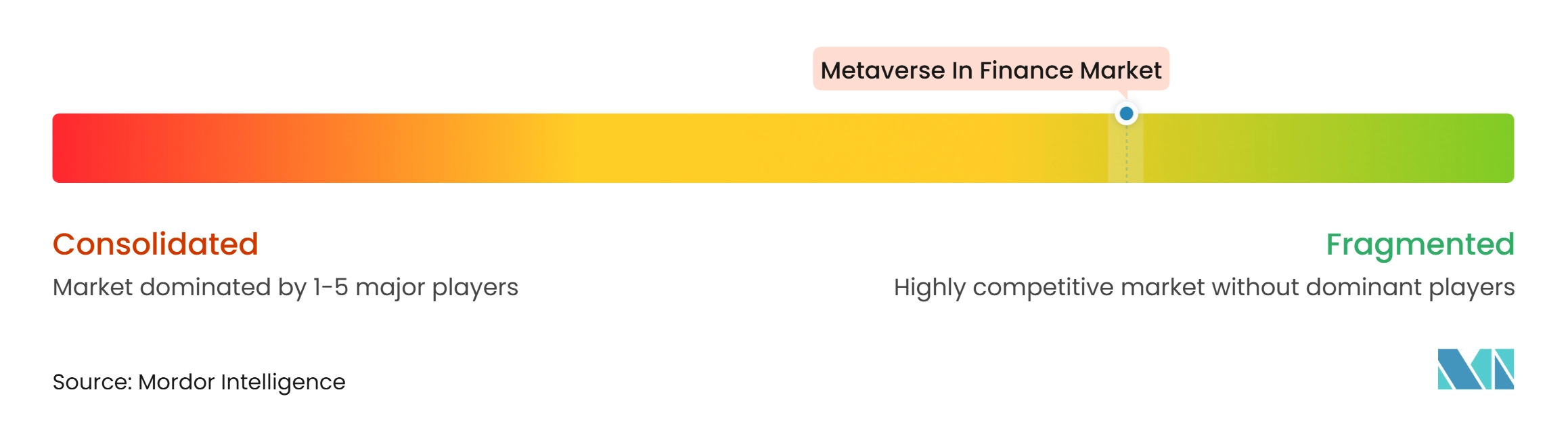
The metaverse in finance market has 2 connected competitive layers. The first layer includes technology platforms and infrastructure providers with spatial computing, rendering, and game-engine capabilities. NVIDIA, Microsoft, and Unity Software are important providers at this level. The second layer includes financial institutions that are developing proprietary services and payment infrastructure. Competition among financial institutions is more fragmented because deployments are tied to each firm's customers, compliance model, and existing systems. This structure creates moderate-to-high competitive intensity in technology infrastructure and a more dispersed pattern in financial services.
NVIDIA worked with the United Kingdom Financial Conduct Authority on the Supercharged Digital Sandbox in June 2025, illustrating the role of AI infrastructure in regulated financial development. Microsoft moved 3D collaboration functions into Teams Immersive events, which places virtual workspaces within an established enterprise software environment. Mastercard introduced end-to-end stablecoin transaction capabilities in April 2025 for wallet-to-checkout payments and merchant settlement. The capability included relationships with OKX and Nuvei, while JPMorgan Chase and Standard Chartered were connected to the Multi-Token Network. These moves show that competitive positioning depends on payment interoperability, compliance integration, and enterprise technology access.
Open opportunities in the metaverse in finance market include digital identity for cross-platform financial transactions, browser-accessible virtual banking that does not depend on headsets, and immersive wealth management tools for mass-affluent users. Fintech firms building on blockchain infrastructure can compete with established institutions by developing services directly within these environments. The MAS BLOOM initiative provides a setting for interoperability work involving both fintech and established financial companies. JPMorgan is extending tokenization capabilities through Kinexys Fund Flow and its JPM Coin deployment on Ethereum. HSBC continues to develop digital bond issuance and AI-supported financial service capabilities. Smaller vendors face higher governance demands where AI, digital identity, and regulated transactions are combined in a single offering.
Metaverse In Finance Industry Leaders
-
JPMorgan Chase & Co.
-
HSBC Holdings plc
-
Meta Platforms, Inc.
-
Microsoft Corporation
-
Visa Inc.
- *Disclaimer: Major Players sorted in no particular order
Metaverse In Finance Market Companies Covered in this Report
- JPMorgan Chase & Co.
- HSBC Holdings plc
- Bank of America Corporation
- BNP Paribas S.A.
- CaixaBank, S.A.
- DBS Group Holdings Ltd.
- Shinhan Financial Group Co., Ltd.
- KEB Hana Bank
- KB Financial Group Inc.
- The Goldman Sachs Group, Inc.
- Visa Inc.
- Mastercard Incorporated
- Meta Platforms, Inc.
- Microsoft Corporation
- NVIDIA Corporation
- Accenture plc
- Unity Software Inc.
- The Sandbox (Animoca Brands)
- Decentraland Foundation
- Avalanche BVI, Inc.
Recent Industry Developments in Metaverse In Finance Market
- October 2026: JPMorgan's JPM Coin (JPMD) had gone live on Ethereum, extending USD-denominated deposit token access to institutional clients on the Layer 1 blockchain network. The Kinexys platform had processed over USD 4 trillion in cumulative transactions with a USD 7 billion average daily volume, establishing institutional-scale tokenized payment capability across public and private blockchain networks.
- October 2025: MAS launched the BLOOM initiative for borderless, multi-currency tokenized settlement in tokenized bank liabilities and regulated stablecoins. Members included Circle, DBS, OCBC, Partior, Stripe, UOB, Coinbase, and Ant International, targeting cross-border wholesale settlement, programmable compliance, and AI-driven agentic payments.
- September 2025: Nine European banks announced a MiCAR-compliant euro stablecoin consortium, comprising ING, UniCredit, CaixaBank, KBC, Danske Bank, DekaBank, SEB, Banca Sella, and Raiffeisen Bank International. First issuance is targeted for the second half of 2026, establishing a European alternative to the United States-dominated stablecoin sector for programmable settlement.
- September 2025: DBS Hong Kong completed the e-HKD+ pilot under Project e-HKD Phase 2, using Purpose Bound Money technology and DBS Token Services for programmable digital vouchers with instant merchant settlement. The findings contributed to the Hong Kong Monetary Authority's assessment of the feasibility of mass retail e-HKD adoption.
Global Metaverse In Finance Market Report Scope
Segmentation Overview
| Hardware |
| Software and Platforms |
| Services |
| Virtual Banking and Branches |
| Immersive Financial Advisory and Wealth Management |
| Virtual Trading and Investment |
| Metaverse-Enabled Payments, Settlement and Tokenised Asset Transactions |
| Financial Education, Training and Institutional Collaboration |
| Other Applications |
| Retail and Commercial Banking Institutions |
| Investment Banks and Capital Markets Institutions |
| Insurance Providers |
| Asset and Wealth Management Firms |
| Fintech and Digital-Asset Firms |
| Other Financial Services Providers |
| North America | United States |
| Canada | |
| Mexico | |
| South America | Brazil |
| Argentina | |
| Rest of South America | |
| Europe | United Kingdom |
| Germany | |
| France | |
| Italy | |
| Spain | |
| Rest of Europe | |
| Asia-Pacific | China |
| Japan | |
| India | |
| South Korea | |
| Australia | |
| Indonesia | |
| Thailand | |
| Malaysia | |
| Singapore | |
| Vietnam | |
| Rest of Asia-Pacific | |
| Middle East and Africa | Saudi Arabia |
| United Arab Emirates | |
| Turkey | |
| South Africa | |
| Egypt | |
| Rest of Middle East and Africa |
| By Component | Hardware | |
| Software and Platforms | ||
| Services | ||
| By Application | Virtual Banking and Branches | |
| Immersive Financial Advisory and Wealth Management | ||
| Virtual Trading and Investment | ||
| Metaverse-Enabled Payments, Settlement and Tokenised Asset Transactions | ||
| Financial Education, Training and Institutional Collaboration | ||
| Other Applications | ||
| By Buyer Vertical | Retail and Commercial Banking Institutions | |
| Investment Banks and Capital Markets Institutions | ||
| Insurance Providers | ||
| Asset and Wealth Management Firms | ||
| Fintech and Digital-Asset Firms | ||
| Other Financial Services Providers | ||
| By Geography | North America | United States |
| Canada | ||
| Mexico | ||
| South America | Brazil | |
| Argentina | ||
| Rest of South America | ||
| Europe | United Kingdom | |
| Germany | ||
| France | ||
| Italy | ||
| Spain | ||
| Rest of Europe | ||
| Asia-Pacific | China | |
| Japan | ||
| India | ||
| South Korea | ||
| Australia | ||
| Indonesia | ||
| Thailand | ||
| Malaysia | ||
| Singapore | ||
| Vietnam | ||
| Rest of Asia-Pacific | ||
| Middle East and Africa | Saudi Arabia | |
| United Arab Emirates | ||
| Turkey | ||
| South Africa | ||
| Egypt | ||
| Rest of Middle East and Africa | ||
Key Questions Answered in the Report
What is the projected value of metaverse in finance by 2032?
The metaverse in finance market is projected to reach USD 491.8 million by 2032, with a 16.2% CAGR from 2027 to 2032.
Which component currently generates the largest share of spending?
Software and Platforms leads by component with 47.6% share in 2026, while Services has the highest projected component CAGR at 19.7% through 2032.
Which application is expected to grow fastest through 2032?
Metaverse-Enabled Payments, Settlement, and Tokenized Asset Transactions is expected to grow at a 21.8% CAGR from 2027 to 2032.
Why are banks using immersive financial services?
Banks are using these services for employee training, virtual collaboration, tokenized settlement, and selected advisory interactions where operating benefits can be measured.
Which region is forecast to grow fastest?
Asia-Pacific is projected to grow at a 19.2% CAGR through 2032, supported by tokenization pilots, digital banking initiatives, and AI-supported financial services.
What are the main challenges affecting adoption?
Key challenges include uncertain commercial returns, customer privacy concerns, hardware procurement, regulatory differences, cybersecurity, and identity verification requirements.