
Metalized Flexible Packaging Market Size and Share
Market Overview
| Study Period | 2022 - 2032 |
|---|---|
| Market Size (2027) | USD 9.98 Billion |
| Market Size (2032) | USD 12.65 Billion |
| Fastest Growing Market | Asia-Pacific |
| Largest Market | Asia-Pacific |
| Market Concentration | Medium |
Major Players *Disclaimer: Major Players sorted in no particular order Image © Mordor Intelligence. Reuse requires attribution under CC BY 4.0. | |
Metalized Flexible Packaging Market Analysis by Mordor Intelligence
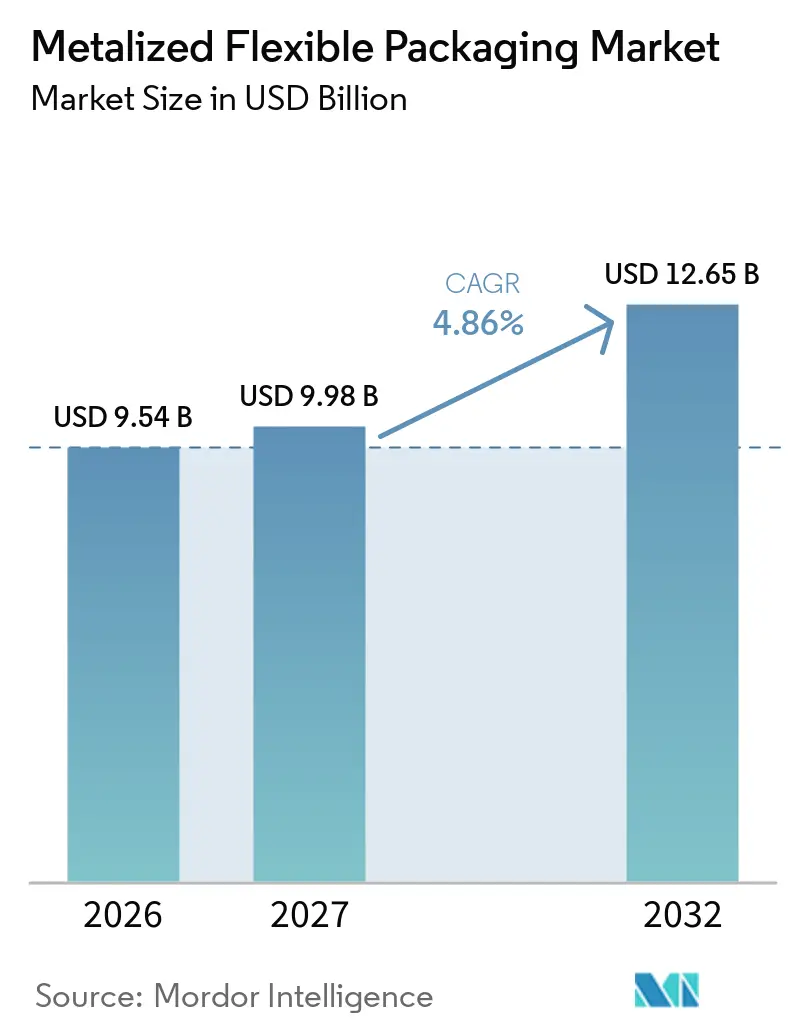
The Metalized Flexible Packaging Market size was valued at USD 9.54 billion in 2026 and is estimated to grow from USD 9.98 billion in 2027 to reach USD 12.65 billion by 2032, at a CAGR of 4.86% during the forecast period (2027-2032). The market is supported by demand for packaging that protects products from oxygen, moisture, and light while using less material than rigid formats. Food, pharmaceutical, and industrial buyers continue to require stable barrier performance during storage, transport, and retail handling. Regulatory pressure is also moving converters toward recyclable designs, particularly mono-material metalized films. This change creates opportunities for producers that can provide high barrier performance without relying on complex multilayer laminates. Higher aluminum, polymer, and energy costs remain important constraints because they affect converter margins and purchasing decisions.
Key Report Takeaways
- By material type, aluminum-foil-based flexible packaging held 42.56% of the metalized flexible packaging market share in 2026, while metalized film flexible packaging is forecast to advance at a 5.26% CAGR through 2032.
- By structure, laminated structures held 62.35% of the metalized flexible packaging market share in 2026, while mono-extruded structures are forecast to advance at a 5.63% CAGR through 2032.
- By packaging type, pouches held 45.11% of the metalized flexible packaging market share in 2026 and are forecast to advance at a 5.71% CAGR through 2032.
- By end-use industry, food held 53.28% of the metalized flexible packaging market share in 2026, while pharmaceuticals are forecast to advance at a 5.89% CAGR through 2032.
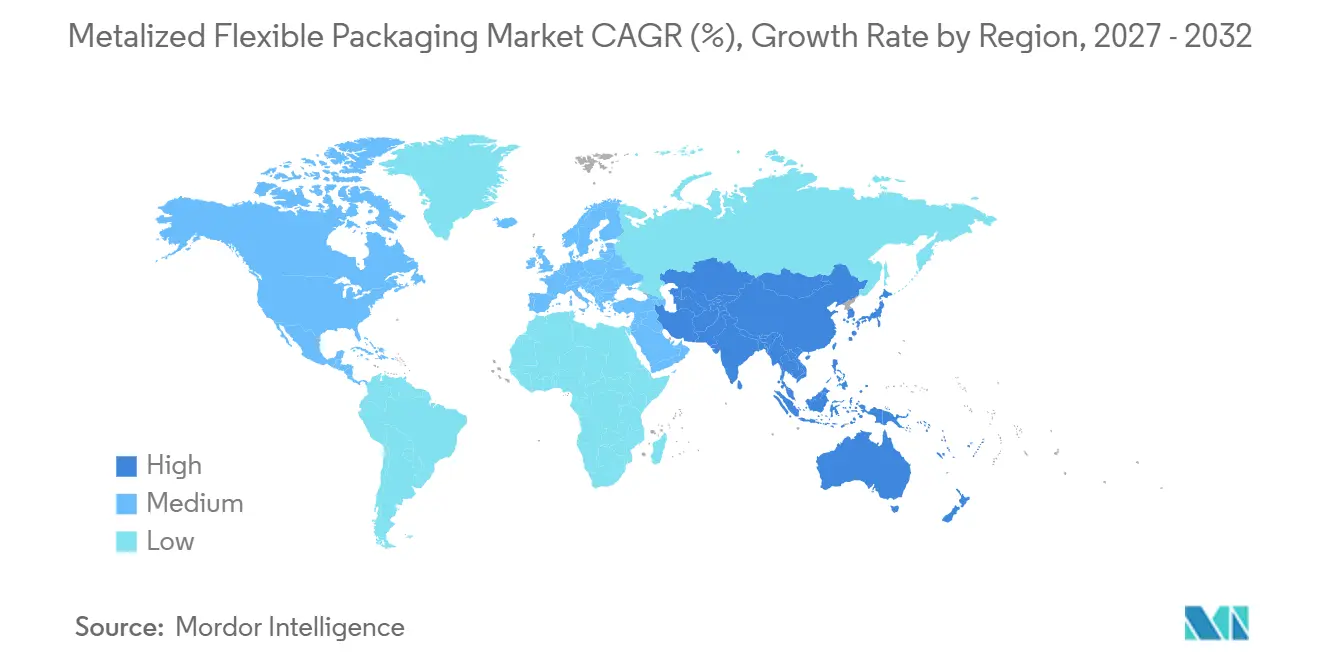
- By geography, Asia-Pacific held 42.84% of the metalized flexible packaging market share in 2026 and is forecast to advance at a 5.74% CAGR through 2032.
Note: Market numbers in this report are based on Mordor Intelligence's proprietary estimation framework, which combines nine months of actuals with Q4 projections for base year 2026.
Market Trends and Insights
Drivers Impact Analysis of Metalized Flexible Packaging Market*
| Driver | (~) % Impact on CAGR Forecast | Geographic Relevance | Impact Timeline |
|---|---|---|---|
| Demand for High-Barrier Shelf-Life Extension | +1.3% | Global, concentrated gains in Asia-Pacific and North America | Long term (≥ 4 years) |
| Growth of Convenience, Ready-to-Eat, and Single-Serve Foods | +1.0% | Asia-Pacific core, spillover to Middle East and Africa | Medium term (2–4 years) |
| Lightweighting and Material Reduction Versus Rigid Packaging | +0.8% | North America & EU, adoption accelerating in Asia-Pacific | Medium term (2–4 years) |
| E-Commerce and Direct-to-Consumer Packaging Requirements | +0.6% | Asia-Pacific core, North America & EU | Short term (≤ 2 years) |
| Shift Toward Recyclable Mono-Material Metalized Structures | +0.5% | North America & EU, early-mover spillover to Asia-Pacific | Medium term (2–4 years) |
| Source: Mordor Intelligence | |||
Growth of Convenience, Ready-to-Eat, and Single-Serve Foods
Convenience foods require compact packs that offer reliable barriers at low material weights. Metalized pouches support snack foods, coffee, ready-to-eat meals, pet food, and portioned dry products that need moisture and oxygen protection. These formats also fit single-serve and multipack formats used in modern retail, foodservice, and online grocery channels. Water vapor control is particularly important for dry foods with moisture-sensitive ingredients, which limits the use of lower-barrier structures. Resealable and portioned formats have a further role in North American and European food categories where ease of use remains important. This demand supports the metalized flexible packaging market because converters can pair format flexibility with high protection levels.
Lightweighting and Material Reduction Versus Rigid Packaging
Metalized flexible formats can provide high barrier protection while using less material than many rigid packs. Amcor plc reported that a Canadian dairy customer reduced package weight by 82% after moving from a paperboard overpack to a flow-wrap format. Lower package weight can reduce freight requirements and improve transport efficiency for distribution-intensive foodservice and e-commerce supply chains. The Canadian Plastics Pact reported that a truckload of empty flexible packaging can replace 26 truckloads of rigid containers. Companies are developing metalized machine-direction-oriented polyethylene films that seek to preserve barrier performance while enabling a mono-material design. SAES Coated Films reported oxygen transmission below 0.25 cm³/m²/day for its PROPYLESTER-XE-MDO film.
E-Commerce and Direct-to-Consumer Packaging Requirements
E-commerce exposes packages to drops, vibration, moisture, and handling across several delivery stages. Metalized flexible packaging must therefore retain its barrier properties after mechanical stress, not only when it leaves the production line. This requirement increases the value of durable laminations and well-designed seals in meal-kit, direct-to-consumer food, and other sensitive product applications. The International Trade Administration expects United States business-to-consumer e-commerce revenue to reach USD 5.5 trillion by 2027, which supports the growing importance of transit-ready packaging[1]. China is also encouraging recyclable parcel packaging, which favors mono-material structures that can combine protection with sorting compatibility. The metalized flexible packaging market is thus moving into distribution-center specifications that were historically centered on conventional retail packaging.
Shift Toward Recyclable Mono-Material Metalized Structures
Recyclability requirements are changing material development priorities in the metalized flexible packaging market. Regulation (EU) 2025/40 on packaging and packaging waste entered into force on February 11, 2025, and set a framework for more recyclable packaging in the European Union[2]. Mono-material designs seek to reduce the separation problem created by incompatible polymer layers and metal-containing laminates. These formats are intended to run on existing form-fill-seal equipment, which can reduce adoption barriers for brand owners. Dai Nippon Printing Co., Ltd (DNP) announced a vacuum metalized high-barrier polypropylene film in July 2025 and stated that it offered roughly twice the barrier performance of conventional mono-material polypropylene packaging. Development work is increasingly focused on structures that can meet food, pharmaceutical, and retort requirements while remaining compatible with recycling pathways.
Restraints Impact Analysis of Metalized Flexible Packaging Market*
| Restraint | (~) % Impact on CAGR Forecast | Geographic Relevance | Impact Timeline |
|---|---|---|---|
| Difficult Recycling of Multilayer Metal-Plastic Structures | -0.8% | Global, most acute in North America & EU | Long term (≥ 4 years) |
| Volatility in Aluminum, Polymer, and Energy Costs | -0.6% | North America most impacted; EU under separate energy cost pressure | Short term (≤ 2 years) |
| Barrier Loss from Pinholes, Flex Cracking, and Coating Nonuniformity | -0.4% | Global, concentrated in high-throughput converting markets | Medium term (2–4 years) |
| Source: Mordor Intelligence | |||
Difficult Recycling of Multilayer Metal-Plastic Structures
Multilayer metal-plastic laminates remain difficult to recycle because sorting systems cannot easily separate metal-containing layers from incompatible polymers. A 2025 peer-reviewed study found that metallic contamination in recycled multilayer materials reduced polymer mechanical properties, limiting the use of the recovered material. The same study discussed solvent-based delamination methods that achieved material recovery above 95% in laboratory conditions, while noting scale-up and solvent recovery challenges. These constraints create market-access and compliance risks for conventional laminates as European recyclability rules become more significant. They also redirect investment toward mono-material platforms rather than larger-scale expansion of existing multilayer products. The restraint affects the metalized flexible packaging market most strongly, where recycling obligations and waste-management infrastructure are more advanced.
Volatility in Aluminum, Polymer, and Energy Costs
Converters are exposed to changes in aluminum, polymer resin, and energy prices, which do not necessarily move in the same direction. This exposure is significant for contracts where material costs cannot be passed through quickly. Flexible Packaging Europe reported lower aluminum foil prices in the third quarter of 2025, while noting continued pressure from volatile energy costs. United States aluminum tariffs and related trade measures also changed procurement conditions during 2025. Cost uncertainty can delay equipment investment and encourage regional sourcing strategies. The result is a more uneven competitive environment for suppliers in the metalized flexible packaging market.
*Our forecasts treat driver/restraint impacts as directional, not additive. The impact forecasts reflect baseline growth, mix effects, and variable interactions.
Metalized Flexible Packaging Market Segment Analysis
By Material Type:
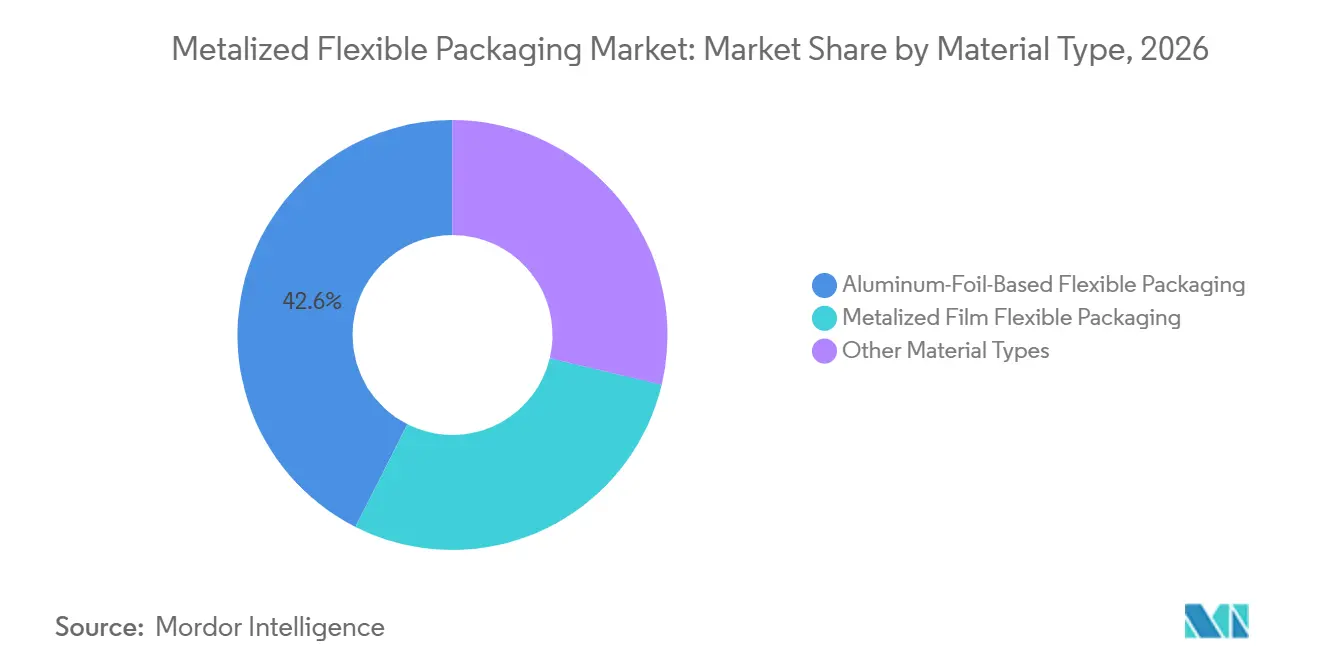
Aluminum-Foil-Based Flexible Packaging Dominates, Metalized Film Flexible Packaging Gains GroundAluminum-foil-based flexible packaging held 42.56% of the metalized flexible packaging share in 2026. Its position reflects strong and familiar barrier performance for food, pharmaceutical, and industrial applications. An unbroken foil layer can provide very low oxygen transmission and support retort, aseptic, and print applications. Buyers also value the extensive record of shelf-life validation available for foil-based structures. Metalized film flexible packaging is projected to advance at a 5.26% CAGR through 2032. The faster growth reflects lower areal weight and the potential for mono-material designs.
DNP introduced a vacuum metalized high-barrier polypropylene film in July 2025. The company stated that the film achieved roughly twice the oxygen and water-vapor barrier performance of conventional mono-material polypropylene packaging. It also estimated a 19% life-cycle carbon dioxide reduction against aluminum foil equivalents. Metalized paper has a smaller role in premium food and cosmetics applications. These material choices allow brands to balance barrier needs, appearance, weight, and recycling requirements. The metalized flexible packaging market is likely to see more applications move to precision-metalized films where they can meet required performance levels.

By Structure:
Laminated Structures Lead, While Mono-Extruded Formats Gain on Sustainability MandateLaminated structures held 62.35% of the metalized flexible packaging share in 2026. Their lead comes from the ability to combine sealant films, printed substrates, aluminum foil, and metalized films into a single structure. This arrangement supports demanding barrier, mechanical, and appearance requirements in premium food, pharmaceutical, and pet food packs. The installed base of laminating equipment also supports continued use of these structures. Mono-extruded structures are projected to advance at a 5.63% CAGR through 2032. Their growth reflects investment in mono-material films that can run on existing form-fill-seal lines.
BOBST, Brückner Maschinenbau, and Mitsui Chemicals demonstrated a mono-material metalized retort solution in October 2025. The development addressed the challenge of creating recyclable packaging for retort applications. Taghleef Industries and Packstyle have also developed a mono-polypropylene format that replaces a PET/ALU/NYLON/LLDPE cosmetics laminate. SAES Coated Films has applied machine-direction orientation to a metalized polyethylene film while maintaining a polyethylene-based recycling design. Other structures, including co-extruded formats, continue to serve industrial and agricultural uses. The metalized flexible packaging market will retain laminated formats where their performance remains difficult to reproduce.
By Packaging Type:
Pouches Lead Across Both Scale and GrowthPouches held 45.11% of the metalized flexible packaging share in 2026. Pouches are also projected to advance at a 5.71% CAGR through 2032. Their position reflects adaptability across stand-up, flat, spouted, and retort formats. These formats support single-serve and multi-serve products in convenience retail and online channels. Resealable designs are useful for snack foods, protein products, dry ingredients, and other food categories. Bags and rollstock remain important for bulk goods, industrial uses, and high-volume filling operations.
Rollstock remains a core input for horizontal form-fill-seal and vertical form-fill-seal operations. Wraps, sachets, and stick packs are used for portion-controlled pharmaceutical and personal care products. Amcor plc announced a major expansion of North American printing, lamination, and converting capacity for protein packaging in November 2025. The investment supports forming and non-forming applications and the expansion of polyethylene-based flexible formats. Better access to cost-competitive metalized film inputs can also broaden high-barrier pouch use among mid-sized food brands. The metalized flexible packaging market benefits because pouch formats can combine protection, convenience, and lower transport weight.
By End-Use Industry:
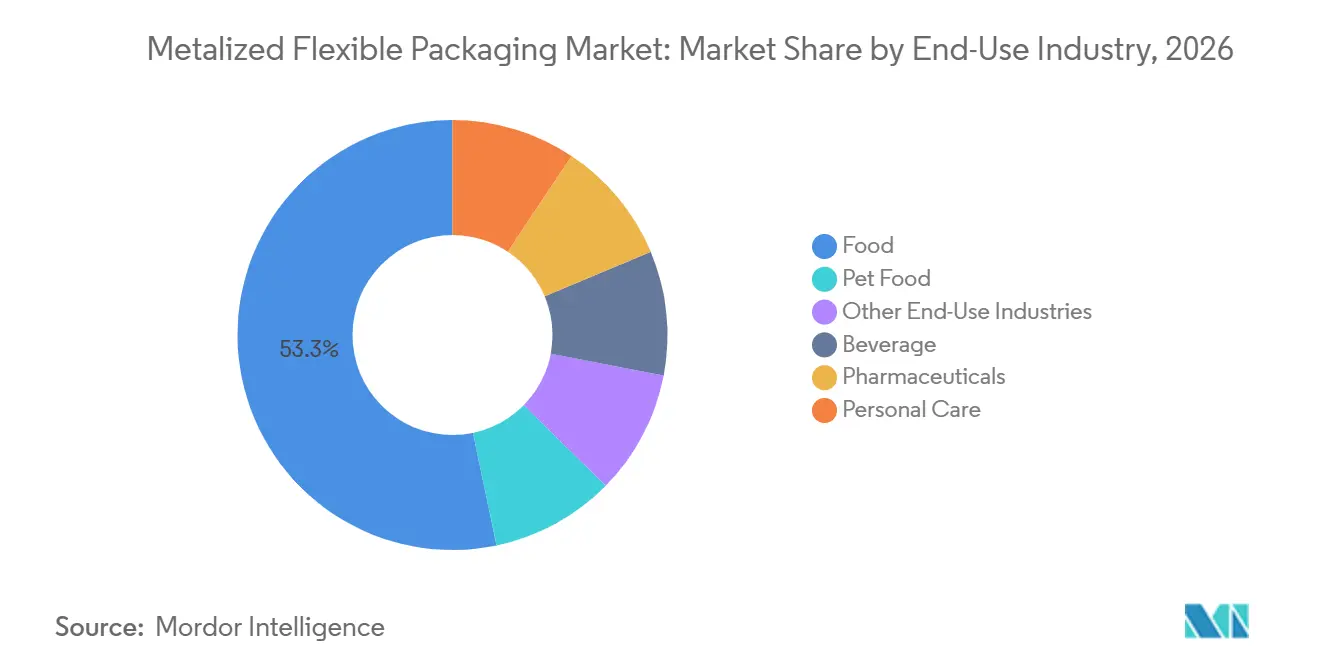
Food Anchors Share, Pharmaceuticals Drive GrowthFood held 53.28% of the metalized flexible packaging share in 2026. Coffee, snack foods, confectionery, dried ingredients, and ready-to-eat meals require packaging that protects flavor, texture, and safety. Food manufacturers also use flexible barriers to limit moisture gain or loss during long distribution periods. Beverage pouches for juices and liquid nutrition products account for a smaller but growing application. Pet food applications depend on stable moisture and oxygen barriers for premium dry and wet products.
Pharmaceuticals are projected to advance at a 5.89% CAGR through 2032. Growth is linked to blister packaging volumes, biologic and injectable drug pipelines, and requirements for temperature-sensitive products. Pharmaceutical applications require controlled performance across the registered product shelf life. Personal care brands are also evaluating mono-material metalized pouches as alternatives to laminate sachets. Taghleef Industries has demonstrated a recyclable mono-polypropylene cosmetic-packaging structure with Packstyle. This diversification supports demand beyond core food applications.
Geography Analysis
APAC Metalized Flexible Packaging Market
Asia-Pacific held 42.84% of the metalized flexible packaging share in 2026 and is projected to advance at a 5.74% CAGR through 2032. China has a large regional role because of its e-commerce scale, flexible packaging manufacturing base, and recycling policy direction. Amcor plc's USD 460 million investment in Changzhou reflects the importance of regional capacity and high-barrier packaging demand. India is supported by growth in packaged food processing and pharmaceutical exports. Japan benefits from rigorous food-safety and pharmaceutical packaging standards. Southeast Asia offers further demand as modern retail and cold-chain systems expand.
North America Metalized Flexible Packaging Market
North America remains an important geography for food, beverage, and pharmaceutical packaging. Rigid-to-flexible conversion supports demand for lightweight high-barrier structures in the region. Aluminum trade measures introduced in 2025 have encouraged interest in domestic sourcing and metalized-film alternatives. Amcor plc's North American capacity expansion for protein packaging shows continued investment in flexible converting capability. State-level extended producer responsibility programs are also encouraging work on recyclable mono-material structures. These conditions favor suppliers that can offer validated barrier performance with simpler material designs.
EMEA and South America Metalized Flexible Packaging Market
Europe is shaped by established converter capability and the implementation pathway for the Packaging and Packaging Waste Regulation. Germany, the United Kingdom, France, and Italy remain important end markets for food, pharmaceutical, and personal care packaging. Constantia Flexibles announced facility investment in September 2025, including capacity additions in Austria, Germany, and Spain. Coveris completed an upgrade at its Halle site in Germany in August 2025. South America and the Middle East and Africa remain smaller regional markets. Urbanization, processed-food adoption, and pharmaceutical development support their demand outlook.
Competitive Landscape
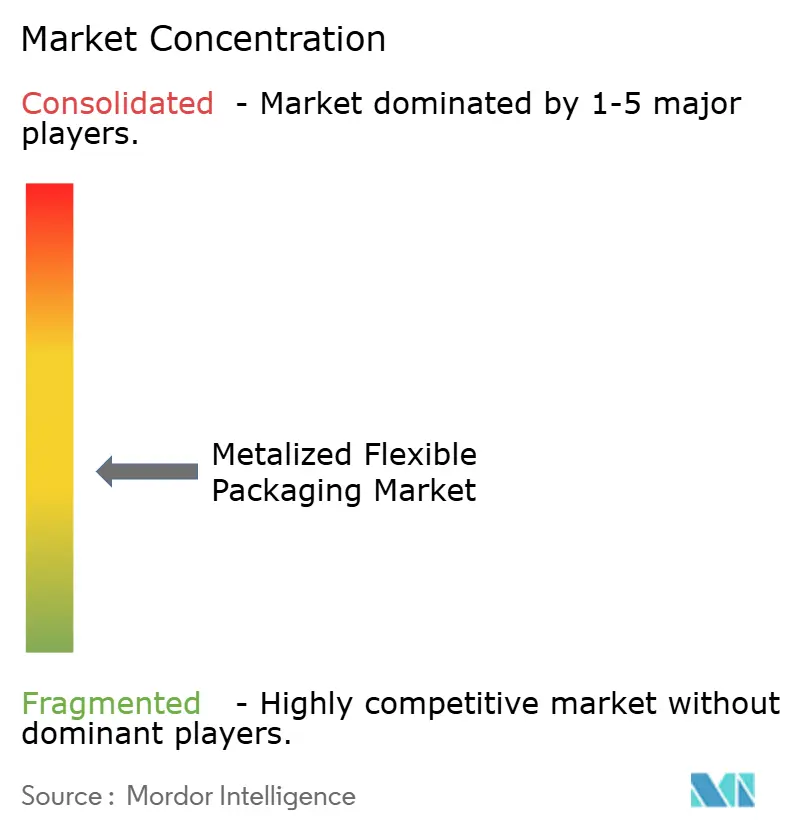
The metalized flexible packaging market is moderately concentrated, with the top five players including Amcor plc, Mondi, Sealed Air Corporation, Huhtamäki Oyj, and Constantia Flexibles. Amcor plc completed its merger with Berry Global in April 2025, expanding its footprint in flexible barrier films, lamination, and pouch conversion. Constantia Flexibles completed its acquisition of Aluflexpack in September 2025, strengthening its food and pharmaceutical flexible-packaging portfolio. These transactions increase the importance of scale and integrated production capability. Customers continue to assess suppliers on supply reliability, barrier performance, and recyclable-design options.
Film and specialist suppliers compete through material innovation and application expertise. Jindal Films, Taghleef Industries, Polyplex, Cosmo Films, Ester, and UFlex Limited are relevant participants in films, metallization, specialty substrates, and related converting applications. Jindal Films installed a proprietary 3.7-meter-wide vacuum metallizer at its Brindisi plant in January 2025. The installation expanded capacity for recyclable mono-material Biaxially Oriented Polypropylene (BOPP) and Biaxially Oriented Polyethylene (BOPE) structures. Taghleef Industries has focused on mono-polypropylene solutions for cosmetics packaging. Cosmo Films received the International Flexible Packaging and Folding Carton Association (IFCA) Star Award 2025 for metalized barrier BOPP film and retortable lidding-film innovations.
Strategic activity increasingly centers on recyclable formats, digital printing, and integrated supply chains. Constantia Flexibles installed a digital printing line for aluminum and polyethylene terephthalate substrates in Copenhagen and linked the activity with product carbon footprint certification. ProAmpac displayed foil-replacement technologies, mono-material recyclable films, and post-consumer recycled-content options at PACK EXPO Las Vegas 2025. Coveris has invested in cast-film extrusion, gravure printing, and logistics capacity to support recyclable monofilm solutions. The competitive landscape, therefore, rewards technical differentiation as well as production scale. Opportunities remain in recyclable blister lidding, mono-material retort packaging, and high-barrier paper applications.
Metalized Flexible Packaging Industry Leaders
-
Amcor plc
-
Mondi
-
Sealed Air Corporation
-
Huhtamäki Oyj
-
Constantia Flexibles
- *Disclaimer: Major Players sorted in no particular order
Metalized Flexible Packaging Market Companies Covered in this Report
- Amcor plc
- Constantia Flexibles
- Cosmo Films
- Coveris
- Ester
- Huhtamäki Oyj
- Jindal Films
- Mondi
- Polyplex
- ProAmpac
- Sealed Air Corporation
- Sonoco Products Company
- Taghleef Industries
- Transcontinental Packaging
- UFlex Limited
Recent Industry Developments in Metalized Flexible Packaging Market
- October 2026: Innovia Films launched Propafilm CHBM, an ultra-high-barrier metalized BOPP film designed to provide strong oxygen and moisture protection while supporting more recyclable polypropylene-based packaging structures. The launch supports the metalized flexible packaging market by enabling high-barrier packaging that can replace aluminum foil in selected flexible packaging laminates.
- September 2026: Pregis Performance Flexibles announced a new metalized polyethylene high-barrier sealant film for presentation at PACK EXPO International 2026. The development supports the metalized flexible packaging market by combining barrier protection for food packaging with a design intended to improve compatibility with polyethylene recycling streams.
Global Metalized Flexible Packaging Market Report Scope
Metalized flexible packaging consists of flexible packaging materials that incorporate a thin metallic layer or aluminum foil to improve barrier performance and protect packaged products. These materials help limit exposure to moisture, oxygen, and light while supporting lightweight packaging and efficient storage and transportation.
The Metalized Flexible Packaging Market is segmented by material type, structure, packaging type, end-use industry, and geography. By material type, the market is segmented into aluminum-foil-based flexible packaging, metalized film flexible packaging, and other material types. By structure, the market is segmented into laminated structures, mono-extruded structures, and other structures. By packaging type, the market is segmented into pouches, bags, wraps, rollstock, and other packaging types. By end-use industry, the market is segmented into food, beverage, pharmaceuticals, personal care, pet food, and other end-use industries. The report also covers the market size and forecasts for metalized flexible packaging across 15 countries. For each segment, the market sizing and forecasts have been done on the basis of value (USD).
Segmentation Overview
| Aluminum-Foil-Based Flexible Packaging |
| Metalized Film Flexible Packaging |
| Other Material Types |
| Laminated Structures |
| Mono-Extruded Structures |
| Other Structures |
| Pouches |
| Bags |
| Wraps |
| Rollstock |
| Other Packaging Types |
| Food |
| Beverage |
| Pharmaceuticals |
| Personal Care |
| Pet Food |
| Other End-Use Industries |
| Asia-Pacific | China |
| India | |
| Japan | |
| South Korea | |
| ASEAN Countries | |
| Rest of Asia-Pacific | |
| North America | United States |
| Canada | |
| Mexico | |
| Europe | Germany |
| United Kingdom | |
| France | |
| Italy | |
| NORDIC Countries | |
| Rest of Europe | |
| South America | Brazil |
| Argentina | |
| Rest of South America | |
| Middle East and Africa | Saudi Arabia |
| South Africa | |
| Rest of Middle East and Africa |
| By Material Type | Aluminum-Foil-Based Flexible Packaging | |
| Metalized Film Flexible Packaging | ||
| Other Material Types | ||
| By Structure | Laminated Structures | |
| Mono-Extruded Structures | ||
| Other Structures | ||
| By Packaging Type | Pouches | |
| Bags | ||
| Wraps | ||
| Rollstock | ||
| Other Packaging Types | ||
| By End-Use Industry | Food | |
| Beverage | ||
| Pharmaceuticals | ||
| Personal Care | ||
| Pet Food | ||
| Other End-Use Industries | ||
| By Geography | Asia-Pacific | China |
| India | ||
| Japan | ||
| South Korea | ||
| ASEAN Countries | ||
| Rest of Asia-Pacific | ||
| North America | United States | |
| Canada | ||
| Mexico | ||
| Europe | Germany | |
| United Kingdom | ||
| France | ||
| Italy | ||
| NORDIC Countries | ||
| Rest of Europe | ||
| South America | Brazil | |
| Argentina | ||
| Rest of South America | ||
| Middle East and Africa | Saudi Arabia | |
| South Africa | ||
| Rest of Middle East and Africa | ||
Key Questions Answered in the Report
What is the size of the metalized flexible packaging market?
The metalized flexible packaging market size was valued at USD 9.54 billion in 2026 and is estimated to grow from USD 9.98 billion in 2027 to reach USD 12.65 billion by 2032, at a CAGR of 4.86% during the forecast period (2027-2032).
What is driving demand for metalized flexible packaging?
Demand is supported by high-barrier protection, lightweighting, convenience-food formats, e-commerce requirements, and recyclable mono-material development.
Which material type held the largest share in 2026?
Aluminum-foil-based flexible packaging held 42.56% of the market share in 2026.
Which packaging type is projected to grow fastest through 2032?
Pouches are projected to grow at a 5.71% CAGR through 2032.