
Merchant Cash Advance Debt Settlement Market Size and Share
Market Overview
| Study Period | 2020 - 2031 |
|---|---|
| Market Size (2026) | USD 250.30 Million |
| Market Size (2031) | USD 376.40 Million |
| Growth Rate (2026 - 2031) | 8.50 % |
| Fastest Growing Market | Asia-Pacific |
| Largest Market | North America |
| Market Concentration | Low |
Major Players *Disclaimer: Major Players sorted in no particular order Image © Mordor Intelligence. Reuse requires attribution under CC BY 4.0. | |
Merchant Cash Advance Debt Settlement Market Analysis by Mordor Intelligence
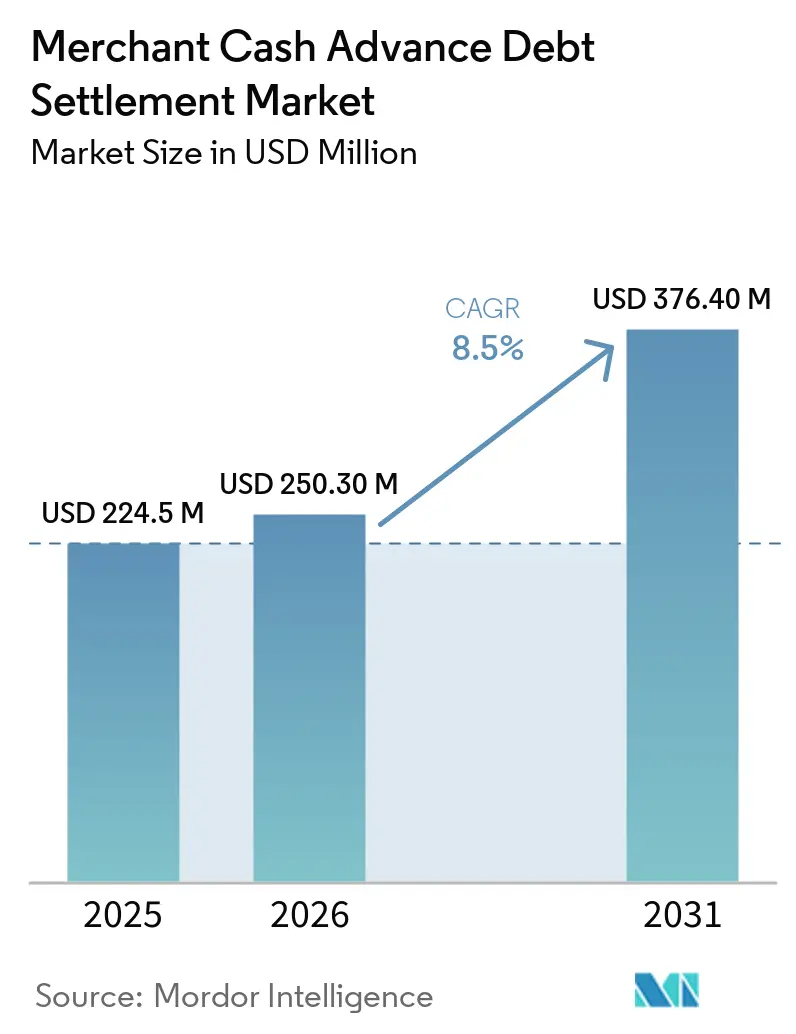
The merchant cash advance debt settlement market size was valued at USD 224.5 million in 2025 and is projected to expand from USD 250.3 million in 2026 to USD 376.4 million by 2031, registering a CAGR of 8.5% between 2026 and 2031. Demand is tied to businesses that need to resolve revenue-based financing obligations when daily withdrawals no longer match operating cash flow. Multiple concurrent advances create the most difficult cases because each provider may hold different contractual rights and collection arrangements. Legal scrutiny, clearer financing disclosures, and greater awareness of reconciliation rights can improve a merchant’s position during a negotiated resolution. Providers are responding by combining negotiation, legal review, lien management, and pre-default support rather than relying on a single settlement format. The merchant cash advance debt settlement market therefore has room for specialized services, although complex contracts and uneven lender participation will continue to limit the speed of case resolution.
Key Report Takeaways
- By settlement structure, lump-sum settlement held 50.4% of the merchant cash advance debt settlement market share in 2025, while hybrid close is forecast at a 12.2% CAGR through 2031.
- By MCA position complexity, the stacked/multi-position cases segment accounted for 62.1% of the merchant cash advance debt settlement market share in 2025 and is forecast to expand at a 9.8% CAGR through 2031.
- By enrolled remaining purchased amount, the large-balance enrollments segment held 38.9% of the merchant cash advance debt settlement market share in 2025 and is forecast to expand at a 10.2% CAGR through 2031.
- By merchant industry, food service & hospitality held 23.7% of the merchant cash advance debt settlement market share in 2025, while construction & contracting is forecast to expand at a 10.7% CAGR through 2031.
- By geography, North America held 91.2% of the merchant cash advance debt settlement market share in 2025, while Asia-Pacific is forecast to expand at a 14.8% CAGR through 2031.
Note: Market size and forecast figures in this report are generated using Mordor Intelligence’s proprietary estimation framework, updated with the latest available data and insights as of January 2026.
Global Merchant Cash Advance Debt Settlement Market Trends and Insights
Drivers Impact Analysis*
| Driver | (~) % Impact on CAGR Forecast | Geographic Relevance | Impact Timeline |
|---|---|---|---|
| Rising Prevalence of Stacked MCA Obligations | +3.2% | North America, with spillover to the United Kingdom and Australia | Short term (≤ 2 years) |
| Increasing Merchant Cash-Flow Stress and MCA Delinquencies | +2.1% | North America and Europe | Medium term (2-4 years) |
| Growing Demand for Revenue-Based Repayment Restructuring | +1.3% | Global | Medium term (2-4 years) |
| Increasing Legal Challenges to MCA Contract Enforceability | +0.9% | North America, particularly New York, California, and New Jersey | Medium term (2-4 years) |
| Greater Regulatory Scrutiny and Disclosure of MCA Financing | +0.8% | North America and the European Union | Long term (≥ 4 years) |
| Increasing Complexity of Multi-Funder MCA Debt Resolution | +0.7% | North America | Medium term (2-4 years) |
| Source: Mordor Intelligence | |||
Rising Prevalence of Stacked MCA Obligations
Stacked positions occur when a business carries 2 or more merchant cash advances at the same time. This pattern increases settlement demand because each new daily debit reduces the cash available for payroll, rent, inventory, and taxes. A business with several positions must usually resolve claims in an order shaped by lien rights, contract terms, and each funder’s willingness to negotiate. This coordination requirement favors providers with experience in multi-funder cases and legal documentation. Stacked/Multi-Position cases held the largest share of the merchant cash advance debt settlement market in 2025 and also had the highest growth rate within this segmentation. The merchant cash advance debt settlement market remains exposed to this issue because underwriting across separate providers may not fully identify obligations already supported by the same business revenue.
Increasing Merchant Cash-Flow Stress and MCA Delinquencies
Merchant cash-flow pressure increases the need for a negotiated resolution when fixed daily withdrawals continue during weaker trading periods. Restaurants face particular pressure because food and labor costs take a large share of sales, while payments under an advance are often linked to gross receipts rather than net profit. The National Restaurant Association reported that 42% of operators were not profitable in 2025, which illustrates why a daily withdrawal can become unsustainable when margins narrow[1]“State of the Restaurant Industry,” National Restaurant Association, restaurant.org. Merchants that seek support before a default may have more options to reconcile payment obligations or negotiate a revised schedule. This earlier intervention can widen the range of cases served by the merchant cash advance debt settlement market. It can also reduce the likelihood that a business waits until the debt burden requires a formal insolvency process.
Increasing Legal Challenges to MCA Contract Enforceability
Legal challenges are becoming more relevant when a merchant argues that an agreement operated like a loan rather than a purchase of future receivables. The issue can affect the leverage available to both parties because litigation raises time, legal costs, and uncertainty. Contract language, collection behavior, reconciliation provisions, and the allocation of business risk can shape how a dispute is assessed. California’s SB 362 took effect in January 2026 and limits misleading uses of interest-related terminology in specified offers of USD 500,000 or less. This change adds a compliance consideration for providers and merchants operating in the state. The merchant cash advance debt settlement market can benefit when negotiated outcomes become a less costly alternative to extended disputes.
Greater Regulatory Scrutiny and Disclosure of MCA Financing
Disclosure rules make financing terms more visible and may provide clearer records for merchants reviewing an obligation. Texas House Bill 700 took effect in September 2025 and established disclosure and registration requirements for certain sales-based financing transactions. The law also voided confession-of-judgment provisions and restricted certain automatic debits, subject to the conditions set out in the statute[2]“Texas Commercial Financing Disclosure and Registration Law Threatens Sales-Based Financing Industry,” Mayer Brown, mayerbrown.com. Louisiana’s commercial financing disclosure law applied from January 2025 and covers commercial financing disclosures without a maximum transaction threshold[3]“Louisiana Commercial Financing Disclosure Law, HB 470,” Louisiana Legislature, legis.la.gov. Standardized records can support contract review and help parties identify the payment terms that need to be addressed. These measures may gradually strengthen the documentation used in merchant cash advance debt settlement market negotiations.
Restraints Impact Analysis*
| Restraint | (~) % Impact on CAGR Forecast | Geographic Relevance | Impact Timeline |
|---|---|---|---|
| Non-Standardized MCA Contract Structures and Settlement Terms | -1.5% | Global | Long-term (≥ 4 years) |
| Limited Funder Willingness to Accept Principal Discounts | -1.2% | North America | Long term (≥ 4 years) |
| Fragmented MCA Regulatory and Enforcement Frameworks | -0.9% | Global | Medium term (2-4 years) |
| Limited Transparency of MCA Settlement Outcomes and Recovery Rates | -0.7% | Global | Long term (≥ 4 years) |
| Source: Mordor Intelligence | |||
Non-Standardized MCA Contract Structures and Settlement Terms
Non-standardized contracts make every settlement case different and increase the time needed for review. Agreements can differ in their reconciliation terms, lien language, withdrawal authorization, venue provisions, and treatment of alleged default. The issue is more difficult when a merchant has several funders because the parties may have different filing dates and competing claims. A settlement provider must assess each position before proposing a coordinated payment plan. This work reduces case throughput and can raise the cost of serving smaller accounts. The merchant cash advance debt settlement market must therefore balance tailored case work with the need for procedures that can be applied consistently.
Limited Funder Willingness to Accept Principal Discounts
Funder willingness to accept a discount varies with the age of the account, the merchant’s operating condition, collateral rights, and the expected recovery from other options. Some funders may prefer a prompt payment that provides certainty, while others may continue collection activity or pursue litigation. Institutional funding arrangements can also make it harder for a provider to recognize a material reduction in the claimed balance. This can lengthen negotiations and reduce the number of accounts that reach a voluntary settlement. Misconduct by intermediaries has also made funders more cautious when handling escrow arrangements or outside representatives. The merchant cash advance debt settlement market depends on credible operating practices because confidence between funders, merchants, and advisers affects whether an agreement can be completed.
*Our forecasts treat driver/restraint impacts as directional, not additive. The impact forecasts reflect baseline growth, mix effects, and variable interactions.
Segment Analysis
By Settlement Structure: Hybrid Close Is Expanding Alongside Lump-Sum Resolutions
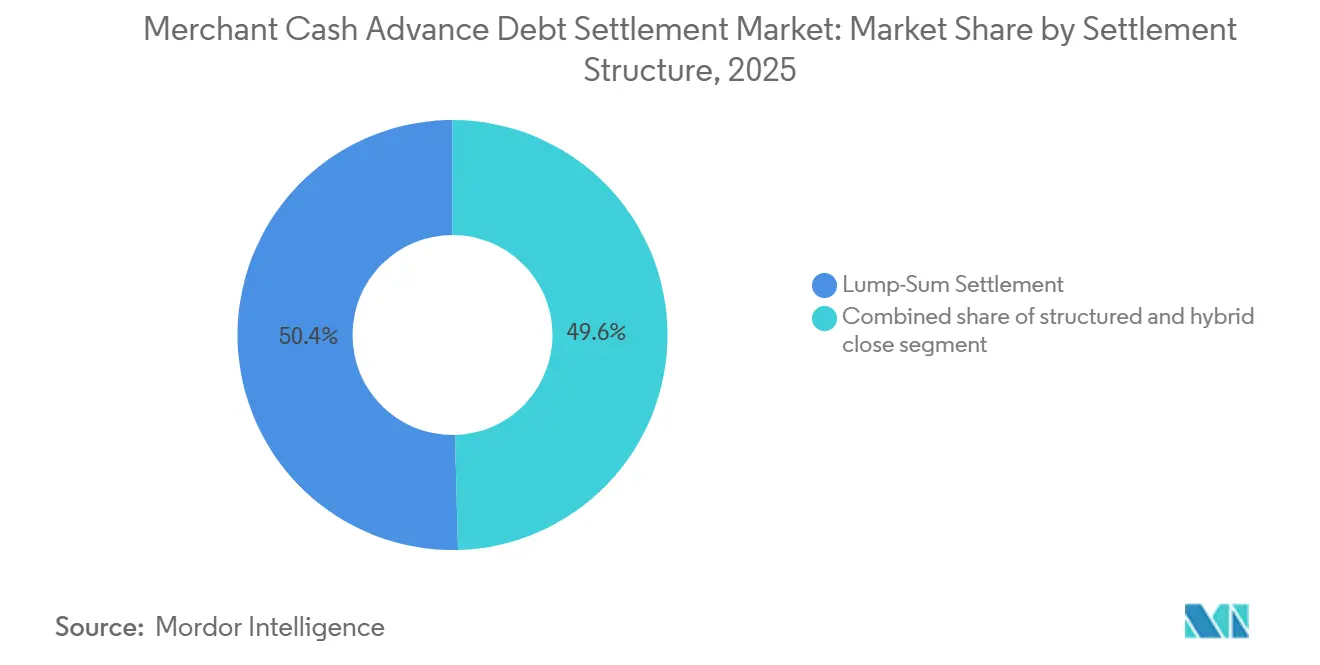
Lump-Sum Settlement held 50.4% of the merchant cash advance debt settlement market size by settlement structure in 2025. This format gives a funder a defined recovery date and allows a merchant to close an obligation without maintaining a long payment schedule. It is generally most practical when a business can access a one-time source of capital. Settlement firms may also prefer this format when their compensation depends partly on documented savings. The continued lead of lump-sum arrangements shows that speed and certainty remain important to both sides of a case.
Structured/Installment Settlement offers a reduced balance that is repaid across a longer period. It can suit a merchant that continues to generate cash but cannot fund a one-time payment. Hybrid Close combines a discounted upfront payment with a limited modified payment stream. Hybrid Close is forecast to expand at a 12.2% CAGR, making it the fastest-growing settlement structure in the merchant cash advance debt settlement market. Its growth reflects the need for an arrangement that recognizes both a merchant’s limited liquidity and a funder’s preference for immediate recovery. Wider use of this structure could reduce the share held by lump-sum settlements during the forecast period.



By MCA Position Complexity: Stacked Cases Remain the Core Case Type
Stacked/multi-position cases accounted for 62.1% of the merchant cash advance debt settlement market share in 2025. They are also forecast to grow at a 9.8% CAGR through 2031, which makes them both the largest and fastest-growing position-complexity category. These cases involve several active advances and often require coordinated communication with multiple funders. Lien priority, bank account access, withdrawal disputes, and different contract terms can all influence the settlement sequence. The category’s large share indicates that the most severe payment pressure is concentrated among merchants with multiple obligations.
Single-position cases represent the remaining cases and can often be handled through a more direct discussion with one funder. They do not usually require the same level of coordination across several liens or payment claims. Stacked cases may arise when providers assess revenue deposits without a complete view of advances already tied to those deposits. This can leave a merchant with obligations that each relies on the same underlying cash flow. A centralized record of outstanding advances or stronger reporting practices could reduce this problem over time. Until then, the merchant cash advance debt settlement market is likely to retain a strong need for specialists who can manage complex multi-funder resolutions.
By Enrolled Remaining Purchased Amount: Large Balances Support Specialized Case Work
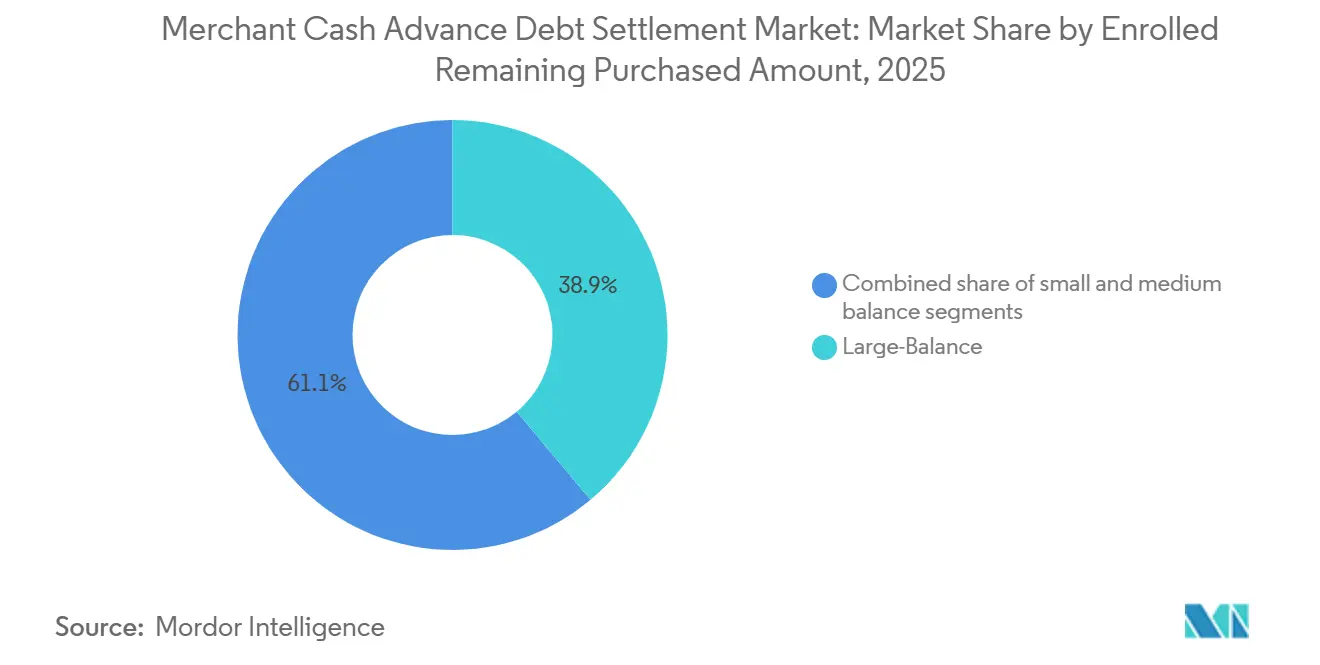
Large-balance enrollments held 38.9% of the merchant cash advance debt settlement market size by the remaining purchased amount in 2025. They are expected to expand at a 10.2% CAGR through 2031, the highest growth rate among the balance tiers. These cases can involve several positions, refinanced obligations, and larger business operations. Their value can support legal review, lien-release work, personal guarantee discussions, and coordination across states. The combination of larger balances and more complex documentation makes this category attractive to established settlement providers.
Medium-balance and small-balance enrollments account for the remaining cases. Small-balance cases may be served through lower-cost models because extensive legal work can consume a large portion of the potential fee. Medium-balance cases sit between streamlined negotiation and a fully tailored resolution process. Large balances are more likely to require formal alternatives when a voluntary agreement cannot be achieved. Businesses with high obligations may evaluate bankruptcy options alongside out-of-court settlement discussions. This mix means the merchant cash advance debt settlement market needs different service models for accounts with different economics and legal complexity.
By Merchant Industry: Food Service Leads While Construction Grows Faster
Food service & hospitality held 23.7% of the merchant cash advance debt settlement market share in 2025. Many restaurant operators have narrow margins, and daily withdrawals based on revenue can place pressure on working capital during slower periods. Restaurant closures and insolvencies can intensify this challenge when food, labor, occupancy, and financing costs rise together. The category’s leading position reflects the limited capacity of many operators to absorb a fixed daily payment during a downturn. Larger franchise and multi-unit operators can face the same problem when several locations depend on constrained cash flow.
Construction & contracting is projected to grow at a 10.7% CAGR through 2031, the highest rate among merchant industries. Contractors often receive cash through project milestones, which can create periods with lower receipts between draws. Daily advance withdrawals may continue even when a payment from a customer has been delayed. Retail & e-commerce, healthcare, transportation & logistics, and professional & business services form the remaining merchant base. Healthcare and professional service businesses can carry larger receivables, which may result in higher advance amounts. The merchant cash advance debt settlement market benefits from this varied client base, but each sector requires a settlement plan that reflects how the business receives cash.
Geography Analysis
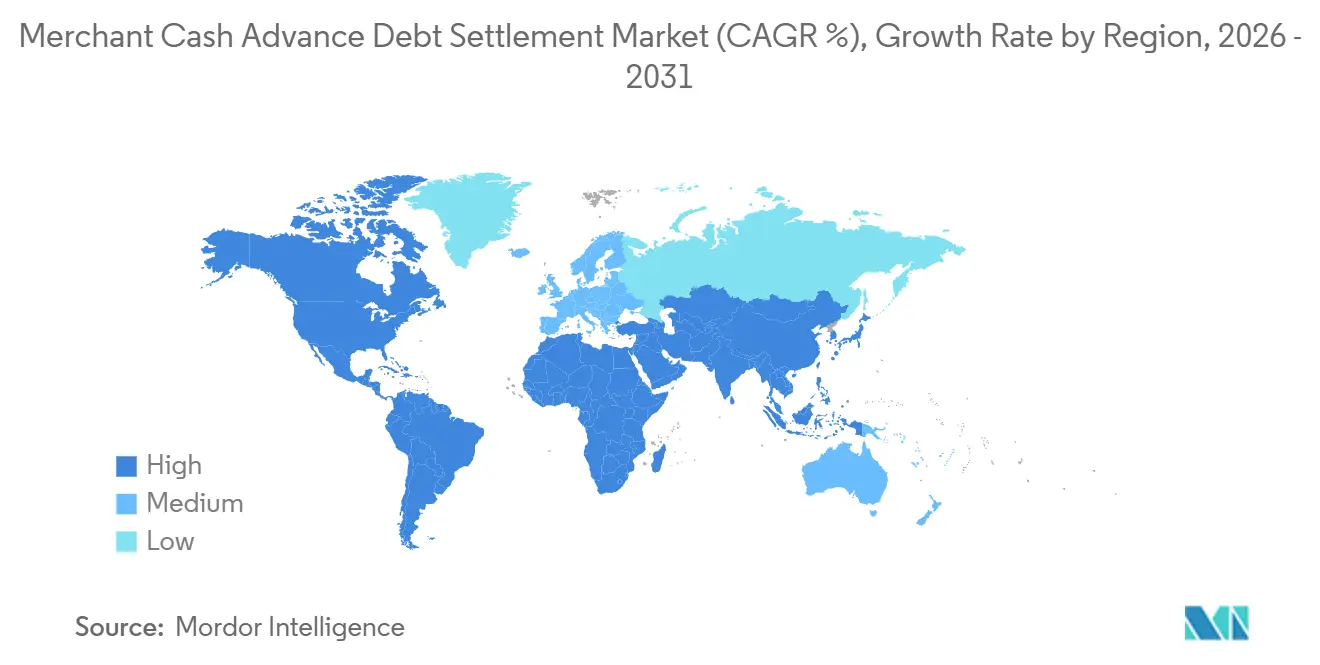
North America held 91.2% of the merchant cash advance debt settlement market share in 2025. The United States remains the primary base for merchant cash advance activity and for the associated debt-resolution demand. Its legal environment, commercial finance practices, and concentration of service providers support a large number of negotiated cases. Canada holds a smaller but distinct position through its licensed insolvency and business restructuring framework. Mexico remains at an earlier stage because comparable commercial financing products have not produced settlement demand on the same scale. North America is likely to remain the primary revenue base even as growth becomes more balanced across regions.
South America represented a small share of the merchant cash advance debt settlement market in 2025. Brazil has a substantially small business debt burden and a broad need for debt renegotiation, although its structure differs from the United States model. Government-backed programs can provide businesses with alternatives to private fee-based settlement services. Argentina also has restructuring mechanisms that may be used before a formal bankruptcy process. These public and legal channels may limit the pace at which a stand-alone merchant cash advance settlement model develops. The region’s opportunity depends on how revenue-based business financing evolves and how merchants access restructuring support.
Asia-Pacific is projected to grow at a 14.8% CAGR through 2031, the fastest regional rate in the merchant cash advance debt settlement market. Its growth is linked to the broader development of revenue-based financing, merchant funding, embedded finance, and related payment-linked products. India’s MSME financing ecosystem is supported by digital lending infrastructure, while Malaysia has introduced sales-linked merchant financing products. Indonesia adopted a framework for buy-now-pay-later and embedded financing through POJK 32/2025, which took effect in December 2025[4]“POJK Nomor 32 Tahun 2024 Tentang Penyelenggaraan Produk Pembiayaan Transaksi Bagi Konsumen,” Otoritas Jasa Keuangan, ojk.go.id. Australia brought low-cost credit contracts into a dedicated regulatory approach from June 2025. Europe is anchored by the United Kingdom's alternative lending activity, while the Middle East and Africa remain early-stage because formal alternative lending and debt-resolution services are less developed.

Competitive Landscape
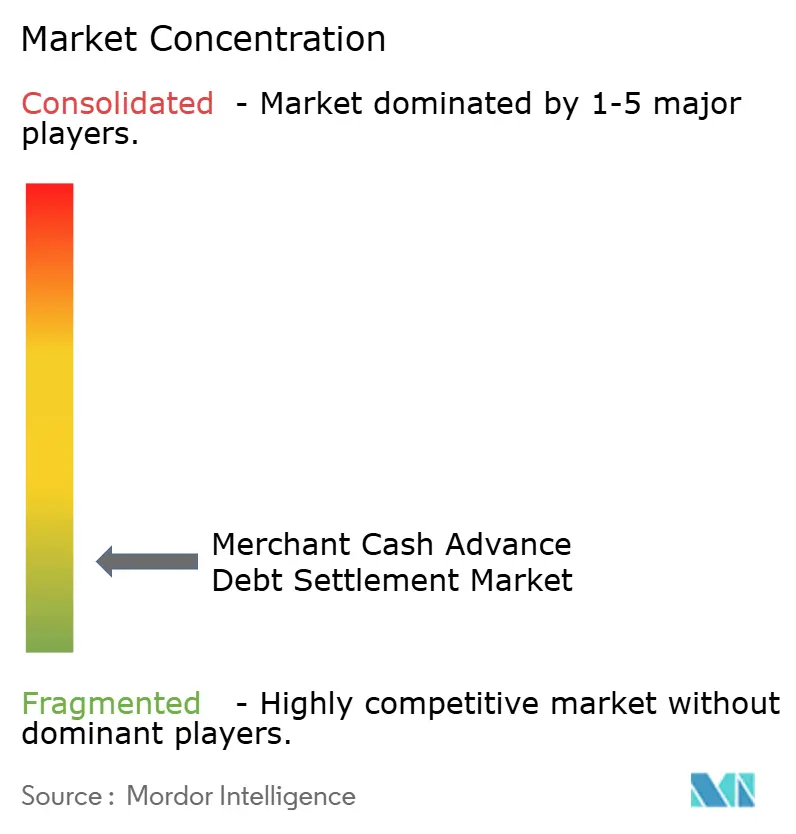
The merchant cash advance debt settlement market is fragmented, with more than 50 active providers that range from individual practitioners to multistate attorney-led networks. The leading 5 to 6 firms together account for less than 30% of revenue. This structure leaves no provider with a dominant position and gives merchants a wide range of service models. Non-attorney negotiators rely on funder relationships, account review, and settlement administration. Attorney-led platforms add legal work involving lien issues, contract defenses, personal guarantees, and bankruptcy alternatives. The merchant cash advance debt settlement market is becoming more demanding because clients increasingly expect both negotiation support and a clear legal process.
Delancey Street expanded its licensed-attorney network to all 50 states and the District of Columbia in March 2026. The company stated that it had surpassed USD 100 million in commercial debt settled for more than 1,000 small businesses. The expansion supports coordination where a client has liens, collection activity, or related disputes in different jurisdictions. In April 2026, Delancey Street launched The Reconciliation Shield™, a program aimed at merchants that remain current but face declining revenue. The program uses contractual reconciliation clauses to seek payment adjustments before default. This move illustrates how the merchant cash advance debt settlement market is extending from post-default negotiations toward earlier financial intervention.
Second Wind Consultants and its Rise Alliance division reported that they had addressed more than USD 300 million in obligations across more than 2,000 businesses during the 12 months before their 2026 announcement. The company’s reported model focused on out-of-court restructuring and a path toward conventional financing. The number of cases indicate that established providers can serve a larger number of distressed businesses without relying solely on bankruptcy proceedings. Smaller businesses with balances below USD 50,000 remain difficult to serve through attorney-intensive approaches because fees can outweigh the potential value of the case. Technology-supported monitoring and early intervention may address that gap if providers can identify cash-flow pressure before default. The merchant cash advance debt settlement market remains fragmented because specialized legal capability, funder relationships, and transparent client safeguards all influence a provider’s ability to compete.
Merchant Cash Advance Debt Settlement Industry Leaders
Coastal Debt Resolve
Rise Alliance
Delancey Street
Business Debt Adjusters
Regroup Partners
- *Disclaimer: Major Players sorted in no particular order

Recent Industry Developments
- June 2026: New York AG sued Rapid Ruling over alleged sham MCA arbitration practices, alleging that the platform presented itself as a neutral arbitration forum while secretly coordinating with an MCA company and using rules favoring the MCA industry. The action is significant for the debt-settlement market because it increases scrutiny of MCA arbitration, collections, and legal-defense practices used when merchants default.
- April 2026: New York implemented the Yellowstone Capital settlement, resulting in USD 534 million+ of merchant debt cancellation and termination of related judgments and liens.
- March 2026: Delancey Street expanded its attorney network to all 50 states and Washington, D.C., providing nationwide legal support for MCA defense, debt restructuring, confession-of-judgment actions and UCC-lien disputes. The expansion reflects growing integration between commercial debt settlement and legal-defense services in the MCA distress market.
- September 2025: Texas House Bill 700 took effect, requiring standardized cost disclosures for sales-based financing transactions under USD 1 million offered in Texas, voiding confession-of-judgment provisions in MCA contracts, and restricting automatic debits to providers holding a first-priority security interest. Registration with the Office of the Consumer Credit Commissioner was required by December 31, 2026.


Global Merchant Cash Advance Debt Settlement Market Report Scope
Merchant Cash Advance Debt Settlement Market covers specialized services that negotiate with merchant cash advance providers on behalf of businesses to reduce, restructure, or settle outstanding MCA obligations. These services may involve lowering repayment amounts, extending repayment periods, negotiating lump-sum settlements, or resolving default-related claims, helping small and medium-sized businesses manage cash flow pressures and avoid further collection or legal action.
The Merchant Cash Advance Debt Settlement Market is Segmented by Settlement Structure (Lump-Sum, Structured/Installment, Hybrid Close), MCA Position Complexity (Single-Position, Stacked), Enrolled Amount (Small, Medium, Large-Balance), Merchant Industry (Retail, Food Service, and More), and Geography (North America, South America, Europe, Asia-Pacific, Middle East and Africa). Market Forecasts are provided in terms of value (USD).
| Lump-Sum Settlement |
| Structured / Installment Settlement |
| Hybrid Close |
| Single-Position |
| Stacked / Multi-Position |
| Small-Balance |
| Medium-Balance |
| Large-Balance |
| Retail & E-commerce |
| Food Service & Hospitality |
| Healthcare |
| Construction & Contracting |
| Transportation & Logistics |
| Professional & Business Services |
| Other Industries (Manufacturing and industrial businesses, wholesale and distribution, etc.) |
| North America | United States |
| Canada | |
| Mexico | |
| South America | Brazil |
| Argentina | |
| Rest of South America | |
| Europe | United Kingdom |
| Germany | |
| France | |
| Italy | |
| Spain | |
| Rest of Europe | |
| Asia-Pacific | China |
| Japan | |
| India | |
| South Korea | |
| Australia | |
| Indonesia | |
| Thailand | |
| Malaysia | |
| Singapore | |
| Vietnam | |
| Rest of Asia-Pacific | |
| Middle East and Africa | Saudi Arabia |
| United Arab Emirates | |
| Turkey | |
| South Africa | |
| Egypt | |
| Rest of Middle East and Africa |
| By Settlement Structure | Lump-Sum Settlement | |
| Structured / Installment Settlement | ||
| Hybrid Close | ||
| By MCA Position Complexity | Single-Position | |
| Stacked / Multi-Position | ||
| By Enrolled Remaining Purchased Amount | Small-Balance | |
| Medium-Balance | ||
| Large-Balance | ||
| By Merchant Industry | Retail & E-commerce | |
| Food Service & Hospitality | ||
| Healthcare | ||
| Construction & Contracting | ||
| Transportation & Logistics | ||
| Professional & Business Services | ||
| Other Industries (Manufacturing and industrial businesses, wholesale and distribution, etc.) | ||
| By Geography | North America | United States |
| Canada | ||
| Mexico | ||
| South America | Brazil | |
| Argentina | ||
| Rest of South America | ||
| Europe | United Kingdom | |
| Germany | ||
| France | ||
| Italy | ||
| Spain | ||
| Rest of Europe | ||
| Asia-Pacific | China | |
| Japan | ||
| India | ||
| South Korea | ||
| Australia | ||
| Indonesia | ||
| Thailand | ||
| Malaysia | ||
| Singapore | ||
| Vietnam | ||
| Rest of Asia-Pacific | ||
| Middle East and Africa | Saudi Arabia | |
| United Arab Emirates | ||
| Turkey | ||
| South Africa | ||
| Egypt | ||
| Rest of Middle East and Africa | ||


Key Questions Answered in the Report
What is the projected growth of merchant cash advance debt settlement?
The merchant cash advance debt settlement market is estimated at USD 250.3 million in 2026 and is forecast to reach USD 376.4 million by 2031, registering an 8.5% CAGR during 2026-2031.
Which settlement structure is growing fastest?
Hybrid Close is the fastest-growing settlement structure, with a projected 12.2% CAGR through 2031. It combines an upfront payment with a modified payment stream.
Why do stacked merchant cash advances require specialized support?
Stacked cases involve several funders, daily debits, competing contract terms, and possible lien-priority issues. They represented 62.1% of merchant cash advance debt settlement market share in 2025 and are expected to grow at a 9.8% CAGR.
Which business sector has the largest need for settlement services?
Food Service & Hospitality led the merchant base with a 23.7% share in 2025. Its narrow operating margins can make daily revenue-based withdrawals difficult to manage.
Which region is expanding fastest for debt resolution services?
Asia-Pacific is expected to grow at a 14.8% CAGR through 2031 as revenue-based and payment-linked financing products develop across the region.
How concentrated is the provider landscape?
The market is fragmented, with the leading providers accounting for a relatively small share of total market revenue.
Page last updated on:


 Your data is secure and never sold or shared.


