
Medical Device Vision Inspection Systems Market Size and Share
Market Overview
| Study Period | 2020 - 2031 |
|---|---|
| Market Size (2026) | USD 586.64 Million |
| Market Size (2031) | USD 873.17 Million |
| Growth Rate (2026 - 2031) | 8.28 % |
| Fastest Growing Market | Asia-Pacific |
| Largest Market | North America |
| Market Concentration | Medium |
Major Players *Disclaimer: Major Players sorted in no particular order Image © Mordor Intelligence. Reuse requires attribution under CC BY 4.0. | |
Medical Device Vision Inspection Systems Market Analysis by Mordor Intelligence
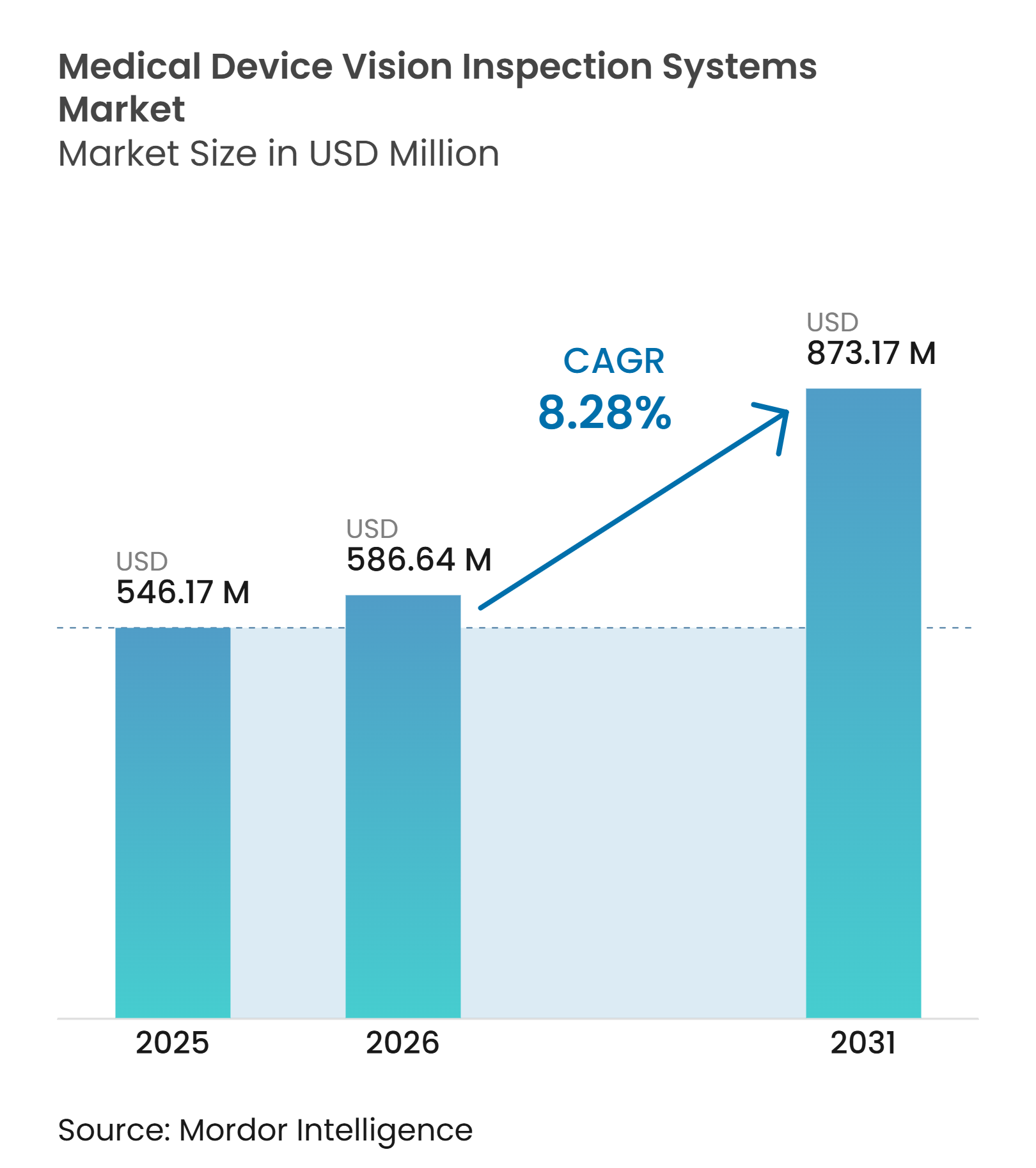
The medical device vision inspection systems market size is projected to expand from USD 546.17 million in 2025 and USD 586.64 million in 2026 to USD 873.17 million by 2031, registering a CAGR of 8.28% between 2026 to 2031. Regulatory requirements are making automated inspection and traceable records more important in the medical device vision inspection systems market. The FDA Quality Management System Regulation took effect on February 2, 2026, and aligned 21 CFR Part 820 with ISO 13485:2016.[1] The EUDAMED UDI and Devices module becomes mandatory on May 28, 2026, which increases the need for reliable identification and packaging checks in Europe. Demand is also shifting toward inspection tools that can assess complex geometries, transparent materials, and reflective surfaces. Vendors are responding with 3D imaging, edge-based AI, remote model updates, and validation support that help manufacturers manage compliance requirements. These conditions create opportunities for suppliers that combine equipment, software, and validation services in the medical device vision inspection systems market.
Key Report Takeaways
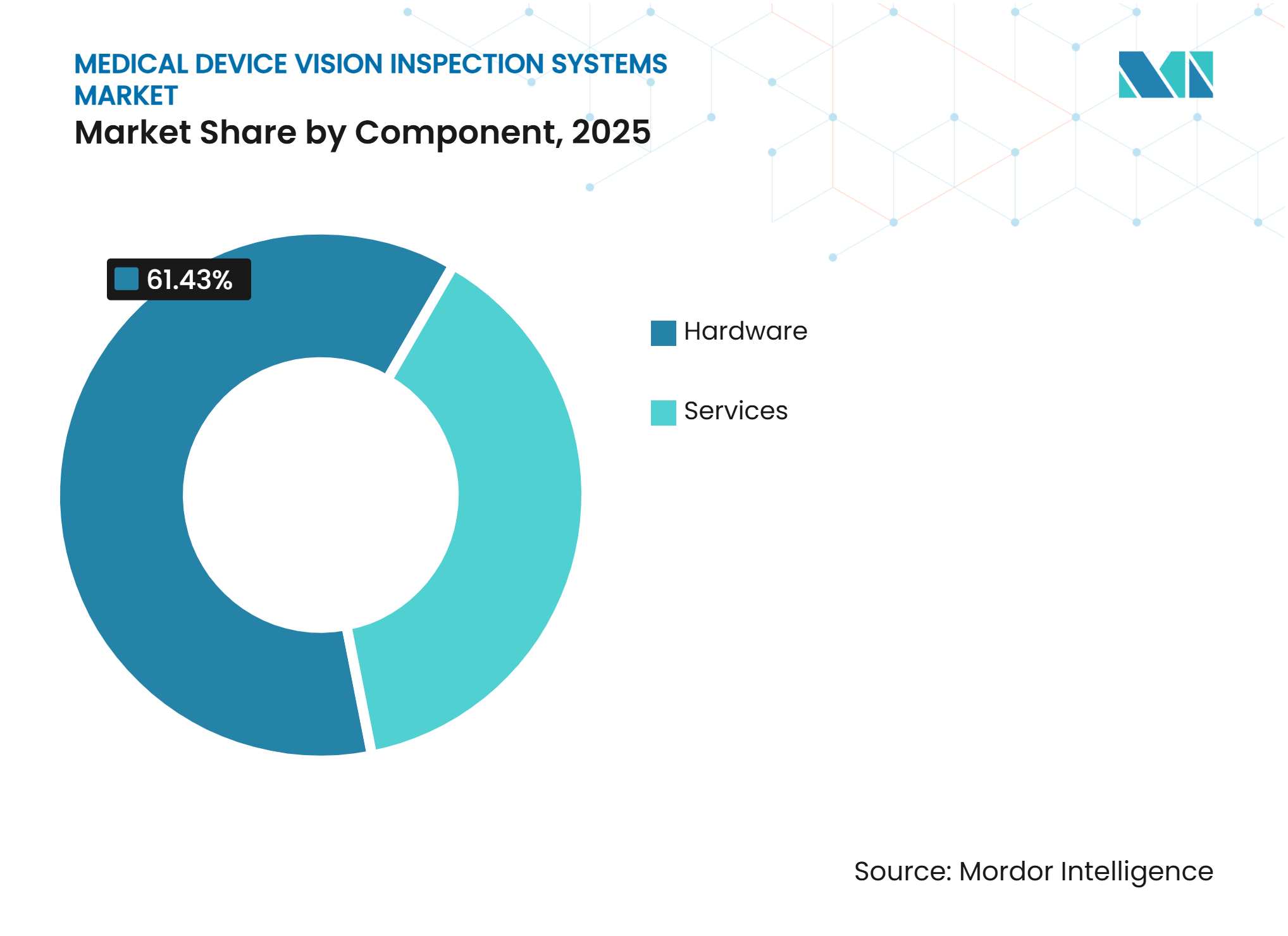
- By component, hardware held 61.43% of the medical device vision inspection systems market share in 2025, while services are projected to expand at an 8.42% CAGR through 2031.
- By system type, 2D vision inspection systems accounted for 48.71% share in 2025, while 3D vision inspection systems are projected to expand at an 8.64% CAGR through 2031.
- By application, defect and surface inspection held 31.83% share in 2025, while identification, traceability, and packaging inspection are projected to expand at an 8.73% CAGR through 2031.
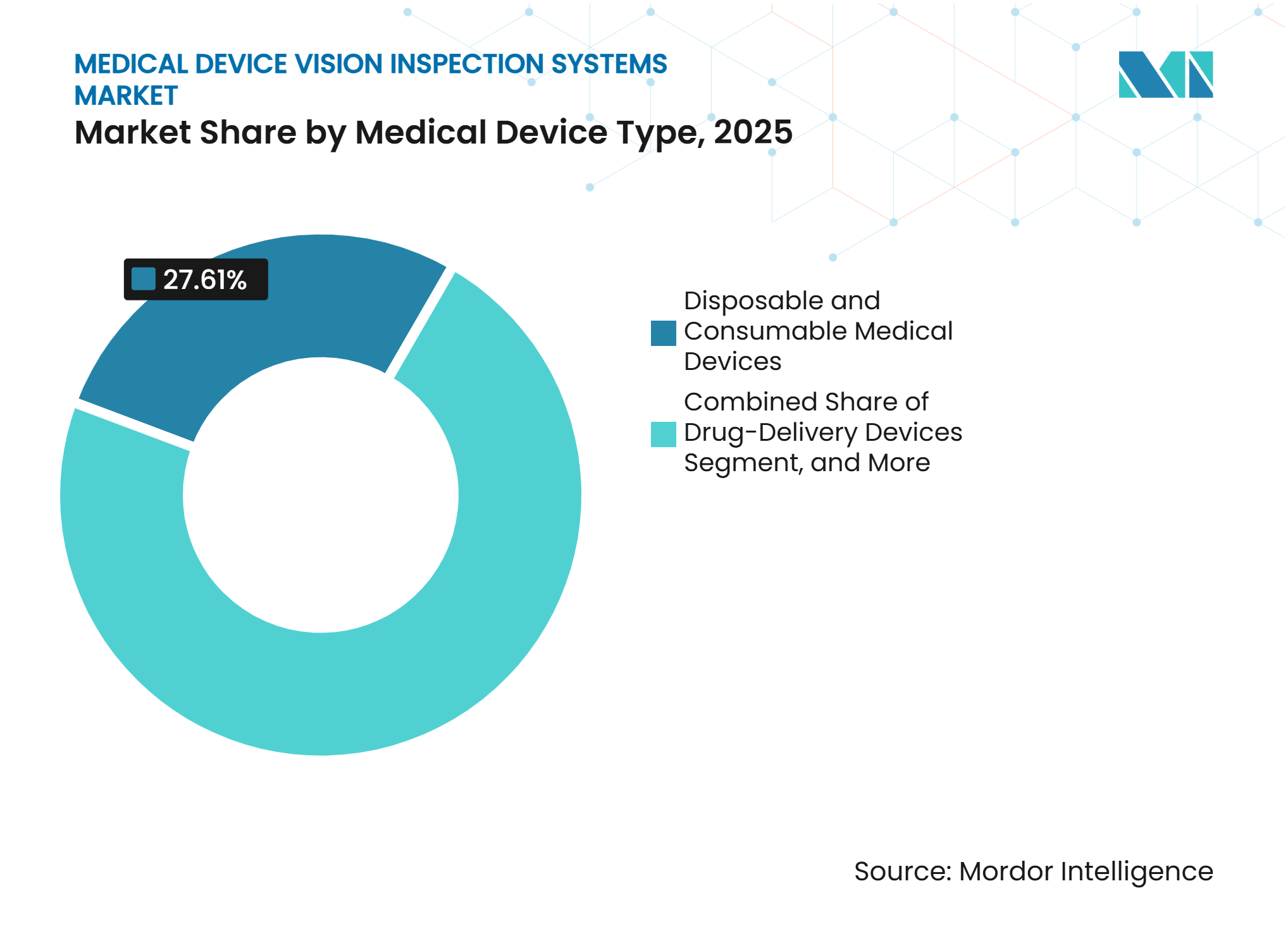
- By medical device type, disposable and consumable medical devices accounted for 27.61% share in 2025, while drug-delivery devices are projected to expand at an 8.96% CAGR through 2031.
- By end-user industry, medical device manufacturers held 51.27% share in 2025, while pharmaceutical and biopharmaceutical manufacturers are projected to expand at an 8.84% CAGR through 2031.
- By geography, North America held 34.79% share in 2025, while Asia-Pacific is projected to expand at an 8.97% CAGR through 2031.
Note: Market size and forecast figures in this report are generated using Mordor Intelligence’s proprietary estimation framework, updated with the latest available data and insights as of January 2026.
Market Trends and Insights
Drivers Impact Analysis of Medical Device Vision Inspection Systems Market*
| Driver | (~) % Impact on CAGR Forecast | Geographic Relevance | Impact Timeline |
|---|---|---|---|
| Stringent Medical Device Quality and Traceability Requirements | +1.8% | Global, with highest enforcement urgency in North America and Europe | Short term (≤ 2 years) |
| Increasing Complexity and Miniaturization of Medical Devices | +1.5% | Global, led by North America, Europe, and Japan | Medium term (2-4 years) |
| Expansion of Automated and Zero-Defect Manufacturing | +1.3% | Global, with accelerating adoption in Asia-Pacific core | Medium term (2-4 years) |
| Rising Adoption of AI-Enabled Defect Detection | +1.2% | Global, with strongest uptake in North America and East Asia | Short term (≤ 2 years) |
| Validation-Ready Inspection for Distributed and CMO Manufacturing | +0.9% | North America and Europe, with spillover to Asia-Pacific core | Medium term (2-4 years) |
| Increasing Inspection Difficulty for Transparent and Reflective Components | +0.6% | Global, concentrated in precision manufacturing hubs | Long term (≥ 4 years) |
| Source: Mordor Intelligence | |||
Stringent Medical Device Quality and Traceability Requirements
The FDA Quality Management System Regulation took effect on February 2, 2026, and incorporated ISO 13485:2016 into 21 CFR Part 820 by reference. This change places more attention on consistent quality records and traceable inspection decisions across medical device production. The FDA also replaced the former Quality System Inspection Technique with its compliance program 7382.850 for device facility inspections. In Europe, the mandatory EUDAMED UDI and Devices module requires manufacturers to register device identification information before devices or certificates are recorded.[2] These requirements favor automated systems that capture reliable inspection evidence and support traceability. Mid-sized manufacturers that still use manual final checks face a stronger reason to add automated vision inspection within the medical device vision inspection systems market.
Increasing Complexity and Miniaturization of Medical Devices
Medical components are becoming smaller and more intricate, which raises the limits of standard 2D inspection equipment. Catheters, micro-cannulas, wearable biosensor housings, and similar components need closer checks for surface and dimensional defects. Small defects can be harder to distinguish from acceptable variation on narrow or curved parts. High-magnification optics, structured-light 3D sensors, and AI-based anomaly detection help address these inspection needs. The medical device vision inspection systems market benefits because manufacturers need systems that can review difficult features with repeatable methods. These needs also encourage recurring software updates, as inspection models may require retraining for new device designs and production conditions.
Expansion of Automated and Zero-Defect Manufacturing
Medical device producers face high consequences when a defective product reaches a patient. A defective implant can create recall, remediation, and quality-system costs that are far greater than the cost of an inspection station. This encourages manufacturers to use in-line checks on every unit rather than depend only on statistical sampling. The requirement is especially relevant for sterile assemblies, Class III implants, and prefilled drug-delivery systems. Cleanroom lines also require equipment with suitable enclosures and cleaning procedures. These operating needs support demand for ruggedized equipment and validated inspection processes across the medical device vision inspection systems market.
Rising Adoption of AI-Enabled Defect Detection
AI-enabled inspection can reduce reliance on separate rule-based programs for each defect type. A centralized model can support related device families when it is appropriately trained and validated. Cognex made its OneVision platform generally available in May 2026 and reported that more than 100 customers had moved from initial pilots toward broader deployments. Cognex also reported that centralized model development can reduce AI vision scaling costs by up to 50%.[3] For regulated users, the practical value is not limited to improved detection because fewer separate validation workflows may reduce qualification time. This makes AI tools relevant even when a manufacturer is not ready to replace all existing hardware.
Restraints Impact Analysis of Medical Device Vision Inspection Systems Market*
| Restraint | (~) % Impact on CAGR Forecast | Geographic Relevance | Impact Timeline |
|---|---|---|---|
| High Capital Expenditure and Long Validation Cycles | -1.4% | Global, most acute in emerging Asia-Pacific markets and smaller manufacturers | Long term (≥ 4 years) |
| Integration Complexity Across Legacy Manufacturing Systems | -1.0% | North America and Europe, where older installed equipment is common | Medium term (2-4 years) |
| Cybersecurity and Data-Integrity Risks in Connected Inspection Systems | -0.8% | Global, with heightened concern in North America and Europe | Short term (≤ 2 years) |
| Limited Availability of Medical Device Vision-Validation Specialists | -0.5% | Global, with acute shortages in Southeast Asia and South America | Long term (≥ 4 years) |
| Source: Mordor Intelligence | |||
High Capital Expenditure and Long Validation Cycles
Inspection lines for medical device production generally cost more than comparable industrial systems because each configuration must be validated. Equipment costs are joined by integration, validation planning, IQ, OQ, PQ, training-data preparation, and operator training. This burden can be particularly difficult for smaller manufacturers and contract manufacturers. Their quality obligations may resemble those of large original equipment manufacturers, but their validation engineering capacity is often smaller. Long qualification cycles can delay installation while a production line is being prepared or expanded. These conditions can slow adoption in the medical device vision inspection systems market, even when producers recognize the quality benefits of automation.
Integration Complexity Across Legacy Manufacturing Systems
Established facilities often contain equipment installed across several decades. Modern inspection stations must interact with programmable logic controllers, manufacturing execution systems, and enterprise resource planning platforms. These connections can require custom interfaces, line modifications, documentation, and formal change control. The challenge becomes greater when a new 3D scanner or AI inference engine is added to a legacy line. Buyers may favor a turnkey supplier when that supplier can provide both the equipment and the integration support. This preference can raise the value of validated systems but can also increase procurement costs for manufacturers with older facilities.
*Our forecasts treat driver/restraint impacts as directional, not additive. The impact forecasts reflect baseline growth, mix effects, and variable interactions.
Medical Device Vision Inspection Systems Market Segment Analysis
By Component:
Hardware Leads While Services Gain From AI AdoptionHardware accounted for 61.43% of the medical device vision inspection systems market share in 2025. Cameras, lighting assemblies, frame grabbers, optical components, and edge processors form the main cost base of a production inspection station. High-volume sterile manufacturing lines require several inspection points, which reinforces the importance of hardware spending. Industrial cameras and structured-light sensors are particularly relevant where manufacturers need detailed defect localization. The move toward 3D sensors can raise system values because these systems combine depth measurement with traditional visual checks. Hardware also requires suitable mounting, protection, and cleanroom compatibility for many medical applications. The largest suppliers can benefit when they offer cameras, software, and lighting as an integrated system. This improves the ability to configure the medical device vision inspection systems market offering for specific production needs. It also helps manufacturers avoid managing compatibility across separate component suppliers.
Services are projected to expand at an 8.42% CAGR through 2031, the highest rate among components. Service work includes installation, validation support, model training, maintenance, and updates to inspection routines. Medical manufacturers often need documented support when software changes affect a validated production process. Remote model management can help large users distribute approved updates across several production lines. This can reduce the effort required to maintain consistent inspection rules across sites. Recurring service revenue is also less dependent on a new hardware purchase cycle. Suppliers that provide these services can build closer relationships with users over the lifetime of a line. The medical device vision inspection systems industry therefore has a growing service requirement alongside its equipment demand. This requirement is strongest where AI models need periodic retraining for changes in material, packaging, or device design.



By System Type:
2D Systems Lead While 3D Systems Address Complex Geometries2D vision inspection systems held 48.71% of the segment share in 2025. They are widely used for surface defect detection, label verification, code reading, and presence or absence checks. These systems have an established validation history in regulated production settings. Their supply chains are mature, and their lower station cost can make them accessible to mid-sized manufacturers. Disposable device lines often use 2D equipment because many checks are performed on flat or consistently oriented items. The systems can also support fast inspection for printed labels and packaging codes. This broad set of applications keeps 2D tools important in the medical device vision inspection systems market. It also gives manufacturers a practical starting point when they automate a line for the first time. Many facilities will continue to use 2D systems alongside newer 3D tools rather than replace their entire installed base.
3D vision inspection systems are projected to expand at an 8.64% CAGR through 2031. Miniaturized components and complex device geometries can require depth data that standard 2D images cannot provide. Orthopedic implants, autoinjector subassemblies, and microfluidic diagnostic cartridges are examples of parts that may need such checks. A depth map can review dimensional tolerances, surface finish, and assembly position within a single capture. This can reduce the need for multiple 2D stations in some applications. Fewer stations can reduce production-line footprint and simplify the number of validation steps. The system type is particularly relevant when manufacturers inspect transparent polymers or reflective metal surfaces. Other technologies, such as hyperspectral and X-ray vision hybrids, continue to address narrower requirements. These include sealed-package integrity and internal assembly verification where optical surface imaging alone is not sufficient.
By Application:
Surface Defect Inspection Leads While Traceability AcceleratesDefect and surface inspection accounted for 31.83% of the medical device vision inspection systems market size in 2025. It is a basic requirement across a wide range of device categories and production volumes. Manufacturers use these systems to identify scratches on surgical instruments, particulate contamination on polymer surfaces, and defects in sterile packaging. Prefilled syringe containers also require inspection for cosmetic and material defects. The broad relevance of surface checks explains why this application has the largest revenue share. Dimensional and geometric inspection provides a second layer of control for parts that must meet strict shape requirements. Assembly, presence, and completeness inspection confirm that multi-part devices include the right components in the correct positions. Together, these applications make vision inspection part of the routine quality process on many production lines. The medical device vision inspection systems market continues to rely on these foundational checks even as more specialized applications emerge.
Identification, traceability, and packaging inspection are projected to expand at an 8.73% CAGR through 2031. The mandatory EUDAMED UDI and Devices module supports demand for systems that read and verify device identifiers on packaging lines. Manufacturers need reliable information capture before device data and certificates are recorded in EUDAMED. In June 2026, OMRON released the VHV5-SRV Barcode Verification System for real-time code verification at up to 1,200 parts per minute. The system supports ISO/IEC 15415, ISO/IEC 15416, and ISO/IEC TR 29158 requirements. This type of product addresses identification tasks that manufacturers cannot manage consistently through manual review. Traceability systems are also relevant to packaging-line retrofits where UDI checks need to be inserted into an existing workflow. Demand is likely to be strongest at facilities serving European markets that need reliable device-identification records. The medical device vision inspection systems industry benefits because traceability moves inspection closer to a compliance requirement rather than an optional productivity tool.
By Medical Device Type:
Disposables Lead While Drug-Delivery Devices Expand FastestDisposable and consumable medical devices represented 27.61% of the medical device vision inspection systems market size in 2025. Syringes, IV sets, catheters, gloves, and wound-care products account for very high production volumes. Their large unit volumes create a substantial installed base of inspection systems. Producers use automated checks to identify surface flaws, missing parts, packaging issues, and coding errors. These lines commonly require high throughput because even small delays can affect large production runs. The inspection approach is often standardized across related disposable products, which supports broader use of 2D vision systems. However, polymer materials and small device features can still require carefully designed lighting and optics. Disposable device production, therefore, remains an important source of equipment demand in the medical device vision inspection systems market. Its high throughput also makes reliable, low-false-reject operation important for manufacturers.
Drug-delivery devices are projected to expand at an 8.96% CAGR through 2031. The increase in GLP-1 receptor agonist production and broader biosimilar injectable activity is increasing demand for autoinjectors and prefilled syringe systems. These products combine device, packaging, and drug-quality considerations within the same production environment. Manufacturers need inspection for assembly accuracy, container condition, component presence, and final packaging. Autoinjector parts can also have geometries that are difficult to inspect with planar images alone. This favors higher-resolution optics and, in some cases, 3D inspection methods. Production lines need to operate at high speeds while maintaining reliable checks for every unit. This makes drug-delivery devices an important source of new demand for the medical device vision inspection systems market. The category also supports interest in integrated systems that combine hardware, software, and validation documentation. Suppliers that can address both device and pharmaceutical quality workflows may be better positioned for these projects.

By End-User Industry:
Device Manufacturers Lead While Pharmaceutical Users ExpandMedical device manufacturers held 51.27% of the segment share in 2025. They are the main purchasers of inspection platforms built specifically for device manufacturing environments. These users often require turnkey systems with documented validation support. Their quality teams need evidence that inspection methods are repeatable and suitable for regulated production. Dedicated device manufacturers also operate across many product types, including disposables, implants, diagnostics, and surgical tools. This creates demand for systems that can be tailored to different component materials and defect types. ISO 13485 measurement and monitoring requirements make inspection documentation particularly important for these users. The large share reflects the central role of automated inspection in device production. It also makes this customer group a major focus for suppliers in the medical device vision inspection systems market.
Pharmaceutical and biopharmaceutical manufacturers are projected to expand at an 8.84% CAGR through 2031. Injectable biologics and GLP-1 therapies are making fill-finish operations more relevant to device-oriented inspection suppliers. Prefilled syringes, cartridges, vials, and autoinjectors require checks that can cover both drug-product and device-related quality needs. This expands the range of applications for vision systems in pharmaceutical production. Testing, inspection, and certification laboratories have a smaller role but need flexible systems for different device types. Research and development organizations also purchase modular platforms for development and verification work. The boundary between pharmaceutical and medical device inspection is becoming less distinct for injectable combination products. Suppliers can respond by providing validation packages that address both good manufacturing practice requirements and ISO 13485 expectations. This creates a cross-sector opportunity in the medical device vision inspection systems market. It also raises the value of platforms that can be reconfigured without extensive disruption to a validated workflow.
Geography Analysis
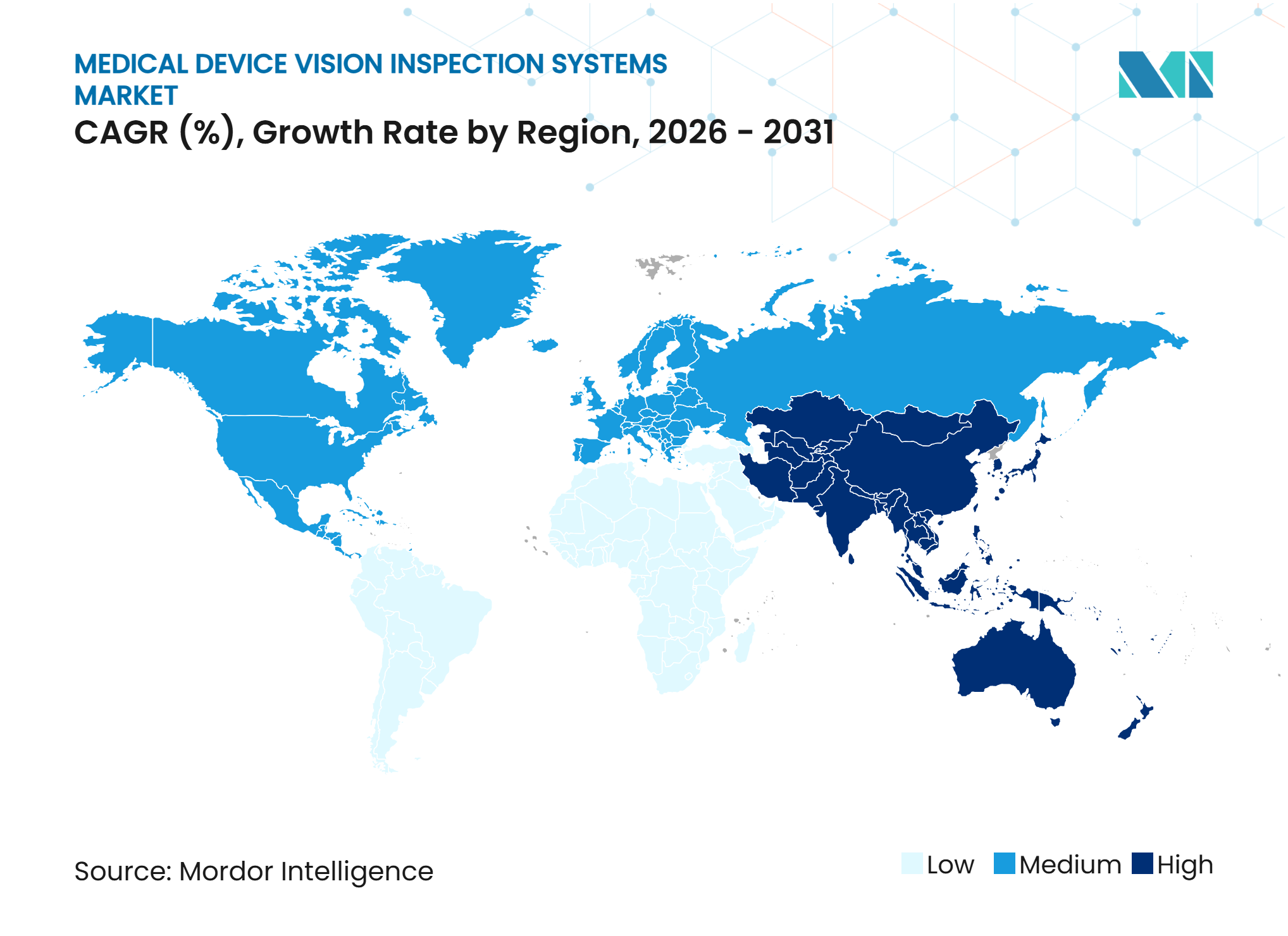
North America held 34.79% of the regional share in 2025. The region has a large concentration of FDA-regulated Class II and Class III device manufacturers. It also has an established base of automation suppliers, contract manufacturers, and quality-service providers. The QMSR took effect in February 2026, which increases attention on the quality records associated with inspection activities. Contract manufacturing organizations face particular pressure because device brand owners remain accountable for product quality. This can encourage original equipment manufacturers to request stronger inspection controls at external production sites. North America, therefore, remains an important source of demand for validated systems, AI software, and services. The region also has a large installed base of legacy equipment, which can make integration a significant part of each project. Suppliers that support modernization without extended production disruption can address this need. The medical device vision inspection systems market in North America benefits from compliance needs and from the concentration of high-value device production.
Europe held the second-largest regional position in 2025, supported by medical device production in Germany, the United Kingdom, and France. The EUDAMED UDI and Devices module becomes mandatory on May 28, 2026, which encourages investments in device identification and packaging-line verification. Manufacturers serving European markets need systems that can capture and confirm UDI-related information reliably. German precision-manufacturing clusters provide an important supplier base for machine vision hardware and software. Medical manufacturers in the region also need inspection systems for implants, diagnostic products, and sterile packaging. Europe has many established production facilities, so new systems often need to connect with existing manufacturing infrastructure. This can create demand for turnkey integration and validation support. South America remains a smaller regional opportunity, led by Brazil. Gradual alignment with ISO 13485 practices can strengthen the quality requirements that support inspection adoption. The region's demand is more sensitive to the availability of local technical support and validation expertise.
Asia-Pacific is projected to expand at an 8.97% CAGR through 2031, the fastest regional rate in the medical device vision inspection systems market. China is increasing manufacturing capacity for domestic medical devices and quality-focused facilities. India is attracting interest in new medical device facilities through its production-linked incentive scheme. Greenfield projects can adopt inspection equipment before legacy systems become a constraint. Japan remains important for high-precision medical and laboratory components, including micro-catheters and endoscope parts. Japanese equipment suppliers continue to develop compact, high-resolution vision sensors for demanding applications. South Korea combines electronics-related machine vision expertise with precision medical device manufacturing. This gives suppliers access to technically experienced customers with an interest in short AI-model deployment cycles. The Middle East and Africa remains the smallest regional segment. New manufacturing operations in Saudi Arabia and the United Arab Emirates are beginning to adopt quality infrastructure aligned with international device standards.
Competitive Landscape
Market Concentration
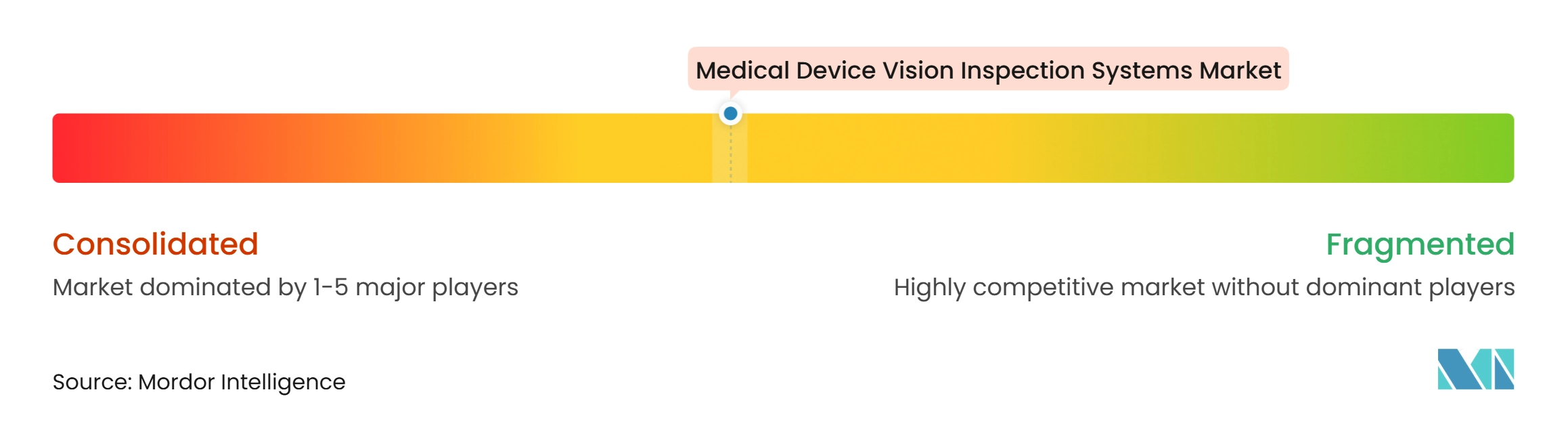
The medical device vision inspection systems market has moderate concentration, with global automation companies and specialist machine vision suppliers serving regulated manufacturers. Competition is based on hardware quality, software capability, inspection accuracy, and validation support. Providers of standard 2D systems face price competition where product requirements are familiar. More complex applications can support higher-value offerings because transparent polymers, reflective metals, and intricate assemblies are harder to inspect. Suppliers increasingly offer edge AI so manufacturers can use local processing in controlled production environments. Subscription-based model updates also allow customers to manage inspection software after installation. Validation support is an important differentiator because IQ, OQ, and PQ work can delay a project. These features make integrated vendors more competitive than suppliers that sell only cameras or lighting. The medical device vision inspection systems market, therefore, rewards suppliers that combine technical performance with documented support for regulated use.
Cognex expanded its edge-AI product line in 2026 with the In-Sight 6900 Vision Controller, which uses NVIDIA Jetson technology for demanding applications. The company also introduced the In-Sight 3900 Vision System, which uses Qualcomm Dragonwing platforms and does not require an external PC. Both developments support local AI inspection with centralized model management through OneVision. This approach helps manufacturers manage models across several lines while keeping runtime execution close to the production equipment. OMRON introduced the VHV5-SRV Barcode Verification System in June 2026 for 100% inline code verification. The product supports the needs of manufacturers that must verify UDI and barcode information at production speed. These examples show that leading companies are focusing on AI deployment, traceability, and simplified system management. The same priorities guide purchasing decisions in the medical device vision inspection systems market. Suppliers that can provide application support alongside these products can reduce the risk faced by regulated buyers.
Opportunities remain for validation-as-a-service offerings aimed at small and mid-sized contract manufacturers. These facilities may lack the engineering resources needed to qualify a complex inspection system while increasing production. Transparent component inspection is another area where structured-light 3D imaging and trained algorithms can address difficult reflections. Wearable and implantable devices also create demand for systems that can inspect small, complex features. Companies adapting semiconductor inspection methods may bring high-resolution capabilities to medical component production. Contract manufacturers are increasingly interested in longer agreements that combine hardware, software subscriptions, and validation support. This can favor vertically integrated suppliers that control several parts of the offering. Existing regulatory requirements for embedded inspection software can also benefit vendors with established quality and regulatory resources. Antares Vision Group has expanded automated visual inspection for glass and plastic prefilled syringes, including systems with combined visual inspection and container closure integrity testing. This reflects the value of inspection systems that can address injectable products across multiple container formats.
Medical Device Vision Inspection Systems Industry Leaders
-
Cognex Corporation
-
Keyence Corporation
-
OMRON Corporation
-
Mettler-Toledo International Inc.
-
Antares Vision S.p.A.
- *Disclaimer: Major Players sorted in no particular order
Medical Device Vision Inspection Systems Market Companies Covered in this Report
- Cognex Corporation
- Keyence Corporation
- OMRON Corporation
- Mettler-Toledo International Inc.
- Antares Vision S.p.A.
- Teledyne Technologies Incorporated
- Basler AG
- SICK AG
- Siemens AG
- Datalogic S.p.A.
- ISRA VISION AG
- Optel Group
- WIPOTEC-OCS GmbH
- Robert Bosch GmbH
- Syntegon Technology GmbH
- Korber AG
- Vitronic Dr.-Ing. Stein Bildverarbeitungssysteme GmbH
- Carl Zeiss AG
- Stemmer Imaging AG
- National Instruments Corporation
Recent Industry Developments in Medical Device Vision Inspection Systems Market
- July 2026: OMRON Automation introduced the FHV7-AI Detection Camera, a compact vision sensor that automates training data selection and threshold-setting from OK/NG image examples, significantly reducing specialist setup time for inspection integration on high-mix medical and pharmaceutical production lines without requiring specialized vision engineering expertise.
- June 2026: OMRON Automation released the VHV5-SRV Barcode Verification System, delivering real-time ISO/IEC 15415-, ISO/IEC 15416-, and ISO/IEC TR 29158-compliant UDI and barcode code verification at up to 1,200 parts per minute, directly addressing the EU MDR's enforceable EUDAMED UDI traceability requirements that took effect from May 28, 2026.
- May 2026: Cognex Corporation launched the In-Sight 3900 Vision System powered by Qualcomm Dragonwing platforms, delivering embedded AI inspection at the edge without external PC requirements and integrating with OneVision's cloud-to-edge ecosystem for centralized AI model management with local runtime execution.
- April 2026: Cognex Corporation launched the In-Sight 6900 Vision Controller, powered by NVIDIA Jetson technology, enabling high-capacity edge AI for demanding medical device inspection workloads with modular camera, optics, and lighting configuration suited to specialized applications where fixed-configuration systems impose quality trade-offs.
Global Medical Device Vision Inspection Systems Market Report Scope
The Medical Device Vision Inspection Systems Market comprises automated machine vision hardware and software solutions that inspect medical devices and components for defects, dimensional accuracy, assembly correctness, labeling, and packaging integrity.
The Medical Device Vision Inspection Systems Report is Segmented by Component (Hardware, Software, and Services), System Type (2D, 3D, Other), Application (Defect and Surface Inspection, Dimensional, Geometric, and Position Inspection, Assembly, Presence, and Completeness Inspection, Identification, Traceability, and Packaging Inspection, and Other Applications), Device Type (Disposable and Consumable Medical Devices, Drug-Delivery Devices, Diagnostic Devices and Laboratory Consumables, Surgical Instruments and Implants, and Other Medical Devices), End-User (Medical Device Manufacturers, Pharmaceutical and Biopharmaceutical Manufacturers, Testing, Inspection, and Certification Laboratories, Research and Development Organizations, and Other End-User Industries), and Geography (North America, South America, Europe, Asia-Pacific, and Middle East and Africa). The Market Forecasts are Provided in Terms of Value (USD).
Segmentation Overview
| Hardware |
| Software |
| Services |
| 2D Vision Inspection Systems |
| 3D Vision Inspection Systems |
| Other System Types |
| Defect and Surface Inspection |
| Dimensional, Geometric, and Position Inspection |
| Assembly, Presence, and Completeness Inspection |
| Identification, Traceability, and Packaging Inspection |
| Other Applications |
| Disposable and Consumable Medical Devices |
| Drug-Delivery Devices |
| Diagnostic Devices and Laboratory Consumables |
| Surgical Instruments and Implants |
| Other Medical Devices |
| Medical Device Manufacturers |
| Pharmaceutical and Biopharmaceutical Manufacturers |
| Testing, Inspection, and Certification Laboratories |
| Research and Development Organizations |
| Other End-User Industries |
| North America | United States |
| Canada | |
| Mexico | |
| South America | Brazil |
| Rest of South America | |
| Europe | Germany |
| United Kingdom | |
| France | |
| Rest of Europe | |
| Asia-Pacific | China |
| Japan | |
| India | |
| Rest of Asia-Pacific | |
| Middle East and Africa | Middle East |
| Africa |
| By Component | Hardware | |
| Software | ||
| Services | ||
| By System Type | 2D Vision Inspection Systems | |
| 3D Vision Inspection Systems | ||
| Other System Types | ||
| By Application | Defect and Surface Inspection | |
| Dimensional, Geometric, and Position Inspection | ||
| Assembly, Presence, and Completeness Inspection | ||
| Identification, Traceability, and Packaging Inspection | ||
| Other Applications | ||
| By Medical Device Type | Disposable and Consumable Medical Devices | |
| Drug-Delivery Devices | ||
| Diagnostic Devices and Laboratory Consumables | ||
| Surgical Instruments and Implants | ||
| Other Medical Devices | ||
| By End-User Industry | Medical Device Manufacturers | |
| Pharmaceutical and Biopharmaceutical Manufacturers | ||
| Testing, Inspection, and Certification Laboratories | ||
| Research and Development Organizations | ||
| Other End-User Industries | ||
| By Geography | North America | United States |
| Canada | ||
| Mexico | ||
| South America | Brazil | |
| Rest of South America | ||
| Europe | Germany | |
| United Kingdom | ||
| France | ||
| Rest of Europe | ||
| Asia-Pacific | China | |
| Japan | ||
| India | ||
| Rest of Asia-Pacific | ||
| Middle East and Africa | Middle East | |
| Africa | ||
Key Questions Answered in the Report
What is the 2026 size of the medical device vision inspection systems market?
The medical device vision inspection systems market is valued at USD 586.64 million in 2026 and is projected to reach USD 873.17 million by 2031 at an 8.28% CAGR. The forecast reflects a greater need for automated inspection, traceability, and documented quality controls in regulated device production. It also reflects the wider use of AI software and 3D systems for difficult applications across regulated manufacturing lines.
What is driving demand for medical device vision inspection systems?
FDA QMSR requirements and mandatory EUDAMED UDI and Devices registration increase the need for traceable, automated inspection processes. Manufacturers also need equipment that can inspect complex parts, small features, transparent materials, and reflective surfaces with repeatable results. These needs are important for large producers and mid-sized facilities that are upgrading manual final inspection processes across their lines.
Which component leads spending on vision inspection systems for medical devices?
Hardware led with 61.43% share in 2025 because cameras, lighting, processors, and optical components are central to installed inspection lines. Hardware demand also includes cleanroom-compatible enclosures, mounting systems, and sensor configurations built for high-volume production settings. The systems must also be integrated with the controls and data systems used on each production line and production site.
Which inspection application is expanding fastest?
Identification, traceability, and packaging inspection is projected to expand at an 8.73% CAGR through 2031, supported by UDI verification needs. The application includes reading and verifying printed codes, package markings, and identification information before products reach distribution channels. Automated code verification helps maintain a documented record at the speed required by high-volume packaging lines and supports traceable release processes.
Which region is projected to expand fastest through 2031?
Asia-Pacific is projected to expand at an 8.97% CAGR through 2031, supported by new manufacturing capacity and greenfield facilities. China, India, Japan, and South Korea each support different parts of the region's demand, from new production lines to high-precision components. New facilities can install inspection systems during line design and avoid some difficulties associated with retrofitting older equipment at established manufacturing sites.
Why are pharmaceutical manufacturers becoming important buyers of inspection systems?
Pharmaceutical and biopharmaceutical manufacturers are projected to expand at an 8.84% CAGR as injectable biologics, prefilled syringes, and autoinjectors require device-focused inspection. These users need systems that can manage both product-quality requirements and the assembly, traceability, and packaging checks associated with delivery devices. Their requirements support demand for flexible platforms that can apply documented inspection methods across a range of injectable formats, containers, and delivery devices. These platforms can support inspections for component presence, assembly quality, container condition, printed codes, package integrity, and final product identification within a documented production workflow.