
Mechanical Tube and Pipe Market Size and Share
Market Overview
| Study Period | 2021 - 2031 |
|---|---|
| Market Size (2026) | USD 27.11 Billion |
| Market Size (2031) | USD 33.06 Billion |
| Growth Rate (2026 - 2031) | 4.05 % |
| Fastest Growing Market | Asia-Pacific |
| Largest Market | Asia-Pacific |
| Market Concentration | Low |
Major Players *Disclaimer: Major Players sorted in no particular order Image © Mordor Intelligence. Reuse requires attribution under CC BY 4.0. | |
Mechanical Tube and Pipe Market Analysis by Mordor Intelligence
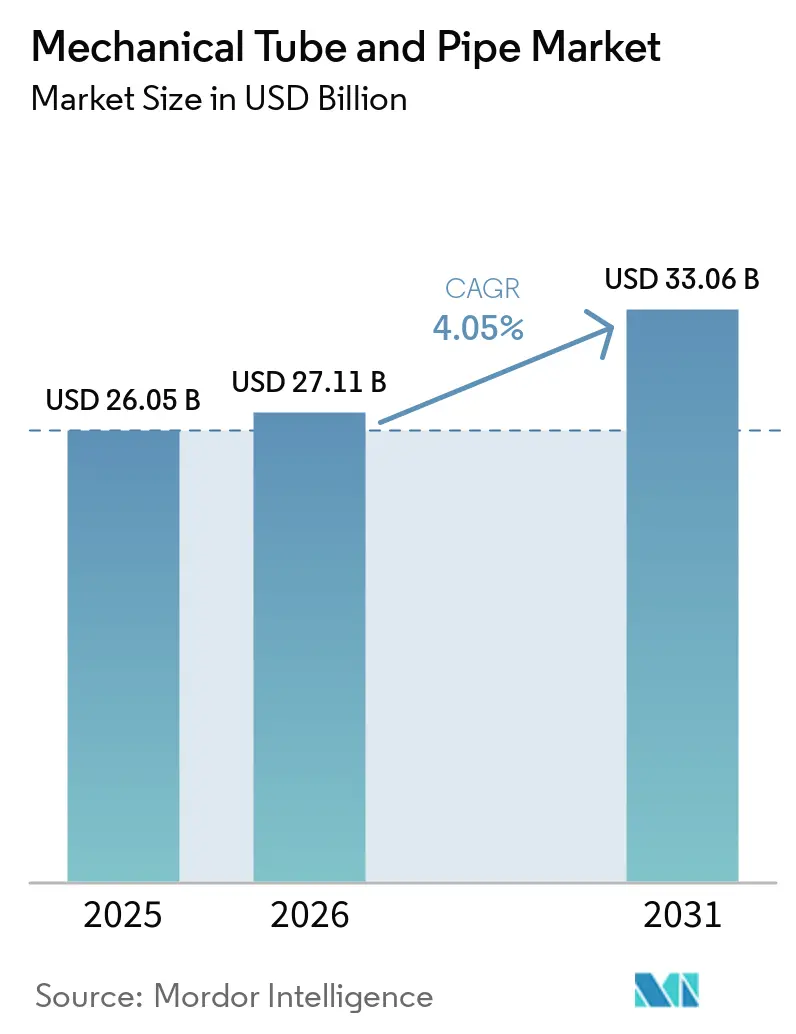
The Mechanical Tube and Pipe Market size was valued at USD 26.05 billion in 2025 and is estimated to grow from USD 27.11 billion in 2026 to reach USD 33.06 billion by 2031, at a CAGR of 4.05% during the forecast period (2026-2031). Demand is supported by manufacturing activity, vehicle production, and energy infrastructure investment. Vehicle electrification is changing tube specifications for structural, thermal management, and fluid-handling uses. Industrial automation is increasing the need for precise tubes in equipment that requires stable dimensions and documented quality. Infrastructure renewal broadens demand across water networks, energy systems, and transport projects. Producers are responding through automation, advanced metallurgy, and lower-carbon production routes, while trade measures and carbon compliance change sourcing decisions.
Key Report Takeaways
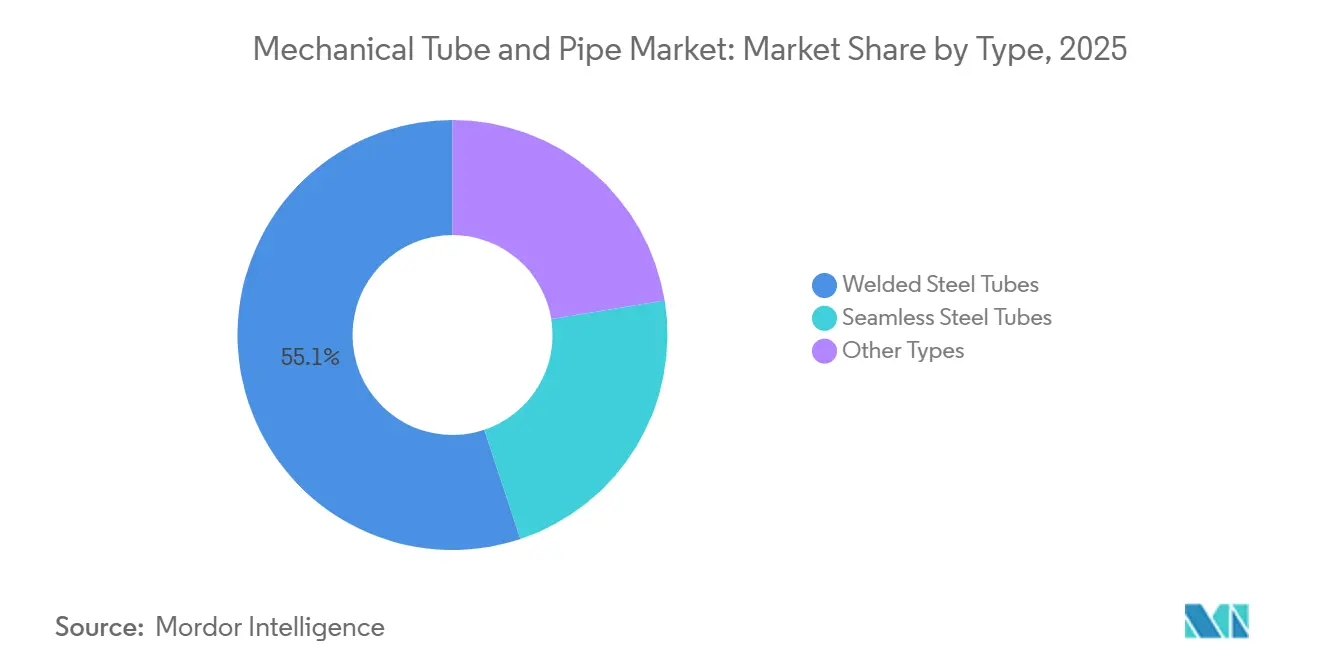
- By type, welded steel tubes held 55.13% of the mechanical tube and pipe market share in 2025, while seamless steel tubes are projected to advance at a 4.78% CAGR through 2031.
- By material, carbon steel held 41.48% of the mechanical tube and pipe market share in 2025, while alloy steel is projected to advance at a 5.06% CAGR through 2031.
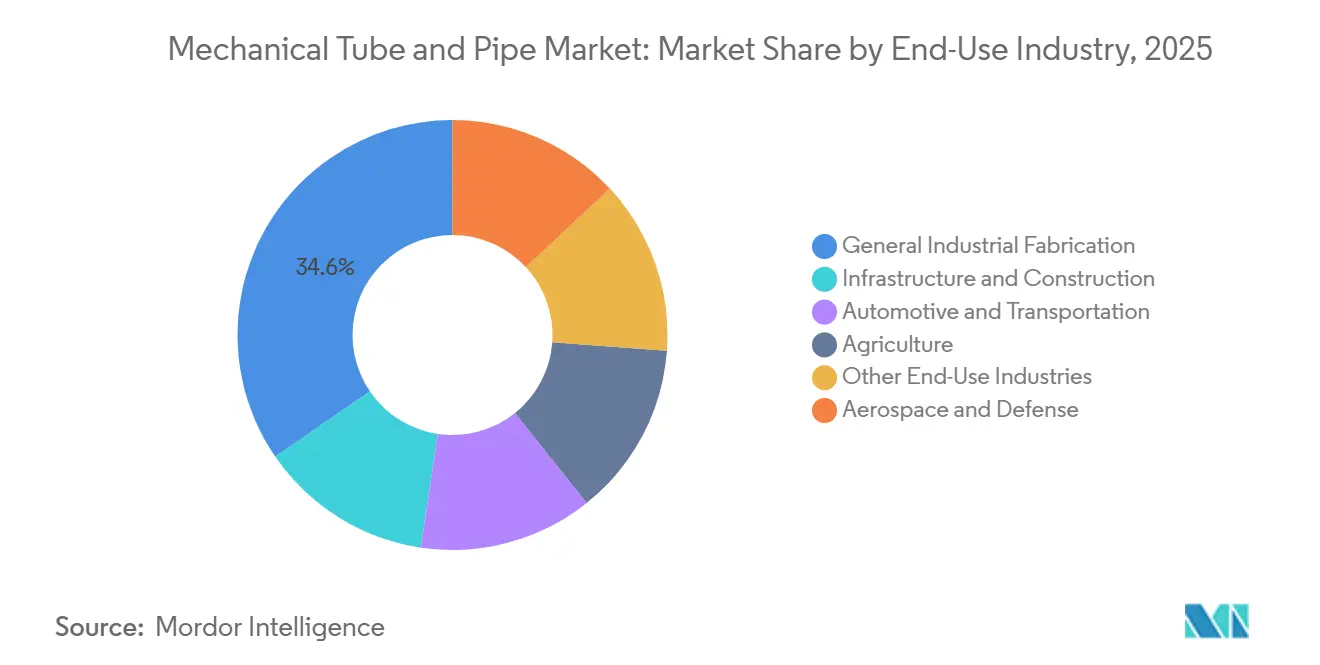
- By end-use industry, general industrial fabrication held 34.56% of the mmechanical tube and pipe market share in 2025, while automotive and transportation are projected to advance at a 5.23% CAGR through 2031.
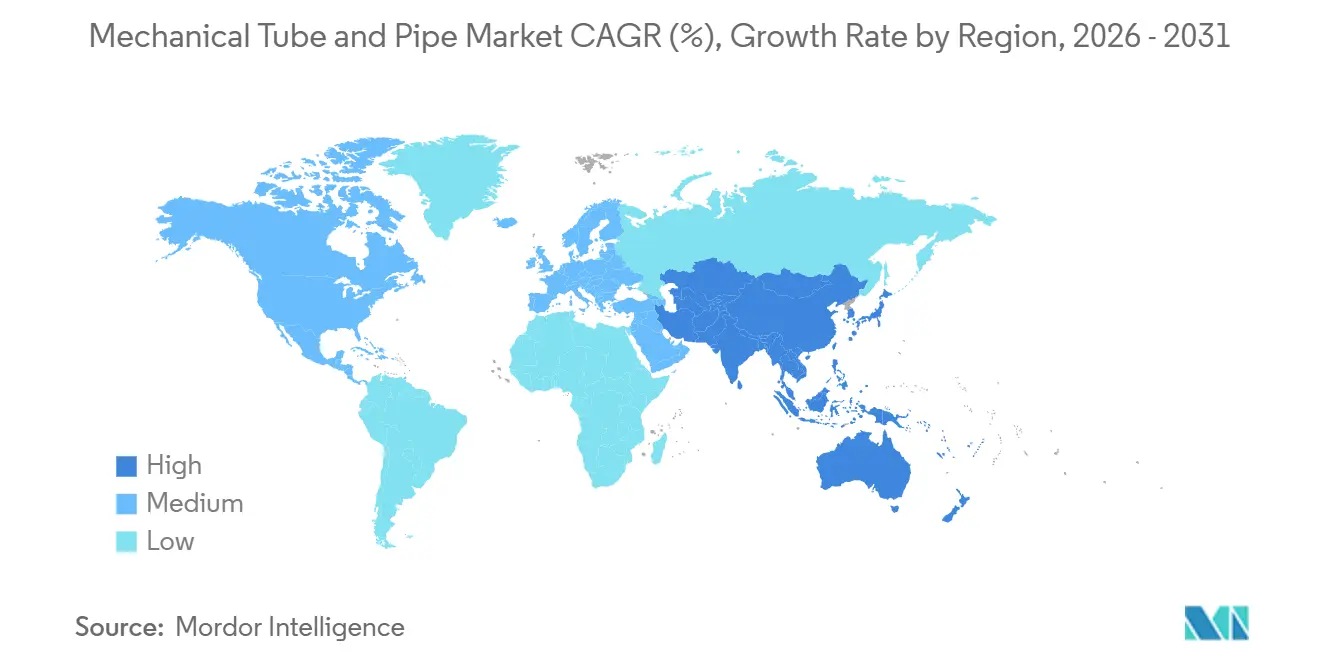
- By geography, Asia-Pacific held 45.12% of the mechanical tube and pipe market share in 2025 and is projected to advance at a 4.84% CAGR through 2031.
Note: Market size and forecast figures in this report are generated using Mordor Intelligence’s proprietary estimation framework, updated with the latest available data and insights as of January 2026.
Market Trends and Insights
Drivers Impact Analysis of Mechanical Tube and Pipe Market*
| Driver | (~) % Impact on CAGR Forecast | Geographic Relevance | Impact Timeline |
|---|---|---|---|
| Vehicle Lightweighting and Electrification | +1.1% | Global, led by China, Europe, and North America | Medium term (2-4 years) |
| Industrial Automation and Precision Equipment Demand | +0.9% | Global, led by APAC and EU manufacturing cores | Medium term (2-4 years) |
| Infrastructure Modernization and Energy Investment | +0.8% | Global, APAC and North America primary beneficiaries | Long term (≥ 4 years) |
| High-Strength and Corrosion-Resistant Tube Substitution | +0.7% | Global, strongest in Europe and APAC offshore markets | Medium term (2-4 years) |
| Smart Manufacturing and Automated Tube Processing | +0.5% | Global, early gains in Europe, Japan, and North America | Long term (≥ 4 years) |
| Source: Mordor Intelligence | |||
Vehicle Lightweighting and Electrification
Battery electric vehicles are changing the mechanical tube and pipe market because their structures and thermal systems use tubes differently from combustion vehicles. Battery enclosures, rotor shafts, suspension arms, and coolant circuits require close dimensional tolerances and higher fatigue resistance. NIPPON STEEL CORPORATION reported that its 980 MPa high-tensile steel tube trailing arm matched the weight of aluminum components while meeting electric vehicle structural requirements. Advanced high-strength steel grades can reduce a vehicle’s structural weight by up to 25%, allowing thinner designs without compromising crash performance. These requirements create longer program cycles for qualified automotive tube suppliers in the mechanical tube and pipe market.
Industrial Automation and Precision Equipment Demand
Industrial automation supports demand in the mechanical tube and pipe market for hydraulic cylinders, pneumatic actuators, robotic assemblies, and machine tools. Precision manufacturing buyers increasingly evaluate repeatability, certification, and traceability alongside purchase price. In 2025, the University of Science and Technology Beijing reported the scaled deployment of a quality diagnosis and closed-loop control system with Chengde Jianlong, designed to improve seamless tube dimensional accuracy to within ±0.05 mm. In February 2026, Orrcon Steel increased structural tube production at Unanderra through a fully automated One-Turn-Over (OTO) tube mill from Fives, including robotic packaging and preloaded production recipes. These investments improve throughput and consistency in the mechanical tube and pipe market. They also support producers who can provide reliable dimensional and surface-quality records.
Infrastructure Modernization and Energy Investment
Infrastructure renewal creates multi-year demand for mechanical and structural tubes and reduces exposure to short-term industrial cycles. India’s Jal Jeevan Mission 2.0 has an INR 8.69 lakh crore allocation (approximately USD 103.5 billion) for water infrastructure. The U.S. Pipeline and Hazardous Materials Safety Administration recorded 2,370,773 miles of gas distribution mains and services in 2024, indicating the scale of replacement and maintenance needs. In August 2026, JFE Steel Corporation’s research on Mighty Seam electric resistance welded pipe for high-pressure carbon dioxide transport was selected for the Nippon Foundation-DeepStar joint research and development program. Conventional infrastructure and energy-transition projects, therefore, support a broader demand base for the mechanical tube and pipe market.
High-Strength and Corrosion-Resistant Tube Substitution
High-strength and corrosion-resistant grades are replacing standard carbon steel tubes in energy, chemical, and advanced manufacturing applications. Tata Steel produced India’s first hydrogen-compliant American Petroleum Institute X65 pipes at its Khopoli plant, using steel produced at Kalinganagar. The company identified hydrogen transport as a use case for these specialized products. SeAH Steel Corporation secured technologies for high-pressure hydrogen tubing and related components through a Korea Evaluation Institute of Industrial Technology-led research collaboration with the Korea Institute of Industrial Technology. Duplex and super-duplex stainless steels are also used in offshore energy and desalination projects because they provide better resistance to chloride stress corrosion. These grades can support thinner wall designs when project specifications allow them. This shift favors mechanical tube and pipe market suppliers with metallurgy, testing, and grade-development capabilities.
Restraints Impact Analysis of Mechanical Tube and Pipe Market*
| Restraint | (~) % Impact on CAGR Forecast | Geographic Relevance | Impact Timeline |
|---|---|---|---|
| Steel and Alloy Price Volatility | -0.6% | Global, acute in North America, EU, and import-dependent APAC markets | Short term (≤ 2 years) |
| Energy-Intensive Production and Carbon Compliance Costs | -0.5% | Global, particularly India, China, and other non-EU exporting countries | Medium term (2-4 years) |
| Import Dependence and Trade Policy Uncertainty | -0.4% | North America and APAC exporters, with spillover to South America | Short term (≤ 2 years) |
| Source: Mordor Intelligence | |||
Energy-Intensive Production and Carbon Compliance Costs
The European Union Carbon Border Adjustment Mechanism entered its financial phase on January 1, 2026, and includes steel tubes and pipes classified under Combined Nomenclature codes 7304 and 7306[1]. Its requirements affect non-European Union producers that serve European buyers. Production based on blast furnace-basic oxygen furnace routes carries higher embedded emissions than electric arc furnace production. Producers that can document emissions and use lower-emission routes may have a cost and compliance advantage in European trade. The mechanism will become more consequential as free allowances are phased out through 2034. This difference may divide the mechanical tube and pipe market between suppliers that can support verified emissions reporting and those that cannot.
Import Dependence and Trade Policy Uncertainty
Import dependence and policy changes can alter pricing and supply choices in the mechanical tube and pipe market with limited notice. The United States revised its Section 232 treatment in April 2026 to apply tariffs to the full value of covered steel derivative articles, including relevant tube and pipe imports[2]. Domestic producers may gain protection when imported material becomes less competitive. However, buyers may face higher procurement costs or smaller supplier pools. Canada’s 2026 counter-tariff actions also changed cross-border conditions for oil and gas line pipe. Trade rules, therefore, affect the relative appeal of domestic production, Asian supply, and regional sourcing arrangements. These changes reinforce the value of flexible procurement in the mechanical tube and pipe market.
*Our forecasts treat driver/restraint impacts as directional, not additive. The impact forecasts reflect baseline growth, mix effects, and variable interactions.
Mechanical Tube and Pipe Market Segment Analysis
By Type:
Welded Tubes Lead Revenue and Seamless Steel Tubes Reshape Premium PricingWelded steel tubes held 55.13% of the mechanical tube and pipe market share in 2025. Their position reflected cost efficiency, high production speeds, and broad use in general industrial fabrication and construction. Electric resistance-welded and high-frequency induction-welded products remain widely used for structural tube supply. Their continuous production formats also fit automation investments by tube makers. Searing Industries renewed its partnership with Fives in 2026 for integrated OTO tube mill lines with artificial intelligence-enabled optimization and robotic packaging. Seamless steel tubes are projected to advance at a 4.78% CAGR through 2031, supported by oil and gas, high-pressure machinery, and automotive applications.
Seamless products avoid a weld seam and are used where service conditions require strong failure resistance. This supports higher-value applications such as oil country tubular goods, boiler systems, and automotive chassis components. China opened a large-diameter seamless steel pipe continuous rolling line in Hengyang in July 2026 with an intelligent control platform for automated pipe rolling. The mechanical tube and pipe market size for seamless products is supported by this widening production capability. The result is greater competitive pressure between high-volume welded supply and scalable seamless output.

By Material:
Carbon Steel Dominates, While Alloy Steel ExpandsCarbon steel held 41.48% of the market share in 2025. It is used across general fabrication, construction, and standard infrastructure because its properties meet many conventional requirements. Alloy steel is projected to advance at a 5.06% CAGR through 2031. Automotive demand for 780 to 980 MPa high-strength tube grades supports this expansion. The American Iron and Steel Institute reported that advanced high-strength steel can reduce structural vehicle weight by up to 25%. Stainless steel tubes remain important where process hygiene and corrosion resistance are needed.
Aluminum tubes are used in electric vehicle battery thermal-management circuits and compete on weight in nonstructural applications. Copper and copper alloy tubes continue to serve heating, ventilation, air conditioning, and heat-exchanger systems because of their thermal conductivity. NIPPON STEEL CORPORATION found that a 980 MPa steel tube trailing arm met aluminum weight targets while retaining steel recyclability and established supply chains. Other materials, including titanium and nickel superalloys, have specialized aerospace and deep-sea energy uses. These product choices raise revenue per metric ton for suppliers with advanced melting and rolling capabilities. They also preserve steel’s position in several electric vehicle applications within the mechanical tube and pipe market.
By End-Use Industry:
General Industrial Fabrication Anchors Revenue, While Automotive and Transportation Drive GrowthGeneral industrial fabrication held 34.56% of the market share in 2025. The segment includes hydraulic cylinders, fluid-power systems, process piping, machine frames, and material-handling equipment. Its demand follows manufacturing activity and industrial capital expenditure. Automated equipment creates a steady demand for tubes with close dimensional control. Automotive and transportation are projected to advance at a 5.23% CAGR through 2031. Electric vehicle platforms add applications in battery enclosures, thermal circuits, and high-pressure fluid lines.
Infrastructure and construction provide another broad source of demand through water, energy, and transport projects. Agriculture remains a stable use case for irrigation equipment, grain-handling conveyors, and tractor hydraulic circuits. Aerospace and defense applications use titanium and high-alloy seamless tubes in landing gear, hydraulic actuation, and airframe structures. These categories tend to track consumer spending and face stronger price competition from lower-cost supply. The mechanical tube and pipe market, therefore, combines industrial demand with faster growth in vehicle applications.
Geography Analysis
APAC Mechanical Tube and Pipe Market
Asia-Pacific held 45.12% of the market share in 2025 and is projected to advance at a 4.84% CAGR through 2031. China remains the region’s main production and consumption center. India is strengthening its position through water infrastructure projects and steel capacity investment. In March 2026, JFE Steel Corporation and JSW Steel completed their 50:50 joint venture at Sambalpur, Odisha. The venture produces hot-rolled and cold-rolled coils, bars, wire rods, and steel pipes. Japan and South Korea contribute specialty seamless output for automotive, energy, and semiconductor equipment uses.
Europe, Oceania and North America Mechanical Tube and Pipe Market
NIPPON STEEL CORPORATION announced the merger of Sanyo Special Steel into the parent company in May 2026 to optimize specialty steel operations. ASEAN demand benefits from manufacturing relocation and public construction activity. Australia contributes to mining and offshore energy requirements. Exporters in the region must also consider European Union carbon-border requirements. North America remains important because domestic supply protection and infrastructure projects support tube demand. The Section 232 tariff revision in April 2026 strengthened the trade barrier for covered steel derivative articles.
The Americas and EMEA Mechanical Tube and Pipe Market
Tenaris invested more than USD 90 million in June 2026 to modernize its Koppel and Ambridge, Pennsylvania, facilities. Europe has a significant demand for precision seamless and cold-drawn tubes used in automotive, machine-tool, and aerospace applications. BENTELER invested EUR 17 million (approximately USD 18.5 million) in a Paderborn expansion in March 2026. South America is supported by offshore activity in Brazil. Vallourec received a September 2026 contract for Petrobras’ Sepia 2 project, covering 130 km of rigid risers and flowlines and more than 15,000 metric tons of seamless line pipe. The Middle East and Africa are supported by energy infrastructure and water-distribution investment.
Competitive Landscape
The mechanical tube and pipe market is highly fragmented, with the top five players including Tenaris, NIPPON STEEL CORPORATION, Vallourec, ArcelorMittal, and Tata Steel. The premium seamless category has higher technical barriers because of heat treatment, threading, and metallurgical qualification requirements. Commodity welded products have more regional competitors and stronger price pressure. Companies are pursuing upstream supply control, consolidation, automation, and proprietary grade development. These approaches address both quality requirements and volatile feedstock costs.
ArcelorMittal completed the acquisition of a 28.4% stake in Vallourec for EUR 955 million (approximately USD 1.04 billion), strengthening its position in premium seamless tubes. Tenaris announced an agreement in May 2026 to acquire 100% of Artrom Steel Tubes S.A. for EUR 86 million (approximately USD 94 million) subject to approvals. The planned acquisition would expand its industrial pipe range and European manufacturing footprint. Tenaris also modernized its Pennsylvania operations to increase automation and material-handling efficiency. These moves show how major suppliers are aligning regional production with customer requirements and trade conditions. The mechanical tube and pipe market rewards firms that can supply qualified products from local or regional assets.
Hydrogen-grade qualifications and carbon dioxide transport pipes are important areas for technical differentiation. JFE Steel Corporation’s high-alloy seamless product was selected for casing in the Tomakomai Carbon Capture and Storage project in February 2026. TMK Group merged 8 key subsidiaries into its parent company in January 2026 to consolidate processes and expand financing capacity for investment programs. Zekelman Industries’ Atlas Tube subsidiary formed a joint venture with Maruichi USA in June 2026 to combine hollow structural sections operations under Atlas Tube management. Smaller suppliers remain exposed to hot-rolled coil volatility and price-sensitive construction demand. The mechanical tube and pipe market is therefore more competitive in standard welded products than in specialized seamless applications.
Mechanical Tube and Pipe Industry Leaders
-
Tenaris
-
NIPPON STEEL CORPORATION
-
Vallourec
-
ArcelorMittal
-
Tata Steel
- *Disclaimer: Major Players sorted in no particular order

Mechanical Tube and Pipe Market Companies Covered in this Report
- ArcelorMittal
- BAOWU Metal
- BENTELER
- Hyundai Steel Company
- JFE Steel Corporation
- MARCEGAGLIA CARBON STEEL
- NIPPON STEEL CORPORATION
- Nucor Corporation
- Salzgitter AG
- SeAH Steel Corporation
- Tata Steel
- Tenaris
- TMK Group
- United States Steel Corporation
- Vallourec
- Zekelman Industries
Recent Industry Developments in Mechanical Tube and Pipe Market
- August 2026: APL Apollo Tubes Limited announced plans to add 2 million metric tons per year of new manufacturing capacity and another 1 million metric tons per year through debottlenecking over the next two-and-a-half years. The expansion will increase the supply of value-added tubes and pipes for automotive, construction, infrastructure, and industrial applications.
- June 2026: Tenaris announced an investment of more than USD 90 million to modernize its steelmaking facility in Koppel and seamless pipe manufacturing facility in Ambridge, Pennsylvania, including upgrades to the electric arc furnace, automation, and material handling. The investment is expected to improve production efficiency and capacity for seamless pipes, supporting demand from the U.S. oil and gas sector.
Global Mechanical Tube and Pipe Market Report Scope
Mechanical tubes and pipes are engineered tubular products designed to provide structural support, dimensional precision, and material handling capabilities across industrial applications. They are manufactured from different metals and produced in welded or seamless forms to meet varying mechanical and performance requirements.
The Mechanical Tube and Pipe Market is segmented by type, material, end-use industry, and geography. By type, the market is segmented into welded steel tubes, seamless steel tubes, and other types. By material, the market is segmented into carbon steel, stainless steel, alloy steel, aluminum, copper and copper alloys, and other materials. By end-use industry, the market is segmented into general industrial fabrication, infrastructure and construction, automotive and transportation, agriculture, aerospace and defense, and other end-use industries. The report also covers the market size and forecasts for mechanical tubes and pipes across 15 countries. For each segment, the market sizing and forecasts have been done on the basis of value (USD).
Segmentation Overview
| Welded Steel Tubes |
| Seamless Steel Tubes |
| Other Types |
| Carbon Steel |
| Stainless Steel |
| Alloy Steel |
| Aluminum |
| Copper and Copper Alloys |
| Other Materials |
| General Industrial Fabrication |
| Infrastructure and Construction |
| Automotive and Transportation |
| Agriculture |
| Aerospace and Defense |
| Other End-Use Industries |
| Asia-Pacific | China |
| India | |
| Japan | |
| South Korea | |
| ASEAN Countries | |
| Rest of Asia-Pacific | |
| North America | United States |
| Canada | |
| Mexico | |
| Europe | Germany |
| United Kingdom | |
| France | |
| Italy | |
| NORDIC Countries | |
| Rest of Europe | |
| South America | Brazil |
| Argentina | |
| Rest of South America | |
| Middle East and Africa | Saudi Arabia |
| South Africa | |
| Rest of Middle East and Africa |
| By Type | Welded Steel Tubes | |
| Seamless Steel Tubes | ||
| Other Types | ||
| By Material | Carbon Steel | |
| Stainless Steel | ||
| Alloy Steel | ||
| Aluminum | ||
| Copper and Copper Alloys | ||
| Other Materials | ||
| By End-Use Industry | General Industrial Fabrication | |
| Infrastructure and Construction | ||
| Automotive and Transportation | ||
| Agriculture | ||
| Aerospace and Defense | ||
| Other End-Use Industries | ||
| By Geography | Asia-Pacific | China |
| India | ||
| Japan | ||
| South Korea | ||
| ASEAN Countries | ||
| Rest of Asia-Pacific | ||
| North America | United States | |
| Canada | ||
| Mexico | ||
| Europe | Germany | |
| United Kingdom | ||
| France | ||
| Italy | ||
| NORDIC Countries | ||
| Rest of Europe | ||
| South America | Brazil | |
| Argentina | ||
| Rest of South America | ||
| Middle East and Africa | Saudi Arabia | |
| South Africa | ||
| Rest of Middle East and Africa | ||
Key Questions Answered in the Report
What is the size of the mechanical tube and pipe market?
The mechanical tube and pipe market stands at USD 27.11 billion in 2026 and is projected to reach USD 33.06 billion by 2031.
What is driving demand for mechanical tubes and pipes?
Vehicle electrification, industrial automation, infrastructure renewal, and the shift toward higher-strength and corrosion-resistant grades support demand.
Which type held the largest share in 2025?
Welded steel tubes led with a 55.13% share in 2025.
Which material is expected to grow fastest through 2031?
Alloy steel is projected to advance at a 5.06% CAGR through 2031, supported by higher-performance automotive and industrial specifications.