
Mechanical Presses Market Size and Share
Market Overview
| Study Period | 2020 - 2031 |
|---|---|
| Market Size (2026) | USD 6.67 Billion |
| Market Size (2031) | USD 8.19 Billion |
| Growth Rate (2026 - 2031) | 4.19 % |
| Fastest Growing Market | Asia-Pacific |
| Largest Market | Asia-Pacific |
| Market Concentration | Medium |
Major Players *Disclaimer: Major Players sorted in no particular order Image © Mordor Intelligence. Reuse requires attribution under CC BY 4.0. | |
Mechanical Presses Market Analysis by Mordor Intelligence
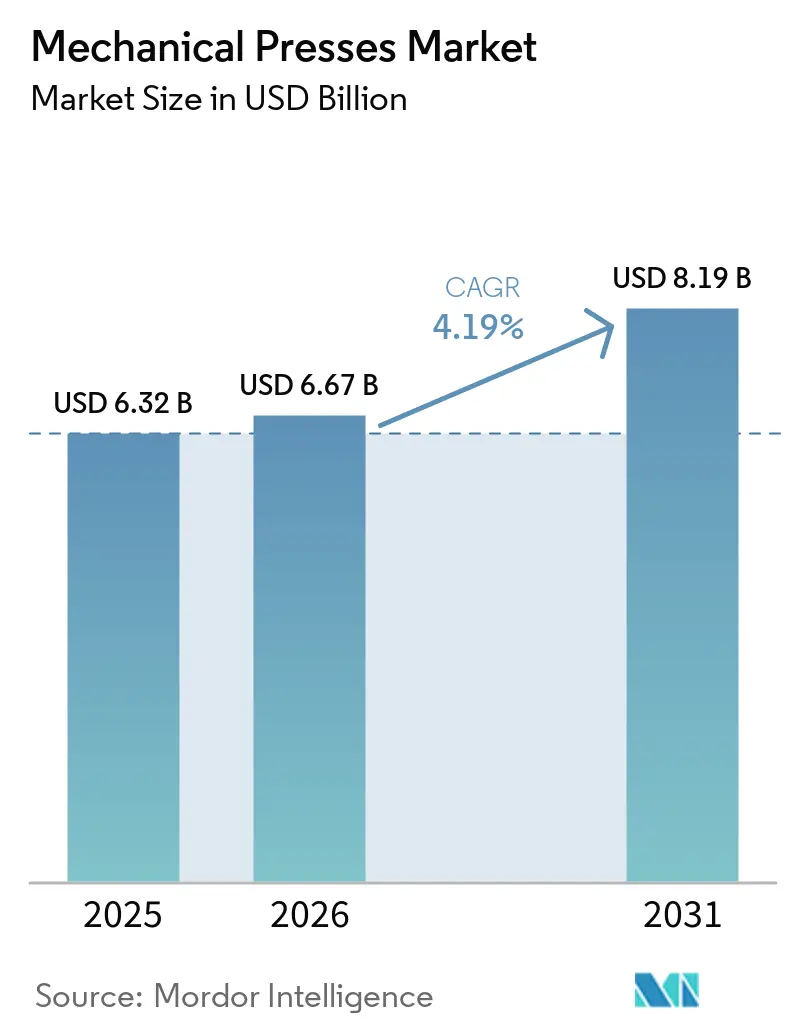
The Mechanical Presses Market size is projected to expand from USD 6.32 billion in 2025 and USD 6.67 billion in 2026 to USD 8.19 billion by 2031, registering a CAGR of 4.19% between 2026 and 2031.
Demand remains closely linked to automotive body-in-white production, electrical laminations, and general metal forming applications, where flywheel-based force supports high-volume operations by delivering the consistent energy required for repetitive stamping processes. Electric vehicle production is reshaping the mix of press demand rather than eliminating it, as EV manufacturing requires a different combination of stamped components and production capabilities. Motor laminations, battery enclosures, and vehicle structural components require precision, dimensional consistency, and repeatable output to meet performance and safety requirements. Premium suppliers are responding by offering connected production lines, automated material handling, and equipment designed to process demanding materials, including high-strength steels and other advanced materials used in modern vehicle manufacturing. Modernization activities in North America and Europe also provide suppliers with service and retrofit revenue opportunities, as manufacturers upgrade existing equipment to improve productivity, automation, and operational reliability when spending on new units slows.
Key Report Takeaways
- By frame configuration, straight-side and H-frame presses held 46% of the mechanical presses market share in 2025, while the same configuration recorded the highest projected CAGR of 4.9% through 2031.
- By press force, the 101–500 ton range accounted for 38% of the mechanical presses market size in 2025, while the 1,001–2,000 ton range is forecast to grow at a 4.8% CAGR through 2031.
- By application, blanking and punching held 40% of the mechanical presses market size in 2025, while fine blanking is projected to expand at a 6% CAGR through 2031.
- By end-use industry, automotive and transportation accounted for 44% of the mechanical presses market share in 2025, while electrical and electronics is forecast to advance at a 6.5% CAGR through 2031.
- By geography, Asia-Pacific led with 47.7% of the mechanical presses market share in 2025 and is projected to grow at a 4.9% CAGR through 2031.
Note: Market size and forecast figures in this report are generated using Mordor Intelligence’s proprietary estimation framework, updated with the latest available data and insights as of January 2026.
Global Mechanical Presses Market Trends and Insights
Drivers Impact Analysis*
| Driver | (~) % Impact on CAGR Forecast | Geographic Relevance | Impact Timeline |
|---|---|---|---|
| Automotive Lightweighting and Electric Vehicle Component Production | +1.3% | Global, with Asia-Pacific and North America as core markets | Long term (≥ 4 years) |
| Electrical, Electronics, and Precision Component Manufacturing | +0.8% | Asia-Pacific, including China, Japan, South Korea, and Taiwan, with spillover to Europe | Long term (≥ 4 years) |
| High-Speed and High-Volume Metal Forming Demand | +0.7% | Global | Medium term (2-4 years) |
| Industrial Automation and Smart Press-Room Adoption | +0.5% | North America and Europe, with accelerating adoption in the Asia-Pacific | Medium term (2-4 years) |
| Manufacturing Capacity Expansion in Emerging Markets | +0.4% | India, Southeast Asia, Morocco, Turkey, and South Africa | Long term (≥ 4 years) |
| Reshoring and Industrial Policy-Driven Manufacturing Investment | +0.3% | North America, Europe, and India | Medium term (2-4 years) |
| Source: Mordor Intelligence | |||
Automotive Lightweighting and Electric Vehicle Component Production
The shift toward electric vehicles changes the type of automotive press work required across the mechanical presses market. Each battery electric vehicle traction motor uses 300–500 silicon steel laminations, and a program producing 200,000 motors annually needs 60–100 million laminations. This volume can require 2–3 dedicated high-speed press lines. SEAT and CUPRA installed a PXL transfer press at Martorell in 2025 that can stamp 4 million body parts annually at 15 strokes per minute for the CUPRA Raval and Volkswagen ID. Polo. India reported cumulative investment of INR 35,657 crore (USD 4.0 billion), under the PLI Auto Scheme through September 2025.[1] High-strength steel and aluminum parts need stiff frames and precise ram guidance, supporting demand for higher-specification straight-side and H-frame equipment.
Electrical, Electronics, and Precision Component Manufacturing
Electrical and electronics production supports a separate source of demand for the mechanical presses market. Precision motor cores and connector components need tight tolerances and stable press movement. Kuroda Seiko installed the AIDA MSP-4000-430 high-speed precision press at its Nagano factory in January 2025. The 4,000 kN press uses a multi-row die arrangement that blanks and stacks 2 large motor cores in one cycle. The arrangement doubled output per cycle while reducing required floor space. Schuler Inc. has developed SMARTLINE high-speed presses for rotor and stator laminations. At the same time, fine blanking is forecast to grow at 6% as buyers require low-burr edges, flat parts, and accurate lamination stacks.
High-Speed and High-Volume Metal Forming Demand
Blanking and punching remained central to the mechanical presses market because many metal parts require cutting, holes, or shaped edges. Automotive, appliances, and electrical equipment all rely on this type of forming. Flywheel energy storage allows mechanical presses to deliver high peak force at 60–120 strokes per minute, which remains important where output volume and unit cost determine equipment selection. Schuler Inc. launched the HFA plus+ fineblanking press series in January 2026. The series covers 3,200–15,500 kN, reaches up to 85 strokes per minute, and uses servo-controlled hydraulic pump drives to improve energy efficiency. ISO 16092-2 remained confirmed in November 2025, supporting a consistent safety framework for mechanical press equipment.[2]
Industrial Automation and Smart Press-Room Adoption
Automation is increasing the value of press lines in the mechanical presses market. Buyers increasingly evaluate robotic transfer, inspection, production records, and remote diagnostics with the press itself. Schuler Inc. Metris Smart Monitoring System provides force, vibration, and temperature data by die set on Triton transfer presses. This information supports predictive error analysis and helps operators reduce unplanned downtime. Sutherland Presses offers the I-PRESS platform with production logging, remote diagnostics, and MES or ERP integration across mechanical and servo-hydraulic fleets. These functions improve traceability and make integrated lines more attractive when utilization is high and lost production time is costly.
Restraints Impact Analysis*
| Restraint | (~) % Impact on CAGR Forecast | Geographic Relevance | Impact Timeline |
|---|---|---|---|
| High Capital and Installation Costs | -0.7% | Global, with greater pressure in small and medium manufacturer markets | Long term (≥ 4 years) |
| Long Equipment Replacement Cycles | -0.5% | North America and Europe, where installed bases are mature | Long term (≥ 4 years) |
| High Tooling and Die Costs | -0.3% | Global | Medium term (2-4 years) |
| Safety Compliance and Skilled Workforce Requirements | -0.2% | North America and Europe, with expanding relevance in the Asia-Pacific | Medium term (2-4 years) |
| Source: Mordor Intelligence | |||
High Capital and Installation Costs
High purchase and installation costs constrain adoption in the mechanical presses market, particularly among smaller manufacturers and job shops with lower production volumes. Large automotive producers can distribute these costs across multiple vehicle programs and higher output volumes, improving equipment utilization and reducing the effective payback period. In contrast, smaller buyers face a more challenging payback calculation because the initial investment extends beyond the press itself. It includes foundations, electrical systems, material-handling equipment, tooling, dies, installation, commissioning, and operator training. Space requirements and ongoing energy consumption can further increase the total cost of ownership, particularly for manufacturers with limited production-floor capacity. OSHA requirements also impose ongoing costs on mechanical power press operators. The regulations require structured inspections of clutch, brake, and antirepeat systems and mandate the removal of noncompliant equipment from service. While these requirements improve worker safety, they increase planning, maintenance, compliance, tooling, and die-related costs for buyers launching specialized production programs.
Long Equipment Replacement Cycles
Mechanical presses often remain in service for 15–25 years, which reduces the frequency of replacement purchases and extends replacement cycles for manufacturers. This long service life constrains new equipment sales in mature regions, particularly where existing presses retain sufficient forming capacity and can be economically refurbished.[3] Weekly checks of core mechanisms form part of OSHA requirements and help preserve equipment reliability, while ISO 16092-2 provides safety requirements rather than a fixed replacement term for compliant equipment. As a result, equipment age alone does not necessarily trigger replacement, with buyers increasingly evaluating machine condition, productivity, safety performance, and upgrade costs before committing to a new press. Buyers may instead direct spending toward new controls, die-protection systems, servo feeders, energy-efficient drives, condition-monitoring technologies, or automated material handling. Brownfield upgrades can therefore capture budgets that might otherwise support a full new press purchase, extending the productive life of installed equipment and moderating replacement-driven demand for new mechanical presses.
*Our forecasts treat driver/restraint impacts as directional, not additive. The impact forecasts reflect baseline growth, mix effects, and variable interactions.
Segment Analysis
By Frame / Structural Configuration: Straight-Side Presses Define the Premium Tier
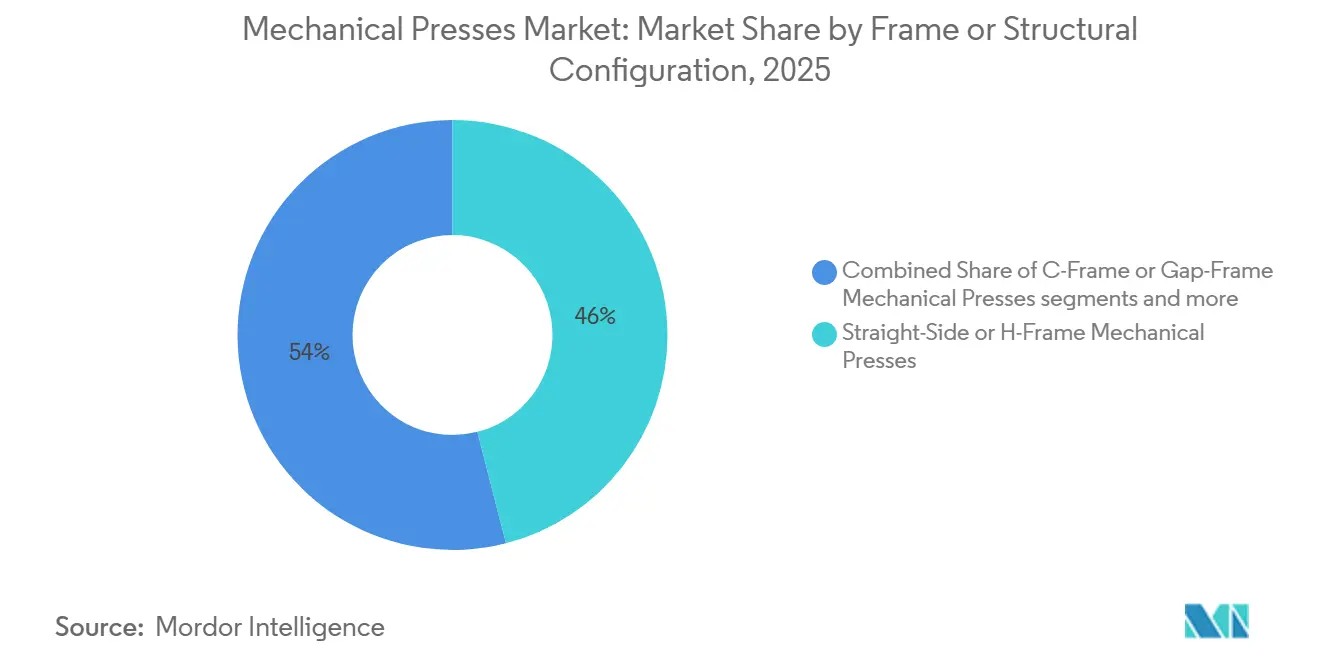
Straight-side and H-frame presses held 46% of the mechanical presses market share in 2025 and are forecast to grow at 4.9% through 2031. This was the strongest forecast rate among frame configurations. Straight-side structures limit angular deflection more effectively than C-frame alternatives, which matters for multi-station progressive tooling and transfer programs. High-strength steel and aluminum parts require repeatable dimensions under peak force, so buyers of vehicle panels and chassis parts favor rigid frames. The mechanical presses industry uses these designs, where a stable tool path supports consistent output.
Yangli developed its TL4-3750 link-drive transfer press as the largest standalone single-tonnage press manufactured in China. The system includes a servo transfer bar, automatic quick-die change, and online vision inspection for electric vehicle body panels and chassis components. C-frame and gap-frame presses remain more accessible for smaller batches and frequent tooling changes. Their position is constrained where program complexity and difficult materials increase, while solid and monoblock frames serve coining, fine blanking, and connector stamping. In those uses, stiffness at modest press force is the core purchasing requirement.

By Press Force / Capacity: Heavy-Tonnage Segment Outpaces the Mid-Range on Growth
The 101–500 ton range accounted for 38% of the mechanical presses market size in 2025. Its scale reflects broad use in progressive stamping, blanking, and connector work across automotive, appliance, and electronics supply chains. The 1,001–2,000 ton category is forecast to grow at 4.8% through 2031. This was the fastest projected rate across press-force categories. Demand comes from heavy transfer lines for truck chassis, electric vehicle underbody parts, and large aluminum body panels.
The up to 100-ton category supports high-speed work for small connectors, motor laminations, and hardware. Its prospects are linked to precision electronics and electric motor supply chains. The 501–1,000 ton range bridges standard progressive operations and lighter transfer work, where link-drive and servo-mechanical hybrids compete actively. Buyers compare systems on cost per part, changeover needs, and production flexibility. Heavy-tonnage presses remain important where large structural parts require a stable forming platform, and the mix shifts upward as vehicle structures and tooling become more demanding.
By Application / Process: Fine Blanking Outpaces All Other Processes Despite Its Niche Scale
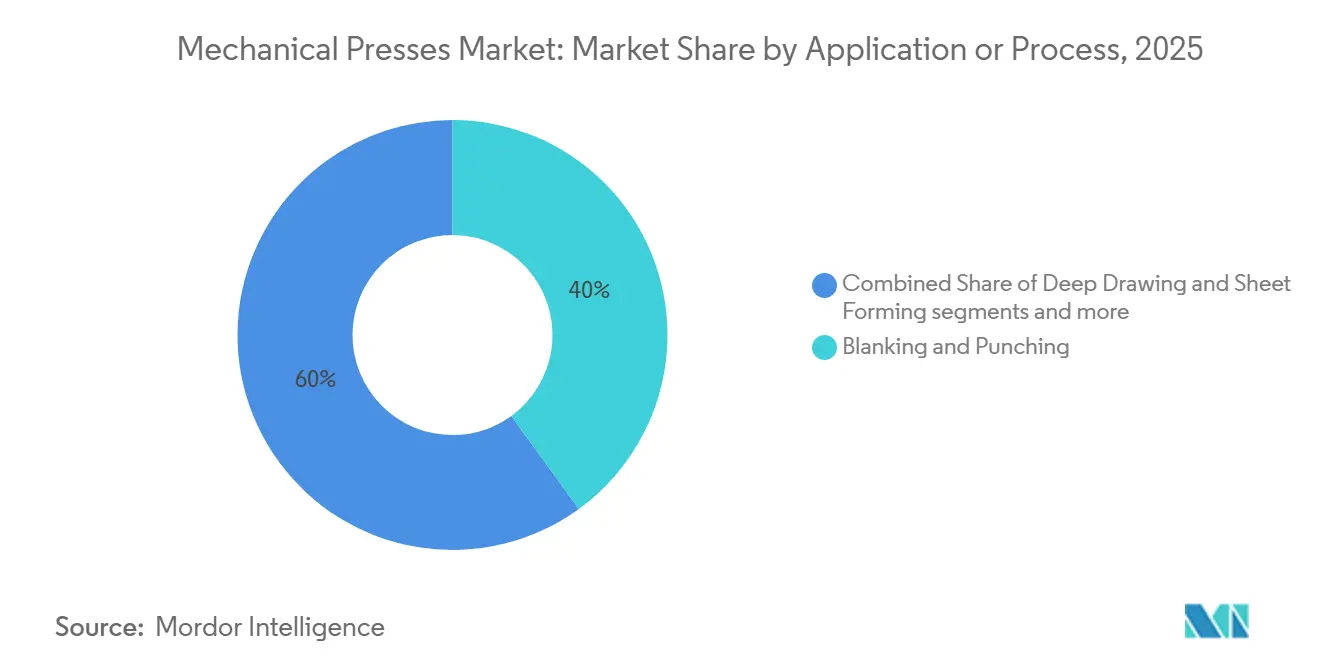
Blanking and punching accounted for 40% of the mechanical presses market size in 2025, supported by their widespread use for producing parts with holes, cutouts, slots, and defined outer profiles across automotive, appliance, electrical, and fabricated metal manufacturing. Fine blanking is forecast to grow at approximately 6% through 2031, reflecting demand for higher-precision stamped components used in electric motor laminations, precision gears, brake components, and medical hardware. These applications require low burr height, consistent surface quality, tight dimensional tolerances, and high flatness, increasing the need for controlled press operations and specialized tooling.
The projected 6% growth rate indicates increasing demand for precision cutting capabilities within the mechanical presses market. In January 2026, Schuler Inc. introduced the HFA plus+ series for fineblanking applications, incorporating servo-driven energy features and Industry 4.0 process monitoring to support process control and production efficiency. Deep drawing and sheet forming remain important for fuel tanks, battery enclosures, appliance housings, and other three-dimensional components, while coining and embossing are used in precision hardware and specialized metal-forming applications. High-speed precision stamping supports the production of connectors, terminals, and other small components requiring high-volume output. Across these processes, buyers increasingly prioritize tighter tolerances, shorter cycle times, automated material feeding, reduced scrap, and real-time process monitoring, supporting demand for higher-performance mechanical press systems.
By End-Use Industry: Automotive Anchors Demand as Electronics Accelerates
Automotive and transportation held 44% of the mechanical presses market share in 2025, making it the largest end-user segment. The sector uses blanking, transfer pressing, progressive stamping, and deep drawing for body-in-white, chassis, structural, powertrain, and other stamped components. Automakers and Tier-1 suppliers establish major capacity and technical requirements through vehicle programs that typically extend over several years, supporting demand for high-throughput presses, automated feeding systems, precision tooling, and integrated quality controls. The transition toward electric vehicles is also shifting stamping requirements toward battery trays, motor laminations, electrical connectors, and lightweight structural components, although the equipment mix varies by vehicle platform.
Electrical and electronics is forecast to grow at 6.5% through 2031, supported by demand for motor laminations, transformer cores, connector terminals, electrical contacts, and battery-enclosure stampings. These applications require high repeatability, tight tolerances, and high-speed production, broadening demand for precision mechanical presses beyond conventional vehicle body applications. Appliances and consumer durables contribute relatively stable blanking, forming, and deep-drawing demand for housings and internal components, while industrial machinery and fabricated metal products require formed parts across recurring production cycles.
Geography Analysis
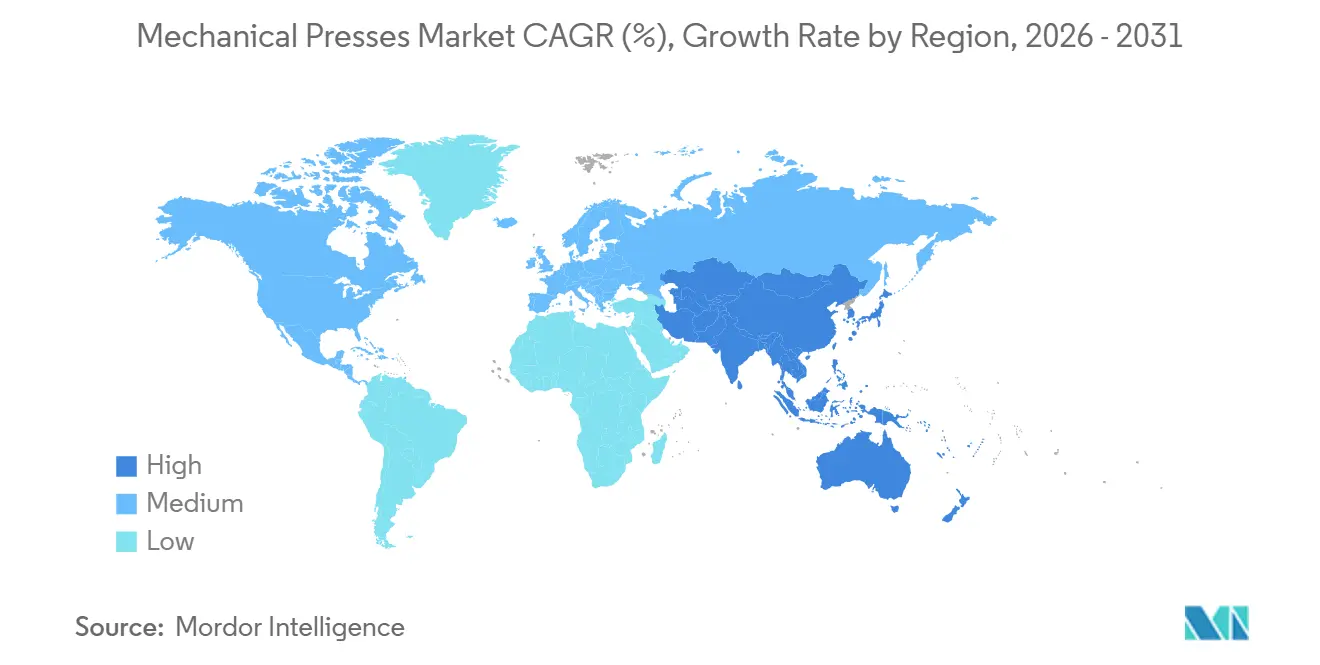
Asia-Pacific held 47.7% of the mechanical presses market share in 2025 and is forecast to grow at 4.9% through 2031. China combines a large domestic press manufacturing base with extensive automotive and electronics production, while India adds demand through automotive capacity and component investment. The PLI Auto Scheme had mobilized INR 35,657 crore (USD 4.0 billion) by September 2025. Southeast Asia benefits from automotive investment by Japanese and Korean manufacturers, while Japan remains a precision demand center for electric vehicle motor cores. Kuroda Seiko’s 2025 installation in Nagano shows continued investment in high-value motor-core stamping.
Europe is the second-largest regional market in the mechanical presses market. Germany, Italy, and Spain provide automotive, industrial machinery, and precision component demand, while the EU Machinery Regulation 2023/1230 increases the importance of cybersecurity and functional safety in connected systems. North America is supported by the United States and its automotive manufacturing base. Stellantis announced a USD 13 billion, 4-year United States investment plan in October 2025. Mexico remains important as a nearshore automotive production location.
The Middle East and Africa region is adding industrial press capacity from a smaller base, with Morocco gaining automotive capability and demand for advanced forming equipment. Schuler Inc. supplied a TML4-1600 transfer press for AK Nova Automotive’s Tangier plant in July 2026, with camera-based Visual Die Protection. Turkey has continued to add transfer-press capacity, while South America is centered on Brazil for automotive stamping. Metalúrgica Nakayone ordered a fourth 1,600-ton Triton-series mechanical transfer press in 2025, with commissioning planned for mid-2026, and Gulf diversification can support medium-capacity equipment demand.
Competitive Landscape
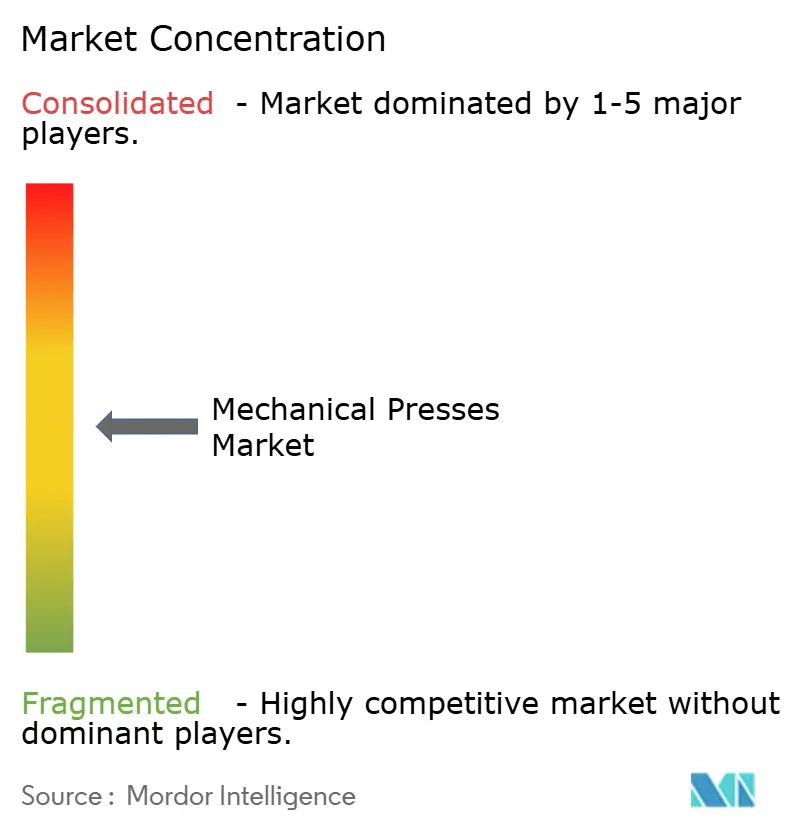
The mechanical presses market exhibits a medium level of market concentration. Schuler Inc., AIDA Engineering, and Komatsu Industries have established positions in automotive original equipment manufacturer programs, while JIER Machine-Tool Group, Yangli Group, Qiqihar No. 2, SIMPAC, SEYI, and Chin Fong or STAMTEC compete across Asian and emerging-market segments. Western and Japanese suppliers defend their position through integrated systems, monitoring software, and connectivity features. Schuler Inc. restructured its Feintool partnership in January 2026, retaining responsibility for HFA fineblanking press manufacturing and turnkey delivery. Feintool continued as a process and tooling knowledge partner.
Established suppliers benefit from safety and compliance capabilities under ISO 16092-2 and OSHA requirements. Chinese manufacturers are strengthening their position in the 1,000–3,000 ton range. Their progress puts pressure on suppliers that depend on a price premium without service or automation advantages. Opportunities remain in smart retrofits for the large installed base in North America and Europe, flexible systems for smaller manufacturers, and local rebuild networks in emerging markets. Service infrastructure remains limited in several of those markets.
BRUDERER’s high-speed expertise above 400 strokes per minute supports a specialty position, while AMADA PRESS SYSTEM focuses on progressive transfer equipment. These specialty areas have not been replicated at scale by volume-oriented competitors. ISGEC Heavy Engineering is expanding in India alongside PLI-related automotive investment in the 500–2,000 ton range. Buyers compare technology, service reach, automation, and price across the mechanical presses market.
Mechanical Presses Industry Leaders
-
Schuler Inc.
-
AIDA Engineering, Ltd.
-
JIER Machine-Tool Group Co., Ltd.
-
Komatsu Industries Corp.
-
Nidec Press & Automation
- *Disclaimer: Major Players sorted in no particular order
Recent Industry Developments
- July 2026: Schuler Inc. announced the supply of a TML4-1600 Triton-series transfer press, rated at 1,600 tons and 30 strokes per minute, with a 6,100 × 2,500 mm table and camera-based Visual Die Protection to AK Nova Automotive’s Tangier plant.
- July 2026: Schuler Inc. do Brasil confirmed a new strategic order from ITAESBRA Indústria Mecânica in Diadema, São Paulo, for 4 Yadon presses rated at 315, 500, 630, and 1,250 tons for automotive stamping. The order complemented the 800-ton press acquired in 2025.
- January 2026: Schuler Inc. formally launched the HFA plus+ series, rated at 3,200–15,500 kN and up to 85 strokes per minute, with servo-controlled hydraulic pump drives and Industry 4.0 process monitoring interfaces. Two 8,800 kN systems were built for Feintool USA at Göppingen in early 2025.
- July 2026: Schuler Inc. started production on the GLK 6500, the world’s largest forging press featuring a Kinetic Energy Recovering System. The system reduced power demand by up to 40% versus conventional presses of comparable size.
Global Mechanical Presses Market Report Scope
The Mechanical Presses Market is Segmented by Frame Configuration (C-Frame Mechanical Presses, Straight-Side Mechanical Presses, and more), By Press Force (Up to 100 Tons, and more), By Application (Blanking and Punching, Fine Blanking, and more), By End-Use Industry (Electrical and Electronics, Energy and Power, and more), By Geography (North America, Europe, and more). The Market Forecasts are Provided in Terms of Value (USD).
| C-Frame / Gap-Frame Mechanical Presses |
| Straight-Side / H-Frame Mechanical Presses |
| Solid / Monoblock Frame Mechanical Presses |
| Other Mechanical Press Configurations |
| Up to 100 Tons |
| 101–500 Tons |
| 501–1,000 Tons |
| 1,001–2,000 Tons |
| Above 2,000 Tons |
| Blanking and Punching |
| Deep Drawing and Sheet Forming |
| Coining and Embossing |
| Fine Blanking |
| High-Speed and Precision Stamping |
| Other Mechanical Press Applications |
| Automotive and Transportation |
| Electrical and Electronics |
| Appliances and Consumer Durables |
| Industrial Machinery and Equipment |
| Metal Products and General Manufacturing |
| Aerospace and Defense |
| Construction and Heavy Equipment |
| Energy and Power |
| Other End-Use Industries |
| North America | United States |
| Canada | |
| Mexico | |
| South America | Brazil |
| Argentina | |
| Rest of South America | |
| Europe | Germany |
| Italy | |
| France | |
| United Kingdom | |
| Spain | |
| Russia | |
| Rest of Europe | |
| Asia-Pacific | China |
| Japan | |
| India | |
| South Korea | |
| Taiwan | |
| ASEAN (Singapore, Malaysia, Indonesia, Thailand, Vietnam, Philippines, Myanmar, Cambodia, Laos, Brunei) | |
| Rest of Asia-Pacific | |
| Middle East and Africa | Saudi Arabia |
| United Arab Emirates | |
| Turkey | |
| South Africa | |
| Egypt | |
| Rest of Middle East and Africa |
| By Frame / Structural Configuration | C-Frame / Gap-Frame Mechanical Presses | |
| Straight-Side / H-Frame Mechanical Presses | ||
| Solid / Monoblock Frame Mechanical Presses | ||
| Other Mechanical Press Configurations | ||
| By Press Force / Capacity | Up to 100 Tons | |
| 101–500 Tons | ||
| 501–1,000 Tons | ||
| 1,001–2,000 Tons | ||
| Above 2,000 Tons | ||
| By Application / Process | Blanking and Punching | |
| Deep Drawing and Sheet Forming | ||
| Coining and Embossing | ||
| Fine Blanking | ||
| High-Speed and Precision Stamping | ||
| Other Mechanical Press Applications | ||
| By End-Use Industry | Automotive and Transportation | |
| Electrical and Electronics | ||
| Appliances and Consumer Durables | ||
| Industrial Machinery and Equipment | ||
| Metal Products and General Manufacturing | ||
| Aerospace and Defense | ||
| Construction and Heavy Equipment | ||
| Energy and Power | ||
| Other End-Use Industries | ||
| By Geography | North America | United States |
| Canada | ||
| Mexico | ||
| South America | Brazil | |
| Argentina | ||
| Rest of South America | ||
| Europe | Germany | |
| Italy | ||
| France | ||
| United Kingdom | ||
| Spain | ||
| Russia | ||
| Rest of Europe | ||
| Asia-Pacific | China | |
| Japan | ||
| India | ||
| South Korea | ||
| Taiwan | ||
| ASEAN (Singapore, Malaysia, Indonesia, Thailand, Vietnam, Philippines, Myanmar, Cambodia, Laos, Brunei) | ||
| Rest of Asia-Pacific | ||
| Middle East and Africa | Saudi Arabia | |
| United Arab Emirates | ||
| Turkey | ||
| South Africa | ||
| Egypt | ||
| Rest of Middle East and Africa | ||
Key Questions Answered in the Report
What is the projected value of the mechanical presses market by 2031?
The mechanical presses market is forecast to reach USD 8.2 billion by 2031, from USD 6.7 billion in 2026, at a 4.19% CAGR. The forecast reflects demand for automotive, electrical, and general metal-forming equipment.
Which configuration leads to mechanical press demand?
Straight-side and H-frame presses led frame configurations with 46% share in 2025 and are projected to grow at 4.9% through 2031. Rigid frames support demanding progressive and transfer tooling programs.
Why are electric vehicles relevant to mechanical press equipment?
Electric vehicle production requires motor lamination, battery enclosures, and structural parts that need high output and tight dimensional control. These requirements favor high-speed systems and rigid press configurations.
Which application is growing fastest through 2031?
Fine blanking is projected to grow at 6% through 2031, supported by needs in motor laminations, precision gears, brake components, and medical hardware. The process helps meet low-burr and flatness requirements.
Which end-use sector is growing fastest for mechanical presses?
Electrical and electronics is expected to record the highest end-use CAGR of 6.5% through 2031. Growth includes traction motor laminations, transformer cores, connectors, and battery enclosure stampings.
Which region is expected to lead demand growth?
Asia-Pacific held 47.7% share in 2025 and is forecast to grow at 4.9% through 2031, supported by automotive and electronics production. China, India, Japan, and Southeast Asia contribute to regional demand.