
Material Handling Equipment Market Size and Share
Market Overview
| Study Period | 2020 - 2032 |
|---|---|
| Market Size (2027) | USD 282.29 Billion |
| Market Size (2032) | USD 392.79 Billion |
| Growth Rate (2027 - 2032) | 6.83 % |
| Fastest Growing Market | Asia-Pacific |
| Largest Market | Asia-Pacific |
| Market Concentration | Low |
Major Players *Disclaimer: Major Players sorted in no particular order Image © Mordor Intelligence. Reuse requires attribution under CC BY 4.0. | |
Material Handling Equipment Market Analysis by Mordor Intelligence
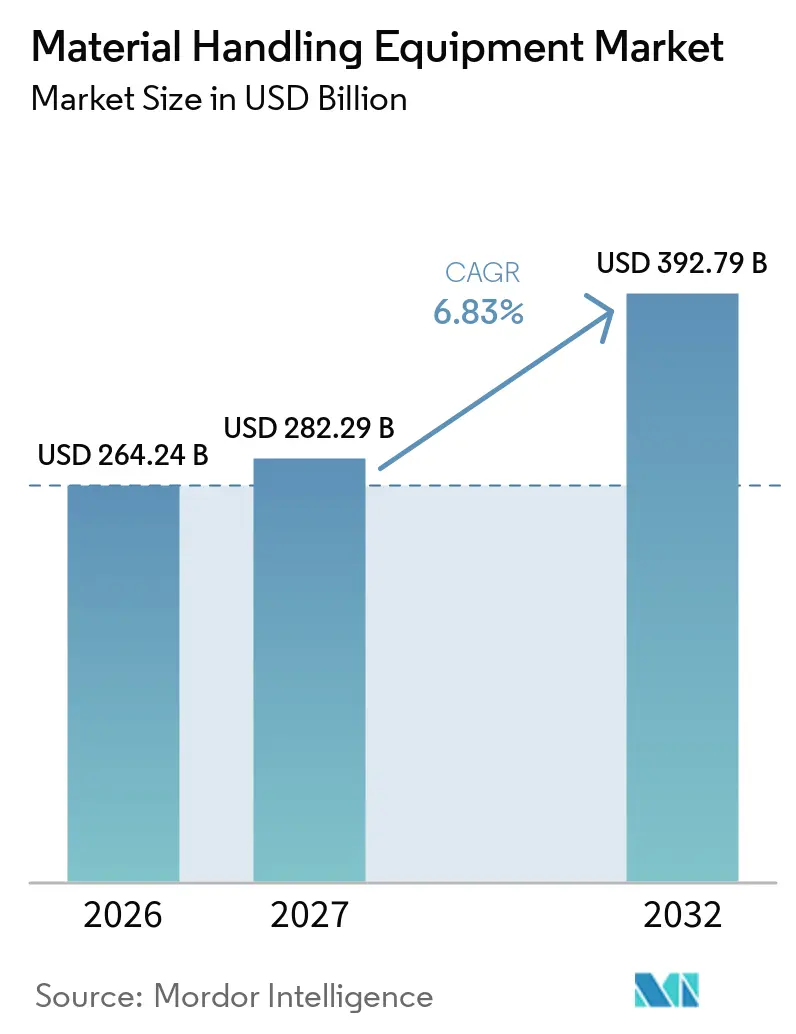
The material handling equipment market size was valued at USD 264.24 billion in 2026 and is forecast to expand from USD 282.29 billion in 2027 to reach USD 392.79 billion by 2032, growing at a CAGR of 6.83% from 2027 to 2032. The material handling equipment market is being shaped by dense e-commerce fulfillment, limited warehouse labor, and investment in domestic manufacturing and distribution capacity. These factors are raising the value placed on dependable material flow, worker safety, and equipment that fits within active sites. The material handling equipment market also benefits when operators replace aging fleets with electric equipment or add automation to existing facilities without stopping daily work. Suppliers are responding by combining trucks, storage, software, and service capabilities rather than selling equipment as standalone assets. This approach creates opportunities for vendors that support planning, installation, integration, ongoing maintenance, operator training, and the gradual redesign of workflows across diverse warehouse conditions. It enables customers to move beyond immediate equipment requirements toward long-term plans for reliable capacity, more controlled daily operations, closer coordination between warehouse and production teams, and a clearer approach to managing change as customer demand shifts. In the material handling equipment market, dependable service and practical implementation support remain central to sustaining equipment value across operating environments.
Key Report Takeaways
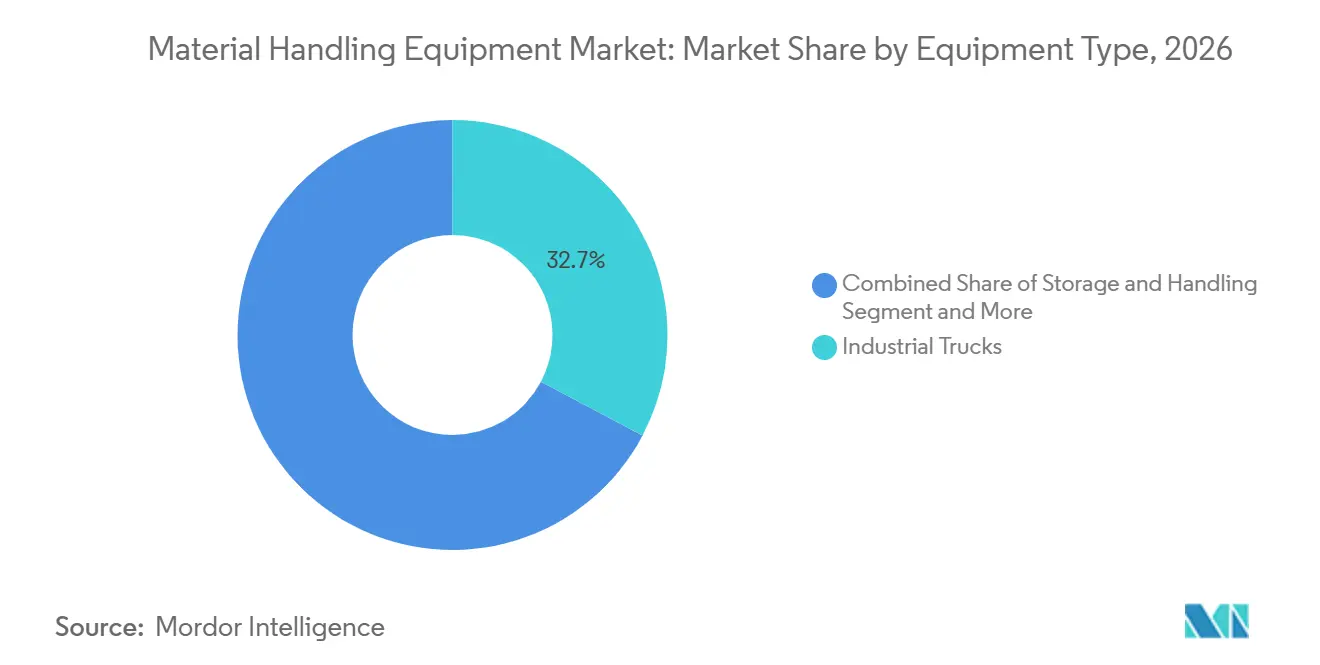
By equipment type, industrial trucks held 32.74% of the material handling equipment market share in 2026, while engineered systems are forecast to grow at a 9.87% CAGR through 2032.
By operation, manual held a 56.27% revenue share in 2026, while fully automated is forecast to grow at a 10.52% CAGR through 2032.
By power source for industrial trucks, electric held a 55.25% revenue share in 2026, while hydrogen fuel cell is forecast to grow at a 12.24% CAGR through 2032.
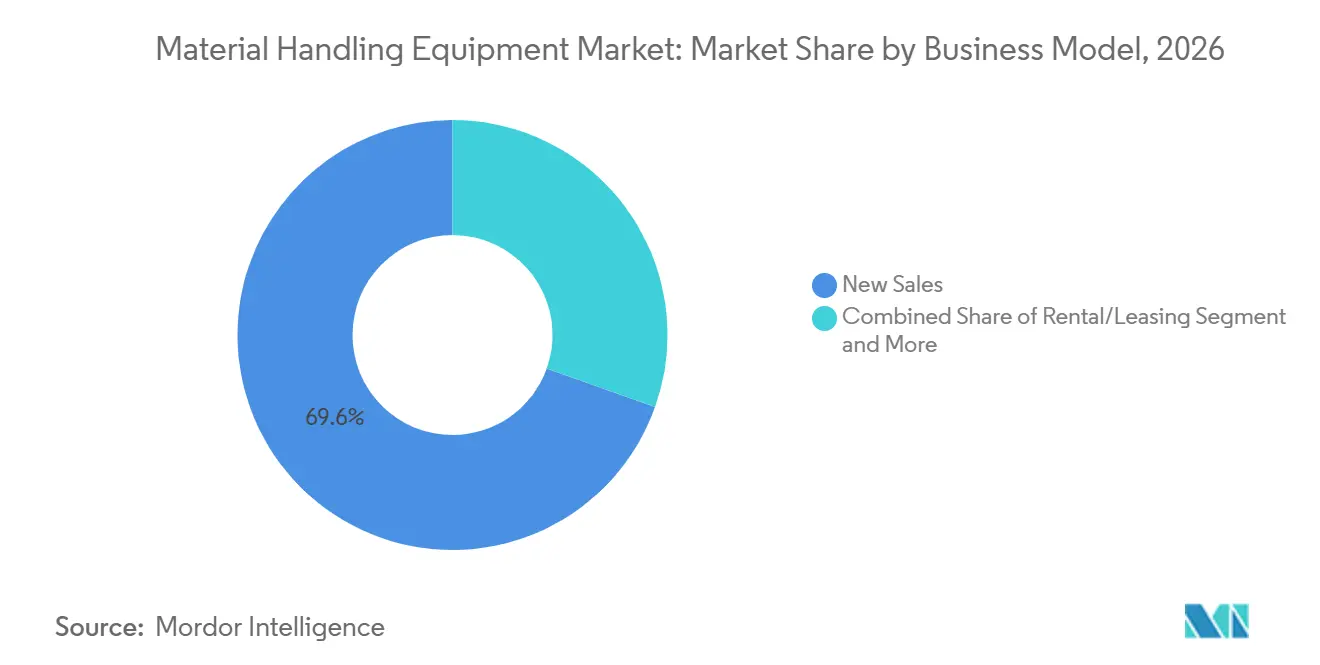
By business model, new sales accounted for 69.57% of revenue in 2026, while rental/leasing is forecast to grow at an 8.58% CAGR through 2032.
By end user, e-commerce and retail held a 22.51% revenue share in 2026, while pharmaceuticals is forecast to grow at a 9.24% CAGR through 2032.
By geography, Asia-Pacific held a 46.45% revenue share in 2026, while Asia-Pacific is forecast to grow at a 6.97% CAGR through 2032.
Note: Market numbers in this report are based on Mordor Intelligence's proprietary estimation framework, which combines nine months of actuals with Q4 projections for base year 2026.
Market Trends and Insights
Drivers Impact Analysis of Material Handling Equipment Market*
| Driver | (~) % Impact on CAGR Forecast | Geographic Relevance | Impact Timeline |
|---|---|---|---|
| E-Commerce Fulfillment Density and Shorter Delivery Windows | +1.8% | Global, with APAC, North America, and Western Europe as primary markets | Short term (≤ 2 years) |
| Warehouse Labor Scarcity and Safety-Led Automation | +1.6% | Global, most acute in North America, Western Europe, and Japan | Medium term (2–4 years) |
| Manufacturing Reshoring and Distribution-Center Modernization | +1.1% | North America (primary), Europe (secondary) | Medium term (2–4 years) |
| Industrial Truck Electrification and Fleet Replacement Cycles | +0.9% | Global, with APAC core and spill-over to North America and Europe | Medium term (2–4 years) |
| Brownfield Retrofit Demand from Legacy Warehouse Constraints | +0.7% | North America and Europe (established economies with aging installed base) | Short term (≤ 2 years) |
| Interoperable Robotics and Software Lowering Automation Entry Barriers | +0.5% | Global, with early gains in APAC and North America | Long term (≥ 4 years) |
| Source: Mordor Intelligence | |||
E-Commerce Fulfillment Density and Shorter Delivery Windows
The material handling equipment market is gaining support from higher fulfillment activity and smaller order sizes. Online retail creates more frequent picking, sorting, replenishment, return handling, and packing work within a fixed warehouse footprint, so operators need to move more individual items without adding floor space. Retailers and third-party logistics providers are therefore adopting sortation lines, goods-to-person storage, conveyor-linked workstations, and improved task coordination where these tools align with their daily volume patterns. Faster delivery commitments also make system uptime more important across several shifts, since a delay in one process can affect packing, dispatch, and the availability of inventory for the next order cycle. This encourages investment in equipment that maintains an orderly flow of parcels and inventory while allowing managers to respond as order patterns or staffing needs change. The effect is especially important for engineered systems used in high-volume fulfillment settings, where process design and dependable service support can matter as much as the equipment itself.
Warehouse Labor Scarcity and Safety-Led Automation
Labor availability is influencing equipment decisions in warehouses that depend on repetitive movement, picking, loading, and replenishment tasks. Operators are seeking systems that reduce physical strain, support safer movement, and make processes more consistent across changing staffing levels without removing the flexibility needed for exceptions or unusual orders. Powered industrial truck rules in the United States also reinforce the need for clear operating practices, trained equipment use, well-organized travel routes, and equipment choices that fit workplace conditions. KION identifies skilled-worker shortages and rising labor costs as demand drivers for electric and automated handling solutions[1]. The result is a growing preference for equipment that supports predictable processes and helps supervisors use available workers more effectively during periods of changing demand. These conditions make partial automation a practical step for operators who cannot redesign an entire facility at once but still need to improve the consistency of recurring tasks.
Manufacturing Reshoring and Distribution-Center Modernization
Domestic manufacturing investment creates demand for equipment that handles incoming materials, work-in-process inventory, finished goods, parts movement, and the transfer of goods between production and distribution functions. New or upgraded facilities also require storage, conveyance, internal transport, and shipping processes that align with revised production flows and with the need to keep materials available when production schedules change. The Reshoring Initiative reported sustained manufacturing job announcements associated with reshoring and foreign direct investment in 2025[2]. This activity provides suppliers with opportunities in facilities near production locations, as well as in nearby distribution sites that manage raw materials, components, spare parts, and finished products. Automotive and pharmaceutical operations are particularly relevant because they require the reliable movement of parts, components, and regulated products in accordance with defined operating procedures. The material handling equipment market consequently benefits from modernization projects that integrate manufacturing and warehouse operations, especially when a customer seeks a more resilient domestic supply chain.
Industrial Truck Electrification and Fleet Replacement Cycles
Electric industrial trucks are gaining attention as operators weigh maintenance requirements, indoor operating conditions, energy use, noise, worker comfort, and the cost of keeping a fleet available over its working life. The transition also corresponds with broader momentum for electrified commercial transport and with customer interest in equipment that can support safer, cleaner operation in enclosed facilities. The International Energy Agency reported continued growth in electric truck sales during 2025, highlighting the wider shift toward electrified freight equipment[3]. In the material handling equipment market, electric forklifts and warehouse trucks are well-suited to enclosed sites where local emissions and noise are a concern, while offering equipment managers new choices for charging and fleet planning. New battery options can also support more flexible charging and planned fleet replacement when a customer needs to minimize disruption to daily activity. These factors make electrification a continuing part of purchasing decisions rather than a short-lived product preference, particularly when suppliers can explain the operational fit for each site.
Restraints Impact Analysis of Material Handling Equipment Market*
| Restraint | (~) % Impact on CAGR Forecast | Geographic Relevance | Impact Timeline |
|---|---|---|---|
| High Upfront Cost and Extended Payback for Integrated Systems | -1.4% | Global, most acute in South America and MEA; moderate in North America and Europe | Medium term (2–4 years) |
| Integration Complexity Across Legacy Controls and Warehouse Software | -0.9% | North America and Europe (highest legacy infrastructure density); APAC secondary | Medium term (2–4 years) |
| Battery-Critical-Mineral Exposure and Charging-Infrastructure Bottlenecks | -0.6% | Global; most acute in emerging markets and remote industrial sites | Long term (≥ 4 years) |
| Project Delivery Risk from Site-Specific Engineering and Commissioning | -0.4% | Global, with higher exposure in brownfield and emerging-market deployments | Short to medium term |
| Source: Mordor Intelligence | |||
High Upfront Cost and Extended Payback for Integrated Systems
Integrated automation can require significant spending before an operator sees operating benefits. Storage, conveyors, software, controls, sorting equipment, site preparation, and commissioning work must often be designed together, which makes the decision more difficult than purchasing a standard piece of equipment. This creates a barrier for smaller shippers and third-party logistics providers with uncertain volumes, limited access to capital, or a need to preserve flexibility while customer demand changes. Rental and leasing can reduce the initial burden for some equipment categories, but they are less effective for highly customized systems with limited reuse outside the original facility. The material handling equipment market must therefore serve customers who favor phased projects, clear milestones, and equipment that can be expanded over time, as well as customers who can fund complete installations. Suppliers can reduce hesitation when they explain the operational changes, service needs, and practical project steps that underlie the initial equipment price.
Integration Complexity Across Legacy Controls and Warehouse Software
Existing warehouses often use control and warehouse software that was not designed for newer automation. Connecting equipment to these systems may require interfaces, revised operating rules, data mapping, site-specific testing, and close coordination between the equipment provider, software team, and the customer's operating staff. Brownfield facilities can also contain uneven layouts, restricted travel routes, variable building conditions, legacy storage arrangements, and processes that cannot be paused for a lengthy installation. KION notes that modernization during ongoing operations requires solutions adapted to the specific site. Such work can lengthen project schedules and make customers more cautious about implementation, especially when a change to one process might affect inventory access or order fulfillment elsewhere in the building. Suppliers that can integrate equipment without disrupting daily throughput are better placed to address this restraint and to create confidence in the material handling equipment market.
*Our forecasts treat driver/restraint impacts as directional, not additive. The impact forecasts reflect baseline growth, mix effects, and variable interactions.
Material Handling Equipment Market Segment Analysis
By Equipment Type:
Industrial Trucks Support Broad Handling NeedsIndustrial trucks held 32.74% of the material handling equipment market share in 2026. Their position reflects the wide use of forklifts, pallet trucks, reach trucks, and warehouse vehicles across manufacturing, retail, logistics, construction, and many supporting distribution activities. These assets move a variety of loads between receiving areas, storage locations, production zones, packing stations, and shipping docks, so they remain essential even where a facility has automated certain processes. Storage and handling equipment includes racks, shelves, bins, and physical organization, enabling facilities to manage inventory accurately and use available space more effectively. Bulk handling systems serve process industries where a reliable, continuous flow of materials matters more than individual-item picking, including facilities that manage heavy or high-volume goods.
Engineered systems are forecast to grow at a 9.87% CAGR through 2032. Automated storage, sortation, palletizing, and connected conveyance can support sites where rising order volumes, labor limits, or delivery expectations make manual methods difficult to sustain on their own. These systems require careful planning because performance depends on the relationship between equipment, controls, building layout, inventory characteristics, and the people who supervise the operation. Industrial trucks remain important in automated facilities because they still support receiving, replenishment, exception handling, and dock work that may not be accommodated by a fixed system design. This broad set of customer needs keeps conventional equipment and engineered solutions relevant, while increasing the value of suppliers that can install, integrate, maintain, and improve both.



By Operation:
Manual Processes Remain Widely Used While Automation ExpandsManual operations accounted for 56.27% of revenue in 2026. The large installed base reflects continued use of conventional equipment across warehouses, factories, and distribution centers, particularly where work patterns, product sizes, and daily volumes can change quickly. Manual methods can suit smaller sites and variable tasks because operators can respond to unexpected conditions without the fixed design requirements of a fully automated system. Electric pallet trucks, improved storage design, digital task guidance, and clearer travel paths can enhance consistency without altering the overall operating model or disrupting facility operations. Semi-automated equipment offers an additional option for operators who want help with repetitive movement or lifting while keeping people involved in decisions that require judgment or flexibility.
Fully automated operation is forecast to grow at a 10.52% CAGR through 2032. Autonomous mobile robots, automated guided vehicles, and automated storage systems are used in defined workflows where continuity, repeatability, and process control have direct value for warehouse operators. Software coordinates routes, tasks, charging, equipment availability, and operating priorities across the facility, helping teams manage recurring work with less reliance on individual operating decisions. A measured deployment often starts in areas with repetitive tasks, clear operating rules, stable product flows, and visible performance needs before extending to other parts of the site. Suppliers must demonstrate that automated systems can operate safely alongside people and conventional equipment during the transition, while also providing training and service to/ help customers manage exceptions.
By Power Source:
Electric Equipment Leads Current DemandElectric held a 55.25% revenue share in 2026 within industrial truck power sources. Electric drive suits indoor warehouse work because operators consider local emissions, noise, maintenance needs, and the need to keep vehicles available through changing shifts and work patterns. Lead-acid batteries remain in use, while lithium-ion options are changing charging practices, equipment availability planning, and the way some customers evaluate fleet replacement decisions. Power-source selection still varies with cold storage requirements, load weight, outdoor activity, duty cycles, energy access, and the physical space available for charging or battery handling. Providers can add value by matching equipment, battery options, charging plans, and service arrangements to each facility's actual working pattern instead of offering a standard fleet configuration.
Hydrogen fuel cell is forecast to grow at a 12.24% CAGR through 2032. Fuel cells can suit cold storage, food distribution, and multi-shift manufacturing where rapid refueling supports continuous work and where an extended charging pause could interrupt material flow. The technology remains a selective choice because access to fuel, site infrastructure, operating scale, and local support differ sharply by geography and by the needs of each fleet. Some buyers will continue to favor battery electric trucks because they can be easier to implement at existing sites and can fit daily operations without a separate fueling system. Competing power options will remain relevant because warehouse conditions, fleet utilization, budgets, and the availability of supporting infrastructure differ across users in the material handling equipment market.
By Business Model:
New Sales Remain the Main Purchasing RouteNew sales held a 69.57% revenue share in 2026. Direct ownership remains familiar to operators who want control over fleet use, maintenance planning, asset timing, and the choice of equipment features that match their internal operating requirements. It supports purchases of standard trucks as well as project-specific systems that are configured around a customer's building, inventory profile, work schedule, and expected handling needs. Aftermarket services are also important because installed equipment needs maintenance, replacement parts, inspections, technical assistance, and timely response when equipment availability affects operations. Service relationships can help suppliers identify later needs for fleet renewal, electrification, workflow improvement, and staged automation, making support activity important beyond the original equipment sale.
Rental/leasing is forecast to grow at an 8.58% CAGR through 2032. This option can appeal to organizations managing cash flow, seasonal demand, temporary capacity needs, or uncertain order volumes, especially when they want access to modern equipment without a large initial purchase. Rental can also give smaller operators a way to assess electric equipment or add capacity while they decide whether a longer-term investment fits their requirements. The model is less straightforward for specialized systems designed for one facility because those systems may have limited use once a contract ends or operating conditions change. Strong maintenance support, transparent contract terms, and equipment availability are essential because customers expect rented equipment to be ready when operational demand increases.

By End User:
E-Commerce and Retail Shape Fulfillment DemandE-commerce and retail held a 22.51% revenue share in 2026. Fulfillment centers, store replenishment networks, and returns operations require frequent picking, sorting, packing, and dispatch, often across broad product assortments and changing demand patterns. Facilities closer to urban demand may need to use space carefully while maintaining order speed, inventory accuracy, and dependable movement between storage, packing, and shipping functions. Storage systems, industrial trucks, conveyors, and selected automation all support these requirements, but the most suitable combination depends on product range, delivery commitments, and the amount of flexibility that the operator needs. The end-user group's handling needs therefore extend across the full supply chain rather than a single warehouse task, supporting demand for both basic equipment and integrated systems.
Pharmaceuticals are forecast to grow at a 9.24% CAGR through 2032. This segment requires careful handling, traceability, and controlled product movement, especially in cold-chain settings where temperature conditions and process discipline affect the way materials can be stored and moved. Automated storage and retrieval systems can organize products while reducing unnecessary handling, and closed conveyor systems can support more controlled movement between storage, packing, and dispatch areas. Equipment selection must consider product integrity, access control, inventory visibility, cleaning practices, and the facility procedures that govern how products move through the site. Suppliers that understand these operating requirements can provide specialized engineering and support, giving pharmaceutical customers equipment that improves consistency without compromising the controlled nature of their processes.
Geography Analysis
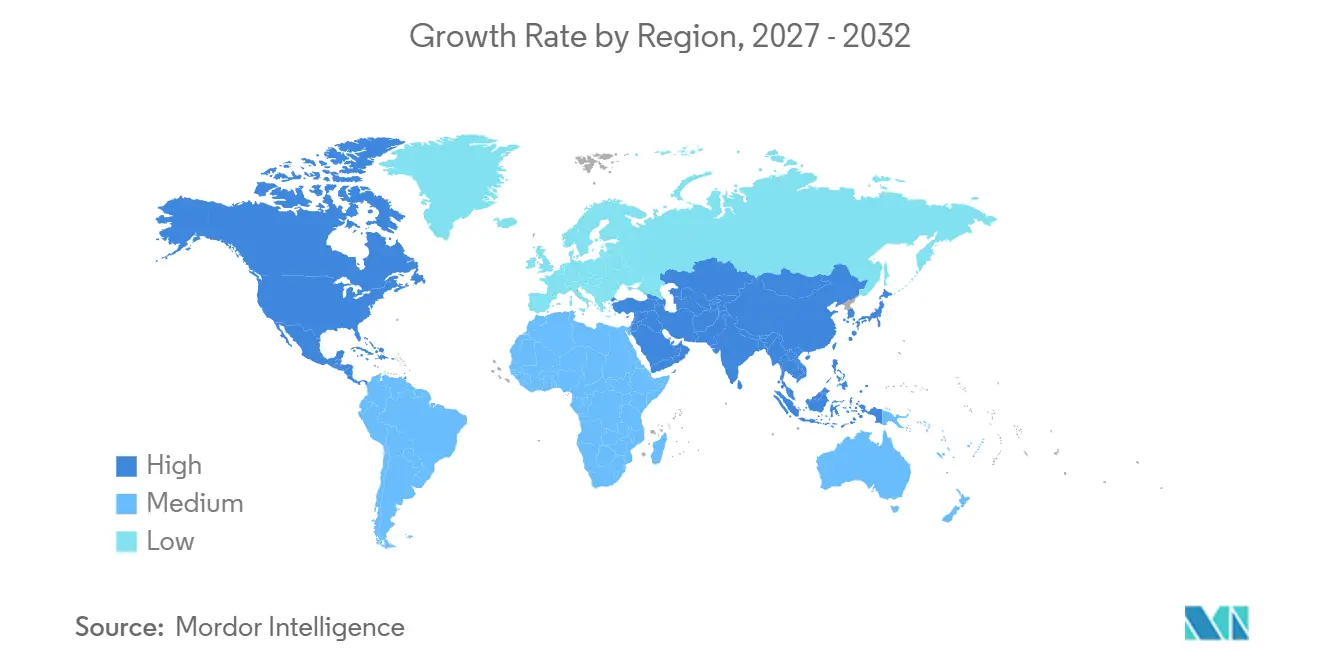
Asia-Pacific held a 46.45% revenue share in 2026 and is forecast to grow at a 6.97% CAGR through 2032. China supports the region through manufacturing activity and demand from retail, logistics, and industrial users, while Japan and South Korea remain important for warehouse automation where labor availability and process consistency shape equipment decisions. India is adding warehouse and manufacturing capacity, creating demand for industrial trucks, storage systems, equipment service, and solutions that can be introduced in stages as sites expand. Southeast Asian markets are developing logistics and e-commerce infrastructure, which supports conventional equipment alongside selected automation as operators balance capital spending with the need to improve order handling. The material handling equipment market in Asia-Pacific gives suppliers a reason to build regional manufacturing, engineering, and service support because buyers differ widely in facility age, labor conditions, product mix, and readiness for automation.
North America is forecast to grow at a 6.31% CAGR through 2032. The region is modernizing distribution sites while adding capacity around domestic manufacturing investment, electric fleet replacement, and warehouse layouts that need to accommodate changing inventory flows and delivery expectations. The Reshoring Initiative linked 2025 manufacturing announcements to continuing domestic production and investment activity. Many customers need phased upgrades that can be installed while a site remains active, which places a premium on equipment compatibility, realistic installation plans, and suppliers that understand how daily work will continue during a project. The material handling equipment market can benefit when providers combine practical equipment choices with responsive service coverage, since an equipment delay can affect fulfillment schedules, production output, inventory access, and customer commitments.
Europe is forecast to grow at a 5.28% CAGR through 2032, supported by automotive supply chains, pharmaceutical logistics, and third-party warehousing. Germany, the Netherlands, and the United Kingdom remain important locations for advanced logistics operations, technology adoption, and customer demand for safe, energy-conscious equipment that can fit established facilities. South America is forecast to grow at a 5.04% CAGR, with Brazil central to demand and neighboring countries offering opportunities in cold-chain logistics, mining-related handling, and industrial distribution. Western Asia is forecast to grow at a 6.11% CAGR as Gulf logistics investment contrasts with earlier-stage industrial truck demand and more basic handling requirements in parts of Africa. The material handling equipment market across these regions requires products, financing options, service capacity, and deployment models that reflect major differences in infrastructure, labor conditions, customer budgets, and the ability to support advanced automation.
Competitive Landscape
Market Concentration
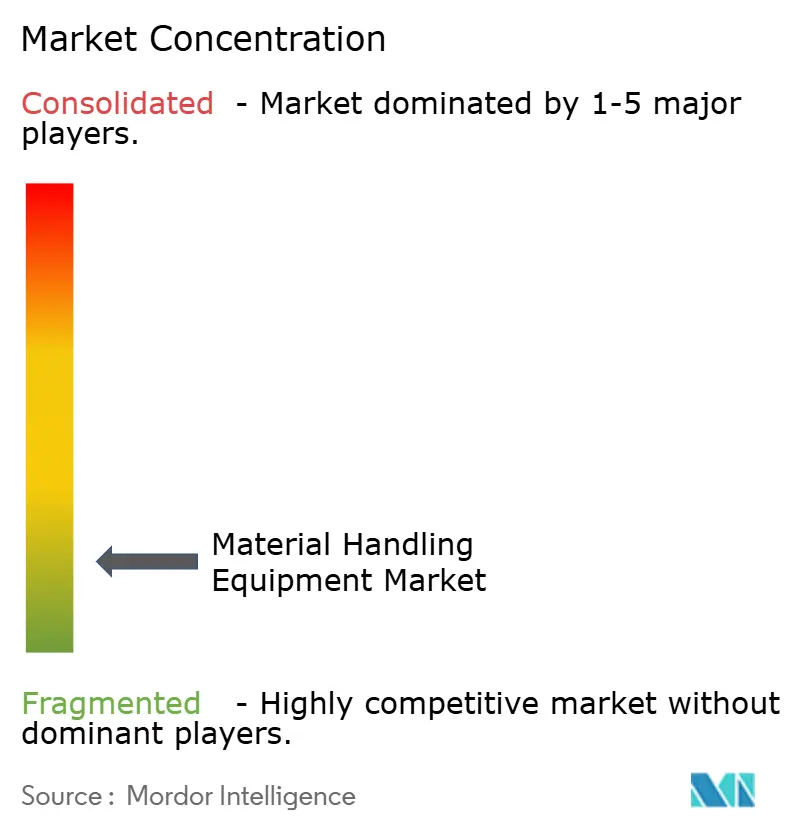
The material handling equipment market includes global equipment groups, focused automation providers, and regional manufacturers. Toyota Industries, KION, Daifuku, Jungheinrich, and Crown Equipment have broad product and service positions, but no single company offers the same reach across all equipment categories, applications, customer segments, and geographies. Buyers compare product availability, local support, integration capability, lifecycle service, operator needs, and the practical fit of a solution within their warehouse as closely as the equipment itself. This leaves room for specialized suppliers with strong solutions in storage automation, mobile robotics, sortation, software, or applications where a focused design can solve a particular handling problem. The competitive structure remains fragmented because customer needs differ by site condition, operating model, facility age, equipment mix, and the level of automation that each operator is ready to adopt.
KION worked with NVIDIA and Accenture in 2025 on AI-supported warehouse control systems that use digital-twin technology for simulation and planning. The collaboration shows how established providers are investing in system intelligence alongside physical equipment and attempting to reduce uncertainty before a customer commits to a complex installation. Digital tools can help users evaluate robot traffic, equipment interaction, workflow changes, and possible constraints in a virtual setting before the project begins in the working facility. Chinese manufacturers, including Hangcha Group and Anhui Heli, are also expanding their presence in price-sensitive industrial truck markets with improving electric product lines and a focus on buyers that value fleet availability and accessible pricing. The material handling equipment market is becoming more competitive as these approaches give customers a wider choice of equipment, technology partnerships, product ranges, and service models.
Jungheinrich introduced the AntOn brand in 2025 with EP Equipment to offer lithium-ion forklifts and pallet trucks through e-commerce, partner, and distributor channels. The initiative illustrates how established suppliers are using partnerships to serve cost-sensitive buyers, extend electric product reach, and address customers that may not need a highly customized system. Smaller providers can still compete through focused designs, faster adaptation to specific warehouse needs, and capabilities that larger groups may later acquire or access through a partnership. Service is another point of difference because predictive maintenance, remote diagnostics, fleet support, and timely technical response can reduce disruption after installation and make a supplier more valuable over time. The material handling equipment market rewards suppliers that remain involved through the equipment lifecycle, strengthen customer relationships through service, and identify later opportunities for replacement, electrification, or carefully phased automation.
Material Handling Equipment Industry Leaders
-
Toyota Industries Corporation
-
KION GROUP AG
-
Daifuku Co., Ltd.
-
Jungheinrich AG
-
Crown Equipment Corporation
- *Disclaimer: Major Players sorted in no particular order
Material Handling Equipment Market Companies Covered in this Report
- Toyota Industries Corporation
- KION GROUP AG
- Daifuku Co., Ltd.
- Jungheinrich AG
- Mitsubishi Logisnext Co., Ltd.
- Crown Equipment Corporation
- Hyster-Yale Materials Handling, Inc.
- SSI SCH�FER GMBH & CO KG
- Murata Machinery, Ltd.
- KNAPP AG
- TGW Logistics Group GmbH
- BEUMER Group GmbH & Co. KG
- Hangcha Group Co., Ltd.
- Anhui Heli Co., Ltd.
- Columbus McKinnon Corporation
- Konecranes Plc
- Mecalux, S.A.
- WITRON Logistik + Informatik GmbH
Recent Industry Developments in Material Handling Equipment Market
- October 2026: Jungheinrich launched the next-generation EFG MB and EFG MC electric counterbalance forklifts in Asia-Pacific, offering businesses greater flexibility in performance, energy systems, and operator features.
- September 2026: KUKA introduced the KMF 1500P-CB, its first autonomous forklift, capable of transporting pallets and containers up to 1,500 kilograms to support warehouse logistics and address labor shortages.
- August 2026: HELI launched its G3 Series Sit-down Reach Truck globally, targeting high-bay and high-density warehousing with a focus on greater productivity and an improved operator experience.
- August 2026: Jungheinrich acquired All Lift Forklifts, a Sydney-based Australian a diversified rental fleet.
Global Material Handling Equipment Market Report Scope
The Material Handling Equipment Market is segmented by Equipment Type, Operation, Power Source, Business Model, End User, and Geography. By Equipment Type, the market is segmented into Storage and Handling (Racks, Shelving, Bins), Industrial Trucks (Forklifts, Pallet Trucks, AGVs/AMRs, Order Pickers), Bulk Material Handling (Conveyors, Stackers, Reclaimers), and Engineered Systems (AS/RS, Sortation, Palletizers). By Operation, the market is segmented into Manual, Semi-Automated, and Fully Automated. By Power Source, the market is segmented into Electric (Lead-Acid, Li-ion), ICE (Diesel, LPG/CNG), and Hydrogen Fuel Cell. By Business Model, the market is segmented into New Sales, Rental/Leasing, and Aftermarket and Services. By End User, the market is segmented into E-commerce and Retail, Food and Beverage, Automotive, Manufacturing, 3PL/Logistics and Warehousing, Pharmaceuticals, Construction, and Others. By Geography, the market is segmented into North America (United States, Canada, and Rest of North America), Europe (Germany, United Kingdom, France, Italy, Spain, Netherlands, Russia, and Rest of Europe), Asia-Pacific (China, Japan, India, South Korea, Australia, Singapore, and Rest of Asia-Pacific), South America (Brazil, Argentina, Chile, Colombia, and Rest of South America), and Middle East and Africa (Saudi Arabia, United Arab Emirates, Turkey, Israel, South Africa, Egypt, Nigeria, and Rest of Middle East and Africa). Market forecasts are provided in terms of Value (USD) and Volume (Units).
Segmentation Overview
| Storage and Handling (Racks, Shelving, Bins) |
| Industrial Trucks (Forklifts, Pallet Trucks, AGVs/AMRs, Order Pickers) |
| Bulk Material Handling (Conveyors, Stackers, Reclaimers) |
| Engineered Systems (AS/RS, Sortation, Palletizers) |
| Manual |
| Semi-Automated |
| Fully Automated |
| Electric (Lead-Acid, Li-ion) |
| ICE (Diesel, LPG/CNG) |
| Hydrogen Fuel Cell |
| New Sales |
| Rental/Leasing |
| Aftermarket and Services |
| E-commerce and Retail |
| Food and Beverage |
| Automotive |
| Manufacturing |
| 3PL/Logistics and Warehousing |
| Pharmaceuticals |
| Construction |
| Others |
| North America | United States |
| Canada | |
| Rest of North America | |
| Europe | Germany |
| United Kingdom | |
| France | |
| Italy | |
| Spain | |
| Netherlands | |
| Russia | |
| Rest of Europe | |
| Asia-Pacific | China |
| Japan | |
| India | |
| South Korea | |
| Australia | |
| Singapore | |
| Rest of Asia-Pacific | |
| South America | Brazil |
| Argentina | |
| Chile | |
| Colombia | |
| Rest of South America | |
| Middle East and Africa | Saudi Arabia |
| United Arab Emirates | |
| Turkey | |
| Israel | |
| South Africa | |
| Egypt | |
| Nigeria | |
| Rest of Middle East and Africa |
| By Equipment Type | Storage and Handling (Racks, Shelving, Bins) | |
| Industrial Trucks (Forklifts, Pallet Trucks, AGVs/AMRs, Order Pickers) | ||
| Bulk Material Handling (Conveyors, Stackers, Reclaimers) | ||
| Engineered Systems (AS/RS, Sortation, Palletizers) | ||
| By Operation | Manual | |
| Semi-Automated | ||
| Fully Automated | ||
| By Power Source | Electric (Lead-Acid, Li-ion) | |
| ICE (Diesel, LPG/CNG) | ||
| Hydrogen Fuel Cell | ||
| By Business Model | New Sales | |
| Rental/Leasing | ||
| Aftermarket and Services | ||
| By End User | E-commerce and Retail | |
| Food and Beverage | ||
| Automotive | ||
| Manufacturing | ||
| 3PL/Logistics and Warehousing | ||
| Pharmaceuticals | ||
| Construction | ||
| Others | ||
| By Geography | North America | United States |
| Canada | ||
| Rest of North America | ||
| Europe | Germany | |
| United Kingdom | ||
| France | ||
| Italy | ||
| Spain | ||
| Netherlands | ||
| Russia | ||
| Rest of Europe | ||
| Asia-Pacific | China | |
| Japan | ||
| India | ||
| South Korea | ||
| Australia | ||
| Singapore | ||
| Rest of Asia-Pacific | ||
| South America | Brazil | |
| Argentina | ||
| Chile | ||
| Colombia | ||
| Rest of South America | ||
| Middle East and Africa | Saudi Arabia | |
| United Arab Emirates | ||
| Turkey | ||
| Israel | ||
| South Africa | ||
| Egypt | ||
| Nigeria | ||
| Rest of Middle East and Africa | ||
Key Questions Answered in the Report
What is driving demand for material handling equipment?
E-commerce fulfillment, warehouse labor constraints, fleet electrification, and distribution-center modernization are key sources of demand. They increase the need for reliable movement, safer work practices, and systems that improve capacity without interrupting daily operations. Operators are also looking for modular upgrades that fit active facilities, including improved storage, electric trucks, connected controls, and selected automation for repetitive work.
Which equipment category is the largest?
Industrial trucks is the largest equipment category, holding 32.74% revenue share in 2026. The category supports receiving, storage, replenishment, production, and shipping across many customer settings. It remains important in automated facilities because trucks can manage exceptions, dock activity, and tasks that do not fit the design of a fixed conveyance or storage system.
Which material handling equipment category is growing fastest?
Engineered systems is forecast to grow at a 9.87% CAGR through 2032 as operators invest in automated storage, sortation, and connected workflows. These systems are relevant where order volumes, labor constraints, and fulfillment expectations make more consistent process control important. Successful deployment depends on clear site planning, software integration, service support, and an approach that reflects each customer's building layout and product flow.
Why are electric industrial trucks gaining adoption?
Electric trucks can support indoor operations, reduce local emissions and noise, and align with evolving fleet replacement needs. Buyers also consider charging plans, maintenance requirements, battery choices, and the ability to keep equipment available through their operating schedule. The best power option depends on the facility because cold storage, heavy handling, outdoor work, and long shifts create different requirements for equipment, infrastructure, and ongoing support.