
Master Patient Index Software Market Size and Share
Market Overview
| Study Period | 2020 - 2031 |
|---|---|
| Market Size (2026) | USD 1.60 Billion |
| Market Size (2031) | USD 2.59 Billion |
| Growth Rate (2026 - 2031) | 10.15 % |
| Fastest Growing Market | Asia-Pacific |
| Largest Market | North America |
| Market Concentration | Medium |
Major Players *Disclaimer: Major Players sorted in no particular order Image © Mordor Intelligence. Reuse requires attribution under CC BY 4.0. | |
Master Patient Index Software Market Analysis by Mordor Intelligence
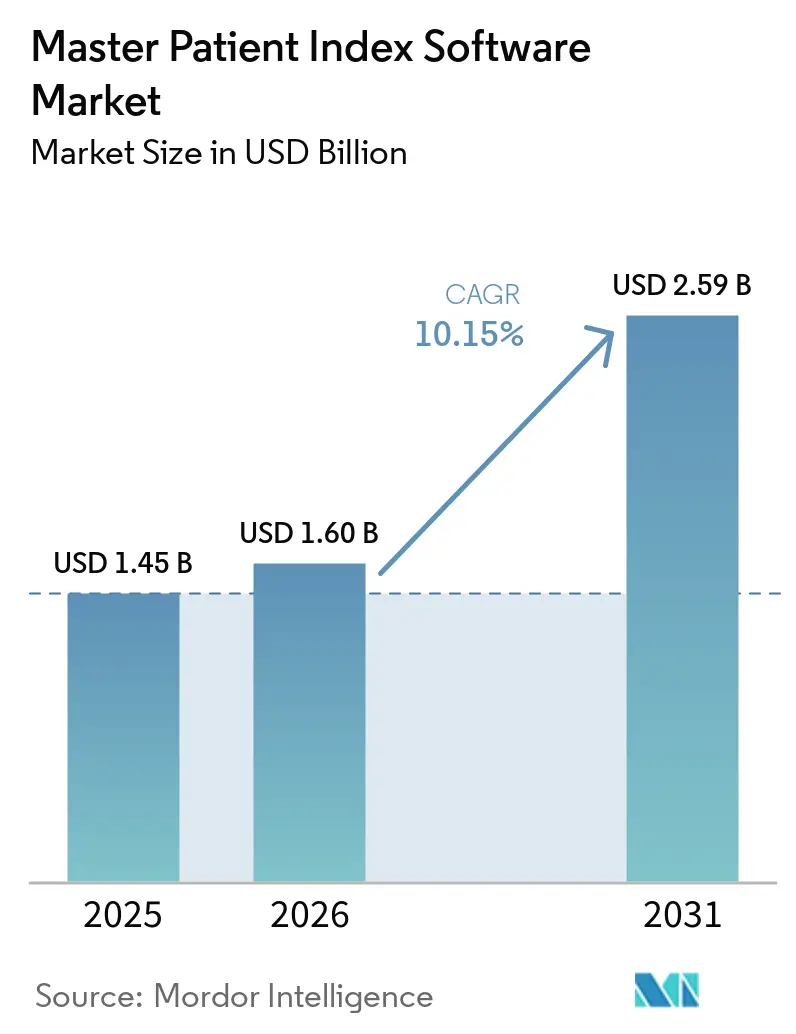
The Master Patient Index Software Market size is expected to increase from USD 1.45 billion in 2025 to USD 1.60 billion in 2026 and reach USD 2.59 billion by 2031, growing at a CAGR of 10.15% over 2026-2031.
The Master Patient Index Software Market is moving from separate hospital record systems toward shared identity resolution across health networks. EHR adoption has created a large base of connected clinical records that requires consistent patient identification. Interoperability rules in the United States and Europe are making this capability part of healthcare data infrastructure. Hospital consolidation also creates recurring needs to combine records from separate clinical systems. Vendors are responding with FHIR-ready platforms, cloud delivery, and services that address ongoing data stewardship.
Key Report Takeaways
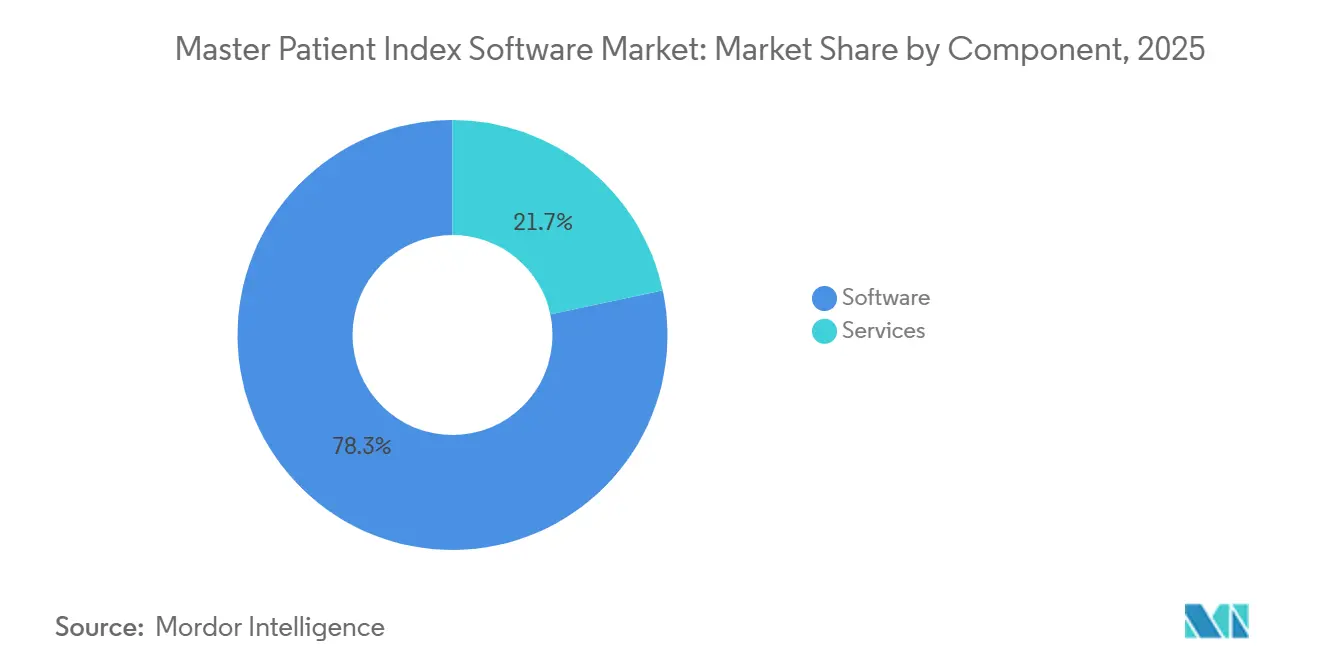
- By component, Software held 78.31% of the Master Patient Index Software Market share in 2025, while Services are expected to record the highest CAGR at 12.65% through 2031.
- By deployment, Cloud-based deployment accounted for 46.24% of the Master Patient Index Software Market share in 2025 and is expected to advance at a 14.42% CAGR through 2031.
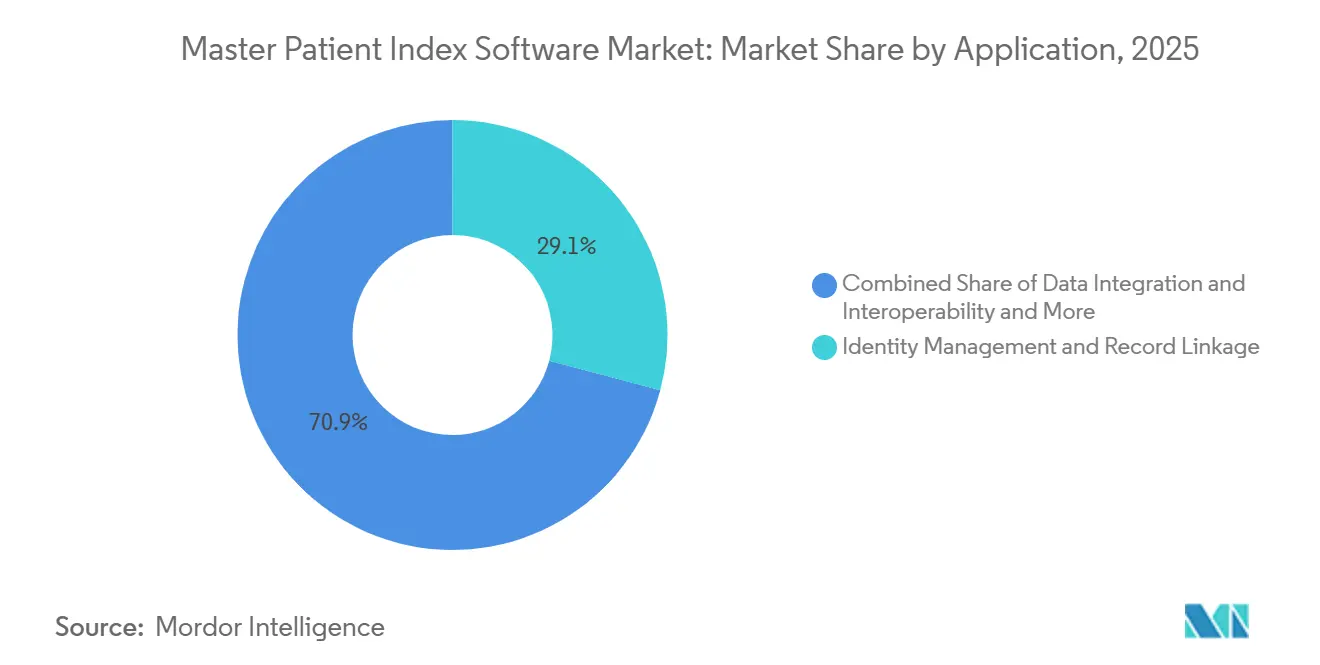
- By application, Identity Management and Record Linkage held 29.14% revenue share in 2025, while Data Integration and Interoperability is expected to record the highest CAGR at 12.42% through 2031.
- By end user, Hospitals and Integrated Delivery Networks accounted for 42.54% revenue share in 2025, while Clinics and Ambulatory Care Centers are projected to have a CAGR at 13.32% through 2031.
- By geography, North America held 46.61% revenue share in 2025, while Asia-Pacific is projected to expand at a 13.25% CAGR through 2031.
Note: Market size and forecast figures in this report are generated using Mordor Intelligence’s proprietary estimation framework, updated with the latest available data and insights as of January 2026.
Global Master Patient Index Software Market Trends and Insights
Drivers Impact Analysis*
| Driver | (~) % Impact on CAGR Forecast | Geographic Relevance | Impact Timeline |
|---|---|---|---|
| EHR and Health Information Exchange Network Expansion | +2.5% | Global, strongest in North America and Asia-Pacific | Medium term (2-4 years) |
| Interoperability Mandates and Digital Health Programs | +1.9% | North America and the European Union, with emerging relevance in Asia-Pacific | Short term (≤ 2 years) |
| Value-Based Care and Longitudinal Patient Data Requirements | +1.4% | North America, with growing relevance in Europe | Medium term (2-4 years) |
| Healthcare Mergers, Acquisitions, and Network Consolidation | +1.2% | North America and Europe | Short term (≤ 2 years) |
| FHIR-Based Patient Matching and API Adoption | +1.1% | Global, accelerating in North America | Short term (≤ 2 years) |
| Demand for AI-Ready, Trusted Healthcare Data | +1.0% | Global | Long term (≥ 4 years) |
| Source: Mordor Intelligence | |||
Expansion of EHR and Health Information Exchange Networks
EHR adoption had reached a mature level in North America before 2025. The installed base now creates demand for shared patient identity resolution across connected systems. Each connection to a health information exchange increases the need to resolve records from different source systems. Duplicate records can create patient-safety risks as well as administrative burden. A 2025 BMJ Quality & Safety report found that patients with duplicate medical records were 5 times more likely to die during an inpatient admission and had hospital stays that were 32% longer than matched patients. The Master Patient Index Software Market, therefore, serves clinical informatics, revenue cycle, and enterprise architecture teams at the same time.
Interoperability Mandates and Digital Health Programs
United States interoperability requirements have made patient matching a compliance-linked data capability. The ONC certification program requires certified health IT to support standardized application programming interfaces and address information-blocking practices. The European Health Data Space Regulation, Regulation (EU) 2025/327, entered into force in March 2025 and established a framework for cross-border health data exchange[1]European Commission, “Regulation (EU) 2025/327 of the European Parliament and of the Council of 11 February 2025 on the European Health Data Space,” Official Journal of the European Union, health.ec.europa.eu.. These requirements increase the need for reliable identity processes across care settings. HL7 published version 2.0.0 of its Interoperable Digital Identity and Patient Matching Implementation Guide in 2025. The Master Patient Index Software Market benefits as platforms are expected to support these common exchange patterns.
Value-Based Care and Longitudinal Patient Data Requirements
Value-based care requires patient records that can be followed across providers and care settings. CMS moved the Medicare Shared Savings Program toward all-payer quality reporting through the APP Plus measure set in 2025. The 2026 quality performance standard is a 73.85 composite score for participating accountable care organizations[2]Centers for Medicare & Medicaid Services, “The Path to Shared Savings: A Guide to 2026 ACO Quality Performance Standards,” MDinteractive, mdinteractive.com.. Fragmented identity records can weaken attribution, risk scoring, care coordination, and quality measurement. CMS also released draft FHIR-based digital quality measure packages for hospital programs in early 2026. This direction places patient identity accuracy closer to reporting and payment operations.
Healthcare Mergers, Acquisitions, and Network Consolidation
Provider consolidation creates a practical need to combine patient records from previously separate organizations. A merged health system may need to connect different EHR environments and remove duplicate records before using data across the network. This work can require license extensions, configuration changes, and migration services from MPI vendors. The need is strongest where a new network combines multiple campuses or clinical groups. It also applies when a health information exchange adds new participant organizations. The Master Patient Index Software Market gains recurring implementation work from these integration programs.
Restraints Impact Analysis*
| Restraint | (~) % Impact on CAGR Forecast | Geographic Relevance | Impact Timeline |
|---|---|---|---|
| High Implementation and Data Remediation Costs | -1.5% | Global, most acute in mid-market and emerging markets | Short term (≤ 2 years) |
| Patient Privacy, Cybersecurity, and Regulatory Exposure | -1.2% | Global | Short term (≤ 2 years) |
| False-Positive Matching and Patient Safety Liability | -0.8% | North America and Europe | Medium term (2-4 years) |
| Cross-Jurisdiction Identity Governance and Reference-Data Dependency | -0.6% | European Union, Middle East and Africa, and Asia-Pacific cross-border use cases | Long term (≥ 4 years) |
| Source: Mordor Intelligence | |||
High Implementation and Data Remediation Costs
Enterprise MPI deployment requires data assessment, deduplication, and ongoing stewardship. The work is difficult for health systems that have inconsistent address formats, shortened name fields, or different demographic coding practices. Reference data often needs normalization before matching tools can work reliably. Mid-sized providers may have enough patient volume to experience identity fragmentation but lack the budget or staffing for a long remediation program. These conditions can extend project timelines and delay the replacement of weak legacy platforms. The Master Patient Index Software Market must therefore offer phased deployment and service models that fit constrained implementation capacity.
Patient Privacy, Cybersecurity, and Regulatory Exposure
Healthcare had the highest average breach cost among industries in IBM Security's 2025 study. The average cost per healthcare breach was USD 7.42 million in 2025, compared with USD 9.77 million in 2024. MPI platforms centralize demographic and identity data and can therefore present a high-value target for fraud or extortion. The EHDS Regulation includes safeguards and penalties related to unlawful use of electronic health data. Buyers increasingly examine security controls and compliance documentation before awarding contracts. These requirements can increase entry and maintenance costs for smaller suppliers in the Master Patient Index Software Market.
*Our forecasts treat driver/restraint impacts as directional, not additive. The impact forecasts reflect baseline growth, mix effects, and variable interactions.
Segment Analysis
By Component: Software Leads Revenue While Services Grow Faster
Software held 78.31% of the Master Patient Index Software Market revenue in 2025. Its position reflects enterprise software deployments across large hospital networks that adopted MPI capabilities during earlier EHR programs. Enterprise MPI platforms support multi-entity health systems and regional exchanges. They maintain patient identity across many clinical source systems. Local MPI software remains suitable for single-facility environments. Hybrid MPI products support organizations moving between local and enterprise architectures.
Services are projected to grow at a 12.65% CAGR through 2031. The Master Patient Index Software Market size for Services is supported by demand for data stewardship, duplicate remediation, and preparation of datasets for AI use. These activities continue after the initial software implementation. Some vendors are using outcome-linked service contracts tied to verified reductions in duplicate records. This structure shifts part of the delivery risk from the buyer to the vendor. In December 2025, 4medica introduced IdentiMatch Worklist Automation, and the company stated that the product could reduce manual patient matching tasks by up to 90%.


By Deployment: Cloud-Based Platforms Hold a Dual Lead
Cloud-based deployment accounted for 46.24% of the Master Patient Index Software Market share in 2025. It is also projected to grow at a 14.42% CAGR through 2031. This position shows that cloud platforms are serving new buyers and organizations, replacing older on-premises systems. Cloud delivery reduces the need for local infrastructure maintenance. It also supports API-based connections across affiliated entities. These capabilities are useful where health systems need a shared identity layer across multiple sites.
On-premises deployment remains relevant for academic medical centers, government agencies, and organizations subject to strict data-residency rules. These users may delay cloud migration while they assess security and national health data requirements. Hybrid architectures allow centralized matching logic while local organizations keep some data stores under their own control. This approach can support secure data exchange across European care settings. The Master Patient Index Software Market industry also sees cloud adoption, where providers need an accessible data foundation for connected health applications. The deployment choice remains linked to the security posture, integration needs, and local governance rules of each organization.
By Application: Identity Resolution Holds Revenue Leadership
Identity Management and Record Linkage accounted for 29.14% of revenue in 2025. The application performs the core MPI tasks of matching, removing duplicates, and maintaining a survivor record across source systems. It supports real-time identity management during clinical and administrative transactions. Patient Data Management brings together longitudinal histories from different care settings. Patient Demographics Management maintains the structured fields used in billing, analytics, and care-gap identification. These applications form the operational base of the Master Patient Index Software Market.
Data Integration and Interoperability is projected to grow at a 12.42% CAGR through 2031. Health networks are building FHIR-native data environments that require consistent identity resolution across connected systems. Health Information Exchange, Population Health, and Care Coordination applications also depend on reliable matching for full-population reporting. The Truveta study showed that hybrid machine-learning and deterministic methods can be applied to large record-linkage datasets. Organizations can face greater remediation work when fragmented records enter analytics pipelines before identity issues are corrected. Vendors, therefore, position identity accuracy as an early step in data integration programs.

By End User: Hospitals and IDNs Lead While Ambulatory Care Expands
Hospitals and Integrated Delivery Networks held 42.54% of the Master Patient Index Software Market share in 2025. These organizations manage large patient volumes and often operate across multiple campuses. Their systems must connect patient records among varied clinical locations and EHR environments. They also participate in national and regional health information exchange efforts. The TEFCA framework supports a common approach to nationwide health information exchange. These operational requirements support continued demand from major provider networks.
Clinics and Ambulatory Care Centers are projected to grow at a 13.32% CAGR through 2031. Chronic care, behavioral health, and procedural services are increasingly delivered in outpatient settings. This change creates more patient touchpoints that must be resolved against a central record. Payers are also becoming relevant buyers because interoperability rules require access to member health data through standardized interfaces. Government and public health agencies use patient identity capabilities for surveillance and emergency-response programs. The Master Patient Index Software Market industry can serve ambulatory organizations with cloud-native products that are faster to deploy than traditional enterprise configurations.
Geography Analysis
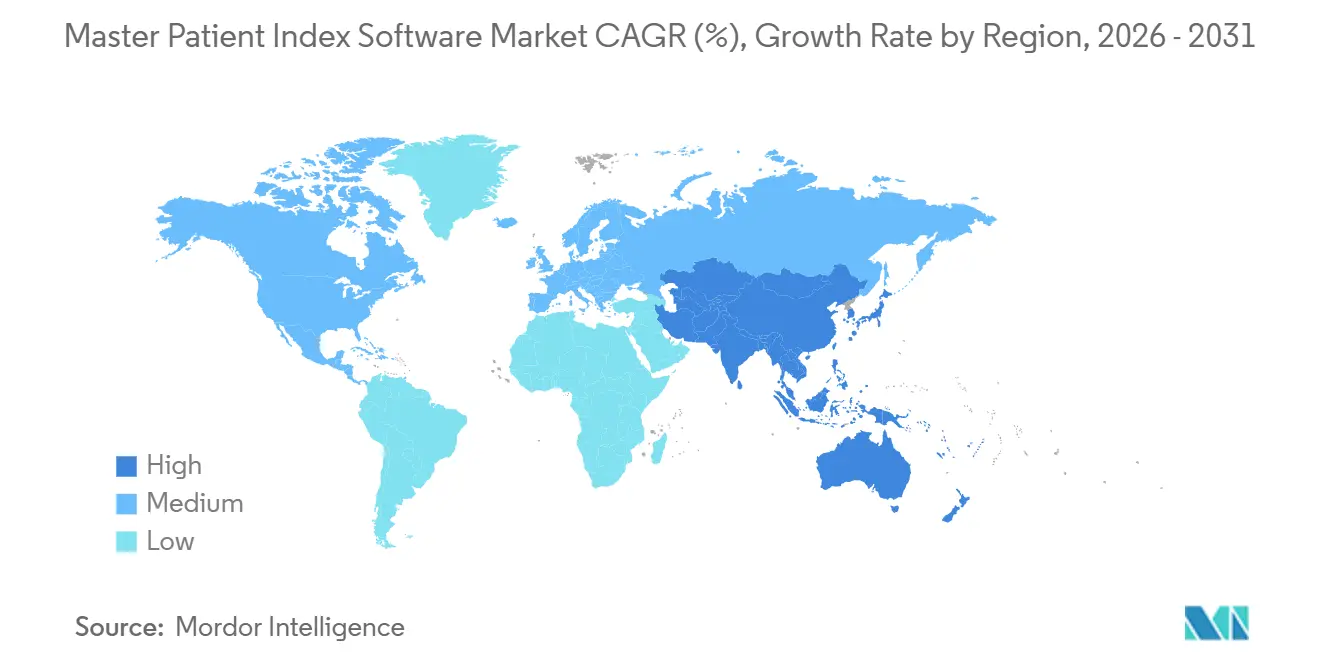
North America accounted for 46.61% of Master Patient Index Software Market revenue in 2025. The region has a large installed base of certified EHR systems and active provider networks that require patient matching across sites. The United States relies on TEFCA and related interoperability work to support nationwide health data exchange. Accurate patient identity is necessary before records can move reliably between participants. Canada is advancing provincial digital health programs, while Mexico has lower MPI penetration and a growing need for cross-border exchange capabilities.
Europe is in an active regulatory implementation phase in 2026. Regulation (EU) 2025/327 created the European Health Data Space framework across the European Union. France has issued MyHealth@EU implementation material through its national digital health agency. Germany is aligning its electronic patient record work with interoperability and cybersecurity requirements. The United Kingdom is pursuing its own patient identity and digital health programs outside the EHDS framework. The Middle East and Africa remain earlier-stage opportunities where national digital health programs can create future demand for unified identity infrastructure.
Asia-Pacific is projected to be the fastest-growing region at a 13.25% CAGR through 2031. National digital health programs, hospital network expansion, and AI-focused health initiatives support this outlook. India has developed the Ayushman Bharat Digital Mission to provide a digital health ecosystem and health records exchange framework[3]National Health Authority, “Ayushman Bharat Digital Mission,” Government of India, abdm.gov.in.. China has introduced patient identity management standards that support consistent verification across medical institutions. Australia is continuing work to modernize its national digital health infrastructure. These developments create opportunities for the Master Patient Index Software Market where private providers need to connect to national exchange systems.

Competitive Landscape
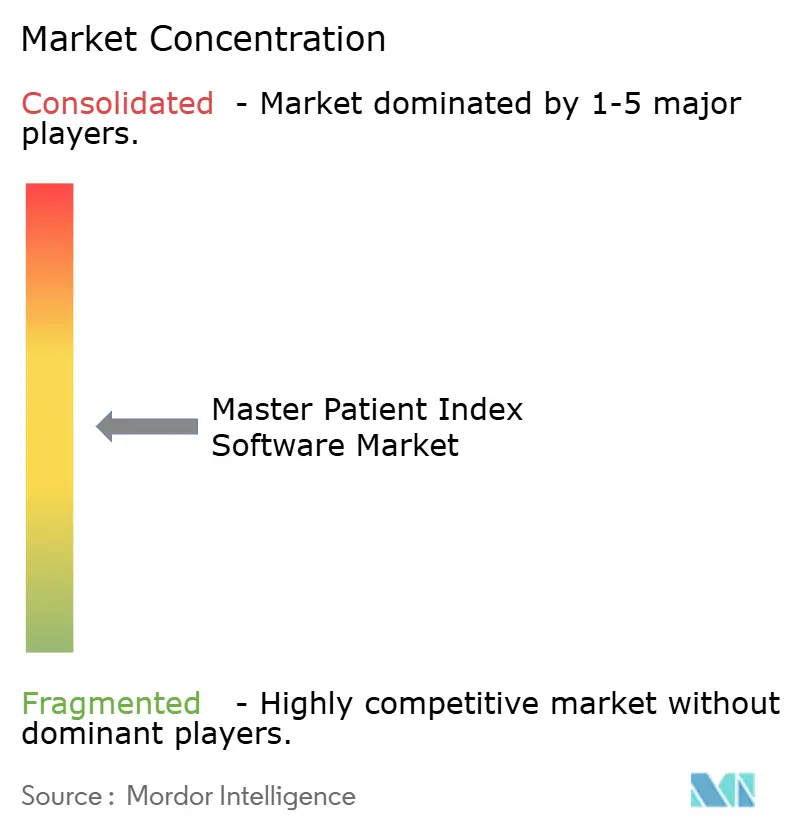
The Master Patient Index Software Market is moderately fragmented. Specialist vendors compete with EHR companies that include MPI capabilities in broader clinical software platforms. Verato, 4medica, Just Associates, Rhapsody Health, and CareEvolution focus on identity resolution across different EHR environments. Epic, Oracle Health, and MEDITECH benefit from installed customer bases and integrated platform workflows. Specialists compete on matching precision, deployment speed, and open interoperability. This division gives buyers a choice between bundled functionality and dedicated identity products.
Verato reported recognition in a 2026 Black Book Research survey for enterprise patient identity, EMPI, and patient matching for revenue cycle management. In December 2025, 4medica launched IdentiMatch Worklist Automation for manual patient matching workflows. In May 2026, 4medica expanded IdentiMatch support for the proposed MATCH IT Act requirements. These moves show how product automation and exchange compliance are shaping competition.
The payer-provider identity layer remains an opportunity for suppliers. Value-based contracts require health plans and providers to reconcile member and patient records across different systems. The proposed MATCH IT Act would establish standards and protocols to improve patient matching. Security and EHDS safeguards are becoming baseline procurement requirements rather than optional product features. The Master Patient Index Software Market remains competitive because no supplier concentration figures were provided. Competition is therefore best described as moderate fragmentation rather than dominance by a small group of firms.
Master Patient Index Software Industry Leaders
Verato, Inc.
Rhapsody Health
Oracle Corporation
InterSystems Corporation
4medica, Inc.
- *Disclaimer: Major Players sorted in no particular order

Recent Industry Developments
- August 2026: Rhapsody launched its Payer Interoperability Suite on the Connection Hub in the Epic Showroom for organizations using Tapestry UM/CM, Claims, and the Epic Payer Platform. The suite combined preconfigured payer interoperability workflows with Rhapsody Axon, an AI-powered integration agent, expanding Rhapsody's reach across more than 1,900 customers worldwide and positioning it in the payer-provider identity convergence layer, a key commercial white space.
- August 2026: The Australian Digital Health Agency (ADHA) signed a three-year AUD 161.6 million (approximately USD 100 million) infrastructure contract with Accenture to operate My Health Record, which covered more than 25 million active records and supported 207 million annual clinician interactions. The contract included provisions to transition to a FHIR-native ecosystem, driving investment in MPI-compatible data architecture across the Australian healthcare system.


Global Master Patient Index Software Market Report Scope
As per the scope of the report, the master patient index (MPI) Software is a healthcare information system that creates and maintains a centralized database containing unique identifiers for individual patients across different healthcare organizations and systems. Its primary purpose is to ensure accurate patient identification, prevent duplicate records, and facilitate seamless sharing of patient information for coordinated care.
The master patient index software market is segmented by component into software, including enterprise master patient index software, local master patient index software, and hybrid master patient index software, and services. By deployment, the market is segmented into cloud-based, on-premises, and hybrid deployments. By application, the market is segmented into patient data management, identity management and record linkage, data integration and interoperability, patient demographics management, health information exchange, population health management and care coordination, and other applications. By end user, the market is segmented into hospitals and integrated delivery networks, clinics and ambulatory care centers, healthcare payers, government and public health agencies, and other end users. By geography, the market is segmented into North America, Europe, Asia-Pacific, the Middle East and Africa, and South America. The market report also covers the estimated market sizes and trends for 17 countries across major regions globally. For each segment, the market size and forecast are provided in terms of value (USD).
| Software | Enterprise Master Patient Index Software |
| Local Master Patient Index Software | |
| Hybrid MPI Software | |
| Services |
| Cloud-Based |
| On-Premises |
| Hybrid Deployment |
| Patient Data Management |
| Identity Management and Record Linkage |
| Data Integration and Interoperability |
| Patient Demographics Management |
| Health Information Exchange |
| Population Health and Care Coordination |
| Other Applications |
| Hospitals and Integrated Delivery Networks |
| Clinics and Ambulatory Care Centers |
| Healthcare Payers |
| Government and Public Health Agencies |
| Other End Users |
| North America | United States |
| Canada | |
| Mexico | |
| Europe | Germany |
| United Kingdom | |
| France | |
| Italy | |
| Spain | |
| Rest of Europe | |
| Asia-Pacific | China |
| Japan | |
| India | |
| Australia | |
| South Korea | |
| Rest of Asia-Pacific | |
| Middle East and Africa | GCC |
| South Africa | |
| Rest of Middle East and Africa | |
| South America | Brazil |
| Argentina | |
| Rest of South America |
| By Component | Software | Enterprise Master Patient Index Software |
| Local Master Patient Index Software | ||
| Hybrid MPI Software | ||
| Services | ||
| By Deployment | Cloud-Based | |
| On-Premises | ||
| Hybrid Deployment | ||
| By Application | Patient Data Management | |
| Identity Management and Record Linkage | ||
| Data Integration and Interoperability | ||
| Patient Demographics Management | ||
| Health Information Exchange | ||
| Population Health and Care Coordination | ||
| Other Applications | ||
| By End User | Hospitals and Integrated Delivery Networks | |
| Clinics and Ambulatory Care Centers | ||
| Healthcare Payers | ||
| Government and Public Health Agencies | ||
| Other End Users | ||
| By Geography | North America | United States |
| Canada | ||
| Mexico | ||
| Europe | Germany | |
| United Kingdom | ||
| France | ||
| Italy | ||
| Spain | ||
| Rest of Europe | ||
| Asia-Pacific | China | |
| Japan | ||
| India | ||
| Australia | ||
| South Korea | ||
| Rest of Asia-Pacific | ||
| Middle East and Africa | GCC | |
| South Africa | ||
| Rest of Middle East and Africa | ||
| South America | Brazil | |
| Argentina | ||
| Rest of South America | ||


Key Questions Answered in the Report
What is driving growth in master patient index software?
Interoperability requirements, connected EHR systems, value-based care, and the need for clean data for AI applications support growth.
How large is the master patient index software market in 2026?
The sector is valued at USD 1.60 billion in 2026 and is forecast to reach USD 2.59 billion by 2031 at a 10.15% CAGR.
Which deployment model is growing fastest for MPI platforms?
Cloud-based deployment is forecast to grow at a 14.42% CAGR through 2031 and held 46.24% revenue share in 2025.
Which users generate the greatest demand for MPI software?
Hospitals and Integrated Delivery Networks led with 42.54% revenue share in 2025 because they manage complex, multi-site patient records.
Why is patient matching important for healthcare interoperability?
Reliable matching helps providers exchange the right records through standardized APIs and national or regional health information networks.
Which region is expected to grow fastest through 2031?
Asia-Pacific is projected to grow at a 13.25% CAGR through 2031, supported by national digital health programs and connected care investment.
Page last updated on:





