
Marine Onboard Communication and Control Systems Market Size and Share
Market Overview
| Study Period | 2020 - 2032 |
|---|---|
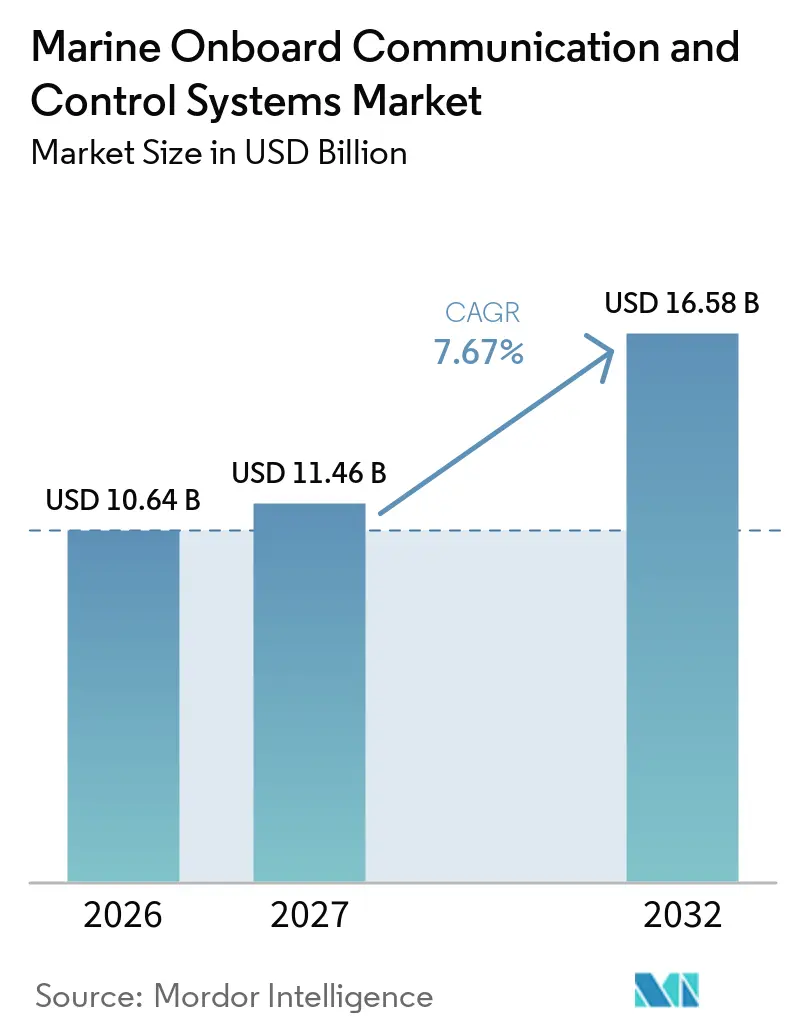
| Market Size (2027) | USD 11.46 Billion |
| Market Size (2032) | USD 16.58 Billion |
| Growth Rate (2027 - 2032) | 7.67 % |
| Fastest Growing Market | Middle East and Africa |
| Largest Market | Asia-Pacific |
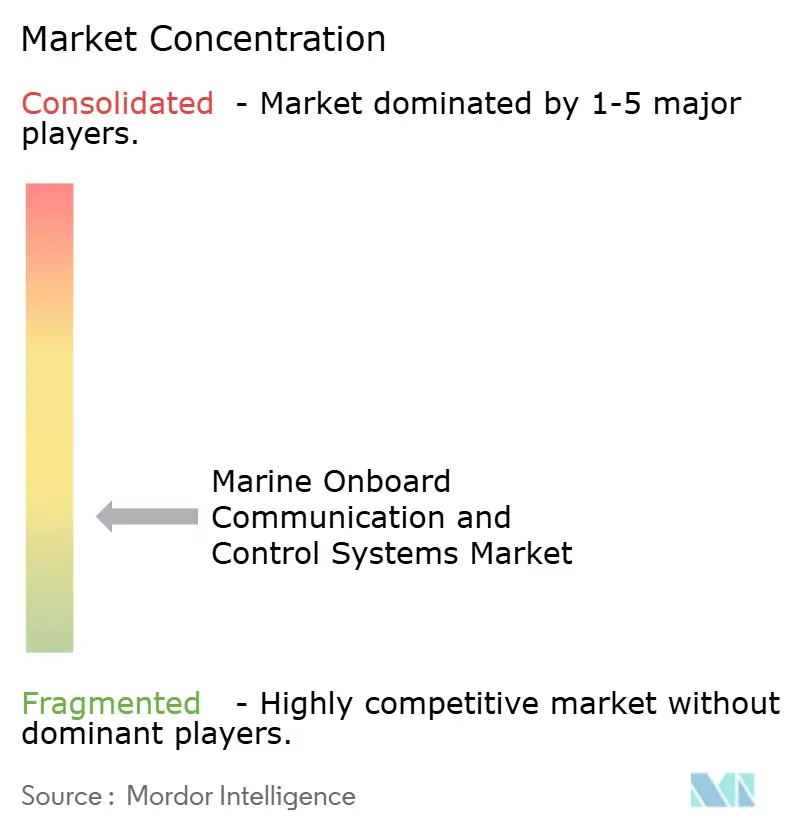
| Market Concentration | Low |
Major Players *Disclaimer: Major Players sorted in no particular order Image © Mordor Intelligence. Reuse requires attribution under CC BY 4.0. | |
Marine Onboard Communication and Control Systems Market Analysis by Mordor Intelligence
The marine onboard communication and control systems market size was valued at USD 10.64 billion in 2026 and is forecast to grow from USD 11.46 billion in 2027 to USD 16.58 billion by 2032, at a 7.67% CAGR during the forecast period (2027-2032). The market is supported by fleet renewal, greater vessel automation, and regulatory requirements for continuous operational data. The IMO Net-Zero Framework requires ships above 5,000 gross tons to measure and manage fuel intensity, which increases demand for integrated sensors, energy management, and reporting systems. The IMO framework for maritime autonomous surface ships also highlights the need for reliable communication links and remote-operations capabilities.[1] Suppliers are responding by combining navigation, automation, connectivity, and diagnostics in integrated packages. The resulting procurement model favors vendors that can reduce interface risk across newbuild and retrofit projects. It also values suppliers that can support installation, integration, and ongoing service within a single coordinated scope.
Key Report Takeaways
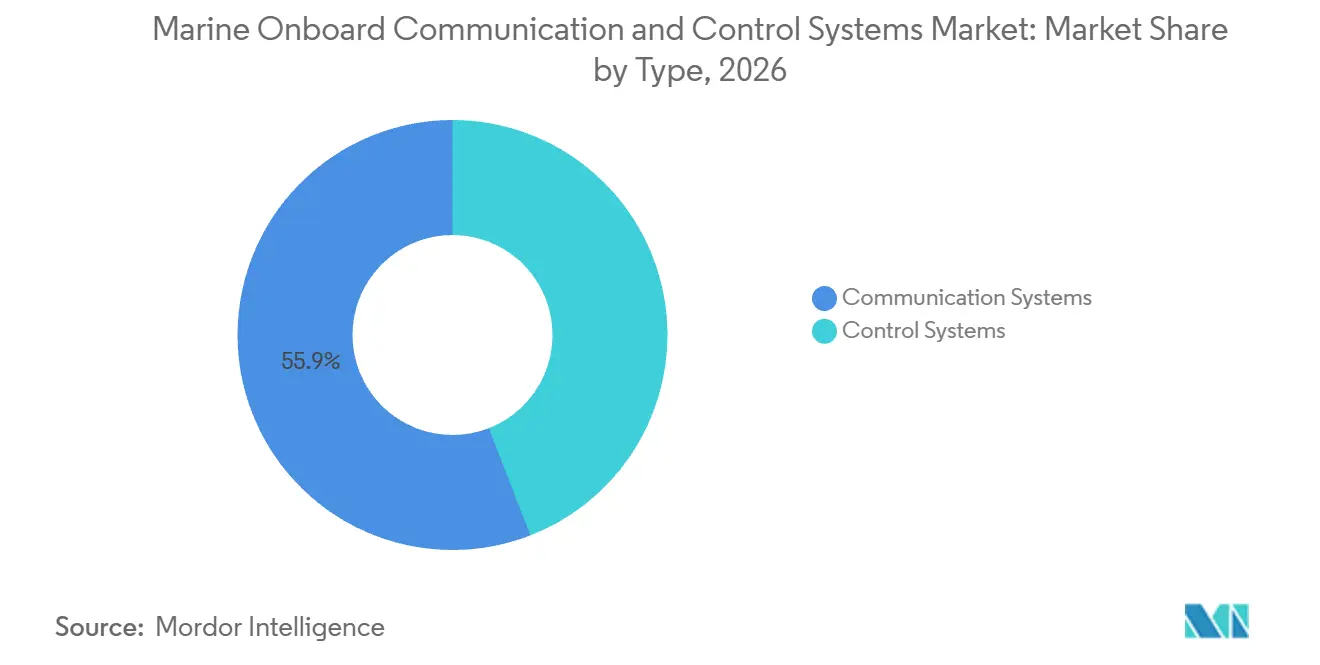
- By type, communication systems held 55.90% of revenue in 2026, while control systems are forecast to grow at an 8.91% CAGR through 2032.
- By installation, OEM and newbuild installations accounted for 64.30% of revenue in 2026, while aftermarket and retrofit are forecast to grow at a 9.55% CAGR through 2032.
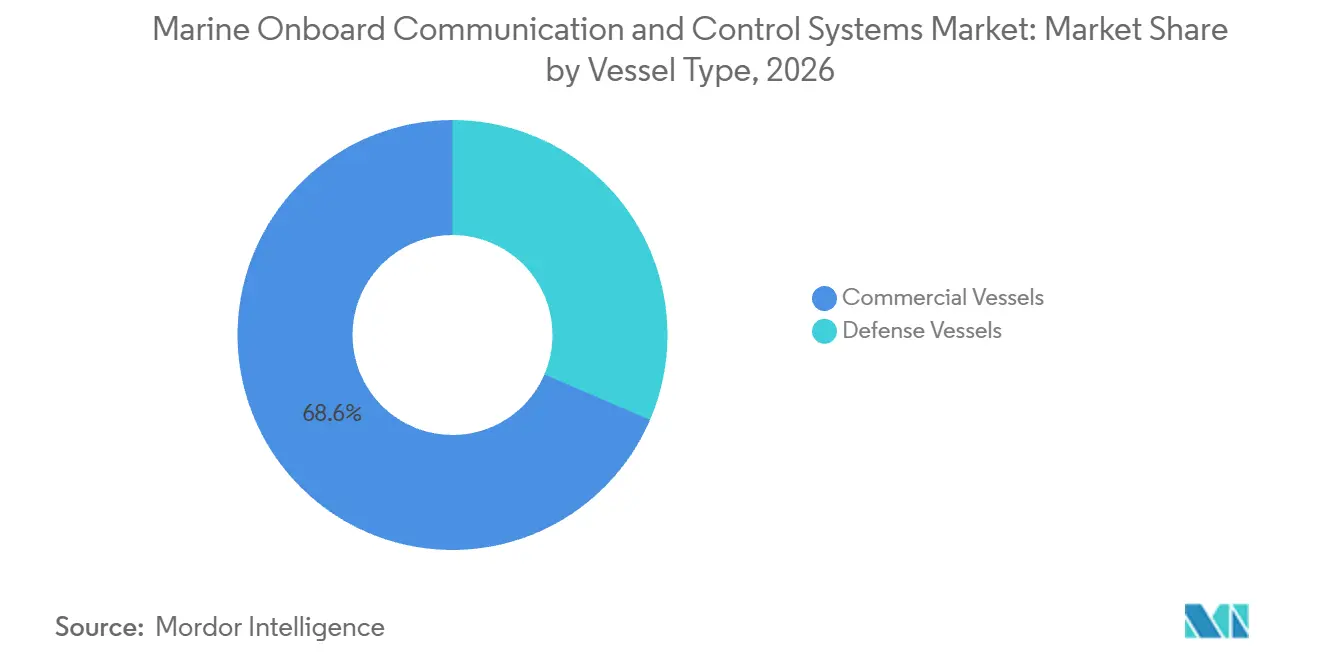
- By vessel type, commercial vessels held 68.55% of revenue in 2026, while defense vessels are forecast to grow at an 8.88% CAGR through 2032.
- By application, monitoring and control held 32.20% of revenue in 2026 and is forecast to grow at a 9.23% CAGR through 2032.
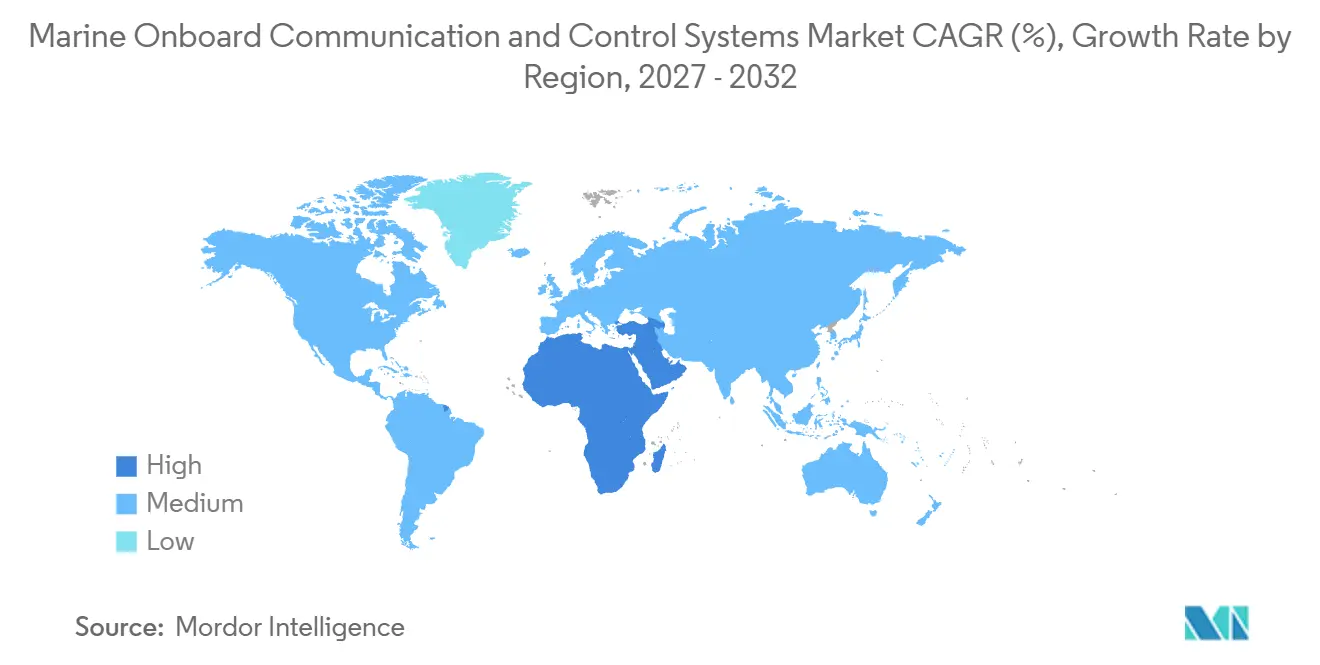
- By geography, Asia-Pacific held 39.50% of revenue in 2026, while the Middle East and Africa is forecast to grow at a 9.01% CAGR through 2032.
Note: Market numbers in this report are based on Mordor Intelligence's proprietary estimation framework, which combines nine months of actuals with Q4 projections for base year 2026.
Global Marine Onboard Communication and Control Systems Market Trends and Insights
Drivers Impact Analysis*
| Driver | (~) % Impact on CAGR Forecast | Geographic Relevance | Impact Timeline |
|---|---|---|---|
| Expansion of commercial and naval fleets | +1.50% | Global, concentrated in Asia-Pacific for shipbuilding and North America and Europe for naval procurement | Medium term (2-4 years) |
| Maritime decarbonization and fuel-efficiency mandates | +1.20% | Global, including vessels above 5,000 gross tons on international voyages | Long term (≥ 4 years) |
| Crew shortages and demand for remote monitoring | +1.00% | Global, particularly acute in Asia-Pacific and emerging maritime economies | Short term (≤ 2 years) |
| Growth of autonomous and remotely operated vessels | +1.30% | Global, with early deployment in Northern Europe and East Asia | Long term (≥ 4 years) |
| Digitalization of vessel operations and fleet management | +1.10% | Global, with adoption led by Asia-Pacific and Europe | Medium term (2-4 years) |
| Cyber-resilient control requirements for newbuilds | +0.90% | North America and global fleets subject to IMO and IACS requirements | Short term (≤ 2 years) |
| Source: Mordor Intelligence | |||
Expansion of Commercial and Naval Fleets
Commercial fleet renewal and naval shipbuilding programs are creating opportunities for suppliers of onboard communication, navigation, and control systems. In August 2026, the US Congressional Budget Office assessed the Navy's FY2027 shipbuilding plan, which proposes procuring 72 large surface combatants through 2056, compared with 51 under the previous plan. Planned annual funding for surface combatants would increase from approximately USD 11 billion to USD 19 billion. These investments could support demand for integrated bridge systems, secure communications, propulsion controls, and vessel automation. Commercial newbuilds similarly generate equipment integration opportunities, although procurement volumes depend on shipowner investment and shipyard delivery schedules.
Maritime Decarbonization and Fuel-Efficiency Mandates
Evolving maritime emissions requirements are increasing the importance of integrated fuel monitoring, propulsion optimization, and onboard data-management systems. In May 2026, the IMO adopted amendments to MARPOL Annex VI that improve fuel-consumption data reporting and database accessibility, with implementation scheduled for September 2027. Subsequently, the IMO's September 2026 working-group discussions continued developing the proposed Net-Zero Framework, which remains unadopted. These developments reinforce the need for reliable emissions data and operational performance monitoring. Shipowners seeking stronger reporting capabilities and fuel efficiency could increase investment in automated sensors, engine controls, and integrated vessel energy-management platforms.
Crew Shortages and Demand for Remote Monitoring
Persistent shortages of qualified maritime officers are strengthening the business case for remote monitoring, automated diagnostics, and integrated vessel-control systems. The June 2026 BIMCO–ICS Seafarer Workforce Report estimated a global shortage of 39,100 certified officers and projected a requirement for 113,735 additional officers by 2030. The industry would need approximately 22,747 new officers annually to meet projected demand. These workforce pressures encourage shipowners to consider systems that automate routine equipment monitoring, improve fault detection, and enable shore-based technical assistance. Integrated alarm-management systems and ship-to-shore communication platforms can improve operational efficiency while supporting existing crews rather than replacing certified personnel.
Autonomous Operations, Digital Fleet Management, and Cyber-Resilient Control
Advances in autonomous shipping and maritime cybersecurity are increasing requirements for secure communication networks and integrated vessel-control architectures. In May 2026, the IMO adopted the non-mandatory Maritime Autonomous Surface Ships Code, effective as of July 2026, establishing a framework for remotely operated and autonomous commercial vessels.[2] Additionally, the US Coast Guard's July 2026 regulatory guidance reinforced cybersecurity obligations for covered maritime operators under rules that have been effective since July 2025. These developments create opportunities for redundant ship-to-shore communications, secure remote-access platforms, automated navigation systems, and cyber-resilient operational technology. Suppliers offering interoperable systems with documented cybersecurity capabilities could benefit from newbuild and modernization projects.
Restraints Impact Analysis*
| Restraint | (~) % Impact on CAGR Forecast | Geographic Relevance | Impact Timeline |
|---|---|---|---|
| High retrofit costs and drydock disruption | -0.60% | Global, with a greater effect on South and Southeast Asian operators with older fleets | Medium term (2-4 years) |
| Legacy-system interoperability and vendor lock-in | -0.40% | Global, particularly European and Asian fleets with long-service vessels | Long term (≥ 4 years) |
| Exposure of connected operational technology to cyberattacks | -0.40% | Global, with high exposure on geopolitically sensitive trade routes | Short term (≤ 2 years) |
| Limited connectivity reliability on remote and polar routes | -0.30% | Arctic, Southern Ocean, and remote Pacific routes, particularly for fishing and research vessels | Long term (≥ 4 years) |
| Source: Mordor Intelligence | |||
High Retrofit Costs, Drydock Disruption, and Legacy-System Interoperability
High integration costs and operational downtime constrain the adoption of advanced onboard communication and control systems, particularly across aging commercial fleets. Retrofitting integrated bridge systems, automation platforms, and communication networks requires compatibility assessments, equipment installation, system testing, and crew training. Legacy vessels often operate navigation, propulsion, and monitoring equipment using proprietary interfaces, increasing integration complexity and project costs. IMO's revised maritime cyber-risk guidelines, issued in May 2026, further emphasize operational resilience and cybersecurity management. These requirements increase the importance of secure integration between existing and new systems. Consequently, shipowners may postpone comprehensive upgrades or implement phased modernization during scheduled maintenance periods.
Cybersecurity Exposure and Limited Connectivity on Remote Routes
Cybersecurity compliance costs and connectivity limitations constrain the deployment of advanced maritime communication and control systems. In July 2026, the US Coast Guard clarified cybersecurity obligations for covered maritime operators, including entities holding existing security waivers. Cybersecurity assessments, access controls, and system protection measures increase implementation complexity, particularly for interconnected operational technologies.[3] Meanwhile, the US Coast Guard's 2026–2030 Arctic Maritime Domain Awareness Plan identified critical shortcomings in high-latitude communications. Although satellite networks offer polar coverage, service capabilities vary by technology and location. These constraints complicate continuous remote diagnostics, autonomous operations, and real-time ship-to-shore data exchange, potentially increasing integration costs and delaying adoption.
*Our forecasts treat driver/restraint impacts as directional, not additive. The impact forecasts reflect baseline growth, mix effects, and variable interactions.
Segment Analysis
By Type: Communication Systems Lead Revenue, While Control Systems Grow Faster
Communication systems accounted for an estimated 55.90% of market revenue in 2026, supported by demand for satellite communications, marine radio, GMDSS equipment, and onboard networking infrastructure. The IMO's May 2026 Maritime Safety Committee meeting adopted SOLAS amendments that enable maritime safety information to be distributed via all recognized operational GMDSS satellite services, with entry into force scheduled for January 2028. The same meeting adopted provisions permitting the use of VHF Data Exchange System (VDES) equipment as an alternative to AIS. These developments reinforce the importance of maritime communication modernization, while increasing ship-to-shore connectivity requirements support investment in broadband terminals, integrated networks, and secure vessel communication platforms.
Control systems are projected to grow at an 8.91% CAGR during 2027–2032, driven by increasing integration of propulsion automation, power management, dynamic positioning, machinery controls, and vessel performance monitoring. In May 2026, the IMO adopted updated guidelines covering engine-load monitoring, emissions measurement, and operational carbon-intensity calculations. These developments strengthen the importance of accurate machinery and propulsion data within vessel-management systems. Additionally, the IMO's 2026 MASS Code establishes a framework for remotely operated and autonomous ships, supporting future demand for reliable onboard control architectures. Suppliers offering interoperable automation platforms can address requirements across newbuilds, retrofits, and specialized vessel operations.
By Installation: OEM and Newbuild Installation Retain Scale, While Retrofits Expand Faster
OEM and newbuild installations accounted for an estimated 64.30% of market revenue in 2026, reflecting the integration of communication, navigation, propulsion, and automation equipment into vessels during construction. According to UNCTAD's 2026 shipping statistics, approximately 91% of global shipbuilding completions by gross tonnage in 2025 were concentrated in China, South Korea, and Japan. This geographic concentration creates opportunities for suppliers with established shipyard relationships and integrated equipment portfolios. Newbuild installation allows communication networks, bridge systems, engine controls, and power-management platforms to be configured within a common vessel architecture, reducing retrofit complexity and supporting standardized equipment deployment across vessel series.
Aftermarket and retrofit installations are projected to grow at a 9.55% CAGR during 2027–2032, supported by modernization requirements across the existing commercial fleet. UNCTAD reported approximately 116,000 merchant vessels of at least 100 gross tons operating globally at the beginning of 2026, representing a substantial installed fleet that may require equipment upgrades. IMO's May 2026 amendments covering GMDSS communications and VDES, alongside evolving emissions-reporting requirements, provide additional reasons for owners to evaluate existing systems. Retrofit opportunities span satellite connectivity, bridge electronics, automation, propulsion monitoring, and cybersecurity improvements. However, integration costs, equipment compatibility, and maintenance schedules influence upgrade timing and investment decisions.
By Vessel Type: Commercial Vessels Anchor Demand, While Defense Vessels Accelerate
Commercial vessels accounted for an estimated 68.55% of market revenue in 2026, reflecting equipment requirements across container ships, bulk carriers, tankers, passenger vessels, offshore support vessels, and fishing fleets. UNCTAD reported approximately 62,000 merchant vessels exceeding 1,000 gross tons worldwide at the beginning of 2026, highlighting the scale of the installed commercial fleet. Equipment demand varies by vessel type: cargo ships require navigation, communications, and machinery monitoring systems, while offshore vessels need dynamic positioning and specialized control systems. The IMO's 2026 autonomous shipping framework and maritime communication amendments further support technology modernization across applicable categories of commercial vessels.
Defense vessels are projected to grow at an 8.88% CAGR during 2027–2032, driven by naval modernization programs and the need for secure communication, navigation, and integrated platform controls. In August 2026, the US Congressional Budget Office assessed the Navy's FY2027 shipbuilding plan, which proposes acquiring 72 large surface combatants through 2056, compared with 51 under the previous plan. This planned expansion creates opportunities for encrypted tactical communications, integrated navigation, propulsion automation, and resilient vessel control systems. Demand also extends to frigates, submarines, patrol vessels, and amphibious platforms, although program funding, qualification requirements, and extended procurement schedules influence equipment orders and supplier participation.
By Application: Monitoring and Control Serves as the Core Operating Layer
Monitoring and control systems accounted for an estimated 32.20% of market revenue in 2026, with applications spanning propulsion performance, machinery condition, cargo handling, power management, and operational safety. The IMO's Marine Environment Protection Committee adopted updated operational carbon-intensity calculation guidelines and engine-load monitoring guidance in May 2026, reinforcing the importance of reliable onboard performance data. Monitoring systems integrate sensor information, equipment alarms, energy consumption, and operational parameters to support vessel management. These capabilities are relevant to both commercial and defense vessels, particularly where equipment reliability and operating efficiency are critical. Increasing integration also supports ship-to-shore diagnostics and fleet-level performance assessment.
Monitoring and control applications are projected to grow at a 9.23% CAGR during 2027–2032, reflecting demand for integrated automation, predictive maintenance, and remote operational support. The IMO's May 2026 adoption of the non-mandatory MASS Code establishes new operational considerations for autonomous navigation, remote vessel management, and system reliability. These developments create opportunities for advanced condition monitoring, automated alarms, and coordinated control architectures. Navigation and positioning systems continue to support safe vessel movement, while safety and surveillance applications address hazard detection and regulatory requirements. Connectivity platforms enable information exchange between onboard equipment and shore teams, strengthening the value of interoperable monitoring and control solutions.
Geography Analysis
Asia-Pacific held an estimated 39.50% of market revenue in 2026, supported by its shipbuilding ecosystem and growing investment in intelligent maritime technologies. In March 2026, China announced a smart-shipping development initiative targeting more than 100 intelligent vessels, five pilot routes, and three demonstration zones by 2027. The initiative focuses on intelligent navigation, BeiDou satellite positioning, shipboard communications, and automated vessel operations. Japan and South Korea also maintain established marine electronics and vessel automation industries. These developments support demand for integrated bridge systems, navigation electronics, communication networks, and control platforms across commercial, coastal, and specialized vessels.
Europe and North America are established markets with distinct priorities for marine communication and control systems. Europe's European Maritime Single Window Environment, applicable since August 2025, standardizes port-reporting interfaces, while EMSA's March 2026 program prioritizes interoperable maritime monitoring and vessel-tracking services. These developments support demand for secure ship-to-shore data exchange and integrated information systems. In North America, the US Coast Guard operates 12 Vessel Traffic Centers using AIS, VHF communications, radar, and other surveillance technologies. This infrastructure reinforces demand for compatible onboard navigation, vessel-tracking, communication, and situational-awareness equipment across commercial shipping and specialized maritime operations.
The Middle East and Africa is forecast to grow at a 9.01% CAGR during 2027–2032, with offshore energy and terminal-support operations driving specialized demand. Saudi Aramco's marine operations support offshore exploration, production, transportation, and vessel maintenance, requiring dependable navigation, communications, and machinery controls. In South America, Petrobras awarded BRL 11 billion (USD 2.21 billion) in contracts in May 2026 covering the construction, chartering, and operation of four subsea support vessels for deepwater and ultra-deepwater activities. These projects create demand for dynamic positioning, power management, integrated automation, and remote monitoring, with equipment specifications shaped by the rigors of offshore operations.
Competitive Landscape
The marine onboard communication and control systems market has a differentiated competitive structure, with established technology providers competing for integrated vessel projects and specialized suppliers serving individual equipment categories. Kongsberg Maritime, ABB, Wärtsilä, FURUNO, Honeywell, and L3Harris participate across different parts of the market, ranging from bridge electronics and automation to propulsion controls and secure communications. Competition increasingly depends on system interoperability, engineering capabilities, and long-term service support. Suppliers capable of integrating navigation, propulsion, power management, and monitoring functions can compete for larger project scopes. At the same time, specialized manufacturers retain opportunities in radio communications, satellite terminals, navigation equipment, and defense-specific technologies.
Recent contract awards reflect competition through integrated technology packages rather than standalone equipment. In March 2026, ABB secured a contract covering power distribution, Azipod propulsion, integrated automation, energy storage, and remote diagnostics for two Orange Marine cable-repair vessels. Similarly, Kongsberg Maritime received a February 2026 contract for LS Marine Solution's ultra-large cable-laying vessel, including dynamic positioning, integrated navigation and controls, hybrid electrical systems, and thrusters. Separately, ABB completed propulsion-drive upgrades across nine CoolCo LNG carriers in March 2026, demonstrating opportunities in existing fleets. These developments highlight the competitive importance of project integration, specialized vessel expertise, and lifecycle modernization capabilities.
Managed connectivity and recurring service offerings are emerging as important areas of competitive differentiation. In March 2026, Marlink introduced Sealink Multi-LEO, combining Starlink and Eutelsat OneWeb connectivity under a single managed service with shared data allowances and network orchestration. In June 2026, the company expanded Starlink connectivity across more than 80 Oldendorff Carriers vessels, integrating it with existing GEO VSAT and mobile satellite service backup. These developments illustrate competition extending beyond hardware supply toward managed bandwidth, network availability, cybersecurity, and fleet-wide service delivery. Suppliers combining onboard equipment integration with ongoing digital support can strengthen customer relationships and expand recurring service opportunities.
Marine Onboard Communication and Control Systems Industry Leaders
-
Wärtsilä Corporation
-
Kongsberg Maritime ASA
-
Northrop Grumman Corporation
-
FURUNO ELECTRIC CO., LTD.
-
ABB Ltd.
- *Disclaimer: Major Players sorted in no particular order
Recent Industry Developments
- September 2026: ABB Ltd. was selected to supply integrated power, propulsion, and automation technologies for two new Ro-Pax ferries, Kupe and Cook, under New Zealand's Cook Strait Ferry Replacement Program. The package included Azipod propulsion, PEMS™ Power and Energy Management System, and ABB Ability Remote Diagnostic System. The vessels are scheduled for delivery in 2029.
- August 2026: Kongsberg Maritime ASA secured a contract to supply integrated navigation, dynamic positioning, thruster control, bridge, and automation systems for a multipurpose deepwater construction vessel operated by Solstad Offshore and SBM Offshore. The broader equipment package also included battery energy storage and anchor-handling winches powered by Kongsberg's XT140 permanent magnet motors.
- March 2026: ABB Ltd. secured a contract from Colombo Dockyard PLC to supply integrated power, propulsion, automation, and energy management technologies for two Orange Marine cable-repair vessels. The package includes the ABB Ability 800xA Integrated Automation System, PEMS™ Power and Energy Management System, Remote Diagnostic System, and Azipod propulsion with remote controls. Vessel deliveries are scheduled for 2028 and 2029.
Global Marine Onboard Communication and Control Systems Market Report Scope
Marine onboard communication and control systems comprise integrated communication, navigation, monitoring, and automation technologies designed to support safe vessel operations, ship-to-ship and ship-to-shore connectivity, propulsion management, and operational efficiency. These systems are installed across commercial and defense vessels, including cargo ships, passenger vessels, offshore support vessels, fishing vessels, destroyers, frigates, submarines, and other specialized maritime platforms.
The marine onboard communication and control systems market is segmented by type, installation, vessel type, application, and geography. By type, the market is segmented into communication systems and control systems. By installation, the market is segmented into OEM/newbuild installation and aftermarket/retrofit. By vessel type, the market is segmented into commercial vessels and defense vessels. By application, the market is segmented into navigation and positioning, monitoring and control, safety and surveillance, and communication and connectivity. The report also covers the market sizes and forecasts for the marine onboard communication and control systems market in major countries across different regions. For each segment, the market size is provided in terms of value (USD).
| Communication Systems | Satellite Communication Systems |
| Radio Communication Systems | |
| Onboard Communication and Networking Systems | |
| Other Communication Systems | |
| Control Systems | Navigation and Positioning Control Systems |
| Engine and Propulsion Control Systems | |
| Vessel Monitoring and Automation Systems | |
| Other Control Systems |
| OEM/Newbuild Installation |
| Aftermarket/Retrofit |
| Commercial Vessels | Cargo Vessels |
| Passenger Vessels | |
| Offshore Vessels | |
| Fishing Vessels | |
| Other Vessels (Research, Recreational, etc.) | |
| Defense Vessels | Destroyers |
| Frigates | |
| Corvettes | |
| Submarines | |
| Amphibious Warfare Ships | |
| Other Defense Vessels (Patrol, Auxiliary, etc.) |
| Navigation and Positioning |
| Monitoring and Control |
| Safety and Surveillance |
| Communication and Connectivity |
| North America | United States | |
| Canada | ||
| Mexico | ||
| Europe | United Kingdom | |
| France | ||
| Germany | ||
| Italy | ||
| Rest of Europe | ||
| Asia-Pacific | China | |
| Japan | ||
| India | ||
| South Korea | ||
| Rest of Asia-Pacific | ||
| South America | Brazil | |
| Rest of South America | ||
| Middle East and Africa | Middle East | United Arab Emirates |
| Saudi Arabia | ||
| Rest of Middle East | ||
| Africa | South Africa | |
| Rest of Africa | ||
| By Type | Communication Systems | Satellite Communication Systems | |
| Radio Communication Systems | |||
| Onboard Communication and Networking Systems | |||
| Other Communication Systems | |||
| Control Systems | Navigation and Positioning Control Systems | ||
| Engine and Propulsion Control Systems | |||
| Vessel Monitoring and Automation Systems | |||
| Other Control Systems | |||
| By Installation | OEM/Newbuild Installation | ||
| Aftermarket/Retrofit | |||
| By Vessel Type | Commercial Vessels | Cargo Vessels | |
| Passenger Vessels | |||
| Offshore Vessels | |||
| Fishing Vessels | |||
| Other Vessels (Research, Recreational, etc.) | |||
| Defense Vessels | Destroyers | ||
| Frigates | |||
| Corvettes | |||
| Submarines | |||
| Amphibious Warfare Ships | |||
| Other Defense Vessels (Patrol, Auxiliary, etc.) | |||
| By Application | Navigation and Positioning | ||
| Monitoring and Control | |||
| Safety and Surveillance | |||
| Communication and Connectivity | |||
| By Geography | North America | United States | |
| Canada | |||
| Mexico | |||
| Europe | United Kingdom | ||
| France | |||
| Germany | |||
| Italy | |||
| Rest of Europe | |||
| Asia-Pacific | China | ||
| Japan | |||
| India | |||
| South Korea | |||
| Rest of Asia-Pacific | |||
| South America | Brazil | ||
| Rest of South America | |||
| Middle East and Africa | Middle East | United Arab Emirates | |
| Saudi Arabia | |||
| Rest of Middle East | |||
| Africa | South Africa | ||
| Rest of Africa | |||
Key Questions Answered in the Report
What is the projected value of the marine onboard communication and control systems market by 2032?
The marine onboard communication and control systems market is projected to reach USD 16.58 billion by 2032, from USD 10.64 billion in 2026, at a 7.67% CAGR through 2032.
Which system type holds the largest revenue share?
Communication systems hold the largest share, accounting for 55.90% of revenue in 2026.
Which installation channel is growing fastest?
Aftermarket and retrofit is the fastest-growing installation channel, with a projected 9.55% CAGR through 2032.
Why are vessel operators investing in monitoring and control systems?
IMO fuel-intensity rules and fleet operating needs increase demand for continuous data collection, reporting, and equipment monitoring.
Which region is expanding fastest through 2032?
Middle East and Africa is projected to grow at a 9.01% CAGR through 2032.
What is driving demand for remote vessel monitoring?
A reported global shortfall of 39,100 maritime officers in 2026 supports the need for remote diagnostics and automated alerts.