
Manufacturing Inspection Services Market Size and Share
Market Overview
| Study Period | 2021 - 2032 |
|---|---|
| Market Size (2027) | USD 31.92 Billion |
| Market Size (2032) | USD 42.90 Billion |
| Growth Rate (2027 - 2032) | 6.10 % |
| Fastest Growing Market | Asia-Pacific |
| Largest Market | Asia-Pacific |
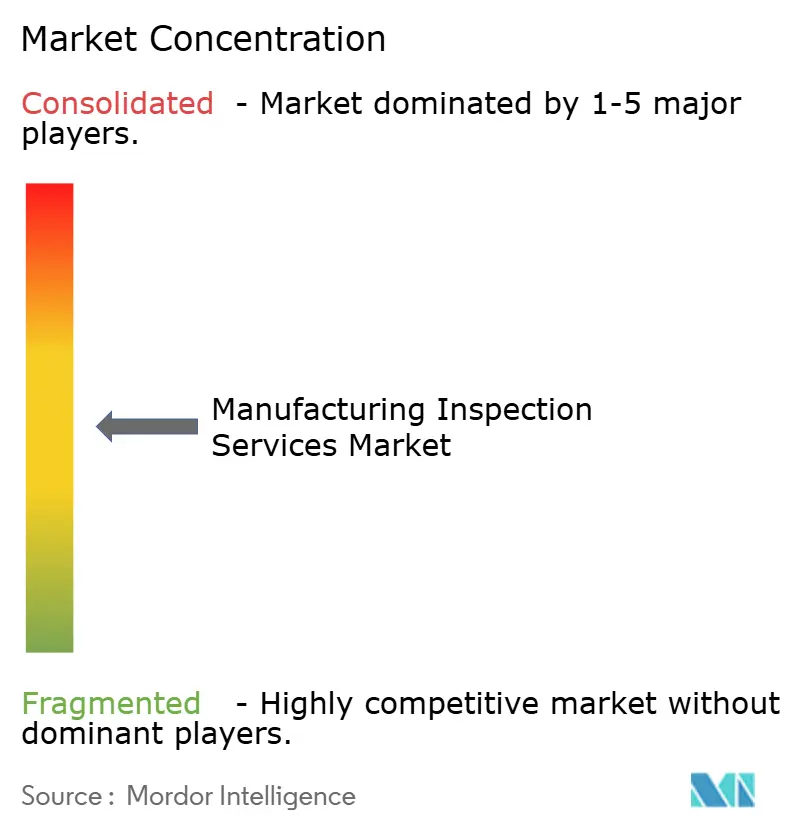
| Market Concentration | Medium |
Major Players *Disclaimer: Major Players sorted in no particular order Image © Mordor Intelligence. Reuse requires attribution under CC BY 4.0. | |
Manufacturing Inspection Services Market Analysis by Mordor Intelligence
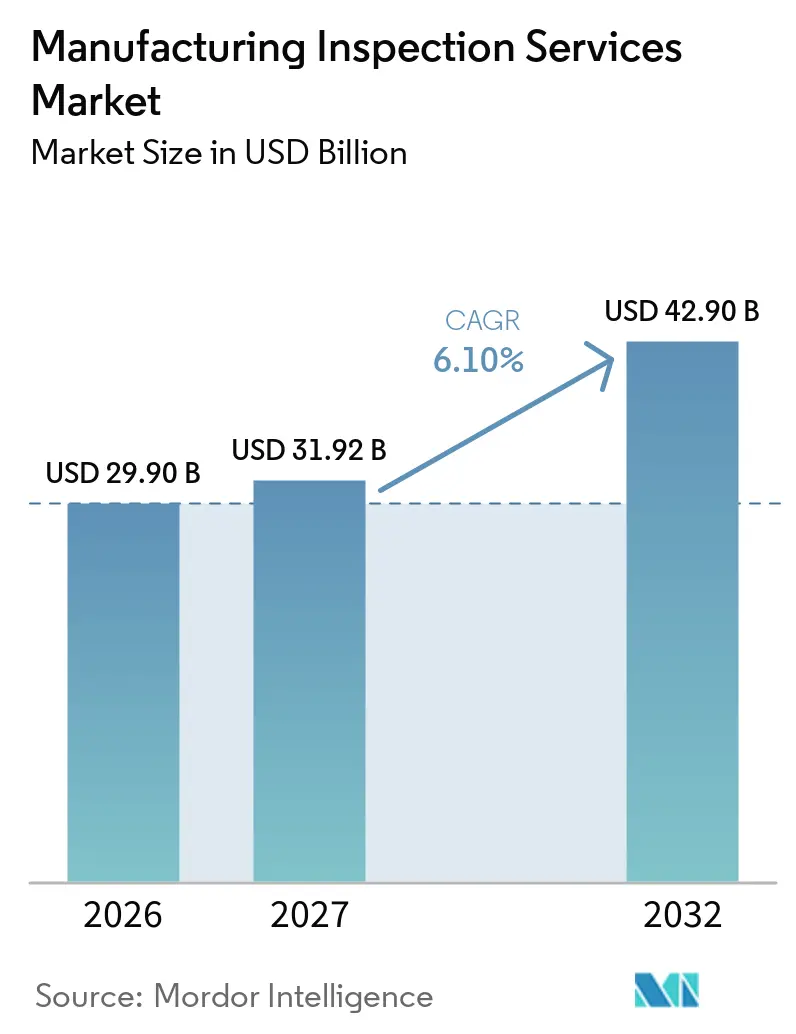
The Manufacturing Inspection Services Market size is projected to expand from USD 29.90 billion in 2026 and USD 31.92 billion in 2027 to USD 42.90 billion by 2032, registering a CAGR of 6.10% between 2027 and 2032.
The manufacturing inspection services market is supported by rising manufacturing activity and the growing need for independent quality verification across production processes, supplier qualification, and final product delivery. Manufacturers increasingly engage inspection service providers to verify compliance with technical specifications, identify defects, and maintain consistent quality standards across facilities and supplier networks. Regulatory changes and evolving industry requirements are raising expectations for inspection bodies, particularly in risk management, traceability, documentation, and data control. In addition, geographically dispersed supply chains are increasing the need for on-site verification. Buyers seek to assess supplier capabilities, validate production quality, and reduce the risk of non-conforming products across international markets. The market is also evolving as service providers integrate digital inspection reports, remote oversight, automated data capture, and technology-assisted inspection into conventional field-based services. These capabilities can improve reporting efficiency, enhance traceability, and support faster decision-making. However, adoption varies by industry, inspection complexity, and facility requirements. Meanwhile, greater automation in manufacturing facilities may reduce demand for certain repetitive manual inspection activities while creating opportunities for specialized inspection services for automated equipment and production systems. The limited availability of qualified inspectors remains another constraint, as technical expertise, industry-specific knowledge, and compliance requirements can restrict service capacity and affect the timely delivery of inspection services.
Key Report Takeaways
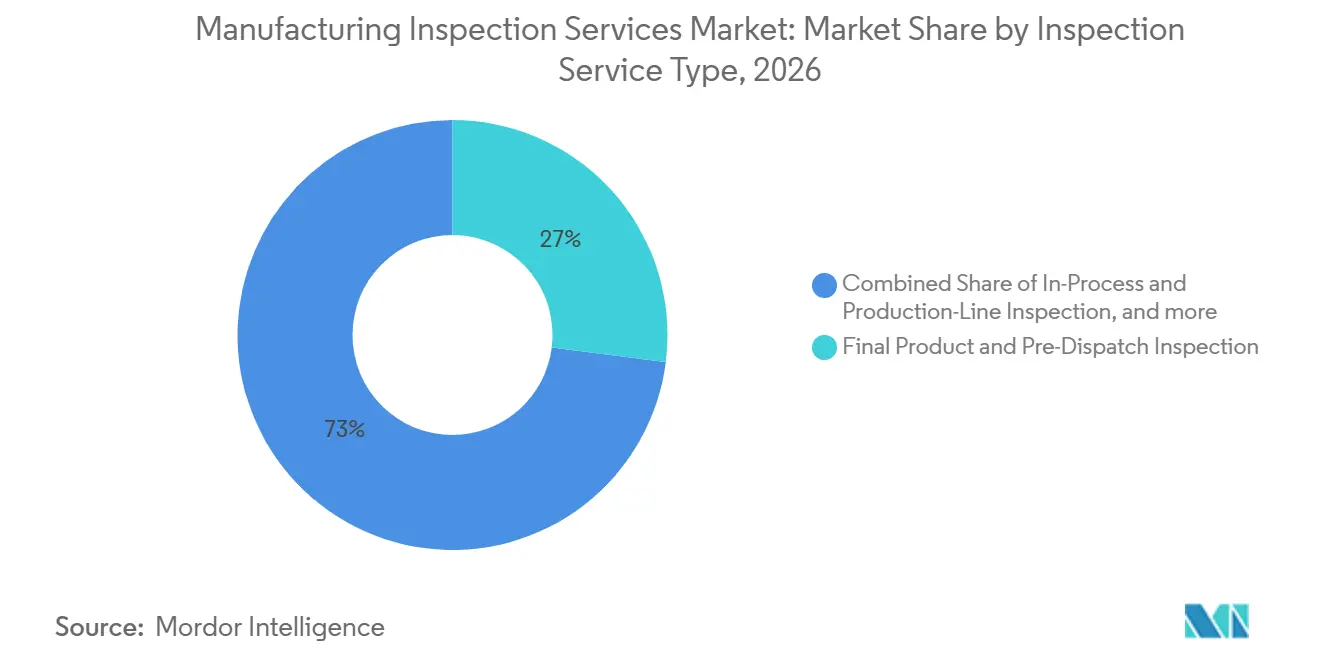
- By inspection service type, final product and pre-dispatch inspection accounted for 27% of the manufacturing inspection services market share in 2026, while manufacturing process and production surveillance inspection is projected to be the fastest-growing, with a 7.3% CAGR through 2032.
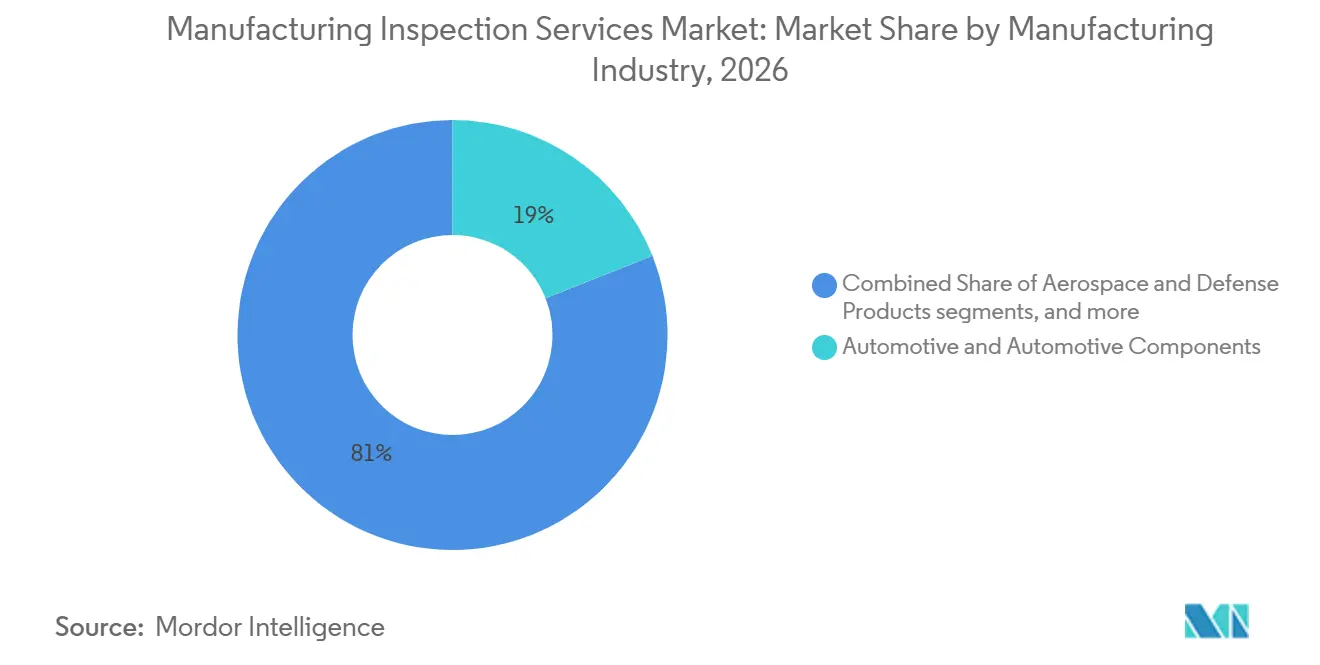
- By manufacturing industry, automotive and automotive components accounted for 19% of the manufacturing inspection services market size in 2026, while electronics, electrical equipment, and semiconductors are projected to be the fastest-growing, with a 7.4% CAGR through 2032.
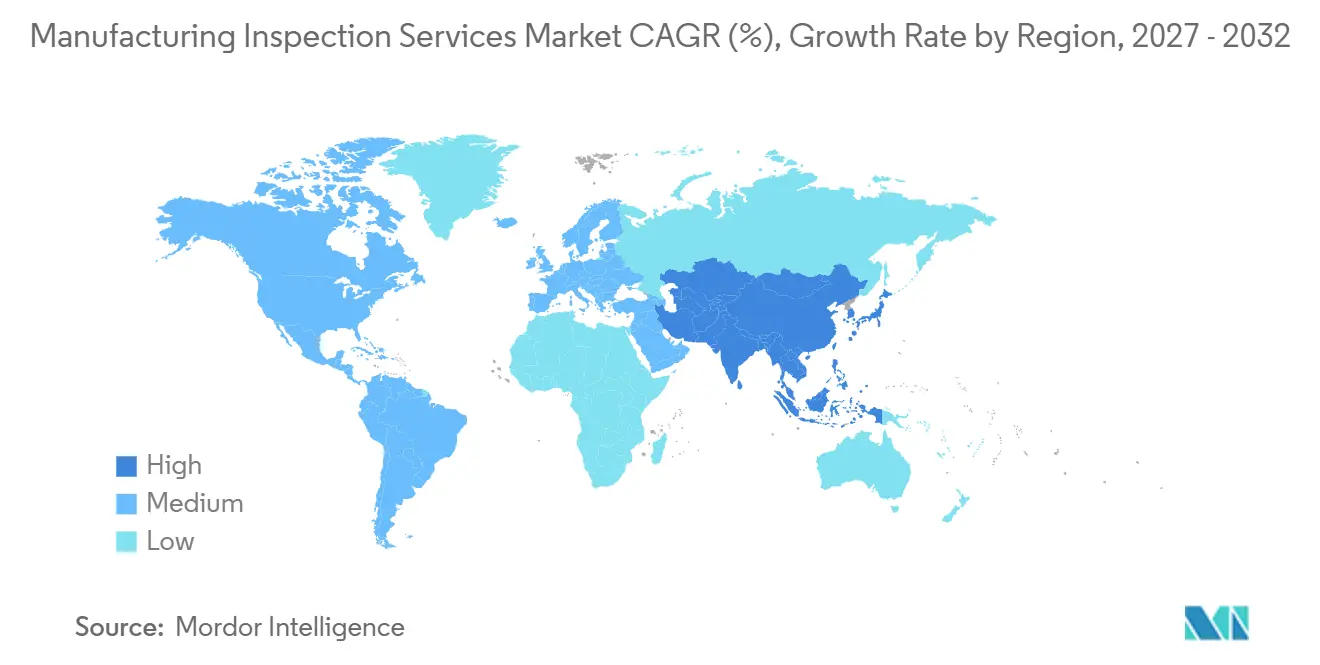
- By geography, Asia-Pacific held the leading position, accounting for a 53% market share in 2026 and is expected to remain the fastest-growing regional segment at a 6.5% CAGR through 2032.
Note: Market numbers in this report are based on Mordor Intelligence's proprietary estimation framework, which combines nine months of actuals with Q4 projections for base year 2026.
Market Trends and Insights
Drivers Impact Analysis of Manufacturing Inspection Services Market*
| Driver | (~) % Impact on CAGR Forecast | Geographic Relevance | Impact Timeline |
|---|---|---|---|
| Stringent Product Quality, Safety, and Regulatory Compliance Requirements | +1.8% | Global | Medium term (2-4 years) |
| Increasing Manufacturing Outsourcing and Global Supplier Networks | +1.5% | Global, with Asia-Pacific and South Asia as primary sourcing hubs | Long term (≥ 4 years) |
| Rising Costs of Product Defects, Recalls, and Quality Failures | +1.0% | North America and Europe, with spillover to Asia-Pacific | Short term (≤ 2 years) |
| Expansion of Manufacturing Investments and Supplier Diversification | +0.9% | Asia-Pacific, South and Southeast Asia, and the Middle East and Africa | Long term (≥ 4 years) |
| Growing Product Complexity and Precision Manufacturing Requirements | +0.6% | North America, Europe, and East Asia | Medium term (2-4 years) |
| Increasing Quality Control Requirements in Automotive, Electronics, and Aerospace Manufacturing | +0.4% | Global, with early gains in Germany, Japan, South Korea, and the United States | Medium term (2-4 years) |
| Source: Mordor Intelligence | |||
Stringent Product Quality, Safety, and Regulatory Compliance Requirements
ISO/IEC 17020:2026 is changing the requirements for inspection bodies and their customers. The standard adds risk-based thinking, changes independence classifications, and introduces stronger data control requirements[1]. Inspection bodies have until March 27, 2029, to transition, and providers that do not conform can lose accreditation validity. The change affects daily inspection planning because providers must show that their processes, personnel, and records are controlled. These requirements support demand in the manufacturing inspection services market because manufacturers need accredited partners with reliable reporting systems. IATF 16949 Rules, 6th Edition, also strengthened third-party audit requirements across automotive supply chains.
Increasing Manufacturing Outsourcing and Global Supplier Networks
Cross-border supply networks make it harder for buyers to observe quality conditions directly at supplier sites. World trade in goods and commercial services rose 8% to USD 34.89 trillion in 2025, while services represented 27.5% of global commerce. Third-party inspection gives buyers an independent record of whether goods meet agreed specifications before they leave the supplier. Manufacturing output expanded in Africa, Asia, and North America during 2025, increasing the number of locations that require inspection coverage. The manufacturing inspection services market benefits during supplier approval, when first-article, pre-production, and surveillance work is often required before regular orders begin.
Rising Costs of Product Defects, Recalls, and Quality Failures
Product recalls increase the value of preventing defects before goods leave the factory. The United States National Highway Traffic Safety Administration recorded 997 safety recalls covering 31.3 million units in 2025. The United States Consumer Product Safety Commission issued 420 recall notices in 2025, a 38% increase from the prior year. A recall can require remedies, regulatory action, legal claims, customer communication, and changes to production or supplier processes. The manufacturing inspection services market responds to this risk through pre-dispatch and in-process coverage for automotive components, consumer electronics, and medical devices.
Expansion of Manufacturing Investments and Supplier Diversification
New production capacity creates inspection needs before a supplier relationship is fully established. Global foreign direct investment increased 6% to USD 1.6 trillion in 2025, with developing Asia receiving USD 644 billion[2]. The United States manufacturing also recorded the largest industry-level increase in direct investment abroad in 2025, led by chemical and electrical equipment manufacturing. A new supplier usually needs a site audit, initial sample review, and production surveillance before it can gain repeat orders. This expands the manufacturing inspection services market in South and Southeast Asia, Mexico, Morocco, and Sub-Saharan Africa, where local quality systems can still be developing.
Restraints Impact Analysis of Manufacturing Inspection Services Market*
| Restraint | (~) % Impact on CAGR Forecast | Geographic Relevance | Impact Timeline |
|---|---|---|---|
| Pricing Pressure and Competition from In-House Quality Control | -1.2% | North America and Europe | Medium term (2-4 years) |
| Shortage of Qualified and Industry-Specialized Inspectors | -0.9% | Global, especially North America and Europe | Short term (≤ 2 years) |
| Limited Inspection Outsourcing in Highly Automated Manufacturing Facilities | -0.7% | East Asia, North America, and Germany | Long term (≥ 4 years) |
| Integration Challenges with Manufacturer Quality Management Systems | -0.5% | Global | Medium term (2-4 years) |
| Source: Mordor Intelligence | |||
Pricing Pressure and Competition from In-House Quality Control
Large manufacturers often maintain internal quality teams that can perform standard inspection tasks. This reduces the need for outsourced services, especially in stable production programs where processes and defect patterns are well understood. The United States Bureau of Labor Statistics projects nearly no net growth in quality control inspector employment through 2034, which suggests manufacturers are retaining established internal capacity. Pricing pressure is strongest in final product and pre-dispatch inspection because visual protocols can be reproduced internally. Providers in the manufacturing inspection services market must use technology, speed, or specialized knowledge to maintain their position.
Shortage of Qualified and Industry-Specialized Inspectors
The supply of experienced inspectors does not always match the needs of advanced manufacturing. The United States Bureau of Labor Statistics expects 69,900 annual openings for quality control inspectors by 2034, largely due to replacement needs. Advanced methods require certification and years of supervised experience before personnel can work independently, which limits the speed of workforce expansion. The United States Government Accountability Office reported that FDA inspection workforce vacancy rates reached 16% in June 2024, showing the effects of sustained staffing gaps. Limited talent can constrain the manufacturing inspection services market even where customer demand is strong.
*Our forecasts treat driver/restraint impacts as directional, not additive. The impact forecasts reflect baseline growth, mix effects, and variable interactions.
Manufacturing Inspection Services Market Segment Analysis
By Inspection Service Type:
Final Product and Pre-Dispatch Inspection Holds the Largest PositionFinal product and pre-dispatch inspection accounted for 27% of the manufacturing inspection services market share in 2026. Buyers use this service to identify defects before goods move to ports, distribution centers, or end users. This timing can reduce remediation costs when compared with addressing issues after delivery, when transport, replacement, and customer communication may already be necessary. The service is particularly relevant where buyers source from distant factories and need independent evidence that products meet stated specifications. It is also used in consumer goods, automotive components, and electronics, where visible defects or missing components can disrupt delivery. Final checks remain a core part of the manufacturing inspection services market because they provide a clear decision point before shipment. Pre-production material and component inspection remains important in medical devices and aerospace. These sectors require traceability and controlled inputs under frameworks such as ISO 13485 and AS9100. First-article inspection also supports supplier approval when companies add new production locations, since buyers need evidence that initial output meets stated requirements. Quality containment and reinspection can command higher fees when batches fail acceptance criteria and require rapid intervention. These services help manufacturers resolve immediate quality issues without stopping broader production activity, which supports their role in the manufacturing inspection services market.
Manufacturing process and production surveillance inspection is forecast to grow at a 7.3% CAGR from 2027 to 2032. This approach moves inspection earlier in the production cycle so that manufacturers can identify process drift before defects spread across a full run. ISO/IEC 17020:2026 supports this approach by requiring risk-based inspection program design. Electronics assembly and automotive production lines use in-process checks to monitor high-volume output and respond before affected batches are completed. Continuous observation can also show whether a corrective action has addressed the cause of a defect, rather than only confirming the condition of a finished item. This can help manufacturers manage recurring issues across longer production runs. Remote surveillance with digital oversight is also becoming part of inspection planning, especially when customers need coverage across multiple sites in the manufacturing inspection services market.

By Manufacturing Industry:
Automotive and Automotive Components Lead DemandAutomotive and automotive components represented 19% of the manufacturing inspection services market size in 2026. The segment relies on extensive supplier controls because a defect can affect vehicle safety, warranty costs, and production continuity. IATF 16949 Rules 6th Edition has reinforced third-party audit requirements since January 2025. Original equipment manufacturers such as Ford and General Motors also use customer-specific requirements across their supplier networks. These conditions make inspection spending less discretionary than in many other manufacturing categories. Automotive suppliers need reliable verification from incoming materials through final component delivery, making the segment an important base for the manufacturing inspection services market. Aerospace and defense operations require close control of components, materials, and production records. First-article requirements and traceability rules create a specialized inspection environment in which documentation is as important as physical verification. Industrial machinery, fabricated metals, chemicals, and plastics generate high inspection volumes when buyer specifications and export requirements are strict. Pharmaceutical and medical device manufacturing also requires rigorous controls under good manufacturing practice frameworks and ISO 13485.
Electronics, electrical equipment, and semiconductors are forecast to grow at a 7.4% CAGR from 2027 to 2032. Advanced packaging and smaller components make defect detection more demanding because minor deviations can affect larger production yields. The segment requires machine vision, AI-assisted defect analytics, and conventional metrology alongside trained human review. Human oversight remains important when a system identifies a potential defect that requires technical interpretation or a decision about product acceptance. These requirements make inspection an operating requirement rather than a final administrative step in advanced facilities. Production capacity is expanding in the United States, South Korea, Japan, and Taiwan, which increases the need for capable inspection programs. Textiles, apparel, consumer goods, and furniture remain high-volume categories. However, standardized visual inspection creates strong price competition in Asia-Pacific sourcing locations and affects service positioning in the manufacturing inspection services market.
Geography Analysis
APAC Manufacturing Inspection Services Market
Asia-Pacific represented 53% of the manufacturing inspection services market share in 2026. It is also the fastest-growing region, with a projected CAGR of 6.5% during 2027-2032. China generates large inspection volumes through its export-oriented electronics, automotive components, textiles, and consumer goods facilities. India is adding manufacturing capacity in pharmaceuticals, electronics, and capital goods, which requires supplier qualification before major sourcing volumes begin. Japan, South Korea, and Taiwan require high-complexity inspection in semiconductors, precision machinery, and automotive production. Vietnam, Thailand, Indonesia, and Malaysia are expanding as production locations and as operating bases for local inspection providers.
North America and Europe Manufacturing Inspection Services Market
North America and Europe remain substantial and technically demanding parts of the manufacturing inspection services market. Manufacturing also recorded the largest industry-level increase in United States direct investment abroad in 2025[3]. European demand is anchored in automotive, aerospace, industrial equipment, and pharmaceutical clusters across Germany, France, Italy, the United Kingdom, and Poland. Mexico is receiving nearshoring investment and needs new inspection programs as suppliers begin serving the United States end markets.
MEA and South America Manufacturing Inspection Services Market
The Middle East and Africa is developing as a manufacturing inspection location through industrial diversification programs in Saudi Arabia and the UAE. Investment in petrochemicals, food processing, and construction materials supports a wider need for inspection services. Bureau Veritas reported 16.6% organic revenue growth in its Middle East and Africa segment in 2025, its highest regional rate. African manufacturing recorded the fastest regional quarterly growth in Q3 2025, supporting interest from regional and global providers. Brazil anchors South American demand through automotive, food and beverage, and chemical production. Chile, Colombia, and Argentina provide smaller opportunities as regional supply chains adjust to global trade changes.
Competitive Landscape
The manufacturing inspection services market is moderately concentrated at the global level. SGS SA, Bureau Veritas SA, and Intertek Group plc are among the diversified providers operating across regions and manufacturing categories. Each reported organic growth of 4%-7% in 2025, showing continued demand for testing, inspection, and certification services. Regional specialists remain essential where quick deployment and sector experience matter more than a broad global portfolio. This creates price competition in consumer goods and garment inspection across South and Southeast Asia.
Large providers are using acquisitions to broaden their technical reach and geographic coverage. Bureau Veritas signed an agreement to acquire Lotusworks in April 2026, adding capabilities in data center and semiconductor quality assurance. SGS completed the acquisition of Applied Technical Services in January 2026, strengthening specialized testing, inspection, calibration, and forensic capabilities in North America. SGS also acquired Murray-Brown Laboratories in March 2026 to expand food safety and nutraceutical testing capabilities. These moves give larger groups stronger access to technical segments and customer relationships.
Specialists such as QIMA, Pro QC International, HQTS, Sofeast, and V-Trust compete through accessible, on-demand inspection models. Digital booking and reporting can shorten response times for small and medium-sized manufacturers. Machine vision and AI-assisted defect detection are becoming important where electronics and precision manufacturing require consistent detection at very low defect levels. QIMA added TA Associates as a strategic equity partner in March 2025 to develop its digital inspection platforms and AI capability. ISO/IEC 17020:2026 can favor providers that have the resources to upgrade controls, reporting, and risk management processes.
Manufacturing Inspection Services Industry Leaders
-
SGS SA
-
Bureau Veritas SA
-
Intertek Group plc
-
TÜV SÜD AG
-
DEKRA SE
- *Disclaimer: Major Players sorted in no particular order
Manufacturing Inspection Services Market Companies Covered in this Report
- SGS SA
- Bureau Veritas SA
- Intertek Group plc
- TÜV SÜD AG
- TÜV Rheinland AG
- TÜV NORD Group
- DEKRA SE
- UL Solutions Inc.
- QIMA
- Pro QC International
- HQTS Group
- V-Trust Inspection Service
- Cotecna Inspection SA
- China Certification & Inspection Group (CCIC)
- TRIGO Group
- Formel D Group
- SQA Services, Inc.
- Insight Quality Services
- Tetra Inspection
- Sofeast Limited
- Applus+
- RINA S.p.A.
- Kiwa Group
- Apave Group
Recent Industry Developments in Manufacturing Inspection Services Market
- April 2026: Bureau Veritas signed an agreement to acquire Lotusworks, a provider of commissioning, quality assurance and quality control, calibration, and maintenance services for mission-critical facilities. The proposed acquisition strengthens Bureau Veritas' capabilities in data centers and semiconductor manufacturing, expanding its presence in technically complex environments that require specialized quality assurance and verification.
- February 2026: SGS announced the acquisition of Murray-Brown Laboratories, an ISO/IEC 17025-accredited food testing laboratory in Denver, Colorado. The acquisition expands SGS's North American food safety and nutraceutical testing capabilities, including microbial analysis and the detection of pesticides and mycotoxins, supporting manufacturers' product quality and regulatory compliance requirements.
- January 2026: SGS completed the acquisition of Applied Technical Services, a North American provider of specialized testing, inspection, calibration, and forensic services. The transaction strengthens SGS's technical service portfolio and expands its capabilities across industrial inspection and testing applications.
Global Manufacturing Inspection Services Market Report Scope
The Manufacturing Inspection Services Market Report is Segmented by Inspection Services Type (Pre-Production Material and Component Inspection, and More), by Manufacturing Industry (Automotive and Automotive Components, Aerospace and Defense Products, Food and Beverage Products, and More), and by Geography (Asia-Pacific, Europe, and More). The Report Offers Market Size and Forecasts in Value (USD) for all the Above Segments.
Segmentation Overview
| Pre-Production Material and Component Inspection |
| First-Article and Initial Production Inspection |
| In-Process and Production-Line Inspection |
| Final Product and Pre-Dispatch Inspection |
| Manufacturing Process and Production Surveillance Inspection |
| Quality Containment and Reinspection Services |
| Automotive and Automotive Components |
| Aerospace and Defense Products |
| Electronics, Electrical Equipment, and Semiconductors |
| Industrial Machinery, Equipment, and Fabricated Metals |
| Chemicals, Plastics and Industrial Materials |
| Food and Beverage Products |
| Pharmaceuticals, Medical Devices, and Life Sciences Products |
| Textiles, Apparel, Footwear, and Accessories |
| Furniture, Homeware, Toys, and Other Consumer Products |
| Building Materials and Construction Products |
| Packaging, Paper, and Printed Products |
| Other Manufactured Products |
| North America | United States |
| Canada | |
| Mexico | |
| Europe | Germany |
| United Kingdom | |
| France | |
| Italy | |
| Spain | |
| Netherlands | |
| Poland | |
| Turkey | |
| Russia | |
| Rest of Europe | |
| Asia-Pacific | China |
| Japan | |
| India | |
| South Korea | |
| Taiwan | |
| Australia | |
| ASEAN | |
| Rest of Asia-Pacific | |
| Middle East and Africa | Saudi Arabia |
| United Arab Emirates | |
| Qatar | |
| South Africa | |
| Egypt | |
| Nigeria | |
| Rest of Middle East | |
| Rest of Africa | |
| South America | Brazil |
| Argentina | |
| Rest of South America (Chile, Colombia, Peru, etc.) |
| By Inspection Service Type | Pre-Production Material and Component Inspection | |
| First-Article and Initial Production Inspection | ||
| In-Process and Production-Line Inspection | ||
| Final Product and Pre-Dispatch Inspection | ||
| Manufacturing Process and Production Surveillance Inspection | ||
| Quality Containment and Reinspection Services | ||
| By Manufacturing Industry | Automotive and Automotive Components | |
| Aerospace and Defense Products | ||
| Electronics, Electrical Equipment, and Semiconductors | ||
| Industrial Machinery, Equipment, and Fabricated Metals | ||
| Chemicals, Plastics and Industrial Materials | ||
| Food and Beverage Products | ||
| Pharmaceuticals, Medical Devices, and Life Sciences Products | ||
| Textiles, Apparel, Footwear, and Accessories | ||
| Furniture, Homeware, Toys, and Other Consumer Products | ||
| Building Materials and Construction Products | ||
| Packaging, Paper, and Printed Products | ||
| Other Manufactured Products | ||
| By Geography | North America | United States |
| Canada | ||
| Mexico | ||
| Europe | Germany | |
| United Kingdom | ||
| France | ||
| Italy | ||
| Spain | ||
| Netherlands | ||
| Poland | ||
| Turkey | ||
| Russia | ||
| Rest of Europe | ||
| Asia-Pacific | China | |
| Japan | ||
| India | ||
| South Korea | ||
| Taiwan | ||
| Australia | ||
| ASEAN | ||
| Rest of Asia-Pacific | ||
| Middle East and Africa | Saudi Arabia | |
| United Arab Emirates | ||
| Qatar | ||
| South Africa | ||
| Egypt | ||
| Nigeria | ||
| Rest of Middle East | ||
| Rest of Africa | ||
| South America | Brazil | |
| Argentina | ||
| Rest of South America (Chile, Colombia, Peru, etc.) | ||
Key Questions Answered in the Report
What is the projected growth rate for manufacturing inspection services?
The manufacturing inspection services market is projected to grow at a 6.1% CAGR from 2027 to 2032, rising from USD 29.9 billion in 2026 to USD 42.9 billion by 2032. Demand is supported by supplier qualification, compliance requirements, wider production networks, the need for documented quality verification, and rising consequences when product defects reach customers across regulated and high-volume product categories during supplier transitions across several global regions.
Which inspection service has the largest share?
Final product and pre-dispatch inspection leads with a 27% share in 2026. It helps buyers verify that finished goods meet specifications before shipment and before delivery risks become more difficult to manage.
Which inspection service is expanding fastest?
Manufacturing process and production surveillance inspection is forecast to grow at a 7.3% CAGR through 2032. It supports earlier defect detection during active production rather than after completion, reducing the risk that defects affect entire production runs.
Which manufacturing category generates the most demand?
Automotive and automotive components is the largest category, accounting for a 19% share in 2026. Extensive supplier controls and safety obligations support recurring inspection needs across multi-tier supply chains.
Which manufacturing category is expected to grow fastest?
Electronics, electrical equipment, and semiconductors are forecast to grow at a 7.4% CAGR through 2032. Smaller components and advanced packaging require more precise defect detection, metrology, and specialist technical review.
Which region leads global demand?
Asia-Pacific leads with a 53% share in 2026 and is also forecast to record the fastest regional CAGR of 6.5% through 2032. Its large export manufacturing base sustains inspection demand across multiple sectors and varied supplier locations.