
Manufacturing Inspection Equipment Market Size and Share
Market Overview
| Study Period | 2021 - 2032 |
|---|---|
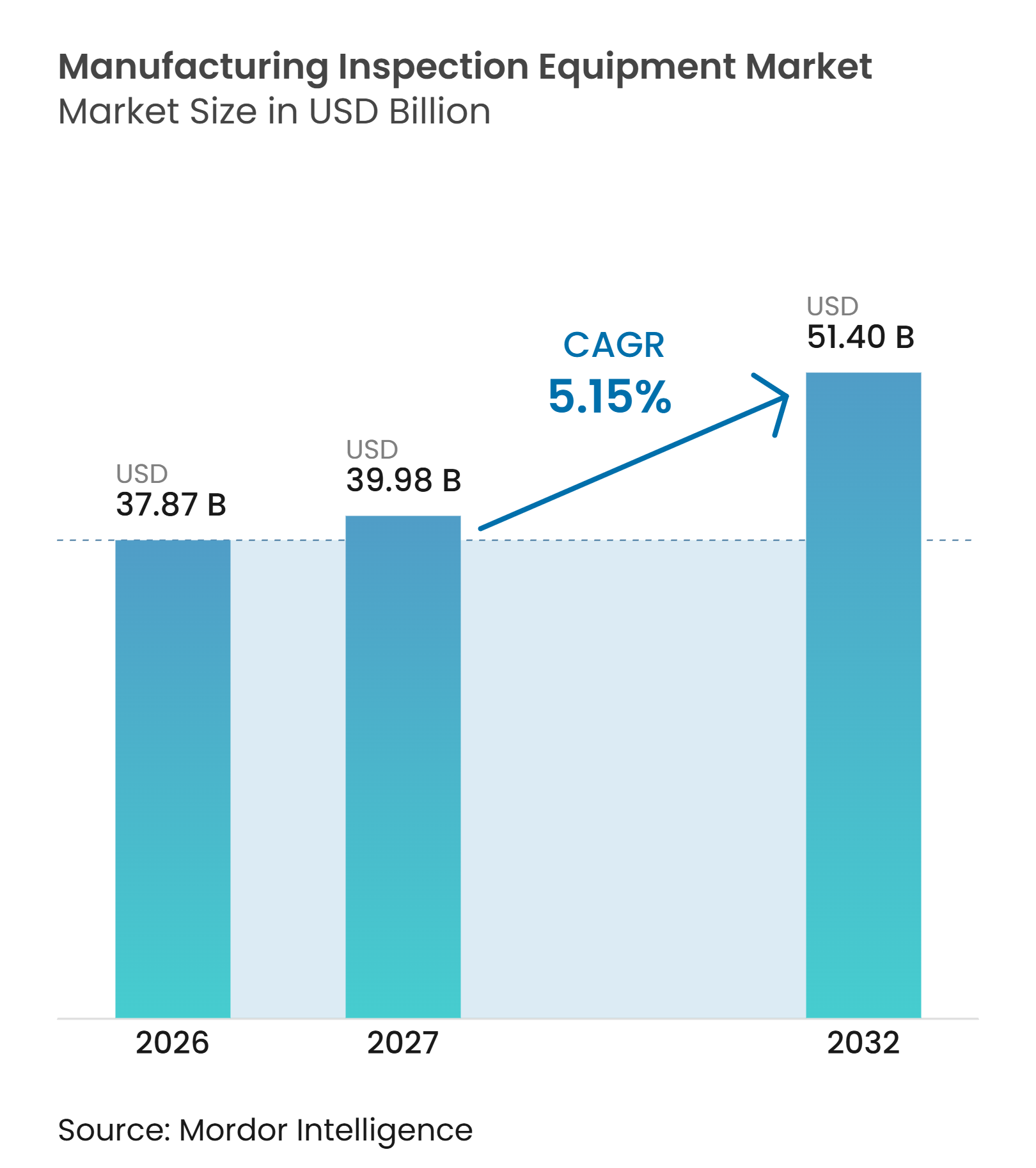
| Market Size (2027) | USD 39.98 Billion |
| Market Size (2032) | USD 51.40 Billion |
| Growth Rate (2027 - 2032) | 5.15 % |
| Fastest Growing Market | Asia-Pacific |
| Largest Market | Asia-Pacific |
| Market Concentration | Medium |
Major Players *Disclaimer: Major Players sorted in no particular order Image © Mordor Intelligence. Reuse requires attribution under CC BY 4.0. | |
Manufacturing Inspection Equipment Market Analysis by Mordor Intelligence
The Manufacturing Inspection Equipment Market size was valued at USD 37.87 billion in 2026 and is estimated to grow from USD 39.98 billion in 2027 to reach USD 51.40 billion by 2032, at a CAGR of 5.15% during the forecast period (2027-2032).
The Manufacturing Inspection Equipment Market is shifting from end-of-line checks to measurement systems that operate during production. Semiconductors, batteries, and advanced electronics projects are creating demand for tools that identify defects before they reduce yield. New quality requirements also make inspection investment more closely tied to compliance, documentation, and traceability. Vendors are responding through broader technology portfolios, service capabilities, and products that can connect with established factory systems. The integration of automated inspection, machine vision, and real-time data analysis is further supporting the shift toward continuous quality monitoring. The strongest opportunity lies where manufacturers need optical, dimensional, and non-destructive inspection data to work together in a production environment.
Key Report Takeaways
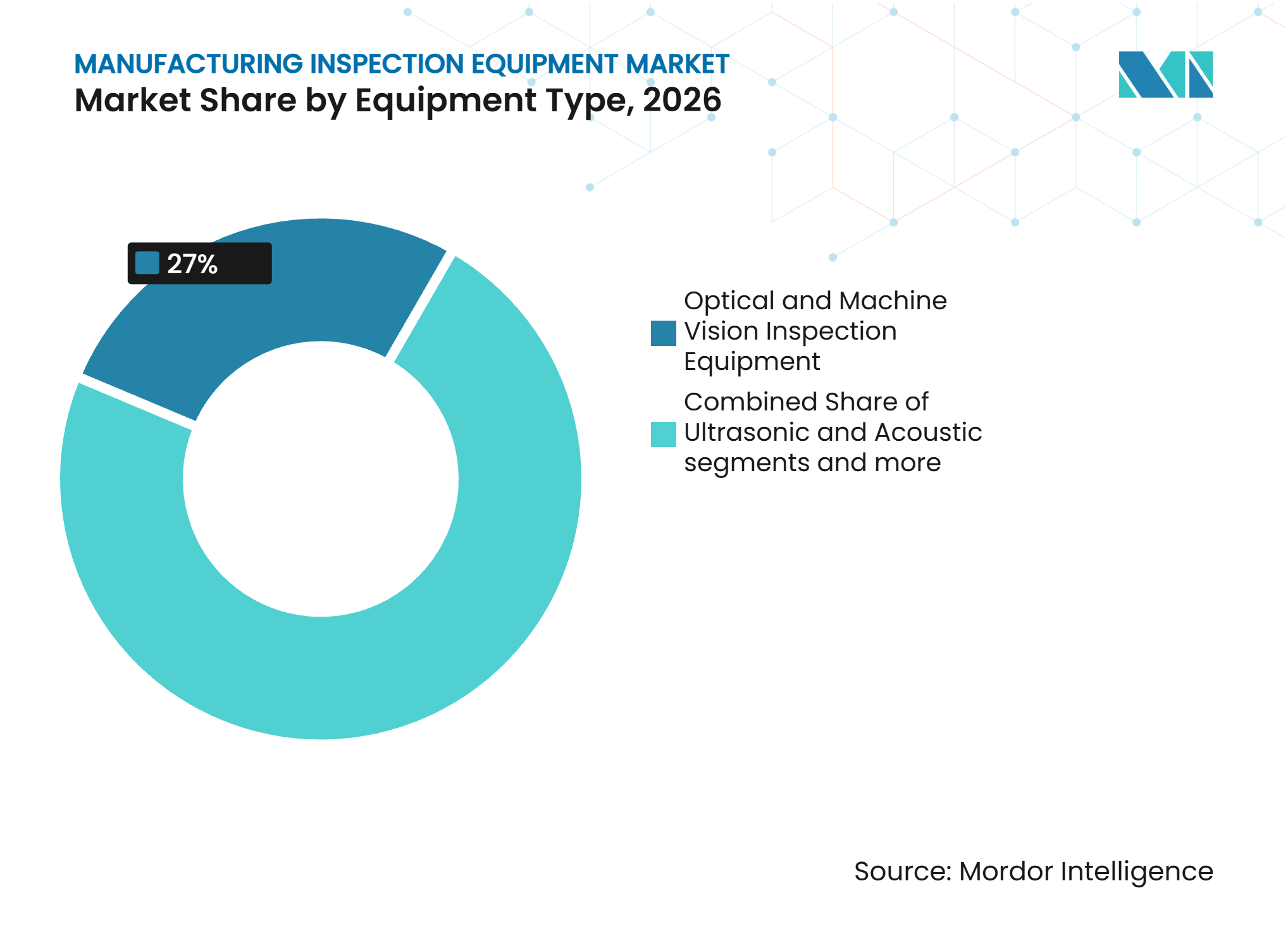
- By equipment type, optical and machine vision inspection equipment held 27% of the Manufacturing Inspection Equipment Market share in 2026, while specialized semiconductor inspection equipment is forecast to grow at an 8.5% CAGR through 2032.
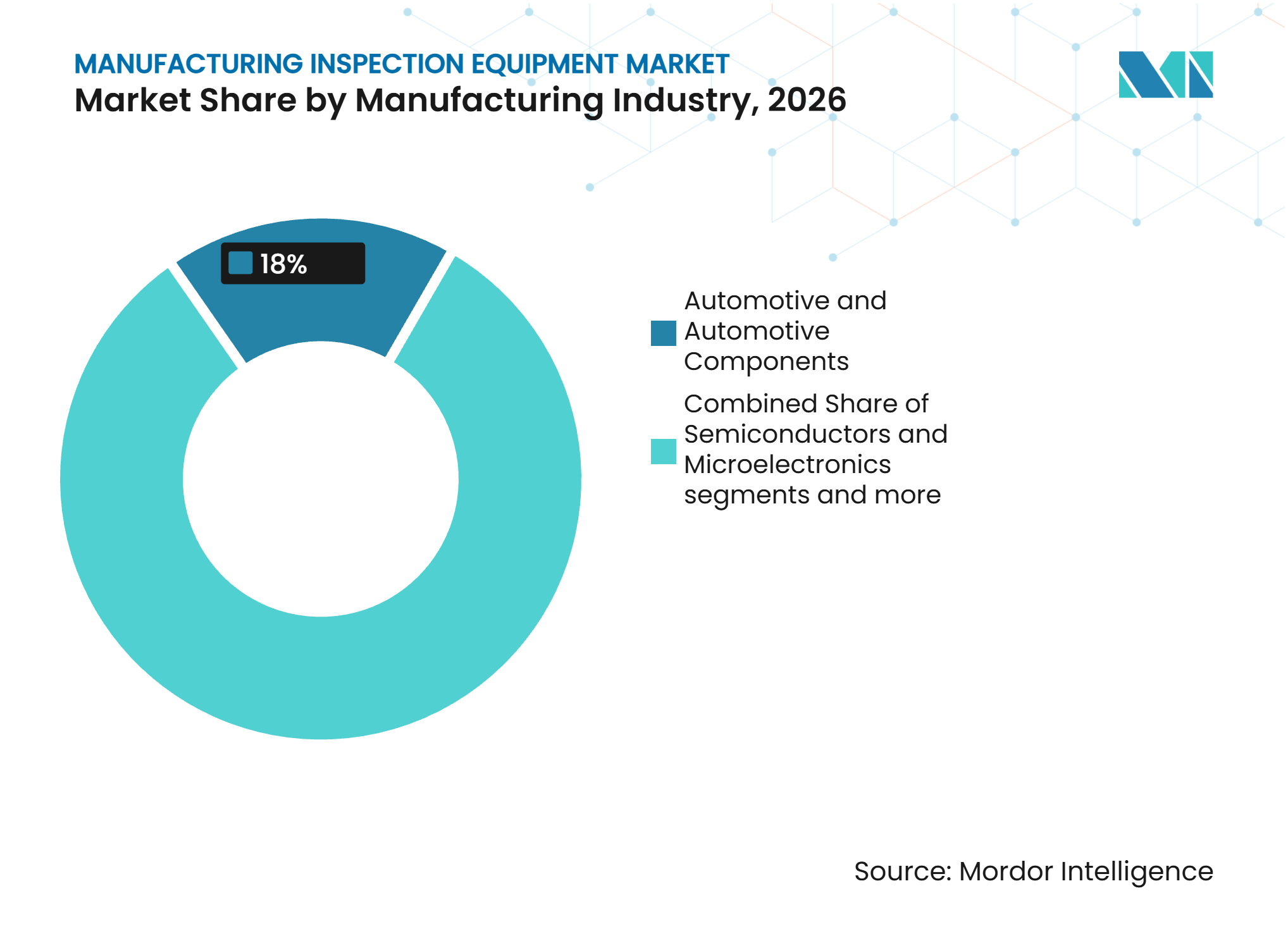
- By manufacturing industry, automotive and automotive components held 18% of the Manufacturing Inspection Equipment Market size in 2026, while semiconductors and microelectronics are forecast to grow at an 8.8% CAGR through 2032.
- By geography, Asia-Pacific held 38% of the Manufacturing Inspection Equipment Market share in 2026 and is forecast to grow at a 6.8% CAGR through 2032.
Note: Market numbers in this report are based on Mordor Intelligence's proprietary estimation framework, which combines nine months of actuals with Q4 projections for base year 2026.
Market Trends and Insights
Drivers Impact Analysis of Manufacturing Inspection Equipment Market*
| Driver | (~) % Impact on CAGR Forecast | Geographic Relevance | Impact Timeline |
|---|---|---|---|
| Stringent Product Quality, Safety and Regulatory Requirements | +1.2% | Global, with higher intensity in North America, Europe, Japan, and South Korea | Short term (≤ 2 years) to Medium term (2-4 years) |
| Increasing Manufacturing Automation and Quality Control Investments | +1.0% | Global, especially North America, Western Europe, China, and Japan | Short term (≤ 2 years) to Medium term (2-4 years) |
| Expansion of Semiconductor, Electronics and Battery Manufacturing | +0.9% | Asia-Pacific, with spillover to North America and Europe | Medium term (2-4 years) to Long term (≥ 4 years) |
| Rising Product Complexity and Precision Manufacturing Requirements | +0.7% | Global, with highest intensity in Asia-Pacific, Europe, and North America | Long term (≥ 4 years) |
| Growing Demand for Defect Detection and Production Yield Improvement | +0.6% | Global, with earlier adoption in Asia-Pacific and North America | Short term (≤ 2 years) to Medium term (2-4 years) |
| Increasing Quality Requirements in Automotive, Aerospace and Medical Device Manufacturing | +0.5% | Global, with high compliance intensity in Europe, North America, and Japan | Medium term (2-4 years) |
| Source: Mordor Intelligence | |||
Stringent Product Quality, Safety, and Regulatory Requirements
The Manufacturing Inspection Equipment Market benefits when new compliance rules require manufacturers to document and verify production quality. The IATF 16949 Rules 6th Edition took effect on January 1, 2025, with expanded manufacturing process and product audits included alongside quality management system audits. Major non-conformities require corrective action within 15 days under the revised rules, which increases attention to evidence collected from the production line.[1] The FDA Quality Management System Regulation takes effect on February 2, 2026, replacing the prior medical device quality system regulation and incorporating ISO 13485 requirements by reference.[2] These concurrent changes matter for suppliers that serve both automotive and medical customers because their inspection records must support separate audit needs. ISO 9001, IATF 16949, AS9100, and ISO 13485 therefore keep inspection systems connected to quality management programs rather than isolated capital purchases.
Increasing Manufacturing Automation and Quality Control Investments
The Manufacturing Inspection Equipment Market is supported by factory investments that combine automation, machine data, and quality control. The need is especially clear where manual sampling cannot provide a fast enough response to defects or equipment drift. NIST estimated annual costs of discrete manufacturing defects at USD 32 billion to USD 58.6 billion and annual plant downtime at USD 245 billion in its 2025 assessment of the United States manufacturing economy.[3] These costs support the use of in-line inspection when the equipment can prevent scrap, rework, or unplanned downtime. Automated systems also give manufacturers a more consistent record for process verification and corrective action. As factories add connected equipment, suppliers that support factory data flows and existing control systems have a clearer path to deployment.
Expansion of Semiconductor, Electronics, Battery, and Yield-Control Capacity
The Manufacturing Inspection Equipment Market is gaining from semiconductor and battery investments because both activities require frequent defect detection. SEMI reported that global front-end semiconductor fab equipment spending reaches USD 110 billion in 2025 and is projected to reach USD 130 billion in 2026. It also reported 18 new semiconductor fab construction projects beginning in 2025, supporting demand for wafer, reticle, and advanced packaging inspection. Advanced capacity produces a greater need for process control because smaller features increase the cost of undetected defects. A 2025 Nature Communications study found that 2D X-ray inspection costs USD 0.05 per kWh of cells inspected, compared with a USD 7.50 per kWh field-failure cost at a 2.5% battery pack failure rate. The same study reported that factory scrap can reach 90% during battery production ramp-up, placing inspection within the economics of yield improvement.
Rising Product Complexity and Precision Manufacturing Requirements
The Manufacturing Inspection Equipment Market serves products whose internal features and dimensional tolerances cannot be assessed by older visual systems alone. Semiconductor architectures, solid-state batteries, and advanced power electronics require detection methods that can identify defects below the surface. SEMI reported that growth in leading-edge manufacturing capacity is raising the need for advanced equipment at 7 nm and below. In aerospace, AS9100 requires a First Article Inspection when a design or process changes, making traceable measurement capability important across production transitions. Delamination, micro-cracks, and gas pockets may require ultrasonic, computed tomography, or acoustic inspection instead of optical measurement. This expands the role of suppliers that can provide multi-sensor systems without interrupting production throughput.
Restraints Impact Analysis of Manufacturing Inspection Equipment Market*
| Restraint | (~) % Impact on CAGR Forecast | Geographic Relevance | Impact Timeline |
|---|---|---|---|
| Equipment Integration and Production Line Compatibility Challenges | -0.8% | Global, with greater difficulty in Asia-Pacific legacy plants and European small and medium-sized suppliers | Medium term (2-4 years) |
| Budget Constraints Among SMEs and Smaller Manufacturers | -0.6% | Global, especially South and Southeast Asia, Eastern Europe, and South America | Short term (≤ 2 years) to Medium term (2-4 years) |
| Shortage of Skilled Inspection Equipment Operators | -0.5% | Global, with more acute shortages in North America and Western Europe | Short term (≤ 2 years) |
| Calibration, Maintenance, and Equipment Lifecycle Costs | -0.4% | Global, with a greater effect in developing manufacturing markets | Medium term (2-4 years) to Long term (≥ 4 years) |
| Source: Mordor Intelligence | |||
Equipment Integration and Production Line Compatibility Challenges
The Manufacturing Inspection Equipment Market faces slower adoption because new systems must connect to older production equipment. Long-established factories often use different communication protocols, data formats, and mechanical interfaces across individual lines. These differences can require custom work to align sampling rates, alarm rules, traceability records, and quality data with programmable logic controllers, manufacturing execution systems, and enterprise resource planning systems. The delay can move a buyer toward a smaller upgrade or a manual procedure rather than a full in-line deployment. The barrier is most visible in legacy plants and small supplier facilities that cannot stop production for extended commissioning. Equipment providers can reduce this pressure by offering compatible connectors, clear implementation support, and systems designed to work with common manufacturing platforms.
Budget, Skills, and Lifecycle Constraints for Smaller Manufacturers
The Manufacturing Inspection Equipment Market also faces an adoption gap among smaller manufacturers that operate under the same quality rules as larger original equipment manufacturers. Equipment costs are only one part of the investment because training, calibration, maintenance, and workflow changes also require funding. NIST noted in 2025 that inspection automation is becoming more accessible to smaller manufacturers, although workforce preparation remains important for adoption. The Department of Labor awarded more than USD 86 million in skills-training grants across 14 states in September 2025, showing the scale of the workforce issue in manufacturing sectors. Some smaller firms will continue to use outsourced quality control where dedicated systems cannot be financed. Equipment-as-a-service models, shared inspection capacity, and practical operator support can reduce the difference in inspection intensity between large manufacturers and their suppliers.
*Our forecasts treat driver/restraint impacts as directional, not additive. The impact forecasts reflect baseline growth, mix effects, and variable interactions.
Manufacturing Inspection Equipment Market Segment Analysis
By Equipment Type:
Optical Systems Hold the Largest Base While Semiconductor Inspection Grows FastestOptical and machine vision inspection equipment held 27% of the Manufacturing Inspection Equipment Market share in 2026. Its broad installed base spans electronics assembly, automotive body inspection, pharmaceutical visual inspection, and food and beverage production lines. The category includes 2D area-scan cameras, 3D structured-light systems, hyperspectral imaging, and AI-enabled vision tools. This variety allows optical inspection to support both basic presence checks and more detailed surface-defect analysis. Dimensional and Geometric Inspection Equipment remains important for aerospace and medical device machining, where suppliers need measured evidence that components meet specified tolerances.
Specialized semiconductor inspection equipment is projected to expand at an 8.5% CAGR through 2032, giving it the strongest equipment-type growth rate in the Manufacturing Inspection Equipment Market. The category supports advanced-node production in the Manufacturing Inspection Equipment Market, where wafers, reticles, and packaging steps need repeated inspection to limit yield loss. Radiographic and Computed Tomography Inspection Equipment is also becoming more relevant for batteries because it can inspect internal structures that optical systems cannot see. Leak and seal integrity systems support food, beverage, and pharmaceutical uses where package protection is central to product quality. Material identification systems have a related role in aerospace and pharmaceutical supply chains that require verification of incoming material. Electromagnetic, magnetic, thermal, and infrared systems retain focused roles in metal fabrication and process industries, where in-line measurement can replace periodic sampling.



By Manufacturing Industry:
Automotive Holds the Largest Share While Semiconductors Lead GrowthAutomotive and automotive components accounted for 18% of the Manufacturing Inspection Equipment Market size in 2026. The segment uses inspection across body-in-white measurement, powertrain tolerancing, electronics assembly, and supplier quality processes. The 2025 IATF audit rule changes increase attention to production process audits, product audits, and corrective action timing. Aerospace, defense, pharmaceutical, and medical device production also require high levels of inspection because they have detailed verification and traceability requirements. AS9100 and the FDA QMSR create continuing demand for documentation, inspection evidence, and upgraded verification procedures.
Semiconductors and microelectronics are projected to grow at an 8.8% CAGR through 2032, the highest manufacturing-industry growth rate in the Manufacturing Inspection Equipment Market. Leading-edge fab capacity needs real-time process-control inspection because defects can affect production yield at multiple stages. Batteries and Energy Storage Products are another fast-growing use case due to microscopic defect sensitivity and the cost of field failures. Industrial machinery, metal products, fabrication, chemicals, plastics, and industrial materials provide a stable base for demand as factories shift from sampling to continuous measurement. Food and beverage, pharmaceuticals, and medical devices remain steady users because product safety, contamination, and package-integrity needs do not depend only on expansion projects. The Manufacturing Inspection Equipment Industry therefore serves both high-growth capital programs and recurring compliance-led replacement needs.

Geography Analysis
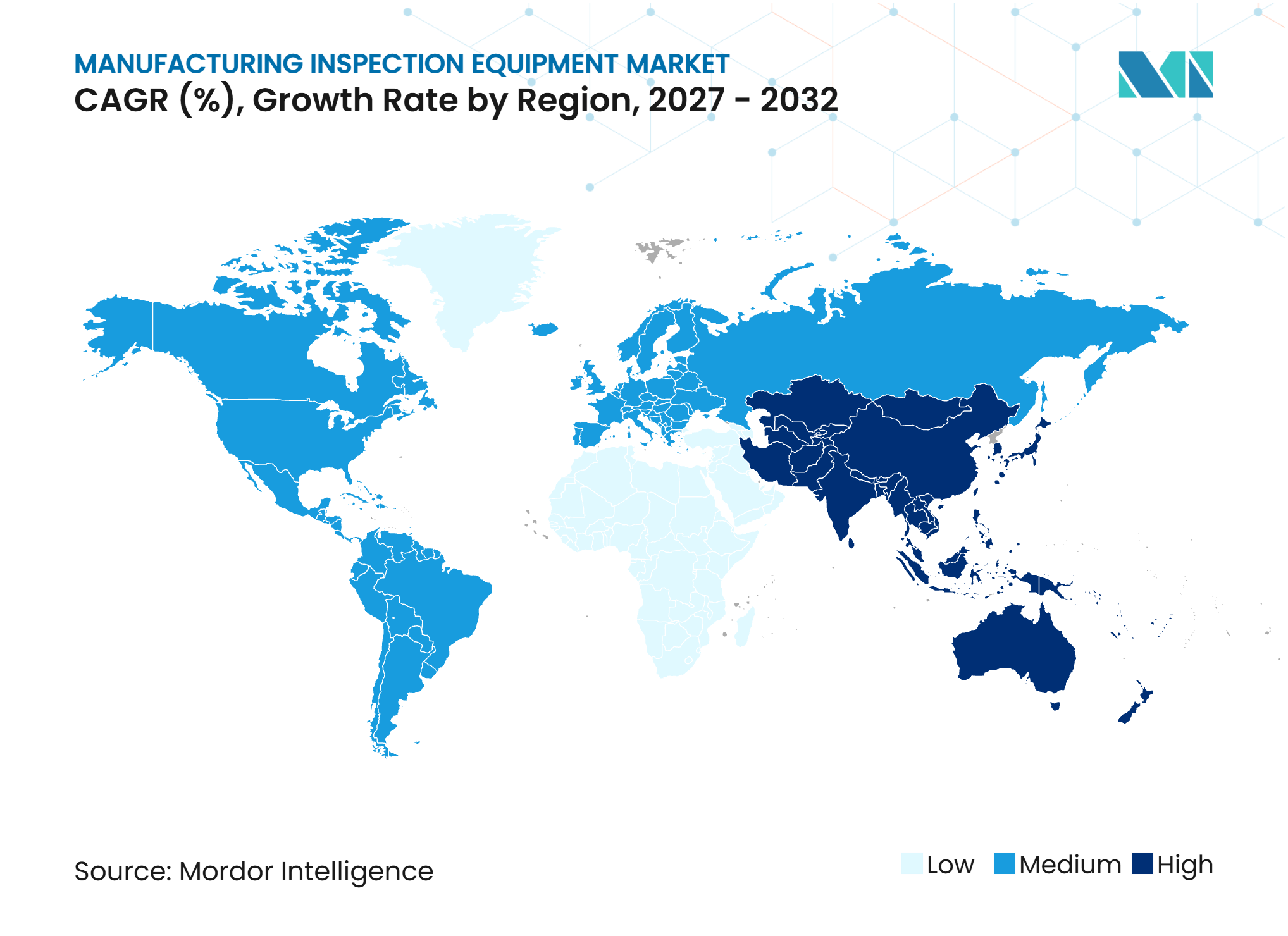
Asia-Pacific held 38% of the Manufacturing Inspection Equipment Market share in 2026 and is projected to grow at a 6.8% CAGR through 2032. The region combines semiconductor fabs, automotive assembly, consumer electronics production, and growing battery capacity. SEMI reported that 4 of the 18 semiconductor fabs beginning construction in 2025 are in Japan, while Taiwan and South Korea remain central to advanced-node manufacturing. China’s 2025 machinery development plan identifies intelligent inspection equipment as a priority and targets CNY 10 trillion (USD 11.8 trillion) in machinery industry operating revenue for 2025 and 2026. India is also extending its automotive and electronics manufacturing base through the Production Linked Incentive program, which supports investment in related quality assurance capability.
North America holds the second-largest position in the Manufacturing Inspection Equipment Market. Semiconductor manufacturing programs, defense production, and tighter quality requirements in regulated industries support its demand. The United States Government Accountability Office reported USD 30.9 billion in CHIPS Act incentive awards across 40 projects as of July 2025. The White House reported a USD 165 billion United States manufacturing commitment from TSMC in March 2025. NIST reported Micron’s USD 200 billion commitment in June 2025, which adds to the need for advanced process-control equipment. The ARM Institute also awarded USD 2.3 million to 2 robotic inspection projects for casting and forging in August 2025.
Europe has a durable role in the Manufacturing Inspection Equipment Market because of Germany’s metrology base, France’s aerospace and defense activity, and regional automotive production. The IATF 16949 audit changes are prompting European automotive suppliers to review their in-process and end-of-line coverage. The move toward in-line metrology, AI integration, and digital production records also supports equipment demand. Middle East and Africa remain at an earlier stage of adoption, with activity concentrated in Saudi Arabia and the UAE as manufacturing sectors develop. South American demand is centered on Brazilian automotive and food and beverage production. In these regions, safety standards and product-quality requirements are the main reasons for investment in contamination detection and seal-integrity systems.
Competitive Landscape
Market Concentration
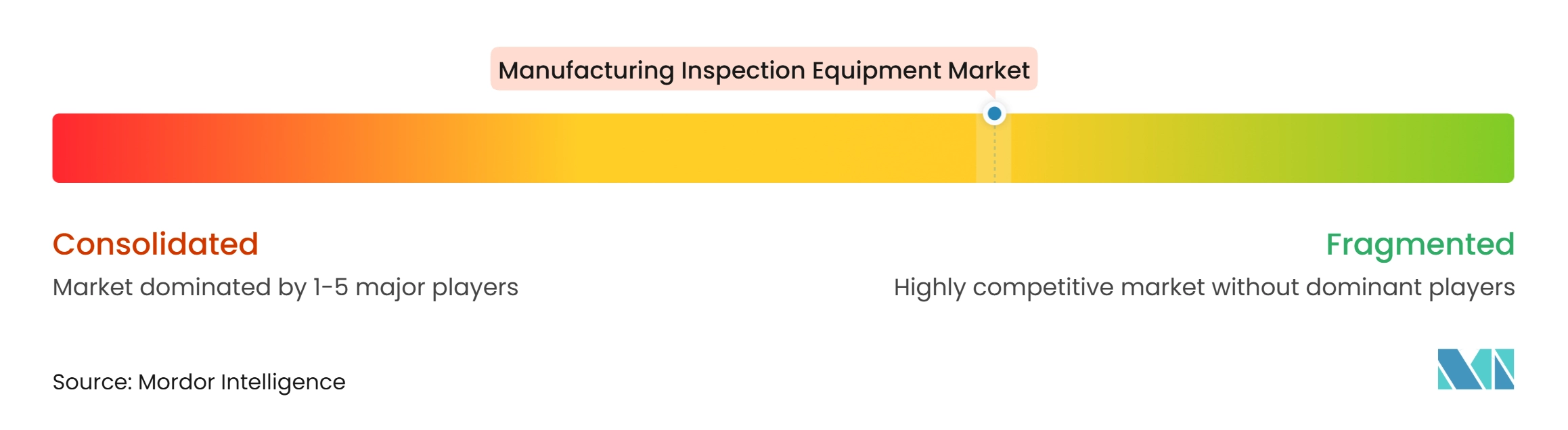
The Manufacturing Inspection Equipment Market exhibits a medium level of market concentration because the leading firms are strongest in individual technology areas rather than across every inspection category. KLA Corporation and Applied Materials hold important positions in semiconductor inspection, while Hexagon AB and Carl Zeiss AG are established in dimensional metrology. Cognex Corporation and KEYENCE Corporation have strong positions in machine vision, and other suppliers compete through focused applications, local support, or pricing. KLA reported that service revenue accounted for 22% of total revenue in its fiscal year ended June 30, 2025, which reflects the value of recurring support for installed semiconductor inspection systems. The Manufacturing inspection equipment industry is therefore influenced by customer requirements for calibration, process knowledge, software updates, and support, as well as initial equipment performance.
AMETEK completed its acquisition of FARO Technologies in July 2025 and acquired Virtek Vision International in October 2025. These moves expand the Manufacturing Inspection Equipment Market offering through portable measurement, laser scanning, optical coordinate measurement, and AI-enabled laser projection. Crane NXT announced an agreement to acquire Antares Vision Group in September 2025 for an enterprise value of EUR 445 million (USD 533.5 million), extending its inspection, detection, and track-and-trace portfolio into life sciences and food and beverage. Cognex stated in its 2025 filing that it intends to use its AI and optical-component capabilities to support customer expansion and potential acquisitions. These actions show why vendors are seeking complementary capabilities rather than remaining limited to a single inspection method.
The next area of competition is likely to center on systems that combine optical, non-destructive, and dimensional data in one production workflow. Manufacturers want defect classification that can improve without exposing sensitive production information, which supports interest in privacy-preserving learning methods. Suppliers also need to reduce the integration burden faced by plants with several generations of equipment. ISO 17025 accreditation and electromagnetic compatibility requirements continue to favor firms with strong calibration and certification capabilities. Regional suppliers can remain competitive where customers need customization or local service, even as larger companies add technologies through acquisitions.
Manufacturing Inspection Equipment Industry Leaders
-
Cognex Corporation
-
KEYENCE Corporation
-
OMRON Corporation
-
SICK AG
-
Teledyne Technologies Incorporated (Teledyne DALSA)
- *Disclaimer: Major Players sorted in no particular order
Manufacturing Inspection Equipment Market Companies Covered in this Report
- Cognex Corporation
- KEYENCE Corporation
- OMRON Corporation
- SICK AG
- Teledyne Technologies Incorporated
- Atlas Copco Group
- Dr. Schenk GmbH
- Hexagon AB
- Carl Zeiss AG
- Mitutoyo Corporation
- Nikon Corporation
- AMETEK, Inc.
- Renishaw plc
- Marposs S.p.A.
- Wabtec Corporation
- Comet Holding AG (Comet Yxlon)
- Waygate Technologies
- ESAB Corporation (Eddyfi Technologies)
- Nordson Corporation
- Koh Young Technology Inc.
- ViTrox Corporation Berhad
- KLA Corporation
- Applied Materials, Inc.
- Hitachi High-Tech Corporation
- Lasertec Corporation
- Onto Innovation Inc.
- Camtek Ltd.
- METTLER-TOLEDO International Inc.
- Anritsu Corporation
- Ishida Co., Ltd.
- MinebeaMitsumi Inc. (Minebea Intec)
- Thermo Fisher Scientific Inc.
- Sesotec GmbH
- Syntegon Technology GmbH
- Antares Vision Group
- INFICON Holding AG
- ATEQ
Recent Industry Developments in Manufacturing Inspection Equipment Market
- August 2026: Hexagon introduced METRICAL, an automated loading and unloading system for coordinate measuring machines, enabling more continuous inspection operations and reducing manual handling requirements.
- May 2026: Cognex announced general availability of OneVision, a cloud-to-edge AI vision development platform that helps manufacturers deploy and manage inspection models across multiple production lines and facilities.
- May 2026: Cognex launched the In-Sight 3900 embedded AI vision system, designed for high-speed, high-resolution inspection directly on production lines without requiring an external PC.
- October 2025: Axcelis Technologies and Veeco Instruments announced a definitive all-stock merger creating a semiconductor equipment company with USD 4.4 billion in enterprise value and USD 1.7 billion in pro forma 2024 revenue, expanding the combined company’s addressable market to more than USD 5 billion across implantation, deposition, and inspection for advanced packaging.
Global Manufacturing Inspection Equipment Market Report Scope
The Manufacturing Inspection Equipment Market Report is segmented by Equipment Type (Optical and Machine Vision Inspection Equipment, Optical and Machine Vision Inspection Equipment and more), by Manufacturing Industry (Semiconductors and Microelectronics, Food and Beverage Products and more), and by Geography (North America, Europe, Asia-Pacific, and more). The Market Forecasts are Provided in Terms of Value (USD).
Segmentation Overview
| Optical and Machine Vision Inspection Equipment |
| Dimensional and Geometric Inspection Equipment |
| Radiographic and Computed Tomography Inspection Equipment |
| Ultrasonic and Acoustic Inspection Equipment |
| Electromagnetic and Magnetic Inspection Equipment |
| Thermal and Infrared Inspection Equipment |
| Specialized Semiconductor Inspection Equipment |
| Material Identification and Composition Inspection Equipment |
| Leak and Seal Integrity Inspection Equipment |
| Product Contamination and Physical Conformity Inspection Equipment |
| Other Specialized Manufacturing Inspection Equipment |
| Automotive and Automotive Components |
| Aerospace, Defense and Other Transportation Equipment |
| Semiconductors and Microelectronics |
| Other Electronics and Electrical Equipment |
| Batteries and Energy Storage Products |
| Industrial Machinery, Metal Products and Fabrication |
| Chemicals, Plastics and Industrial Materials |
| Food and Beverage Products |
| Pharmaceuticals and Biopharmaceuticals |
| Medical Devices and Healthcare Products |
| Textiles, Apparel, Footwear and Accessories |
| Furniture, Homeware, Toys and Other Consumer Products |
| Building Materials and Construction Products |
| Packaging, Paper and Printed Products |
| Other Manufactured Products |
| North America | United States |
| Canada | |
| Mexico | |
| Europe | Germany |
| United Kingdom | |
| France | |
| Italy | |
| Spain | |
| Netherlands | |
| Poland | |
| Turkey | |
| Russia | |
| Rest of Europe | |
| Asia-Pacific | China |
| Japan | |
| India | |
| South Korea | |
| Taiwan | |
| Australia | |
| ASEAN(Indonesia, Vietnam, Thailand, Singapore, Malaysia, Philippines, etc.) | |
| Rest of Asia-Pacific | |
| Middle East and Africa | Saudi Arabia |
| United Arab Emirates | |
| Qatar | |
| South Africa | |
| Egypt | |
| Nigeria | |
| Rest of Middle East | |
| Rest of Africa | |
| South America | Brazil |
| Argentina | |
| Rest of South America (Chile, Colombia, Peru, etc.) |
| By Equipment Type | Optical and Machine Vision Inspection Equipment | |
| Dimensional and Geometric Inspection Equipment | ||
| Radiographic and Computed Tomography Inspection Equipment | ||
| Ultrasonic and Acoustic Inspection Equipment | ||
| Electromagnetic and Magnetic Inspection Equipment | ||
| Thermal and Infrared Inspection Equipment | ||
| Specialized Semiconductor Inspection Equipment | ||
| Material Identification and Composition Inspection Equipment | ||
| Leak and Seal Integrity Inspection Equipment | ||
| Product Contamination and Physical Conformity Inspection Equipment | ||
| Other Specialized Manufacturing Inspection Equipment | ||
| By Manufacturing Industry | Automotive and Automotive Components | |
| Aerospace, Defense and Other Transportation Equipment | ||
| Semiconductors and Microelectronics | ||
| Other Electronics and Electrical Equipment | ||
| Batteries and Energy Storage Products | ||
| Industrial Machinery, Metal Products and Fabrication | ||
| Chemicals, Plastics and Industrial Materials | ||
| Food and Beverage Products | ||
| Pharmaceuticals and Biopharmaceuticals | ||
| Medical Devices and Healthcare Products | ||
| Textiles, Apparel, Footwear and Accessories | ||
| Furniture, Homeware, Toys and Other Consumer Products | ||
| Building Materials and Construction Products | ||
| Packaging, Paper and Printed Products | ||
| Other Manufactured Products | ||
| By Geography | North America | United States |
| Canada | ||
| Mexico | ||
| Europe | Germany | |
| United Kingdom | ||
| France | ||
| Italy | ||
| Spain | ||
| Netherlands | ||
| Poland | ||
| Turkey | ||
| Russia | ||
| Rest of Europe | ||
| Asia-Pacific | China | |
| Japan | ||
| India | ||
| South Korea | ||
| Taiwan | ||
| Australia | ||
| ASEAN(Indonesia, Vietnam, Thailand, Singapore, Malaysia, Philippines, etc.) | ||
| Rest of Asia-Pacific | ||
| Middle East and Africa | Saudi Arabia | |
| United Arab Emirates | ||
| Qatar | ||
| South Africa | ||
| Egypt | ||
| Nigeria | ||
| Rest of Middle East | ||
| Rest of Africa | ||
| South America | Brazil | |
| Argentina | ||
| Rest of South America (Chile, Colombia, Peru, etc.) | ||
Key Questions Answered in the Report
What is the projected value of Manufacturing Inspection Equipment in 2032?
The Manufacturing Inspection Equipment Market is projected to reach USD 51.4 billion by 2032, growing at a 5.15% CAGR from 2027.
Which equipment category holds the largest Manufacturing Inspection Equipment Market share?
Optical and machine vision inspection equipment holds 27% of the total in 2026.
Which equipment category is growing fastest?
Specialized semiconductor inspection equipment is projected to grow at an 8.5% CAGR through 2032.
Which manufacturing sector creates the greatest growth opportunity?
Semiconductors and microelectronics is projected to grow at an 8.8% CAGR through 2032.
Which region leads global demand?
Asia-Pacific holds 38% of the total in 2026 and is projected to grow at a 6.8% CAGR through 2032.
What restricts Manufacturing Inspection Equipment Market adoption among smaller manufacturers?
Integration demands, capital limits, workforce skills, calibration, and maintenance costs can delay investment in in-line inspection systems.