
Managed ZTNA Services Market Size and Share
Market Overview
| Study Period | 2021 - 2032 |
|---|---|
| Market Size (2027) | USD 3.51 Billion |
| Market Size (2032) | USD 9.31 Billion |
| Growth Rate (2027 - 2032) | 21.49 % |
| Fastest Growing Market | Asia-Pacific |
| Largest Market | North America |
| Market Concentration | Medium |
Major Players *Disclaimer: Major Players sorted in no particular order Image © Mordor Intelligence. Reuse requires attribution under CC BY 4.0. | |
Managed ZTNA Services Market Analysis by Mordor Intelligence
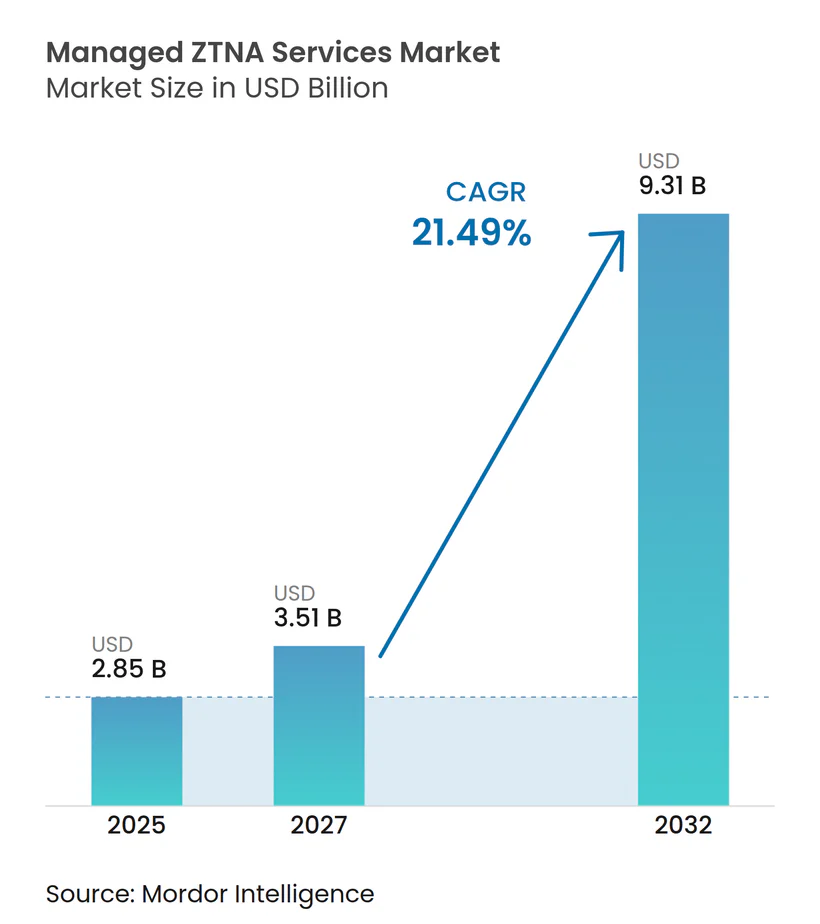
The managed ZTNA services market size is expected to grow from USD 2.85 billion in 2025 to USD 3.51 billion in 2027 and is forecast to reach USD 9.31 billion by 2032 at 21.49% CAGR over 2027-2032. The market is moving away from perimeter-based VPN access toward cloud-delivered access that verifies identity for each session. Enterprises are shifting this work to providers that can manage policies, monitor sessions around the clock, and support customers that do not maintain the specialized staff or operational coverage needed for continuous access governance. Federal zero-trust programs and practical reference designs are making implementation more structured for regulated buyers. Providers can benefit when an initial remote-access deployment expands to contractors, cloud applications, connected devices, and machine identities, because each extension increases the number of access relationships that require consistent policy, monitoring, and practical support. Competition is tied closely to wider secure access service edge procurement, which favors platforms and managed service providers with broad delivery capabilities, established integration experience, and the ability to support customers across varied deployment stages.
Key Report Takeaways
- By service type, Managed ZTNA Services held 79.54% of the Managed ZTNA services market share in 2026, while Managed ZTNA Services is projected to expand at a 22.78% CAGR through 2032.
- By managed service model, Fully Managed ZTNA held 40.35% share in 2026, while MDR-Integrated ZTNA is projected to expand at a 22.68% CAGR through 2032.
- By industry vertical, BFSI held 21.43% share in 2026, while Manufacturing and Critical Infrastructure is projected to expand at a 22.45% CAGR through 2032.
- By geography, North America held 41.82% share in 2026, while Asia-Pacific is projected to expand at a 22.73% CAGR through 2032.
Note: Market numbers in this report are based on Mordor Intelligence's proprietary estimation framework, which combines nine months of actuals with Q4 projections for base year 2026.
Market Trends and Insights
Drivers Impact Analysis of Managed ZTNA Services Market*
| Driver | (~) % Impact on CAGR Forecast | Geographic Relevance | Impact Timeline |
|---|---|---|---|
| Regulatory Accountability for Zero Trust Outcomes | +4.8% | Global, concentrated early gains in North America and Europe | Medium term (2-4 years) |
| Hybrid Workforce and VPN Modernization | +4.2% | Global, highest in North America, Western Europe, and Australia | Short term (≤ 2 years) |
| Cloud and SaaS Migration Requiring Identity-Aware Access | +3.6% | Global, with Asia-Pacific showing accelerating uptake | Short term (≤ 2 years) |
| Escalating Ransomware and Generative-AI Attack Surfaces | +3.0% | Global, concentrated in North America and Western Europe | Short term (≤ 2 years) |
| Managed Security Talent Shortages | +2.3% | Global, most acute in North America, EU, and Asia-Pacific | Medium term (2-4 years) |
| Industrial and IoT Access Expansion | +1.7% | Asia-Pacific core, spillover to North America and Middle East | Long term (≥ 4 years) |
| Source: Mordor Intelligence | |||
Regulatory Accountability for Zero Trust Outcomes
The managed Zero Trust Network Access (ZTNA) services market is supported by zero trust requirements that now influence procurement eligibility and audit expectations. The Department of Defense issued DTM 25-003 on July 17, 2025, creating a Zero Trust Portfolio Management Office and a Chief Zero Trust Officer position.[1] The memorandum directs coordinated zero-trust adoption across the Department of Defense enterprise. NIST published SP 1800-35 in June 2025 with 19 zero trust architecture implementations developed with 24 technology collaborators. These implementations cover areas including microsegmentation, identity governance, and secure access service edge architectures. This material gives compliance-focused organizations a clearer route to implementation and supports managed delivery across the Managed Zero Trust Network Access services market.
Hybrid Workforce and VPN Modernization
VPN replacement has moved from evaluation to active security planning across many enterprises. Zscaler reported that 56% of surveyed organizations had experienced a VPN-related breach in the prior year. The same report found that 92% viewed VPNs as a ransomware exposure and 89% identified lateral movement as a main concern. It also found that 65% planned to retire their VPN service within 12 months.[2] A remote-user program can later cover contractor access and integration needs after acquisitions. Cloudflare describes a phased VPN-replacement approach that can broaden an initial access deployment into a wider secure access service edge program, giving the Managed Zero Trust Network Access services market a route from a defined pilot to a broader operational relationship.
Cloud and SaaS Migration Requiring Identity-Aware Access
Cloud migration reduces the relevance of a trusted internal network and increases the need for application-specific controls. The Managed ZTNA services market therefore benefits when organizations need access rules across private applications and SaaS services. Netskope introduced Universal ZTNA enhancements in October 2025, including a Copilot capability for creating policies for discovered private applications. The company said the capability continually refines configurations and reduces manual policy work. Cloud environments also require auditable access records for security and compliance operations, giving the Managed Zero Trust Network Access services market a practical role in creating evidence that internal teams can review during routine governance work. The protected population now includes application and workload identities as well as individual users, which broadens the Managed ZTNA services market requirement.
Escalating Ransomware and Generative-AI Attack Surfaces
Ransomware campaigns increasingly target credentials and paths that allow movement across internal systems. Akamai reported that groups including FunkSec and Black Basta were using generative AI and large language models to generate malicious code, phishing scripts, and negotiation tools. CrowdStrike reported that 48% of surveyed organizations identified AI-automated attack chains as their greatest current ransomware threat. Its survey also found that 85% believed traditional detection methods were becoming obsolete against AI-enhanced attacks. IBM reported that 16% of breaches involved an attacker's use of AI, commonly for phishing and deepfake impersonation, which adds urgency to the Managed ZTNA services market's need for controls that limit broad network access after credential misuse. Session-specific, least-privilege access can limit the network exposure available after a credential is compromised, strengthening the Managed Zero Trust Network Access services market case.
Restraints Impact Analysis of Managed ZTNA Services Market*
| Restraint | (~) % Impact on CAGR Forecast | Geographic Relevance | Impact Timeline |
|---|---|---|---|
| Fragmented Legacy IAM and Directory Estates | -2.1% | Global, most acute in North America and Europe with large enterprise deployments | Medium term (2-4 years) |
| Brownfield OT Transition Costs and Latency Risks | -1.6% | Asia-Pacific, North America, and Europe with significant industrial base | Long term (≥ 4 years) |
| Shortage of Zero Trust Architecture Skills | -1.3% | Global, highest in Asia-Pacific and South America | Medium term (2-4 years) |
| Proprietary Policy Engines and Vendor Lock-In | -0.9% | Global, concentrated in North America and Europe | Medium term (2-4 years) |
| Source: Mordor Intelligence | |||
Fragmented Legacy IAM and Directory Estates
Managed deployments often encounter their main constraint in identity infrastructure rather than at the access gateway. Multi-forest Active Directory environments, on-premises LDAP directories, and different identity providers make policy alignment more difficult. The Managed Zero Trust Network Access services market can face longer onboarding cycles when dormant accounts, unmanaged service principals, and misaligned permissions must be identified. Organizations must also protect their compliance position while moving access controls to a new operating model. This can delay the point at which a provider can apply consistent policy enforcement. Providers that automate attribute normalization, group mapping, and legacy-protocol retirement can reduce friction and strengthen retention in the Managed ZTNA services market.
Brownfield OT Transition Costs and Latency Risks
Operational technology settings create constraints that differ from conventional information technology deployments. SCADA controllers, programmable logic controllers, and human-machine interfaces often use proprietary protocols and may not support endpoint agents. Industrial workloads can also require sub-100-millisecond response times, which a cloud-broker route may not always meet. Cisco notes that unauthorized cellular gateways and vendor-installed remote tools can complicate industrial remote-access management. Hardware security modules, protocol gateways, and network segmentation can extend the investment and implementation period, which can slow the managed ZTNA services market, where industrial organizations must justify technology upgrades alongside access-control modernization. Netskope states that its Universal ZTNA approach supports secure access for OT and IoT systems while addressing audit needs associated with NERC CIP and IEC 62443.
*Our forecasts treat driver/restraint impacts as directional, not additive. The impact forecasts reflect baseline growth, mix effects, and variable interactions.
Managed ZTNA Services Market Segment Analysis
By Service Type:
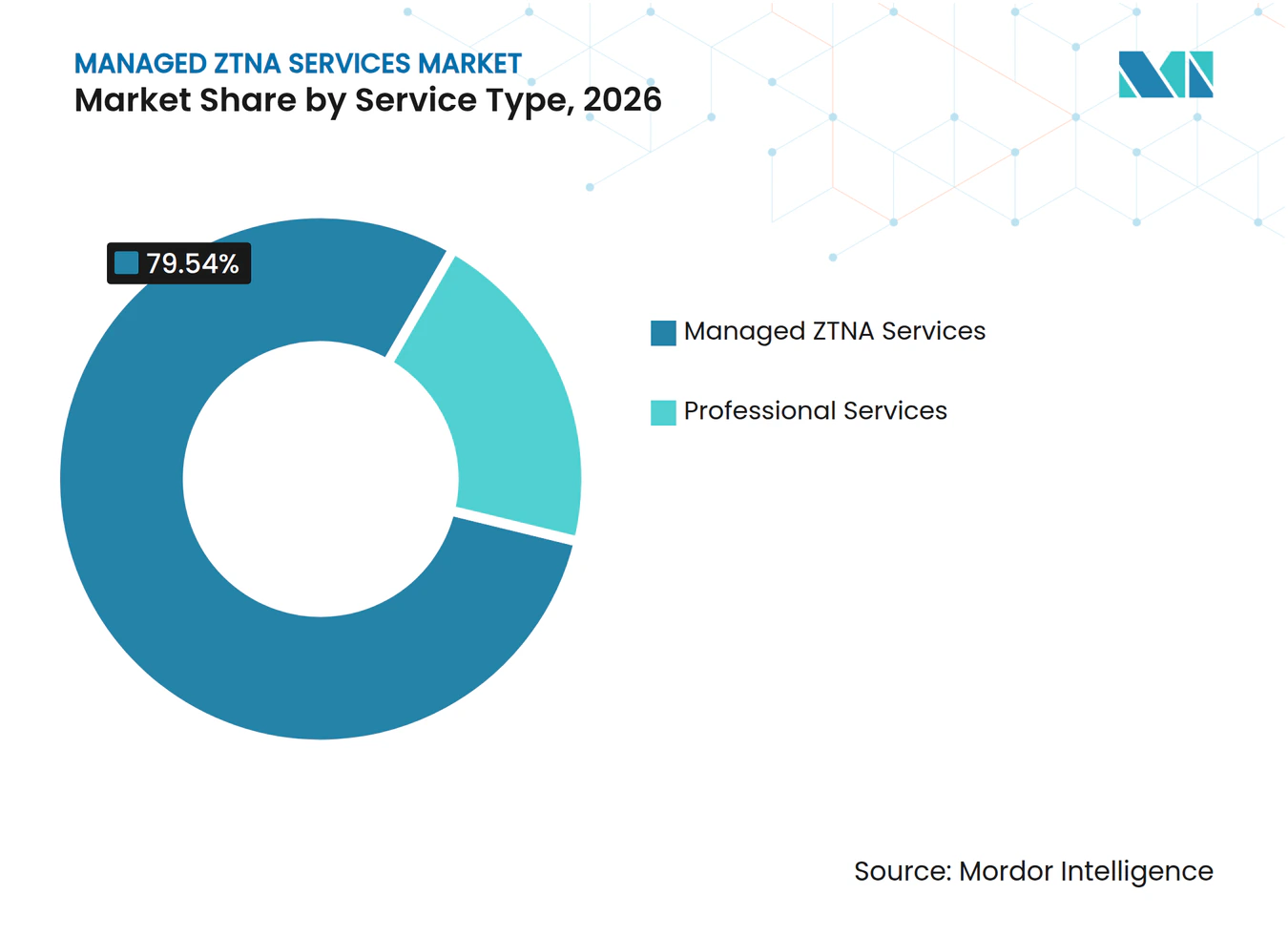
Managed Delivery Supports Long-Term Customer RelationshipsManaged ZTNA Services held 79.54% share in 2026, reflecting enterprise demand for external support with policy enforcement, session monitoring, and identity posture management. The Managed ZTNA services industry depends on continuous delivery rather than a one-time software installation, so providers can distinguish themselves through service-level commitments, co-management options, and operations support. Professional Services covers implementation and integration work and provides the remaining share, often leading into longer managed engagements when customers need ongoing policy operation. The Managed ZTNA services market size for Managed ZTNA Services is projected to expand at a 22.78% CAGR through 2032, supported by deployments that extend from remote workers to contractors, IoT endpoints, and machine identities.
Open Systems launched its Managed Universal SSE platform in September 2025, bringing ZTNA, secure web gateway, cloud access security broker, and firewall as a service into one managed offering.[3] Professional Services also connects policy engines with cloud workloads, identity providers, and security information and event management platforms before a managed operating model begins. NIST SP 1800-35 provides implementation examples that organizations can use when assessing architecture needs. Standardized playbooks may create price pressure on advisory work, but providers can sustain customer value by moving project engagements into managed retainers before the work becomes routine.


By Managed Service Model:
MDR Integration Brings Access Control and Response TogetherFully Managed ZTNA held 40.35% share in 2026 and appeals to organizations that want to delegate daily operations and compliance evidence collection. It is relevant to mid-sized firms and regulated buyers with limited security operations capacity, while Co-Managed ZTNA serves organizations that retain policy ownership but use provider support. MDR-Integrated ZTNA is projected to expand at a 22.68% CAGR through 2032 because it connects access telemetry with detection and response processes, enabling action on unusual session behavior before an attacker establishes persistence. Managed secure access service edge bundles combine ZTNA, secure web gateway, cloud access security broker, and software-defined wide area network capabilities in a wider contract that can reduce vendor management demands.
Zscaler completed its acquisition of Red Canary on August 1, 2025, combining the Zero Trust Exchange with managed detection and response capabilities. The Managed ZTNA services market is seeing interest in combined access and response services rather than separate tool selections. NIST implementation guidance gives buyers a framework for connecting zero-trust components to detection needs. Providers without comparable capability may need partnerships or acquisitions because integrated operations can raise contract values and switching costs.
By Industry Vertical:
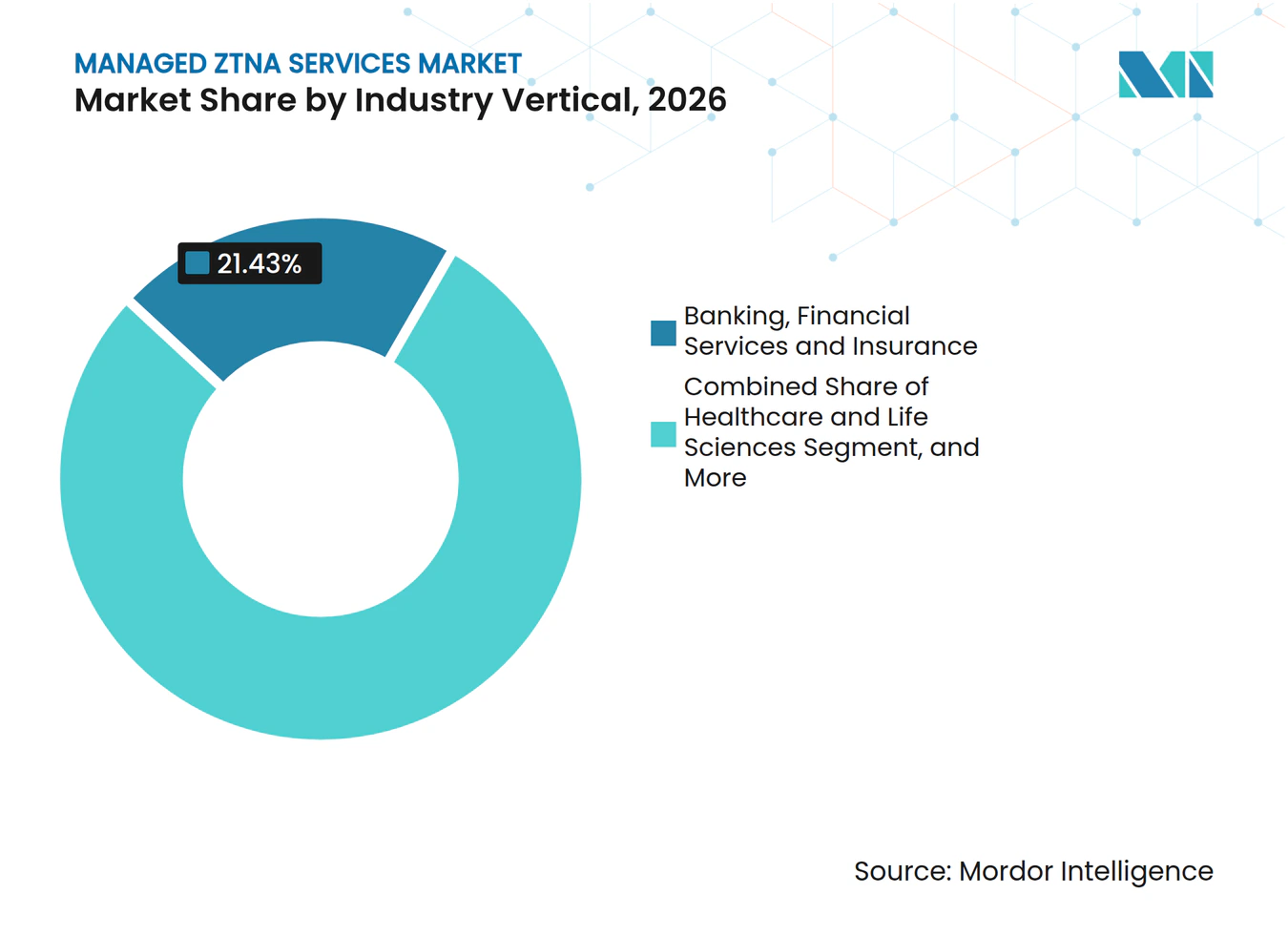
BFSI Leads While Industrial Environments AccelerateBFSI held 21.43% share in 2026 because it needs granular access controls, session verification, and records that support compliance reviews. Akamai found that 64% of financial services institutions had adopted ZTNA, which places it among established security controls for many buyers. Healthcare and life sciences, government and public sector, and IT and telecom also manage sensitive information and hybrid access, while education and retail and e-commerce represent smaller current demand pools. The Managed ZTNA services market has a broad vertical base because organizations across these fields need detailed access governance without continuous internal policy operation.
Manufacturing and Critical Infrastructure is projected to expand at a 22.45% CAGR through 2032 as Industry 4.0 programs extend IP connectivity to previously isolated systems. Google Cloud's Office of the CISO states that cloud-connected OT needs identity-aware access to limit movement between IT and OT systems. IEC 62443 guides industrial cybersecurity design, and providers can apply its zones-and-conduits approach when designing OT access services. Netskope introduced Universal ZTNA capabilities for OT and IoT in October 2025, supporting session recording and access logging for operationally sensitive environments.


Geography Analysis
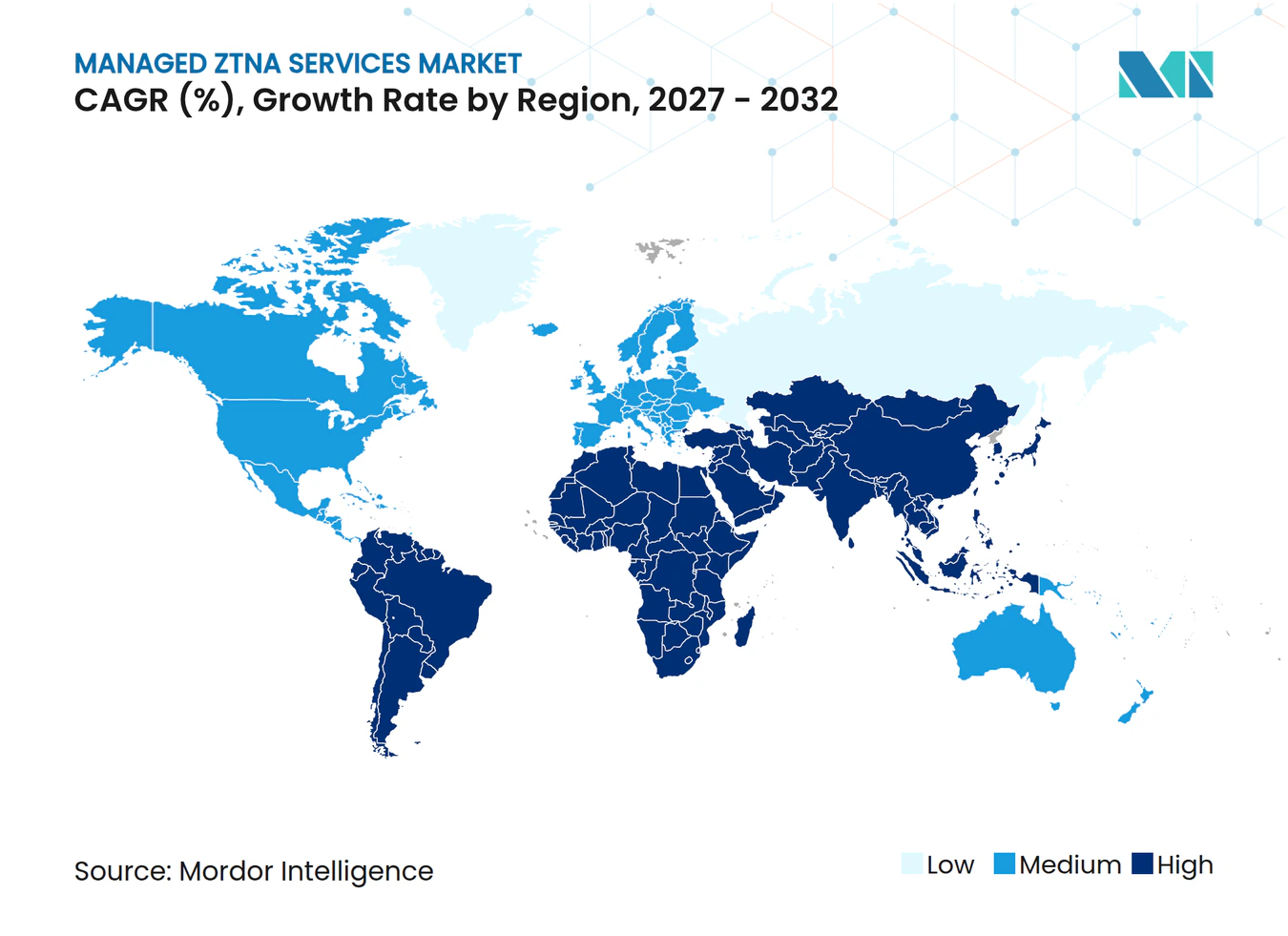
North America held 41.82% share in 2026, supported by early federal mandates, cloud-native enterprises, and mature managed security service providers. Department of Defense zero trust direction influences agencies, defense contractors, and regulated commercial organizations, while the United States remains the main regional market and Canada and Mexico add cross-border access needs. FIS reported that 38% of North American financial institutions were deploying zero trust strategies and another 42% planned adoption within 12 months, supporting continued demand during the forecast period.[4] The Managed ZTNA services market retains a strong regional base because federal programs affect both public-sector buyers and their supply chains.
Asia-Pacific is projected to expand at a 22.73% CAGR through 2032 as India, Southeast Asia, Japan, and South Korea combine cloud adoption with cybersecurity modernization. China has a distinct operating environment, where data localization and domestic infrastructure requirements can limit global providers although multinational enterprises still need to govern access across locations. Australia and Singapore are established submarkets, and their cybersecurity controls align with zero trust principles that support managed services. Europe is the third-largest regional area, with the United Kingdom, Germany, and France as primary demand centers and NIS2 enforcement influencing access-control priorities across essential services organizations.
South America, the Middle East, and Africa are at earlier adoption stages, with Brazil's data protection requirements supporting access governance, and Saudi Arabia and the UAE investing under digital transformation programs. Xage Security's industrial and operational technology focus is relevant to energy and infrastructure operators in Gulf Cooperation Council markets. Africa is the smallest regional part of the Managed ZTNA services market, although South Africa, Nigeria, and Kenya show early demand through financial services and telecommunications. Providers need delivery models that address data residency and latency as regulations develop across these markets. The regional mix remains uneven because cloud maturity, local regulation, and provider coverage differ across countries.
Competitive Landscape
Market Concentration
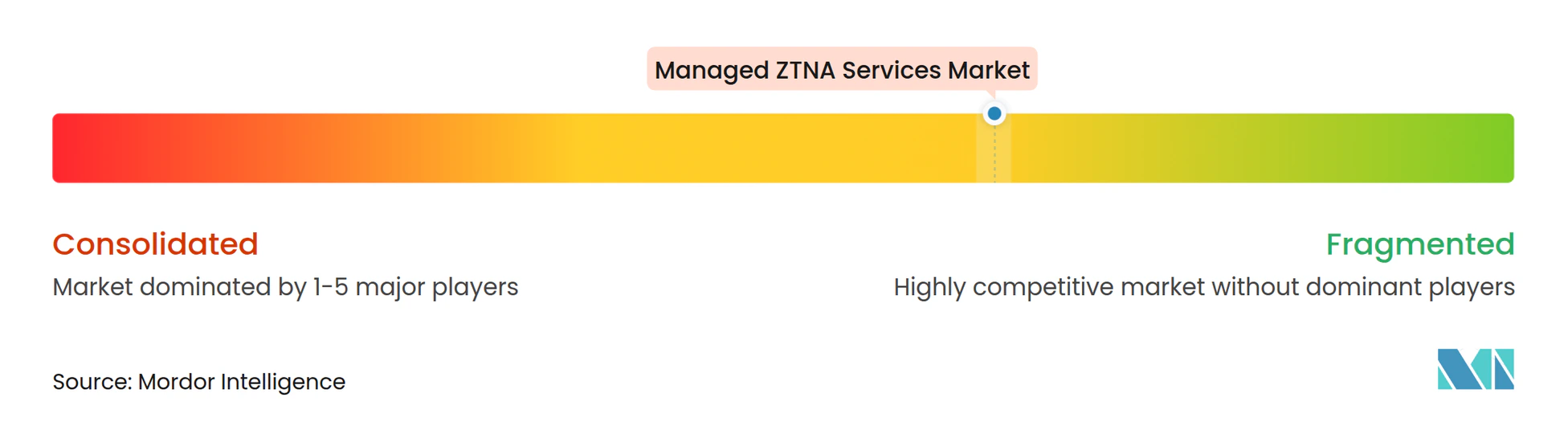
The managed ZTNA services market is moderately fragmented because no provider holds a dominant position across all service models, verticals, and regions. Zscaler and Cloudflare have leading positions through global networks, identity integrations, and their ability to bundle ZTNA into broader secure access service edge and security service edge decisions. Zscaler reported USD 2,167.1 million in fiscal 2025 revenue. Netskope is using AI-supported policy administration in its Universal ZTNA offering, illustrating the emphasis on automation.
Demand opportunities include MDR-integrated delivery for buyers that cannot support separate access and response contracts, OT-focused services for industrial and energy operators, and co-managed options for sectors that retain policy authority for data sovereignty reasons. AI-supported policy lifecycle tools can reduce the work needed to create, audit, and retire access rules. Netskope and Forescout formed a partnership in February 2026 that combined real-time device intelligence with cloud security policy enforcement across managed and unmanaged IT, OT, IoT, and IoMT devices. The alliance addresses device visibility and policy control in settings that contain many agentless devices.
Platform consolidation, channel expansion, and industrial specialization guide competitive strategy in the Managed ZTNA services market. Zscaler's Red Canary acquisition is a consolidation example, and the Netskope-Forescout partnership is an example of a technology alliance that extends device coverage. NIST reference implementations matter in buyer evaluations because they describe practical zero trust architectures, so compliance-aligned delivery is becoming a basic procurement requirement. The absence of disclosed combined shares for leading providers supports a moderate fragmentation assessment.
Managed ZTNA Services Industry Leaders
-
Zscaler, Inc.
-
Cloudflare, Inc.
-
Netskope, Inc.
-
iboss, Inc.
-
Appgate AB
- *Disclaimer: Major Players sorted in no particular order
Managed ZTNA Services Market Companies Covered in this Report
- Zscaler, Inc.
- Cloudflare, Inc.
- Netskope, Inc.
- iboss, Inc.
- Appgate AB
- Forcepoint LLC
- Akamai Technologies, Inc.
- Lookout, Inc.
- Menlo Security, Inc.
- Twingate, Inc.
- NetFoundry, Inc.
- Teleport, Inc.
- Cloudbrink, Inc.
- Oleria Corporation
- Island Technology, Inc.
- Elisity, Inc.
- Zero Networks, Inc.
- Xage Security, Inc.
- ColorTokens, Inc.
- Absolute Software Corporation
- Banyan Security, Inc.
- Axis Security, Inc.
- Perimeter 81 Ltd.
- Cato Networks Ltd.
Recent Industry Developments in Managed ZTNA Services Market
- October 2026: Xcitium expanded its SASE, SD-WAN, and ZTNA platform capabilities through a strategic technology partnership with Roqos, extending zero trust access management to MSP customers across endpoints, users, branch locations, and remote workforces under a unified multi-tenant cloud management architecture. This partnership strengthens Xcitium's position in the MSP-delivered managed ZTNA segment, where demand for integrated networking and security is accelerating.
- June 2026: CyberFox acquired Timus Networks, a provider of adaptive zero trust and SASE capabilities built natively for the MSP channel. The acquisition signals continued consolidation among MSP-focused cybersecurity platforms and brings adaptive, identity-based network access controls under CyberFox's broader service portfolio.
- May 2026: iboss partnered with Sysdojo, a specialist managed security service provider, to deliver cloud-native ZTNA and Zero Trust SASE to organizations migrating from legacy VPN and hardware-centric security stacks. The partnership extends iboss's managed delivery reach across the enterprise and mid-market segments and adds an MSSP execution layer to iboss's cloud-native platform.
- February 2026: Netskope and Forescout Technologies formed a technology partnership to deliver integrated zero trust security across managed and unmanaged IT, OT, IoT, and IoMT devices. By combining Forescout's real-time device intelligence with Netskope's AI-powered cloud security, the joint solution dynamically adapts ZTNA access decisions based on device posture and risk, closing a critical gap in environments with large populations of agentless devices.
Global Managed ZTNA Services Market Report Scope
The Managed ZTNA Services Market comprises managed security services that enable organizations to implement, operate, monitor, and maintain Zero Trust Network Access (ZTNA) solutions for secure access to private applications, enterprise networks, cloud environments, and distributed IT resources. These services include identity-based access control, continuous user and device verification, application-level access policies, policy configuration and administration, access monitoring, troubleshooting, and integration with identity and security platforms. Managed ZTNA providers support fully managed and co-managed deployments, including integration with managed detection and response (MDR) and Secure Access Service Edge (SASE) solutions, to facilitate secure access for remote and hybrid workforces, third-party users, and distributed enterprise environments.
The Managed ZTNA Services Market Report is Segmented by Service Type (Managed ZTNA Services, and Professional Services), Managed Service Model (Fully Managed ZTNA, Co-Managed ZTNA, Managed Detection and Response-Integrated ZTNA, and Managed Secure Access Service Edge Bundles), Industry Vertical (Banking, Financial Services and Insurance, Healthcare and Life Sciences, Government and Public Sector, IT and Telecom, Manufacturing and Critical Infrastructure, Retail and E-Commerce, Education, and Other Industry Verticals), and Geography (North America, South America, Europe, Asia-Pacific, Middle East, and Africa). The Market Forecasts are Provided in Terms of Value (USD).
Segmentation Overview
| Managed ZTNA Services |
| Professional Services |
| Fully Managed ZTNA |
| Co-Managed ZTNA |
| Managed Detection and Response-Integrated ZTNA |
| Managed Secure Access Service Edge Bundles |
| Banking, Financial Services and Insurance |
| Healthcare and Life Sciences |
| Government and Public Sector |
| IT and Telecom |
| Manufacturing and Critical Infrastructure |
| Retail and E-Commerce |
| Education |
| Other Industry Verticals |
| North America | United States |
| Canada | |
| Mexico | |
| South America | Brazil |
| Argentina | |
| Chile | |
| Rest of South America | |
| Europe | United Kingdom |
| Germany | |
| France | |
| Italy | |
| Rest of Europe | |
| Asia-Pacific | China |
| Japan | |
| India | |
| South Korea | |
| Australia | |
| Singapore | |
| Rest of Asia-Pacific | |
| Middle East | Saudi Arabia |
| United Arab Emirates | |
| Israel | |
| Turkey | |
| Rest of Middle East | |
| Africa | South Africa |
| Nigeria | |
| Kenya | |
| Rest of Africa |
| By Service Type | Managed ZTNA Services | |
| Professional Services | ||
| By Managed Service Model | Fully Managed ZTNA | |
| Co-Managed ZTNA | ||
| Managed Detection and Response-Integrated ZTNA | ||
| Managed Secure Access Service Edge Bundles | ||
| By Industry Vertical | Banking, Financial Services and Insurance | |
| Healthcare and Life Sciences | ||
| Government and Public Sector | ||
| IT and Telecom | ||
| Manufacturing and Critical Infrastructure | ||
| Retail and E-Commerce | ||
| Education | ||
| Other Industry Verticals | ||
| By Geography | North America | United States |
| Canada | ||
| Mexico | ||
| South America | Brazil | |
| Argentina | ||
| Chile | ||
| Rest of South America | ||
| Europe | United Kingdom | |
| Germany | ||
| France | ||
| Italy | ||
| Rest of Europe | ||
| Asia-Pacific | China | |
| Japan | ||
| India | ||
| South Korea | ||
| Australia | ||
| Singapore | ||
| Rest of Asia-Pacific | ||
| Middle East | Saudi Arabia | |
| United Arab Emirates | ||
| Israel | ||
| Turkey | ||
| Rest of Middle East | ||
| Africa | South Africa | |
| Nigeria | ||
| Kenya | ||
| Rest of Africa | ||
Key Questions Answered in the Report
What is the Managed ZTNA services market size?
The Managed ZTNA services market is valued at USD 2.85 billion in 2026 and is projected to reach USD 9.31 billion by 2032, at a 21.49% CAGR during 2027-2032.
What is driving adoption of managed ZTNA services?
VPN replacement, cloud migration, ransomware exposure, and zero trust implementation requirements are increasing demand for managed access controls.
Which service type has the largest share of Managed ZTNA services?
Managed ZTNA Services held 79.54% share in 2026 because organizations often outsource ongoing policy enforcement and session monitoring.
Which managed service model is expanding fastest?
MDR-Integrated ZTNA is projected to expand at a 22.68% CAGR through 2032 as buyers seek closer coordination between access control and threat response.
Which vertical has the largest share of managed ZTNA services?
BFSI held 21.43% share in 2026, supported by access governance, audit, and session verification requirements.
Which region is advancing fastest for managed ZTNA services?
Asia-Pacific is projected to expand at a 22.73% CAGR through 2032, supported by cloud adoption and cybersecurity modernization programs.