
Managed Workplace Energy Optimization Services Market Size and Share
Market Overview
| Study Period | 2021 - 2032 |
|---|---|
| Market Size (2027) | USD 0.96 Billion |
| Market Size (2032) | USD 1.79 Billion |
| Growth Rate (2027 - 2032) | 13.27 % |
| Fastest Growing Market | Asia-Pacific |
| Largest Market | North America |
| Market Concentration | Medium |
Major Players *Disclaimer: Major Players sorted in no particular order Image © Mordor Intelligence. Reuse requires attribution under CC BY 4.0. | |
Managed Workplace Energy Optimization Services Market Analysis by Mordor Intelligence
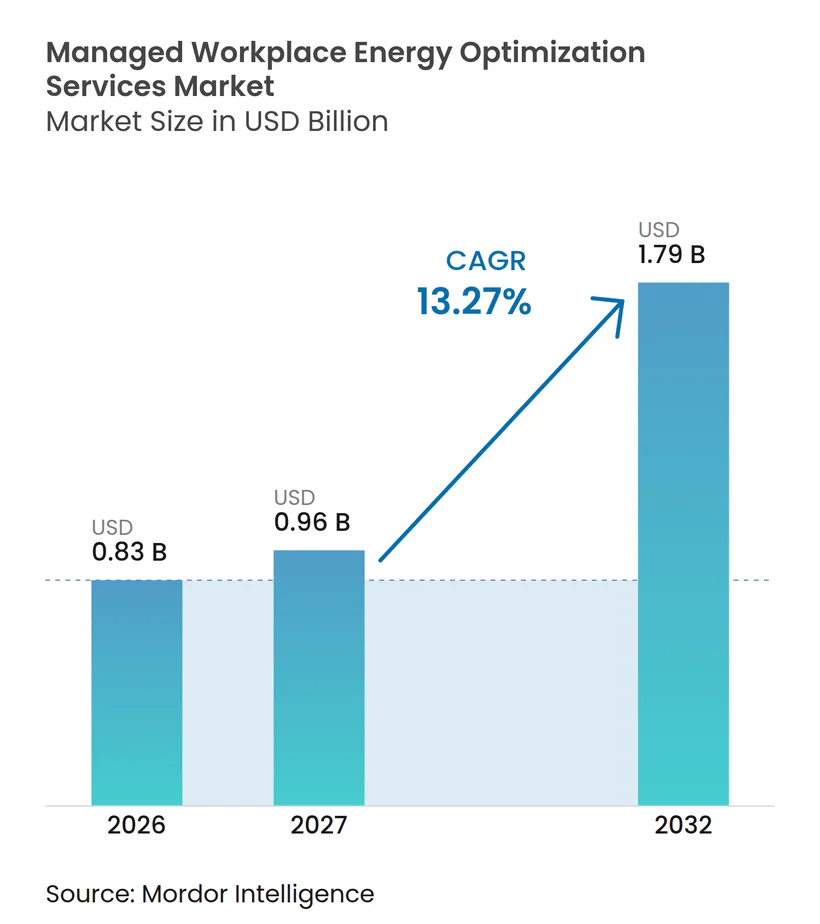
The managed workplace energy optimization services market size is projected to be USD 0.83 billion in 2026, USD 0.96 billion in 2027, and reach USD 1.79 billion by 2032, growing at a CAGR of 13.27% from 2027 to 2032. Building performance rules are making energy reporting and emissions reduction a required operating activity for many commercial property owners. This is increasing demand across the managed workplace energy optimization services market for providers that can connect building systems, measure results, and support compliance across several sites. Cost pressure is also shifting customer interest toward contracts that link payment to verified energy savings. Software-led controls are becoming more important because they can improve existing building systems without a full equipment replacement. The managed workplace energy optimization services market also benefits from wider use of grid flexibility programs, which can turn controllable building loads into a source of revenue.
Key Report Takeaways
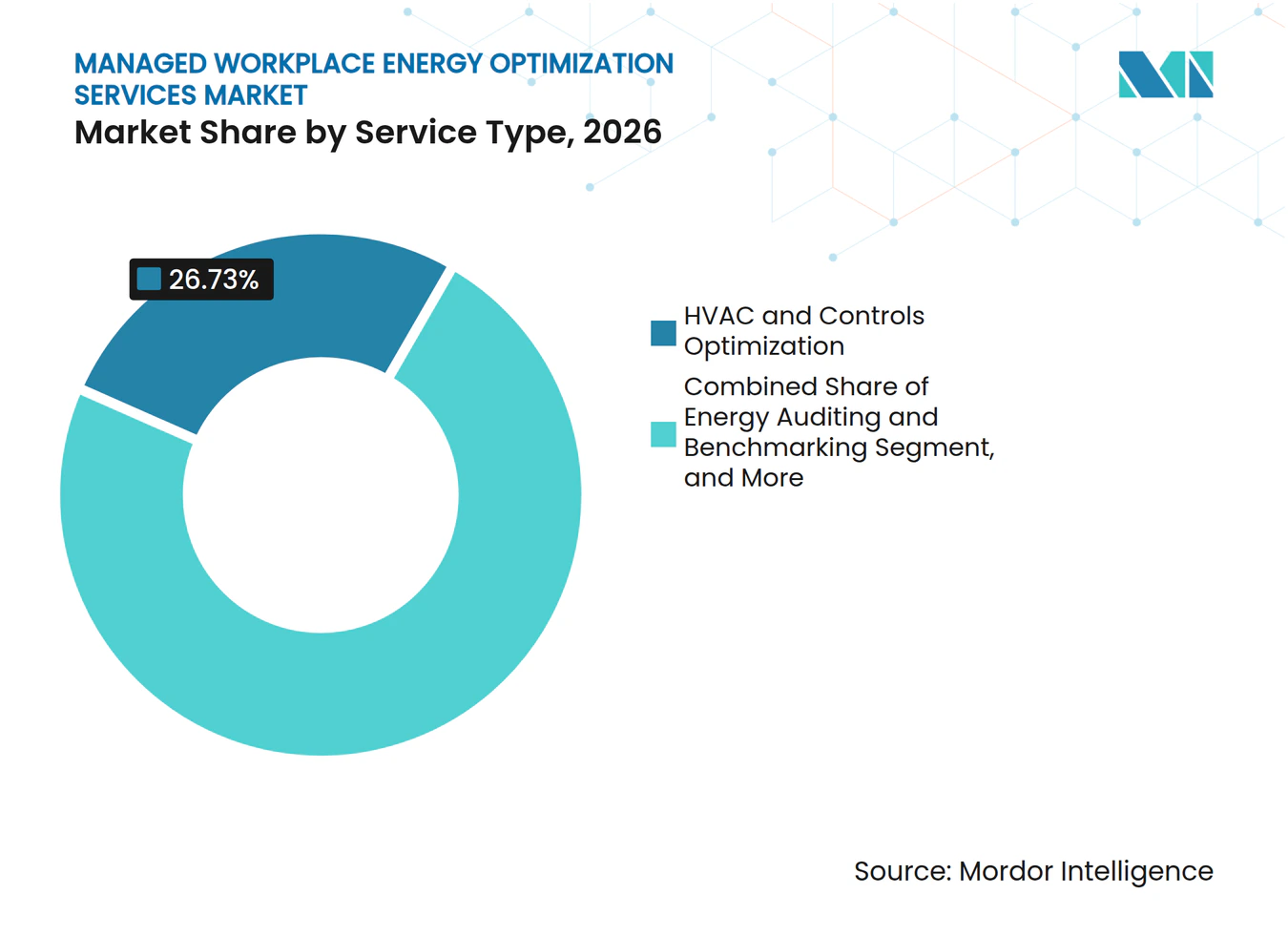
- By service type, HVAC and Controls Optimization held 26.73% of the managed workplace energy optimization services market revenue in 2026, while Renewable Energy and Storage Optimization is projected to expand at a 15.91% CAGR through 2032.
- By deployment model, Cloud-Based Managed Services accounted for 72.51% of revenue in 2026, while Hybrid Managed Services are projected to expand at a 14.63% CAGR through 2032.
- By workplace facility type, Corporate Offices held 32.97% of the managed workplace energy optimization services market revenue in 2026, while Healthcare Facilities are projected to expand at a 14.86% CAGR through 2032.
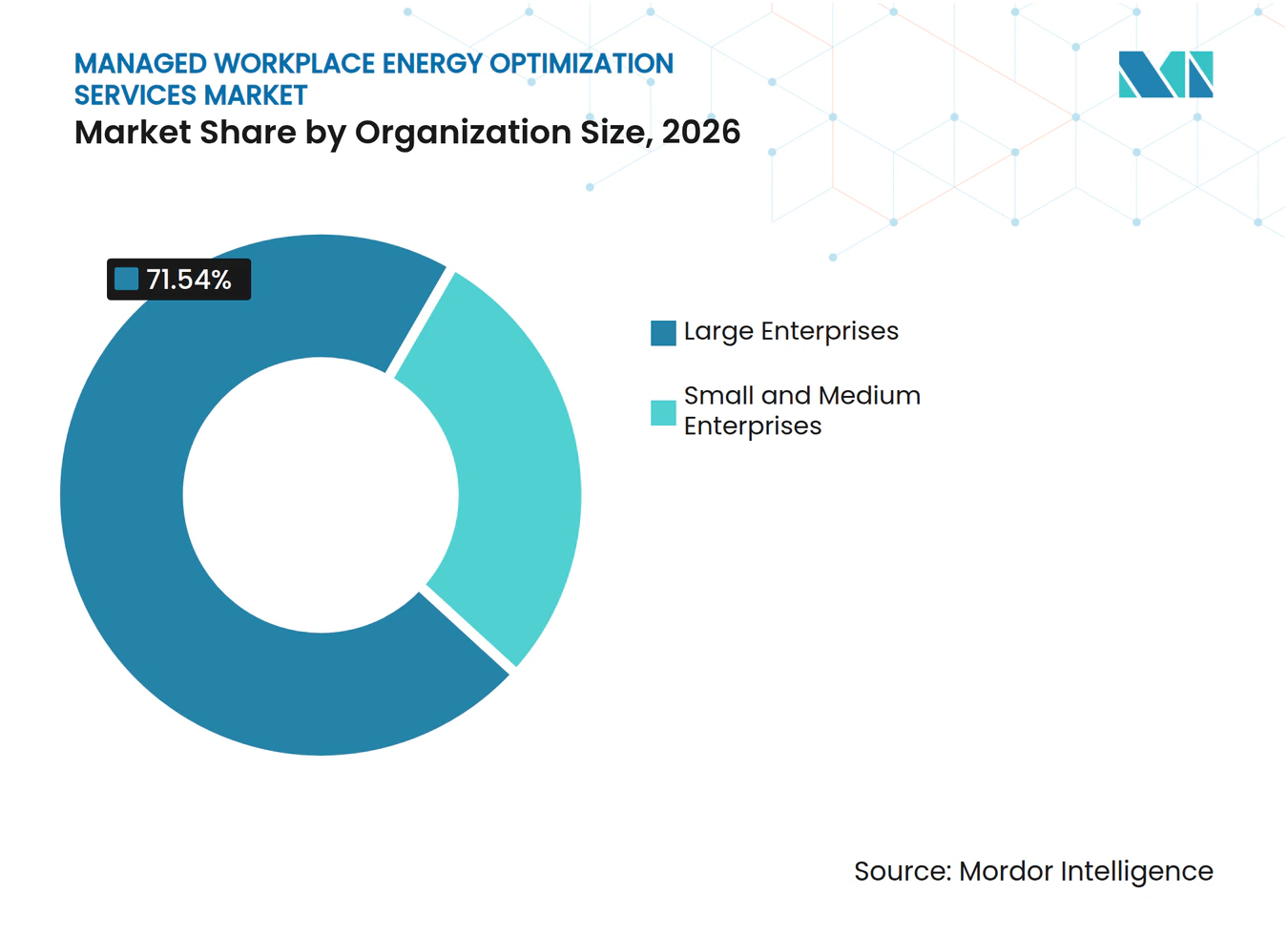
- By organization size, Large Enterprises held 71.54% of revenue in 2026, while SMEs are projected to expand at a 16.24% CAGR through 2032.
- By end-user industry, IT and Telecommunications accounted for 29.86% of revenue in 2026, while the healthcare and life sciences industry is projected to expand at a 14.37% CAGR through 2032.
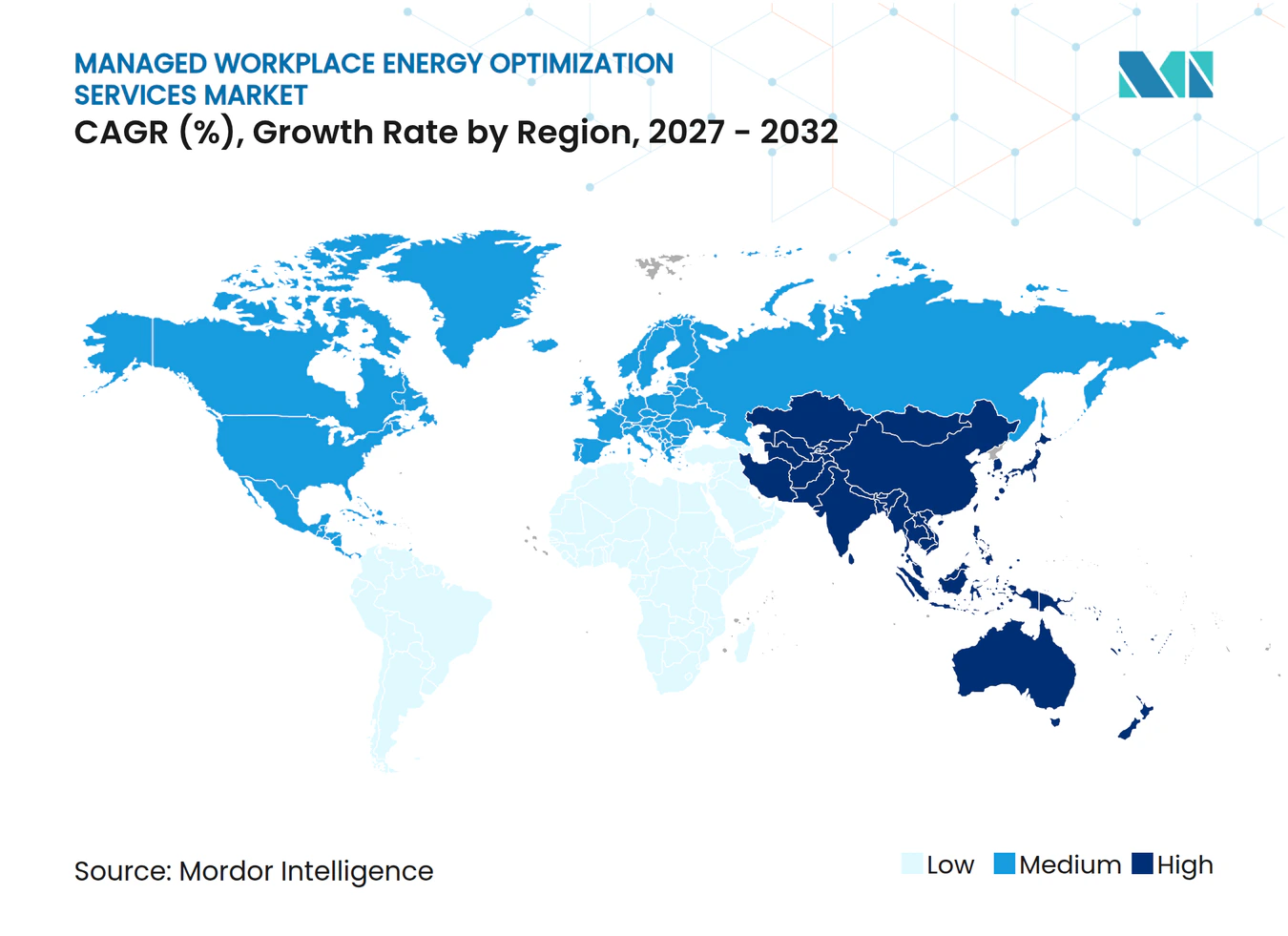
- By geography, North America held 38.64% of the managed workplace energy optimization services market revenue in 2026, while Asia-Pacific is projected to expand at a 15.82% CAGR through 2032.
Note: Market numbers in this report are based on Mordor Intelligence's proprietary estimation framework, which combines nine months of actuals with Q4 projections for base year 2026.
Market Trends and Insights
Drivers Impact Analysis of Managed Workplace Energy Optimization Services Market*
| Driver | (~) % Impact on CAGR Forecast | Geographic Relevance | Impact Timeline |
|---|---|---|---|
| Building Performance Standards and Carbon Disclosure | +3.2% | North America and Europe, with spillover to Asia-Pacific and the Middle East through multinational tenant compliance | Short term (≤ 2 years) |
| Measurable Operating Cost Reduction | +2.8% | Global, with stronger demand in North America and Western Europe | Short term (≤ 2 years) |
| AI-Enabled Fault Detection and Predictive Building Control | +2.5% | Global, with faster uptake in North America, Germany, Japan, and Australia | Medium term (2-4 years) |
| Hybrid-Work Occupancy Variability and Zone-Level Optimization | +1.8% | North America and Europe, expanding to Asia-Pacific metropolitan areas | Medium term (2-4 years) |
| Grid Flexibility and Demand-Response Monetization | +1.4% | North America, Europe, and Australia | Medium term (2-4 years) |
| Service-Based Delivery and Lower Upfront Capital Barriers | +1.1% | Global, with high relevance in SME-dense Asia-Pacific and South American markets | Long term (≥ 4 years) |
| Source: Mordor Intelligence | |||
Building Performance Standards and Carbon Disclosure Requirements
Building performance standards are a direct buying trigger in the managed workplace energy optimization services market because they turn energy reduction into a legal requirement with financial consequences. New York City began the first Local Law 97 compliance year in 2026 for buildings larger than 25,000 square feet, while Boston, Cambridge, and Washington, D.C., also reached active compliance milestones. The European Energy Performance of Buildings Directive continued to move through national implementation in 2025 and 2026, increasing the need for emissions performance tracking in nonresidential property. Owners often need outside support for measurement, verification, and reporting because internal facilities teams may not have the required systems or specialist capacity. Third-party verification can create longer service relationships because the provider already manages the data connections and reporting history. This reinforces demand in the managed workplace energy optimization services market. ASHRAE Standard 90.1 and ENERGY STAR Portfolio Manager remain important reporting tools for building benchmarking programs.
Rising Demand for Measurable Operating Cost Reduction
The managed workplace energy optimization services market is driven by customers seeking documented savings relative to a clear operating baseline. The International Energy Agency reported in 2025 that small firms achieved average savings of 12% from energy efficiency measures, compared with nearly 20% for larger firms.[1] This gap reflects uneven access to monitoring tools, diagnostic capabilities, and dedicated energy managers. Outcome-based service contracts can reduce a customer’s need for upfront capital because the provider assumes part of the performance risk. ComEd’s 2025 pilot showed that cloud-based energy management systems can deliver meaningful savings for small and medium-sized businesses, including facilities with less than 100,000 square feet. This wider economic fit supports the projected 16.24% CAGR for SMEs through 2032.
AI-Enabled Fault Detection and Predictive Building Control
AI-based fault detection is strengthening the managed workplace energy optimization services market by identifying waste and control failures earlier. Peer-reviewed research published in 2025 and 2026 found that machine-learning approaches can support accurate fault diagnosis and predictive maintenance in building management systems. Schneider Electric reported in 2025 that occupancy-based controls at 150 Holborn in London reduced meeting-room energy use and carbon emissions by 22%. The rooms remained in a resting state for 76% of business hours, which shows the cost of operating spaces that are not in use. A 2025 review also found that AI approaches can improve resource management in smart buildings when combined with sound data and control practices. Johnson Controls introduced OpenBlue Energy and Comfort Intelligence in August 2026 and reported nearly 10% lower airside energy use at DATEV facilities without comfort complaints.
Hybrid-Work Occupancy Variability Enabling Zone-Level Optimization
Hybrid schedules have made fixed building operating plans less effective, increasing demand for continuous adjustment in the managed workplace energy optimization services market. Occupancy can vary by 30% to 70% across zones and days in the same office building. Research presented in 2025, using data from the Montreal office, found that sensor-fusion models achieved zone-level occupancy prediction accuracy and F1 scores above 80%. This can help operators avoid conditioning rooms that are not in use. A 2025 California field trial also validated energy reductions from occupancy-adaptive micro-zone HVAC control. As occupancy changes become routine, one-time retro-commissioning is less effective at addressing current operating conditions.
Restraints Impact Analysis of Managed Workplace Energy Optimization Services Market*
| Restraint | (~) % Impact on CAGR Forecast | Geographic Relevance | Impact Timeline |
|---|---|---|---|
| Fragmented Building Data and Interoperability Gaps | -2.1% | Global, especially legacy-heavy commercial property in Europe and North America | Short term (≤ 2 years) |
| Cybersecurity and Privacy Exposure Across IT/OT Systems | -1.6% | Global, with higher exposure in healthcare, government, and multi-tenant campuses | Medium term (2-4 years) |
| Split Incentives Between Owners, Tenants, and Facility Managers | -0.9% | Europe, multi-tenant North America, and Asia-Pacific commercial property joint ventures | Medium term (2-4 years) |
| Limited Availability of Energy Optimization and Controls Talent | -0.7% | Global, with greater pressure in emerging Asia-Pacific markets and Tier-2 cities | Long term (≥ 4 years) |
| Source: Mordor Intelligence | |||
Fragmented Building Data and Interoperability Gaps
Fragmented data is a practical constraint on the managed workplace energy optimization services market because optimization depends on reliable information from several building systems. Many commercial properties use equipment from different vendors and protocols such as BACnet, Modbus, IEC 61850, Zigbee, and proprietary networks. These systems often lack a shared semantic model, making it harder to join data for portfolio-wide analysis. The IEA EBC Annex 81 final report identified interoperability as a frequently cited barrier to building digitalization in 2025.[2] Providers that can normalize mixed data sets can secure a stronger role in a customer’s long-term operating model. This capability can differentiate suppliers in the managed workplace energy optimization services market. BACnet Secure Connect and Brick Schema can help address this issue, but broad adoption across existing buildings will take time.
Cybersecurity and Privacy Exposure Across IT/OT Systems
Connecting building controls with enterprise networks and cloud tools expands the cyber risk for the managed workplace energy optimization services market. A compromise of HVAC or lighting controls can affect physical operations as well as information security. Claroty’s 2025 analysis of more than 467,000 building management systems found that 75% of organizations had devices affected by known exploitable vulnerabilities and 69% had devices linked to confirmed ransomware campaigns. NIST issued building automation cybersecurity guidance in August 2026 for owners operating HVAC, lighting, access control, and energy management systems. CISA also issued advisories in 2025 and 2026 covering Schneider Electric and Johnson Controls controllers. Providers, therefore, need secure access controls, monitoring, and network separation to compete in regulated settings.
*Our forecasts treat driver/restraint impacts as directional, not additive. The impact forecasts reflect baseline growth, mix effects, and variable interactions.
Managed Workplace Energy Optimization Services Market Segment Analysis
By Service Type:
HVAC Optimization Leads While Renewable Integration AcceleratesHVAC and Controls Optimization held 26.73% of the managed workplace energy optimization services market share in 2026. HVAC has a direct effect on building performance because it represents more than 50% of commercial building energy consumption in Canada’s commercial sector.[3] The segment benefits from mature fault detection tools and broad use across office, healthcare, retail, and campus facilities. Its services include control tuning, automated diagnostics, scheduling, and continuous performance monitoring. Customers can use these services to address comfort, maintenance, and energy performance in one operating program. Energy Auditing and Benchmarking, Energy Monitoring and Analytics, Lighting and Plug-Load Optimization, Demand Response and Load Management, and Measurement, Verification, and Reporting address separate customer needs. Measurement, Verification, and Reporting have added importance where rules require validated disclosures or third-party review.
Renewable Energy and Storage Optimization is projected to expand at a 15.91% CAGR through 2032. This part of the managed workplace energy optimization services market supports customers who combine solar photovoltaic systems, battery storage, controllable loads, and demand response under a single service agreement. A 2025 Applied Energy study found that a commercial building system using monocrystalline silicon solar panels and lithium iron phosphate storage covered 46% of annual energy demand and had a 5.5-year payback period. The appeal comes from coordinating on-site generation with building demand and market signals. Carrier launched Abound Advisory and Managed Services in May 2025, offering 24/7 remote expert support for multi-site portfolios. EnergyCAP introduced Insights, powered by Watts AI, in September 2026 to prioritize high-impact actions across multi-site portfolios.



By Deployment Model:
Cloud Leads While Hybrid Supports Sensitive EnvironmentsCloud-Based Managed Services accounted for 72.51% of revenue in 2026, giving this model the largest position in the managed workplace energy optimization services market. Cloud platforms support remote oversight of multiple facilities and can receive regular software updates without major local infrastructure changes. They also reduce the need for each site to maintain specialized information technology resources. Iris Ohyama launched the ENEverse cloud energy management service in Japan in 2025 for remote monitoring and control of HVAC and LED lighting across facilities. This type of subscription service can extend energy management tools to medium-sized operators. Cloud deployment is especially useful where portfolio managers need a common view of energy use, alerts, and performance reporting.
Hybrid Managed Services is projected to expand at a 14.63% CAGR through 2032. The model keeps real-time control processing close to the building while using cloud tools for analysis, reporting, and portfolio management. This approach is relevant for hospitals, pharmaceutical laboratories, financial data centers, and other settings where latency and data handling require greater control. Research published in Energy Informatics in 2026 described the value of hybrid approaches for latency-sensitive building management tasks. On-Premises Managed Services remain relevant for government and other high-security facilities with strict data residency requirements. Siemens presented Desigo CC V9 and Building X applications in 2026 with secure BACnet/SC networking and hybrid cloud-edge capabilities.
By Workplace Facility Type:
Corporate Offices Lead While Healthcare Expands FasterCorporate Offices held 32.97% of revenue in 2026, the largest workplace facility type in the managed workplace energy optimization services market. Office portfolios face building performance rules in several major cities and often have established building management system installations. HVAC and occupancy controls are also easier to deploy in open-plan locations with recurring daily patterns. Within the managed workplace energy optimization services market, portfolio owners can use managed services to standardize reporting across several properties. The segment benefits from long-term contracts that align with the way commercial real estate owners manage assets. Co-Working and Flexible Workspaces present a related opportunity because fluctuating tenant and schedule needs require more frequent operational changes. Commercial Campuses also need coordinated management across buildings with different loads and equipment.
The healthcare facilities are projected to expand at a 14.86% CAGR through 2032. Their energy requirements are high because essential services and environmental controls operate around the clock. Health systems also balance energy programs with patient safety, infection control, and resilience needs. OSF HealthCare achieved Joint Commission Sustainable Healthcare Certification in 2025, demonstrating the added role of formal sustainability practices in the sector. Energy costs account for 2% to 3% of operating expenses for healthcare organizations, which can represent a significant annual cost for large systems. Government and Public-Sector Buildings are also supported by energy performance contracting programs. The US Army Corps of Engineers awarded a USD 3 billion Energy Savings Performance Contract MATOC IV in June 2025 to 18 energy service companies for Department of Defense modernization.
By Organization Size:
Large Enterprises Anchor Revenue While SMEs Expand AccessLarge Enterprises held 71.54% of revenue in 2026, reflecting their large property portfolios and established spending on sustainability reporting. Within the managed workplace energy optimization services market, this concentration makes them an important revenue base. Large customers often need centralized management across offices, data centers, factories, and campuses. They also have the resources to integrate energy data with enterprise reporting systems. Their purchasing decisions can support longer contracts that combine software, controls, maintenance, and verification. This customer group is likely to remain important in the near term because it manages a substantial share of multi-site commercial real estate. It also provides a practical first market for advanced optimization services that require data integration.
SMEs are projected to expand at a 16.24% CAGR through 2032, the highest rate among the reported segment categories. The International Energy Agency found that 40% to 80% of SMEs could not implement a given energy efficiency improvement in its 2025 business research. Subscription pricing and savings-linked contracts can reduce the cost and expertise barriers that previously limited adoption. ComEd’s 2025 pilot confirmed the practical value of cloud-based systems for smaller commercial facilities. This gives providers a path to serve customers that do not have dedicated energy teams. It also encourages standardized services that can be deployed across many smaller sites. The managed workplace energy optimization industry is therefore becoming more accessible beyond its historic focus on large portfolios.

By End-User Industry:
IT and Telecommunications Anchor Demand While Healthcare and Life Sciences Lead GrowthIT and Telecommunications accounted for 29.86% of revenue in 2026, the largest end-user position in the managed workplace energy optimization services market. Technology campuses and data centers have high energy density and strong uptime requirements. These users also tend to have extensive sensor networks, established building management systems, and experienced facilities teams. This makes technical integration more achievable than in less digitally prepared property types. Corporate reporting requirements add further pressure to track energy performance at a detailed level. The sector uses recognized reporting frameworks such as the Global Reporting Initiative and CDP. These factors make continuous optimization a practical part of operational management rather than a periodic project.
The healthcare and life sciences industry is projected to expand at a 14.37% CAGR through 2032. The segment requires reliable ventilation, temperature, and environmental control at all times. Energy management must therefore work alongside patient safety, research integrity, and facility resilience. Building operators can use managed services to identify improvements without compromising essential operating conditions. Banking, Financial Services, and Insurance also presents demand because trading environments and data centers have substantial power needs. Government and Public Sector customers benefit from mandated performance contracting and reporting programs. Industrial Manufacturing, Retail and E-Commerce, and other verticals add market volume through their distinct load profiles. Retail chains are increasingly suitable for managed services because shared platforms can support consistent deployment across several locations.
Geography Analysis
North America Managed Workplace Energy Optimization Services Market
North America held 38.64% of revenue in 2026, the largest regional managed workplace energy optimization services market share. The region has active building performance rules in New York City, Boston, Cambridge, Denver, Washington, D.C., and Washington state. The United States also has a well-developed Energy Savings Performance Contract structure. The USD 3 billion Department of Defense contract awarded in 2025 supports modernization through third-party-financed improvements. Canada contributes through energy benchmarking and building rating activity, while Mexico remains an earlier-stage market with growing commercial and industrial development.
Europe and South America Managed Workplace Energy Optimization Services Market
Europe is the second-largest region in the managed workplace energy optimization services market. The United Kingdom, Germany, France, Italy, and Spain are core markets because regulations and property modernization needs are well established. The Energy Performance of Buildings Directive sets a policy direction toward zero-emission new buildings by 2030 and upgrades to the weakest buildings. Germany’s major industrial energy users also face formal energy management requirements. Siemens and COIMA reported that the Pirelli 35 project in Milan achieved 60% lower energy consumption and avoided 2,000 metric tons of CO₂e annually. South America is at an earlier stage, with demand centered on modern commercial campuses, multinational tenants, and government buildings in Brazil, Argentina, Colombia, and other major urban markets.
APAC and Middle East Managed Workplace Energy Optimization Services Market
Asia-Pacific is projected to expand at a 15.82% CAGR through 2032, making it the fastest-growing regional market. China’s smart grid expansion and building energy codes support a wider base for commercial energy management services. Japan’s Top Runner standards and energy management system subsidies are drawing more mid-market operators into formal services. India’s Bureau of Energy Efficiency expansion and the Energy Conservation Amendment Act are extending audit and reporting requirements across more commercial buildings. Australia’s NABERS framework supports performance accountability and recurring energy management work. The Middle East is also progressing, as ENGIE Solutions deployed its Smart O&M platform at the B1 Mall in Dubai in 2026 and Schneider Electric agreed to deploy its platform across 26 Brands For Less stores in the United Arab Emirates.
Competitive Landscape
Market Concentration
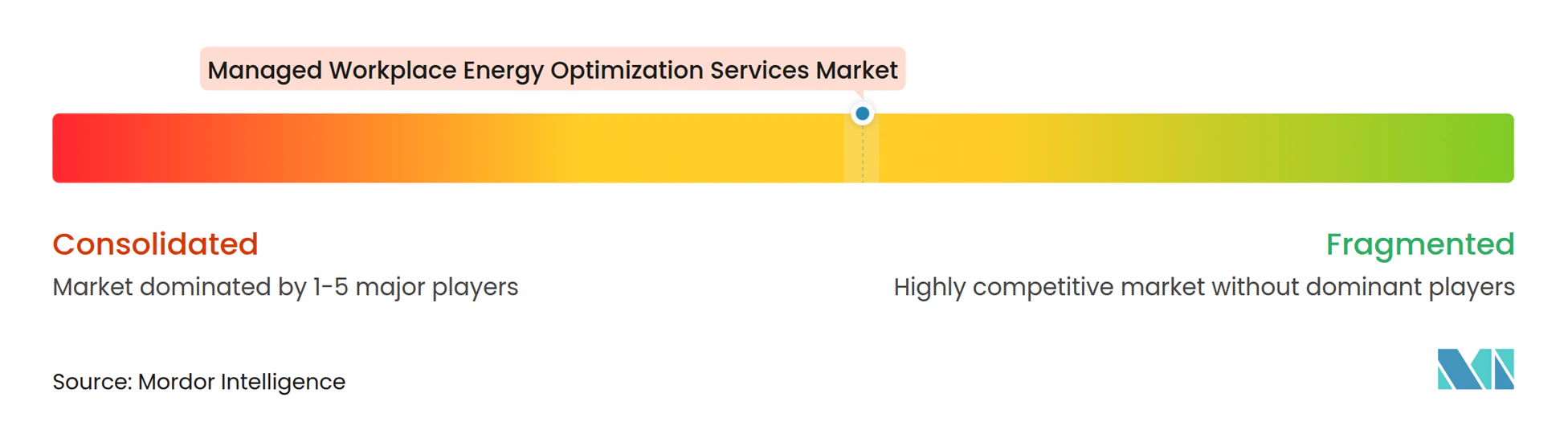
The managed workplace energy optimization services market is moderately fragmented, with large building technology suppliers competing alongside energy service companies and specialized software providers. Schneider Electric, Siemens, Johnson Controls, and Honeywell have established positions in building automation. Ameresco, ENGIE, and Centrica Business Solutions compete through performance-based energy services. BrainBox AI, EnergyCAP, and GridPoint represent software and AI-focused participants. The leading suppliers are building wider platforms that combine HVAC, lighting, power, and demand response in one operating environment. Schneider Electric introduced EcoStruxure Foresight Operation in November 2025 to unify energy, power, and building systems in an AI-powered platform. The company stated that the platform can reduce engineering workflow time by up to 40%.
Performance contracts remain an important competitive approach because they can remove upfront capital requirements for customers. Competitive conditions in the managed workplace energy optimization services market favor providers that can document savings and manage complex portfolios. Ameresco secured a USD 197 million energy infrastructure project with the US Naval Research Laboratory in October 2025 and projected more than USD 362 million in savings over 21 years. Johnson Controls reported in 2025 that a composite OpenBlue customer could achieve up to 155% ROI over 3 years. These offers shift customer decisions toward measured operating outcomes. Providers are also focusing on the SME segment, retail chains, and healthcare campuses where standardized services can be repeated across several locations. Cybersecurity and compliance capabilities are becoming more important as building control systems connect with business networks.
Demand response is creating another route for differentiation in the managed workplace energy optimization services market. Voltus and Nantum AI announced an API integration in September 2025 that enables commercial buildings to participate in ancillary services markets across PJM, NYISO, ISO-NE, and ERCOT. BrainBox AI’s Cloud Building Management System had been deployed in more than 2,000 buildings globally by February 2025 and was designed to work with major building automation brands. This reduces the need to replace existing hardware before adopting advanced controls. ISO 50001, ASHRAE 90.1, and European verification requirements raise the documentation standard for providers. Established suppliers have an advantage where customers need documented compliance, integrated security, and a history of delivery.
Managed Workplace Energy Optimization Services Industry Leaders
-
Schneider Electric SE
-
Siemens AG
-
Johnson Controls International plc
-
Honeywell International Inc.
-
CBRE Group, Inc.
- *Disclaimer: Major Players sorted in no particular order
Managed Workplace Energy Optimization Services Market Companies Covered in this Report
- Schneider Electric SE
- Siemens AG
- Johnson Controls International plc
- Honeywell International Inc.
- CBRE Group, Inc.
- Ameresco, Inc.
- ENGIE SA
- Veolia Environnement S.A.
- Cushman & Wakefield plc
- JLL
- Trane Technologies plc
- Carrier Global Corporation
- ABB Ltd.
- Ecolab Inc.
- Centrica Business Solutions
- Enel X S.r.l.
- GridPoint, Inc.
- BrainBox AI Inc.
- Spacewell International NV
- EnergyCAP, LLC
Recent Industry Developments in Managed Workplace Energy Optimization Services Market
- October 2026: The Cybersecurity and Infrastructure Security Agency issued advisory ICSA-26-274-05 for Johnson Controls EasyIO Neo Series EC and CW Controllers, disclosing a clear-text credential transmission vulnerability, CVE-2026-64893, in controllers used for HVAC, lighting, and energy management in commercial buildings. The advisory highlights the systemic IT/OT cybersecurity challenge facing managed services providers that integrate building automation with corporate networks.
- August 2026: NIST published a Building Automation and Control System Cybersecurity infographic and guidance on August 19, 2026, providing OT owners with actionable security steps for managing HVAC, lighting, access control, and energy management control systems, directly addressing the 75% vulnerability rate found in commercial building management systems by Claroty's 2025 analysis.
- August 2026: Johnson Controls unveiled AI-powered OpenBlue platform expansions on August 5, 2026, introducing Energy and Comfort Intelligence powered by Nantum AI, which reduced airside energy use by nearly 10% at DATEV's facilities, agentic AI capabilities through OBI, and an AI-native architecture that reduces onboarding and implementation time by up to 95%, targeting complex multi-site deployments.
- June 2026: Leap and Verantum announced a strategic partnership on June 2, 2026, to integrate virtual power plant capabilities with Verantum's HVAC, refrigeration, and lighting management platform across commercial retail portfolios, including Dollar Tree across California, New York, Texas, and other major grid territories, commercializing demand response revenue for multi-site commercial tenants.
Global Managed Workplace Energy Optimization Services Market Report Scope
Managed workplace energy optimization services market helps organizations monitor, analyze, and reduce energy consumption across offices, campuses, and other workplace facilities. Providers typically manage building systems such as HVAC, lighting, occupancy controls, and energy metering, using analytics and automation to lower energy costs, improve comfort, and support sustainability targets.
The Managed Workplace Energy Optimization Services Market Report is Segmented by Service Type (Energy Auditing and Benchmarking, Energy Monitoring and Analytics, HVAC and Controls Optimization, Lighting and Plug-Load Optimization, Demand Response and Load Management, Renewable Energy and Storage Optimization, and Measurement, Verification, and Reporting), Deployment Model (On-Premises Managed Services, Cloud-Based Managed Services, and Hybrid Managed Services), Workplace Facility Type (Corporate Offices, Co-Working and Flexible Workspaces, Commercial Campuses, Government and Public-Sector Buildings, Healthcare Facilities, Educational Institutions, Retail Stores and Shopping Centers, and Other Workplace Facilities), Organization Size (Large Enterprises, and Small and Medium-Sized Enterprises), End-User Industry (Banking, Financial Services and Insurance (BFSI), IT and Telecommunications, Healthcare and Life Sciences, Government and Public Sector, Industrial Manufacturing, Retail and E-Commerce, and Other End-User Industries), and Geography (North America, South America, Europe, Asia-Pacific, Middle East, and Africa). The Market Forecasts are Provided in Terms of Value (USD).
Segmentation Overview
| Energy Auditing and Benchmarking |
| Energy Monitoring and Analytics |
| HVAC and Controls Optimization |
| Lighting and Plug-Load Optimization |
| Demand Response and Load Management |
| Renewable Energy and Storage Optimization |
| Measurement, Verification, and Reporting |
| On-Premises Managed Services |
| Cloud-Based Managed Services |
| Hybrid Managed Services |
| Corporate Offices |
| Co-Working and Flexible Workspaces |
| Commercial Campuses |
| Government and Public-Sector Buildings |
| Healthcare Facilities |
| Educational Institutions |
| Retail Stores and Shopping Centers |
| Other Workplace Facilities |
| Large Enterprises |
| Small and Medium Enterprises |
| Banking, Financial Services and Insurance (BFSI) |
| IT and Telecommunications |
| Healthcare and Life Sciences |
| Government and Public Sector |
| Industrial Manufacturing |
| Retail and E-Commerce |
| Other End-User Industries |
| North America | United States |
| Canada | |
| Mexico | |
| South America | Brazil |
| Argentina | |
| Rest of South America | |
| Europe | United Kingdom |
| Germany | |
| France | |
| Italy | |
| Rest of Europe | |
| Asia-Pacific | China |
| Japan | |
| India | |
| South Korea | |
| Rest of Asia-Pacific | |
| Middle East | Saudi Arabia |
| United Arab Emirates | |
| Rest of Middle East | |
| Africa | South Africa |
| Nigeria | |
| Rest of Africa |
| By Service Type | Energy Auditing and Benchmarking | |
| Energy Monitoring and Analytics | ||
| HVAC and Controls Optimization | ||
| Lighting and Plug-Load Optimization | ||
| Demand Response and Load Management | ||
| Renewable Energy and Storage Optimization | ||
| Measurement, Verification, and Reporting | ||
| By Deployment Model | On-Premises Managed Services | |
| Cloud-Based Managed Services | ||
| Hybrid Managed Services | ||
| By Workplace Facility Type | Corporate Offices | |
| Co-Working and Flexible Workspaces | ||
| Commercial Campuses | ||
| Government and Public-Sector Buildings | ||
| Healthcare Facilities | ||
| Educational Institutions | ||
| Retail Stores and Shopping Centers | ||
| Other Workplace Facilities | ||
| By Organization Size | Large Enterprises | |
| Small and Medium Enterprises | ||
| By End-User Industry | Banking, Financial Services and Insurance (BFSI) | |
| IT and Telecommunications | ||
| Healthcare and Life Sciences | ||
| Government and Public Sector | ||
| Industrial Manufacturing | ||
| Retail and E-Commerce | ||
| Other End-User Industries | ||
| By Geography | North America | United States |
| Canada | ||
| Mexico | ||
| South America | Brazil | |
| Argentina | ||
| Rest of South America | ||
| Europe | United Kingdom | |
| Germany | ||
| France | ||
| Italy | ||
| Rest of Europe | ||
| Asia-Pacific | China | |
| Japan | ||
| India | ||
| South Korea | ||
| Rest of Asia-Pacific | ||
| Middle East | Saudi Arabia | |
| United Arab Emirates | ||
| Rest of Middle East | ||
| Africa | South Africa | |
| Nigeria | ||
| Rest of Africa | ||
Key Questions Answered in the Report
What is the size of the managed workplace energy optimization services market?
The managed workplace energy optimization services market size is projected to be USD 0.83 billion in 2026, USD 0.96 billion in 2027, and reach USD 1.79 billion by 2032, growing at a CAGR of 13.27% from 2027 to 2032.
What is driving demand for managed workplace energy optimization services?
Building performance rules, energy cost control, AI-based fault detection, and demand response programs are increasing use of managed services.
Which service type leads managed workplace energy optimization services?
HVAC and Controls Optimization led with a 26.73% share in 2026, supported by the central role of HVAC in commercial building energy use.
Which deployment model is most widely used?
Cloud-Based Managed Services held 72.51% of revenue in 2026 because they support centralized monitoring across several facilities.
Which customer group is expected to expand fastest?
SMEs are projected to expand at a 16.24% CAGR through 2032 as subscription and savings-linked offers reduce adoption barriers.
Which region is projected to expand fastest?
Asia-Pacific is projected to expand at a 15.82% CAGR through 2032, supported by energy management policies in China, Japan, India, and Australia.