
Managed Storage and Backup Services Market Size and Share
Market Overview
| Study Period | 2021 - 2032 |
|---|---|
| Market Size (2027) | USD 17.46 Billion |
| Market Size (2032) | USD 23.84 Billion |
| Growth Rate (2027 - 2032) | 6.43 % |
| Fastest Growing Market | Asia-Pacific |
| Largest Market | North America |
| Market Concentration | Medium |
Major Players *Disclaimer: Major Players sorted in no particular order Image © Mordor Intelligence. Reuse requires attribution under CC BY 4.0. | |
Managed Storage and Backup Services Market Analysis by Mordor Intelligence
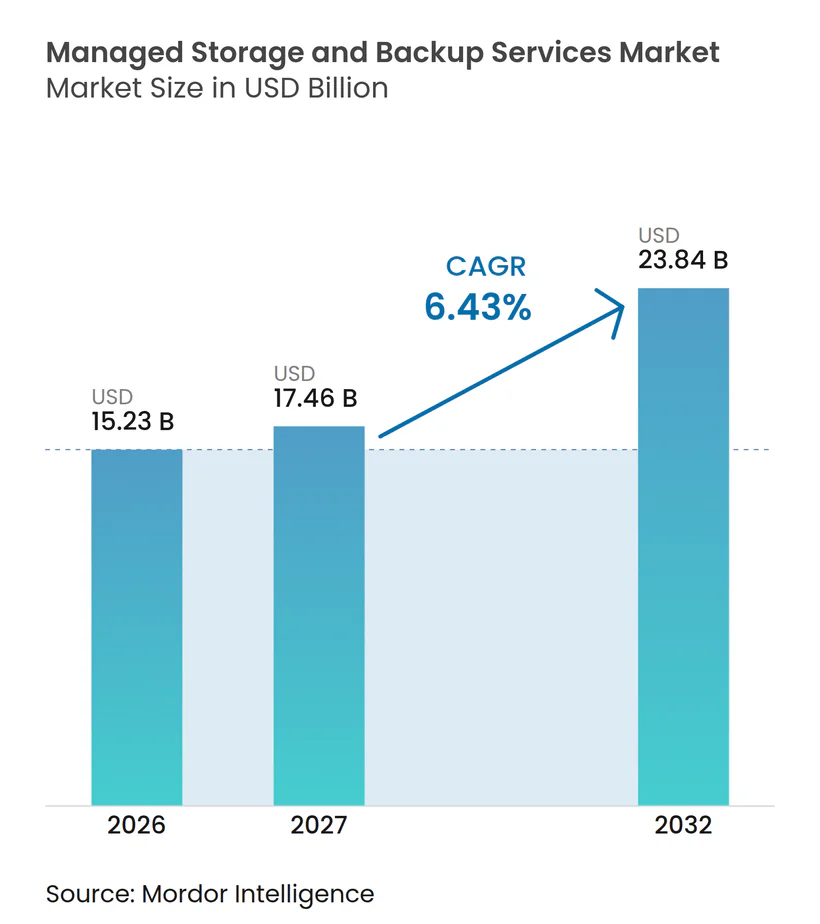
The managed storage and backup services market size is expected to increase from USD 15.23 billion in 2026 to USD 17.46 billion in 2027 and reach USD 23.84 billion by 2032, growing at a CAGR of 6.43% over 2027-2032. Demand is moving toward managed delivery because AI workloads create larger volumes of model logs, synthetic data, and inference outputs that older backup designs do not consistently protect. Ransomware recovery requirements are also moving storage decisions beyond capacity management, as buyers seek immutable backups, recovery testing, and documented restoration processes. Compliance deadlines strengthen the case for providers that can manage retention, residency, and recovery controls across several jurisdictions. The Managed storage and backup services market is also shaped by a shift from capital spending on owned infrastructure toward subscription services that combine operations, security, and recovery support. Providers that pair multi-cloud flexibility with transparent recovery pricing have an opening among organizations seeking to reduce vendor concentration and sovereignty exposure.
Key Report Takeaways
- By service type, Backup and Restore Management held 24.73% of the managed storage and backup services market share in 2026, while Cyber-Recovery as a Service is projected to expand at a 7.29% CAGR through 2032.
- By service delivery model, Fully Managed Services held 46.91% of revenue in 2026, while Co-Managed Services is expected to expand at an 8.34% CAGR through 2032.
- By storage type, Backup and Recovery Storage accounted for 27.48% of revenue in 2026 and is projected to expand at a 7.81% CAGR through 2032.
- By storage environment, Cloud-Based Storage held 68.79% of revenue in 2026, while Hybrid and Multi-Cloud Storage are projected to expand at a 9.32% CAGR through 2032.
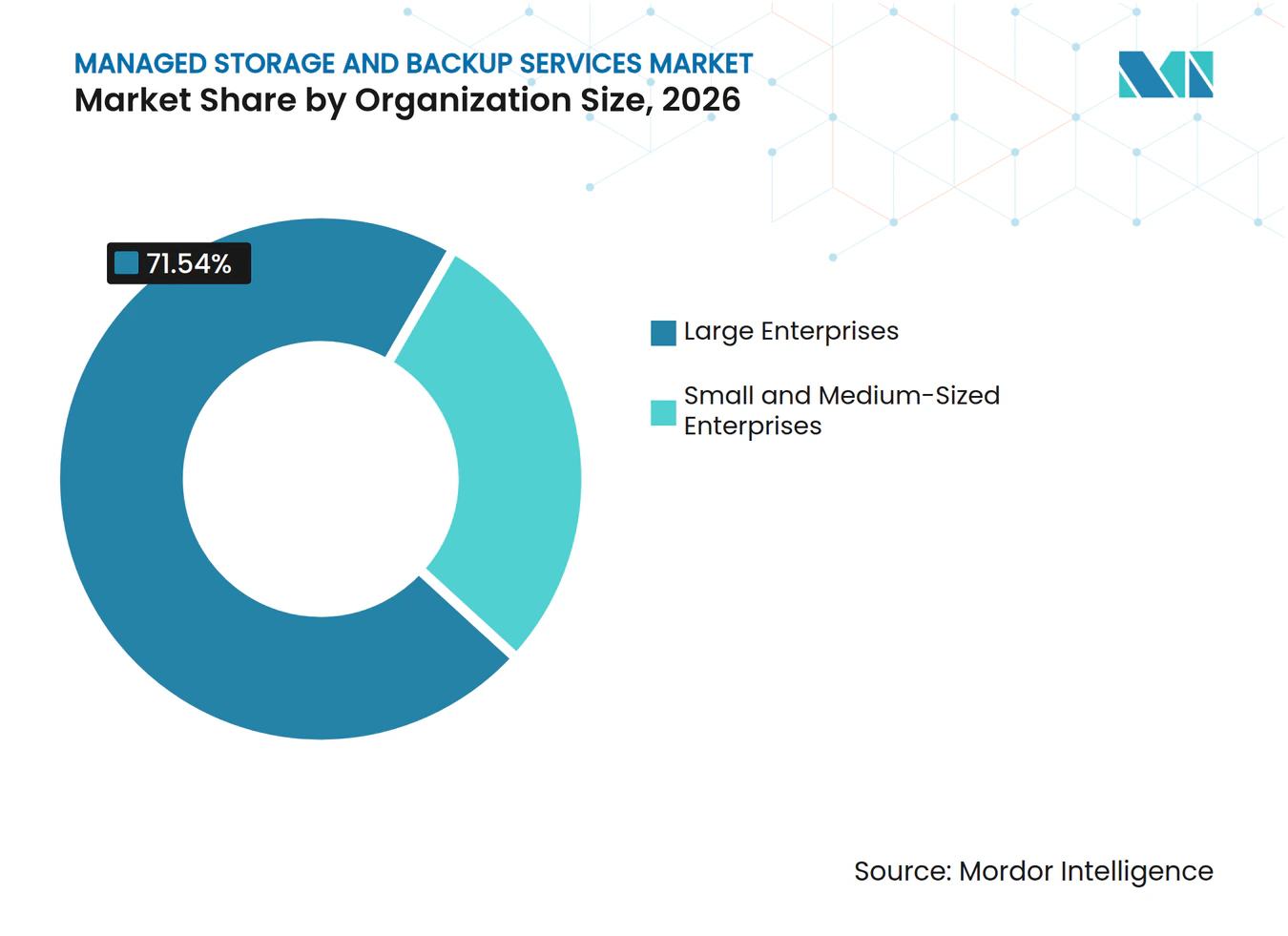
- By organization size, Large Enterprises accounted for 71.54% of revenue in 2026, while Small and Medium-Sized Enterprises are expected to expand at an 8.64% CAGR through 2032.
- By end-user industry, BFSI held 31.66% of revenue in 2026, while Healthcare and Life Sciences are projected to expand at a 9.27% CAGR through 2032.
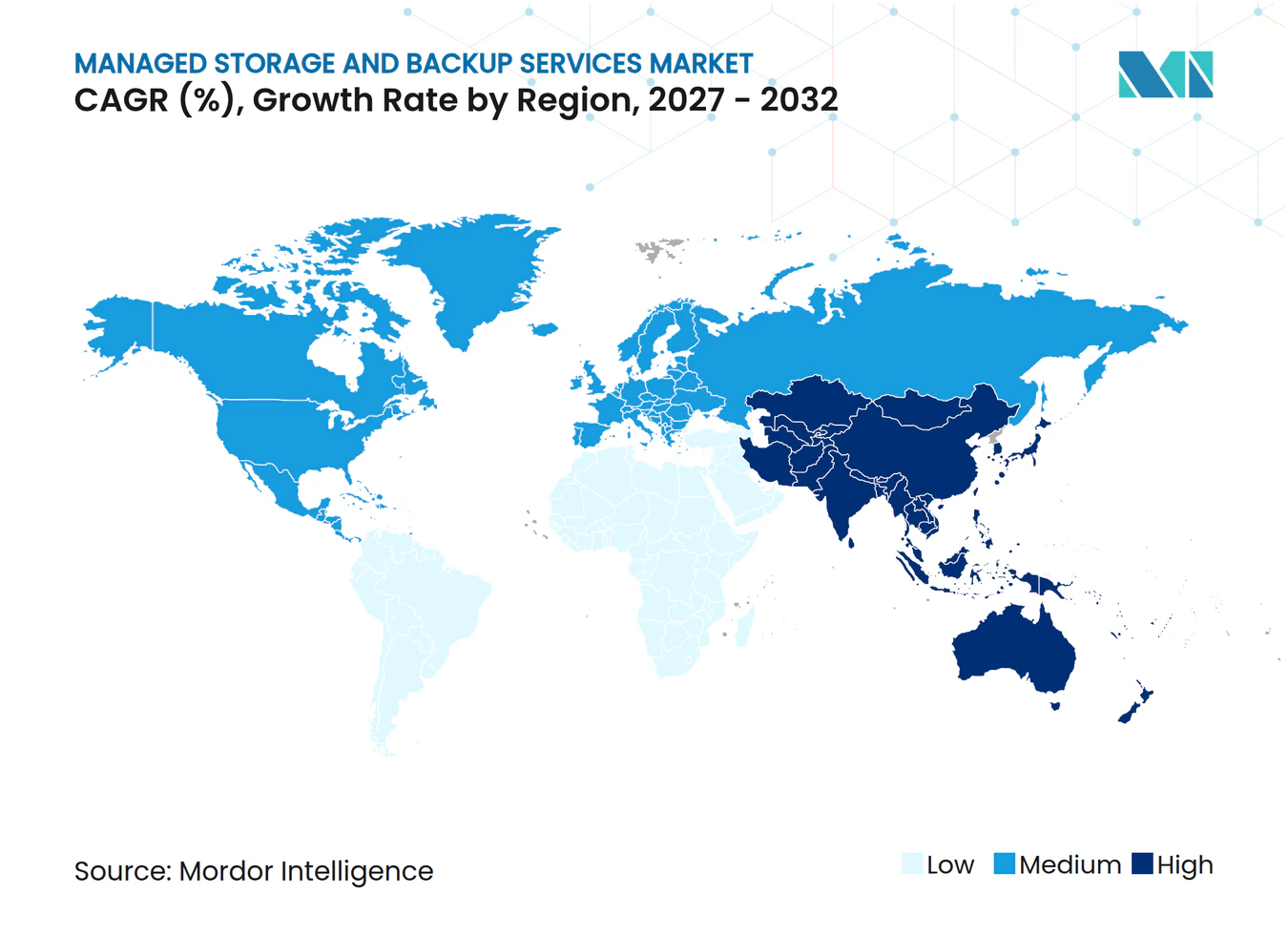
- By geography, North America held 38.64% of the managed storage and backup services market revenue in 2026, while Asia-Pacific is expected to expand at a 9.91% CAGR through 2032.
Note: Market numbers in this report are based on Mordor Intelligence's proprietary estimation framework, which combines nine months of actuals with Q4 projections for base year 2026.
Market Trends and Insights
Drivers Impact Analysis of Managed Storage and Backup Services Market*
| Driver | (~) % Impact on CAGR Forecast | Geographic Relevance | Impact Timeline |
|---|---|---|---|
| Explosive Enterprise Data Growth and AI Workloads | +1.8% | Global, with early gains in North America, China, and India | Long term (≥ 4 years) |
| Ransomware-Resilient Backup and Cyber-Recovery Requirements | +1.4% | Global, strongest in North America and Western Europe | Short term (≤ 2 years) |
| SaaS and Cloud-Native Workload Protection Gaps | +1.0% | North America and Europe, with spillover to Asia-Pacific core | Medium term (2-4 years) |
| Regulatory Retention, Residency, and Recovery Mandates | +0.8% | EU and North America, with spillover to the Middle East and South America | Medium term (2-4 years) |
| Recovery Assurance as a Board-Level Operating Metric | +0.4% | North America and Europe | Short term (≤ 2 years) |
| AI-Assisted Backup Policy and Capacity Optimization | +0.2% | Global, with early gains in North America, the United Kingdom, and Japan | Long term (≥ 4 years) |
| Source: Mordor Intelligence | |||
Explosive Enterprise Data Growth and AI Workloads
AI inference is changing storage economics because it increases both the volume of business data and the speed at which teams need to find, validate, and retrieve it. Seagate reported that 98% of surveyed organizations view AI as changing storage into a strategic business infrastructure, rather than leaving it as a routine back-office responsibility.[1] The same report found that only 38% of organizations considered themselves fully prepared for AI's long-term data demands, which leaves many buyers with a clear planning and operating gap. Enterprises operating several AI models must retain model logs, synthetic outputs, inference results, and related records that may not fit older backup policies or simple archive schedules. This makes the managed storage and backup services market relevant for policy management, capacity planning, archive access, and the continuing review of where data should be held. The longer retention cycle also raises the value of services that classify information across active, backup, and archival tiers while keeping retrieval practical for business and technical users.
Ransomware-Resilient Backup and Cyber-Recovery Requirements
Ransomware has made recovery readiness a direct operating concern because the cost of restoring systems can be as important as the cost of the attack itself. Sophos reported that 56% of ransomware attacks surveyed encrypted data, while the median ransom payment was USD 769,000, underscoring why organizations are focused on protecting usable recovery copies.[2] Sophos also reported average recovery costs of USD 1.7 million per incident, a figure that makes tested recovery arrangements material to finance and operational leaders. Veeam found that only 28% of ransomware-affected organizations fully recovered their data, while 44% recovered less than 75%, highlighting the difference between holding backups and restoring operations. These results increase demand for immutable, air-gapped services and managed recovery processes that can be tested before an incident occurs. The Managed storage and backup services market benefits when organizations treat recovery validation, documented procedures, and responsible ownership as continuing requirements rather than periodic technology purchases.
SaaS and Cloud-Native Workload Protection Gaps
Many organizations adopted SaaS applications and cloud-native databases faster than they extended their data protection practices, leaving gaps in the records that support daily operations and regulated processes. Arcserve reported that 19% of surveyed organizations had no SaaS backup coverage, indicating that a meaningful share of organizations still rely on limited native protection. The gap is most visible where Microsoft 365, Salesforce, and cloud-native databases were added without matched recovery policies, ownership procedures, or clear retention controls. Cloud platforms operate under shared-responsibility models, so customers still need to manage the availability and recovery of their own data even where an application is delivered as a service. Providers can address this requirement through API-connected protection, policy controls, and recovery procedures that cover the application layer as well as the underlying infrastructure. This extends managed engagements beyond infrastructure operations and into application continuity, giving customers a more consistent approach across a changing set of business applications.
Regulatory Retention, Residency, and Recovery Mandates
DORA has been applied since January 17, 2025, and requires financial entities to maintain documented backup policies, segregated restoration environments, and redundant ICT capacity that supports operational resilience. NIS2 extends security and resilience duties to essential and important entities across 18 critical sectors, expanding the range of organizations that must demonstrate structured cyber-risk practices. NIS2 allows fines of up to EUR 10 million (USD 11.19 million) or 2% of worldwide annual turnover for the highest-tier entities, giving senior leaders a direct reason to review readiness. These rules increase the need for auditable retention, restoration, and recovery-test processes that are clear enough to show regulators and internal assurance teams. The Managed storage and backup services market presents an opportunity for providers to apply comparable controls across multiple regulatory frameworks without forcing customers to operate separate workflows for each rule. Managed delivery is particularly relevant for organizations that cannot maintain separate specialists for each jurisdiction, recovery environment, compliance report, and technical control.
Restraints Impact Analysis of Managed Storage and Backup Services Market*
| Restraint | (~) % Impact on CAGR Forecast | Geographic Relevance | Impact Timeline |
|---|---|---|---|
| Data Sovereignty and Cross-Border Transfer Complexity | -0.9% | EU and Middle East, with spillover to Asia-Pacific | Long term (≥ 4 years) |
| Multi-Tenant Security and Privacy Concerns | -0.7% | Global, strongest in regulated BFSI and healthcare sectors | Medium term (2-4 years) |
| Cloud Egress Costs and Recovery Economics | -0.5% | Global, most acute in North America and the EU | Short term (≤ 2 years) |
| Limited Edge-Grade Protection for Operational Technology | -0.2% | Asia-Pacific, South America, and the Middle East | Long term (≥ 4 years) |
| Source: Mordor Intelligence | |||
Data Sovereignty and Cross-Border Transfer Complexity
Data-localization requirements can make a managed storage design more costly and difficult to operate across borders. The EU Data Act has been applied since September 12, 2025, and establishes switching requirements for data processing services. Providers must align segregated recovery environments with DORA requirements and with safeguards for international transfers under the GDPR. This requirement is also becoming more important in India, Saudi Arabia, and Southeast Asia. Multi-region architecture can delay contract decisions when customers need to determine where primary and recovery copies can reside. It can also favor large providers that already operate broad regional infrastructure, while creating a more difficult delivery environment for independent regional providers.
Multi-Tenant Security and Privacy Concerns
Regulated organizations remain careful about placing sensitive workloads in shared managed-service environments. Arcserve found that 88.7% of surveyed organizations used 2 or more data-protection tools. Multiple tools can reflect a need for parallel protection methods when customers do not consider a single provider sufficient for all workloads. HIPAA requires covered entities and business associates to establish contingency plans that include data backup and disaster recovery procedures. DORA also requires segregated restoration environments for financial entities. Until providers can demonstrate tenant isolation through audits and usable compliance reporting, some customers will retain hybrid or co-managed models.
*Our forecasts treat driver/restraint impacts as directional, not additive. The impact forecasts reflect baseline growth, mix effects, and variable interactions.
Managed Storage and Backup Services Market Segment Analysis
By Service Type:
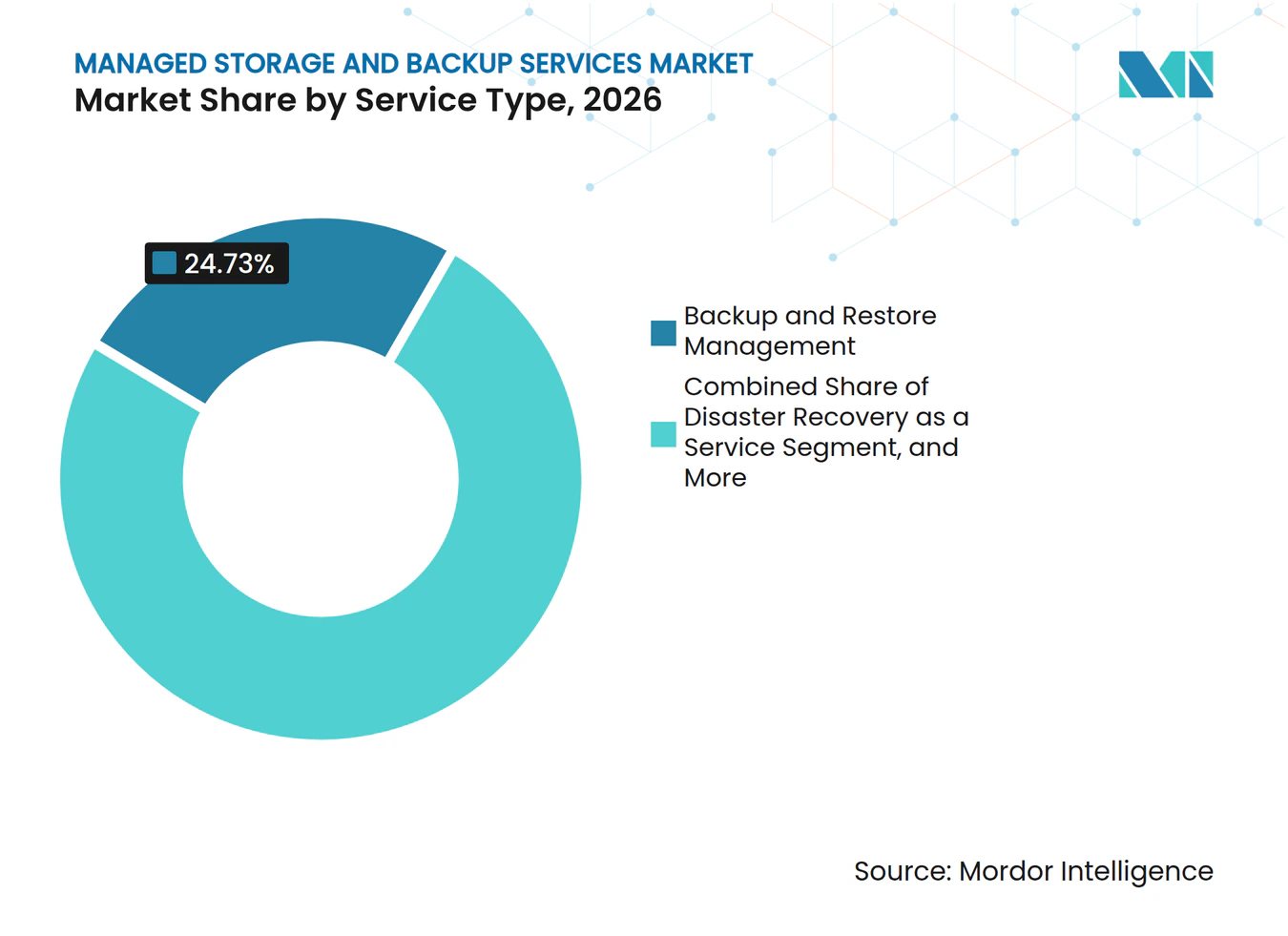
Cyber Recovery Expands the Managed PortfolioBackup and Restore Management held 24.73% of the Managed storage and backup services market share in 2026, making it the core service across enterprise storage contracts. Sophos reported that 66% of organizations whose data was encrypted used backups to recover. Buyers, therefore, treat managed backup as a necessary continuity expense, rather than an optional infrastructure service. Disaster Recovery as a Service supports restoration after a wider operational outage. Data Archiving and Retention Management supports long-term retention and retrieval requirements. Compliance and Security Management, Capacity Planning, and Reporting are gaining relevance as customers need evidence that their recovery processes can meet regulatory expectations.
Cyber-Recovery as a Service is projected to expand at a 7.29% CAGR through 2032. The service treats ransomware and supply-chain attacks as the primary recovery scenario rather than hardware failure. It requires immutable vaults, malware scanning before restoration, and multi-party approval steps. These controls fill gaps that standard backup may not address. The Managed storage and backup services market is moving toward offerings that connect backup operations with security operations. This shift allows providers to support customers before, during, and after an attempted attack.



By Service Delivery Model:
Co-Managed Services Gain GroundFully Managed Services accounted for 46.91% of revenue in 2026, supported by large enterprises seeking a complete operational transfer. BFSI and healthcare customers often pay for this approach because they need continuous monitoring and SLA-backed recovery windows. Remote Managed Services support distributed organizations that do not need staff at each location. On-Site Managed Services remain relevant in settings where air-gapped data or on-premises sovereignty is a contractual requirement. IBM and Cobalt Iron launched Secure Automated Backup with Compass for IBM Cloud customers in March 2026.[3] The offering provides a fully managed Backup-as-a-Service experience across several cloud environments.
Co-Managed Services is expected to expand at an 8.34% CAGR through 2032. Mid-market IT teams use this model to retain policy authority while outsourcing daily operations. Consumption-based services from Dell APEX and HPE GreenLake lower entry barriers for buyers that need scale without a large capital commitment. The model is relevant to insurers, regional banks, and professional-services firms that require clear accountability for audit purposes. Co-managed delivery also lets customers retain internal knowledge of their data and recovery priorities. This balance explains its stronger expected expansion within the Managed storage and backup services market.
By Storage Type:
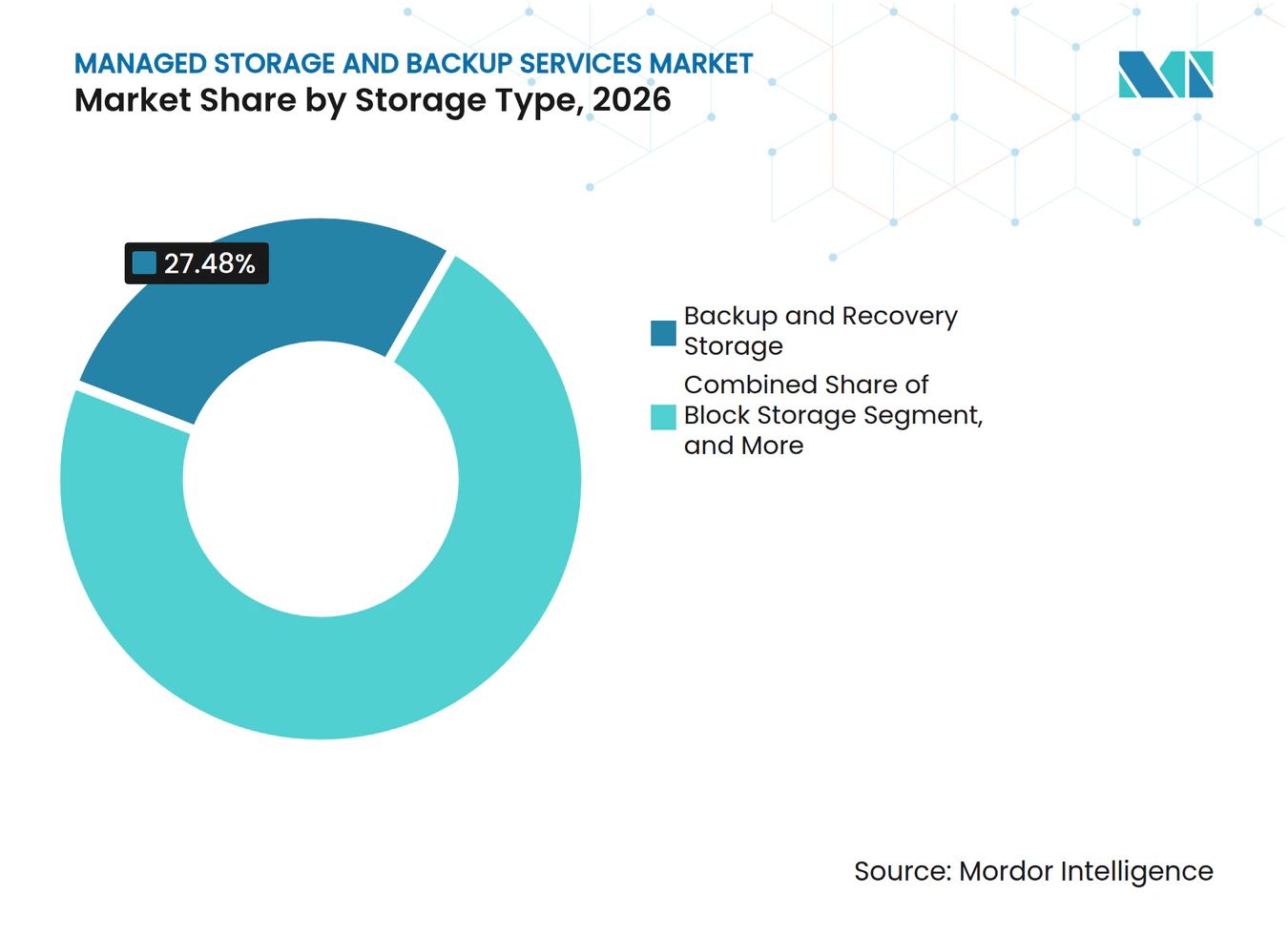
Backup and Recovery Storage Supports Both Scale and ExpansionBackup and Recovery Storage accounted for 27.48% of revenue in 2026 and is projected to expand at a 7.81% CAGR through 2032. Its position reflects the need for recovery storage across nearly all enterprise technology environments. ExaGrid launched an All Flash/SSD Tiered Backup Storage Solution in January 2026 with AI-powered Retention Time-Lock and a non-network-facing tiered air gap. This product illustrates demand for faster recovery alongside immutability controls. Block Storage and Object Storage serve AI training and inference workloads. File Storage continues to support structured data workloads in media, manufacturing, and life sciences.
Archive and Cold Storage is becoming an active data layer rather than just a tape replacement option. Organizations are bringing cold-tier data back online to support AI-related work, which increases the need for faster retrieval. AWS introduced a low-cost warm storage tier for Amazon S3 backup data in November 2025.[4] AWS stated that the tier can reduce long-term storage costs by up to 30% through automatic tiering. Automated movement across hot, warm, and cold tiers is becoming an important part of managed storage delivery. This need gives providers a reason to combine capacity management with retrieval planning and cost control.

By Storage Environment:
Hybrid and Multi-Cloud Storage Becomes the Growth EngineCloud-Based Storage held 68.79% of revenue in 2026, reflecting the move from on-premises tape libraries to elastic cloud repositories. The environment lets organizations add capacity without buying and operating all storage hardware directly. On-Premises Storage remains important for defense, government, and financial trading workloads that need physical isolation or low latency. It also supports customers whose retention requirements limit where copies can be kept. These needs sustain on-premises deployments even as cloud services mature. The Managed storage and backup services market must therefore support cloud, local, and connected environments rather than treating cloud delivery as the only operating model.
Hybrid and Multi-Cloud Storage is expected to expand at a 9.32% CAGR through 2032. Organizations use it to reduce the vendor and regulatory exposure that can result from cloud-only designs. Arcserve found that 72.3% of surveyed organizations were evaluating or planning changes to their hypervisors. These infrastructure changes require providers to reconfigure data protection and recovery processes. Cohesity received a 2026 Google Cloud Partner of the Year Award for Infrastructure Modernization, Disaster Recovery, and Backup. Its FortKnox solution supports sovereign copies within the Google Cloud Data Boundary.
By Organization Size:
Small and Medium-Sized Enterprises Adopt Managed ProtectionLarge Enterprises held 71.54% of revenue in 2026 because they operate complex, multi-petabyte environments and can negotiate premium managed contracts. Their procurement decisions increasingly specify recovery time and recovery point objectives. Arcserve reported that only 35.4% of organizations met their RPO and RTO targets in actual ransomware recovery testing. This gap supports demand for providers that can validate recovery outcomes rather than simply retain data copies. Large enterprises also need coverage across several business units, infrastructure environments, and legal jurisdictions. Those requirements favor providers with consistent reporting and operational depth.
Small and Medium-Sized Enterprises are projected to expand at an 8.64% CAGR through 2032. Ransomware risk and compliance obligations are extending into smaller organizations through supply chains and customer requirements. Sophos reported that only 1 in 3 smaller organizations stopped a ransomware attack before it encrypted data. Standardized managed backup tiers can help these buyers access protection without having to maintain large internal teams. Consumption-based services from N-able and Arcserve lower the initial operating threshold. Small organizations commonly begin with managed backup and add other managed storage functions as their needs increase.
By End-User Industry:
Healthcare and Life Sciences Outpace the BFSI BaseBFSI held 31.66% of revenue in 2026, supported by stringent continuity, retention, and recovery obligations. DORA requires financial entities to establish and review backup policies as part of their ICT risk management framework. PCI DSS requirements and the financial cost of recovery failure add to the sector's need for managed services. IT, Telecommunications, Government, and Public Sector also require continuity controls and retention of sensitive information. Industrial Manufacturing is adopting managed storage as operational technology, and Industry 4.0 systems generate more governed data. Retail and E-Commerce use cloud-based protection as their distributed application environments expand.
The healthcare and life sciences industry is expected to expand at a 9.27% CAGR through 2032. Electronic health records and AI-assisted diagnostics are generating larger volumes of imaging and patient data. HIPAA requires contingency plans that include data backup and disaster recovery procedures. The proposed HIPAA Security Rule updates would make encryption and multi-factor authentication mandatory. Managed providers can perform related configuration and monitoring work at scale. The combination of rising data volume and stricter safeguards supports the segment's expected expansion in the Managed storage and backup services market.
Geography Analysis
North America Managed Storage and Backup Services Market
North America held 38.64% of revenue in 2026, giving the region the largest position in the Managed storage and backup services market. A mature enterprise IT base and high data volumes per organization underpin this scale. NIST guidance, SOC 2 expectations, and state-level data-governance requirements encourage organizations to document how business data is protected and recovered. The United States accounts for most regional demand, with BFSI and healthcare representing major areas of managed storage spending. Canada and Mexico add demand from banking, natural resources, and manufacturing-export activities. The region also has a developed co-managed services base because many mid-market customers have enough IT capability to retain governance while outsourcing execution.
APAC Managed Storage and Backup Services Market
Asia-Pacific is projected to expand at a 9.91% CAGR through 2032, making it the fastest-expanding regional part of the managed storage and backup services market. India combines a large SME base with rising use of cloud-native services and requirements under the Digital Personal Data Protection Act. China is shaped by national cybersecurity requirements that favor localized cloud infrastructure and locally managed data environments. South Korea's advanced cloud infrastructure supports demand across the region, while Southeast Asian SMEs are adopting managed services as their technology estates become more distributed. Japan's information and communications sector recorded 6.1% year-on-year revenue growth in December 2024, supported by demand in automotive, electronics, and financial services. These conditions favor providers that can combine regional infrastructure coverage with local compliance support and practical services for smaller customers.
EMEA and South America Managed Storage and Backup Services Market
Europe remains a meaningful part of the managed storage and backup services market, with Germany, the United Kingdom, and France as its largest country contributors. DORA and NIS2 increase demand for controlled, tested, and auditable recovery practices in the region. South America is expanding as Brazil's BFSI and government organizations prioritize managed backup and continuity arrangements. The Middle East is active through Saudi Arabia and the UAE, where data-sovereignty requirements and cloud-first government digitalization programs support demand. Africa is at an earlier stage, although infrastructure development in South Africa, Nigeria, and Egypt supports future adoption. Providers that can demonstrate residency controls, local recovery options, and dependable operating support are better placed to address regional differences across the Managed storage and backup services market.
Competitive Landscape
Market Concentration
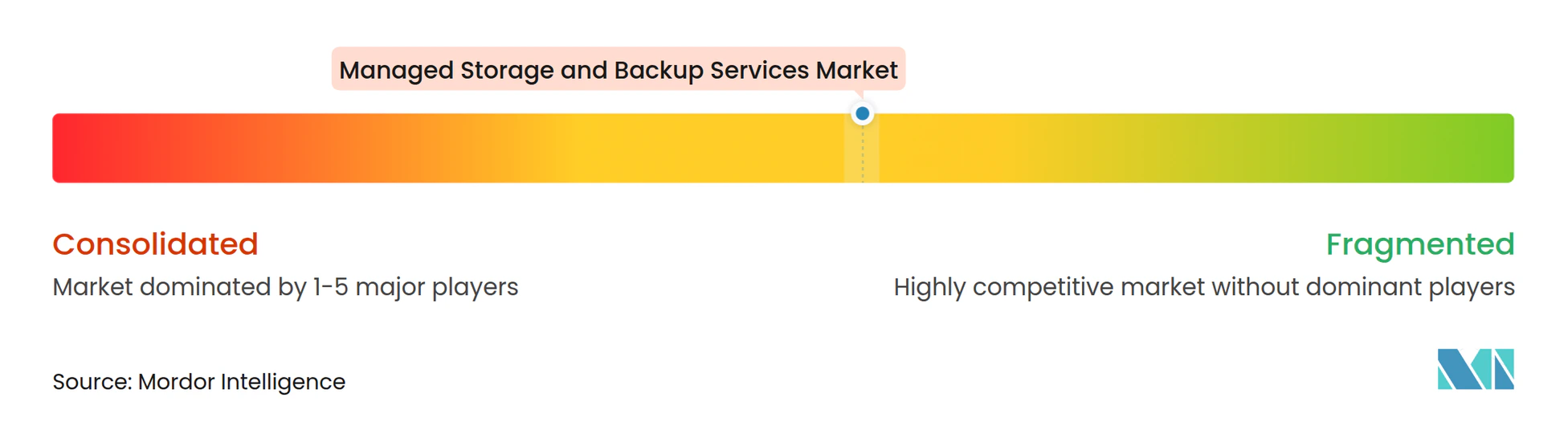
The managed storage and backup services market is moderately fragmented, with hyperscaler-aligned companies and pure-play specialists holding a stronger position than a wider group of regional and niche providers. Competition is moving away from capacity pricing and toward validated recovery, anomaly detection, identity resilience, and automated orchestration. The premium tier includes the combined Cohesity and Veritas organization, AWS, Microsoft, and IBM. Rubrik, Druva, and Arcserve compete through cyber-resilience features and managed protection capabilities. Regional providers continue to compete on price, vertical expertise, and closeness to customers.
Commvault disclosed its acquisition of Satori Cyber Ltd. in its Q2 FY2026 filing, adding capabilities intended to manage AI-related risks across hybrid and multi-cloud environments. The Cohesity and Veritas combination was completed in December 2024, creating a larger pure-play storage management company and raising the competitive bar for smaller providers. Cohesity's 2026 Google Cloud recognition reflected its integration of Google Threat Intelligence and Private Scanning into Cohesity Data Cloud. IBM and Cobalt Iron added another example in March 2026 when they introduced Secure Automated Backup with Compass across IBM Cloud and other cloud environments. These moves show how suppliers in the Managed storage and backup services market are strengthening their platforms through acquisitions, cloud partnerships, and bundled managed offerings.
Opportunities remain in operational-technology protection, SaaS coverage, and sovereign-cloud managed delivery. Arcserve's research points to continuing SaaS protection gaps, including organizations with no coverage for SaaS data. A 2026 study in Scientific Reports described an AI-based backup data-integrity verification framework that achieved 98.45% security accuracy. ISO 27001 and SOC 2 Type II attestations remain important in procurement by regulated customers. Hyperscalers benefit from native cloud integration, while specialists compete through portability across clouds and deeper compliance reporting. The competitive outcome in the managed storage and backup services market will depend on which providers can make complex recovery and security controls easier for customers to operate.
Managed Storage and Backup Services Industry Leaders
-
Amazon Web Services, Inc.
-
Microsoft Corporation
-
International Business Machines Corporation
-
Dell Technologies Inc.
-
Veeam Software Group GmbH
- *Disclaimer: Major Players sorted in no particular order
Managed Storage and Backup Services Market Companies Covered in this Report
- Amazon Web Services, Inc.
- Microsoft Corporation
- International Business Machines Corporation
- Dell Technologies Inc.
- Veeam Software Group GmbH
- Hewlett Packard Enterprise Company
- Google LLC
- Commvault Systems, Inc.
- Veritas Technologies LLC
- Cohesity, Inc.
- Rubrik, Inc.
- Acronis International GmbH
- Druva Inc.
- Barracuda Networks, Inc.
- NetApp, Inc.
- Oracle Corporation
- Open Text Corporation
- Arcserve LLC
- Backblaze, Inc.
- Iron Mountain Incorporated
- N-able, Inc.
- Asigra Inc.
Recent Industry Developments in Managed Storage and Backup Services Market
- October 2026: Microsoft Azure Backup added vaulted backup support for Azure PostgreSQL Flexible Server and Elastic Cluster in preview, extending immutable protection to distributed relational database workloads.
- September 2026: Microsoft Azure Backup achieved general availability of operational backup for Azure Elastic SAN volumes and introduced time-based immutability for Recovery Services vaults, strengthening ransomware-recovery guarantees for large-scale block-storage environments.
- March 2026: IBM and Cobalt Iron globally launched Secure Automated Backup with Compass for IBM Cloud customers, delivering a fully managed Backup-as-a-Service experience across IBM Cloud, AWS, Microsoft Azure, Google Cloud Platform, and Alibaba Cloud with immutable encryption and Zero Access architecture. IBM and Cobalt Iron globally launched Secure Automated Backup with Compass for IBM Cloud customers, delivering a fully managed Backup-as-a-Service experience across IBM Cloud, AWS, Microsoft Azure, Google Cloud Platform, and Alibaba Cloud with immutable encryption and Zero Access architecture.
- January 2026: FalconStor launched Habanero, a globally available SaaS offering for IBM Power environments, providing secure off-site data protection with object-storage economics across 12 IBM Cloud regions.
Global Managed Storage and Backup Services Market Report Scope
Managed storage and backup services market provides externally operated management of enterprise data storage infrastructure and data-protection processes. Providers handle storage provisioning, capacity and performance management, backup scheduling, replication, retention, recovery testing, and restoration support to ensure data availability, resilience, and business continuity.
The Managed Storage and Backup Services Market Report is Segmented by Service Type (Managed Storage Provisioning and Operations, Backup and Restore Management, Disaster Recovery as a Service, Data Archiving and Retention Management, Compliance and Security Management, Capacity Planning and Reporting, Cyber-Recovery as a Service, and Other Service Types), Service Delivery Model (Fully Managed Services, Co-Managed Services, Remote Managed Services, and On-Site Managed Services), Storage Type (Block Storage, File Storage, Object Storage, Backup and Recovery Storage, and Archive and Cold Storage), Storage Environment (Cloud-Based Storage, On-Premises Storage, and Hybrid and Multi-Cloud Cloud Storage), Organization Size (Large Enterprises, and Small and Medium-Sized Enterprises), End-User Industry (Banking, Financial Services, and Insurance (BFSI), Government and Public Administration, IT and Telecommunications, Healthcare and Life Sciences, Energy and Utilities, Manufacturing and Industrial, and Other End Users), and Geography (North America, South America, Europe, Asia-Pacific, Middle East, and Africa). The Market Forecasts are Provided in Terms of Value (USD).
Segmentation Overview
| Managed Storage Provisioning and Operations |
| Backup and Restore Management |
| Disaster Recovery as a Service |
| Data Archiving and Retention Management |
| Compliance and Security Management |
| Capacity Planning and Reporting |
| Cyber-Recovery as a Service |
| Other Service Types |
| Fully Managed Services |
| Co-Managed Services |
| Remote Managed Services |
| On-Site Managed Services |
| Block Storage |
| File Storage |
| Object Storage |
| Backup and Recovery Storage |
| Archive and Cold Storage |
| Cloud-Based Storage |
| On-Premises Storage |
| Hybrid and Multi-Cloud Cloud Storage |
| Large Enterprises |
| Small and Medium-Sized Enterprises |
| Banking, Financial Services and Insurance (BFSI) |
| IT and Telecommunications |
| Healthcare and Life Sciences |
| Government and Public Sector |
| Industrial Manufacturing |
| Retail and E-Commerce |
| Other End-User Industries |
| North America | United States |
| Canada | |
| Mexico | |
| South America | Brazil |
| Argentina | |
| Rest of South America | |
| Europe | United Kingdom |
| Germany | |
| France | |
| Italy | |
| Rest of Europe | |
| Asia-Pacific | China |
| Japan | |
| India | |
| South Korea | |
| Rest of Asia-Pacific | |
| Middle East | Saudi Arabia |
| United Arab Emirates | |
| Rest of Middle East | |
| Africa | South Africa |
| Nigeria | |
| Rest of Africa |
| By Service Type | Managed Storage Provisioning and Operations | |
| Backup and Restore Management | ||
| Disaster Recovery as a Service | ||
| Data Archiving and Retention Management | ||
| Compliance and Security Management | ||
| Capacity Planning and Reporting | ||
| Cyber-Recovery as a Service | ||
| Other Service Types | ||
| By Service Delivery Model | Fully Managed Services | |
| Co-Managed Services | ||
| Remote Managed Services | ||
| On-Site Managed Services | ||
| By Storage Type | Block Storage | |
| File Storage | ||
| Object Storage | ||
| Backup and Recovery Storage | ||
| Archive and Cold Storage | ||
| By Storage Environment | Cloud-Based Storage | |
| On-Premises Storage | ||
| Hybrid and Multi-Cloud Cloud Storage | ||
| By Organization Size | Large Enterprises | |
| Small and Medium-Sized Enterprises | ||
| By End-User Industry | Banking, Financial Services and Insurance (BFSI) | |
| IT and Telecommunications | ||
| Healthcare and Life Sciences | ||
| Government and Public Sector | ||
| Industrial Manufacturing | ||
| Retail and E-Commerce | ||
| Other End-User Industries | ||
| By Geography | North America | United States |
| Canada | ||
| Mexico | ||
| South America | Brazil | |
| Argentina | ||
| Rest of South America | ||
| Europe | United Kingdom | |
| Germany | ||
| France | ||
| Italy | ||
| Rest of Europe | ||
| Asia-Pacific | China | |
| Japan | ||
| India | ||
| South Korea | ||
| Rest of Asia-Pacific | ||
| Middle East | Saudi Arabia | |
| United Arab Emirates | ||
| Rest of Middle East | ||
| Africa | South Africa | |
| Nigeria | ||
| Rest of Africa | ||
Key Questions Answered in the Report
What is the size of the managed storage and backup services market?
The managed storage and backup services market size is expected to increase from USD 15.23 billion in 2026 to USD 17.46 billion in 2027 and reach USD 23.84 billion by 2032, growing at a CAGR of 6.43% over 2027-2032.
What is driving demand for managed storage services?
AI-related data growth, ransomware recovery needs, SaaS protection gaps, and stronger recovery and residency requirements are supporting demand.
Which service type has the largest revenue share?
Backup and Restore Management held 24.73% of revenue in 2026, making it the largest service type.
Which service delivery model is expected to expand fastest?
Co-Managed Services is projected to expand at an 8.34% CAGR through 2032 as customers retain policy control while outsourcing operations.
Which end-user sector is expected to expand fastest?
Healthcare and Life Sciences is projected to expand at a 9.27% CAGR through 2032, supported by electronic health records and diagnostic data needs.
Which region is expected to expand fastest?
Asia-Pacific is expected to expand at a 9.91% CAGR through 2032, supported by India, South Korea, and adoption among Southeast Asian SMEs.