
Managed Software Asset Management Services Market Size and Share
Market Overview
| Study Period | 2021 - 2032 |
|---|---|
| Market Size (2027) | USD 2.28 Billion |
| Market Size (2032) | USD 4.64 Billion |
| Growth Rate (2027 - 2032) | 15.27 % |
| Fastest Growing Market | Asia-Pacific |
| Largest Market | North America |
| Market Concentration | Medium |
Major Players *Disclaimer: Major Players sorted in no particular order Image © Mordor Intelligence. Reuse requires attribution under CC BY 4.0. | |
Managed Software Asset Management Services Market Analysis by Mordor Intelligence
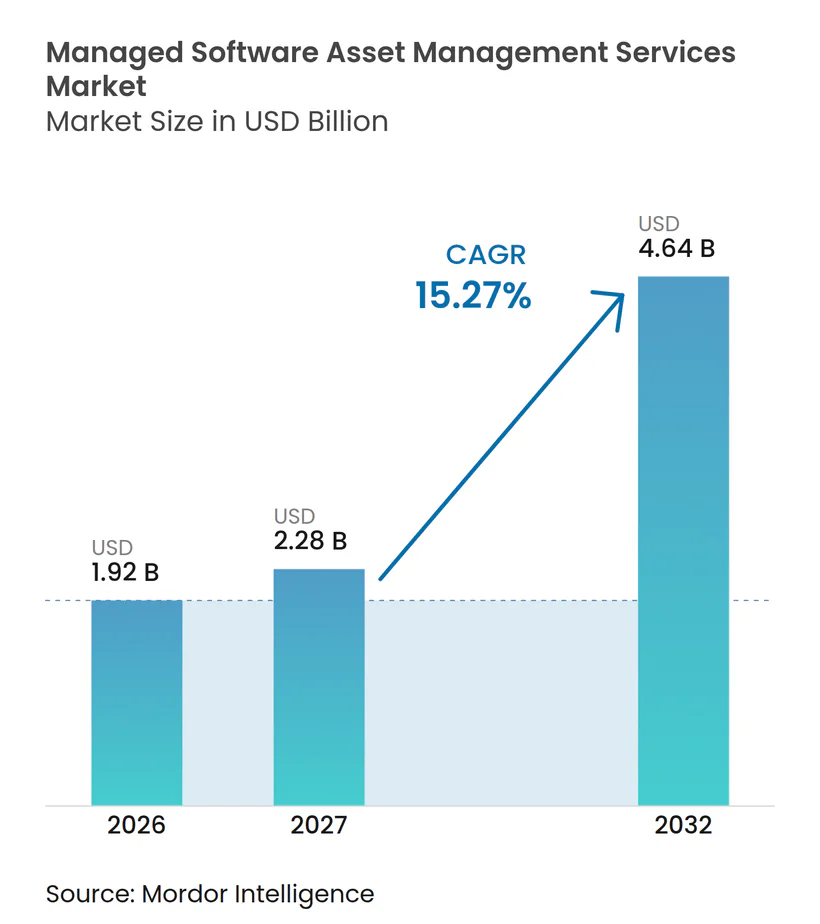
The managed software asset management services market size is projected to expand from USD 1.92 billion in 2026 and USD 2.28 billion in 2027 to USD 4.64 billion by 2032, registering a CAGR of 15.27% between 2027 and 2032. The managed software asset management services market is being shaped by enterprises that must control rights across on-premises systems, private clouds, public clouds, SaaS subscriptions, and AI-linked services, often within one vendor relationship. These environments use different measurement rules, so a single internal view of entitlement, deployment, consumption, contract terms, and renewal exposure is difficult to maintain, particularly after a cloud expansion, ERP migration, merger, or divestiture. Demand is also supported by more frequent audit activity and by the need to manage renewals before costs become fixed, which has moved license governance beyond a technical control and into finance and procurement decision-making. Providers are responding by combining license governance with cost-management processes, SaaS discovery, usage monitoring, contract management, and continuous operational support rather than isolated remediation projects. Scale is becoming more important in the managed software asset management services market as reseller-affiliated providers consolidate, while independent specialists continue to compete on neutrality, publisher expertise, SaaS-focused discovery, and the ability to offer recommendations that are separated from resale incentives.
Key Report Takeaways
- By service type, Software License Management held 24.73% of the managed software asset management services market share in 2026, while SaaS Asset Management Services is projected to expand at a 17.29% CAGR through 2032.
- By delivery model, Fully Managed SAM Services held 43.96% revenue share in 2026, while Co-Managed SAM Services is projected to expand at an 18.34% CAGR through 2032.
- By organization size, Large Enterprises held 71.54% of the managed software asset management services market revenue share in 2026, while small and mid-sized enterprises are projected to expand at an 18.64% CAGR through 2032.
- By end-user industry, BFSI held 31.66% revenue share in 2026, while the healthcare and life sciences industry is projected to expand at a 19.27% CAGR through 2032.
- By publisher category, Microsoft held 28.52% revenue share in 2026, while Broadcom is projected to expand at a 16.64% CAGR through 2032.
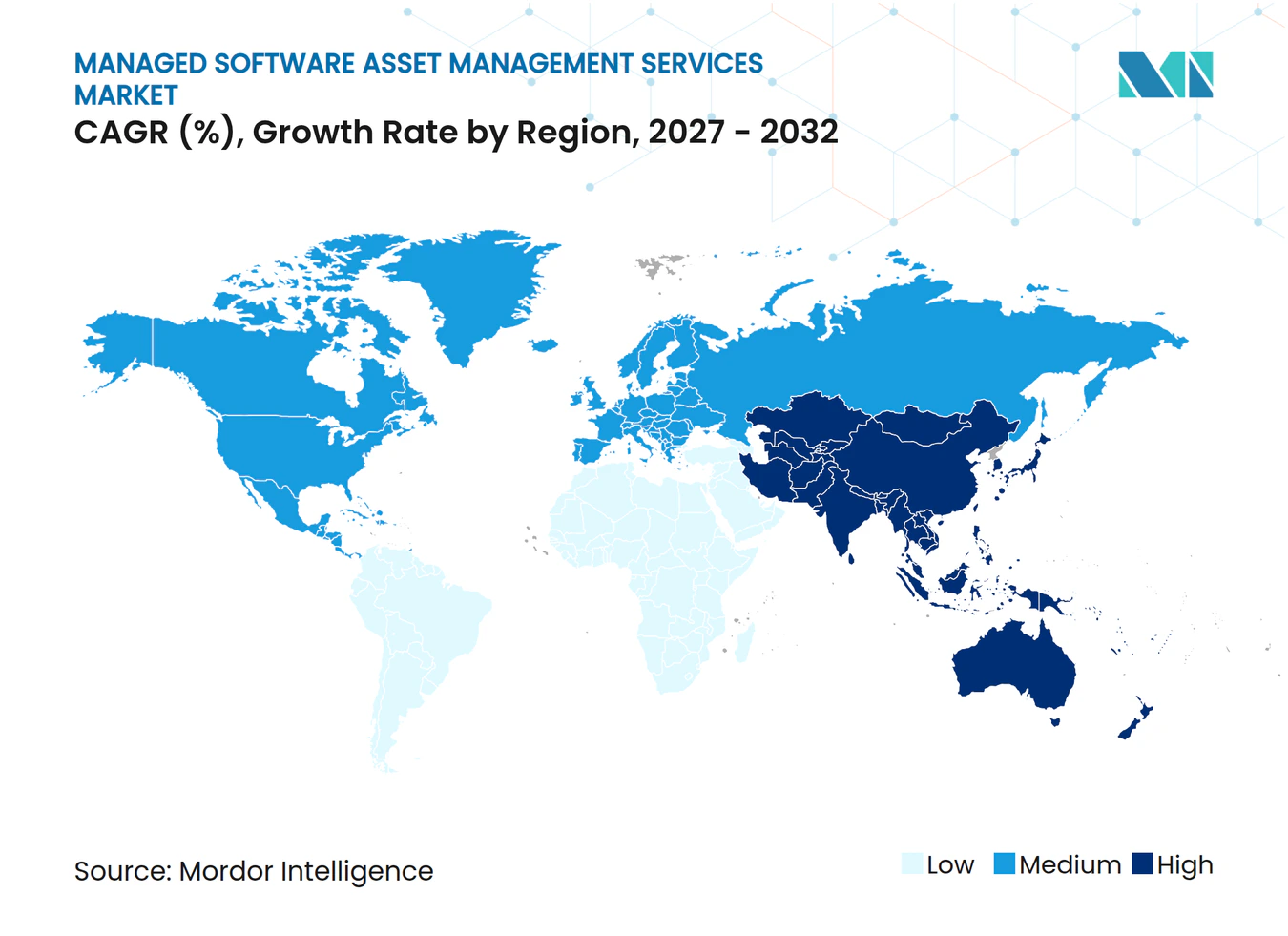
- By geography, North America held 38.64% of the managed software asset management services market revenue share in 2026, while Asia-Pacific is projected to expand at a 19.91% CAGR through 2032.
Note: Market numbers in this report are based on Mordor Intelligence's proprietary estimation framework, which combines nine months of actuals with Q4 projections for base year 2026.
Market Trends and Insights
Drivers Impact Analysis of Managed Software Asset Management Services Market*
| Driver | (~) % Impact on CAGR Forecast | Geographic Relevance | Impact Timeline |
|---|---|---|---|
| Increasing Software Licensing Complexity Across Hybrid and Multicloud Estates | +3.2% | Global, with core gains in North America and Europe | Short term (≤ 2 years) |
| Escalating Vendor Audit and Compliance Exposure | +2.8% | Global, highest concentration in North America and Asia-Pacific core | Short term (≤ 2 years) |
| Enterprise Demand for Predictable Software Spend and FinOps Alignment | +2.4% | North America and Europe, with spillover to Asia-Pacific | Medium term (2-4 years) |
| Shortage of In-House Licensing and SAM Expertise | +1.9% | Global, acute in Southeast Asia and South America | Medium term (2-4 years) |
| Expansion of SaaS, Usage-Based, and AI-Linked Licensing Metrics | +1.6% | Global, with the highest velocity in North America and Asia-Pacific SaaS environments | Long term (≥ 4 years) |
| Outsourcing of Continuous License Position and Renewal Operations | +1.2% | North America and Europe, emerging in the Middle East | Long term (≥ 4 years) |
| Source: Mordor Intelligence | |||
Increasing Software Licensing Complexity Across Hybrid and Multicloud Estates
The managed software asset management services market is supported by enterprises that run workloads across on-premises, private cloud, and several public cloud settings. Rights for a workload can change when it moves from bare-metal infrastructure to a virtual machine under a bring-your-own-license arrangement. This makes it difficult to compare an internal license position with the interpretation a publisher may apply during an audit. Each cloud-region expansion or enterprise resource planning migration can reset the effective license position and create a need for ongoing oversight. ISO/IEC 19770 also provides organizations with a recognized basis for establishing software asset management controls in regulated environments.
Escalating Vendor Audit and Compliance Exposure
Software publishers intensified audit activity in 2025 and 2026 as cloud migration, AI services, and subscription transitions created new areas of licensing exposure. A survey by Azul Systems and the ITAM Forum found that 1 in 4 organizations spent more than USD 500,000 each year resolving software license non-compliance.[1] Broadcom introduced a mandatory 180-day compliance-reporting requirement for VMware Cloud Foundation 9.0 in May 2025. The requirement turned a periodic review into a continuing operational responsibility for affected customers. Oracle, SAP, and Adobe introduce distinct areas of audit exposure, increasing the need for publisher-specific knowledge. This environment favors continuing managed engagement because buyers in the managed software asset management services market need evidence, license positions, renewal decisions, and a clear allocation of responsibility to be ready before an audit begins.
Enterprise Demand for Predictable Software Spend and FinOps Alignment
The managed software asset management services market is also benefiting from the extension of FinOps practices beyond infrastructure bills to software licenses and SaaS subscriptions. The FinOps Foundation expanded its 2025 framework to include software licenses, SaaS, and private-cloud infrastructure within its Cloud+ scope.[2] Its June 2025 partnership with the ITAM Forum established joint work on SaaS inventory, cloud-license compliance, and renewal governance. This connection brings software optimization into finance-led decisions on cost avoidance and spending predictability. Providers can therefore compete on a single view of on-premises rights, SaaS commitments, and cloud use. The model is most useful when savings opportunities can be tied to commercial actions before the next renewal date.
Shortage of In-House Licensing and SAM Expertise
The scope of software asset management is widening faster than many internal teams can build specialist capability. Flexera reported that only 33% of SAM professionals could consistently track software use across all teams, projects, and environments in 2025.The workload now includes SaaS applications, cloud agreements, traditional licenses, and AI-related consumption rights. Organizations also need staff who understand the commercial rules of specific publishers and can prepare defensible audit records. Managed providers can spread that expertise across several clients rather than requiring each enterprise to build a large internal practice. Certification remains useful as a hiring standard, but it does not eliminate the immediate demand for external support in the managed software asset management services market, where qualified practitioners must understand technology, contract language, and commercial licensing rules.
Restraints Impact Analysis of Managed Software Asset Management Services Market*
| Restraint | (~) % Impact on CAGR Forecast | Geographic Relevance | Impact Timeline |
|---|---|---|---|
| Incomplete Entitlement and Usage Data Across Disconnected Systems | -1.4% | Global, most acute in large distributed enterprises | Short term (≤ 2 years) |
| Complexity of Integrating SAM With CMDB, Procurement, ERP, and FinOps Platforms | -1.1% | North America and Europe, where IT service management environments are deepest | Medium term (2-4 years) |
| Client Concerns About Provider Independence in Resale-Linked Engagements | -0.8% | North America and Europe | Short term (≤ 2 years) |
| Long Enterprise Transition Cycles and Change-Management Burden | -0.6% | Global, amplified in regulated sectors | Medium term (2-4 years) |
| Source: Mordor Intelligence | |||
Incomplete Entitlement and Usage Data Across Disconnected Systems
Reliable delivery begins with reliable records, yet entitlement data, discovery records, and legal archives often show different versions of the same software estate. Procurement systems may show a purchase but not the deployment status or the contractual rights attached to it. Discovery tools can identify installed software but may not capture the terms that govern its permitted use. ServiceNow identified configuration management database quality as a frequent obstacle in SAM program implementation during its 2025 community review. Providers must often spend the first months of an engagement reconciling the data rather than optimizing the estate. The problem is especially pronounced after mergers and acquisitions, when systems and contract records may only be partly integrated.
Complexity of Integrating SAM With CMDB, Procurement, ERP, and FinOps Platforms
Software intelligence is more valuable when asset, configuration, procurement, finance, and governance systems can exchange relevant data. Achieving that connection in a live enterprise can require coordination between several teams and can extend the implementation schedule. ServiceNow notes that SAM Pro depends on a healthy configuration management database and requires ongoing tuning across several discovery sources. Indirect SAP access can also arise from links between third-party systems and the core application, which may not appear in a standard inventory. Full value can take 12 to 24 months to realize, so providers need clear interim milestones to retain client confidence. Providers with repeatable connectors and implementation methods can reduce this barrier while making their offerings harder to replace.
*Our forecasts treat driver/restraint impacts as directional, not additive. The impact forecasts reflect baseline growth, mix effects, and variable interactions.
Managed Software Asset Management Services Market Segment Analysis
By Service Type:
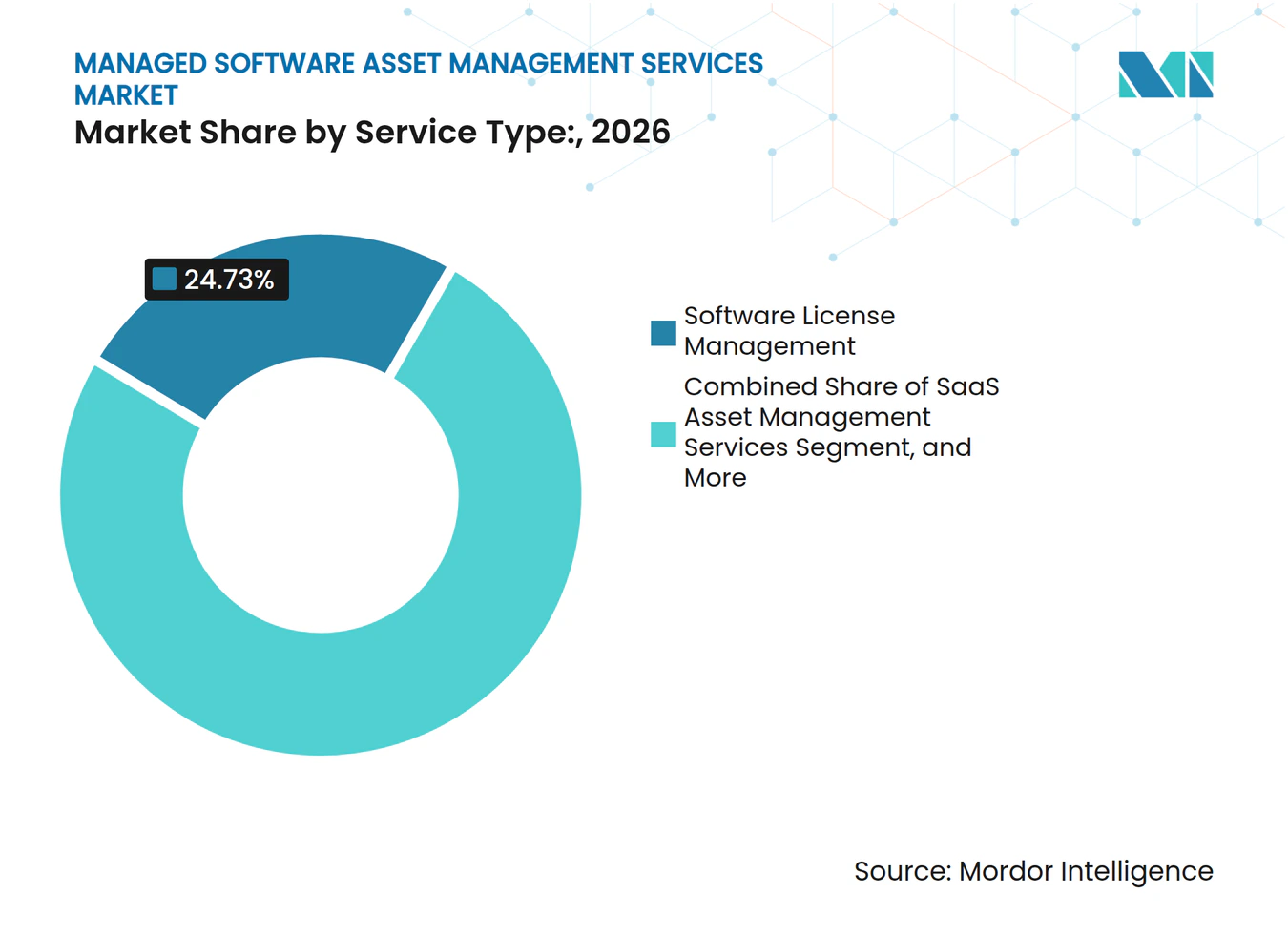
License Management Anchors Demand and SaaS Intelligence ExpandsSoftware License Management held 24.73% of the managed software asset management services market share in 2026. The segment remains central because organizations need a defensible reconciliation of rights and deployments across Oracle, Microsoft, IBM, and SAP environments. These publishers have distinct product terms, cloud rules, and audit approaches, which makes general inventory work insufficient. License management also supports decisions on renewal quantities, unused rights, and contractual exposure. It is the base service that allows other managed activities to rely on a common record of entitlement. Its importance remains high where large estates include older installations alongside newer subscription agreements.
SaaS Asset Management Services are projected to expand at a 17.29% CAGR through 2032. The service addresses applications that may be acquired outside conventional procurement pathways and discovered only when renewal approaches. Generative AI adoption makes the visibility problem more acute because employees can begin using tools before governance teams assess the contract or data implications. Providers are extending discovery to SaaS applications, subscriptions, usage levels, and renewal owners. Software Discovery and Inventory Management and Software Usage Monitoring and Optimization remain necessary complementary services because they provide the operational data behind compliance and cost decisions. Contract and Vendor Management Services, together with Cloud Software License Optimization Services, add support for renewal calendars and cloud-related license choices. The managed software asset management services market is therefore moving toward service bundles that link evidence collection, contractual control, commercial action, and a continuing view of software use across the organization.



By Delivery Model:
Fully Managed Services Lead While Co-Managed Support GainsFully Managed SAM Services commanded 43.96% of the managed software asset management services market size in 2026. Many enterprises select this model when their internal teams cannot maintain the breadth of licensing, contract, discovery, and audit-response skills required. Full outsourcing is particularly relevant when the organization needs ongoing control across multiple publishers but lacks a dedicated SAM function. The provider takes responsibility for recurring reporting, license-position work, and operational governance. This can make responsibilities clearer for procurement, IT, finance, and legal teams. It also allows the client to use specialized expertise without hiring a full internal group.
Co-Managed SAM Services are projected to expand at an 18.34% CAGR through 2032. This model suits organizations with an established ITAM program that need targeted assistance for audits, complex publishers, or cloud licensing changes. AI-linked and usage-based pricing increase the need for current consumption data alongside traditional entitlement counting. The internal team retains ownership of governance while the provider adds specialist analysis and delivery capacity. Monitor-and-Notify Services give smaller organizations lower-cost license surveillance. On-Demand and Retainer-Based Services address limited events such as audit preparation, divestitures, and license carve-outs. These delivery choices allow the managed software asset management services market to address buyers with different levels of internal maturity.
By Organization Size:
Large Enterprises Hold Most Spending and SMEs Add DemandLarge Enterprises held 71.54% of revenue in 2026. Their software estates are broad, their contractual obligations are material, and they are more likely to be targets of vendor audit programs. Large organizations may operate several business units, regions, and acquisition-era systems, which makes a single license position difficult to sustain. Their needs often span enterprise applications, productivity suites, cloud services, and specialized engineering or industry software. The size of these estates supports recurring managed contracts and deep publisher expertise. It also explains why enterprise buyers remain the main source of revenue for many providers.
Small and mid-sized enterprises are projected to expand at an 18.64% CAGR through 2032. Cloud-based delivery reduces the implementation burden that previously made it harder for smaller organizations to justify outsourcing. Hybrid pricing that combines user seats with consumption metrics can create licensing complexity even in modest portfolios. Productized subscriptions and online onboarding let providers serve this group with more standardized delivery. The segment is likely to rely on support for renewal planning, SaaS discovery, and basic compliance monitoring before adopting broader managed services. The broader shift toward managed technology services gives providers a route to reach organizations that lack dedicated asset-management staff. In this setting, the managed software asset management services market can broaden beyond complex global accounts without changing its core compliance function, especially where cloud delivery makes specialist support easier to access.
By End-User Industry:
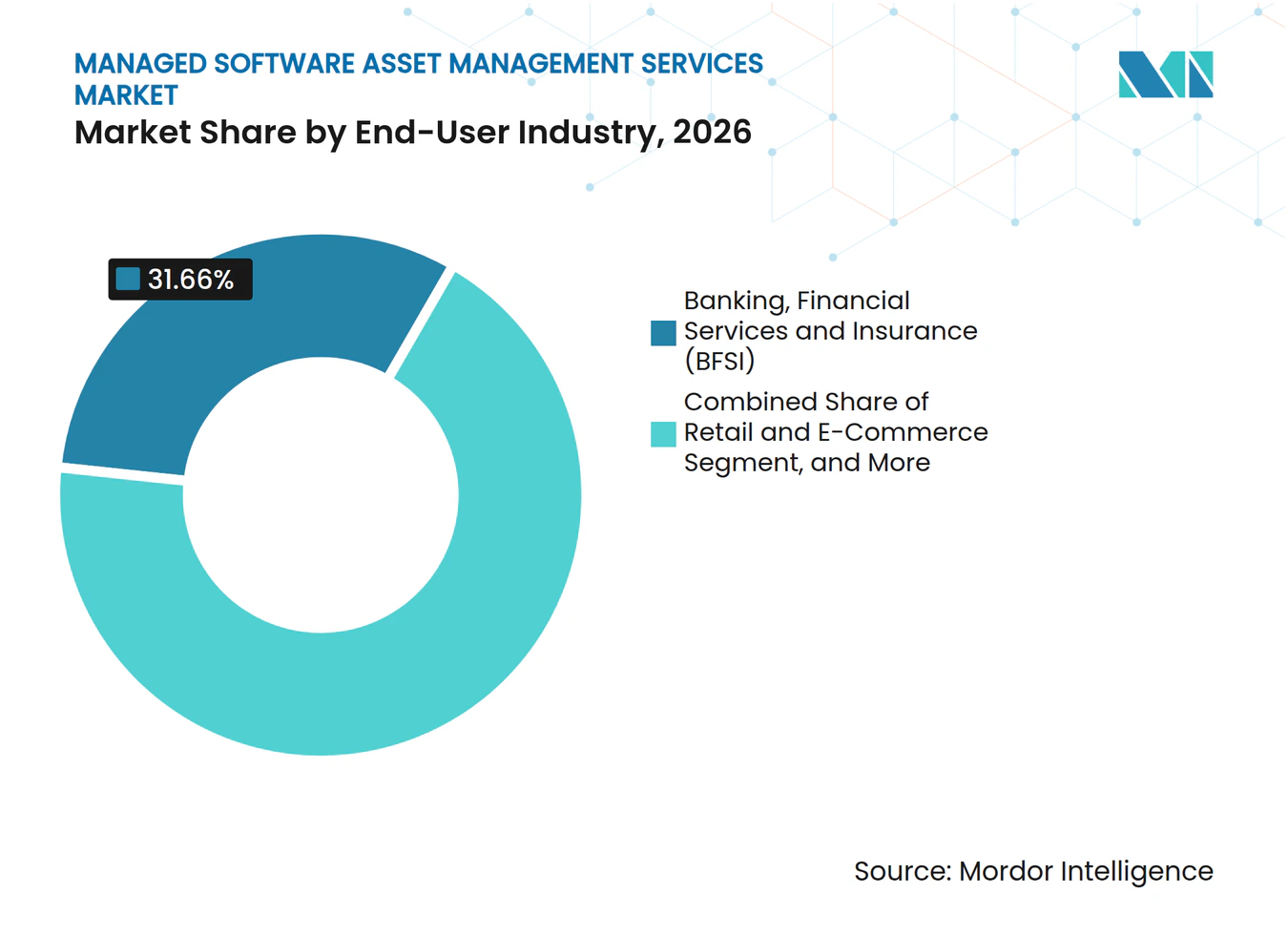
BFSI Maintains Revenue Leadership and Healthcare AcceleratesBFSI accounted for 31.66% of the end-user industry segment in 2026. Financial institutions face clear governance expectations for software records, vendor details, renewal dates, versions, patch levels, and hosting arrangements. The Federal Financial Institutions Examination Council specifies these elements in its guidance on software inventories. This requirement closely aligns with the records needed for software asset management operations. ServiceNow introduced an Asset Audit Response application in its Zurich release in July 2025 to support evidence workflows for financial services requirements. The combination of regulatory reporting and broad software use keeps the sector important to managed providers.
The healthcare and life sciences industry is projected to expand at a 19.27% CAGR through 2032. A January 2025 proposed update to the HIPAA Security Rule included a requirement for regulated entities to maintain written technology asset inventories and update them at least annually. This direction raises the importance of disciplined software and technology records across regulated healthcare environments. Providers can support asset visibility while helping organizations structure evidence for governance activities. IT and Telecommunications, Government and Public Sector, Industrial Manufacturing, and Retail and E-Commerce also need managed support as their cloud and SaaS estates expand. Their growth remains below the healthcare rate in this analysis, but their requirements support a broad base of demand. The managed software asset management services market benefits where regulated operations need documented control rather than only cost savings.

By Publisher Category:
Microsoft Leads and Broadcom Changes Compliance PrioritiesMicrosoft held 28.52% of the publisher category segment in 2026. Its importance reflects the wide deployment of Microsoft 365, Azure, and related enterprise software across corporate environments. Hybrid cloud benefits and newer Copilot licensing introduce terms that organizations must interpret alongside established agreements. The breadth of the Microsoft estate often makes it a priority for license reconciliation and renewal planning. Buyers need to understand how cloud incentives, user assignments, and usage data affect their rights. Providers with Microsoft expertise can therefore support both compliance and commercial decisions. This publisher category accounts for a substantial share of recurring managed activity.
Broadcom is projected to expand at a 16.64% CAGR through 2032. The May 2025 VMware Cloud Foundation 9.0 reporting requirement increased the need for continuing evidence and operational monitoring among affected customers. European scrutiny of VMware licensing practices in 2026 added a further consideration for organizations operating in the region. Oracle Java enforcement, SAP digital-access reviews, and Adobe Creative Cloud seat compliance maintain other publisher-specific areas of work. The portfolio is not limited to one vendor because organizations often manage several overlapping contracts. The managed software asset management services market therefore rewards providers that can combine broad software intelligence with depth in the rules of a specific publisher.
Geography Analysis
North America Managed Software Asset Management Services Market
North America held 38.64% of the managed software asset management services market share in 2026. The region has a dense base of large enterprises with mature IT governance programs and complex relationships with major software publishers. The United States accounts for most regional spending because financial services requirements, disclosure expectations, and broad SaaS use create a continuing demand base. Canada contributes through enterprises that align their software controls with data-sovereignty needs. Mexico is also becoming more relevant as multinational organizations apply global license-governance standards across their operations. The concentration of large accounts and audit activity makes North America a core delivery region for the managed software asset management services market.
Europe Managed Software Asset Management Services Market
Europe remains the second-largest regional market, with the United Kingdom, Germany, and France leading regional value in 2026. Germany supports demand through software-intensive operations in automotive, manufacturing, and financial services. France added a public-sector procurement route when USU received the CANUT SAM-MCO framework contract in December 2025.[3] The Digital Operational Resilience Act compliance deadline in January 2025 strengthened the need for financial institutions to keep complete ICT asset records. European clients also place weight on provider independence, contractual clarity, and the ability to work across national procurement structures.
APAC, MEA and South America Managed Software Asset Management Services Market
Asia-Pacific is projected to expand at a 19.91% CAGR through 2032. The region combines rising SaaS use, wider multicloud estates, and a comparatively smaller base of internal SAM specialists. India, China, Japan, South Korea, and Southeast Asia show different levels of outsourcing adoption, yet each has enterprises that must govern increasingly complex software rights. South America, the Middle East, and Africa are smaller but increasingly active, with Brazil, the United Arab Emirates, Saudi Arabia, Turkey, South Africa, and Egypt providing important centers of demand. Rapid migration to cloud services in these regions can leave internal teams with governance gaps that make the managed software asset management services market more relevant, particularly when contract, deployment, and consumption records sit in different systems.
Competitive Landscape
Market Concentration
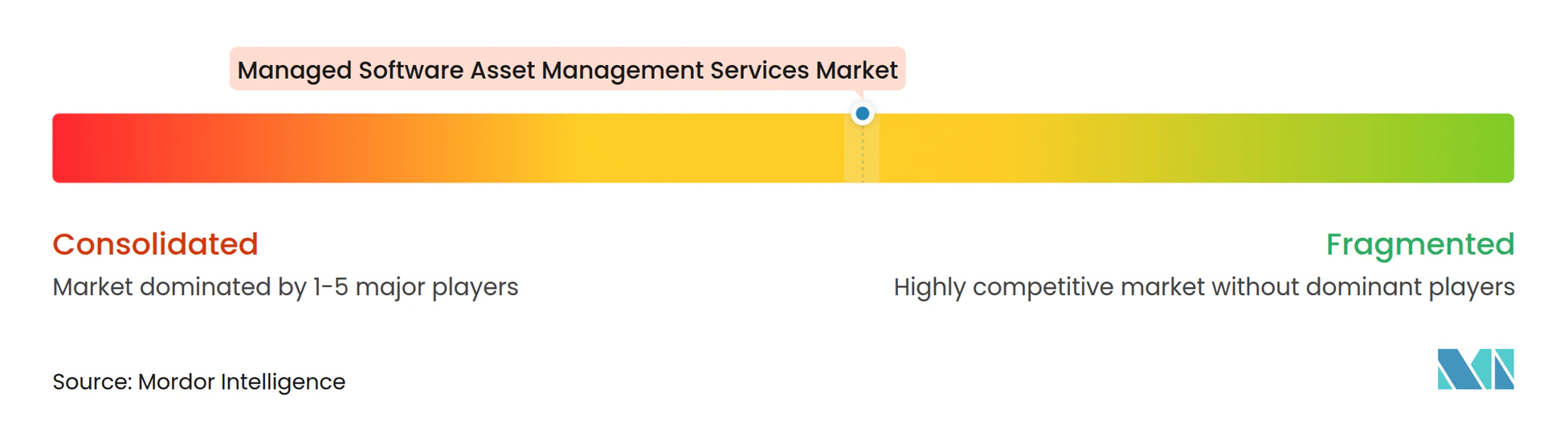
The managed software asset management services market is moderately concentrated among large enterprise providers and fragmented across the mid-market. SoftwareOne completed its acquisition of Crayon Group Holding ASA in July 2025, creating a combined provider operating in more than 70 countries. The transaction included CHF 515 million in total cash consideration, and the combined operations reported CHF 1.6 billion in revenue. This scale makes it harder for smaller pure-play providers to match the global reach and adjacent licensing capabilities of larger providers. At the same time, client concerns about resale-linked advice support demand for specialists who position themselves as independent.
Anglepoint, Certero, Xensam, and Zylo use neutrality, SaaS-native architecture, and focused software intelligence to differentiate from reseller-affiliated firms. A 2025 Certero account of the VMware-Siemens dispute showed how inventory information supplied during a support renewal could become relevant in a copyright case. The episode reinforces the value clients place on an internally calculated, current license position. Global systems integrators, including Accenture, Deloitte Touche Tohmatsu, Ernst and Young, Tata Consultancy Services, Infosys, Wipro, and HCL Technologies, compete by embedding SAM services within broader technology programs. Specialist firms compete through publisher-specific knowledge, discovery capability, and the ability to support audit defense. The managed software asset management services market has room for both approaches because buyers differ in their need for broad transformation support or focused licensing work.
ServiceNow and SoftwareOne announced a multiyear partnership in January 2025 that combined workflow automation with software-licensing consultancy. Flexera launched Flexera One SaaS Management in July 2025, bringing SaaS discovery, optimization, and control into a unified platform. USU acquired SaaSmetrix in March 2025 to strengthen its SaaS-management portfolio. These moves show that platform integration, SaaS visibility, and managed expertise are becoming closely connected. Opportunities remain in AI-linked license governance, standardized bundles for small and mid-sized enterprises, and links between SAM intelligence and sustainability reporting. Providers that can make complex data usable for procurement and finance teams are likely to have an advantage in the managed software asset management services market, because decisions on renewals, remediation, and vendor negotiations depend on timely evidence.
Managed Software Asset Management Services Industry Leaders
-
SoftwareOne AG
-
Crayon Group Holding ASA
-
Anglepoint Group, Inc.
-
DXC Technology Company
-
Infosys Limited
- *Disclaimer: Major Players sorted in no particular order
Managed Software Asset Management Services Market Companies Covered in this Report
- SoftwareOne AG
- Crayon Group Holding ASA
- Anglepoint Group, Inc.
- DXC Technology Company
- Infosys Limited
- Wipro Limited
- Insight Enterprises, Inc.
- HCL Technologies Limited
- SHI International Corp.
- Tata Consultancy Services Limited
- KPMG International Cooperative
- Livingstone Technologies LLC
- Accenture plc
- Deloitte Touche Tohmatsu Limited
- Ernst & Young Global Limited
- International Business Machines Corporation
- Flexera Software, Inc.
- ServiceNow, Inc.
- USU Software AG
- Ivanti, Inc.
- BMC Software, Inc.
- OpenText Corporation
- Certero Limited
- Eracent, Inc.
- Lansweeper NV
- Zylo, Inc.
- Torii Labs Ltd.
- Xensam AB
- License Dashboard Limited
- Microsoft Corporation
Recent Industry Developments in Managed Software Asset Management Services Market
- October 2026: Crayon's brand completed full integration into SoftwareOne globally, finalizing a rebranding process begun after the July 2025 acquisition. The combined entity now operates under a single SoftwareOne brand across all markets, enabling a unified go-to-market strategy spanning software licensing advisory, cloud solutions, and managed SAM services for enterprise clients worldwide.
- September 2026: Infosys announced the expansion of its Indore Development Center (DC) with the inauguration of a new Software Development Block (SDB-2) at its campus in the Super Corridor, Indore. The new 330,000-sq. ft. block further strengthens Infosys’ presence in Central India and its commitment to the region’s growing technology and talent ecosystem.
- October 2026: DXC Technology announced a series of investments and capabilities designed to help insurers modernize critical operations, improve productivity, and adopt AI without disrupting the systems their businesses depend on. Unveiled at the DXC Connect Insurance Executive Forum in London, the announcements build on DXC's Protect, Extend, Transform strategy and Smart AI approach, helping insurers modernize critical operations and apply AI with the governance, human oversight, and accountability essential to insurance.
- January 2026: Flexera acquired ProsperOps and Chaos Genius to expand its FinOps solution with agentic and AI-enabled cost optimization. The acquisitions extend Flexera's platform reach into FinOps for AI workloads and FinOps for data clouds, deepening the convergence of technology spend intelligence with managed SAM capabilities.
Global Managed Software Asset Management Services Market Report Scope
Managed software asset management services market, outsourced capabilities for discovering, tracking, licensing, optimizing, and governing software assets across an organization. These services help enterprises maintain license compliance, reduce software waste and audit risk, control spending, and improve visibility into on-premises, SaaS, and cloud-based software usage.
The Managed Software Asset Management Services Market Report is Segmented by Service Type (Software Discovery and Inventory Management, Software License Management, Software Usage Monitoring and Optimization, Software Compliance and Audit Defense Services, SaaS Asset Management Services, Cloud Software License Optimization Services, Software Contract and Vendor Management Services, and Other Service Types), Delivery Model (Fully Managed SAM Services, Co-Managed SAM Services, Monitor-and-Notify Services, and On-Demand and Retainer-Based Services), Organization Size (Large Enterprises, and Small and Medium-Sized Enterprises), End-User Industry (Banking, Financial Services, and Insurance (BFSI), Government and Public Administration, IT and Telecommunications, Healthcare and Life Sciences, Energy and Utilities, Manufacturing and Industrial, and Other End Users), Publisher Category (Microsoft, Oracle, IBM, SAP, Adobe, Broadcom, Salesforces, and Other SaaS Publishers), and Geography (North America, South America, Europe, Asia-Pacific, Middle East, and Africa). The Market Forecasts are Provided in Terms of Value (USD).
Segmentation Overview
| Software Discovery and Inventory Management |
| Software License Management |
| Software Usage Monitoring and Optimization |
| Software Compliance and Audit Defense Services |
| SaaS Asset Management Services |
| Cloud Software License Optimization Services |
| Software Contract and Vendor Management Services |
| Other Service Types |
| Fully Managed SAM Services |
| Co-Managed SAM Services |
| Monitor-and-Notify Services |
| On-Demand and Retainer-Based Services |
| Large Enterprises |
| Small and Mid-Sized Enterprises |
| Banking, Financial Services and Insurance (BFSI) |
| IT and Telecommunications |
| Healthcare and Life Sciences |
| Government and Public Sector |
| Industrial Manufacturing |
| Retail and E-Commerce |
| Other End-User Industries |
| Microsoft |
| Oracle |
| IBM |
| SAP |
| Adobe |
| Broadcom |
| Salesforce |
| Other SaaS Publishers |
| North America | United States |
| Canada | |
| Mexico | |
| South America | Brazil |
| Argentina | |
| Rest of South America | |
| Europe | United Kingdom |
| Germany | |
| France | |
| Italy | |
| Rest of Europe | |
| Asia-Pacific | China |
| Japan | |
| India | |
| South Korea | |
| Rest of Asia-Pacific | |
| Middle East | Saudi Arabia |
| United Arab Emirates | |
| Rest of Middle East | |
| Africa | South Africa |
| Egypt | |
| Rest of Africa |
| By Service Type | Software Discovery and Inventory Management | |
| Software License Management | ||
| Software Usage Monitoring and Optimization | ||
| Software Compliance and Audit Defense Services | ||
| SaaS Asset Management Services | ||
| Cloud Software License Optimization Services | ||
| Software Contract and Vendor Management Services | ||
| Other Service Types | ||
| By Delivery Model | Fully Managed SAM Services | |
| Co-Managed SAM Services | ||
| Monitor-and-Notify Services | ||
| On-Demand and Retainer-Based Services | ||
| By Organization Size | Large Enterprises | |
| Small and Mid-Sized Enterprises | ||
| By End-User Industry | Banking, Financial Services and Insurance (BFSI) | |
| IT and Telecommunications | ||
| Healthcare and Life Sciences | ||
| Government and Public Sector | ||
| Industrial Manufacturing | ||
| Retail and E-Commerce | ||
| Other End-User Industries | ||
| By Publisher Category | Microsoft | |
| Oracle | ||
| IBM | ||
| SAP | ||
| Adobe | ||
| Broadcom | ||
| Salesforce | ||
| Other SaaS Publishers | ||
| By Geography | North America | United States |
| Canada | ||
| Mexico | ||
| South America | Brazil | |
| Argentina | ||
| Rest of South America | ||
| Europe | United Kingdom | |
| Germany | ||
| France | ||
| Italy | ||
| Rest of Europe | ||
| Asia-Pacific | China | |
| Japan | ||
| India | ||
| South Korea | ||
| Rest of Asia-Pacific | ||
| Middle East | Saudi Arabia | |
| United Arab Emirates | ||
| Rest of Middle East | ||
| Africa | South Africa | |
| Egypt | ||
| Rest of Africa | ||
Key Questions Answered in the Report
What is the managed software asset management services market size?
The managed software asset management services market size is projected to expand from USD 1.92 billion in 2026 and USD 2.28 billion in 2027 to USD 4.64 billion by 2032, registering a CAGR of 15.27% between 2027 to 2032.
What is driving demand for managed software asset management services?
Hybrid cloud environments, SaaS adoption, AI-linked licensing, recurring audit exposure, and the need to control renewal costs are increasing demand for managed support.
Which service type leads managed software asset management services?
Software License Management held the largest share at 24.73% in 2026, while SaaS Asset Management Services is projected to record the fastest service growth at a 17.29% CAGR.
Why do organizations use co-managed SAM services?
Co-managed models allow internal ITAM teams to retain governance while using external specialists for audit defense, complex publishers, and consumption-based licensing.
Which end-user sector is expanding fastest for managed SAM services?
Healthcare and Life Sciences is projected to expand at a 19.27% CAGR through 2032, supported by stronger technology asset inventory expectations.
Which region is expanding fastest for managed software asset management services?
Asia-Pacific is projected to expand at a 19.91% CAGR through 2032 as enterprises increase SaaS and multicloud adoption.