
Managed Service Desk Services Market Size and Share
Market Overview
| Study Period | 2021 - 2032 |
|---|---|
| Market Size (2027) | USD 41.23 Billion |
| Market Size (2032) | USD 59.82 Billion |
| Growth Rate (2027 - 2032) | 7.73 % |
| Fastest Growing Market | Asia-Pacific |
| Largest Market | North America |
| Market Concentration | Medium |
Major Players *Disclaimer: Major Players sorted in no particular order Image © Mordor Intelligence. Reuse requires attribution under CC BY 4.0. | |
Managed Service Desk Services Market Analysis by Mordor Intelligence
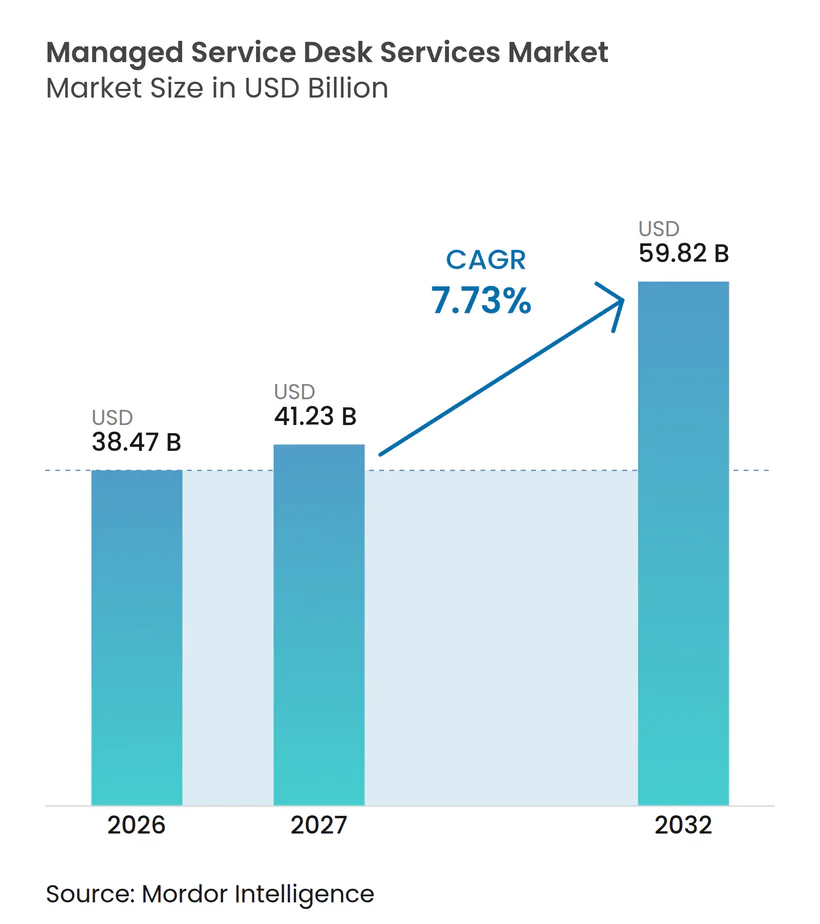
The Managed Service Desk Services Market size is projected to be USD 38.47 billion in 2026, USD 41.23 billion in 2027, and reach USD 59.82 billion by 2032, growing at a CAGR of 7.73% from 2027 to 2032. The managed service desk services market is being shaped by enterprise demand for outside support across cloud, on-premises, and software-as-a-service environments. Buyers are placing greater weight on employee experience and productivity measures than on traditional service-level agreements alone. This raises the importance of platforms that can report service quality and resolve routine issues before they reach an agent. The managed service desk services market is also becoming more dependent on reliable knowledge and identity controls. Providers are responding with automated routing, knowledge tools, and security controls that fit each customer’s operating environment. The managed service desk market also offers opportunities for vendors to move from ticket-volume pricing to contracts linked to service outcomes.
Key Report Takeaways
- By service type, outsourced Level 1 service desk held 31.47% of managed service desk services market share in 2026, while knowledge management and self-service are expected to expand at a 8.83% CAGR through 2032.
- By enterprise size, large enterprises held 69.83% share in 2026, while small and medium enterprises are projected to expand at a 8.17% CAGR through 2032.
- With technology enablement, the traditional human-led service desk held a 47.23% share in 2026, while the autonomous and agentic service desk is expected to expand at a 8.37% CAGR through 2032.
- By deployment model, cloud-based configurations held 54.37% share in 2026, while hybrid deployment is projected to expand at a 8.63% CAGR through 2032.
- By end-user industry, information technology and telecommunications held 23.87% share in 2026, while healthcare is expected to expand at a 8.41% CAGR through 2032.
- By geography, North America held 37.43% share in 2026, while Asia-Pacific is projected to expand at a 8.26% CAGR through 2032.
Note: Market numbers in this report are based on Mordor Intelligence's proprietary estimation framework, which combines nine months of actuals with Q4 projections for base year 2026.
Market Trends and Insights
Drivers Impact Analysis of Managed Service Desk Services Market*
| Driver | (~) % Impact on CAGR Forecast | Geographic Relevance | Impact Timeline |
|---|---|---|---|
| Hybrid and Multi-Cloud Complexity | +2.0% | Global, concentrated in North America and Europe | Short term (≤ 2 years) |
| Demand for 24/7 User Support and Faster Resolution | +1.8% | Global, pronounced in North America, Europe, and Asia-Pacific | Short term (≤ 2 years) |
| AI-Enabled Ticket Automation and Self-Service | +1.5% | Global, early-mover gains in North America and Japan | Medium term (2-4 years) |
| Expansion of Remote and Hybrid Workforces | +1.2% | North America and Europe core, spill-over to Asia-Pacific | Medium term (2-4 years) |
| Global Capability Center Expansion in Asia-Pacific | +0.9% | Asia-Pacific core, specifically India | Medium term (2-4 years) |
| Outcome-Based Managed Service Contracts | +0.7% | North America and Europe | Long term (≥ 4 years) |
| Source: Mordor Intelligence | |||
Hybrid and Multi-Cloud Complexity
The managed service desk market benefits as internal teams face more systems to support across hybrid-cloud, multi-cloud, and software-as-a-service estates. Migration, repatriation, and new AI workloads can simultaneously place systems across different infrastructures. Support requests can therefore require routing across cloud platforms, on-premises applications, and authentication layers. Providers with diagnostic workflows and established escalation paths can make this operating model easier for customers to manage.
Demand for 24/7 User Support and Faster Resolution
Continuous support is increasingly relevant for firms with staff and customers across several time zones. Freshworks reported a 20% rise in daily ticket volume in the final days of March 2026, while after-hours service-level agreement compliance was 2 to 5 percentage points lower during its observation period. HDI reported that the average IT help desk handled 492 tickets per month in 2025, 17% more than in 2023. Gaps in coverage can interrupt employee work even when the underlying issue is straightforward. The managed service desk services market can address this need through round-the-clock coverage and automated triage. Providers also need staffing and automation models that can handle peaks without reducing service quality.
AI-Enabled Ticket Automation and Self-Service
Automation is becoming a practical part of service desk delivery rather than an optional add-on. ServiceNow introduced agentic AI capabilities for IT service management, IT operations management, and IT asset management in May 2025. Riverbed introduced Aternity Self-Service in October 2025, which uses an AI agent to handle triage, diagnostics, and endpoint remediation before creating a ticket for further support. Such tools can resolve recurring requests before they reach Level 1 agents. Each resolved case can also improve the knowledge available for future diagnosis. This gives the managed service desk services market a stronger case for contracts based on outcomes rather than ticket volume.
Expansion of Remote and Hybrid Workforces
Remote and hybrid work continues to create distributed support needs. Gallup reported in May 2026 that 52% of remote-capable U.S. employees worked in a hybrid arrangement and 26% worked exclusively remotely. Ivanti found that 78% of IT workers globally worked at least part of the time virtually. Ivanti also reported that 81% of office workers used personal devices for work, including 40% who did so without employer knowledge. Password resets, multi-factor authentication unlocks, and access requests are common needs in a dispersed workforce. Broad coverage and secure identity checks are therefore as important as specialist technical support.
Restraints Impact Analysis of Managed Service Desk Services Market*
| Restraint | (~) % Impact on CAGR Forecast | Geographic Relevance | Impact Timeline |
|---|---|---|---|
| Data Security and Cybercrime Exposure | -1.1% | Global, highest concern in Europe and North America | Short term (≤ 2 years) |
| Integration, Migration, and Customization Costs | -0.9% | Global, concentrated in large enterprises with legacy ITSM stacks | Medium term (2-4 years) |
| Inconsistent Knowledge Bases and Configuration Data | -0.7% | Global | Medium term (2-4 years) |
| Client Dependence on Proprietary Automation Platforms | -0.5% | North America and Europe | Long term (≥ 4 years) |
| Source: Mordor Intelligence | |||
Data Security and Cybercrime Exposure
Service desks have access to identity systems, making them targets for social engineering attacks. Microsoft documented a 2026 attack method in which threat actors impersonated help desk staff, obtained Quick Assist access, and moved through the environment using Windows Remote Management.[1] These incidents can lengthen sales cycles and increase customer requirements for authentication and session controls. Providers that show clear zero-trust verification and continuous monitoring can reduce this concern.
Integration, Migration, and Customization Costs
Replacing an existing service management platform can require substantial transition work. Costs can arise from moving configuration data, rebuilding workflows, connecting enterprise systems, and running both old and new processes simultaneously. Regulated customers must also maintain continuity of support during the change. Pre-built links to major service management and enterprise platforms can reduce the scope of work. However, years of local customization can still create difficult migration decisions. This restraint can favor existing providers when customers weigh the cost and risk of changing vendors.
*Our forecasts treat driver/restraint impacts as directional, not additive. The impact forecasts reflect baseline growth, mix effects, and variable interactions.
Managed Service Desk Services Market Segment Analysis
By Service Type:
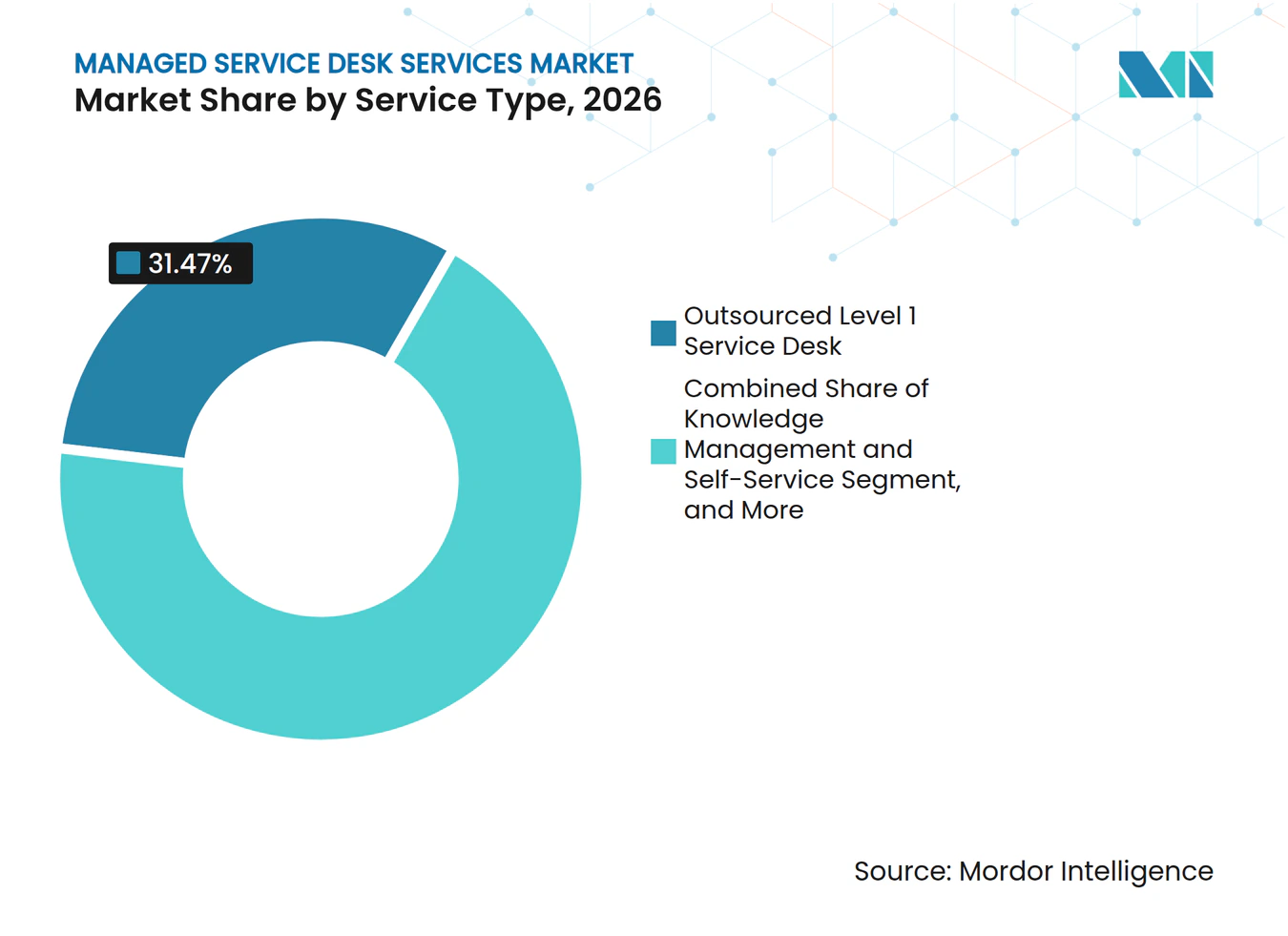
Knowledge Automation Changes First-Contact SupportOutsourced Level 1 service desk held 31.47% of the managed service desk services market in 2026. Large organizations continue to use outside providers for high-volume requests and repetitive first-contact resolution. Existing providers often hold years of ticket history that can improve routing and self-service guidance. Knowledge management and self-service are expected to expand at an 8.83% CAGR through 2032. This part of the managed service desk services market size benefits when a request is resolved before a human agent is involved. Microsoft described autonomous IT service management systems that can detect log patterns, take corrective actions such as restarting services or rolling back changes, and automatically close tickets. Level 2 and Level 3 support remain important for complex cloud, security, and application issues. Remote monitoring and management, along with incident, request, and problem management, face more price pressure as cloud platforms build monitoring into their offerings. Deskside and onsite support remains relevant where physical environments limit remote resolution.
Knowledge management is moving beyond a back-office repository toward a core service capability. Providers can use resolved cases to maintain knowledge graphs and support more consistent answers. This can improve time to resolution and allow providers to make clearer contractual commitments. ServiceNow launched Flow by ServiceNow in October 2026 as an AI-native service desk designed to resolve employee issues through conversational interfaces in existing chat channels. The release points to a shift away from standalone portals and ticket forms. Providers linked with major collaboration platforms can place answers closer to where users work. The managed service desk services industry is likely to keep human specialists in the process for complex cases. However, self-service can reduce the volume that reaches those specialists. This supports a more focused role for agents handling exceptions and sensitive requests.



By Enterprise Size:
Cloud Delivery Broadens Access for Smaller OrganizationsLarge enterprises accounted for 69.83% of the managed service desk market in 2026. Their scale and long-standing outsourcing relationships have supported multi-year service arrangements. Historically, service desk delivery required infrastructure and a broad staffing base that smaller organizations could not justify. Small and medium enterprises are expected to expand at an 8.17% CAGR through 2032. Cloud-based platforms reduce the initial commitment required to use managed support services. Smaller IT teams can find this burden especially difficult because they have fewer people to absorb operational work. Automated onboarding and standardized playbooks can make small contracts more viable for providers. Consumption-based pricing can also make managed support easier for smaller organizations to adopt.
The shift does not remove the importance of large accounts. Large organizations often need custom integrations, compliance controls, and specialist escalation paths. These requirements support higher-value contracts but can also increase delivery costs. Smaller organizations generally need simpler deployments and faster activation. This creates room for providers that can offer a standard service without extensive customization. The managed service desk services market can therefore grow across two different client needs. Large accounts remain important for revenue stability. Smaller accounts can create a broader base of recurring demand when delivered through efficient operating models. Providers will need to protect service quality as they increase the number of smaller customers.
By Technology Enablement:
Agentic Tools Advance Alongside Human SupportTraditional human-led service desks accounted for 47.23% of the managed service desk market in 2026. Many customers retain this model because existing teams understand their applications, escalation paths, and internal practices. Fully autonomous support requires reliable knowledge and configuration data before it can replace human judgment. Autonomous and agentic service desk is expected to expand at an 8.37% CAGR through 2032. Kyndryl introduced Agentic Service Management in April 2026, along with implementation blueprints to transition from conventional service operations to autonomous workflows. Intellias introduced Agentic ServiceOps in October 2026 to deliver managed services across IT service management and IT operations management platforms.[2] The tools show that autonomous workflows are moving into operational use. Customers must still manage the risk of poor ticket classification and incorrect automated action.
AI-assisted service desks provide a middle path for organizations that need human control. In this model, software can propose answers, summarize incidents, and guide agents while people approve the resolution. This approach can be especially useful in regulated settings where accountability remains important. Integrated IT service management and AIOps models can combine infrastructure signals with service desk queues. That can help teams identify issues before users report them. The managed service desk services market has room for each of these models because customer readiness differs. Human-led delivery remains important where institutional knowledge is difficult to document. Autonomous models can gain share where repetitive tasks and reliable data make automation practical. Providers that support both approaches can manage the transition without forcing a single path on customers.
By Deployment Model:
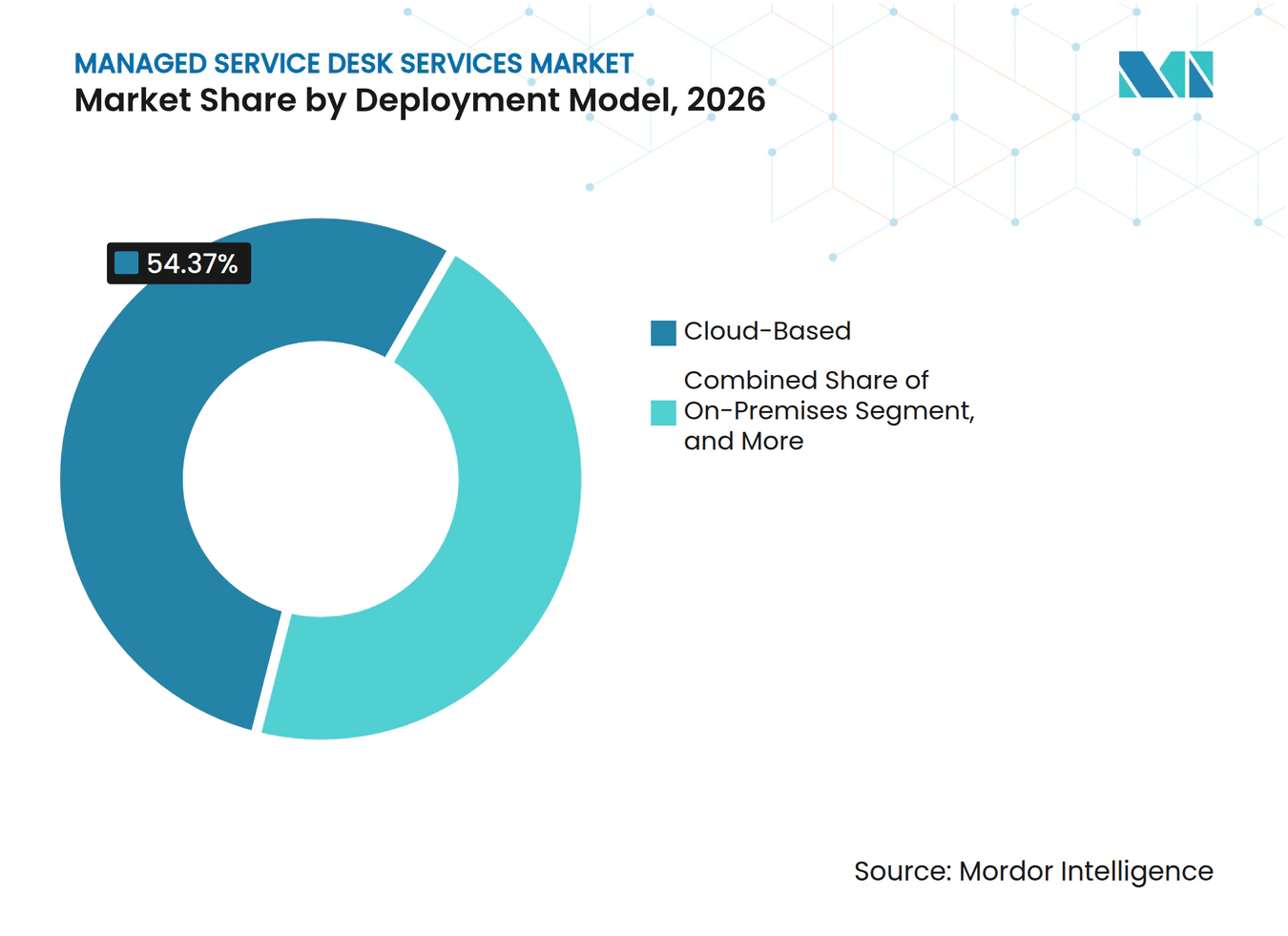
Hybrid Delivery Responds to Data RequirementsCloud-based deployment accounted for 54.37% of the managed service desk market share in 2026. Organizations have adopted cloud delivery for scalability and reduced infrastructure commitments. Hybrid deployment is expected to expand at an 8.63% CAGR through 2032. Flexera reported that cloud repatriation activity rose by 2 percentage points in 2026 as organizations moved workloads and data to where they best fit operational needs. Some organizations keep sensitive ticketing records or security workflows on their own infrastructure. They can still use cloud platforms for initial triage, knowledge delivery, and less sensitive support processes. This model helps organizations balance access, performance, and data-residency needs. It also creates demand for providers capable of managing consistent workflows across both environments.
On-premises deployment is declining as the main model, but it remains important in defense, critical infrastructure, and financial services. These customers may face legal or policy limits on where personal, security, or classified information can be stored. Hybrid delivery can provide them with a way to use cloud-based tools without moving every record. The approach may require more integration and careful governance than a cloud-only deployment. Providers need secure connections and clear ownership of identity, data, and incident records. This can increase the value of certified service-management practices. The managed service desk services market size for hybrid services is supported by customers that need flexible deployment choices. Vendors without cloud-to-on-premises capabilities may lose work to specialists with more established regulated-sector experience.

By End-User Industry:
Healthcare Adds Compliance Needs to Support DemandInformation technology and telecommunications accounted for 23.87% of the managed service desk market in 2026. Organizations in this sector often have the internal expertise to set detailed service-level and experience-level requirements. Healthcare is expected to expand at an 8.41% CAGR through 2032. Clinical systems, numerous endpoints, and protected health information create a demanding support environment. The HIPAA Security Rule requires covered entities and business associates to protect electronic protected health information. Outsourced providers may need Business Associate Agreements and formal security controls. Providers with healthcare training and documented information-security practices can address this requirement. The managed service desk industry benefits when healthcare organizations need support that combines operational availability with privacy controls.
Financial services also require auditable workflows and strong access controls. Retail and e-commerce need support for point-of-sale systems and customer-facing operations. Manufacturing needs help bridging operational technology and enterprise systems. Government and defense have meaningful requirements but can involve long public procurement cycles. Healthcare buyers need ongoing controls rather than a one-time compliance review. Role-based access, monitoring of protected health information, and verified user authentication can support that operating model. RSA found that 45% of respondents said the cost of an identity-related breach exceeded a typical data-breach benchmark, with 24% reporting costs above USD 10 million. These conditions make secure service processes central to vendor selection. They also increase the value of support providers that understand sector-specific obligations.
Geography Analysis
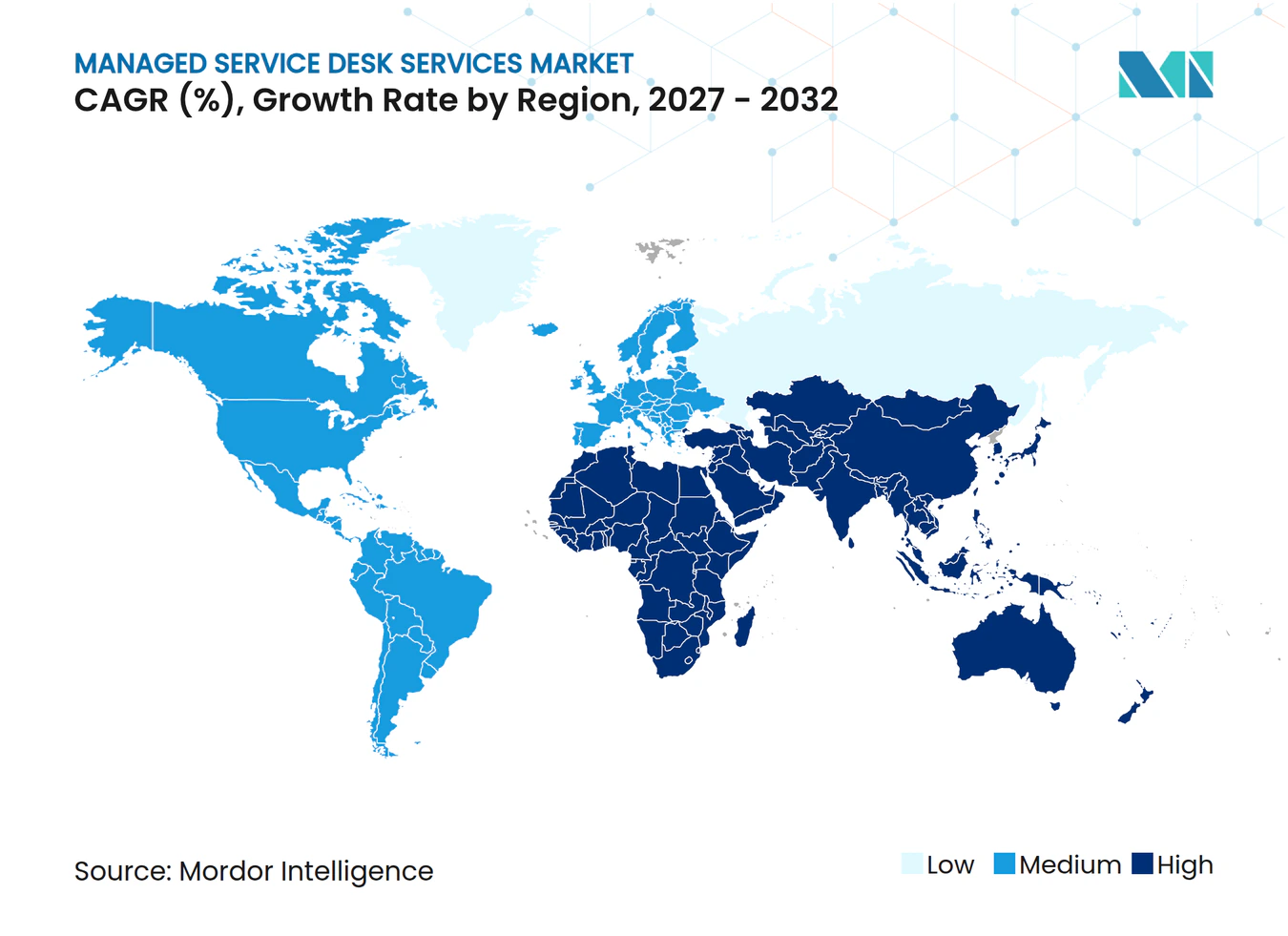
North America accounted for 37.43% of the managed service desk market in 2026. The region has a concentrated base of multinational technology buyers and mature outsourcing practices. Canada and Mexico add demand through nearshore delivery, including bilingual first-contact support for Spanish-speaking workforces. This work pattern maintains demand for support across home, office, and cloud environments. Public-sector modernization and mid-market adoption of software-as-a-service IT service management can support regional demand through 2032.
Asia-Pacific is expected to expand at an 8.26% CAGR through 2032. India’s global capability center ecosystem creates demand for providers capable of supporting global policies, multilingual first-contact resolution, and shared IT service management platforms. Kyndryl Japan and PKSHA Technology announced an AI-BPaaS collaboration in June 2025 that combines an AI help desk platform with digital workplace services.[3] The offering covers consulting, environment build, and ongoing operations. Japan’s IT talent constraints make this model relevant to local enterprise buyers. China, South Korea, and Australia also add demand from financial services, manufacturing, and government users.
Europe has a significant position in the managed service desk services market, supported by Germany, the United Kingdom, and France. Compliance expectations and enterprise technology spending continue to support outside service desk demand. Atos won a 5-year GBP 150 million (USD 192.39 million) contract in March 2025 to transform the UK Department for Environment, Food and Rural Affairs service desk for 34,000 users. South America shows measured demand from Brazil’s financial services and retail sectors. The Middle East and Africa remain earlier-stage markets, with Saudi Arabia and the United Arab Emirates leading regional demand and Nigeria and South Africa supporting telecommunications and banking activity.
Competitive Landscape
Market Concentration
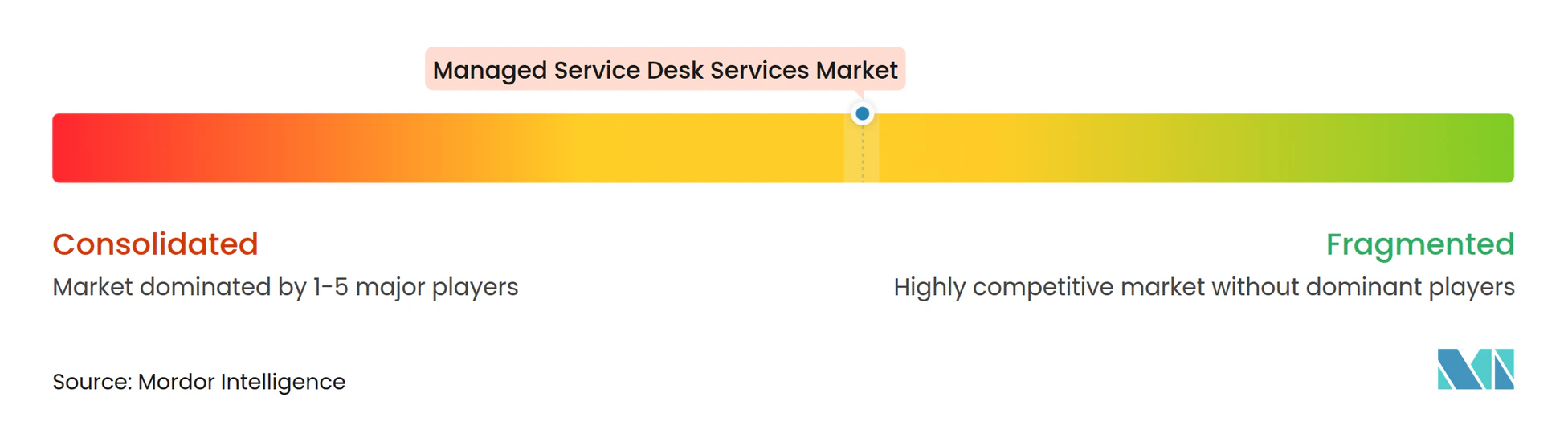
The managed service desk services market has a two-part competitive structure. Global integrators compete on AI platforms, compliance capabilities, and outcome-linked pricing. Regional and mid-market providers compete on faster deployment, sector knowledge, and nearshore delivery. Accenture, HCL Technologies, Tata Consultancy Services, Infosys, Wipro, and Capgemini have invested in AI-supported service transformation. Kyndryl launched Agentic Service Management in April 2026 with tools intended to help enterprises adopt autonomous workflows. It also received a contract from the Texas Department of Information Resources in March 2026 to provide technology services to state and local governments. These moves show how infrastructure service providers are adding AI-led service operations to their portfolios.
DXC Technology, Atos, Fujitsu, NTT DATA, and Unisys have established positions in government, financial services, and large enterprises. Long customer relationships can matter because a change in service desk provider can involve significant transition work. Providers with digital experience tools can use these measures in their contracts. HCLTech was selected by M Group in September 2026 to modernize IT operations across more than 200 locations with its AI Force platform.[4] Tata Consultancy Services was selected by Kalmar in January 2026 for an enterprise IT transformation that includes end-user service and hybrid cloud operations. These examples show the focus on integrated delivery across applications, infrastructure, and user support.
Smaller providers such as Stefanini, Microland, and Sutherland Global Services can compete in healthcare and hybrid deployments through focused knowledge bases and lower contract thresholds. Their position can be stronger where a customer needs a specific sector capability but does not need a full global delivery model. Agentic AI specialists also offer autonomous Level 0 and Level 1 resolution as a standalone service. This can challenge larger providers for initial projects. Large providers can respond by making service desk offerings more modular. The managed service desk services market can reward providers that make that transition without disrupting established customer operations. ISO/IEC 20000 can also influence procurement by providing a recognized framework for IT service management.
Managed Service Desk Services Industry Leaders
-
Accenture plc
-
HCL Technologies Limited
-
International Business Machines Corporation
-
Infosys Limited
-
Wipro Limited
- *Disclaimer: Major Players sorted in no particular order
Managed Service Desk Services Market Companies Covered in this Report
- Accenture plc
- HCL Technologies Limited
- International Business Machines Corporation
- Infosys Limited
- Wipro Limited
- DXC Technology Company
- Tata Consultancy Services Limited
- NTT DATA Corporation
- Capgemini SE
- Cognizant Technology Solutions Corporation
- Kyndryl Holdings, Inc.
- Atos SE
- Fujitsu Limited
- Unisys Corporation
- Stefanini Group
- Computacenter plc
- CompuCom Systems, Inc.
- Microland Limited
- Sutherland Global Services, Inc.
- Unify Technologies
Recent Industry Developments in Managed Service Desk Services Market
- October 2026: Intellias launched Agentic ServiceOps, a managed IT service applying governed agentic AI across IT service management and IT operations management, running on existing ServiceNow, Jira Service Management, Datadog, Dynatrace, and PagerDuty platforms. The service resolves eligible requests at L0 using ticket history, runbooks, and configuration data without human intervention and links commercial pricing to outcomes rather than ticket volume.
- October 2026: ServiceNow launched Flow by ServiceNow, an AI-native service desk that deploys without an implementation project and resolves employee issues through conversational interfaces in existing chat channels. The offering targets organizations seeking IT service management modernization without multi-month integration programs and is positioned as a complementary startup within the broader ServiceNow platform.
- July 2026: Kyndryl modernized Forvis Mazars Group's global IT support with a remote service desk supported from Brno, Czech Republic, while retaining on-site expertise in France, and transformed the firm's internal IT platform into a continuously updated knowledge base enabling employee self-service.
- April 2026: Kyndryl launched Agentic Service Management, including implementation blueprints to help enterprises transition from traditional service operations to autonomous, intelligent workflows at scale, extending its digital workplace services portfolio beyond infrastructure support.
Global Managed Service Desk Services Market Report Scope
The Managed Service Desk Services Market report defines managed service desk services as outsourced IT support solutions that provide organizations with centralized assistance for incident resolution, service requests, technical troubleshooting, and end-user support.
The Managed Service Desk Services Market Report is Segmented by Service Type (Outsourced Level 1 Service Desk, Outsourced Level 2 and Level 3 Technical Support, Remote Monitoring and Management, Incident, Request, and Problem Management, Knowledge Management and Self-Service, Deskside and Onsite Support, and Other Service Types), Enterprise Size (Large Enterprises and Small and Medium Enterprises), Technology Enablement (Traditional Human-Led Service Desk, AI-Assisted Service Desk, Autonomous and Agentic Service Desk, and Integrated ITSM and AIOps Service Desk), Deployment Model (On-Premises, Cloud-Based, and Hybrid), End-User Industry (Information Technology and Telecommunications, BFSI, Healthcare, Retail and E-Commerce, Manufacturing, Government and Defense, and Other End-User Industries), and Geography (North America, South America, Europe, Asia-Pacific, Middle East, and Africa). The Market Forecasts are Provided in Terms of Value (USD).
Segmentation Overview
| Outsourced Level 1 Service Desk |
| Outsourced Level 2 and Level 3 Technical Support |
| Remote Monitoring and Management |
| Incident, Request, and Problem Management |
| Knowledge Management and Self-Service |
| Deskside and Onsite Support |
| Other Service Types |
| Large Enterprises |
| Small and Medium Enterprises |
| Traditional Human-Led Service Desk |
| AI-Assisted Service Desk |
| Autonomous and Agentic Service Desk |
| Integrated ITSM and AIOps Service Desk |
| On-Premises |
| Cloud-Based |
| Hybrid |
| Information Technology and Telecommunications |
| BFSI |
| Healthcare |
| Retail and E-Commerce |
| Manufacturing |
| Government and Defense |
| Other End-User Industries |
| North America | United States |
| Canada | |
| Mexico | |
| South America | Brazil |
| Argentina | |
| Rest of South America | |
| Europe | Germany |
| United Kingdom | |
| France | |
| Italy | |
| Spain | |
| Russia | |
| Rest of Europe | |
| Asia-Pacific | China |
| India | |
| Japan | |
| South Korea | |
| Australia | |
| Rest of Asia-Pacific | |
| Middle East | Saudi Arabia |
| United Arab Emirates | |
| Turkey | |
| Rest of Middle East | |
| Africa | South Africa |
| Egypt | |
| Nigeria | |
| Rest of Africa |
| By Service Type | Outsourced Level 1 Service Desk | |
| Outsourced Level 2 and Level 3 Technical Support | ||
| Remote Monitoring and Management | ||
| Incident, Request, and Problem Management | ||
| Knowledge Management and Self-Service | ||
| Deskside and Onsite Support | ||
| Other Service Types | ||
| By Enterprise Size | Large Enterprises | |
| Small and Medium Enterprises | ||
| By Technology Enablement | Traditional Human-Led Service Desk | |
| AI-Assisted Service Desk | ||
| Autonomous and Agentic Service Desk | ||
| Integrated ITSM and AIOps Service Desk | ||
| By Deployment Model | On-Premises | |
| Cloud-Based | ||
| Hybrid | ||
| By End-User Industry | Information Technology and Telecommunications | |
| BFSI | ||
| Healthcare | ||
| Retail and E-Commerce | ||
| Manufacturing | ||
| Government and Defense | ||
| Other End-User Industries | ||
| By Geography | North America | United States |
| Canada | ||
| Mexico | ||
| South America | Brazil | |
| Argentina | ||
| Rest of South America | ||
| Europe | Germany | |
| United Kingdom | ||
| France | ||
| Italy | ||
| Spain | ||
| Russia | ||
| Rest of Europe | ||
| Asia-Pacific | China | |
| India | ||
| Japan | ||
| South Korea | ||
| Australia | ||
| Rest of Asia-Pacific | ||
| Middle East | Saudi Arabia | |
| United Arab Emirates | ||
| Turkey | ||
| Rest of Middle East | ||
| Africa | South Africa | |
| Egypt | ||
| Nigeria | ||
| Rest of Africa | ||
Key Questions Answered in the Report
What is the managed service desk services market size?
The Managed Service Desk Services Market size is projected to be USD 38.47 billion in 2026, USD 41.23 billion in 2027, and reach USD 59.82 billion by 2032, growing at a CAGR of 7.73% from 2027 to 2032.
What is driving demand for managed service desk services?
Hybrid cloud complexity, around-the-clock support needs, AI-enabled automation, and distributed workforces are expanding demand.
Which service type is growing fastest?
Knowledge management and self-service is expected to grow at an 8.83% CAGR through 2032 as organizations seek to resolve routine requests before they reach an agent.
Which deployment model is growing fastest?
Hybrid deployment is projected to grow at an 8.63% CAGR through 2032 because organizations need both cloud flexibility and control over sensitive data.
Which end-user sector is growing fastest?
Healthcare is expected to grow at an 8.41% CAGR through 2032, supported by clinical system complexity and data-protection requirements.