
Managed Serverless Operations Services Market Size and Share
Market Overview
| Study Period | 2021 - 2032 |
|---|---|
| Market Size (2027) | USD 10.68 Billion |
| Market Size (2032) | USD 21.65 Billion |
| Growth Rate (2027 - 2032) | 18.81 % |
| Fastest Growing Market | Asia-Pacific |
| Largest Market | North America |
| Market Concentration | Medium |
Major Players *Disclaimer: Major Players sorted in no particular order Image © Mordor Intelligence. Reuse requires attribution under CC BY 4.0. | |
Managed Serverless Operations Services Market Analysis by Mordor Intelligence
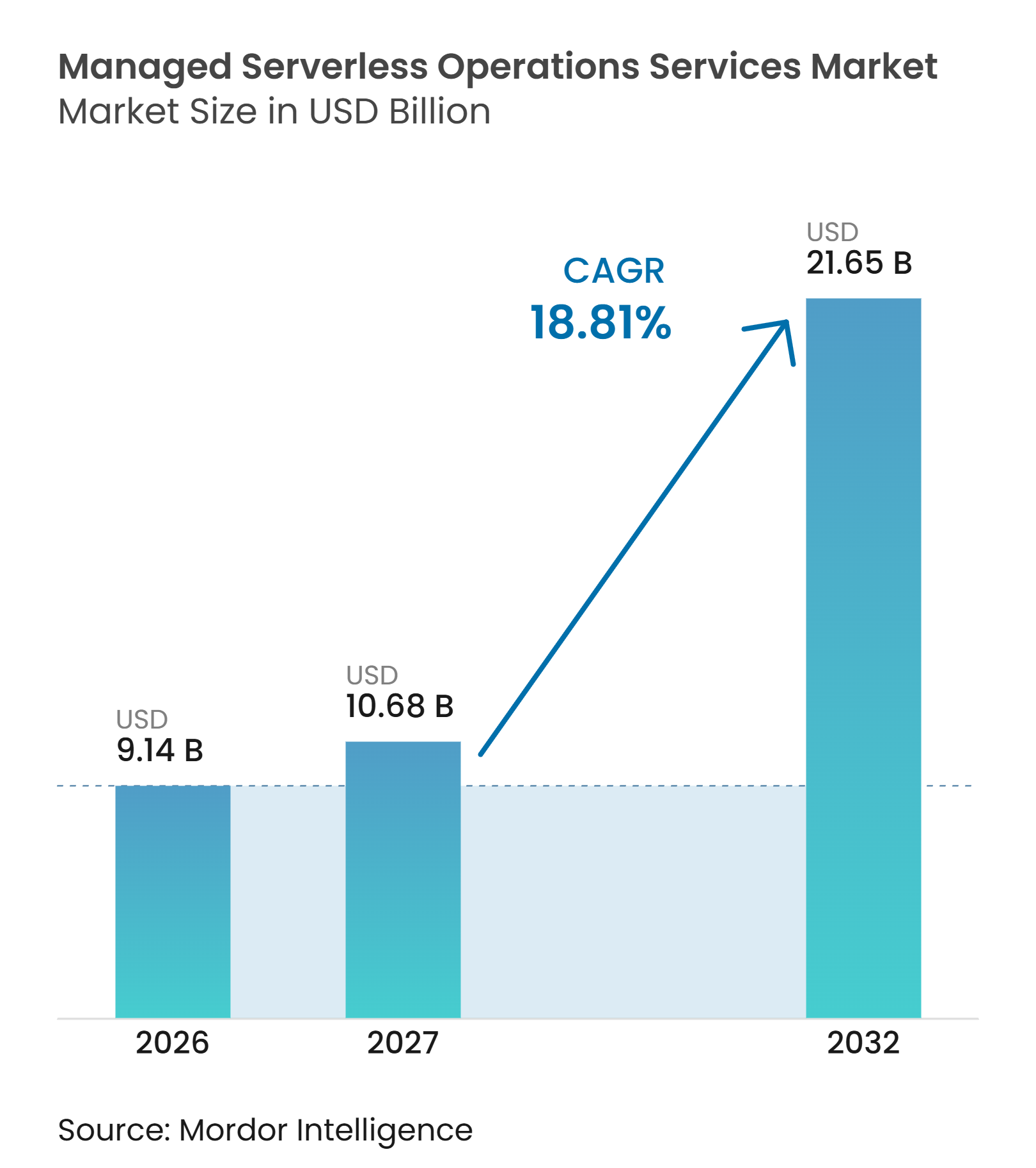
The managed serverless operations services market size is projected to expand from USD 9.14 billion in 2026 and USD 10.68 billion in 2027 to USD 21.65 billion by 2032, registering a CAGR of 18.81% between 2027 to 2032. The managed serverless operations services market is shifting beyond infrastructure support because clients need continuous management of event-driven applications that use many connected cloud services. Multi-cloud governance, limited site reliability engineering capacity, and AI-enabled observability are increasing the value of external operations support. Providers are moving toward service agreements tied to reliability objectives, cost visibility, and response quality. The managed serverless operations services market also gives providers opportunities to combine platform engineering, security controls, and FinOps capabilities in ongoing engagements. Competitive differentiation depends on helping clients improve service reliability while controlling the variable costs of serverless workloads.
Key Report Takeaways
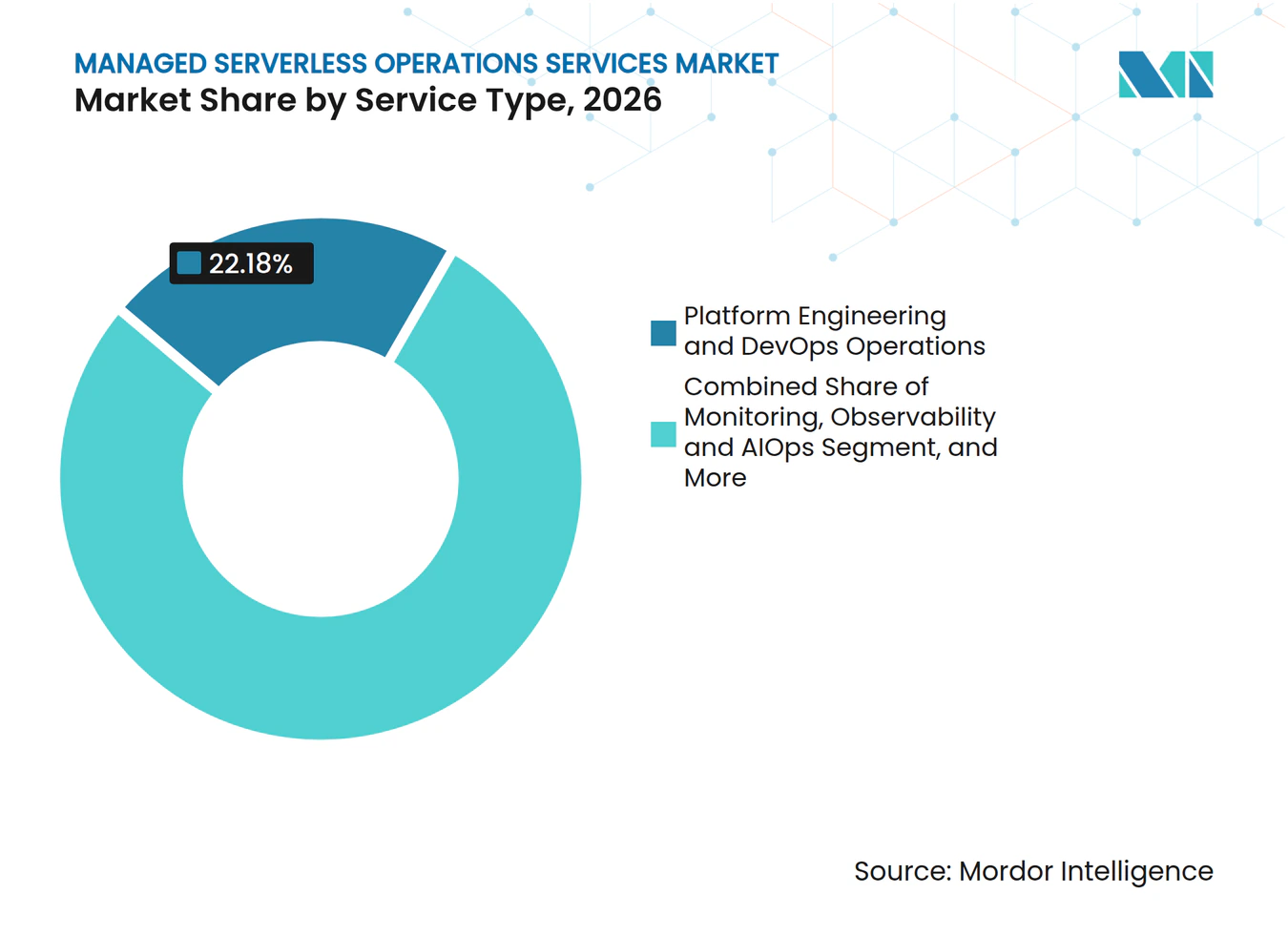
- By service type, Platform Engineering and DevOps Operations held 22.18% of revenue in 2026, while Monitoring, Observability and AIOps is projected to expand at a 19.73% CAGR through 2032.
- By service model, Managed Services accounted for 73.42% of revenue in 2026, while the same segment is projected to advance at a 19.65% CAGR through 2032.
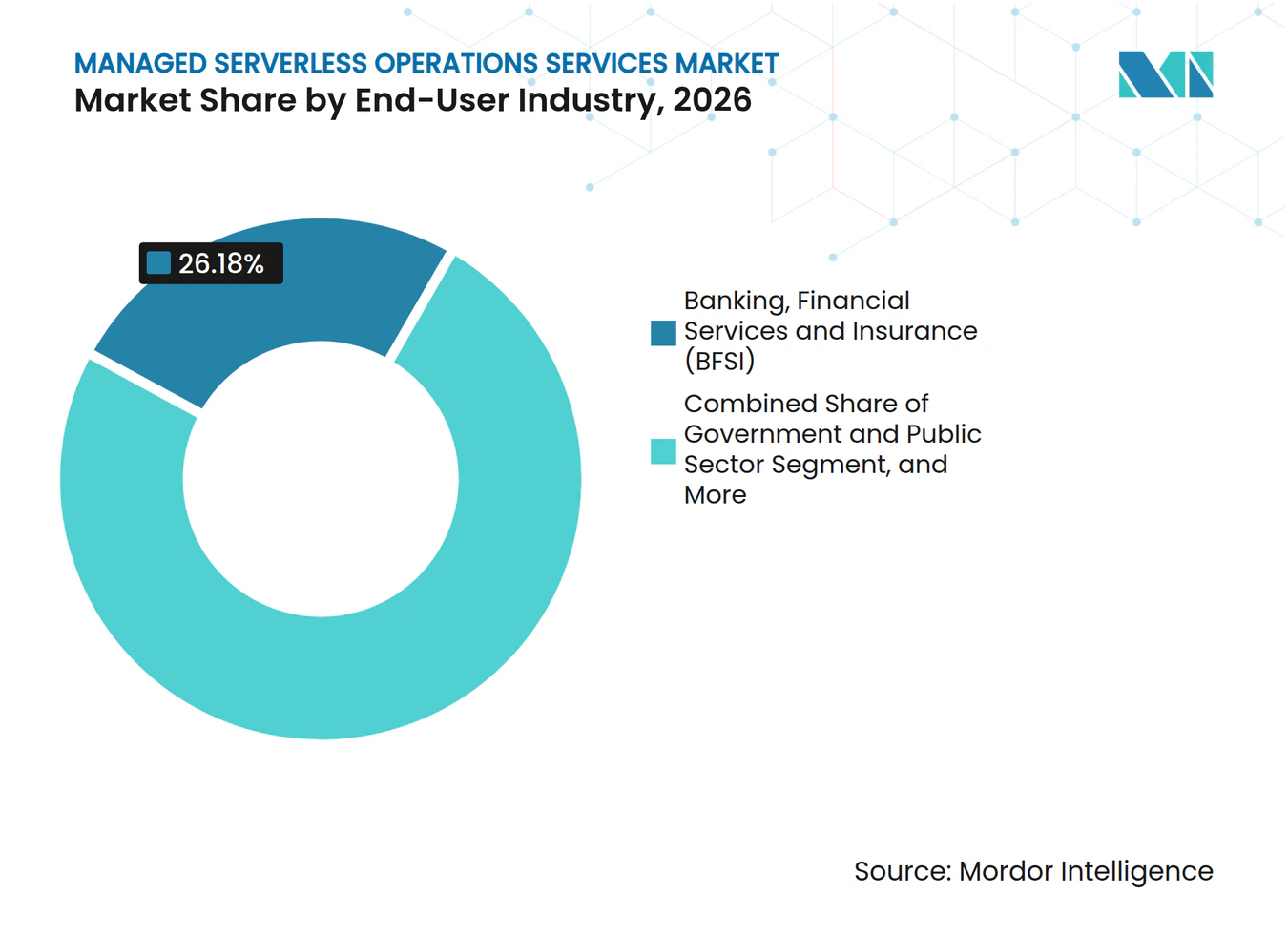
- By end-user industry, BFSI held 26.18% of revenue in 2026 and is projected to record the highest CAGR of 19.87% through 2032.
- By geography, North America held 43.26% of revenue in 2026, while Asia-Pacific is projected to expand at a 19.68% CAGR through 2032.
Note: Market numbers in this report are based on Mordor Intelligence's proprietary estimation framework, which combines nine months of actuals with Q4 projections for base year 2026.
Market Trends and Insights
Drivers Impact Analysis of Managed Serverless Operations Services Market*
| Driver | (~) % Impact on CAGR Forecast | Geographic Relevance | Impact Timeline |
|---|---|---|---|
| Enterprise Shift to Event-Driven and Serverless Architectures | +4.5% | Global, with peak adoption in North America and Western Europe | Short term (≤ 2 years) |
| Multi-Cloud Governance and Operational Complexity | +3.8% | Global, pronounced in North America, Europe, and Asia-Pacific financial hubs | Medium term (2-4 years) |
| AI-Assisted Observability and Automated Remediation | +3.2% | Global, with early gains in North America and Asia-Pacific technology centers | Short term (≤ 2 years) |
| Cloud Talent and Site Reliability Engineering Shortages | +2.8% | North America and Europe, with spillover to Asia-Pacific | Medium term (2-4 years) |
| Serverless Edge and 5G Event Processing | +1.9% | Asia-Pacific, with spillover to the Middle East and North America | Long term (≥ 4 years) |
| Consumption-Based Cost Optimization for Variable Workloads | +1.6% | Global, with early traction in North America and Europe | Short term (≤ 2 years) |
| Source: Mordor Intelligence | |||
Enterprise Shift to Event-Driven and Serverless Architectures
Enterprise adoption of event-driven architectures has moved beyond pilot projects and is changing how operations work is sourced. BMW ConnectedDrive migrated from a monolithic architecture to an event-driven serverless solution on AWS in 2025. The environment supported 24.5 million connected vehicles and processed more than 16.6 billion requests each day. BMW reported a 60% reduction in time to market and a 20% reduction in infrastructure costs. Such deployments need persistent governance for event buses, controlled releases, and resilience testing. The managed serverless operations services market benefits when internal teams cannot maintain those activities at the required scale.[1]AWS introduced an enhanced Custom Event Bus for Amazon EventBridge in October 2026. The service supports up to 10,000 subscribers per bus and changes the pricing structure for event movement. This gives large organizations more flexibility in cross-account event routing. It also increases the number of service settings and usage patterns that operations teams must monitor. Managed providers can help clients set policies for routing, cost allocation, and access control. This driver is most visible where organizations run large event-driven applications across several business units.
Multi-Cloud Governance and Operational Complexity
Many organizations inherited multi-cloud environments through acquisitions, separate business-unit decisions, or earlier technology choices. They now manage different consoles, identity models, security policies, and billing records. This fragmentation makes it difficult to apply one standard for service reliability. It also makes incident coordination slower when a workflow spans multiple cloud services. The managed serverless operations services market gains from this operating gap because external teams can run common controls across environments. Providers that combine policy-as-code with operating procedures can reduce the manual work involved in governance. Compliance requirements add to the pressure on internal teams. SOC 2, ISO 27001, and the EU Cyber Resilience Act require organizations to maintain evidence of how cloud-native workloads are controlled. Serverless applications can change rapidly because new functions and event flows are introduced frequently. Operations teams must keep access rights, configuration records, and audit material current. This work is more difficult when services run across different clouds. The managed serverless operations services market therefore supports a broader role for providers that can connect compliance automation with daily operations.
AI-Assisted Observability and Automated Remediation
AI-assisted observability is changing the cost and pace of managed operations. Research on automated root-cause analysis reported that an LLM-based framework resolved 91% of common incidents and reduced mean time to resolution by 84.2% compared with rule-based methods. This can reduce the manual workload associated with continuous monitoring. It can also allow a provider to respond more consistently to recurring issues. The managed serverless operations services market is supported when clients seek faster incident handling without building large internal operations teams. Providers still need controls that make automated actions traceable and safe.[2]Datadog introduced Bits AI Serverless Remediation in 2026 to support troubleshooting for AWS Lambda applications. The company also expanded its collaboration with AWS around observability and security workflows. These releases show that AI tools are becoming part of the standard operations stack. Providers must manage the models, the telemetry used by those models, and the runbooks that guide remediation. GPU capacity, model drift, and changes in customer environments create additional work. The managed serverless operations services market can benefit as this responsibility becomes a defined service need.
Cloud Talent and Site Reliability Engineering Shortages
A shortage of experienced site reliability engineers makes managed support more important for many organizations. Serverless environments require skills in distributed systems, automation, security, and cloud cost management. These skills are difficult to maintain in smaller internal teams. The challenge is more acute when companies add AI workloads and new data services. Internal engineers must supervise models, manage GPU resources, and monitor automated agents. The managed serverless operations services market provides an alternative for organizations that need this expertise on an ongoing basis. The skill requirement is not limited to technical troubleshooting. Teams also need reliable incident processes, service-level objectives, and clear ownership across applications. Organizations that try to build this capability without enough automation may remain reactive. Managed providers can standardize these practices across a client portfolio. They can also use reusable runbooks to handle common operational issues. This makes external operations support more relevant for mid-sized companies and regulated organizations. The driver will remain important while serverless deployments become more distributed and business critical.
Restraints Impact Analysis of Managed Serverless Operations Services Market*
| Restraint | (~) % Impact on CAGR Forecast | Geographic Relevance | Impact Timeline |
|---|---|---|---|
| Vendor Lock-In and Limited Workload Portability | -2.8% | Global, most acute in North America and Europe | Medium term (2-4 years) |
| Distributed Runtime Visibility and Debugging Complexity | -2.2% | Global | Short term (≤ 2 years) |
| Serverless Consumption Variability and Contract-Margin Risk | -1.7% | North America and Europe, with spillover to Asia-Pacific | Medium term (2-4 years) |
| Data Residency, Shared Responsibility and Audit-Evidence Gaps | -1.3% | Europe, Asia-Pacific national markets, and regulated sectors globally | Long term (≥ 4 years) |
| Source: Mordor Intelligence | |||
Vendor Lock-In and Limited Workload Portability
Provider-specific event triggers, managed-service integrations, and identity models make serverless workloads difficult to move. The problem is architectural because applications depend on the way a specific cloud platform handles events and permissions. A 2025 study of 306 IT professionals found that 68.3% of serverless practitioners viewed provider-specific event triggers as a major migration barrier. The study also found that lock-in became more severe as cloud models moved from infrastructure services toward serverless services. These conditions can delay outsourcing decisions when clients expect to move workloads across providers. The managed serverless operations services market must address portability as part of service design. AWS introduced Azure-to-AWS code conversion in AWS Transform in October 2026. The capability converts Azure Functions to AWS Lambda equivalents and Azure Cosmos DB elements to Amazon DynamoDB. This illustrates the importance that major cloud providers place on workload migration. It also highlights the risk for clients whose services depend heavily on one platform. Abstraction layers, Kubernetes-based frameworks, and open event standards can reduce some exposure. Each option adds design work, operational complexity, and cost.
Distributed Runtime Visibility and Debugging Complexity
Serverless functions are stateless and short lived, and many can run at the same time. These characteristics make root-cause analysis harder than in traditional server environments. Research on distributed tracing found throughput reductions from 19% to 80% and latency increases of up to 175%, depending on the application configuration. High-fidelity telemetry can therefore affect the performance that serverless systems are intended to deliver. This creates a difficult trade-off between application visibility and efficiency. The managed serverless operations services market must provide monitoring designs that balance both requirements. Cold starts add to this challenge because some functions exist for only milliseconds. Telemetry must be captured and exported within that limited period. Many instrumentation tools do not support every runtime behavior in the same way. Clients without mature platform engineering practices may face higher onboarding costs. Providers need clear baselines for tracing depth, latency, and cost before they take responsibility for an environment. This constraint can limit adoption among organizations with less mature cloud operations.
*Our forecasts treat driver/restraint impacts as directional, not additive. The impact forecasts reflect baseline growth, mix effects, and variable interactions.
Managed Serverless Operations Services Market Segment Analysis
By Service Type:
Platform Engineering Supports a Broader Operations StackPlatform Engineering and DevOps Operations held 22.18% of the managed serverless operations services market share in 2026. The segment provides the operational base for infrastructure provisioning, CI/CD management, and multi-account governance. Many enterprises begin their managed operations program with these foundational tasks. They then add observability, FinOps, security, and data services as their workloads become more complex. The segment remains central because serverless applications need controlled deployment and reliable configuration management. It also gives providers a starting point for expanding a client relationship. Security, Compliance and Governance Operations, FinOps and Modernization Operations, Incident and Event Management, and Managed Database and Data Services address different risk and cost requirements. Managed database services are gaining relevance as organizations use more serverless data platforms. Confluent introduced Serverless Flink Apps in 2026 with exactly-once processing, auto-scaling, and no infrastructure provisioning. These capabilities extend managed operations into stateful streaming workloads. Providers need data engineering skills alongside traditional DevOps skills to support such systems. This broadening service scope supports a more diversified managed serverless operations services market.[3]
Monitoring, Observability and AIOps is projected to expand at a 19.73% CAGR through 2032. The managed serverless operations services market size for this segment is supported by the need to detect invocation loops, cold-start cascades, and event backlogs before they raise costs or disrupt services. Observability is essential because ephemeral functions are difficult to diagnose after an issue has passed. The segment can combine technical monitoring with financial controls. This is particularly important when a faulty event pattern can rapidly increase consumption charges. The FinOps Foundation identified workload optimization and governance at scale as leading priorities for cloud practitioners in 2025. These priorities support bundled monitoring and FinOps offerings. Financial services clients also need monitoring processes that support PCI-DSS Level 1 and SOC 2 Type II obligations. Providers can use this need to offer integrated compliance and operational services. The service type is likely to remain important as automated remediation becomes more common. Its growth reflects the need to improve visibility rather than merely collect more telemetry.



By Service Model:
Managed Services Leads an Outcome-Based Delivery ModelManaged Services accounted for 73.42% of revenue in 2026. It is also projected to expand at a 19.65% CAGR through 2032. The model gives clients ongoing support tied to defined service levels and operating outcomes. Large event-driven environments cannot rely on project teams every time a new Lambda trigger, Kafka consumer, or Cloud Run service is added. Continuous operations gives clients a clearer route to stable performance and accountability. Managed engagements are increasingly built around consumption-linked service levels rather than fixed staffing levels. This structure reflects the variable demand patterns of serverless workloads. It also places pressure on providers that cannot automate routine monitoring and response work. Providers with strong automation can keep margins more stable across a large client base. The managed serverless operations services market benefits when customers prefer an always-on operating model. This model is especially relevant for systems that handle payments, customer interactions, and core digital services.
Professional Services held the remaining 26.58% of revenue in 2026. The segment supports early serverless migration, architecture planning, and one-time governance reviews. It remains useful for manufacturing, government, and healthcare organizations that are beginning to adopt cloud-native operations. These clients may need architecture blueprints before they move to an ongoing service agreement. Professional services can also help establish the controls required for regulated workloads. Professional engagements often lead into managed services once deployment becomes stable. This makes the two delivery models connected rather than separate. Providers can use early assessments to identify gaps in observability, security, or cost control. Clients can then decide which functions they want to retain internally. The managed serverless operations services market has room for both models because maturity differs by organization and workload. The delivery mix will depend on how quickly a client moves from migration activity to continuous operations.
By End-User Industry:
BFSI Leads Through Compliance and Real-Time Processing NeedsBFSI held 26.18% of revenue in 2026. It is projected to advance at a 19.87% CAGR through 2032. Real-time payment processing, audit-trail requirements, and fluctuating transaction volumes support demand for serverless operations services. Consumption-based capacity can suit financial workloads that have variable demand. At the same time, these workloads require strict controls over reliability, security, and response time. This combination makes external operational support valuable. Visa deployed its Tier 0 Visa Protect for Account-to-Account Payments workload on AWS in 2025. The workload delivered sub-250 millisecond latency and 99.99% availability. This example shows the operational requirements associated with event-driven financial services. Providers need mature monitoring and incident processes to support workloads of this type. National Australia Bank reported an 18-month regulatory approval process for serverless use in its data environment. The long preparation period shows that governance remains a significant part of financial services adoption.
Information Technology and Telecommunications is the second-largest end-user segment. These organizations often have advanced DevOps practices and large multi-cloud serverless environments. Their complexity creates a continuing need for operations support across application delivery, monitoring, and cost control. Healthcare requires protected data pipelines that meet HIPAA requirements. Government users operate within FedRAMP constraints and need evidence of how cloud services are controlled. Retail and Media and Entertainment use serverless auto-scaling for personalization, streaming, and traffic peaks. Manufacturing and Automotive is an emerging application area as private 5G networks connect factory systems with cloud analytics. These workloads bring edge operations into the service scope. No provider has established a dominant operating model in this area. The managed serverless operations services market offers providers an opportunity to develop specialized practices for industrial data and edge events. Success will depend on connecting cloud operations with the operational needs of physical sites.

Geography Analysis
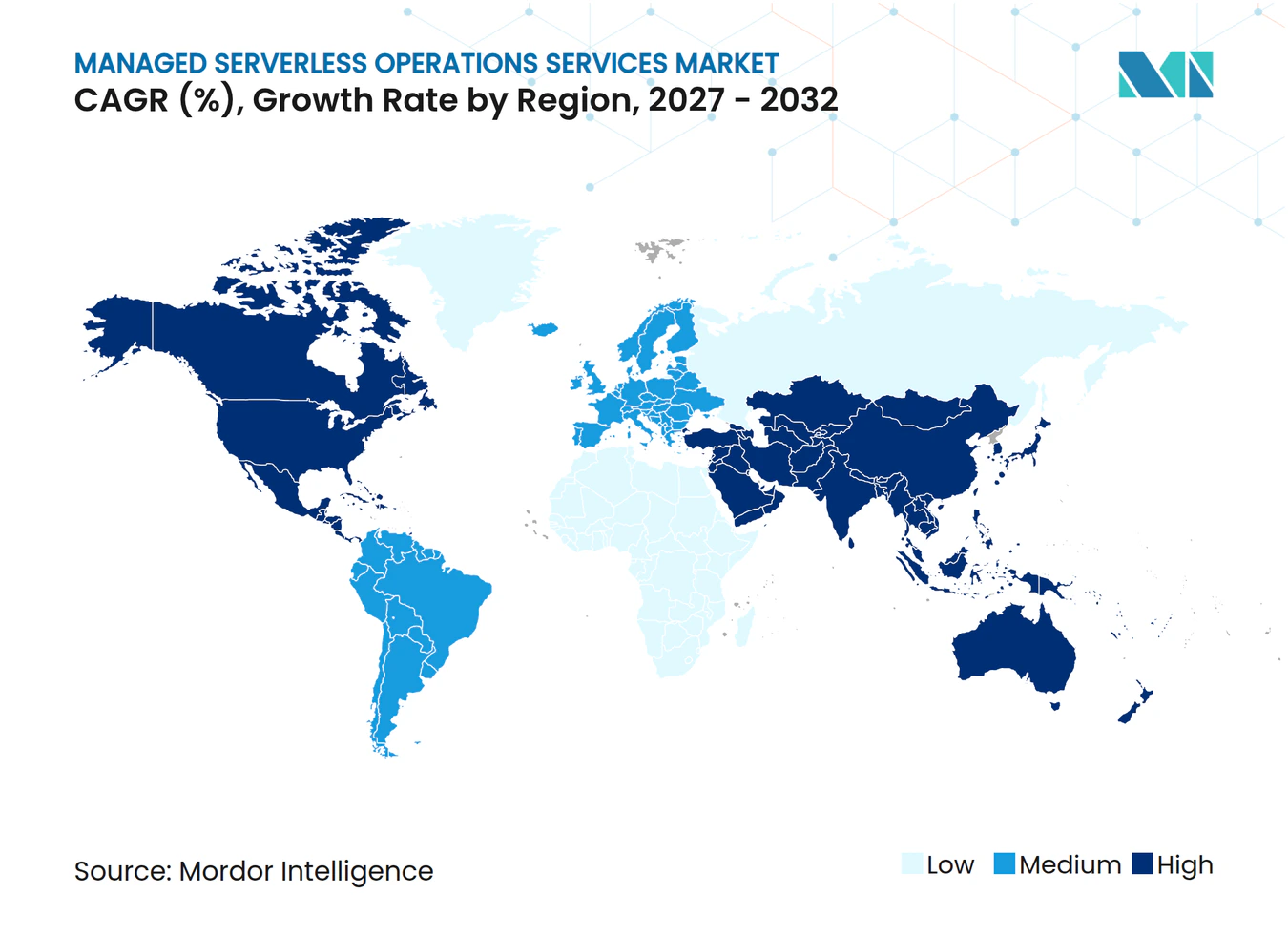
North America held 43.26% of revenue in 2026. The region benefits from major cloud platforms, early cloud-native adoption, and a deep base of technical talent. Its organizations operate mature serverless environments for customer-facing and mission-critical workloads. U.S. financial institutions and digital companies are important users. Canada adds demand through telecommunications providers integrating 5G edge functions.
Asia-Pacific is projected to expand at a 19.68% CAGR through 2032. The managed serverless operations services market size in the region is supported by cloud modernization, expanding digital services, and wider multi-cloud use. Japan’s public cloud market reached JPY 4.49 trillion, equivalent to USD 30 billion, in 2025. The country is using cloud operations support as part of broader technology renewal programs. China’s Ministry of Industry and Information Technology targeted 55% of new cloud-native applications on serverless computing by 2028. India, Southeast Asia, and China are adding digital platforms that need dependable cloud operations.
Europe, South America, the Middle East, and Africa represented the remaining revenue share in 2026. Europe’s development is shaped by GDPR data residency rules and governance obligations under the EU AI Act. South America is developing demand through Brazil’s fintech activity and Argentina’s technology-services exports. Saudi Arabia and the United Arab Emirates are including cloud operations in wider digital infrastructure programs. Africa remains an earlier-stage opportunity, led by mobile-first fintech in South Africa and Nigeria. Growth across these regions will vary by cloud availability, regulations, and local technology skills.
Competitive Landscape
Market Concentration
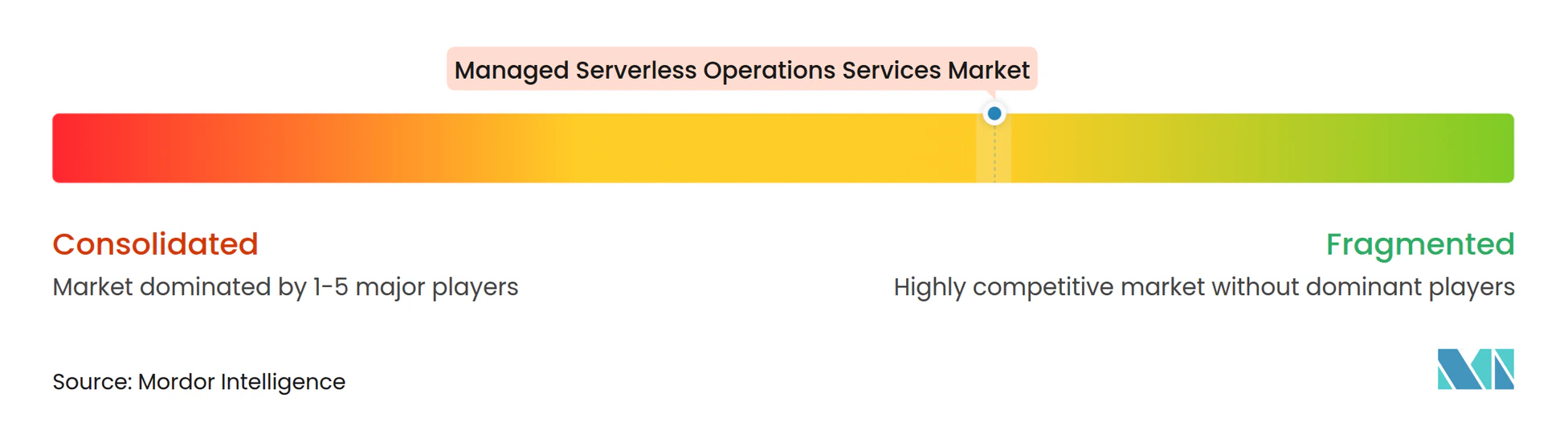
The managed serverless operations services market is moderately fragmented among leading providers and more fragmented below the hyperscaler tier. Amazon Web Services, Microsoft Corporation, and Google LLC shape platform choices, pricing, and the operational tools available to their customers. They compete as cloud infrastructure providers, tooling vendors, and managed services partners. This creates a difficult position for independent providers that build their services on the same platforms. Independent firms must show value through stronger operations processes, specialized skills, or support across more than 1 cloud environment.
AWS Systems Manager, Azure remediation tools, and Google Cloud Run are examples of platform capabilities that influence competition. Google reported that the number of external active developers and applications using Cloud Run doubled in 2025. Platform providers can use these capabilities to strengthen their relationship with customers. However, large enterprise clients may still require support that links platforms with their own internal controls. The managed serverless operations services market therefore retains space for providers that can coordinate complex environments.
Observability specialists are developing deeper integrations with cloud platforms. Datadog introduced serverless agentic onboarding in 2026 across AWS Lambda, Google Cloud Run, and Azure Container Apps. The capability is intended to simplify instrumentation using a single command-line process. This type of tool can help providers standardize service delivery across cloud environments. It can also lower the time needed to begin monitoring a new application. The competitive value depends on whether the tool improves response quality without creating unnecessary telemetry costs.
Managed Serverless Operations Services Industry Leaders
-
Amazon Web Services, Inc.
-
Microsoft Corporation
-
Google LLC
-
Cloudflare, Inc.
-
Fastly, Inc.
- *Disclaimer: Major Players sorted in no particular order
Managed Serverless Operations Services Market Companies Covered in this Report
- Amazon Web Services, Inc.
- Microsoft Corporation
- Google LLC
- Cloudflare, Inc.
- Fastly, Inc.
- Vercel Inc.
- Netlify, Inc.
- DigitalOcean Holdings, Inc.
- Akamai Technologies, Inc.
- MongoDB, Inc.
- Twilio Inc.
- Datadog, Inc.
- Elastic N.V.
- Confluent, Inc.
- Supabase Inc.
- Deno Land Inc.
- Fly.io, Inc.
- Render Services, Inc.
- Modal Labs, Inc.
- Temporal Technologies, Inc.
- TriggerMesh, Inc.
Recent Industry Developments in Managed Serverless Operations Services Market
- October 2026: Google launched Agent Compute Engine at AGNTCon plus MCPCon, a purpose-built compute service providing hardware-isolated runtime sandboxes for autonomous agents and cloud-run workloads, expanding the operational complexity footprint that managed-services providers must cover.
- August 2026: Temporal Technologies released Serverless Workers for AWS Lambda into public preview, enabling Temporal Cloud to automatically invoke, scale, and shut down Workers as Lambda functions in response to task-queue demand, demonstrated at scale with 100,000 workflows processed for USD 10 in compute costs.
- August 2026: Datadog introduced Bits AI Serverless Remediation in preview at AWS re:Invent, enabling AI-augmented troubleshooting of serverless applications on AWS, alongside expanded collaboration with AWS covering Lambda, ECS, and Amazon RDS cost-recommendation automation.
- August 2026: Microsoft announced general availability of Managed Instance on Azure App Service with 99.95% enterprise SLA, expanded to 8+ Azure regions, integrating Azure Monitor and Defender for Cloud governance, a competitive response to AWS Lambda's managed-instance capabilities.
Global Managed Serverless Operations Services Market Report Scope
The Managed Serverless Operations Services Market encompasses the third-party professional and managed services that enable organizations to design, deploy, monitor, secure, optimize, and continuously operate applications and workloads built on serverless computing architectures, including function-as-a-service (FaaS), backend-as-a-service (BaaS), serverless containers, event-driven workflows, serverless databases, and API gateways, across public, private, hybrid, and multi-cloud environments.
The Managed Serverless Operations Services Report is Segmented by Service Type (Platform Engineering and DevOps Operations, Monitoring, Observability and AIOps, Security, Compliance and Governance Operations, FinOps and Modernization Operations, Incident and Event Management, Managed Database and Data Services), Service Model (Managed Services, Professional Services), End-User Industry (BFSI, IT and Telecom, Healthcare, Government, Retail, Manufacturing, Media and Entertainment), and Geography (North America, South America, Europe, Asia-Pacific, Middle East, Africa). The Market Forecasts are Provided in Terms of Value (USD).
Segmentation Overview
| Platform Engineering and DevOps Operations |
| Monitoring, Observability and AIOps |
| Security, Compliance and Governance Operations |
| FinOps and Modernization Operations |
| Incident and Event Management |
| Managed Database and Data Services |
| Managed Services |
| Professional Services |
| Banking, Financial Services and Insurance |
| Information Technology and Telecommunications |
| Healthcare and Life Sciences |
| Government and Public Sector |
| Retail and Consumer Goods |
| Manufacturing and Automotive |
| Media and Entertainment |
| Other End-User Industries |
| North America | United States |
| Canada | |
| Mexico | |
| South America | Brazil |
| Argentina | |
| Rest of South America | |
| Europe | Germany |
| United Kingdom | |
| France | |
| Italy | |
| Spain | |
| Russia | |
| Rest of Europe | |
| Asia-Pacific | China |
| India | |
| Japan | |
| South Korea | |
| Australia | |
| Rest of Asia-Pacific | |
| Middle East | Saudi Arabia |
| United Arab Emirates | |
| Turkey | |
| Rest of Middle East | |
| Africa | South Africa |
| Egypt | |
| Nigeria | |
| Rest of Africa |
| By Service Type | Platform Engineering and DevOps Operations | |
| Monitoring, Observability and AIOps | ||
| Security, Compliance and Governance Operations | ||
| FinOps and Modernization Operations | ||
| Incident and Event Management | ||
| Managed Database and Data Services | ||
| By Service Model | Managed Services | |
| Professional Services | ||
| By End-User Industry | Banking, Financial Services and Insurance | |
| Information Technology and Telecommunications | ||
| Healthcare and Life Sciences | ||
| Government and Public Sector | ||
| Retail and Consumer Goods | ||
| Manufacturing and Automotive | ||
| Media and Entertainment | ||
| Other End-User Industries | ||
| By Geography | North America | United States |
| Canada | ||
| Mexico | ||
| South America | Brazil | |
| Argentina | ||
| Rest of South America | ||
| Europe | Germany | |
| United Kingdom | ||
| France | ||
| Italy | ||
| Spain | ||
| Russia | ||
| Rest of Europe | ||
| Asia-Pacific | China | |
| India | ||
| Japan | ||
| South Korea | ||
| Australia | ||
| Rest of Asia-Pacific | ||
| Middle East | Saudi Arabia | |
| United Arab Emirates | ||
| Turkey | ||
| Rest of Middle East | ||
| Africa | South Africa | |
| Egypt | ||
| Nigeria | ||
| Rest of Africa | ||
Key Questions Answered in the Report
What is the managed serverless operations services market size?
The sector is USD 9.14 billion in 2026 and is projected to reach USD 21.65 billion by 2032 at an 18.81% CAGR.
What is driving demand for managed serverless operations services?
Demand is supported by event-driven application adoption, multi-cloud governance needs, limited SRE capacity, and greater use of AI-assisted observability.
Which service type leads managed serverless operations services?
Platform Engineering and DevOps Operations leads with 22.18% of revenue in 2026, while Monitoring, Observability and AIOps has the highest projected CAGR at 19.73%.
Which service model is most widely used?
Managed Services accounts for 73.42% of 2026 revenue and is projected to expand at a 19.65% CAGR through 2032.
Which end-user sector has the highest demand?
BFSI holds 26.18% of 2026 revenue and is projected to advance at a 19.87% CAGR through 2032 because of payment-processing, security, and compliance requirements.
Which region is expected to expand fastest?
Asia-Pacific is projected to expand at a 19.68% CAGR through 2032, while North America holds the largest share at 43.26% in 2026.