
Managed Security Service Edge (SSE) Services Market Size and Share
Market Overview
| Study Period | 2021 - 2032 |
|---|---|
| Market Size (2027) | USD 15.71 Billion |
| Market Size (2032) | USD 32.95 Billion |
| Growth Rate (2027 - 2032) | 20.11 % |
| Fastest Growing Market | Middle East |
| Largest Market | North America |
| Market Concentration | Medium |
Major Players *Disclaimer: Major Players sorted in no particular order Image © Mordor Intelligence. Reuse requires attribution under CC BY 4.0. | |
Managed Security Service Edge (SSE) Services Market Analysis by Mordor Intelligence
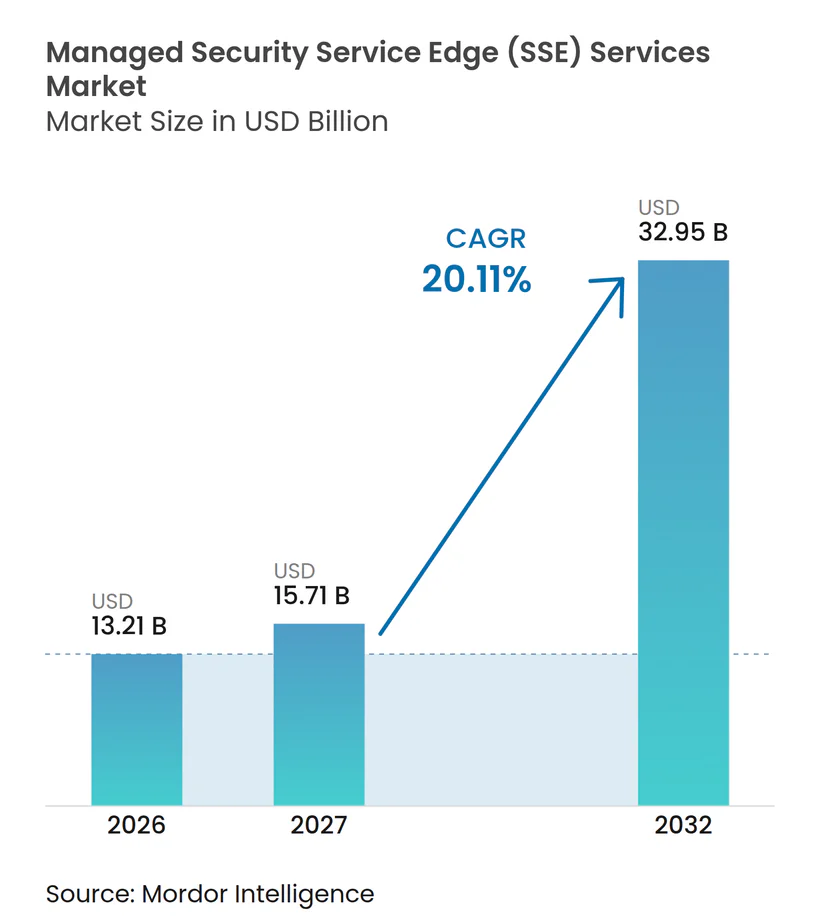
The Managed Security Service Edge (SSE) Services Market size is projected to expand from USD 13.21 billion in 2026 to USD 32.95 billion by 2032, registering a CAGR of 20.11% between 2027 and 2032. Enterprises are moving security controls closer to users, cloud applications, and data because workloads now operate across SaaS platforms, cloud providers, and remote endpoints. This change shifts buying decisions from standalone remote-access tools toward managed platforms that apply consistent inspection and access rules across transactions. Providers that combine data protection, access controls, and policy operations can build longer customer relationships because implementation and ongoing management are linked. The Managed Security Service Edge (SSE) services market also faces higher technical demands as AI applications and non-human identities add traffic that requires fast, reliable inspection.
Key Report Takeaways
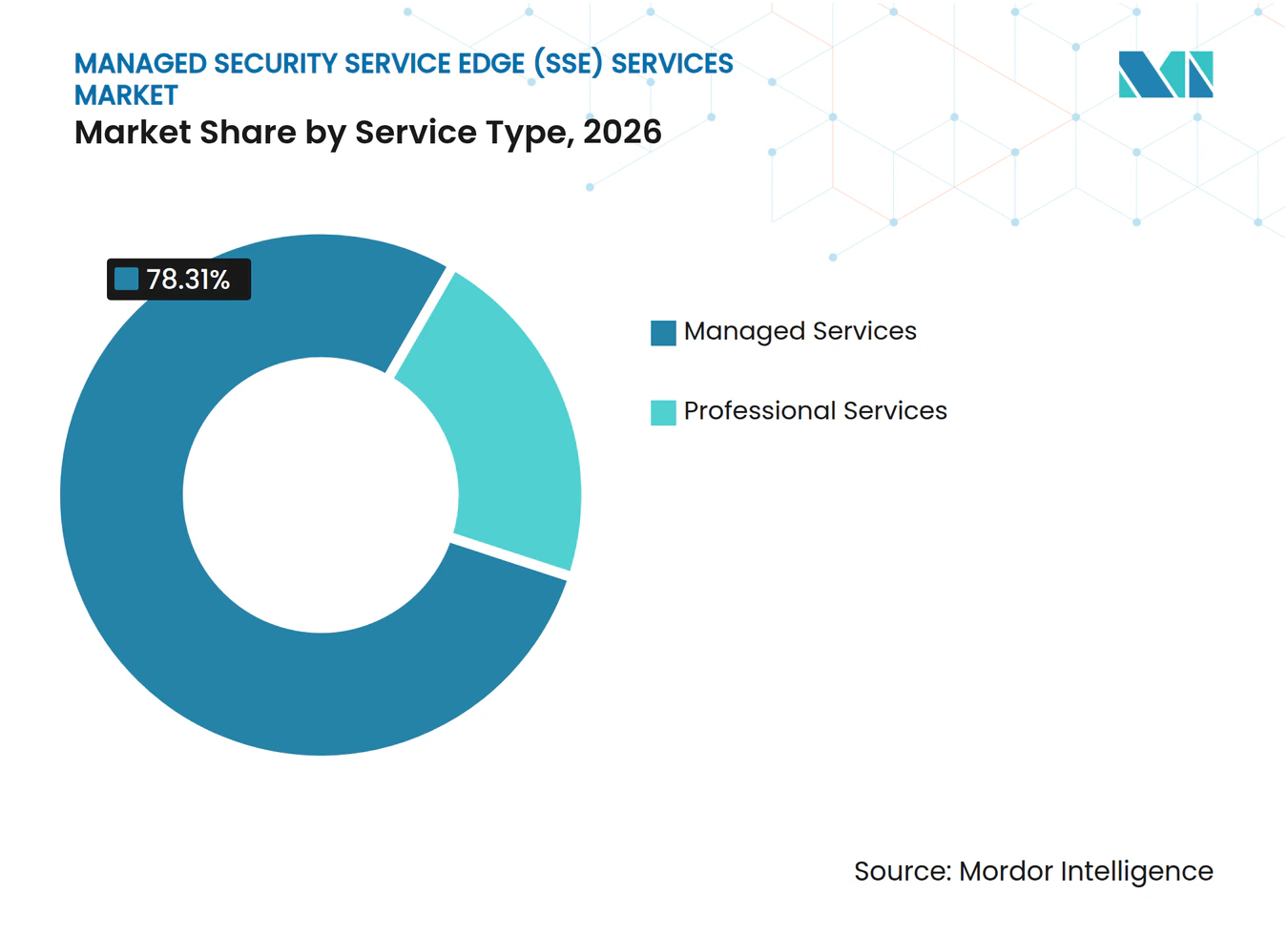
- By service type, managed services held 78.31% of the Managed Security Service Edge (SSE) services market share in 2026, while no forecast CAGR was provided for professional services.
- By SSE capability, Zero Trust Network Access accounted for 31.06% of revenue in 2026, while Data Loss Prevention is projected to expand at a 21.73% CAGR through 2032.
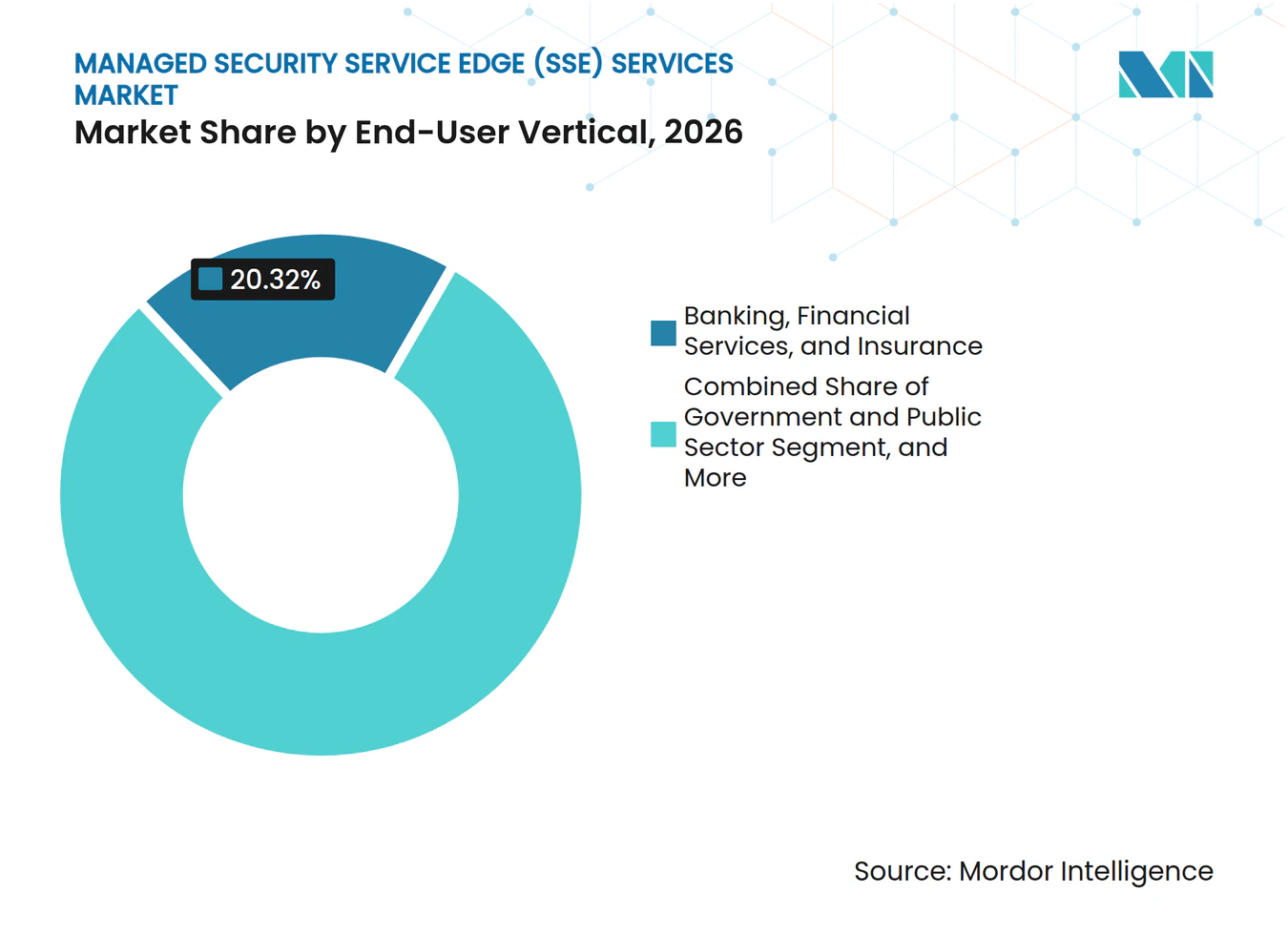
- By end-user vertical, Banking, Financial Services and Insurance held 20.32% of revenue in 2026, while Healthcare and Life Sciences is projected to expand at a 21.72% CAGR through 2032.
- By geography, North America accounted for 42.05% of revenue in 2026, while the Middle East is projected to expand at a 21.67% CAGR through 2032.
Note: Market numbers in this report are based on Mordor Intelligence's proprietary estimation framework, which combines nine months of actuals with Q4 projections for base year 2026.
Market Trends and Insights
Drivers Impact Analysis of Managed Security Service Edge (SSE) Services Market*
| Driver | (~) % Impact on CAGR Forecast | Geographic Relevance | Impact Timeline |
|---|---|---|---|
| Cloud and SaaS Migration Across Enterprise Workloads | +4.5% | Global, with strongest concentration in North America and Western Europe | Short term (≤ 2 years) |
| Expansion of Hybrid and Remote Workforce Access | +3.8% | Global, with outsized effect in North America, Asia-Pacific, and Western Europe | Short term (≤ 2 years) |
| Zero-Trust Mandates and Data-Protection Regulations | +3.2% | North America and EU core, with regulatory spillover to the Middle East and Asia-Pacific | Medium term (2-4 years) |
| Managed Security Skills Shortages Among SMEs and Distributed Enterprises | +2.7% | Global, particularly severe in South America, the Middle East, and Southeast Asia | Medium term (2-4 years) |
| Emergence of AI Workloads and Non-Human Identities | +2.5% | Global, led by North America and Asia-Pacific AI infrastructure markets | Long term (≥ 4 years) |
| Sovereign Inspection and Local-Processing Requirements | +1.8% | Middle East core, Asia-Pacific data-localization markets, and Europe | Long term (≥ 4 years) |
| Source: Mordor Intelligence | |||
Cloud and SaaS Migration Across Enterprise Workloads
Cloud migration is creating a persistent need for controls that can protect users and data across applications that operate outside a traditional network perimeter. The Managed Security Service Edge (SSE) services market benefits when organizations add SaaS applications because each new application increases the number of access paths that need policy oversight. Centralized hardware controls can create delays when they must process traffic from distributed users and cloud workloads. Distributed points of presence allow inspection to occur nearer to users and applications, which supports more consistent performance. The result is a recurring requirement for managed policy updates, monitoring, and data controls as application portfolios change. This gives providers an opportunity to remain involved after the initial deployment through operational support and service renewals.
Expansion of Hybrid and Remote Workforce Access
Hybrid work has changed how organizations manage access because employees, contractors, and partners often connect from locations outside the corporate network. Portnox reported that 67% of surveyed US chief information security officers expected to replace legacy VPNs within the next year, while 93% planned a complete phase-out by 2027 in favor of ZTNA-based access.[1] Replacing a VPN requires organizations to move access rules, certificates, and split-tunneling practices into new policy structures. Managed providers can support this transition while the old and new environments operate in parallel. That work can extend beyond the initial access deployment because security teams must test application behavior and user permissions. The Managed Security Service Edge (SSE) services market, therefore, gains demand from both new access controls and the follow-on work required to retire older infrastructure.
Zero-Trust Mandates and Data-Protection Regulations
Zero-trust requirements and data-protection rules make security modernization a governance priority rather than an optional technology upgrade. Organizations in regulated sectors need clear access rules, audit trails, and evidence that data policies are being enforced. The Managed Security Service Edge (SSE) services market favors platforms that can connect security controls with reporting and documented operational procedures. It also reduces the time spent defining basic requirements because many buyers begin with established compliance obligations. Banking, healthcare, and public-sector organizations have particularly strong reasons to prioritize identity-based access and data inspection. Providers that map services to compliance needs can make adoption easier for customers who must show how their controls support oversight.
Managed Security Skills Shortages Among SMEs and Distributed Enterprises
A shortage of security expertise supports demand for managed delivery because many organizations cannot operate a complex SSE deployment on their own. Hughes Network Systems found that 47% of respondents identified a lack of in-house expertise as a key barrier to self-managing SSE. Modern deployments require skills in cloud networking, access policy design, data classification, identity governance, and threat response. Smaller organizations may lack the staff needed to maintain all these capabilities continuously. Distributed enterprises also face operational pressure when they must apply consistent rules across branches, remote users, and cloud services. The Managed Security Service Edge (SSE) services market is supported by this gap because managed providers can supply monitoring, administration, and specialist support as an ongoing service.
Restraints Impact Analysis of Managed Security Service Edge (SSE) Services Market*
| Restraint | (~) % Impact on CAGR Forecast | Geographic Relevance | Impact Timeline |
|---|---|---|---|
| Legacy VPN, Firewall, and Multi-Cloud Policy Migration Complexity | -2.1% | Global, most severe in large enterprises with distributed on-premise infrastructure | Short term (≤ 2 years) |
| Shortage of Skilled SSE Architects and Operators | -1.8% | Global, with acute gaps in South America, Southeast Asia, and Africa | Medium term (2-4 years) |
| Inline Inspection Latency at AI Traffic Scale | -1.3% | Global, concentrated in AI-focused markets in North America and Asia-Pacific | Long term (≥ 4 years) |
| Proprietary Policy Languages and Telemetry Lock-In | -0.9% | Global, particularly constraining for multinationals managing multi-vendor environments | Medium term (2-4 years) |
| Source: Mordor Intelligence | |||
Legacy VPN, Firewall, and Multi-Cloud Policy Migration Complexity
Moving from legacy VPNs, firewalls, and multi-cloud controls into an SSE model can be difficult because existing rules were built for different technologies. Large organizations may run MPLS networks, hardware firewalls, and several cloud environments with inconsistent access policies. These policies often use vendor-specific formats that do not transfer directly into SSE policy structures. Migration teams in the Managed Security Service Edge (SSE) services market must review rules, test applications, and resolve exceptions before users can be moved safely. Projects may take longer than planned, which can delay deployment decisions and revenue recognition. The same complexity can create later service demand, but it remains a barrier during the first stage of adoption.
Shortage of Skilled SSE Architects and Operators
The shortage of SSE specialists limits delivery capacity, even though the shortage also encourages organizations to buy managed services. Providers need architects and operators who understand cloud security, multi-tenant operations, identity controls, and data policies. Training staff for complex environments requires time, especially when services must operate across many customer systems. This can slow provider expansion when customer demand rises faster than qualified delivery teams. Automation can simplify repetitive work, but experienced personnel remain important for policy design, incident response, and customer-specific decisions. The Managed Security Service Edge (SSE) services market must therefore balance strong demand with the practical ability of providers to build and retain skilled operating teams.
*Our forecasts treat driver/restraint impacts as directional, not additive. The impact forecasts reflect baseline growth, mix effects, and variable interactions.
Managed Security Service Edge (SSE) Services Market Segment Analysis
By Service Type:
Managed Services Anchor Enterprise Security OutsourcingManaged services held 78.31% of the Managed Security Service Edge (SSE) services market share in 2026. This position reflects the need for continuous threat monitoring, policy administration, and incident response. Organizations often require support after deployment because access policies and data rules change as users, applications, and risks change. Managed contracts can combine operational support with the underlying security platform. This arrangement can reduce the burden on internal teams that do not have specialists across cloud networking, identity, and data protection. It also gives customers a defined operating model for maintaining security controls over time.
Within the Managed Security Service Edge (SSE) services market, professional services represent the remaining service revenue through architecture reviews, migration support, implementation work, and training. These engagements are important when customers are consolidating platforms or moving controls from legacy networks. They can also help organizations prepare policies before a managed service begins. Managed contracts usually extend further because they support ongoing operations rather than a one-time implementation. Fortinet Japan reported that 58.7% of surveyed organizations managing SASE or SSE deployments used managed security services fully or partly. The same survey found that 63.3% of organizations that deployed SSE products did so through a single vendor, which reinforces demand for providers that can present a unified service experience.[2]


By SSE Capability:
Zero Trust Access Leads, Data Loss Prevention Accelerates FastestZero Trust Network Access held 31.06% of Managed Security Service Edge (SSE) services market revenue by capability in 2026. Its position is tied to the replacement of legacy VPN access with identity-based rules that limit access to authorized users and applications. Organizations use these controls to reduce broad network access and to apply least-privilege principles. Zero Trust Network Access also fits the operating needs of hybrid work because users can connect to approved applications without receiving broad network access. Regulatory expectations around identity and access controls further strengthen demand. Managed providers can add value by operating policies, monitoring access activity, and helping customers adjust permissions as user roles change.
Data Loss Prevention is projected to expand at a 21.73% CAGR through 2032, the fastest rate among the capability segments. Generative AI has increased the need to monitor sensitive information shared through prompts and other conversational workflows. Netskope stated that its generative AI controls provide real-time, in-line coaching that can intercept sensitive information and offer redaction rather than relying only on hard blocks. Remote Browser Isolation remains smaller by revenue but is relevant for unmanaged devices and third-party users. Secure Web Gateway and Cloud Access Security Broker are established functions with steady adoption, while Firewall-as-a-Service supports organizations that are reducing reliance on hardware appliances. Together, these capabilities allow the Managed Security Service Edge (SSE) services market to support data protection and access control through a common operating layer.
By End-User Vertical:
BFSI Commands Largest Share, Healthcare Grows at the Fastest RateBanking, Financial Services, and Insurance accounted for 20.32% of revenue in 2026, the largest vertical share. Financial institutions manage sensitive data and must maintain detailed controls over access, monitoring, and audit records. These needs make security spending less discretionary than in many other sectors. Managed services can help these organizations operate controls consistently while meeting internal governance requirements. Providers with security reporting and policy expertise can support operational teams that must show how access rules are applied. The Managed Security Service Edge (SSE) services industry is well placed in this segment because managed operations can combine platform oversight with specialized support.
Within the Managed Security Service Edge (SSE) services market, Healthcare and Life Sciences is projected to expand at a 21.72% CAGR through 2032, the fastest rate among end-user verticals. Healthcare organizations face significant exposure from cyber incidents and need to protect patient data while supporting clinical and administrative access. The financial and operational consequences of a serious incident strengthen the case for more consistent access and data controls. Information Technology and Telecommunications, Government and Public Sector, and Manufacturing remain important users because cloud adoption and regulatory needs increase their security requirements. Retail and E-Commerce, Energy and Utilities, and other verticals present further opportunity as cloud use expands and organizations seek simpler ways to manage distributed access. These sectors may adopt services at different speeds, but they face the same need to protect users, applications, and data across changing operating environments.


Geography Analysis
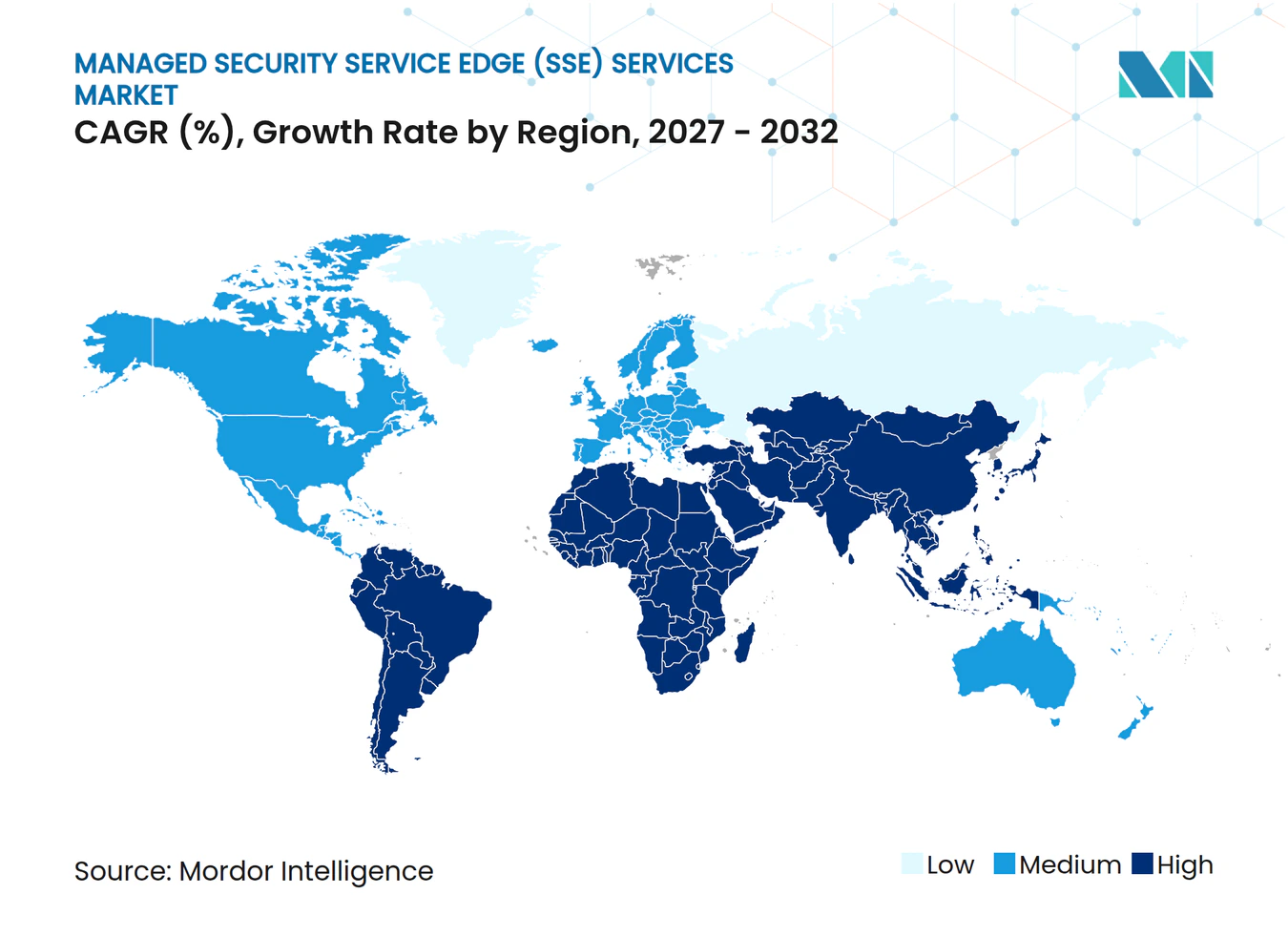
North America accounted for 42.05% of regional revenue in the managed Security Service Edge (SSE) services market in 2026. The region combines a large enterprise SaaS base with established managed security providers and mature cloud adoption. Federal zero-trust requirements also influence security practices beyond government agencies because commercial organizations use similar governance models. The United States remains central to demand, while Canada and Mexico contribute through managed services for mid-sized enterprises that may lack internal security teams. South America is at an earlier stage, with Brazil supporting regional demand through financial-sector digitalization and data-protection requirements.
The managed Security Service Edge (SSE) services market in Europe has a regulation-driven adoption environment shaped by data protection and network-security obligations. Organizations in the region need security services that can support controlled data handling and clear policy evidence. Data sovereignty is important because enterprises may require inspection and data handling within the region. This favors providers with local points of presence and services designed for regional operating requirements. Germany is a key market for software-defined security adoption, while broader cloud migration and operational technology modernization also support demand. Asia-Pacific contains diverse national markets, and Japan, India, South Korea, and Australia are important areas of activity as organizations move toward cloud-native access and inspection models.
The Middle East is projected to expand at a 21.67% CAGR through 2032, making it the fastest-growing regional segment of the Managed Security Service Edge (SSE) services market. Saudi Arabia and the United Arab Emirates support demand through national digital infrastructure and AI programs that require stronger network security. Sovereign inspection requirements can favor providers that process designated traffic within national borders. ZainTECH launched AI-powered managed security operations across the UAE, Saudi Arabia, and Jordan in August 2025, using regional security operations centers to keep client data within GCC borders.[3] Africa remains an early-stage opportunity, with South Africa, Egypt, and Nigeria supporting demand from financial-services organizations and government bodies that are strengthening core cybersecurity capabilities.
Competitive Landscape
Market Concentration
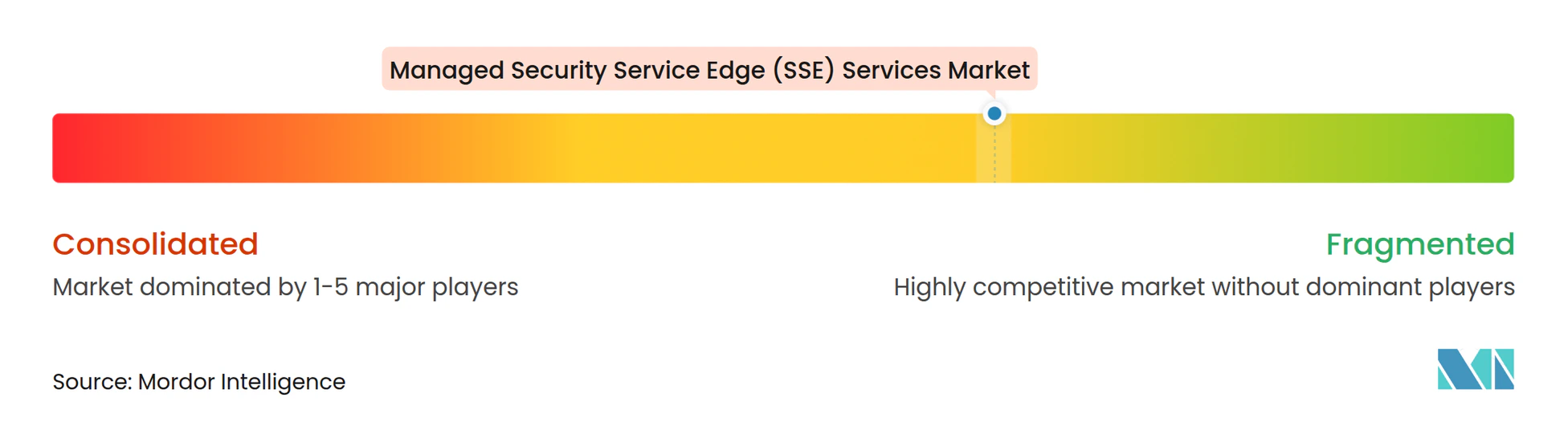
The managed Security Service Edge (SSE) services market has a moderately concentrated platform layer and a fragmented managed-service delivery layer. Zscaler, Netskope, Palo Alto Networks, Fortinet, Cloudflare, Versa Networks, iboss, and Skyhigh Security compete across SSE capabilities and related SASE services. Systems integrators and telecom operators add a managed layer by combining platforms with monitoring, policy operations, service-level commitments, and regional delivery. Competition, therefore, depends on operational depth as well as the functions available within the underlying platform. Providers seek to stand out through automation, transparent service levels, broad points-of-presence coverage, and the ability to apply policies across several customer environments. A provider that combines these elements can reduce complexity for customers who want a single operating relationship.
In the managed Security Service Edge (SSE) services market, pure-play SSE vendors are broadening their offerings toward full SASE platforms, while established networking vendors are adding cloud-native controls to their existing networks. Fortinet acquired Suridata in 2025 to add SaaS Security Posture Management capabilities to its SASE portfolio. The acquisition supports continuous monitoring for SaaS misconfigurations and AI application risks. Check Point expanded its SASE platform with an Enterprise Browser in September 2025 to apply zero-trust controls to unmanaged devices, contractors, and BYOD users. These actions show how providers are extending coverage beyond conventional network access to include application use, unmanaged endpoints, and data behavior.
Within the managed Security Service Edge (SSE) services market, there is room for providers that can address data residency, local processing, and simpler managed packages for smaller organizations. Enterprises in India, China, Saudi Arabia, and selected European markets may favor providers with local infrastructure and policy controls suited to national requirements. Channel-led packages can also make adoption easier for smaller organizations that need clear pricing and preconfigured compliance support. Cloudflare expanded its partner program in October 2025 with platform solution bundles that allow partners to offer SASE and application-security services through a single platform. CyberRatings.org reported security-effectiveness results ranging from 2.95% to 100% across tested SSE platforms, increasing the importance of independent efficacy testing in vendor selection. The managed Security Service Edge (SSE) services market will continue to reward providers that can demonstrate dependable protection while adapting delivery to local requirements.
Managed Security Service Edge (SSE) Services Industry Leaders
-
Zscaler, Inc.
-
Palo Alto Networks, Inc.
-
Cisco Systems, Inc.
-
Netskope, Inc.
-
Fortinet, Inc.
- *Disclaimer: Major Players sorted in no particular order
Managed Security Service Edge (SSE) Services Market Companies Covered in this Report
- Cisco Systems, Inc.
- Palo Alto Networks, Inc.
- Fortinet, Inc.
- Zscaler, Inc.
- Netskope, Inc.
- Broadcom Inc.
- Cloudflare, Inc.
- Forcepoint LLC
- Cato Networks Ltd.
- Hewlett Packard Enterprise Company
- iboss, Inc.
- Lookout, Inc.
- Menlo Security, Inc.
- Akamai Technologies, Inc.
- Barracuda Networks, Inc.
- Aryaka Networks, Inc.
- Skyhigh Security LLC
- SonicWall Inc.
- Versa Networks, Inc.
- Check Point Software Technologies Ltd.
Recent Industry Developments in Managed Security Service Edge (SSE) Services Market
- August 2026: JFrog integrated its Software Supply Chain Platform with Zscaler, Cloudflare, and Netskope to deploy network-layer enforcement, rerouting software package downloads through a centralized curation system, creating an auditable record of every package entering enterprise environments and extending managed SSE traffic inspection to software supply chain infiltration vectors.
- March 2026: Fortinet introduced FortiOS 8.0 at Accelerate 2026, delivering AI-driven SASE with shadow AI detection, model context protocol, and agent-to-agent visibility for AI workload governance, optical character recognition-enabled DLP capable of detecting sensitive data in images and screenshots, and quantum-safe tunneling across its unified SASE platform.
- February 2026: Cisco completed the integration of Secure Access SSE and Catalyst SD-WAN into a single unified management console and simultaneously launched AI-aware SASE with intent-aware inspection designed to govern agentic AI traffic, positioning itself to address autonomous AI system access as a distinct security category.
- January 2026: Palo Alto Networks shipped a major update to Prisma Access introducing the AI Access Security module, which categorizes enterprise AI application usage by risk level, identifies data exposure patterns, and integrates CASB-level shadow AI discovery without requiring separate policy configuration from the core SSE stack.
Global Managed Security Service Edge (SSE) Services Market Report Scope
The Managed Security Service Edge (SSE) Services Market comprises managed security services that enable organizations to secure user access to internet applications, software-as-a-service (SaaS) platforms, and private enterprise applications through cloud-delivered security capabilities. These services include the deployment, configuration, monitoring, administration, and optimization of Secure Web Gateway (SWG), Cloud Access Security Broker (CASB), Zero Trust Network Access (ZTNA), Firewall-as-a-Service (FWaaS), Data Loss Prevention (DLP), and Remote Browser Isolation (RBI). Managed service providers deliver continuous security policy enforcement, threat inspection, access control, data protection, and security monitoring, while professional services support solution assessment, implementation, integration, migration, and configuration across distributed enterprise environments.
The Managed Security Service Edge (SSE) Services Market Report is Segmented by Service Type (Managed Services, and Professional Services), SSE Capability (Secure Web Gateway, Cloud Access Security Broker, Zero Trust Network Access, Firewall-as-a-Service, Data Loss Prevention, and Remote Browser Isolation), End-User Vertical (Banking, Financial Services and Insurance, Information Technology and Telecommunications, Government and Public Sector, Healthcare and Life Sciences, Retail and E-Commerce, Manufacturing and Industrial, Energy and Utilities, and Other Industry Verticals), and Geography (North America, South America, Europe, Asia-Pacific, Middle East, and Africa). The Market Forecasts are Provided in Terms of Value (USD).
Segmentation Overview
| Managed Services |
| Professional Services |
| Secure Web Gateway |
| Cloud Access Security Broker |
| Zero Trust Network Access |
| Firewall-as-a-Service |
| Data Loss Prevention |
| Remote Browser Isolation |
| Banking, Financial Services, and Insurance |
| Information Technology and Telecommunications |
| Government and Public Sector |
| Healthcare and Life Sciences |
| Retail and E-Commerce |
| Manufacturing and Industrial |
| Energy and Utilities |
| Other Industry Verticals |
| North America | United States |
| Canada | |
| Mexico | |
| South America | Brazil |
| Argentina | |
| Rest of South America | |
| Europe | United Kingdom |
| Germany | |
| France | |
| Italy | |
| Spain | |
| Rest of Europe | |
| Asia-Pacific | China |
| Japan | |
| India | |
| South Korea | |
| Australia | |
| Rest of Asia-Pacific | |
| Middle East | Saudi Arabia |
| United Arab Emirates | |
| Turkey | |
| Rest of Middle East | |
| Africa | South Africa |
| Egypt | |
| Nigeria | |
| Rest of Africa |
| By Service Type | Managed Services | |
| Professional Services | ||
| By SSE Capability | Secure Web Gateway | |
| Cloud Access Security Broker | ||
| Zero Trust Network Access | ||
| Firewall-as-a-Service | ||
| Data Loss Prevention | ||
| Remote Browser Isolation | ||
| By End-User Vertical | Banking, Financial Services, and Insurance | |
| Information Technology and Telecommunications | ||
| Government and Public Sector | ||
| Healthcare and Life Sciences | ||
| Retail and E-Commerce | ||
| Manufacturing and Industrial | ||
| Energy and Utilities | ||
| Other Industry Verticals | ||
| By Geography | North America | United States |
| Canada | ||
| Mexico | ||
| South America | Brazil | |
| Argentina | ||
| Rest of South America | ||
| Europe | United Kingdom | |
| Germany | ||
| France | ||
| Italy | ||
| Spain | ||
| Rest of Europe | ||
| Asia-Pacific | China | |
| Japan | ||
| India | ||
| South Korea | ||
| Australia | ||
| Rest of Asia-Pacific | ||
| Middle East | Saudi Arabia | |
| United Arab Emirates | ||
| Turkey | ||
| Rest of Middle East | ||
| Africa | South Africa | |
| Egypt | ||
| Nigeria | ||
| Rest of Africa | ||
Key Questions Answered in the Report
What is the 2026 Managed Security Service Edge (SSE) services market size?
The market is valued at USD 13.21 billion in 2026 and is forecast to reach USD 32.95 billion by 2032 at a 20.11% CAGR.
Which service type leads managed SSE adoption?
Managed services lead with a 78.31% revenue share in 2026 because customers need continuous monitoring, policy management, and incident support.
Which SSE capability is expanding fastest?
Data Loss Prevention is projected to expand at a 21.73% CAGR through 2032, supported by the need to protect data in generative AI workflows.
Which end-user vertical has the largest revenue share?
Banking, Financial Services and Insurance leads with a 20.32% revenue share in 2026 due to its access control, audit, and data-protection requirements.
Which region is projected to expand fastest?
The Middle East is projected to expand at a 21.67% CAGR through 2032, supported by digital infrastructure programs and sovereign inspection requirements.
What makes managed SSE services different from self-managed tools?
Managed services combine security technology with ongoing policy operations, monitoring, incident response, and specialist support for organizations with limited internal resources.