
Managed Secrets Management Services Market Size and Share
Market Overview
| Study Period | 2021 - 2032 |
|---|---|
| Market Size (2027) | USD 4.55 Billion |
| Market Size (2032) | USD 7.39 Billion |
| Growth Rate (2027 - 2032) | 16.26 % |
| Fastest Growing Market | North America |
| Largest Market | Asia-Pacific |
| Market Concentration | Medium |
Major Players *Disclaimer: Major Players sorted in no particular order Image © Mordor Intelligence. Reuse requires attribution under CC BY 4.0. | |
Managed Secrets Management Services Market Analysis by Mordor Intelligence
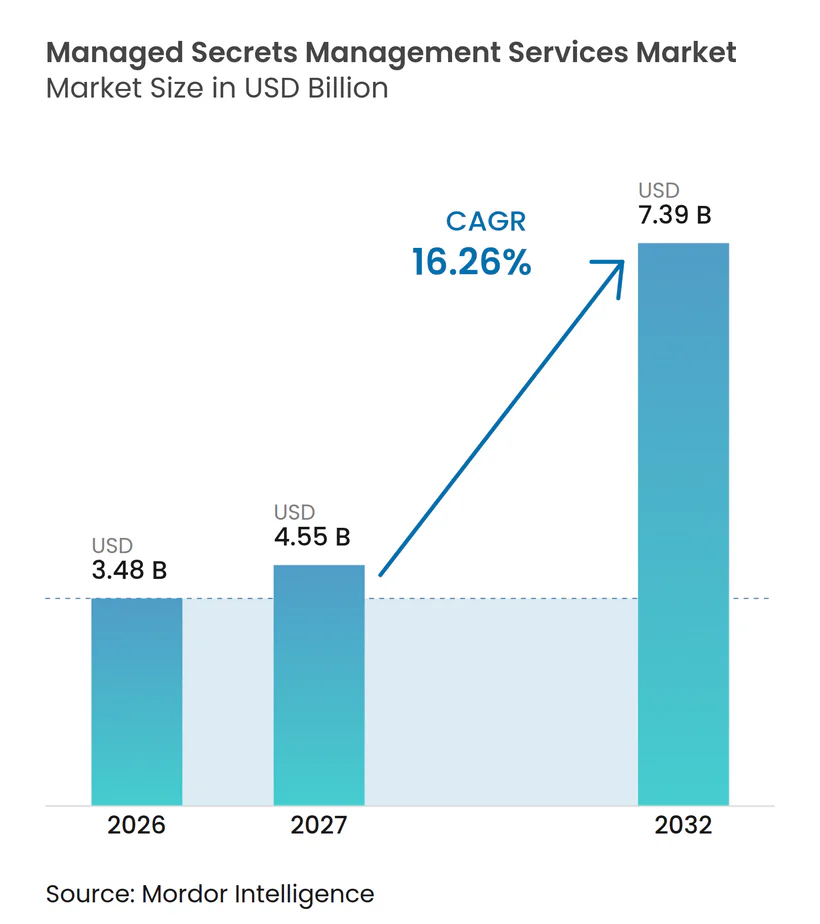
The Managed Secrets Management Services Market is projected to expand from USD 3.48 billion in 2026 and USD 4.55 billion in 2027 to USD 7.39 billion by 2032, registering a CAGR of 16.26% between 2027 to 2032. The managed secrets management services market is being shaped by the rapid spread of DevOps practices, multi-cloud operations, and machine identities that need frequent control. Organizations are creating credentials faster than many internal teams can track, rotate, and protect them. IBM completed its USD 6.4 billion acquisition of HashiCorp in February 2025, while Palo Alto Networks completed its acquisition of CyberArk in February 2026, placing secrets governance closer to core identity and cloud security platforms. The managed secrets management services market also benefits from requirements for auditable access, rotation, and least-privilege controls in regulated settings. Legacy integration work, specialist skill shortages, and deployment costs still slow adoption for some organizations, especially those with older application estates.
Key Report Takeaways
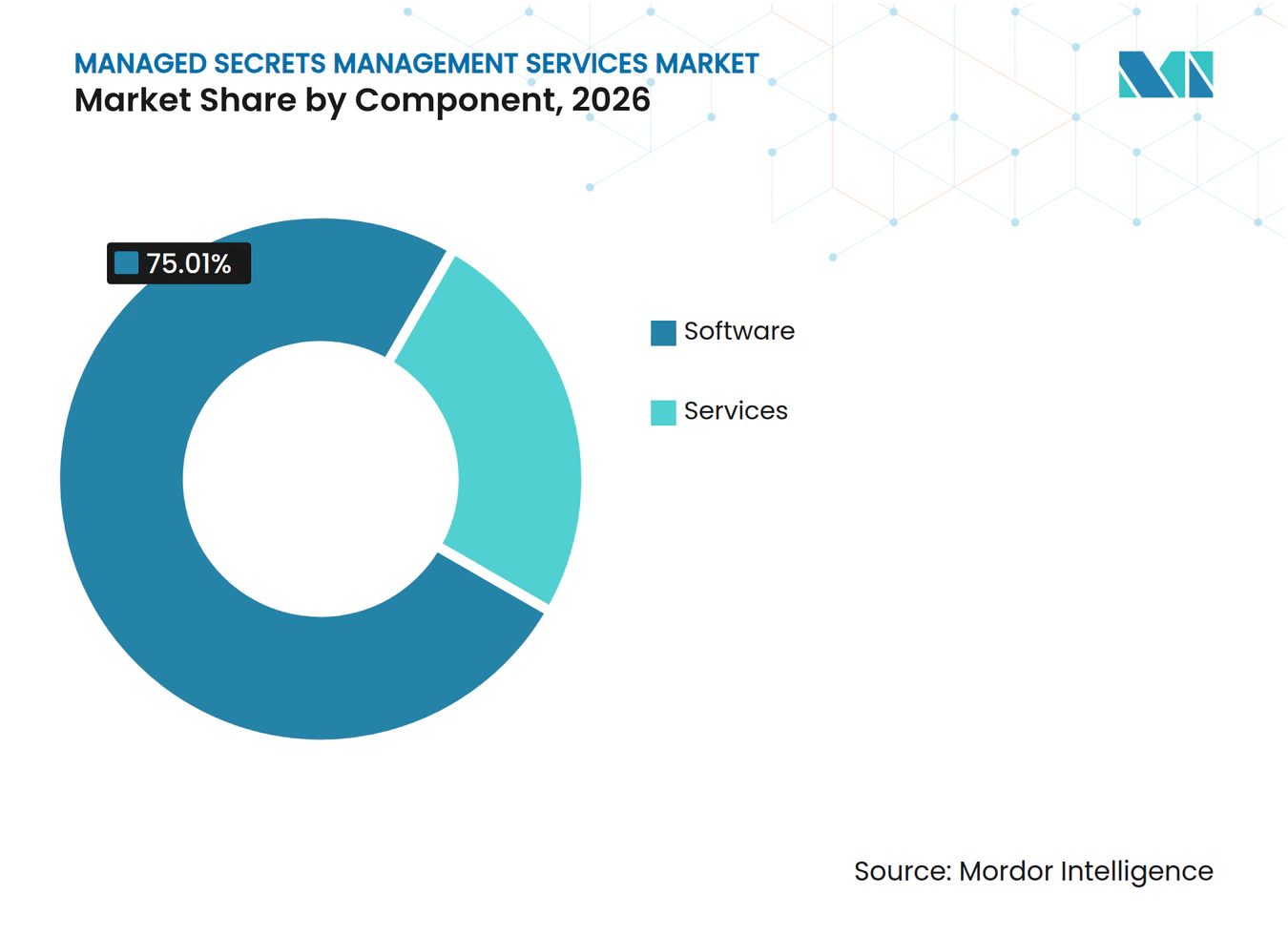
- By component, Software held 75.01% of the managed secrets management services market share in 2026, while Services is projected to expand at a 17.89% CAGR through 2032.
- By deployment model, Cloud-Based deployment accounted for 70.66% of the managed secrets management services market share in 2026 and is expected to advance at a 17.76% CAGR through 2032.
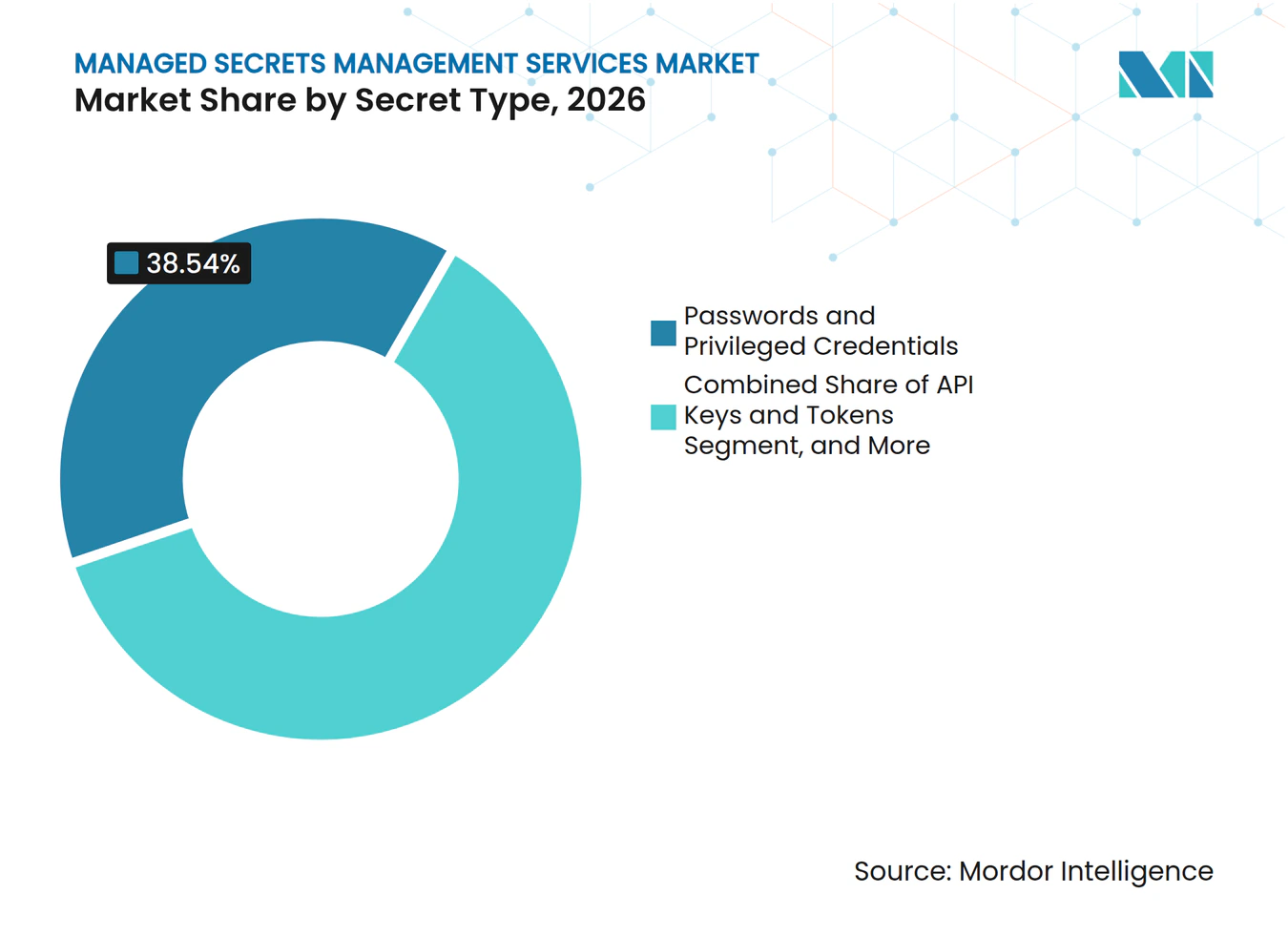
- By secret type, Passwords and Privileged Credentials held 38.54% share in 2026, while API Keys and Tokens is projected to expand at a 17.88% CAGR through 2032.
- By end-use industry, BFSI accounted for 26.03% share in 2026, while IT and Telecom is expected to advance at a 17.67% CAGR through 2032.
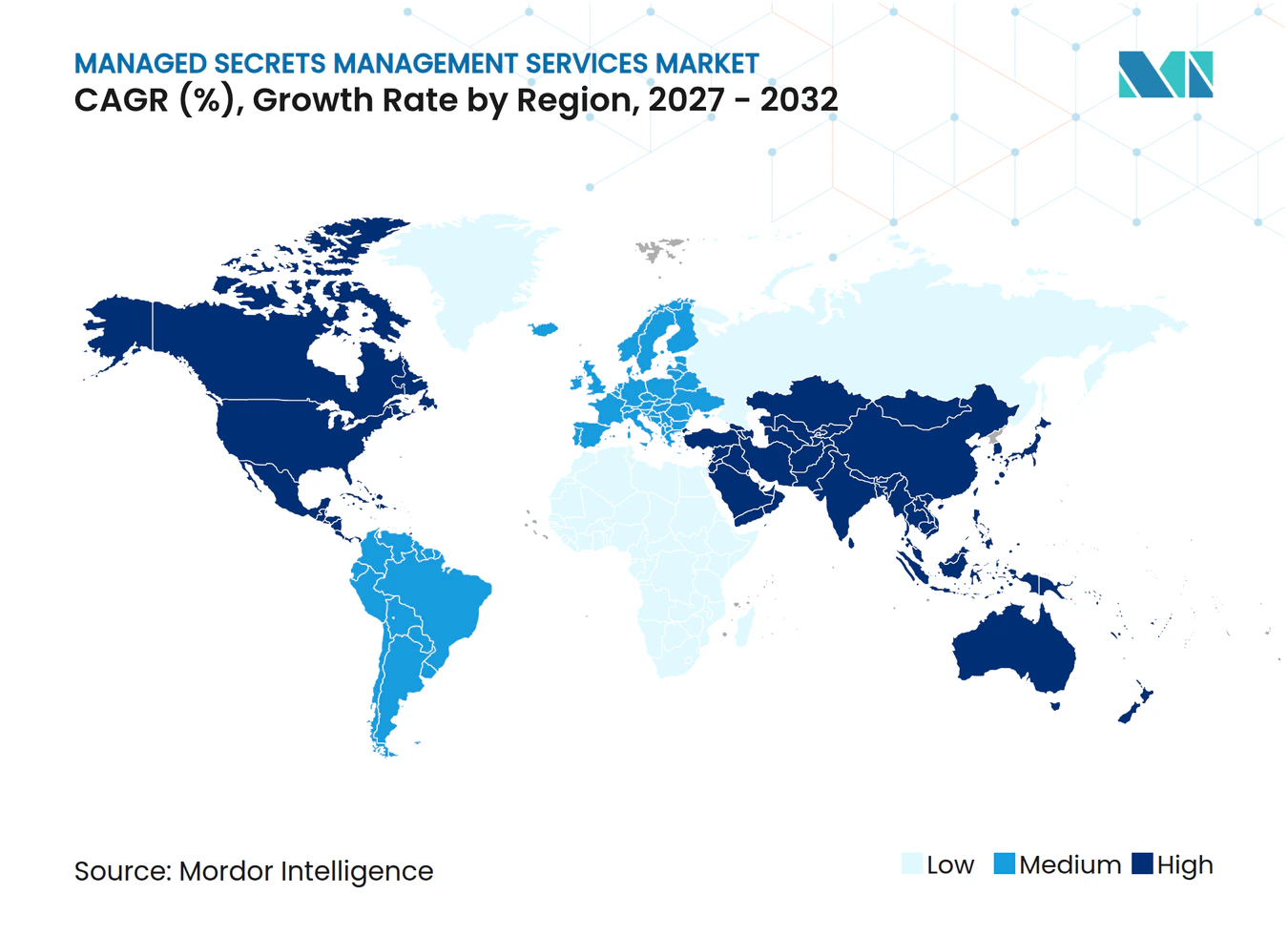
- By geography, North America held 45.54% share in 2026, while Asia-Pacific is projected to expand at a 17.77% CAGR through 2032.
Note: Market numbers in this report are based on Mordor Intelligence's proprietary estimation framework, which combines nine months of actuals with Q4 projections for base year 2026.
Market Trends and Insights
Drivers Impact Analysis of Managed Secrets Management Services Market*
| Driver | (~) % Impact on CAGR Forecast | Geographic Relevance | Impact Timeline |
|---|---|---|---|
| DevOps and CI/CD Pipeline Expansion | +3.2% | Global, concentrated in North America and Europe | Short term (≤ 2 years) |
| Multi-Cloud and Hybrid-Cloud Complexity | +2.8% | Global, Asia-Pacific core, spill-over to Middle East and Africa | Medium term (2-4 years) |
| Expansion of Machine Identities and API Workloads | +2.5% | Global, dominant in North America and Asia-Pacific | Medium term (2-4 years) |
| Regulatory Requirements for Rotation, Auditability and Least Privilege | +2.1% | North America and EU, spill-over to Asia-Pacific | Medium term (2-4 years) |
| AI Agent Credential Governance | +1.8% | Global, early gains in North America and Singapore | Long term (≥ 4 years) |
| Secret-Less Workload Authentication and Short-Lived Credentials | +1.4% | North America and EU | Long term (≥ 4 years) |
| Source: Mordor Intelligence | |||
DevOps and CI/CD Pipeline Expansion
Continuous integration and continuous delivery have made credentials an active part of daily software delivery. Development teams need secrets to be injected, rotated, and logged at the speed of their release pipelines. A 2025 ACM study identified fragmented access control across cloud environments as a persistent API security concern and identified secrets vaults and policy-as-code as important protective measures.[1] The Megalodon campaign injected 5,718 malicious commits across 5,561 GitHub repositories in fewer than 6 hours and exposed the scale at which pipeline weaknesses can be exploited. OWASP lists weak credential hygiene and inadequate identity and access management among significant CI/CD security risks. HashiCorp added a Visual Studio Code plugin for real-time secrets detection and Jira scanning in September 2025, moving detection closer to the point where developers create and manage code.
Multi-Cloud and Hybrid-Cloud Complexity
The managed secrets management services market gains support as organizations operate across AWS, Azure, and Google Cloud Platform. Each platform follows a different approach to credential versions, deletion, and recovery, which makes a consistent policy harder to maintain. GitGuardian reported that 70% of secrets leaked in 2022 remained active 2 years later, showing how long unresolved credentials can remain exposed.[2] ISACA described a 2026 audit case in which hardcoded API keys in CI/CD files led to a company-wide modernization effort tied to SOX and PCI DSS compliance. Akeyless announced AWS integration in July 2025 to support centralized policies and credential synchronization without requiring customers to replace existing AWS Secrets Manager deployments. This approach is relevant where buyers need a common control layer but cannot pause existing cloud operations during a migration.
Expansion of Machine Identities and API Workloads
The managed secrets management services market is responding to a growing volume of credentials used by applications, services, APIs, and automated workloads. The Cloud Security Alliance’s 2026 guidance identifies non-human identity and agentic AI governance as a security priority for organizations adopting autonomous systems.[3] Kong introduced Kong Identity in October 2025 to bring machine-to-machine API access under the same control plane used for human identities. The Non-Human Identity Management Group recommends formal ownership, scope, expiration, and revocation for API keys, client secrets, and tokens. These requirements favor services that can manage credentials throughout their lifecycle rather than simply store them. The need is becoming more pressing as software systems use machine credentials across more services and environments.
Regulatory Requirements for Rotation, Auditability, and Least Privilege
Compliance obligations are increasing the need for documented controls over service accounts and other non-human credentials. PCI DSS Requirement 8.6.3 became mandatory on March 31, 2025, requiring periodic changes to passwords and passphrases for application and system accounts based on risk. DORA covers European financial entities and ICT providers, while NIS2 extends security requirements to sectors such as energy, transport, healthcare, and digital infrastructure. These rules make informal credential practices more difficult to defend during audits. Managed providers can combine vault operation, policy controls, reporting, and access reviews in a service model. The managed secrets management services market therefore has particular relevance in BFSI and healthcare, where compliance work and security operations are closely connected.
Restraints Impact Analysis of Managed Secrets Management Services Market*
| Restraint | (~) % Impact on CAGR Forecast | Geographic Relevance | Impact Timeline |
|---|---|---|---|
| Legacy Application Integration Complexity | -1.5% | Global, particularly North America and Europe | Medium term (2-4 years) |
| High Total Cost of Ownership and Specialist Services Burden | -1.2% | Global, most acute in South America and Africa | Medium term (2-4 years) |
| Shortage of Secrets Governance and Cryptography Skills | -0.9% | Global | Long term (≥ 4 years) |
| Vendor Lock-In and Vault Migration Risk | -0.7% | North America and EU | Long term (≥ 4 years) |
| Source: Mordor Intelligence | |||
Legacy Application Integration Complexity
Many organizations still run core banking systems, industrial control platforms, and enterprise resource planning systems that were designed before API-based secrets injection became common. These systems may not accept dynamic credentials without significant redesign. HashiCorp stated in 2025 that eliminating all static secrets remains an aspiration for many organizations because some legacy systems, SaaS APIs, and databases do not support dynamic credentials. Migration can become a multi-year effort that postpones managed service revenue and increases implementation work. During the transition, organizations may need parallel credential stores, which can temporarily expand the number of places that require oversight. Providers with connectors and adapters for older middleware have an advantage where full application re-engineering is not practical.
High Total Cost of Ownership and Specialist Services Burden
Enterprise deployments require infrastructure, experienced personnel, policy governance, audit records, and incident response processes. Those requirements can make the managed secrets management services market less accessible to mid-sized companies with limited security budgets. Doppler noted in 2025 that manual rotation and environment synchronization do not scale in fast-moving development environments, but automation requires both initial investment and engineering skills. The cost burden is higher when an organization operates multiple vaults across HashiCorp Vault, AWS Secrets Manager, Azure Key Vault, and Google Cloud Secret Manager. Each platform can require separate operating knowledge and governance procedures. Subscription services that package operations, policy controls, and compliance reporting may reduce this burden, although switching costs remain a barrier.
*Our forecasts treat driver/restraint impacts as directional, not additive. The impact forecasts reflect baseline growth, mix effects, and variable interactions.
Managed Secrets Management Services Market Segment Analysis
By Component:
Software Provides the Foundation While Services Expand DeliverySoftware held 75.01% of the total 2026 revenue, reflecting established spending on vault engines, platform licenses, and lifecycle automation. The software layer supports the creation, storage, rotation, and audit of credentials across applications and environments. Services is projected to advance at a 17.89% CAGR from 2027 to 2032, the fastest rate among component types. This reflects the need for implementation support, managed operations, advisory work, and compliance assurance. IBM completed the USD 6.4 billion acquisition of HashiCorp in February 2025 and added HashiCorp Vault to its hybrid cloud automation portfolio. That transaction placed a well-established vault platform alongside Red Hat OpenShift and IBM Ansible Automation Platform.
StrongDM released StrongDM Vault in November 2025 with credential management for Microsoft SQL Server, MySQL, MariaDB, and PostgreSQL within a managed service. The release shows how providers are adding operational delivery around core platform software. Infisical raised USD 16 million in Series A funding in June 2025 and reported securing more than 500 million secrets daily through its open-source platform. Open-source offerings can lower initial software costs and place greater emphasis on service quality, support, and enterprise controls. As environments become more complex, buyers often seek a provider that can operate the platform rather than only supply the software. The managed secrets management services industry is therefore seeing a closer link between platform capability and recurring managed delivery.


By Deployment Model:
Cloud-Based Leadership Reinforces DemandCloud-Based deployment accounted for 70.66% of the managed secrets management services market size in 2026 and is projected to advance at a 17.76% CAGR through 2032. Its scale reflects the large share of workloads already running on managed cloud and SaaS infrastructure. Cloud-hosted delivery can simplify provisioning, updates, and remote administration for distributed development teams. It also supports centralized policy enforcement where applications operate across several cloud environments. Hybrid deployment remains important in BFSI, government, and healthcare where data sovereignty or existing architecture limits fully cloud-hosted credential storage. On-Premises deployment remains relevant for air-gapped systems, critical infrastructure, and sovereign networks with limited cloud connectivity.
HashiCorp added AWS PrivateLink support to HashiCorp Cloud Platform Vault Dedicated in September 2025. The capability supports private connectivity between cloud workloads and managed vault services. This gives compliance-sensitive buyers a way to use cloud delivery while limiting public network exposure. ISO 27001 and SOC 2 Type II certifications also support buyer confidence in hosted security services, especially in sectors that previously favored local infrastructure. The managed secrets management services market is therefore not moving only from on-premises to cloud, as hybrid designs continue to address operational and regulatory requirements. Providers that support private connectivity and policy consistency across deployment models are positioned to address this mix of needs.
By Secret Type:
API Keys and Tokens Lead the Fastest ExpansionPasswords and Privileged Credentials held 38.54% of total revenue in 2026. Their large position reflects the long history of privileged access programs in regulated sectors, including BFSI and healthcare. API Keys and Tokens is projected to expand at a 17.88% CAGR through 2032, the fastest rate among secret types. Microservices, AI agents, SaaS integrations, and API-led applications each create credentials that need ownership, limited scope, expiration, and revocation. This shifts security attention from credentials used by employees to credentials exchanged between software systems. The managed secrets management services market must therefore support both established privileged credentials and newer machine-to-machine identities.
The IETF published a 2026 draft for Credential Broker for Agents that describes the use of short-lived and narrowly scoped proxy credentials for AI agents rather than long-lived tokens. The approach would place credential brokering and governance closer to the point where an AI agent requests access. Certificates and Private Keys also benefit from zero-trust implementation and wider use of encrypted connections. Encryption Keys and Sensitive Configuration are gaining relevance as organizations apply key management hierarchies for data protection. PCI DSS Requirement 3.6 and DORA Article 9 reinforce the importance of controlled encryption and access management in covered environments. Providers that can manage these different secret classes in a unified workflow can reduce fragmentation for security teams.


By End-Use Industry:
BFSI Leads While IT and Telecom Advances FastestBFSI accounted for 26.03% of the managed secrets management services market size in 2026. Financial institutions must maintain controls for payment systems, banking applications, data platforms, and third-party connections. PCI DSS, DORA, GLBA, and SOX raise expectations for rotation, audit trails, and least-privilege access. IT and Telecom is projected to advance at a 17.67% CAGR from 2027 to 2032. Telecom operators manage credentials across network configurations, API gateways, OSS and BSS systems, and AI workloads in network functions. These environments create many separate credential classes that need centralized management.
Healthcare and Life Sciences organizations are adopting secrets services as clinical systems become more connected and compliance requirements remain important. Government and Public Sector buyers also have a need to identify and protect credentials embedded in source code and configuration files. Retail and E-Commerce adoption is closely linked to PCI DSS compliance and payment security. Manufacturing and Industrial organizations are adding device identities as industrial Internet of Things deployments increase. Energy and Utilities operators face a more difficult implementation path, but critical infrastructure obligations are increasing their incentive to improve credential controls. The managed secrets management services industry spans these sectors because each one depends on software, identities, and access policies that must be maintained over time.
Geography Analysis
North America Managed Secrets Management Services Market
North America held 45.54% of total revenue in 2026. The region includes a large concentration of cloud-native businesses, financial institutions, public-sector buyers, and federal contractors. Federal security requirements and FedRAMP-authorized services can shape procurement decisions for secrets management providers. The U.S. Cybersecurity and Infrastructure Security Agency Secure Software Development Framework also supports the protection of secrets in code and configuration files. Palo Alto Networks completed its acquisition of CyberArk in February 2026, changing the regional competitive setting for identity security, privileged access, and secrets management. Canada and Mexico add demand through financial-services digitization and cross-border cloud adoption, although their market volumes remain below the United States.
APAC Managed Secrets Management Services Market
Asia-Pacific is projected to advance at a 17.77% CAGR through 2032, making it the fastest-expanding geography in the managed secrets management services market. The region is adopting hybrid cloud systems while responding to AI-related security threats and newer cybersecurity rules. India’s Digital Personal Data Protection Act creates data-fiduciary accountability obligations that support stronger encryption key management and secrets governance. China’s Personal Information Protection Law favors localized approaches where organizations need to meet domestic data requirements. Japan’s ISMAP certification pathway supports government cloud adoption. South Korea, Australia, and Singapore are additional growth areas because national cybersecurity frameworks increasingly emphasize privileged access, credential rotation, and cloud security.
EMEA and South America Managed Secrets Management Services Market
Europe remains a significant compliance-led region for the managed secrets management services market. Germany, the United Kingdom, and France are leading buyer centers within the region. DORA and NIS2 create a demanding environment for access controls, encryption, resilience, and auditability. This regulatory setting supports demand for services that combine governance with technical operation. South America, the Middle East, and Africa remain earlier-stage regions. Brazil and Chile are advancing digital governance frameworks, while Saudi Arabia and the United Arab Emirates are adding demand through national cloud programs in government and financial services.
Competitive Landscape
Market Concentration
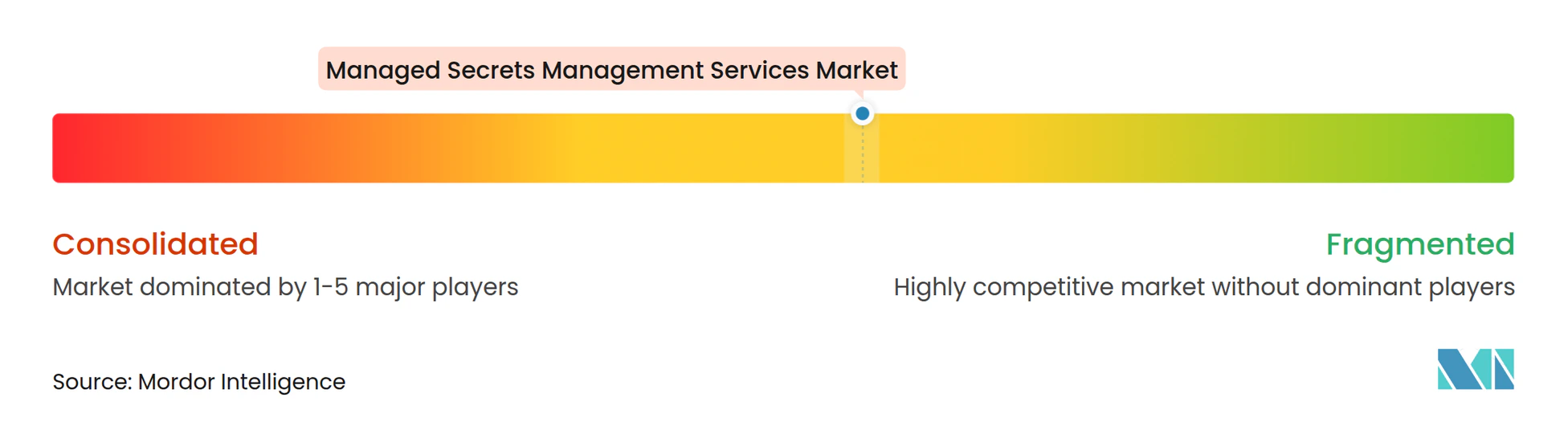
The managed secrets management services market is moderately concentrated among large enterprise platforms but remains fragmented across specialist and developer-led offerings. Palo Alto Networks, IBM, BeyondTrust, Delinea, and Thales compete for large enterprise deployments. Akeyless, Infisical, Doppler, GitGuardian, and Teleport serve specialist use cases and mid-sized organizations. IBM integrated HashiCorp Vault into its hybrid cloud platform after completing its USD 6.4 billion acquisition of HashiCorp in February 2025. Palo Alto Networks completed its acquisition of CyberArk in February 2026, combining identity security, privileged access, and secrets management capabilities. These transactions raise competitive pressure on independent vault providers to differentiate through open-source models, architectural flexibility, and targeted governance tools.
AI agent credential governance is creating an opportunity for providers that can manage short-lived, narrowly scoped access. The IETF Credential Broker for Agents draft provides a technical direction for brokering agent credentials and may influence future platform requirements. Small and medium-sized enterprises without in-house vault teams also present an opportunity for managed service providers. GitGuardian released ggscout in October 2026 with validity and permission-checking capabilities for secrets within enterprise networks. The product reflects a strategy of adding governance and monitoring over existing secret stores rather than requiring a full replacement. This can be attractive to buyers with several vaults and a limited appetite for a large migration.
Certifications including SOC 2 Type II, ISO 27001, and FedRAMP can affect supplier eligibility in North America and Europe. These requirements create an entry barrier for newer vendors, even when their technical products are capable. Established providers can use certification, integration breadth, and professional services capacity to support long procurement cycles. Specialist providers can compete by addressing developer workflows, workload identity, certificate management, and multi-cloud policy consistency. The managed secrets management services market will continue to include both consolidated platform providers and focused vendors. No combined market share for leading suppliers is provided, so a concentration score cannot be assigned from the available evidence without estimating it.
Managed Secrets Management Services Industry Leaders
-
CyberArk Software Ltd.
-
HashiCorp, Inc.
-
Delinea Inc.
-
BeyondTrust Corporation
-
Akeyless Security Ltd.
- *Disclaimer: Major Players sorted in no particular order
Managed Secrets Management Services Market Companies Covered in this Report
- Palo Alto Networks
- HashiCorp, Inc.
- Delinea Inc.
- BeyondTrust Corporation
- Thales DIS CPL USA, Inc.
- Keeper Security, Inc.
- AgileBits Inc.
- Bitwarden Inc.
- Akeyless Security Ltd.
- Doppler Technologies, Inc.
- Infisical Inc.
- GitGuardian SAS
- StrongDM, Inc.
- Teleport Inc.
- CloudTruth, Inc.
- EnvKey, Inc.
- ARCON TechSolutions Pvt. Ltd.
- Zoho Corporation Pvt. Ltd.
- WALLIX Group S.A.
- Keyfactor, Inc.
- Smallstep Labs, Inc.
Recent Industry Developments in Managed Secrets Management Services Market
- October 2026: GitGuardian released ggscout's validity and permission-checking capability, enabling organizations to verify whether vaulted secrets remain active and assess their permissions from within the enterprise network, advancing NHI governance from detection into proactive lifecycle assurance.
- October 2026: HashiCorp completed one year after the release of Vault Enterprise 1.21, introducing SPIFFE Auth Method support for cryptographically verifiable workload identities, Vault Secrets Operator protected secrets for ephemeral Kubernetes credential delivery without persistent etcd storage, and a Vault Model Context Protocol server for natural-language vault interaction.
- June 2026: GitGuardian launched Endpoint Protection, extending real-time secrets detection to developer and privileged workstations to close credential risks introduced by AI coding assistants that generate and cache tokens locally, a gap that grew materially alongside agentic development tooling adoption.
- February 2026: Palo Alto Networks completed its acquisition of CyberArk for USD 25 billion, establishing identity security, including secrets management, privileged access, and AI agent credential governance, as a core pillar of its platformization strategy and reshaping competitive dynamics across enterprise secrets management.
Global Managed Secrets Management Services Market Report Scope
The Managed Secrets Management Services Market refers to the industry focused on outsourced and managed services that help organizations securely store, control, distribute, rotate, monitor, and govern sensitive digital credentials such as passwords, encryption keys, API keys, certificates, tokens, and privileged access secrets across on-premises, cloud, and hybrid IT environments.
The Managed Secrets Management Services Market Report is Segmented by Component (Software, Services), by Deployment Model (Cloud-Based, Hybrid, On-Premises), by Secret Type (Passwords and Privileged Credentials, API Keys and Tokens, Certificates and Private Keys, Encryption Keys and Sensitive Configuration), by End-Use Industry (BFSI, IT and Telecom, Healthcare and Life Sciences, Government and Public Sector, Retail and E-Commerce, Manufacturing and Industrial, Energy and Utilities, Other End-Use Industries), and by Geography (North America [United States, Canada, Mexico], South America [Brazil, Argentina, Chile, Rest of South America], Europe [Germany, United Kingdom, France, Italy, Spain, Russia, Rest of Europe], Asia-Pacific [China, Japan, India, South Korea, Australia, Singapore, Rest of Asia-Pacific], Middle East [Saudi Arabia, United Arab Emirates, Turkey, Rest of Middle East], Africa [South Africa, Nigeria, Rest of Africa]). The Market Forecasts are Provided in Terms of Value (USD).
Segmentation Overview
| Software |
| Services |
| Cloud-Based |
| Hybrid |
| On-Premises |
| Passwords and Privileged Credentials |
| API Keys and Tokens |
| Certificates and Private Keys |
| Encryption Keys and Sensitive Configuration |
| BFSI |
| IT and Telecom |
| Healthcare and Life Sciences |
| Government and Public Sector |
| Retail and E-Commerce |
| Manufacturing and Industrial |
| Energy and Utilities |
| Other End-Use Industries |
| North America | United States |
| Canada | |
| Mexico | |
| South America | Brazil |
| Argentina | |
| Chile | |
| Rest of South America | |
| Europe | Germany |
| United Kingdom | |
| France | |
| Italy | |
| Spain | |
| Russia | |
| Rest of Europe | |
| Asia-Pacific | China |
| Japan | |
| India | |
| South Korea | |
| Australia | |
| Singapore | |
| Rest of Asia-Pacific | |
| Middle East | Saudi Arabia |
| United Arab Emirates | |
| Turkey | |
| Rest of Middle East | |
| Africa | South Africa |
| Nigeria | |
| Rest of Africa |
| By Component | Software | |
| Services | ||
| By Deployment Model | Cloud-Based | |
| Hybrid | ||
| On-Premises | ||
| By Secret Type | Passwords and Privileged Credentials | |
| API Keys and Tokens | ||
| Certificates and Private Keys | ||
| Encryption Keys and Sensitive Configuration | ||
| By End-Use Industry | BFSI | |
| IT and Telecom | ||
| Healthcare and Life Sciences | ||
| Government and Public Sector | ||
| Retail and E-Commerce | ||
| Manufacturing and Industrial | ||
| Energy and Utilities | ||
| Other End-Use Industries | ||
| By Geography | North America | United States |
| Canada | ||
| Mexico | ||
| South America | Brazil | |
| Argentina | ||
| Chile | ||
| Rest of South America | ||
| Europe | Germany | |
| United Kingdom | ||
| France | ||
| Italy | ||
| Spain | ||
| Russia | ||
| Rest of Europe | ||
| Asia-Pacific | China | |
| Japan | ||
| India | ||
| South Korea | ||
| Australia | ||
| Singapore | ||
| Rest of Asia-Pacific | ||
| Middle East | Saudi Arabia | |
| United Arab Emirates | ||
| Turkey | ||
| Rest of Middle East | ||
| Africa | South Africa | |
| Nigeria | ||
| Rest of Africa | ||
Key Questions Answered in the Report
What is the managed secrets management services market size?
The managed secrets management services market is projected to expand from USD 3.48 billion in 2026 and USD 4.55 billion in 2027 to USD 7.39 billion by 2032, at a 16.26% CAGR.
What is driving demand for managed secrets management services?
DevOps delivery, multi-cloud operations, machine identities, API workloads, and requirements for rotation and auditability are increasing demand.
Which deployment model leads managed secrets management services?
Cloud-Based deployment held 70.66% market share in 2026 and is expected to advance at a 17.76% CAGR through 2032.
Which secret type is expanding fastest?
API Keys and Tokens are projected to expand at a 17.88% CAGR through 2032 as machine-to-machine and AI-agent workloads increase.
Which end-use sector has the largest share?
BFSI accounted for 26.03% market share in 2026 because financial organizations require strong controls for payment, banking, and data systems.
Which region is expanding fastest?
Asia-Pacific is projected to advance at a 17.77% CAGR through 2032, supported by cloud adoption and evolving cybersecurity requirements.