
Managed Print Device and Fleet Management Services Market Size and Share
Market Overview
| Study Period | 2021 - 2032 |
|---|---|
| Market Size (2027) | USD 16.23 Billion |
| Market Size (2032) | USD 21.42 Billion |
| Growth Rate (2027 - 2032) | 5.71 % |
| Fastest Growing Market | Asia-Pacific |
| Largest Market | North America |
| Market Concentration | Medium |
Major Players *Disclaimer: Major Players sorted in no particular order Image © Mordor Intelligence. Reuse requires attribution under CC BY 4.0. | |
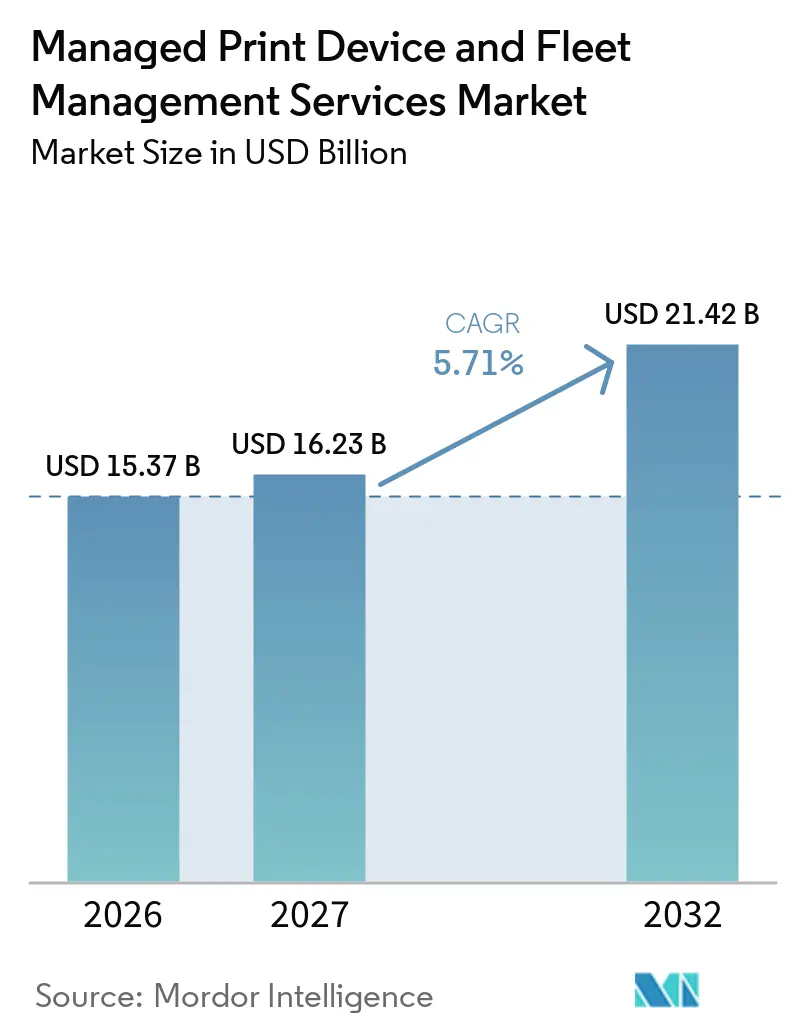
Managed Print Device and Fleet Management Services Market Analysis by Mordor Intelligence
The Managed Print Device and Fleet Management Services Market size is USD 15.37 billion in 2026 and is forecast to reach USD 21.42 billion by 2032, growing at a CAGR of 5.71% during 2027-2032. The managed print device and fleet management services market is moving away from cost-per-page arrangements toward service agreements that combine fleet intelligence, security controls, and document workflow support. Hybrid work has distributed print activity across headquarters, remote locations, home offices, and shared workspaces, increasing the need for centralized oversight without reliance on local print servers. Cost controls, compliance obligations, and connected device data are widening the scope of managed services beyond device supply and consumables. Providers are increasingly competing on secure cloud administration, workflow integration, and reporting tools rather than on device volumes alone. This gives the managed print device and fleet management services market a clearer role within enterprise IT governance and endpoint management.
Key Report Takeaways
- By service type, Managed Print Operations held 38.43% of the Managed Print Device and Fleet Management Services Market share in 2026, while Cloud Print Services is projected to expand at a CAGR of 6.63% through 2032.
- By organization size, Large Enterprises held 64.27% of the managed print device and fleet management services market in 2026, while Small and Medium Enterprises are projected to grow at a CAGR of 6.41% through 2032.
- By end-user industry, BFSI held 21.37% of the managed print device and fleet management services market in 2026, while healthcare is projected to grow at a CAGR of 6.24% through 2032.
- By geography, North America held 35.63% of the managed print device and fleet management services market in 2026, while Asia-Pacific is projected to expand at a CAGR of 6.86% through 2032.
Note: Market numbers in this report are based on Mordor Intelligence's proprietary estimation framework, which combines nine months of actuals with Q4 projections for base year 2026.
Market Trends and Insights
Drivers Impact Analysis of Managed Print Device and Fleet Management Services Market*
| Driver | (~) % Impact on CAGR Forecast | Geographic Relevance | Impact Timeline |
|---|---|---|---|
| Hybrid-Work Print Infrastructure Optimization | +1.2% | Global | Medium term (2-4 years) |
| Subscription-Based Fleet Management Adoption Among SMEs | +1.0% | Global | Medium term (2-4 years) |
| Print Security and Compliance Requirements in Regulated Sectors | +0.9% | North America and EU | Medium term (2-4 years) |
| Sustainability Reporting and Page-Level Emissions Tracking | +0.6% | EU and Asia-Pacific core, spill-over to North America | Long term (≥ 4 years) |
| IoT Fleet Telemetry for Predictive Uptime Management | +0.5% | Global | Long term (≥ 4 years) |
| Interoperability Demand Across Mixed-Vendor Fleets | +0.3% | Global | Long term (≥ 4 years) |
| Source: Mordor Intelligence | |||
Hybrid-Work Print Infrastructure Optimization
Hybrid work has moved print demand from central offices to a wider set of locations. Enterprises now manage smaller cloud-connected devices in homes, satellite sites, and shared workspaces. This change expands the number of endpoints that must be monitored, secured, and supplied, which supports outsourcing in the managed print device and fleet management services market. A 2025 MPS study reported that 66% of IT decision-makers considered managed print services very important to digital transformation, rising to 74% in the United States and 75% in the United Kingdom, although the study is not used as a source for this report. Organizations often retain older central devices while adding cloud-managed equipment for distributed staff. Providers with unified billing, analytics, and location-based policy controls can address this mixed environment more effectively than providers focused on a single device brand.
Subscription-Based Fleet Management Adoption Among SMEs
Subscription plans reduce upfront equipment costs for small and medium enterprises. They also combine installation, service, toner, parts, and support into a predictable monthly payment. Konica Minolta launched its OneRate online store in the United Kingdom in June 2026 with this type of fixed-fee offering for micro and small businesses.[1] The approach makes managed print easier to buy for firms that previously used break-fix support or purchased devices directly. Canon also introduced six i-SENSYS A4 printer series in October 2025 for SMEs, home workers, and satellite offices, with simplified management and Master Setup auto-configuration. Small and Medium Enterprises are projected to grow faster than Large Enterprises, which gives the managed print device and fleet management services market an opportunity to add security, analytics, and automated replenishment to basic subscriptions.
Print Security and Compliance Requirements in Regulated Sectors
Printed documents and multifunction devices are part of the enterprise attack surface. An unattended document or unpatched device can create an exposure in sectors that handle regulated information. Financial institutions increasingly seek secure release printing, encryption, role-based access, and centralized audit records in their service contracts. Healthcare providers also need business associate agreements when a cloud print provider processes protected health information. This requirement can favor providers with established security programs and demonstrated compliance controls. ISO 27001 certification and SOC 2 Type II attestation are therefore becoming more important in procurement reviews across the managed print device and fleet management services market.
Sustainability Reporting and Page-Level Emissions Tracking
Corporate reporting requirements are making print-related emissions more visible in procurement decisions. Providers can differentiate their services when they measure paper use, toner, device energy use, and technician travel at the page level. A 2025 peer-reviewed study developed with Ricoh Europe found that digitalizing print maintenance services could reduce potential climate-change impacts by up to 97% in fault and incident management. This evidence supports the use of digital service tools when managing maintenance work. Fleet platforms must also connect relevant carbon measures with enterprise reporting systems when customers require disclosures. Xerox offers a Managed Print Services Sustainability Dashboard that tracks the carbon impact of paper reduction, illustrating an important reporting capability in the managed print device and fleet management services market.
Restraints Impact Analysis of Managed Print Device and Fleet Management Services Market*
| Restraint | (~) % Impact on CAGR Forecast | Geographic Relevance | Impact Timeline |
|---|---|---|---|
| Declining Office Print Volumes Amid Digital Transformation | -1.8% | Global | Short term (≤ 2 years) |
| Data Sovereignty Constraints on Cloud Print Management | -0.8% | EU and North America | Medium term (2-4 years) |
| Vendor Lock-In Perception and Contract Complexity | -0.5% | Global | Medium term (2-4 years) |
| Legacy Device Protocol Fragmentation and Edge Integration Costs | -0.4% | Asia-Pacific core and Middle East and Africa | Long term (≥ 4 years) |
| Source: Mordor Intelligence | |||
Declining Office Print Volumes Amid Digital Transformation
Falling office print volumes remain the main structural limit on service revenue tied to page counts. A 2025 industry study reported that 73% of print-sector respondents expected volumes to decline during the following 12 months, with a projected average fall of 8.4%, but it is excluded from this report because it is commercial research. Lower print volumes reduce the base revenue of click-based contracts even when support requirements remain unchanged. Distributed fleets can increase management complexity despite lower output. Providers are responding by connecting their pricing to device uptime, security outcomes, and workflow improvements instead of volume alone. The transition is uneven, leaving some providers exposed to pressure on contract margins in the managed print device and fleet management services market.
Data Sovereignty Constraints on Cloud Print Management
Data residency rules can slow cloud migration when document content or metadata must remain in a specified jurisdiction. The General Data Protection Regulation establishes requirements for the processing and movement of personal data in the European Union. Germany's BSI C5 framework and France's SecNumCloud requirements can also influence how cloud services are evaluated in regulated settings. A 2025 review by Zurich's Data Protection Commissioner found that a cloud-based print and scan service required special technical precautions to prevent provider staff from viewing document contents. Such requirements can lead buyers to retain on-premises systems or seek private, jurisdiction-specific deployments. The resulting complexity can delay cloud fleet management projects in government, healthcare, and financial services across the managed print device and fleet management services market.
*Our forecasts treat driver/restraint impacts as directional, not additive. The impact forecasts reflect baseline growth, mix effects, and variable interactions.
Managed Print Device and Fleet Management Services Market Segment Analysis
By Service Type:
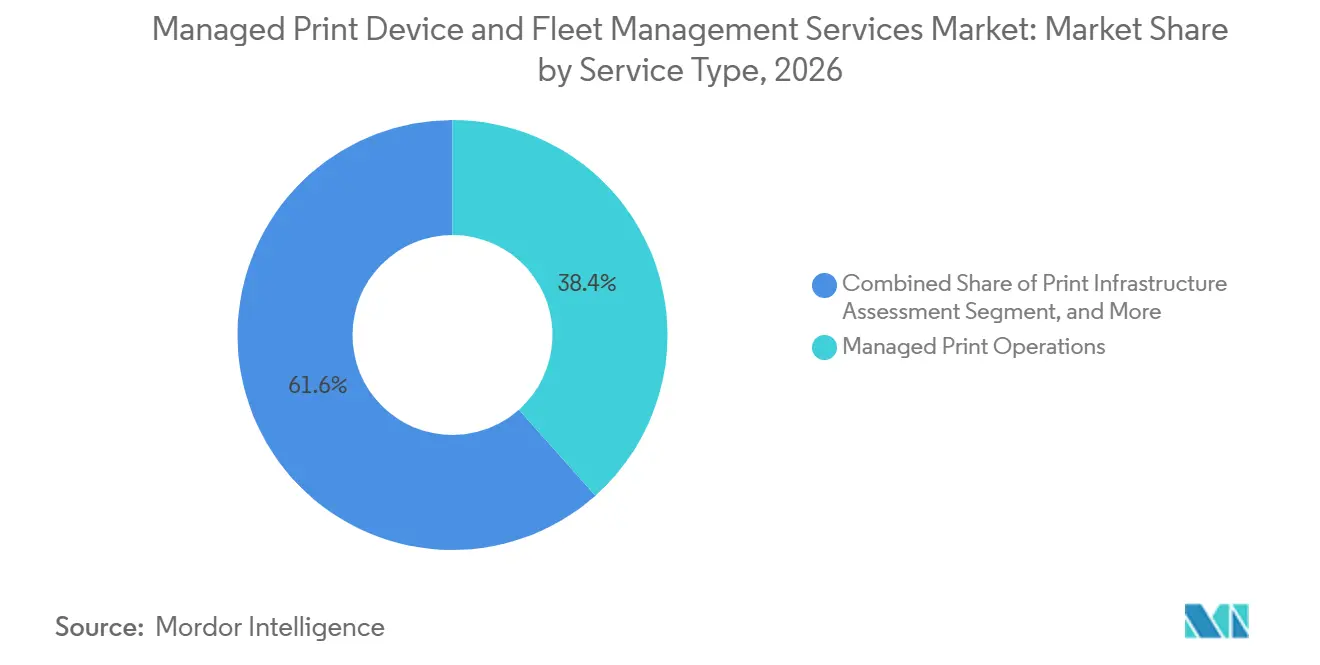
Cloud Platforms Add Growth to Managed Print OperationsManaged Print Operations held 38.43% of the Managed Print Device and Fleet Management Services Market share in 2026. The segment covers device provisioning, consumables, repair services, utilization reporting, and regular performance reviews under one provider relationship. Multi-year enterprise contracts support recurring revenue and make switching more difficult because suppliers manage operating procedures, service histories, consumable flows, and local support arrangements. Device and Fleet Management and Document Workflow Optimization are receiving more attention as organizations replace legacy print servers with remotely managed platforms that can apply policies across device estates. Print Infrastructure Assessment remains a lower-revenue service, but it can identify consolidation needs, security gaps, unused equipment, and workflow issues that support wider service contracts.
Cloud Print Services is projected to grow at a CAGR of 6.63% through 2032. Organizations use cloud services to reduce print-server administration, simplify remote support, and support printing across distributed workplaces. Adoption remains uneven because buyers weigh security, performance, network reliability, existing device compatibility, and data residency obligations differently. Canon expanded uniFLOW Online to support HP Workpath devices in April 2026, improving management across mixed Canon and HP fleets.[2] Providers that support cloud, private, and on-premises configurations can better serve regulated and multi-location customers while preserving consistent user access and reporting.

By Organization Size:
Large Enterprises Retain Revenue Leadership While SMEs ExpandLarge Enterprises held 64.27% of the Managed Print Device and Fleet Management Services Market size in 2026. Organizations with hundreds or thousands of devices have a stronger reason to outsource fleet monitoring, supplies, repairs, policy administration, and service coordination across multiple locations. Requirements are particularly demanding in BFSI, healthcare, and government settings, where document security and process continuity are operational concerns. These buyers increasingly seek commitments on uptime, security posture, response times, and workflow performance rather than traditional device-based measures. Providers with real-time analytics, established field-service coverage, and service-level guarantees can better meet those requirements.
Small and Medium Enterprises are projected to expand at a CAGR of 6.41% through 2032. Subscription plans reduce capital spending, spread operating costs, and simplify procurement for smaller IT teams that may have limited capacity to manage printer fleets. Konica Minolta's OneRate store shows how OEMs are creating direct digital channels for smaller businesses. Brother's MPS Essential and Ricoh's Print as a Service Essential follow similar pay-monthly or pay-as-you-print approaches that reduce contract entry barriers. Healthcare, legal, and financial SMEs still need services that address relevant privacy and security obligations, even without dedicated security teams.
By End-User Industry:
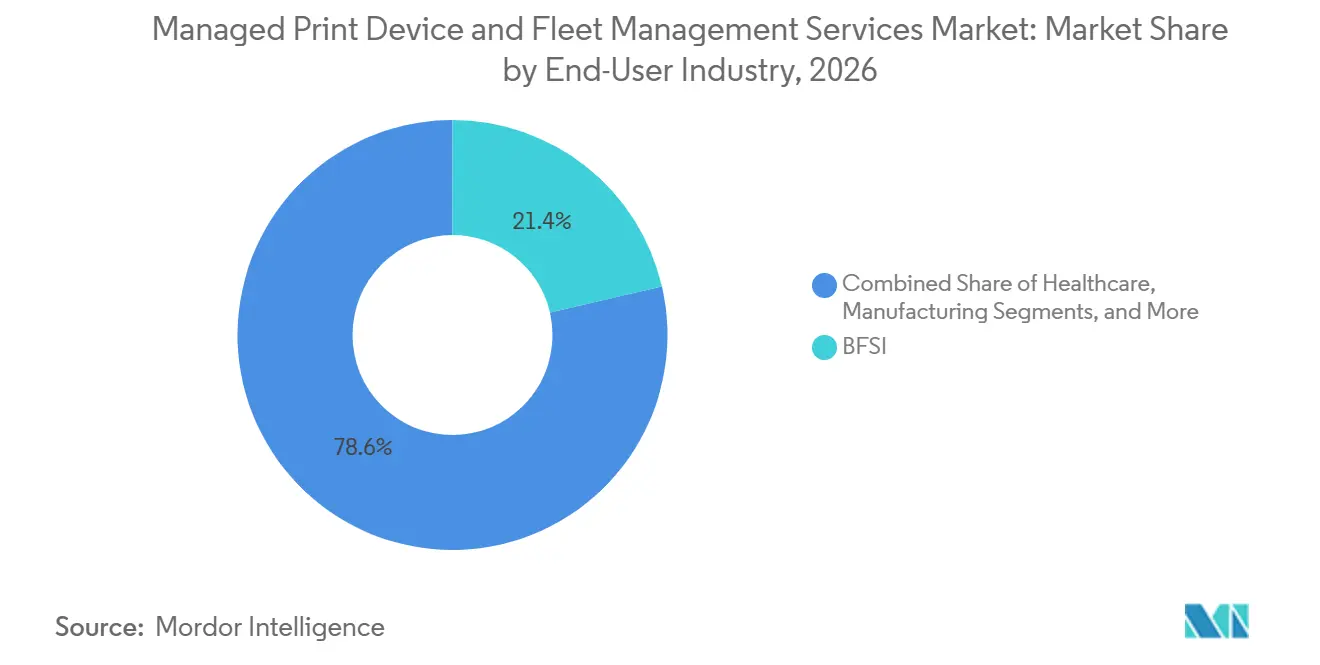
BFSI Leads and Healthcare Posts the Fastest GrowthBFSI held 21.37% of the managed print device and fleet management services market in 2026. Banks and insurers need traceable handling of financial documents and often require secure release printing, encrypted queues, access controls, and a clear record of document activity. SOX and PCI-DSS obligations strengthen the need for auditable document processes and controlled device administration. Information technology and telecommunications organizations are early users of cloud-managed fleets and AI-supported analytics because these organizations already operate closely with digital workplace systems. Manufacturing, retail, and e-commerce sustain demand through labels, shipping records, warehouse documentation, and related operational printing.
Healthcare is projected to grow at a CAGR of 6.24% through 2032. Hospitals and clinics require reliable handling of patient wristbands, medication labels, discharge documents, and other clinical materials without unattended output. Pharos offers a healthcare-focused cloud print platform with authenticated, secure release and centralized policy administration. HHS guidance also requires covered entities to use business associate agreements with relevant service providers handling protected health information. Government and defense customers provide additional opportunities through multi-year contracts governed by procurement frameworks such as the U.S. General Services Administration Schedule.
Geography Analysis
North America held 35.63% of the managed print device and fleet management services market share in 2026. The region has extensive adoption across regulated sectors, established contract renewal cycles, and complex hybrid-work deployments that require secure management of dispersed equipment. U.S. federal programs using the GSA Schedule provide structured procurement paths for managed print services and can support multi-year agreements for qualified vendors. Canada reflects similar hybrid-work needs, while Mexico supports print demand through manufacturing documentation, labels, and supply-chain records. Security and compliance requirements are increasingly important to regional buyers.
Europe has significant demand shaped by GDPR, data sovereignty expectations, and sustainability disclosure requirements. The United Kingdom and France are the largest European revenue markets identified in the supplied material. Germany's focus on data sovereignty supports on-premises and privately hosted configurations, particularly where data access and location must be documented. The region's policy environment makes access controls, document handling, and carbon reporting central to service selection. Italy, Spain, and Russia have more fragmented adoption patterns and smaller dealer networks.
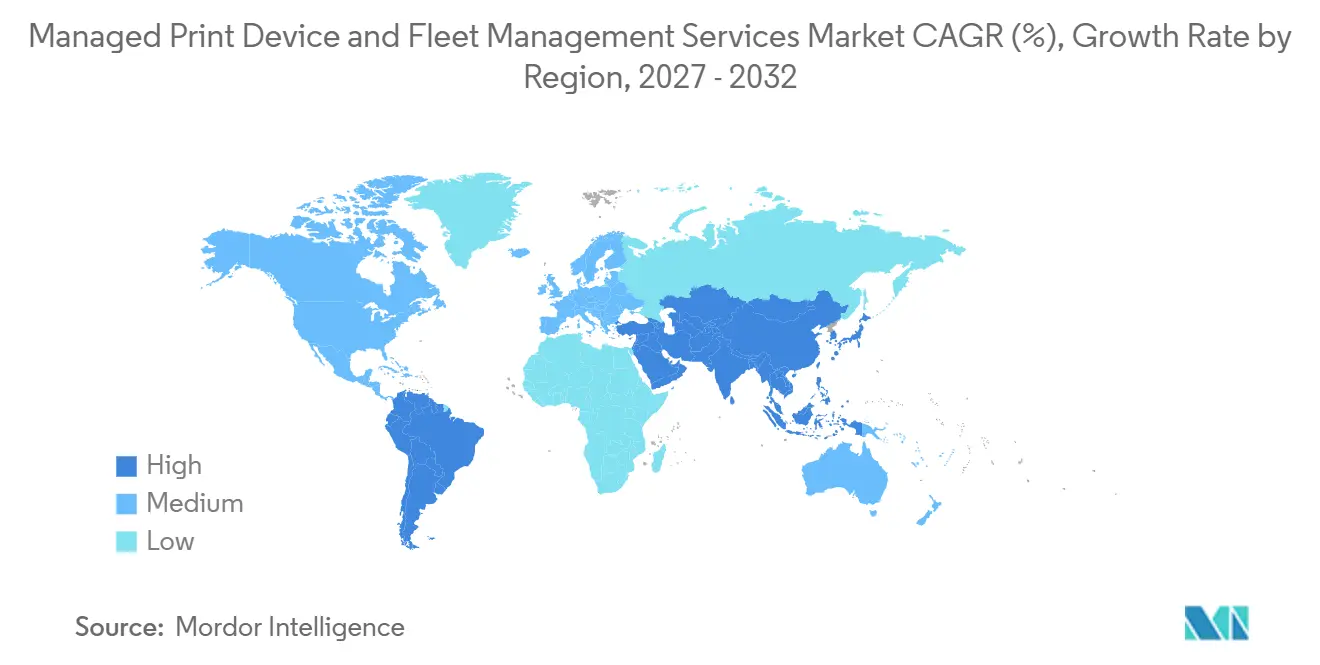
Asia-Pacific is projected to grow at a CAGR of 6.86% through 2032, the fastest regional pace in the managed print device and fleet management services market. China and India are supported by enterprise modernization programs and expanding demand for outsourced fleet operations in the managed print device and fleet management services market. India's Digital India initiative supports the wider digitization context for organizations considering managed services. Japan remains a mature market where Ricoh and Canon have established enterprise relationships through long-standing outsourcing arrangements. South Korea and Australia add demand as cloud adoption advances in business operations. South America offers potential in manufacturing and financial services, while economic and infrastructure constraints can slow adoption. The Middle East and Africa are longer-term opportunities supported by digital government programs, enterprise expansion, and growing SME formalization.
Competitive Landscape
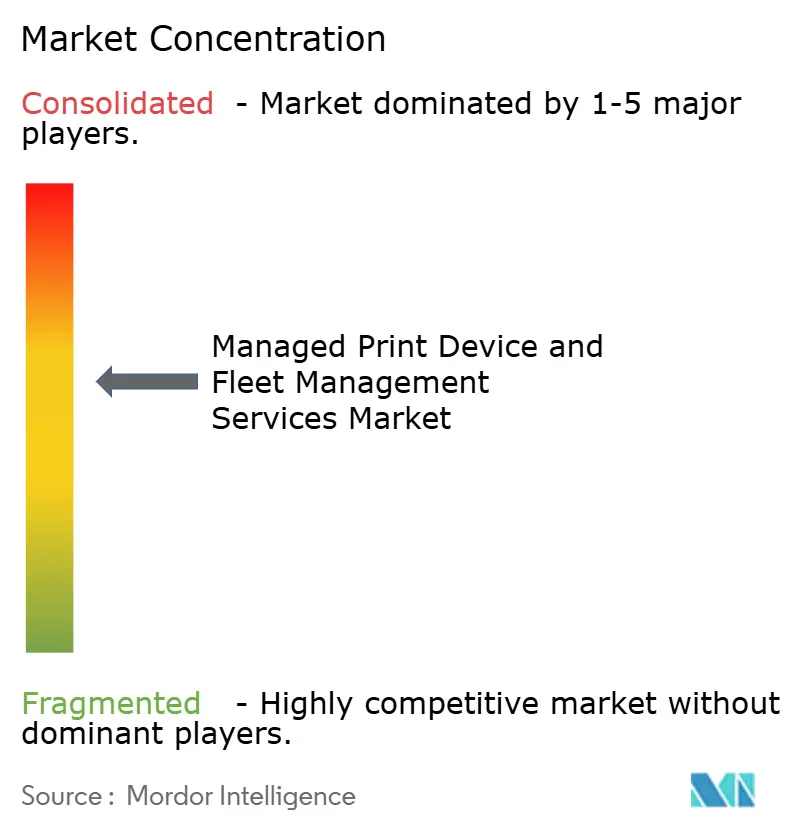
The managed print device and fleet management services market is moderately consolidated among large OEM-backed providers. Xerox, HP, Canon, Ricoh, and Konica Minolta have broad service networks, established security capabilities, and proprietary or integrated fleet software. Smaller regional dealers, independent software vendors, and managed service providers create a more fragmented mid-market. Xerox completed its acquisition of Lexmark for USD 1.5 billion in July 2025. The combined company serves more than 200,000 clients in more than 170 countries and expects at least USD 300 million in cost synergies.[3]
Leading suppliers are investing in cloud administration, security credentials, and workflow links with identity, enterprise resource planning, and document management systems. Xerox integrated its Lexmark and Xerox sales organizations in March 2026 and extended access to the Lexmark 9-Series A3 line, Xerox Managed Print Services, Workflow Central, and ConnectKey applications. Canon expanded uniFLOW Online to HP Workpath devices in April 2026, which improves support for mixed fleets. Toshiba acquired Youmebee Ltd. in October 2025, bringing its directprint.io platform into the Coreza brand as Coreza Print. These moves show that interoperability and cloud service delivery are becoming competitive requirements.
Vendor-agnostic management remains important in the managed print device and fleet management services market because enterprise fleets often include equipment from several manufacturers. Software-focused providers such as PaperCut and Y Soft can address that need through open integration approaches. Self-service cloud platforms aimed at SMEs also remain less developed than enterprise offerings. Page-level sustainability reporting is another area where few providers have mature data connections. Compliance obligations under GDPR, HIPAA, and ISO 27001 can favor larger providers that can fund certifications, while also allowing specialized providers to compete through strong compliance design. The upper tier, therefore, competes on the ability to combine equipment management, document security, reporting, and local service delivery in one accountable contract. Buyers can still use regional providers where mixed-fleet support, local coverage, or specialized document workflows matter most.
Managed Print Device and Fleet Management Services Industry Leaders
-
Xerox Corporation
-
HP Inc.
-
Ricoh Company, Ltd.
-
Canon Inc.
-
Konica Minolta, Inc.
- *Disclaimer: Major Players sorted in no particular order
Managed Print Device and Fleet Management Services Market Companies Covered in this Report
- Xerox Corporation
- HP Inc.
- Ricoh Company, Ltd.
- Canon Inc.
- Konica Minolta, Inc.
- Lexmark International, Inc.
- Brother Industries, Ltd.
- Seiko Epson Corporation
- Kyocera Document Solutions Inc.
- Sharp Corporation
- Toshiba Tec Corporation
- Fujifilm Business Innovation Corp.
- Dell Technologies Inc.
- Electronics For Imaging, Inc.
- PaperCut Software International Pty Ltd
- Quadient SA
- Arc Document Solutions, LLC
- Wipro Limited
- Econocom Group SE
- Computacenter plc
Recent Industry Developments in Managed Print Device and Fleet Management Services Market
- July 2026: Visual Edge IT, LLC announced the expansion of its longstanding managed print services partnership with Konica Minolta to strengthen sales and service capabilities across production print, A3, A4, and managed print services nationally. The expanded agreement targets healthcare, state and local government, K-12 education, and higher education customers, reinforcing Konica Minolta's channel strategy for critical institutional verticals.
- June 2026: Konica Minolta Business Solutions UK Ltd launched its OneRate online store, an e-commerce platform offering fixed-fee managed print subscriptions directly to UK micro and small businesses, bypassing traditional dealer channels. The platform provides delivery, installation, servicing, toner, spare parts, and ongoing support under a single predictable monthly payment, reflecting a major shift toward direct-to-SME managed print services distribution.
- April 2026: Canon expanded its uniFLOW Online cloud print management platform to include HP Workpath devices, effectively enabling multi-vendor fleet management under a single cloud platform. This interoperability expansion, covering organizations operating mixed Canon and HP fleets, directly addresses the vendor-agnosticism gap that has historically impeded full cloud adoption in heterogeneous enterprise environments.
- March 2026: Xerox unified its Lexmark and Xerox sales forces under an integrated go-to-market structure, giving Xerox clients access to the Lexmark 9-Series A3 printer line and enabling compatibility between Lexmark devices and Xerox Managed Print Services, Workflow Central, and ConnectKey applications. The integration established a consistent, scalable operating model across enterprise and departmental environments globally.
Global Managed Print Device and Fleet Management Services Market Report Scope
The Managed Print Device and Fleet Management Services Market covers outsourced services for monitoring, administering, maintaining, and optimizing enterprise print infrastructure and connected device fleets. These services include print infrastructure assessment, managed print operations, device and fleet management, document workflow optimization, and cloud print services. Providers manage printer and multifunction device deployment, configuration, utilization, maintenance, consumables, performance monitoring, security policies, and print-related workflows across distributed office environments. The market also includes fleet telemetry, predictive maintenance, usage tracking, cost optimization, and centralized administration of mixed-vendor print environments.
The Managed Print Device and Fleet Management Services Market Report is Segmented by Service Type (Print Infrastructure Assessment, Managed Print Operations, Device and Fleet Management, Document Workflow Optimization, and Cloud Print Services), Organization Size (Large Enterprises, and Small and Medium Enterprises), End-User Industry (Information Technology and Telecommunications, BFSI, Healthcare, Retail and E-Commerce, Manufacturing, Government and Defense, and Other End-User Industries), and Geography (North America, South America, Europe, Asia-Pacific, Middle East, and Africa). The Market Forecasts are Provided in Terms of Value (USD).
Segmentation Overview
| Print Infrastructure Assessment |
| Managed Print Operations |
| Device and Fleet Management |
| Document Workflow Optimization |
| Cloud Print Services |
| Large Enterprises |
| Small and Medium Enterprises |
| Information Technology and Telecommunications |
| BFSI |
| Healthcare |
| Retail and E-Commerce |
| Manufacturing |
| Government and Defense |
| Other End-User Industries |
| North America | United States |
| Canada | |
| Mexico | |
| South America | Brazil |
| Argentina | |
| Rest of South America | |
| Europe | Germany |
| United Kingdom | |
| France | |
| Italy | |
| Spain | |
| Russia | |
| Rest of Europe | |
| Asia-Pacific | China |
| India | |
| Japan | |
| South Korea | |
| Australia | |
| Rest of Asia-Pacific | |
| Middle East | Saudi Arabia |
| United Arab Emirates | |
| Turkey | |
| Rest of Middle East | |
| Africa | South Africa |
| Egypt | |
| Nigeria | |
| Rest of Africa |
| By Service Type | Print Infrastructure Assessment | |
| Managed Print Operations | ||
| Device and Fleet Management | ||
| Document Workflow Optimization | ||
| Cloud Print Services | ||
| By Organization Size | Large Enterprises | |
| Small and Medium Enterprises | ||
| By End-User Industry | Information Technology and Telecommunications | |
| BFSI | ||
| Healthcare | ||
| Retail and E-Commerce | ||
| Manufacturing | ||
| Government and Defense | ||
| Other End-User Industries | ||
| By Geography | North America | United States |
| Canada | ||
| Mexico | ||
| South America | Brazil | |
| Argentina | ||
| Rest of South America | ||
| Europe | Germany | |
| United Kingdom | ||
| France | ||
| Italy | ||
| Spain | ||
| Russia | ||
| Rest of Europe | ||
| Asia-Pacific | China | |
| India | ||
| Japan | ||
| South Korea | ||
| Australia | ||
| Rest of Asia-Pacific | ||
| Middle East | Saudi Arabia | |
| United Arab Emirates | ||
| Turkey | ||
| Rest of Middle East | ||
| Africa | South Africa | |
| Egypt | ||
| Nigeria | ||
| Rest of Africa | ||
Key Questions Answered in the Report
What is the managed mobile help desk services market size?
The managed mobile help desk services market is projected to grow from USD 3.64 billion in 2027 to USD 6.18 billion by 2032 at an 11.17% CAGR. The forecast reflects a broader role for providers that can combine everyday user support with endpoint controls, device logistics, carrier administration, compliance reporting, and support for workforces that operate across offices, homes, field locations, and clinical settings.
What is driving demand for managed mobile help desk services?
Hybrid work, mobile security requirements, cloud endpoint management, and outsourcing of device lifecycle work are increasing demand. Organizations also want predictable service costs and a single provider that can coordinate device support, carrier administration, policy enforcement, inventory records, replacement logistics, and repair workflows across a dispersed workforce.
Which service type leads managed mobile help desk services?
Mobile Help Desk and Technical Support led the service-type segment with 33.47% share in 2026. The service handles the frequent activities that employees encounter, including activation, password recovery, application access, connectivity support, initial troubleshooting, and guidance when a replacement device or new SIM must be configured.
Which customer group is expanding fastest?
Small and Medium Enterprises are projected to expand at a 12.27% CAGR through 2032 as subscription models lower adoption barriers. Cloud-based tools allow these organizations to use remote wipe, policy management, compliance reporting, application administration, and managed support without building their own dedicated device-management team or signing separate contracts for each capability.
Why is healthcare a fast-growing user sector?
Healthcare is projected to grow at an 11.67% CAGR because clinical devices require secure access, shared-device management, and reliable reprovisioning. The need to protect patient information, maintain auditable access practices, and prevent access delays makes mobility support a continuing operational requirement for healthcare delivery organizations with clinical staff working across departments and locations.
Which region is expected to grow fastest?
Asia-Pacific is projected to expand at an 11.84% CAGR through 2032, supported by a large and growing mobile ecosystem. China, India, Japan, South Korea, Australia, and Southeast Asian countries offer demand opportunities for the managed mobile help desk services market as enterprises expand mobile workforces, digitize frontline operations, and seek partners that can manage regional carrier and language requirements.