
Managed OT Vulnerability Management Services Market Size and Share
Market Overview
| Study Period | 2021 - 2032 |
|---|---|
| Market Size (2027) | USD 1.72 Billion |
| Market Size (2032) | USD 3.81 Billion |
| Growth Rate (2027 - 2032) | 17.24 % |
| Fastest Growing Market | Asia-Pacific |
| Largest Market | North America |
| Market Concentration | Medium |
Major Players *Disclaimer: Major Players sorted in no particular order Image © Mordor Intelligence. Reuse requires attribution under CC BY 4.0. | |
Managed OT Vulnerability Management Services Market Analysis by Mordor Intelligence
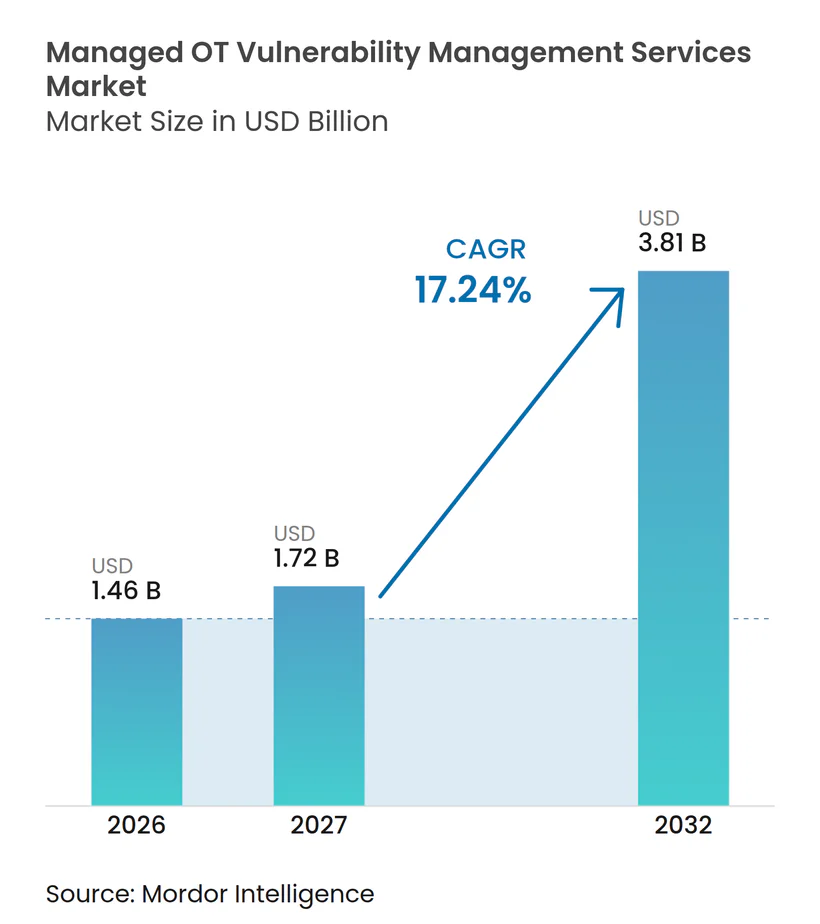
The Managed OT Vulnerability Management Services Market size is projected to be USD 1.46 billion in 2026, USD 1.72 billion in 2027, and reach USD 3.81 billion by 2032, growing at a CAGR of 17.24% from 2027 to 2032. The estimate reflects a move from periodic scanning projects toward continuous outsourced programs for asset discovery, vulnerability assessment, exposure scoring, remediation coordination, documentation, escalation, safe operational follow-up, and accountable management review. A greater connection between enterprise systems and operational technology is increasing the number of assets that need ongoing oversight. Critical infrastructure operators also face more formal cybersecurity requirements and a limited supply of specialists who understand industrial processes. Providers are responding through co-managed models, passive monitoring, risk prioritization, and services that combine edge collection with cloud analytics. These conditions keep the Managed OT vulnerability management services market tied to operating needs rather than discretionary technology spending, because operators need a repeatable way to understand which connected assets are exposed, which vulnerabilities require immediate action, who must own the response, and which controls can reduce risk when a patch cannot be applied without affecting production.
Key Report Takeaways
- By service type, Managed OT Vulnerability Assessment Services held 27.58% of the managed OT vulnerability management services market in 2026, while Managed OT Exposure Management and Risk Prioritization Services are projected to expand at a 19.73% CAGR through 2032.
- By service delivery model, Fully Managed services held 43.39% share in 2026, while Co-Managed arrangements are projected to expand at a 20.61% CAGR through 2032.
- By deployment mode, Cloud-Based deployment held 47.52% of the managed OT vulnerability management services market share in 2026, while Hybrid and Multicloud deployment are projected to expand at a 21.92% CAGR through 2032.
- By OT asset type, Programmable Logic Controllers held 26.91% share in 2026, while Industrial IoT, Edge Devices, and Other OT Assets are projected to expand at a 21.82% CAGR through 2032.
- By end-user industry, Industrial Manufacturing held 26.69% share in 2026, while the Government and Public Sector is projected to expand at a 22.54% CAGR through 2032.
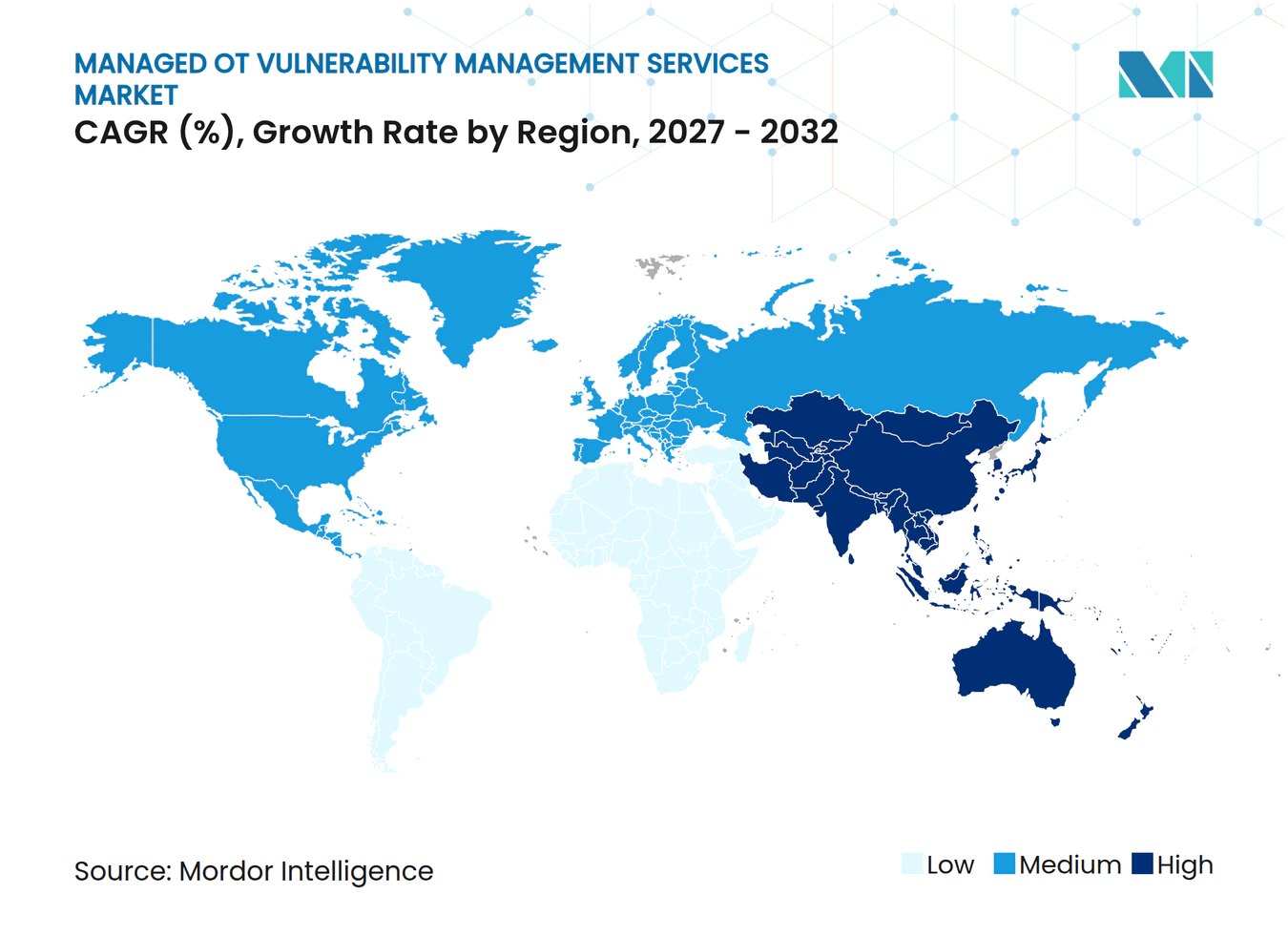
- By geography, North America held 38.64% of the managed OT vulnerability management services market share in 2026, while Asia-Pacific is projected to expand at a 19.86% CAGR through 2032.
Note: Market numbers in this report are based on Mordor Intelligence's proprietary estimation framework, which combines nine months of actuals with Q4 projections for base year 2026.
Market Trends and Insights
Drivers Impact Analysis of Managed OT Vulnerability Management Services Market*
| Driver | (~) % Impact on CAGR Forecast | Geographic Relevance | Impact Timeline |
|---|---|---|---|
| Expansion of IT/OT Connectivity and Industrial Digitization | +4.5% | Global | Medium term (2-4 years) |
| Increasing Cyber Risk to Critical Infrastructure | +4.0% | Global, heightened in North America and Europe | Short term (≤ 2 years) |
| Strengthening OT Cybersecurity Regulation | +3.0% | EU, North America, Asia-Pacific core | Medium term (2-4 years) |
| Shortage of In-House OT Cybersecurity Expertise | +2.5% | Global, most acute in Asia-Pacific and Middle East and Africa | Medium term (2-4 years) |
| Growth of Multi-Site Industrial Operations and Remote Maintenance | +1.5% | Global, early gains in manufacturing hubs | Long term (≥ 4 years) |
| Risk-Based Prioritization of OT Vulnerabilities Using Industrial Context | +1.0% | Global | Long term (≥ 4 years) |
| Source: Mordor Intelligence | |||
Expansion of IT/OT Connectivity and Industrial Digitization
Industrial digitization is weakening the separation that once insulated operational technology from enterprise IT threats. Manufacturers are connecting SCADA systems, programmable logic controllers, and engineering workstations to cloud management platforms. IBM reported that 49% of the 670 OT-impacting vulnerabilities disclosed in the first half of 2025 had Critical or High CVSS ratings.[1] Remote monitoring and predictive maintenance improve operating visibility, but they also require assessment coverage when a site becomes connected. China’s MLPS 2.0 guidelines require state-owned enterprises to allocate 7-10% of IT budgets to OT security, which supports spending on connected industrial environments. The Managed OT vulnerability management services market benefits, as each connected facility requires inventory, risk review, and follow-up management.
Increasing Cyber Risk to Critical Infrastructure
Ransomware groups and state-sponsored actors are targeting industrial environments for financial and geopolitical leverage. Claroty found that 40% of surveyed organizations had OT assets with Known Exploitable Vulnerabilities exposed to the internet, while 68% of manufacturing KEVs were linked to active ransomware groups. IBM reported that OT-affecting incidents cost USD 4.56 million on average in 2025, and 23% of affected organizations experienced direct damage to OT systems or equipment. The SANS 2025 State of ICS Security Report found that half of ICS incidents began with unauthorized external access. Fewer than 15% of organizations in that survey had advanced ICS-aware remote-access controls, such as session recording or device-specific approvals. The Managed OT vulnerability management services market is supported because continuous managed coverage addresses the gap between exposed assets and the ability to identify, prioritize, and control those risks.
Strengthening OT Cybersecurity Regulation
Regulatory requirements are making OT vulnerability management a compliance obligation for many asset owners. NIS2 introduced executive accountability and fines of up to EUR 10 million (USD 11.3 million), while IEC 62443 remains a core technical reference for industrial cybersecurity programs.[2] In September 2025, CISA and the UK National Cyber Security Center issued joint guidance recommending alignment with IEC 62443 and ISO/IEC 27001. These frameworks make asset inventories, access records, and documented risk treatment more important in managed service contracts. The SANS report found that regulated sites experienced 50% fewer financial and safety effects from incidents than non-regulated peers. For the Managed OT vulnerability management services market, managed compliance and reporting services therefore become a practical part of a wider vulnerability management program.
Shortage of In-House OT Cybersecurity Expertise
OT cybersecurity requires knowledge of industrial protocols, process safety, vendor-specific control systems, and security investigation methods. Only 20% of organizations with industrial environments maintained dedicated OT security teams in the 2026 Global Cybersecurity Outlook, cited by Honeywell. Multi-site operators cannot always place qualified specialists at every facility at a sustainable cost. The Managed OT vulnerability management services market gains support as co-managed and fully managed services provide access to centralized expertise while allowing plant teams to retain operational control, creating a defined division of responsibility for routine monitoring, technical escalation, incident support, access review, vulnerability evaluation, and communication with the people responsible for keeping production equipment available and safe. The SANS survey found that organizations involving field technicians in cybersecurity exercises reported readiness levels 1.7 times higher than those that did not. This reinforces the value of providers that can combine industrial judgment with routine vulnerability operations, because a useful service must understand whether a technical change can be completed during a maintenance window, whether it affects safety-related equipment, which operating team owns the asset, and whether a compensating control is more suitable than an immediate patch in a live production environment.
Restraints Impact Analysis of Managed OT Vulnerability Management Services Market*
| Restraint | (~) % Impact on CAGR Forecast | Geographic Relevance | Impact Timeline |
|---|---|---|---|
| Legacy and Proprietary OT Systems That Resist Patching | -2.0% | Global, concentrated in mature industrial economies | Long term (≥ 4 years) |
| Operational Disruption Risks from Active Scanning and Remediation | -1.5% | Global | Short term (≤ 2 years) |
| Fragmented OT Telemetry and Limited Interoperability | -1.0% | Global, most acute in Middle East and Africa and South America | Medium term (2-4 years) |
| Difficulty Quantifying Return on OT Security Investment | -0.8% | Global, most pronounced in SMEs and public sector | Medium term (2-4 years) |
| Source: Mordor Intelligence | |||
Legacy and Proprietary OT Systems That Resist Patching
End-of-life PLCs, SCADA systems, and embedded controllers often use proprietary firmware that limits direct remediation. Security updates may require vendor coordination, physical access, planned maintenance windows, and production stoppages. NIST guidance recognizes that OT owners must balance operational requirements with cybersecurity controls when managing industrial systems. Within the Managed OT vulnerability management services market, providers consequently rely on network segmentation, virtual patching, and behavioral monitoring when direct patches are not viable. CISA’s 2025 asset inventory guidance recommends comparing the potential cost of downtime with replacement or compensating-control options. These factors add complexity to delivery and can extend an engagement before a client accepts a remediation plan.
Operational Disruption Risks from Active Scanning and Remediation
Active scanning can disrupt sensitive OT equipment, including PLCs, embedded HMIs, and older industrial switches. This risk is especially important in oil and gas, chemicals, and power generation, where processes cannot be paused easily. The SANS report documented that industrial organizations must adapt cybersecurity practices to the operational needs of ICS environments. The Managed OT vulnerability management services market requires providers to use passive monitoring, deep-packet inspection, and network-traffic correlation to create an asset and vulnerability view, while carefully validating the information against engineering records, vendor documentation, and operating conditions so the resulting assessment does not confuse inactive equipment, obsolete records, or normal industrial traffic with an immediate vulnerability condition. Passive methods can slow coverage and delay updates to vulnerability records. Digital twin testing can reduce production risk before a production environment is assessed, but it adds work, time, and cost to the service.
*Our forecasts treat driver/restraint impacts as directional, not additive. The impact forecasts reflect baseline growth, mix effects, and variable interactions.
Managed OT Vulnerability Management Services Market Segment Analysis
By Service Type:
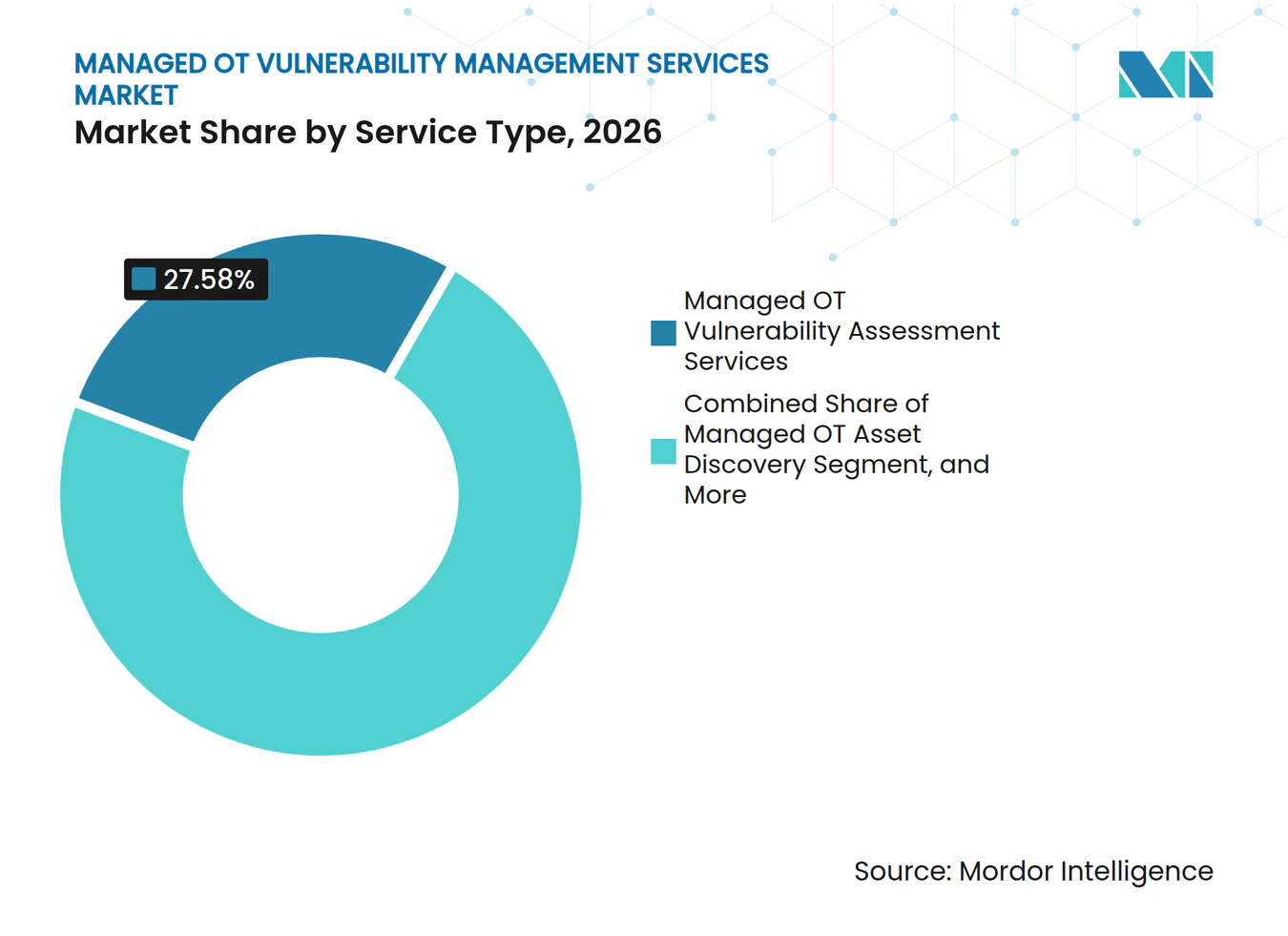
Exposure Management Builds on Assessment LeadershipManaged OT Vulnerability Assessment Services held 27.58% of the Managed OT vulnerability management services market in 2026. The service remains a common entry point because asset owners need a baseline inventory and risk view before they can operate a more continuous program, and the work provides a structured record of assets, software versions, exposure conditions, and responsible operating teams that can be used in later program decisions. Periodic assessment also supports compliance reviews and gives boards a defined view of current exposure. Managed OT Exposure Management and Risk Prioritization Services is projected to expand at a 19.73% CAGR through 2032. Organizations with established inventories are moving toward programs that rank vulnerabilities by production impact rather than generic CVSS scores. The managed OT vulnerability management services market size for this service is supported by clients that want a manageable list of actions rather than a long unresolved vulnerability backlog.
Managed OT Asset Discovery and Inventory Services link assessment work to a maintained picture of the plant environment. Managed OT Vulnerability Monitoring Services help operators identify changes between assessment cycles, including new devices, configuration changes, altered network connections, and newly published vulnerability information that may change the priority assigned to equipment already recorded in the inventory. Managed OT Remediation Planning and Validation Services translate findings into actions that can be completed safely around operating schedules, helping the client weigh production timing, technical dependencies, vendor support, available maintenance windows, and the operational impact of any change before it is authorized. Managed OT Compliance and Reporting Services are becoming more relevant as NIS2, IEC 62443, and sector-specific frameworks require documented evidence. CISA’s 2025 asset inventory guidance describes inventory, taxonomy, lifecycle management, and KEV cross-referencing as core practices for owners and operators. Together, these services connect a technical finding to an operational decision, which keeps service delivery focused on recurring program activity and gives plant, security, compliance, and executive teams a common record of what requires immediate attention, what can be scheduled, and what must be managed through compensating controls.



By Service Delivery Model:
Co-Managed Services Gain With Client MaturityFully Managed services held 43.39% of the managed OT vulnerability management services market in 2026. Many operators have limited OT security staffing and prefer a provider to take responsibility for routine asset discovery, monitoring, reporting, and coordination. The model is also practical for organizations operating facilities across several locations with varying local capability, because a centralized provider can apply consistent processes for inventory, monitoring, escalation, reporting, and interaction with plant personnel without requiring a separate specialist team at every site. Co-Managed arrangements are projected to expand at a 20.61% CAGR through 2032. These contracts allow internal teams to develop operating knowledge while a specialist provider supports detection, intelligence, and more complex investigations. The managed OT vulnerability management services market share held by fully managed delivery reflects current staffing limits, while co-managed demand reflects a more mature operating model.
Rockwell Automation expanded its SecureOT Managed Services in October 2026 to include Firewall Managed Services for Fortinet FortiGate infrastructure and Infrastructure Managed Services for existing customer-owned industrial networks.[3] The expansion illustrates how OEM-led delivery is adapting to customer preferences for flexible responsibility sharing. On-Demand and Retainer-Based services support smaller operators and project-specific needs such as regulatory audits, merger due diligence, and incident response. These models face pressure from subscriptions that bundle recurring access into a fixed monthly arrangement. Hybrid Managed arrangements are useful for multinational enterprises that must work across different OT environments and regulatory jurisdictions. Fully Managed services may lose some share as customers develop internal centers of expertise, although they remain important for organizations with limited specialist capacity, especially where the client needs continuous coverage but cannot recruit, train, and retain personnel with industrial control and cybersecurity experience.
By Deployment Mode:
Hybrid Architectures Address Operational ConstraintsCloud-based deployment accounted for 47.52% of the managed OT vulnerability management services market in 2026. Centralized asset inventories and unified vulnerability dashboards help operators view distributed plants from a common interface. Hybrid and Multicloud deployment is projected to expand at a 21.92% CAGR through 2032. Real-time process control loops and safety instrumented systems need sub-millisecond latency, which a cloud round-trip cannot always provide across time-sensitive industrial control environments. Edge processing nodes can collect and process telemetry near the equipment before transferring information to cloud analytics. The managed OT vulnerability management services market is therefore moving toward architectures that align data handling with process sensitivity, allowing providers to retain centralized reporting and analysis while keeping time-sensitive data processing close to the equipment that controls physical processes and safety functions.
Claroty launched an AI-powered CPS Library in January 2026 with Schneider Electric and Rockwell Automation. The capability supports firmware version tracking and correlation with manufacturer-published vulnerability information.[4] On-Premises deployment remains important in nuclear, defense, and pharmaceutical environments with data sovereignty or air-gap requirements. These environments can also require on-site infrastructure for assessment and monitoring. For large industrial clients, a hybrid design that combines edge-resident passive sensors with cloud analytics is becoming the practical delivery model. Providers that can manage both the edge and cloud components have a stronger position in enterprise contracts, but they also need more distributed collection capability, operational knowledge of the supported equipment, and a delivery model that can maintain visibility when site connectivity, policy, or data residency limits cloud transfer.
By OT Asset Type:
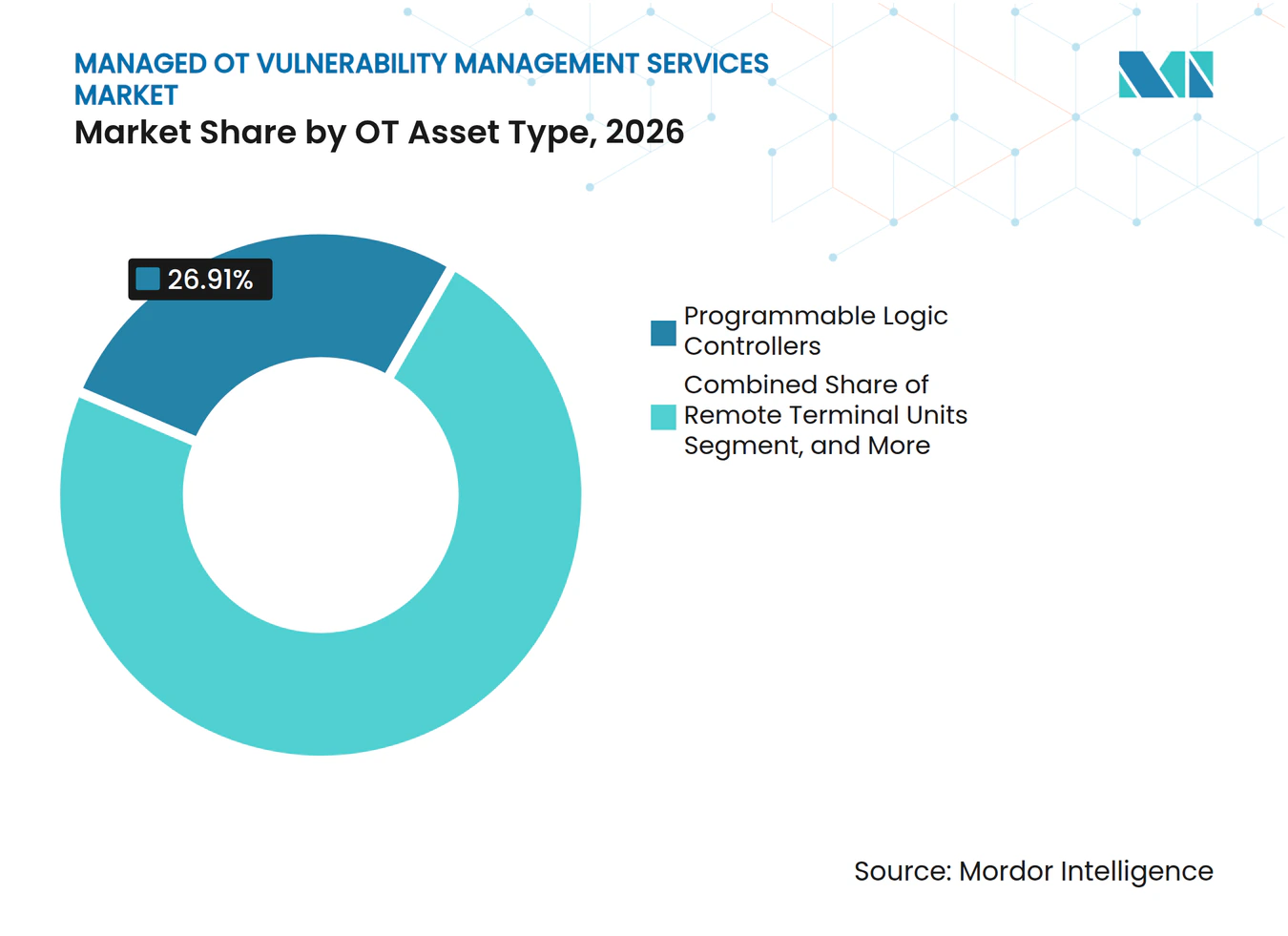
Connected Edge Assets Add to PLC ExposureProgrammable Logic Controllers held 26.91% of the managed OT vulnerability management services market in 2026. PLCs are primary control-layer assets, and their compromise can affect physical processes as well as information systems. Industrial IoT, Edge Devices, and Other OT Assets are projected to expand at a 21.82% CAGR through 2032. Smart sensors, condition-monitoring gateways, and edge computing nodes create a broad and varied attack surface. Conventional inventory tools were not designed to identify every connected device across this type of environment. Claroty found that 12% of nearly 1 million assessed OT devices contained Known Exploitable Vulnerabilities.
Remote Terminal Units, Human Machine Interfaces, and Industrial Control Servers and Engineering Workstations occupy important mid-tier positions in an industrial environment. HMIs attract particular attention because their Windows-based architecture can expose them to common malware moving across IT and OT network connections. Safety Instrumented Systems, safety controllers, and SCADA systems require higher-value assessment because of their role in process safety. IEC 61511 obligations and IEC 62443 SL-3 requirements support structured vulnerability management for these asset classes. The diversity of devices makes a self-directed approach difficult for many asset owners, since each device category can have different firmware, communication protocols, maintenance constraints, safety implications, and vendor support arrangements that need to be reflected in risk prioritization and remediation planning. This complexity favors service providers that can build a complete inventory and assess assets using industrial context rather than a single IT-oriented method, particularly when a vulnerability can affect process availability, equipment reliability, worker safety, or the ability to maintain essential services.

By End-User Industry:
Manufacturing Leads While Public Sector Demand AcceleratesIndustrial Manufacturing held 26.69% of the managed OT vulnerability management services market in 2026. The sector has broad OT exposure, frequent ransomware attention, and rising requirements under NIS2 and sector-specific frameworks. The government and public sector is projected to expand at a 22.54% CAGR through 2032. National cybersecurity mandates are directing more resources toward water treatment, power grids, transportation networks, and communications infrastructure. Japan allocated more than USD 3.8 billion in 2025 to public-private ICS and critical infrastructure cybersecurity projects. The Managed OT vulnerability management services market size for public-sector contracts is also supported by requirements for structured security assessments, architecture review, and compliance support.
Claroty identified manufacturing as a leading ransomware target category and reported that 68% of manufacturing KEVs were linked to active ransomware groups. The healthcare and life sciences industry is gaining attention because internet-connected medical devices and building management systems create exposure near patient-safety systems. BFSI, IT and Telecommunications, and Retail and E-Commerce have smaller shares, but they operate distributed data center and branch-level control infrastructure. Their needs differ from process industries, yet each requires visibility into critical connected assets. Government procurement often creates long-term managed service opportunities because it combines technical requirements with formal oversight. Across end-user categories, the strongest service demand is linked to environments where a cyber incident can interrupt physical operations or public services, because the cost of delayed detection can extend beyond information loss to production delays, equipment damage, safety concerns, and disruption for customers or citizens.
Geography Analysis
North America Managed OT Vulnerability Management Services Market
North America held 38.64% of the managed OT vulnerability management services market in 2026. The region has a large concentration of critical infrastructure assets, early adoption of managed OT programs, and established requirements for power utilities, pipelines, and other regulated operations. CISA’s August 2025 asset inventory guidance expanded the defined scope of asset identification, lifecycle management, and KEV cross-referencing for OT owners. CISA, the FBI, and the UK National Cyber Security Center also published architecture guidance in September 2025 for maintaining a definitive view of OT systems. Canada and Mexico add demand through cross-border energy infrastructure connected to United States operators, where common operating relationships and regulatory expectations make consistent asset visibility, vulnerability documentation, and coordinated remediation planning important across facilities that may be managed by different teams.
Europe and APAC Managed OT Vulnerability Management Services Market
Europe is the second-largest regional area, with Germany, the United Kingdom, and France serving as major demand centers. NIS2 transposition in 21 European Union member states has made OT risk management more formal for manufacturers and energy operators. Orange Cyberdefense received a framework agreement for IT and OT security monitoring from Sweden’s Civil Contingencies Agency in July 2026. Asia-Pacific is projected to expand at a 19.86% CAGR through 2032. Singapore reported a more than 4-fold increase in APT detections from 2021 to 2024 and is introducing mandatory incident reporting for Critical Information Infrastructure owners targeted by APTs. Japan’s public-private investment and China’s MLPS 2.0 allocation rules provide a recurring base for OT security procurement, and they reinforce the need for providers that can translate broad government requirements into repeatable services for asset discovery, monitoring, reporting, and risk prioritization.
South America and MEA Managed OT Vulnerability Management Services Market
South America is developing demand in energy, mining, and petrochemicals, particularly in Brazil and Argentina. International operators can extend global OT security standards to local assets, which creates an opening for managed services. In the Middle East, Saudi Arabia and the UAE are adding OT exposure through petrochemical, desalination, and smart-city projects. Honeywell operates OT cybersecurity Centers of Excellence in Dubai and Dammam to support regional service delivery. Africa remains the smallest geography, although energy infrastructure modernization is creating project-based demand. Fragmented telemetry and limited interoperability in South America and Africa can limit continuous monitoring, so retainer-based and on-demand engagements are often the first form of service adoption, allowing organizations to begin with focused asset assessments, audit preparation, or remediation planning before committing to a full managed monitoring arrangement.
Competitive Landscape
Market Concentration
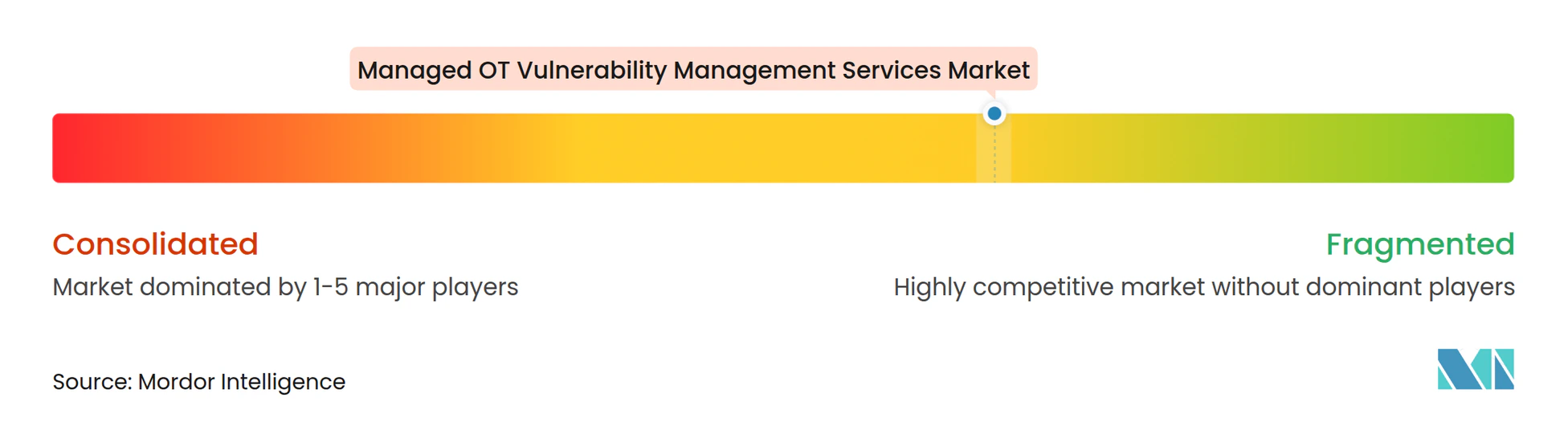
The managed OT vulnerability management services market is moderately fragmented. It includes pure-play OT security specialists, IT services firms, industrial automation OEMs, and network-security providers. In the managed OT vulnerability management services market, providers compete on industrial threat intelligence, asset visibility, protocol-aware behavioral analysis, and the ability to deliver discovery, monitoring, exposure management, and compliance reporting as one service. Accenture agreed in June 2026 to acquire a majority stake in Dragos, as well as all of runZero and NetRise, at a combined enterprise value of USD 4.175 billion. The transaction connected global IT services delivery with specialist capabilities for OT asset visibility and firmware-level exposure analysis, reflecting the value placed on platforms that can identify industrial equipment, understand its operational role, and prioritize vulnerabilities in a way that standard IT management tools do not readily provide. Dragos completed the acquisitions in September 2026, creating an extended OT platform that combined asset visibility, threat detection, firmware exposure analysis, and attack-surface intelligence.
Honeywell, Rockwell Automation, Siemens, Schneider Electric, and other industrial automation companies have an advantage through installed equipment, technical documentation, and established customer relationships. Honeywell expanded its OT Cybersecurity Suite in June 2026 with Cyber Proactive Defense, a vendor-agnostic 24/7 OT security operations center, and automated governance, risk, and compliance reporting. Within the managed OT vulnerability management services market, these additions extend OEM-led services into continuous monitoring and compliance work. Claroty secured USD 150 million in Series F funding in January 2026 and developed its CPS Library with Schneider Electric and Rockwell Automation. Its approach shows how partnerships with equipment providers can strengthen a platform without requiring acquisition by a services conglomerate, as product, firmware, and asset information from industrial partners can improve the completeness and practical relevance of vulnerability intelligence for the equipment owners already operating their technologies.
The mid-market in the managed OT vulnerability management services market remains less fully served because large consulting firms may require engagement sizes that smaller industrial operators cannot support. Point-solution vendors may also lack the delivery infrastructure required for continuous coverage. Providers that offer passive, agentless assessment can address customer concern about production disruption and give the managed OT vulnerability management services market a clearer route into sensitive operating environments. The range of capable participants prevents a small group from controlling most contracts, as an operator can select among specialist platforms, automation vendors, global security service providers, and network-security companies based on its asset base, coverage needs, procurement approach, location, preferred deployment model, and the degree of internal capability it wants to retain. The managed OT vulnerability management services market remains open to different delivery models because those requirements vary widely between a single manufacturing site, a distributed utility, a government operator, and a multinational industrial group.
Managed OT Vulnerability Management Services Industry Leaders
-
Accenture plc
-
ABB Ltd.
-
Atos SE
-
Capgemini SE
-
Cisco Systems, Inc.
- *Disclaimer: Major Players sorted in no particular order
Managed OT Vulnerability Management Services Market Companies Covered in this Report
- Accenture plc
- ABB Ltd.
- Atos SE
- Capgemini SE
- Cisco Systems, Inc.
- Claroty Ltd.
- Deloitte Touche Tohmatsu Limited
- Dragos, Inc.
- DNV AS
- Ernst & Young Global Limited
- Forescout Technologies, Inc.
- Fortinet, Inc.
- Honeywell International Inc.
- International Business Machines Corporation
- KPMG International Limited
- Nozomi Networks, Inc.
- Orange SA
- Rockwell Automation, Inc.
- Schneider Electric SE
- Siemens AG
- Tata Consultancy Services Limited
- Tenable Holdings, Inc.
- Thales S.A.
- Wipro Limited
Recent Industry Developments in Managed OT Vulnerability Management Services Market
- October 2026: Rockwell Automation expanded its SecureOT managed services suite with Firewall Managed Services for Fortinet FortiGate firewalls and Infrastructure Managed Services providing 24/7 monitoring and hardware lifecycle management for existing customer-owned industrial networks without requiring hardware replacement, directly reducing adoption barriers for multi-vendor OT managed service deployment.
- June 2026: Honeywell expanded its OT Cybersecurity Suite with 5 new capabilities, including the AI-powered Cyber Proactive Defense monitoring solution, a vendor-agnostic 24/7 OT Security Operations Center, and a Cyber Governance Risk and Compliance module automating audit evidence collection, addressing continuous managed monitoring and compliance reporting for industrial operators across manufacturing, energy, and critical infrastructure.
- June 2026: Accenture announced its agreement to acquire a majority stake in Dragos and all of runZero and NetRise at a combined enterprise value of USD 4.175 billion, building on its existing USD 10 billion cybersecurity business to deliver an end-to-end OT security platform for critical infrastructure operators, the largest single strategic investment in managed OT cybersecurity in market history.
- January 2026: Claroty secured USD 150 million in Series F funding led by Golub Growth, with valuation increasing 80% since March 2024, and launched the AI-powered CPS Library in partnership with Schneider Electric and Rockwell Automation, automating OT asset specification tracking, firmware version identification, and manufacturer-published vulnerability correlation to close manual gaps in industrial asset inventories.
Global Managed OT Vulnerability Management Services Market Report Scope
Managed OT vulnerability management services market to help industrial organizations discover, assess, prioritize, and remediate or mitigate security weaknesses across operational technology assets, including SCADA systems, PLCs, HMIs, RTUs, and plant networks. These services use OT-safe discovery and risk-based prioritization, accounting for safety, uptime, legacy systems, and limited maintenance windows.
The Managed OT Vulnerability Management Services Market Report is Segmented by Service Type (Managed OT Asset Discovery and Inventory Services, Managed OT Vulnerability Assessment Services, Managed OT Exposure Management and Risk Prioritization Services, Managed OT Vulnerability Monitoring Services, Managed OT Remediation Planning and Validation Services, and Managed OT Compliance and Reporting Services), Service Delivery Model (Fully Managed, Co-Managed, On-Demand and Retainer-Based, and Hybrid Managed), Deployment Mode (Cloud-Based, On-Premises, and Hybrid and Multicloud), OT Asset Type (Programmable Logic Controllers, Remote Terminal Units, Human Machine Interfaces, Industrial Control Servers and Engineering Workstations, Safety Instrumented Systems and Safety Controllers, Supervisory Control and Data Acquisition Systems, and Other OT Asset Types), End User Industry (Banking, Financial Services and Insurance (BFSI), IT and Telecommunications, Healthcare and Life Sciences, Government and Public Sector, Industrial Manufacturing, Retail and E-Commerce, and Other End-User Industries), and Geography (North America, South America, Europe, Asia-Pacific, Middle East, and Africa). The Market Forecasts are Provided in Terms of Value (USD).
Segmentation Overview
| Managed OT Asset Discovery and Inventory Services |
| Managed OT Vulnerability Assessment Services |
| Managed OT Exposure Management and Risk Prioritization Services |
| Managed OT Vulnerability Monitoring Services |
| Managed OT Remediation Planning and Validation Services |
| Managed OT Compliance and Reporting Services |
| Fully Managed |
| Co-Managed |
| On-Demand and Retainer-Based |
| Hybrid Managed |
| Cloud-Based |
| On-Premises |
| Hybrid and Multicloud |
| Programmable Logic Controllers |
| Remote Terminal Units |
| Human Machine Interfaces |
| Industrial Control Servers and Engineering Workstations |
| Safety Instrumented Systems and Safety Controllers |
| Supervisory Control and Data Acquisition Systems |
| Other OT Asset Types |
| Banking, Financial Services and Insurance (BFSI) |
| IT and Telecommunications |
| Healthcare and Life Sciences |
| Government and Public Sector |
| Industrial Manufacturing |
| Retail and E-Commerce |
| Other End-User Industries |
| North America | United States |
| Canada | |
| Mexico | |
| South America | Brazil |
| Argentina | |
| Rest of South America | |
| Europe | Germany |
| United Kingdom | |
| France | |
| Italy | |
| Rest of Europe | |
| Asia-Pacific | China |
| Japan | |
| India | |
| South Korea | |
| Rest of Asia-Pacific | |
| Middle East | Saudi Arabia |
| United Arab Emirates | |
| Rest of Middle East | |
| Africa | South Africa |
| Nigeria | |
| Rest of Africa |
| By Service Type | Managed OT Asset Discovery and Inventory Services | |
| Managed OT Vulnerability Assessment Services | ||
| Managed OT Exposure Management and Risk Prioritization Services | ||
| Managed OT Vulnerability Monitoring Services | ||
| Managed OT Remediation Planning and Validation Services | ||
| Managed OT Compliance and Reporting Services | ||
| By Service Delivery Model | Fully Managed | |
| Co-Managed | ||
| On-Demand and Retainer-Based | ||
| Hybrid Managed | ||
| By Deployment Mode | Cloud-Based | |
| On-Premises | ||
| Hybrid and Multicloud | ||
| By OT Asset Type | Programmable Logic Controllers | |
| Remote Terminal Units | ||
| Human Machine Interfaces | ||
| Industrial Control Servers and Engineering Workstations | ||
| Safety Instrumented Systems and Safety Controllers | ||
| Supervisory Control and Data Acquisition Systems | ||
| Other OT Asset Types | ||
| By End User Industry | Banking, Financial Services and Insurance (BFSI) | |
| IT and Telecommunications | ||
| Healthcare and Life Sciences | ||
| Government and Public Sector | ||
| Industrial Manufacturing | ||
| Retail and E-Commerce | ||
| Other End-User Industries | ||
| By Geography | North America | United States |
| Canada | ||
| Mexico | ||
| South America | Brazil | |
| Argentina | ||
| Rest of South America | ||
| Europe | Germany | |
| United Kingdom | ||
| France | ||
| Italy | ||
| Rest of Europe | ||
| Asia-Pacific | China | |
| Japan | ||
| India | ||
| South Korea | ||
| Rest of Asia-Pacific | ||
| Middle East | Saudi Arabia | |
| United Arab Emirates | ||
| Rest of Middle East | ||
| Africa | South Africa | |
| Nigeria | ||
| Rest of Africa | ||
Key Questions Answered in the Report
What is the size of the managed OT vulnerability management services market?
The managed OT vulnerability management services market size is projected to be USD 1.46 billion in 2026, USD 1.72 billion in 2027, and reach USD 3.81 billion by 2032, growing at a CAGR of 17.24% from 2027 to 2032.
Which service type leads managed OT vulnerability management?
Managed OT Vulnerability Assessment Services leads with a 27.58% share in 2026, while exposure management and risk prioritization is the fastest-expanding service type.
Why are industrial operators adopting managed OT security services?
Connected OT assets, critical infrastructure threats, regulatory requirements, and a shortage of internal OT specialists are supporting adoption.
Which deployment model is expanding fastest for OT vulnerability management?
Hybrid and Multicloud deployment is projected to expand at a 21.92% CAGR through 2032 because industrial control systems need local processing alongside cloud analytics.
Which end-user category is expanding fastest?
Government and Public Sector is projected to expand at a 22.54% CAGR through 2032, supported by critical infrastructure cybersecurity mandates.
Which region is projected to expand fastest?
Asia-Pacific is projected to expand at a 19.86% CAGR through 2032, supported by public investment, threat activity, and evolving compliance requirements.