
Managed OT Security Operations Services Market Size and Share
Market Overview
| Study Period | 2021 - 2032 |
|---|---|
| Market Size (2027) | USD 8.04 Billion |
| Market Size (2032) | USD 17.28 Billion |
| Growth Rate (2027 - 2032) | 16.54 % |
| Fastest Growing Market | Asia-Pacific |
| Largest Market | North America |
| Market Concentration | Medium |
Major Players *Disclaimer: Major Players sorted in no particular order Image © Mordor Intelligence. Reuse requires attribution under CC BY 4.0. | |
Managed OT Security Operations Services Market Analysis by Mordor Intelligence
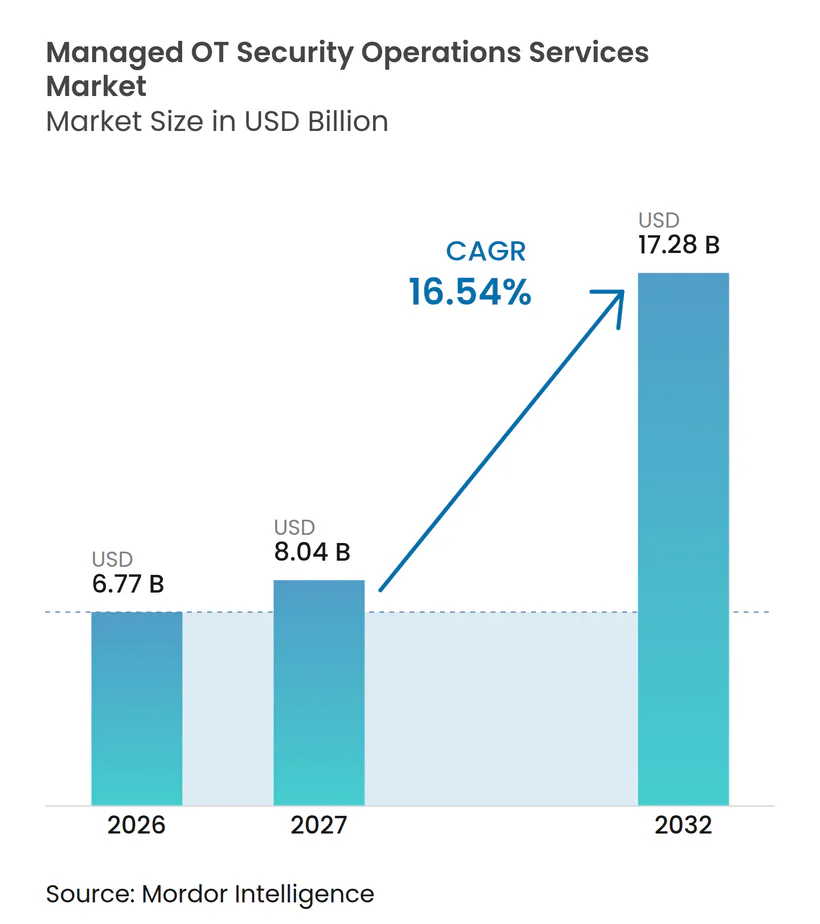
The managed OT security operations services market size is projected to expand from USD 6.77 billion in 2026 and USD 8.04 billion in 2027 to USD 17.28 billion by 2032, registering a CAGR of 16.54% between 2027 and 2032. The managed OT security operations services market is being shaped by the difficulty of protecting production systems that are now connected to enterprise networks, remote users, and cloud applications. Industrial operators increasingly need continuous monitoring, but they also need security teams that understand process safety, industrial protocols, and production constraints. Ransomware, state-linked activity, regulatory reporting, and remote vendor access are pushing security work from isolated projects toward recurring service contracts. Providers that combine passive OT monitoring with practical response procedures can address a gap that conventional IT security operations often cannot cover. The managed OT security operations services market also has room to expand as cloud delivery and modular packages make managed monitoring more accessible to smaller operators.
Key Report Takeaways
- By service model, Fully Managed OT SOC and MDR held 34.28% of the managed OT security operations services market share in 2026, while Managed Threat Hunting is projected to expand at a 16.87% CAGR through 2032.
- By security function, Network Security Monitoring and Detection held 23.37% of revenue in 2026, while Threat Intelligence and Threat Hunting is projected to expand at a 16.96% CAGR through 2032.
- By deployment mode, Cloud-Hosted services accounted for 36.84% of revenue in 2026 and are projected to expand at a 17.21% CAGR through 2032.
- By organization size, Large Enterprises held 76.22% of revenue in 2026, while Small and Medium Enterprises are projected to expand at a 127.16% CAGR through 2032.
- By end-user industry, Energy and Utilities held 21.87% of revenue in 2026, while Building Automation and Data Centers is projected to expand at a 17.21% CAGR through 2032.
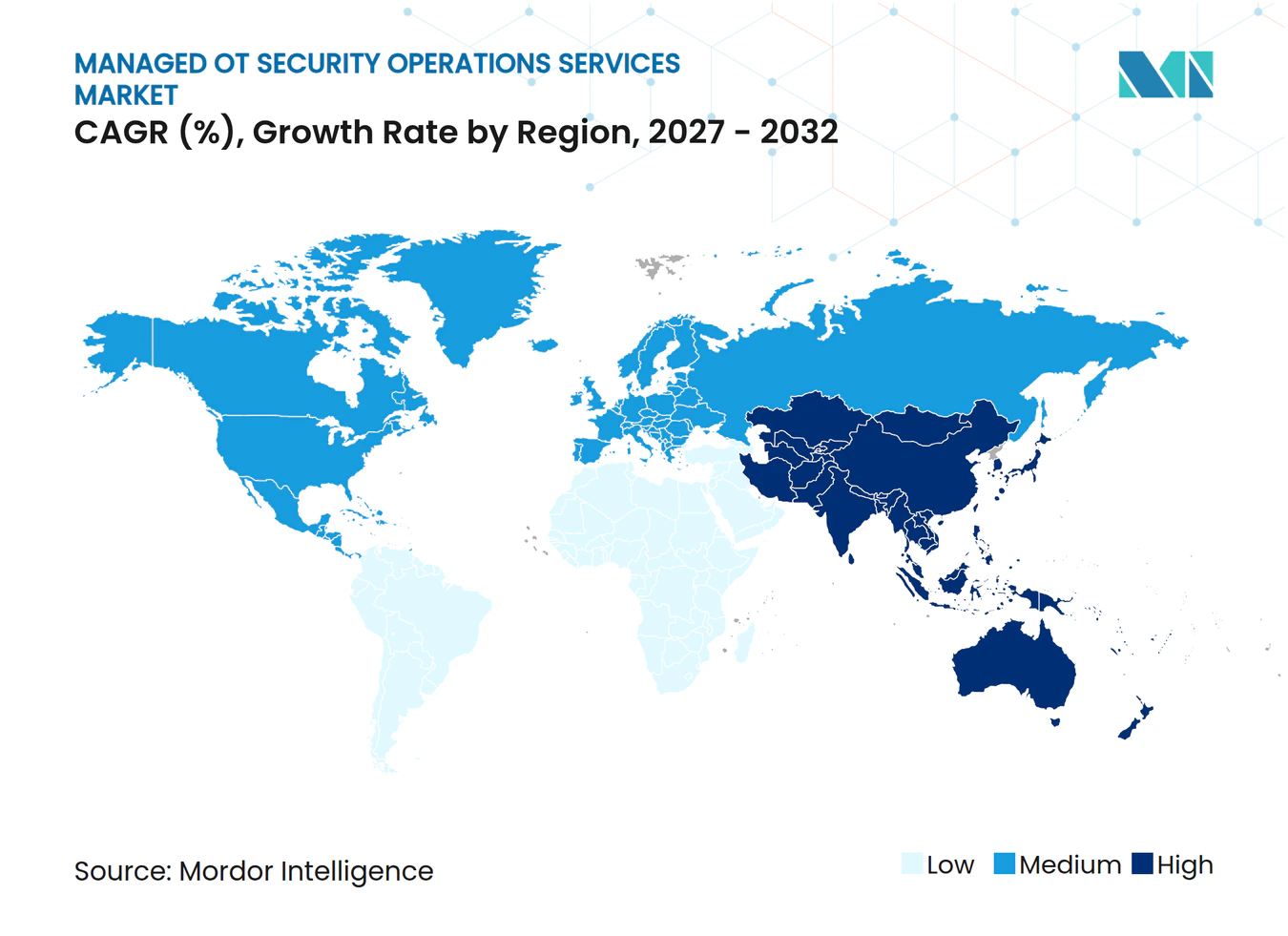
- By geography, North America held 39.88% of revenue in 2026, while Asia-Pacific is projected to expand at a 17.94% CAGR through 2032.
Note: Market numbers in this report are based on Mordor Intelligence's proprietary estimation framework, which combines nine months of actuals with Q4 projections for base year 2026.
Market Trends and Insights
Drivers Impact Analysis of Managed OT Security Operations Services Market*
| Driver | (~) % Impact on CAGR Forecast | Geographic Relevance | Impact Timeline |
|---|---|---|---|
| Escalating Ransomware and Nation-State Attacks | +4.5% | Global, with peak intensity in North America, Europe, and Asia-Pacific critical infrastructure | Short term (≤ 2 years) |
| IT/OT Convergence and Industrial Digitalization | +3.8% | Global, accelerated in Asia-Pacific manufacturing corridors and North American energy grids | Medium term (2-4 years) |
| Regulatory Compliance and Reporting Requirements | +2.8% | North America and Europe, with spillover to Middle East and Africa through national critical infrastructure mandates | Medium term (2-4 years) |
| OT Cybersecurity Talent Shortages | +2.2% | Global, with the sharpest need in Asia-Pacific, Middle East and Africa, and South America | Long term (≥ 4 years) |
| Safety-Critical Change Windows Driving Outsourcing | +1.5% | Global energy, utilities, oil and gas, concentrated in North America and Europe | Long term (≥ 4 years) |
| Vendor Remote Access Sprawl Across Multi-Site Plants | +1% | Global, with high density in discrete and process manufacturing hubs | Medium term (2-4 years) |
| Source: Mordor Intelligence | |||
Escalating Ransomware and Nation-State Attacks
Ransomware has shifted from opportunistic data encryption toward operational disruption in industrial settings. Dragos tracked ransomware affecting 3,300 industrial organizations in 2025, and manufacturers represented more than two-thirds of the victims.[1] The pattern makes downtime a direct business risk for facilities that rely on continuous processes and tightly controlled production schedules. The managed OT security operations services market benefits when security leaders require continuous detection rather than periodic reviews of logs and alerts. State-linked actors can also seek access long before an event becomes visible to operations teams. Managed threat hunting is therefore becoming more relevant for organizations that need analysts to search for unusual behavior before it reaches safety-critical processes.
IT/OT Convergence and Industrial Digitalization
Remote operations platforms, cloud-linked edge devices, and predictive maintenance tools have narrowed the separation between information technology and operational technology. A 2025 University of Turku study found that hybrid IT and OT environments benefit from a framework aligned with IEC 62443 and ISO 27001.[2] Applying those standards in daily operations requires security staff who understand both digital systems and industrial processes. Passive monitoring remains essential because active scanning can disrupt programmable logic controllers and distributed control systems. The managed OT security operations services market is supported by providers that correlate IT and OT telemetry without forcing plants to run separate security teams. A unified service can also simplify the handoff between security personnel, engineers, and site operations.
Regulatory Compliance and Reporting Requirements
Compliance requirements are becoming a practical reason to procure managed services, especially across North America and Europe. The European Commission proposed a cybersecurity package in January 2026 that would extend the EU Cybersecurity Certification Framework to managed security services.[3] This direction increases the importance of documented monitoring, incident handling, and supplier controls in regulated procurement. IEC 62443, NERC CIP, NIS2, and CIRCIA shape many procurement timelines because they link security controls to reporting and accountability. Managed providers can help customers maintain records of monitored events, response actions, and access controls. The managed OT security operations services market gains from this need for ongoing evidence rather than one-time compliance assessments.
OT Cybersecurity Talent Shortages
OT security roles require expertise in industrial protocols, security operations, and process safety. Honeywell and Westlands Advisory reported that many industrial organizations globally had either no security program or only an early-stage program. Establishing an in-house, around-the-clock security team is challenging when specialized talent is scarce, and retention costs are high. This shortage is particularly significant in regions where industrial capacity is expanding faster than the availability of specialized security skills. Managed service contracts transform hiring and coverage challenges into predictable operating expenses. This supports the managed OT security operations services market among organizations that cannot justify a dedicated internal OT security operations center.
Restraints Impact Analysis of Managed OT Security Operations Services Market*
| Restraint | (~) % Impact on CAGR Forecast | Geographic Relevance | Impact Timeline |
|---|---|---|---|
| Legacy Systems and Proprietary Protocols | -2.2% | Global, with high concentrations in North American energy infrastructure and European process industries | Long term (≥ 4 years) |
| High Cost and Operational Disruption of Remediation | -1.8% | Global, most acute in energy, oil and gas, and continuous-process manufacturing | Long term (≥ 4 years) |
| Alert Context Loss Across Mixed OEM Fleets | -0.8% | Global, particularly in multi-vendor plant environments in Asia-Pacific and South America | Medium term (2-4 years) |
| Data Residency and Cross-Border SOC Constraints | -0.5% | Asia-Pacific, Middle East and Africa, and European compliance jurisdictions | Medium term (2-4 years) |
| Source: Mordor Intelligence | |||
Legacy Systems and Proprietary Protocols
Legacy supervisory control and data acquisition systems and programmable logic controllers can be difficult to monitor safely. A 2025 systematic review identified legacy OT systems and the absence of security standards for older industrial protocols as key gaps in OT SOC effectiveness. Many devices provide limited security telemetry, communicate through proprietary protocols, or respond unpredictably to active scans. Providers may need to install passive network taps and develop custom protocol parsers at individual sites. These requirements extend implementation timelines and increase early contract costs. The managed OT security operations services market must therefore accommodate equipment that may remain in operation for 15 to 20 years without receiving a security update.
High Cost and Operational Disruption of Remediation
Response actions in OT environments require careful coordination because abrupt changes can disrupt production. In refining, chemical manufacturing, and water treatment, an unplanned shutdown can cost more than a managed service contract. This drives demand for preventive monitoring but also limits the speed at which providers can isolate assets or implement configuration changes. Siemens stated that its managed detection and response service can significantly reduce investment and ongoing operating costs compared with an in-house security operations center. Providers require pre-approved industrial response playbooks and clear authorization protocols to minimize delays. These operational constraints can slow deployment in the managed OT security operations services market, even when the need for protection remains strong.
*Our forecasts treat driver/restraint impacts as directional, not additive. The impact forecasts reflect baseline growth, mix effects, and variable interactions.
Managed OT Security Operations Services Market Segment Analysis
By Service Model:
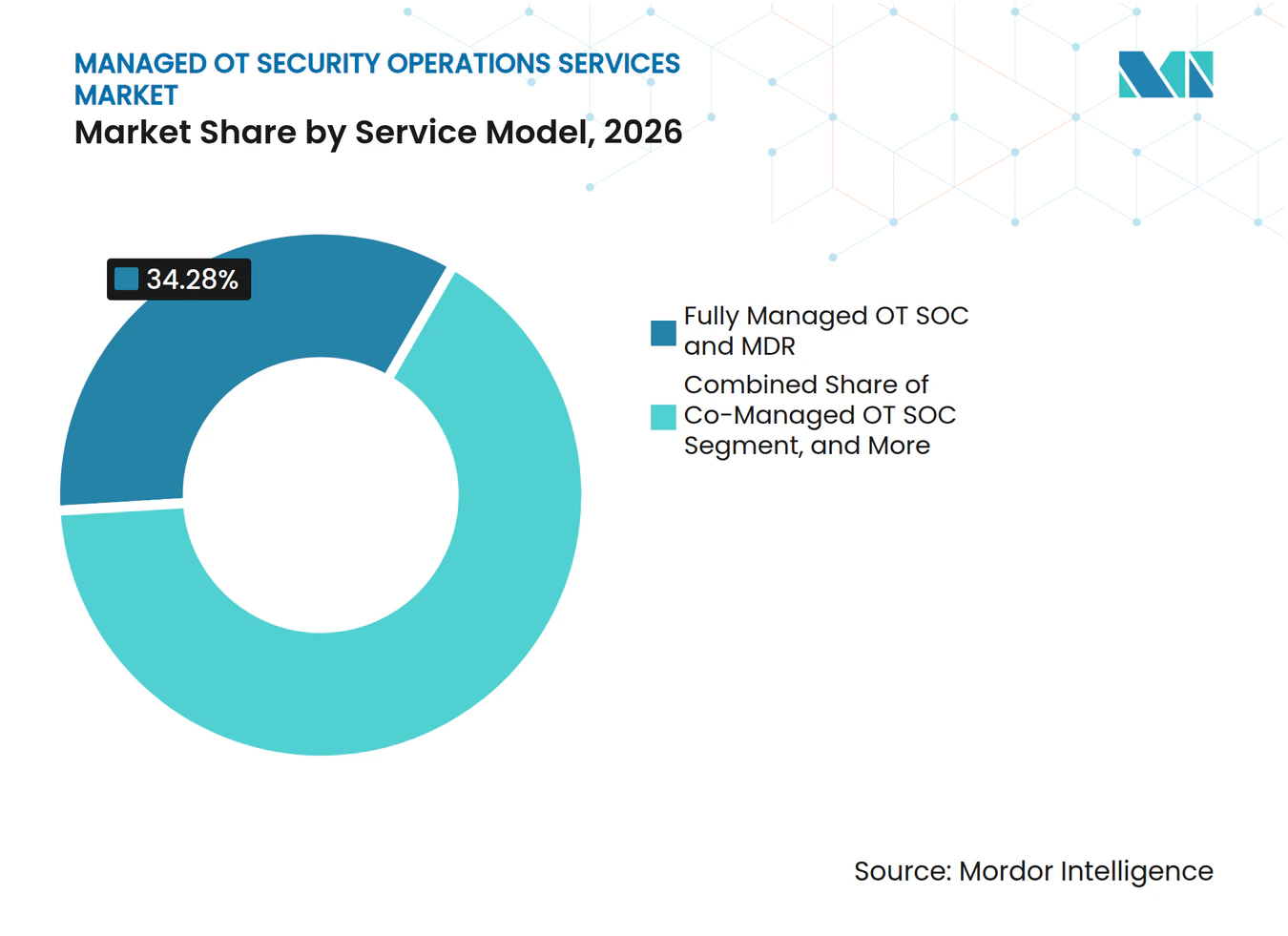
Fully Managed OT SOC Anchors Revenue, Threat Hunting AcceleratesFully Managed OT SOC and MDR held 34.28% of the managed OT security operations services market share in 2026. The service appeals to buyers that want detection and response coverage without staffing every shift internally. Continuous in-house OT SOC coverage can require 4 to 5 full-time analysts at a site, which is practical for only the largest operators. Co-Managed OT SOC services suit organizations that retain internal expertise but need coverage outside standard working hours. Managed OT Platform and Detection Operations serve customers that have visibility technology but need detection content and alert triage. Incident Response Retainers, OT Vulnerability and Exposure Management, and professional services cover readiness, audit support, onboarding, and specialized response needs.
Managed Threat Hunting is projected to expand at a 16.87% CAGR from 2027 to 2032. The service addresses organizations that have basic visibility but need to find activity that does not trigger ordinary alert thresholds. Retainer contracts increasingly use pre-negotiated OT playbooks and production-pause authorization procedures. Those terms can shorten response time after an incident is confirmed. Dragos acquired runZero and NetRise in September 2026 to add asset discovery and composition analysis to its OT cybersecurity platform. The managed OT security operations services market is moving from project work toward recurring contracts as compliance obligations, operations complexity, and staffing needs become more persistent.



By Security Function:
Network Monitoring Leads, Proactive Hunting Gains GroundNetwork Security Monitoring and Detection held 23.37% of revenue in 2026. Passive traffic analysis is important when endpoint agents cannot be safely deployed on programmable logic controllers, distributed control systems, or remote terminal units. Asset Discovery, Inventory, and Risk Contextualization often serve as the starting point, as accurate inventories are necessary for effective monitoring. Endpoint and Industrial Device Monitoring, along with Identity, Privileged Access, and Remote Access Monitoring, cover a growing vendor-access surface. Multi-site plants often provide remote credentials to many original equipment manufacturer maintenance teams. Security Information and Event Management and SOAR Operations then combine these signals into ranked incident queues and reporting records.
Threat Intelligence and Threat Hunting are projected to expand at a 16.96% CAGR from 2027 to 2032. Its role is to identify industrial adversary behavior through protocol-aware telemetry rather than relying solely on general-purpose alerting. NTT DATA launched UnifiedMDR for OT Security in Japan in March 2025 and targeted JPY 22 billion (USD 147 million) in combined annual UnifiedMDR revenue by 2027. Vulnerability and Configuration Monitoring, plus Incident Response, Forensics, and Recovery Guidance, also matter in regulated sectors that require documented post-incident actions. OT-specialist providers can retain customers when they show lower false-positive rates and faster containment in industrial settings. This position supports the managed OT security operations services market, where general-purpose MSSP platforms lack an industrial context.
By Deployment Mode:
Cloud-Hosted Services Lead on Both Share and GrowthCloud-Hosted services held 36.84% of revenue in 2026 and are projected to expand at a 17.21% CAGR through 2032. Centralized cloud data platforms can aggregate telemetry across sites and identify patterns that may not be visible at one facility. The model is useful for customers with dispersed operations and limited local security resources. On-Premises deployment continues to serve defense, nuclear, and some energy grid environments with strict sovereignty or air-gap requirements. Hybrid deployment processes telemetry locally and sends normalized events to cloud-based security information and event management and response platforms. This structure helps organizations balance local controls with centralized analysis.
The managed OT security operations services market size for Cloud-Hosted delivery reflects both adoption by early users and new demand from late adopters. Standard onboarding processes and application programming interface integrations can reduce the site-by-site preparation that once favored On-Premises installations. Open Systems and Nozomi Networks announced a partnership in April 2026 for fully managed OT, IoT, and cyber-physical system security using co-managed SASE and zero-trust models. The partnership targets manufacturing, energy, and critical infrastructure customers. Cloud services will still need to address data residency rules and customer requirements for local control. Hybrid architectures give providers a route to serve those customers without abandoning centralized analytics.
By Organization Size:
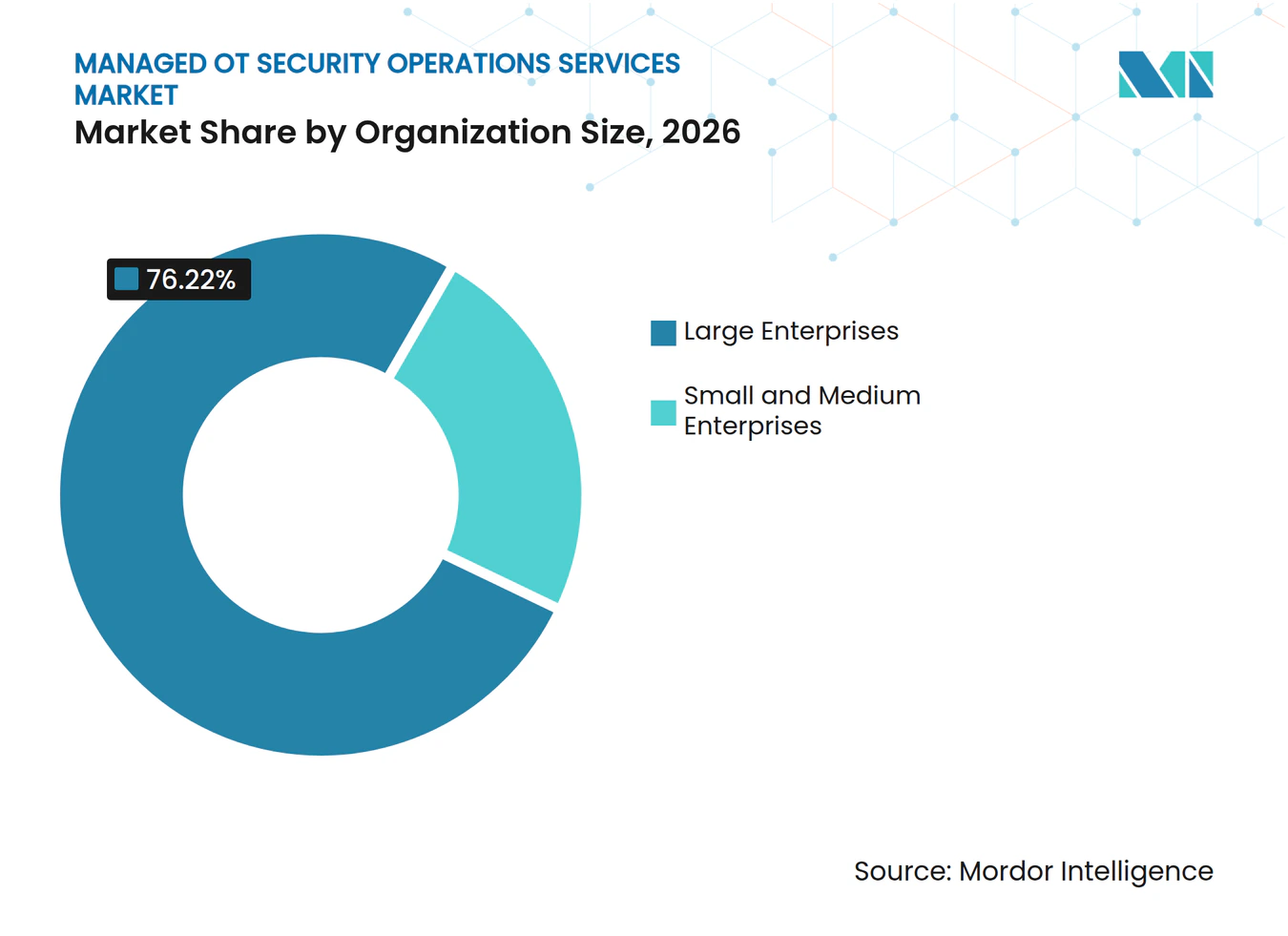
Large Enterprises Lead, SME Adoption AcceleratesLarge Enterprises held 76.22% of revenue in 2026. Their multi-site OT estates, regulatory exposure, and varied equipment fleets create a strong case for managed service contracts. These operators also face a larger vendor-access perimeter and more complex coordination between security teams and operations staff. This revenue position reflects the scale needed to justify broad service coverage. Small and Medium Enterprises have historically delayed security investments because specialized services were expensive and difficult to procure. Modular cloud services and standard per-site pricing are reducing that barrier.
Small and Medium Enterprises are projected to expand at a 127.16% CAGR from 2027 to 2032. NIS2 obligations and cyber insurance requirements are prompting more mid-market operators to formalize monitoring arrangements. Honeywell expanded its OT Cybersecurity Suite in June 2026 with an OT SOC service that offers 24/7 network and endpoint monitoring across vendors. The offering includes service tiers that can serve both large enterprises and mid-market users. Competition for smaller customers is becoming more active as regional providers use cloud delivery and flexible packaging. The managed OT security operations services market could see greater service differentiation around rapid onboarding, practical response support, and accessible contract sizes.

By End-User Industry:
Energy and Utilities Lead, Building Automation and Data Centers Grow FastestEnergy and Utilities held 21.87% of revenue in 2026. High-consequence downtime, nation-state targeting, and NERC CIP reporting requirements sustain demand in this end-user group. Oil and gas depend on remote monitoring across geographically distributed infrastructure. Discrete Manufacturing operates many plants and typically manages extensive third-party vendor access. Process Manufacturing, Transportation and Logistics, and Pharmaceuticals and Life Sciences need careful response actions because safety rules and operational standards limit aggressive remediation. Water and Wastewater, Healthcare Facilities, Mining and Metals, and Chemicals are also adopting managed monitoring as reporting duties expand.
Building Automation and Data Centers are projected to expand at a 17.21% CAGR from 2027 to 2032. Data center operators increasingly connect building management, cooling, and power distribution systems with enterprise computing environments. This creates a converged attack surface that ordinary IT security operations may not cover adequately. The segment is also affected by critical infrastructure rules, data protection requirements, and grid security expectations. Healthcare Facilities have a related need because connected devices and building systems bring OT risks into organizations with limited dedicated OT security staff. The managed OT security operations services market is well positioned where customers need a practical service model instead of building an internal specialist team.
Geography Analysis
North America Managed OT Security Operations Services Market
North America held 39.88% of revenue in 2026. Its leadership is supported by a high concentration of regulated critical infrastructure and a mature managed security service provider ecosystem. NERC CIP, Transportation Security Administration pipeline directives, and CIRCIA reporting timelines support ongoing security spending in the managed OT security operations services market. Canada is seeing stronger adoption in energy and mining, while Mexico presents an opportunity through nearshoring-driven manufacturing investment. Trustwave launched an OT security services portfolio in July 2025 that combined design, testing, and a co-managed SOC using Nozomi Networks monitoring and SpiderLabs threat intelligence.
Europe Managed OT Security Operations Services Market
Europe is influenced by the implementation of NIS2 and national critical infrastructure requirements. Germany’s NIS 2 Implementation Act took effect on December 6, 2025, and its requirements have increased attention to continuous monitoring and incident reporting. The United Kingdom, Germany, and France account for much of the region’s demand. Siemens launched a NIS2-compliant Managed Detection and Response service in April 2026 for energy suppliers and critical infrastructure operators. Eastern European operators are also increasing adoption because of heightened geopolitical concerns and regulatory timelines.
APAC, MEA and South America Managed OT Security Operations Services Market
Asia-Pacific is projected to expand at a 17.94% CAGR from 2027 to 2032. China, Japan, India, and Southeast Asia have different demand patterns, but all combine industrial digitalization with a need for more specialized OT security skills. NTT DATA’s Japan launch reflects investment by large service providers in a localized managed detection and response model. Rockwell Automation opened a Security Operations Center in Singapore in February 2026 to provide 24/7 managed OT detection and response across Asia-Pacific. The managed OT security operations services market also has opportunities in Middle East and Africa and South America, where energy, manufacturing, mining, and data residency needs support localized delivery models.
Competitive Landscape
Market Concentration
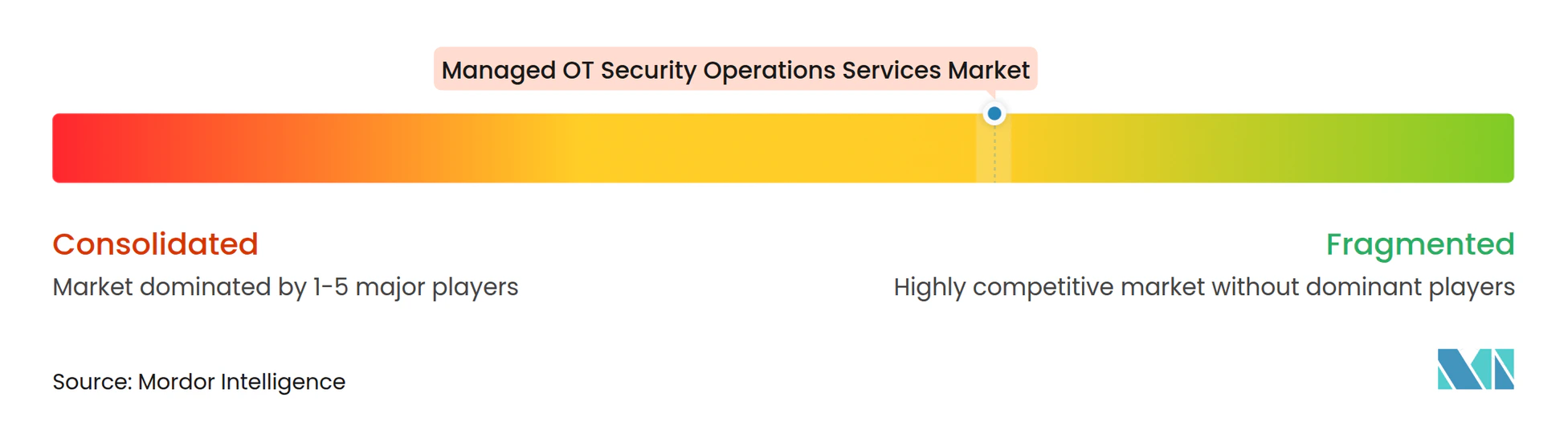
The managed OT security operations services market is moderately fragmented because no single provider combines OT protocol depth, full service coverage, and global reach across every customer category. Dragos, Claroty, and Nozomi Networks compete through industrial visibility and threat intelligence. Honeywell, Siemens, Rockwell Automation, and Schneider Electric can combine security services with long-standing equipment relationships. Accenture, IBM, NTT DATA, Wipro, and Capgemini compete with SOC scale and broader IT and OT integration. IEC 62443 certification and NIS2 compliance evidence are becoming important qualifications in European procurement.
Partnerships are an important route to broader coverage. Rockwell Automation expanded SecureOT managed services in October 2026 to support Fortinet FortiGate firewalls and customer-owned infrastructure. This approach allows manufacturers to bring existing equipment under managed operations without a hardware replacement. Dragos acquired runZero and NetRise in September 2026 to connect asset discovery, composition analysis, and response capabilities. Honeywell’s June 2026 suite expansion added behavioral analytics, deception technology, and a vendor-agnostic OT SOC.
The managed OT security operations services market has a gap in building automation and data center protection, where converged environments need both IT and industrial context. Smaller providers can compete in small and medium enterprise and remote multi-site environments through modular cloud packages and flexible pricing, while larger incumbents retain advantages in geographic coverage, response capacity, and integration with customer technology estates. Detection quality and the ability to use OT-specific response procedures are becoming as important as analyst headcount. Providers also need to demonstrate that their service works across mixed equipment fleets and local compliance requirements.
Managed OT Security Operations Services Industry Leaders
-
Honeywell International Inc.
-
Siemens AG
-
IBM Corporation
-
Accenture plc
-
Rockwell Automation, Inc.
- *Disclaimer: Major Players sorted in no particular order
Managed OT Security Operations Services Market Companies Covered in this Report
- Accenture plc
- Atos SE
- Capgemini SE
- Cisco Systems, Inc.
- Claroty Ltd.
- Dragos, Inc.
- Ernst & Young Global Limited
- Fortinet, Inc.
- Honeywell International Inc.
- IBM Corporation
- KPMG International Limited
- Nozomi Networks Inc.
- NTT DATA Corporation
- Palo Alto Networks, Inc.
- PricewaterhouseCoopers International Limited
- Rockwell Automation, Inc.
- Schneider Electric SE
- Siemens AG
- Tenable, Inc.
- Wipro Limited
Recent Industry Developments in Managed OT Security Operations Services Market
- October 2026: Rockwell Automation expanded SecureOT managed services with Firewall Managed Services supporting Fortinet FortiGate firewalls and Infrastructure Managed Services providing 24/7 monitoring and hardware lifecycle management for customer-owned servers, switches, and virtualization platforms. The expansion enables manufacturers to bring existing third-party infrastructure under managed operations without hardware replacement, broadening addressable contract scope across multi-vendor plant environments.
- September 2026: Dragos acquired runZero and NetRise to complete an end-to-end extended OT cybersecurity platform. The acquisitions add network discovery and firmware/software composition analysis to Dragos's managed detection and incident response capabilities, enabling integrated asset-to-threat visibility for managed OT security operations customers.
- June 2026: Honeywell launched five new OT Cybersecurity Suite capabilities, including AI-powered Cyber Proactive Defense using behavioral analytics and deception technology, and a vendor-agnostic OT SOC managed service with 24/7 network and endpoint monitoring for industrial operators globally.
- April 2026: Open Systems AG and Nozomi Networks announced a strategic partnership to deliver fully managed OT, IoT, and cyber-physical system security across Europe and global markets via co-managed SASE and zero-trust operating models for manufacturing, energy, and critical infrastructure customers.
Global Managed OT Security Operations Services Market Report Scope
The Managed OT Security Operations Services Market comprises outsourced, 24/7 security services that monitor, detect, investigate, and respond to cyber threats targeting operational technology (OT) environments, including industrial control systems (ICS), SCADA, distributed control systems (DCS), and programmable logic controllers (PLCs) across manufacturing, energy/utilities, oil and gas, transportation, and critical infrastructure.
The Managed OT Security Operations Services Market Report is Segmented by Service Model (Fully Managed OT SOC and MDR, Co-Managed OT SOC, Managed OT Platform and Detection Operations, Managed Threat Hunting, Incident Response Retainers and Emergency Response, OT Vulnerability, Exposure, and Compliance Management, and Professional Services Supporting Managed Operations), Security Function (Network Security Monitoring and Detection, Asset Discovery, Inventory, and Risk Contextualization, Endpoint and Industrial Device Monitoring, Identity, Privileged Access, and Remote Access Monitoring, Vulnerability and Configuration Monitoring, Threat Intelligence and Threat Hunting, Incident Response, Forensics, and Recovery Guidance, and Security Information and Event Management and SOAR Operations), Deployment Mode (On-Premises, Cloud-Hosted, and Hybrid), Organization Size (Large Enterprises and Small and Medium Enterprises), End-User Industry (Energy and Utilities, Oil and Gas, Discrete Manufacturing, Process Manufacturing, Transportation and Logistics, Mining and Metals, Pharmaceuticals and Life Sciences, Water and Wastewater, Healthcare Facilities, Chemicals, Building Automation and Data Centers, and Other End-User Industries), and Geography (North America, South America, Europe, Asia-Pacific, and Middle East and Africa). The Market Forecasts Are Provided in Terms of Value (USD).
Segmentation Overview
| Fully Managed OT SOC and MDR |
| Co-Managed OT SOC |
| Managed OT Platform and Detection Operations |
| Managed Threat Hunting |
| Incident Response Retainers and Emergency Response |
| OT Vulnerability, Exposure, and Compliance Management |
| Professional Services Supporting Managed Operations |
| Network Security Monitoring and Detection |
| Asset Discovery, Inventory, and Risk Contextualization |
| Endpoint and Industrial Device Monitoring |
| Identity, Privileged Access, and Remote Access Monitoring |
| Vulnerability and Configuration Monitoring |
| Threat Intelligence and Threat Hunting |
| Incident Response, Forensics, and Recovery Guidance |
| On-Premises |
| Cloud-Hosted |
| Hybrid |
| Large Enterprises |
| Small and Medium Enterprises |
| Energy and Utilities |
| Oil and Gas |
| Manufacturing |
| Mining and Metals |
| Pharmaceuticals and Life Sciences |
| Water and Wastewater |
| Other End-User Industries |
| North America | United States |
| Canada | |
| Mexico | |
| South America | Brazil |
| Argentina | |
| Chile | |
| Rest of South America | |
| Europe | Germany |
| United Kingdom | |
| France | |
| Italy | |
| Rest of Europe | |
| Asia-Pacific | China |
| Japan | |
| India | |
| South Korea | |
| Rest of Asia-Pacific | |
| Middle East and Africa | Saudi Arabia |
| United Arab Emirates | |
| South Africa | |
| Egypt | |
| Rest of Middle East and Africa |
| By Service Model | Fully Managed OT SOC and MDR | |
| Co-Managed OT SOC | ||
| Managed OT Platform and Detection Operations | ||
| Managed Threat Hunting | ||
| Incident Response Retainers and Emergency Response | ||
| OT Vulnerability, Exposure, and Compliance Management | ||
| Professional Services Supporting Managed Operations | ||
| By Security Function | Network Security Monitoring and Detection | |
| Asset Discovery, Inventory, and Risk Contextualization | ||
| Endpoint and Industrial Device Monitoring | ||
| Identity, Privileged Access, and Remote Access Monitoring | ||
| Vulnerability and Configuration Monitoring | ||
| Threat Intelligence and Threat Hunting | ||
| Incident Response, Forensics, and Recovery Guidance | ||
| By Deployment Mode | On-Premises | |
| Cloud-Hosted | ||
| Hybrid | ||
| By Organization Size | Large Enterprises | |
| Small and Medium Enterprises | ||
| By End-User Industry | Energy and Utilities | |
| Oil and Gas | ||
| Manufacturing | ||
| Mining and Metals | ||
| Pharmaceuticals and Life Sciences | ||
| Water and Wastewater | ||
| Other End-User Industries | ||
| By Geography | North America | United States |
| Canada | ||
| Mexico | ||
| South America | Brazil | |
| Argentina | ||
| Chile | ||
| Rest of South America | ||
| Europe | Germany | |
| United Kingdom | ||
| France | ||
| Italy | ||
| Rest of Europe | ||
| Asia-Pacific | China | |
| Japan | ||
| India | ||
| South Korea | ||
| Rest of Asia-Pacific | ||
| Middle East and Africa | Saudi Arabia | |
| United Arab Emirates | ||
| South Africa | ||
| Egypt | ||
| Rest of Middle East and Africa | ||
Key Questions Answered in the Report
What is the managed OT security operations services market size?
The managed OT security operations services market size is USD 6.77 billion in 2026 and is projected to reach USD 17.28 billion by 2032, at a 16.54% CAGR from 2027 to 2032.
Why are industrial organizations using managed OT security services?
Operators use these services for continuous monitoring, OT-specific response support, compliance reporting, and access to specialized security skills.
Which service model leads managed OT security operations?
Fully Managed OT SOC and MDR leads with a 34.28% revenue share in 2026.
Which deployment approach is expanding fastest?
Cloud-Hosted deployment leads in both share and projected expansion, with 36.84% of revenue in 2026 and a 17.21% CAGR through 2032.
Which end-user group has the largest revenue share?
Energy and Utilities leads with a 21.87% revenue share in 2026 because downtime, compliance requirements, and targeted threats increase the need for continuous protection.
Which region is projected to expand fastest?
Asia-Pacific is projected to expand at a 17.94% CAGR from 2027 to 2032 as industrial digitalization and national cybersecurity requirements advance.