
Managed Network Security Policy Operations Services Market Size and Share
Market Overview
| Study Period | 2021 - 2032 |
|---|---|
| Market Size (2027) | USD 9.87 Billion |
| Market Size (2032) | USD 21.07 Billion |
| Growth Rate (2027 - 2032) | 16.37 % |
| Fastest Growing Market | Asia-Pacific |
| Largest Market | North America |
| Market Concentration | Medium |
Major Players *Disclaimer: Major Players sorted in no particular order Image © Mordor Intelligence. Reuse requires attribution under CC BY 4.0. | |
Managed Network Security Policy Operations Services Market Analysis by Mordor Intelligence
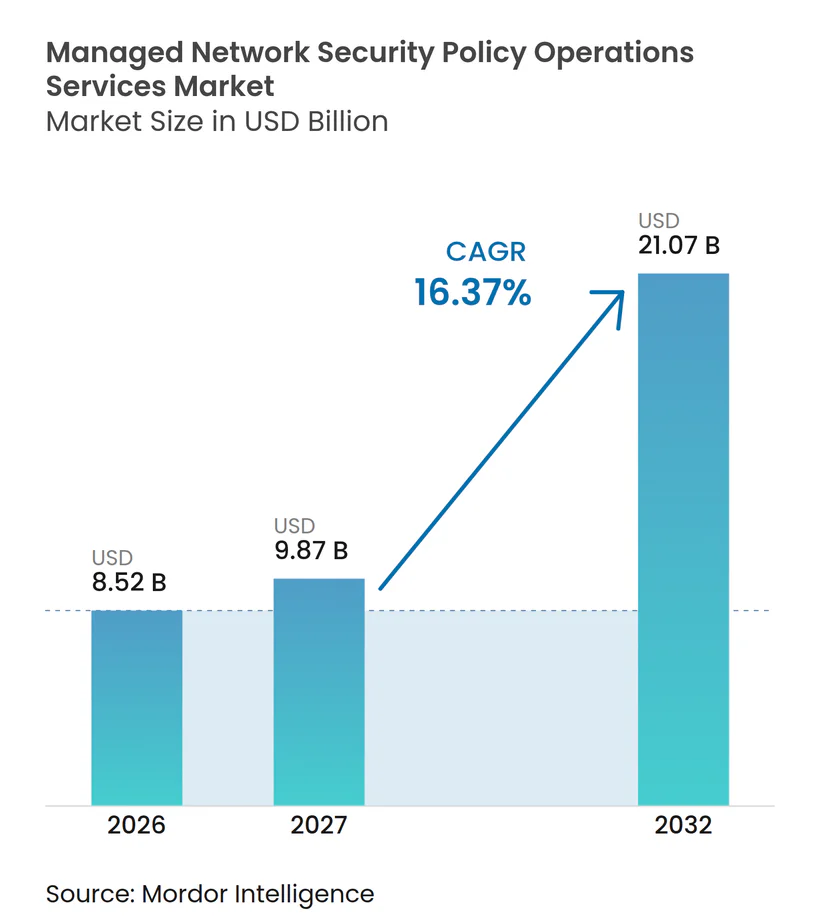
The Managed network security policy operations services market size is projected to expand from USD 8.52 billion in 2026 to USD 9.87 billion in 2027, and to USD 21.07 billion by 2032, registering a CAGR of 16.37% between 2027 and 2032. The Managed network security policy operations services market is driven by hybrid and multi-cloud environments, which have made manual firewall and access policy administration difficult to sustain. Security teams need reliable policy changes, documented approvals, and continuous rule monitoring across several platforms. Zero-trust requirements, secure access service edge adoption, and AI-supported orchestration are raising demand for continuous, vendor-neutral policy governance. Providers are increasingly combining policy administration with compliance evidence, thereby strengthening their value to regulated customers. The market also benefits from organizations that cannot maintain specialized, 24/7 policy operations teams internally.
Key Report Takeaways
- By service type, Firewall Policy Management held 48.12% of the Managed network security policy operations services market share in 2026, while Access Control and Segmentation Policy Management are projected to expand at a 17.32% CAGR through 2032.
- By deployment mode, On-Premise held 67.86% of the Managed network security policy operations services market share in 2026, while Cloud is projected to expand at a 17.66% CAGR through 2032.
- By organization size, Large Enterprises held 71.14% of the Managed network security policy operations services market share in 2026, while SMEs are projected to expand at a 17.92% CAGR through 2032.
- By end-user industry, BFSI held 29.15% of the Managed network security policy operations services market share in 2026, while Government and Public Administration is projected to expand at a 16.68% CAGR through 2032.
- By geography, North America held 37.22% of the Managed network security policy operations services market share in 2026, while Asia-Pacific is projected to expand at a 16.91% CAGR through 2032.
Note: Market numbers in this report are based on Mordor Intelligence's proprietary estimation framework, which combines nine months of actuals with Q4 projections for base year 2026.
Global Managed Network Security Policy Operations Services Market Trends and Insights
Drivers Impact Analysis*
| Driver | (~) % Impact on CAGR Forecast | Geographic Relevance | Impact Timeline |
|---|---|---|---|
| Cybersecurity Skills Shortages and 24/7 Operations Requirements | +3.8% | Global | Short term (≤ 2 years) |
| Increasing Complexity of Hybrid and Multi-Cloud Security Policies | +3.5% | North America and Europe, spill-over to Asia-Pacific | Medium term (2-4 years) |
| Rising Demand for Continuous Policy Compliance Evidence | +2.9% | EU, North America, Gulf Cooperation Council | Medium term (2-4 years) |
| Policy Automation for Faster Firewall and Access-Change Workflows | +2.2% | Global, early gains in North America and Asia-Pacific | Long term (≥ 4 years) |
| Expansion of Remote Access, Branch, and Third-Party Connectivity | +1.7% | Global | Short term (≤ 2 years) |
| Machine-Readable Security Controls for AI-Enabled Network Operations | +1.3% | North America and Asia-Pacific AI-forward markets | Long term (≥ 4 years) |
| Source: Mordor Intelligence | |||
Cybersecurity Skills Shortages and 24/7 Operations Requirements
Cybersecurity staffing remains the most immediate driver of demand for the Managed network security policy operations services market. Fortinet reported that 56% of organizations identified insufficient cybersecurity skills as the leading cause of breaches, while 71% said the shortage created a direct risk to their business in 2026. ISACA reported in 2025 that 55% of cybersecurity teams were understaffed and 65% of organizations had open positions that could not be filled within their current budgets. The same Fortinet research found that 52% of surveyed organizations said security breaches cost more than USD 1 million each. Policy administration requires experienced review of firewall changes, access controls, and compliance records. Providers in the Managed network security policy operations services market can pool these specialists across customers, which makes continuous monitoring and faster rule management more achievable for organizations with limited internal teams.
Increasing Complexity of Hybrid and Multi-Cloud Security Policies
Hybrid and multi-cloud policy complexity is a central source of demand for the Managed network security policy operations services market. A Cloud Security Alliance survey commissioned by AlgoSec found that only 9% of enterprises had fully integrated security policy management into development and deployment workflows in 2026. The survey also found that 61% continued to use manual or reactive policy-management approaches. Each cloud provider, SASE service, and SD-WAN edge can introduce separate enforcement rules, approvals, and logs. Cisco introduced intent-based policy management for its Hybrid Mesh Firewall in January 2026, allowing one intent specification to be applied across Cisco, Palo Alto Networks, Fortinet, and Juniper firewalls. Managed operators in the Managed network security policy operations services market normalize changes and detect policy drift across environments that internal teams struggle to monitor continuously.
Rising Demand for Continuous Policy Compliance Evidence
Continuous compliance evidence is changing how buyers assess the Managed network security policy operations services market. The EU Digital Operational Resilience Act became applicable to financial entities on January 17, 2025, requiring documented ICT risk-management practices and third-party ICT controls. The European Banking Authority amended its ICT and security risk-management guidelines in February 2025 to reflect DORA requirements. These requirements raise the need to log, attribute, and reconcile firewall-rule changes, access-policy modifications, and segmentation decisions quickly. Check Point introduced its Agentic Network Security Orchestration Platform in May 2026 with real-time mapping of rule and configuration changes to DORA, PCI DSS, and NIST frameworks. Managed network security policy operations services market providers that make compliance reporting part of routine policy operations can support customers that cannot separate operational work from audit preparation.
Policy Automation for Faster Firewall and Access-Change Workflows
Automation is becoming a main service differentiator in the Managed network security policy operations services market. Check Point stated in May 2026 that a typical network-security change request can take 2 to 4 weeks to analyze, review, and implement in a large enterprise. Tufin released Orchestration Suite R25-2 in November 2025, extending automated change design and proactive risk analysis to Zscaler Internet Access. AlgoSec launched Horizon in February 2025 to translate application connectivity requests into multi-vendor rule implementation without requiring teams to identify every underlying firewall path. These capabilities reduce manual handoffs between network, cloud, and security teams. In the managed network security policy operations services market, providers that pair automated change execution with risk analysis and clear turnaround commitments are better positioned than providers that offer monitoring without policy automation.
Restraints Impact Analysis*
| Restraint | (~) % Impact on CAGR Forecast | Geographic Relevance | Impact Timeline |
|---|---|---|---|
| Data Sovereignty and Outsourcing Control Concerns | -2.1% | EU, Asia-Pacific, Gulf Cooperation Council | Medium term (2-4 years) |
| Legacy Rule Translation and Multi-Vendor Migration Risk | -1.6% | Global, pronounced in Middle East and South America | Long term (≥ 4 years) |
| Alert Noise, Accountability Gaps, and Service-Level Ambiguity | -1.2% | Global | Short term (≤ 2 years) |
| High Switching Costs and Customer Preference for In-House Control | -0.9% | North America and Europe large-enterprise segment | Medium term (2-4 years) |
| Source: Mordor Intelligence | |||
Data Sovereignty and Outsourcing Control Concerns
Data residency requirements limit the addressable workload for the Managed network security policy operations services market across several fast-developing regions. GDPR requirements can restrict the international transfer of network configuration data that includes personal data elements, such as IP assignments, user-to-device mappings, or traffic logs.[1] China’s Data Security Law and Personal Information Protection Law impose localization requirements in relevant sectors, which can require in-country infrastructure and personnel for managed security operations. India’s Digital Personal Data Protection Act also regulates transfers of certain personal information processed by organizations, including financial and health-care operators. These requirements increase governance review and can extend procurement timelines for outsourced policy services. Providers in the Managed network security policy operations services market can address part of the concern through regional delivery centers and access controls that limit visibility by jurisdiction, but the necessary investment creates an entry barrier.
Legacy Rule Translation and Multi-Vendor Migration Risk
Legacy rule estates can make the first-time adoption of Managed network security policy operations services difficult. Enterprises often have firewall rules accumulated over 10 to 15 years, with entries that lack current business justification or refer to systems that no longer operate. A provider must translate these rules, remove redundant or shadowed entries, and confirm that the revised policy maintains necessary connectivity. A mistranslated rule can interrupt a production application or allow unauthorized lateral movement. The risk is especially significant in industrial manufacturing and health-care environments where an unplanned outage has operational and regulatory consequences. Formal lifecycle analytics and pre-migration risk assessments can reduce the concern, but multi-vendor migration remains a barrier when an estate spans 3 or more firewall platforms.
*Our forecasts treat driver/restraint impacts as directional, not additive. The impact forecasts reflect baseline growth, mix effects, and variable interactions.
Segment Analysis
By Service Type: Firewall Management Leads While Segmentation Supports Faster Expansion
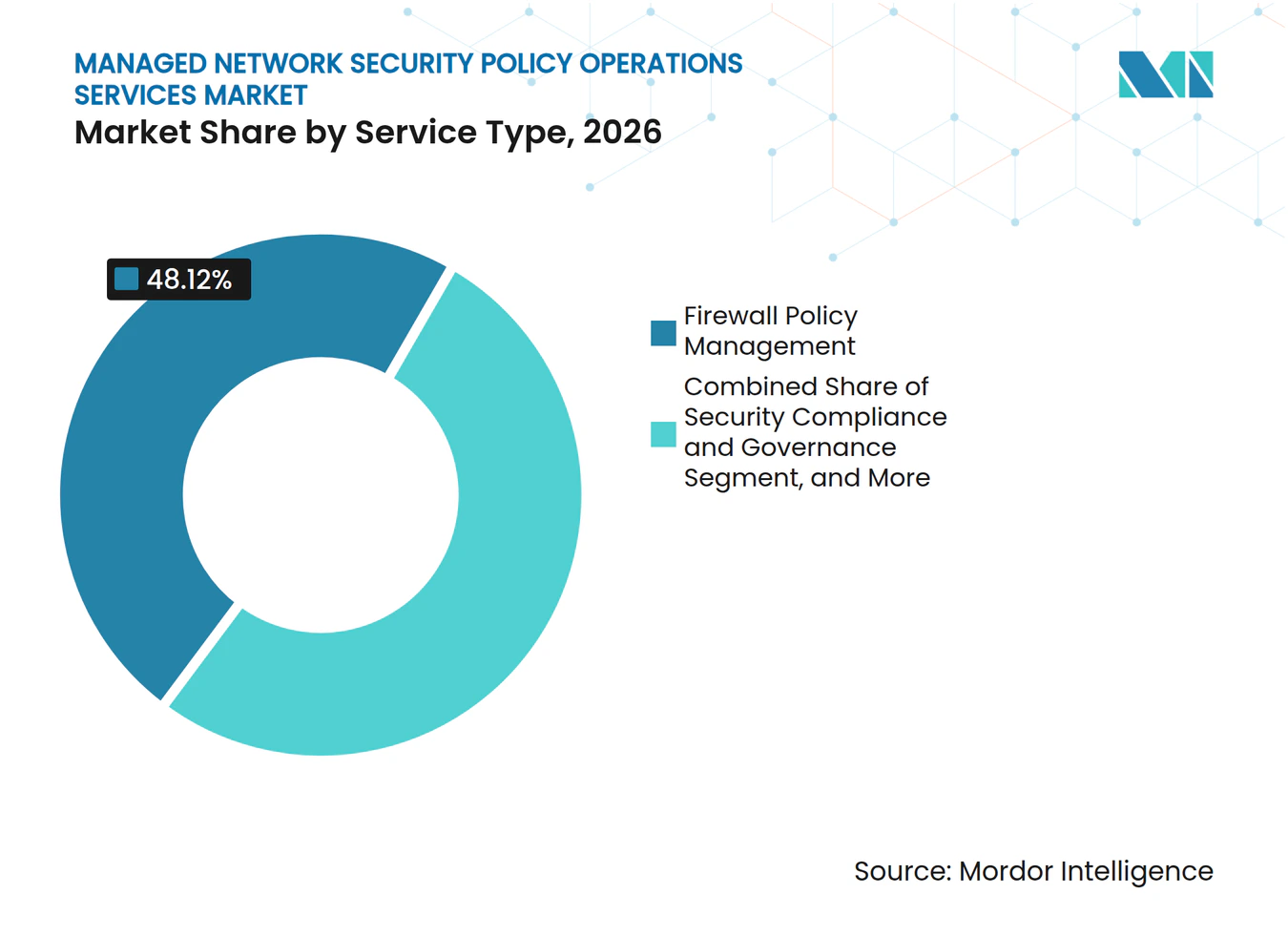
Firewall Policy Management held 48.12% of the Managed network security policy operations services market share in 2026. The segment remains the typical starting point for enterprises outsourcing perimeter security operations. Next-generation firewalls from Palo Alto Networks, Fortinet, Check Point, and Cisco are widely embedded in enterprise environments. Their rule lifecycles, firmware schedules, and compliance requirements create recurring operational work. This large installed base supports managed firewall policy administration and auditable change records across multiple locations and business units.
Access Control and Segmentation Policy Management is projected to expand at a 17.32% CAGR from 2027 to 2032. Zero-trust programs require detailed control of east-west connections, rather than perimeter-only enforcement. Threat Prevention Policy Management covers IPS, DLP, and application-layer controls as AI-related traffic and threats become more common. Check Point Research reported that AI services were present in more than 51% of enterprise networks each month in 2025.[2] Security Compliance and Governance services are expanding in regulated settings because DORA, NIS2, and sector-specific rules require continuous mapping between controls and requirements, while SD-WAN and SASE policy operations increase the need for unified policy management.



By Deployment Mode: On-Premise Systems Retain the Installed Base While Cloud Supports New Workloads
On-Premise held 67.86% of the Managed network security policy operations services market share in 2026. Large organizations continue to operate substantial next-generation firewall hardware estates under multi-year support contracts. Financial services organizations in the EU, U.S. government agencies, and state-owned enterprises in China often retain on-premises enforcement due to data residency and control requirements. Physical control of configuration data remains important in many compliance programs. These conditions preserve a significant role for on-premise managed policy operations and externally delivered expertise.
Cloud deployment is projected to expand at a 17.66% CAGR from 2027 to 2032. Firewall-as-a-service, SASE, and zero-trust network access place enforcement at the edge, rather than solely at a fixed perimeter. Netskope launched Netskope One AI Security in March 2026 with an Agentic Broker designed to decode Model Context Protocol traffic between AI agents and enterprise data sources. Hybrid environments combine on-premises firewalls, cloud security groups, and SASE edges, thereby raising operational complexity. Fortinet introduced Sovereign SASE options with FortiOS 8.0 in March 2026 to support customer-controlled enforcement locations with centralized cloud management.
By Organization Size: Large Enterprises Provide Most Revenue While SMEs Form the Faster-Growing Customer Group
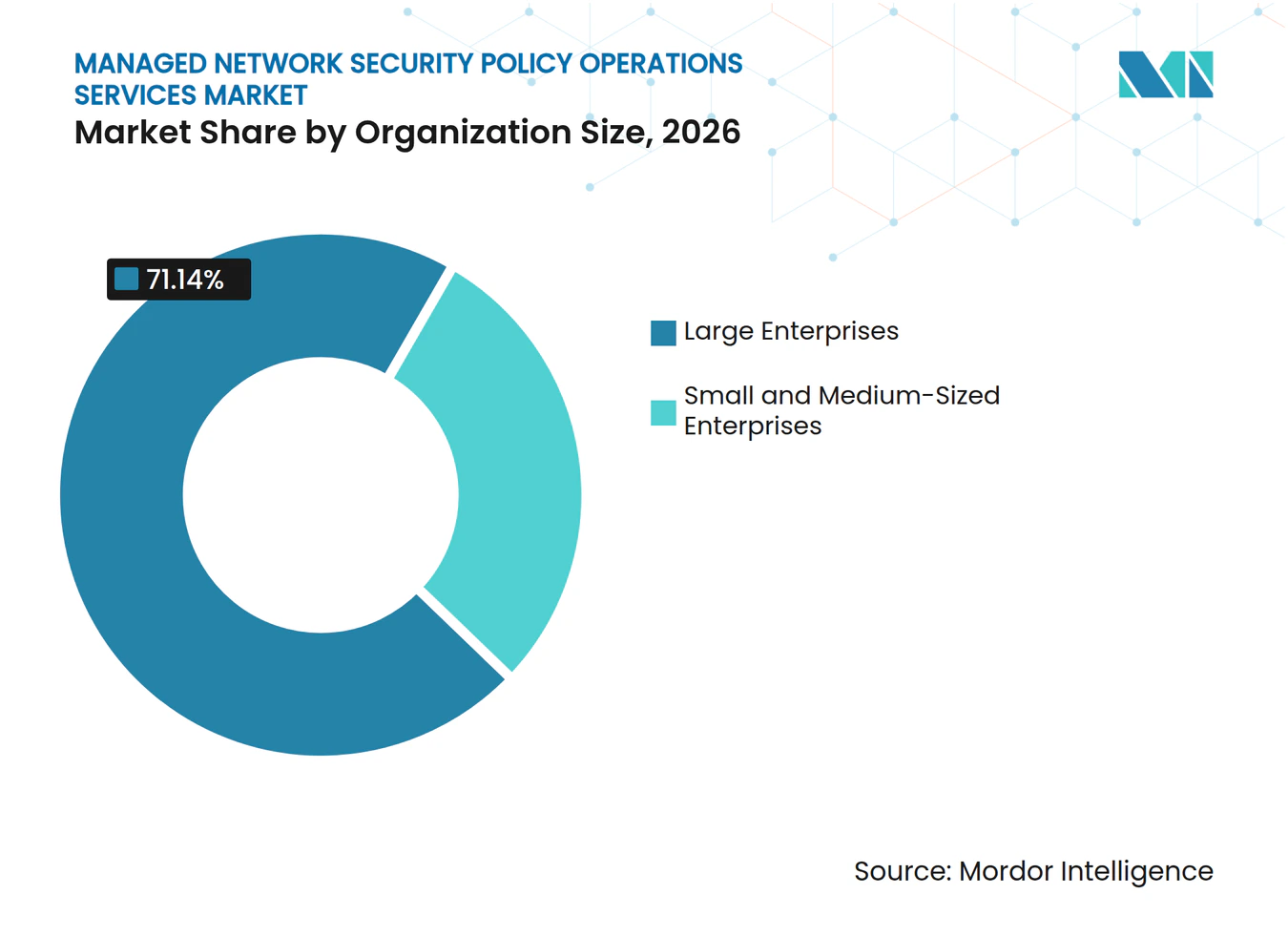
Large Enterprises held 71.14% of the Managed network security policy operations services market share in 2026. Their environments often include hundreds of devices, several geographies, and older multi-vendor configurations. Compliance needs and the cost of a policy failure make risk-checked policy changes commercially important. These organizations have complex approval processes and higher demands for formal reporting. Managed providers can support continuous administration without requiring every specialist role to be internal.
SMEs are projected to expand at a 17.92% CAGR from 2027 to 2032. Cloud-delivered services reduce upfront infrastructure requirements, while consumption-based pricing can align service costs with operational needs. NIS2 extends cybersecurity governance duties to entities with 50 or more employees in critical sectors. ENISA published an SME Cyber Resilience Maturity Assessment Model in July 2026 that aligns with the EU Cyber Resilience Act. Providers with guided onboarding, prebuilt compliance templates, and outcome-based service agreements can support this developing customer group.

By End-User Industry: BFSI Sets Requirements While Government and Public Administration Expands Faster
BFSI held 29.15% of the Managed network security policy operations services market share in 2026. Financial institutions face dense requirements for ICT risk management, third-party provider governance, and documented network security controls. DORA applies to EU financial entities and requires ongoing management of these obligations. The International Monetary Fund stated in 2025 that DORA had become the primary cybersecurity supervisory framework for EU financial entities. Global banks and insurers with EU operations must consider these requirements, making policy governance and compliance reporting important managed services.
Government and Public Administration is projected to expand at a 16.68% CAGR from 2027 to 2032. National cybersecurity strategies are moving disciplined access controls from defense use into civilian-agency procurement. Health-care and life-sciences organizations also require continuous security-policy documentation as privacy, health-care, and device requirements evolve. IT and Telecommunications organizations manage distributed networks that require consistent policy operations across many sites. Industrial Manufacturing, Retail and E-commerce, Education and Research Institutions, and other users drive demand for Managed network security policy operations services, driven by regulatory exposure and network complexity.
Geography Analysis
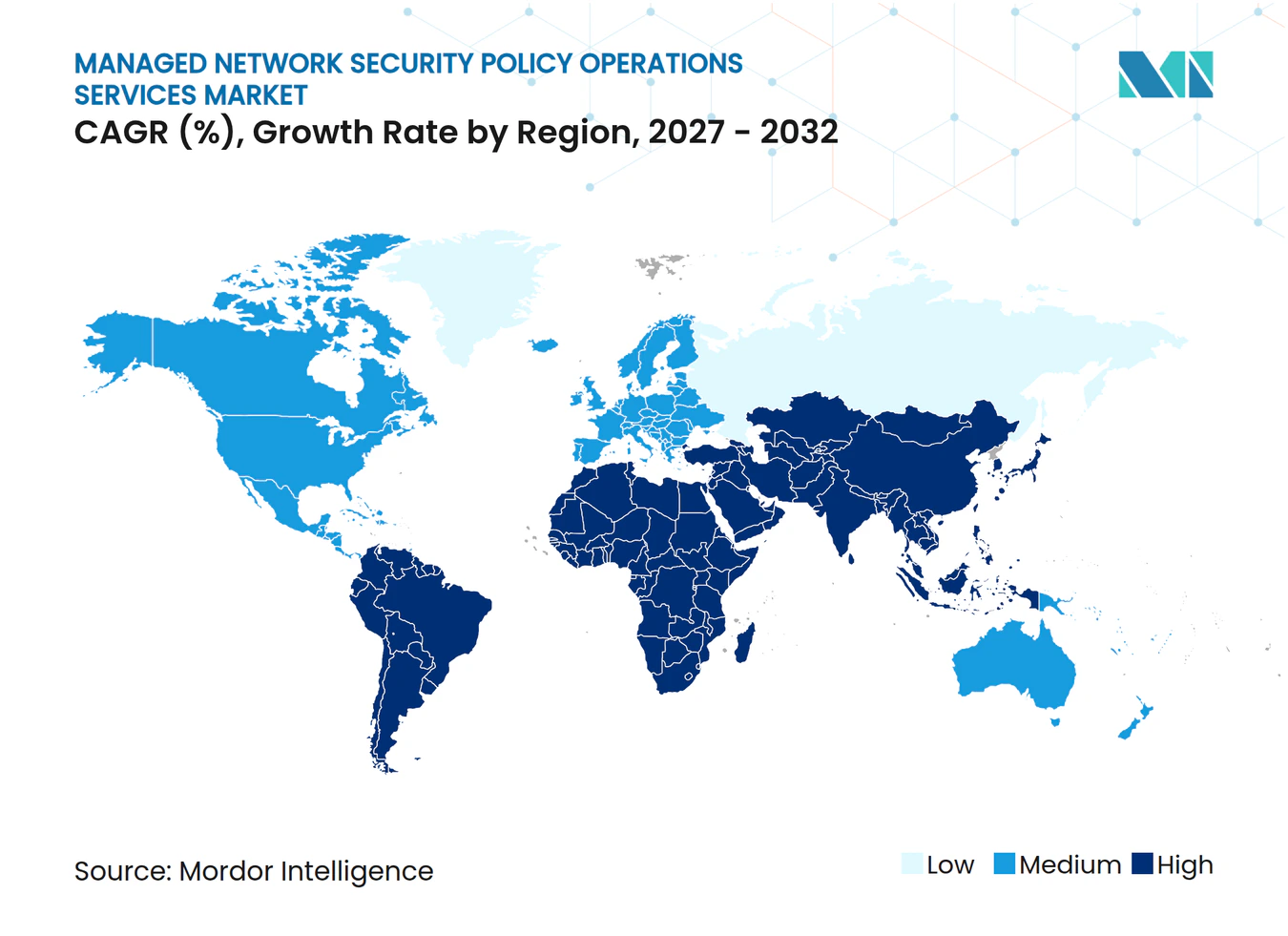
North America held 37.22% of the Managed network security policy operations services market share in 2026. The region contains a large concentration of financial services, defense contractors, health-care systems, and critical-infrastructure operators. These organizations must address overlapping policy-governance expectations under HIPAA, PCI DSS, CMMC 2.0, and SEC cyber incident-disclosure rules. Executive Order 14028 has supported federal adoption of zero-trust approaches, which adds attention to access-control policies. Mexico is an emerging contributor as banking guidance supports early managed firewall engagements, while Europe is supported by DORA and NIS2 demand in Germany, the United Kingdom, and France.
Asia-Pacific is projected to expand at a 16.91% CAGR from 2027 to 2032. China has significant cybersecurity spending associated with a wider critical-infrastructure scope under the Data Security Law and procurement preferences for domestic vendors. International managed security service providers commonly address this demand through local partnerships or joint ventures. India is an important growth area as financial-sector ICT risk rules and an expanding fintech environment raise managed security-policy adoption. Japan refreshes aging perimeter defenses and aligns with cybersecurity guidance for critical industries, while South Korea expands its managed security footprint alongside Digital New Deal infrastructure investment.
South America is developing from a smaller base, with Brazil’s Lei Geral de Proteção de Dados and Argentina’s National Cybersecurity Strategy creating early regulatory pressure.[3] Brazil accounts for most South American managed-security spending cited in the source material and attracts investment from providers seeking regional positions. The Middle East and Africa represent early-to-mid-stage opportunities for the Managed network security policy operations services market, led in the Middle East by the United Arab Emirates and Saudi Arabia through digital transformation and critical-infrastructure requirements. Saudi sector controls, South African financial-services regulation, and Nigeria’s digitizing banking ecosystem are supporting demand for outsourced policy operations.
Competitive Landscape
Market Concentration
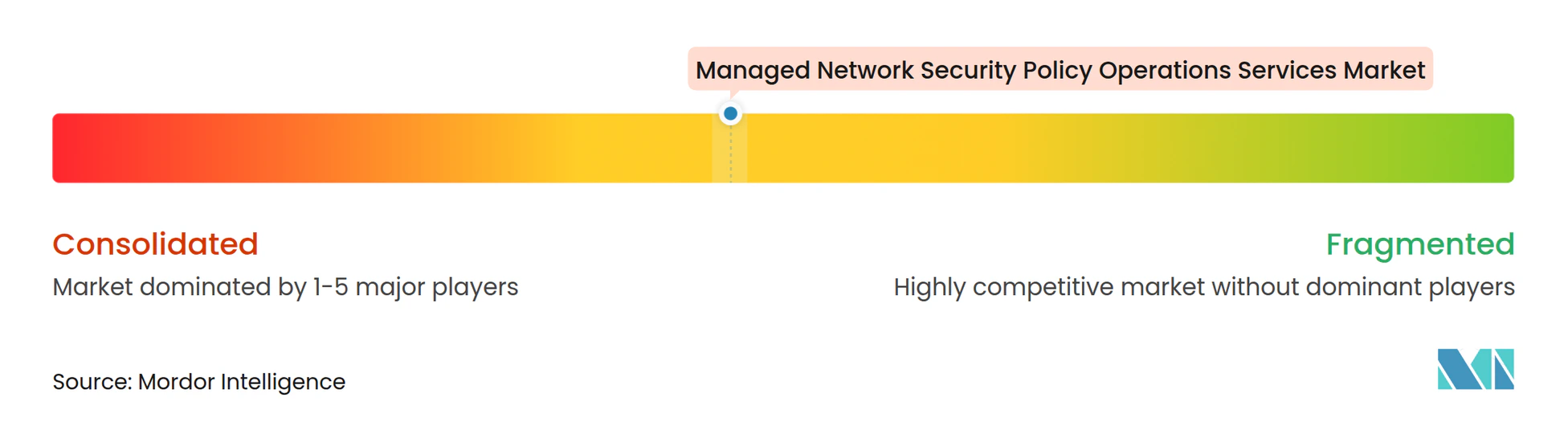
The Managed network security policy operations services market is moderately concentrated, with broad-platform managed security providers competing alongside policy-management specialists. LevelBlue completed its acquisition of Trustwave in August 2025, bringing network security, threat intelligence, managed detection and response, and offensive security capabilities into one pure-play provider. This scale supports investment in threat intelligence, security operations centers, and compliance reporting. Tufin, AlgoSec, and FireMon remain specialist competitors through automation, topology modeling, and multi-vendor rule governance. Tufin acquired select Skybox Security intellectual property, trademarks, and customer information after Skybox ceased operations in February 2025, extending its technology coverage and customer base.
Leading firewall vendors are also building automation stacks that can support managed service delivery. Palo Alto Networks uses Strata Cloud Manager, while Fortinet’s FortiOS 8.0 added AI-agent-supported workflows for firewall and SD-WAN troubleshooting and configuration.[4] Check Point launched its Agentic Network Security Orchestration Platform in May 2026, which interprets business intent and supports the creation of validated, multi-vendor firewall policies under human oversight. These moves reduce manual policy-change work and improve service consistency. SASE integration and evidence of continuous compliance can help providers retain customers in regulated settings.
The Managed network security policy operations services market offers opportunities for cloud-native, consumption-based services aimed at SMEs. Providers can also address industrial customers that need integrated operational technology and information technology policy management. Check Point filed a 2026 patent application covering intent-to-policy semantic mapping, illustrating the importance of intellectual property in automation. ISO/IEC 27001 certification and credible DORA or NIS2 support are increasingly expected in financial-sector and government procurement.
Managed Network Security Policy Operations Services Industry Leaders
-
Rapid7, Inc.
-
Akamai Technologies, Inc.
-
Fortinet, Inc.
-
Palo Alto Networks, Inc.
-
Check Point Software Technologies Ltd.
- *Disclaimer: Major Players sorted in no particular order
Recent Industry Developments
- August 2026: JFrog launched its Software Supply Chain Traffic Controller in partnership with Zscaler, Cloudflare, and Netskope, enabling security policy enforcement at the SASE/SSE network layer to inspect and control open-source package traffic, extending network security policy operations to software supply chain governance.
- May 2026: Check Point Software Technologies launched its Agentic Network Security Orchestration Platform, an autonomous-agent system built around a proprietary Network Knowledge Graph that interprets the business intent behind firewall rules, including legacy rules created decades ago, and executes policy creation, zero-trust tightening, compliance mapping, and troubleshooting under human oversight. The platform compresses changes that previously required 2 to 4 weeks into minutes of verified action. A broader multi-vendor customer preview is planned for H2 2026.
- March 2026: Fortinet released FortiOS 8.0, introducing AI-agent-based guided workflows for firewall and SD-WAN troubleshooting and configuration, Sovereign SASE options for data-residency-sensitive markets, and AI-aware application control for GenAI tool governance. The release extends the Fortinet Security Fabric's policy management capabilities to AI application traffic and post-quantum cryptographic management paths.
- March 2026: Netskope launched Netskope One AI Security, featuring an Agentic Broker that decodes Model Context Protocol traffic between AI agents and enterprise data sources, extending network security policy enforcement to AI-to-AI connectivity patterns that conventional policy management tools were not designed to govern.
Global Managed Network Security Policy Operations Services Market Report Scope
The Managed Network Security Policy Operations Services Market comprises outsourced services for managing, monitoring, enforcing, optimizing, and maintaining security policies across enterprise network environments. These services include firewall policy administration, access-control governance, threat-prevention policy management, compliance enforcement, continuous monitoring, and policy lifecycle management across hybrid and multi-cloud infrastructures.
The Managed Network Security Policy Operations Services Market Report is Segmented by Service Type (Firewall Policy Management, Access Control and Segmentation Policy Management, Threat Prevention Policy Management, Security Compliance and Governance, and Other Service Types), Deployment Mode (On-Premise, Cloud, and Hybrid), Organization Size (Small and Medium-Sized Enterprises, and Large Enterprises), End-User Industry (Banking, Financial Services, and Insurance [BFSI], Government and Public Administration, Healthcare and Life Sciences, IT and Telecommunication, Industrial Manufacturing, Retail and E-commerce, Education and Research Institutions, and Other End-User Industries), and Geography (North America, South America, Europe, Asia-Pacific, Middle East, and Africa). The Market Forecasts are Provided in Terms of Value (USD).
| Firewall Policy Management |
| Access Control and Segmentation Policy Management |
| Threat Prevention Policy Management |
| Security Compliance and Governance |
| Other Service Types |
| On-Premise |
| Cloud |
| Hybrid |
| Small and Medium-Sized Enterprises |
| Large Enterprises |
| Banking, Financial Services, and Insurance (BFSI) |
| Government and Public Administration |
| Healthcare and Life Sciences |
| IT and Telecommunication |
| Industrial Manufacturing |
| Retail and E-commerce |
| Education and Research Institutions |
| Other End-User Industries |
| North America | United States |
| Canada | |
| Mexico | |
| South America | Brazil |
| Argentina | |
| Rest of South America | |
| Europe | Germany |
| United Kingdom | |
| France | |
| Italy | |
| Russia | |
| Rest of Europe | |
| Asia-Pacific | China |
| Japan | |
| India | |
| South Korea | |
| Rest of Asia-Pacific | |
| Middle East | Saudi Arabia |
| United Arab Emirates | |
| Rest of Middle East | |
| Africa | South Africa |
| Nigeria | |
| Rest of Africa |
| By Service Type | Firewall Policy Management | |
| Access Control and Segmentation Policy Management | ||
| Threat Prevention Policy Management | ||
| Security Compliance and Governance | ||
| Other Service Types | ||
| By Deployment Mode | On-Premise | |
| Cloud | ||
| Hybrid | ||
| By Organization Size | Small and Medium-Sized Enterprises | |
| Large Enterprises | ||
| By End-User Industry | Banking, Financial Services, and Insurance (BFSI) | |
| Government and Public Administration | ||
| Healthcare and Life Sciences | ||
| IT and Telecommunication | ||
| Industrial Manufacturing | ||
| Retail and E-commerce | ||
| Education and Research Institutions | ||
| Other End-User Industries | ||
| By Geography | North America | United States |
| Canada | ||
| Mexico | ||
| South America | Brazil | |
| Argentina | ||
| Rest of South America | ||
| Europe | Germany | |
| United Kingdom | ||
| France | ||
| Italy | ||
| Russia | ||
| Rest of Europe | ||
| Asia-Pacific | China | |
| Japan | ||
| India | ||
| South Korea | ||
| Rest of Asia-Pacific | ||
| Middle East | Saudi Arabia | |
| United Arab Emirates | ||
| Rest of Middle East | ||
| Africa | South Africa | |
| Nigeria | ||
| Rest of Africa | ||
Key Questions Answered in the Report
What is the managed network security policy operations services market size?
The market is projected to expand from USD 8.52 billion in 2026 and USD 9.87 billion in 2027 to USD 21.07 billion by 2032, at a 16.37% CAGR.
What is driving demand for managed network security policy operations services?
Hybrid and multi-cloud complexity, cybersecurity skill shortages, continuous compliance needs, and automated policy-change requirements are key demand factors.
Which service type leads managed network security policy operations services?
Firewall Policy Management led with a 48.12% share in 2026, reflecting the large installed base of enterprise firewall environments.
Which deployment mode is expanding fastest?
Cloud deployment is projected to expand at a 17.66% CAGR through 2032 as firewall-as-a-service, SASE, and zero-trust network access adoption increases.
Which customer group is expanding fastest?
SMEs are projected to expand at a 17.92% CAGR through 2032, supported by cloud delivery, consumption-based pricing, and wider cybersecurity obligations.
Which region is projected to expand fastest?
Asia-Pacific is projected to expand at a 16.91% CAGR through 2032, supported by financial-sector requirements and expanding managed security needs.